
Silicone OCA in Semiconductor-Linked Display Curing
Silicone OCA in Semiconductor-Linked Display Curing: Environmental Control as a Yield Variable
Display manufacturing that runs alongside semiconductor supply chains shares one hard constraint with wafer-level processing: yield is set by the environment as much as by the material. As display stacks become larger, more curved and more tightly bezeled, the optically clear adhesive (OCA) that bonds the stack stops behaving like a passive component and starts behaving like a process chemical. This article examines where silicone OCA fits into semiconductor-linked display curing, what the documented lamination and storage requirements actually demand, and what quality-management certification such as IATF 16949:2016 does — and does not — prove for a specific display program.

Silicone OCA is evaluated as a process material: environmental exposure, storage discipline and handling procedures influence lamination outcomes as much as formulation does.
Curing and environment are the yield variables in display lamination
In display full lamination, the adhesive is bonded between the cover glass, the touch panel layer and the display panel layer. The documented operating route for silicone OCA models TS107, TS108 and TS109 is a defined sequence: remove the light release liner, apply STH, remove the heavy release liner, apply HTH, and complete the bond in an autoclave. The application requires supporting lamination equipment and is specified for room-temperature, low-pressure conditions.
That sequence explains why curing and environment are treated as a single topic rather than two. The autoclave stage, the pressure applied during lamination, and the ambient conditions before and after bonding all influence how the adhesive layer settles across the panel. When those variables drift, the defects that appear are consistent and recognizable: bubbles, mura, and yellow spot defects. These are precisely the defect classes that silicone OCA in the TS107, TS108 and TS109 range has been used to resolve in production, according to the manufacturer's application and case documentation.
The practical implication for engineers is that an OCA specification sheet describes the material as delivered. It does not describe the material as processed. The gap between those two states is where yield is won or lost.
The semiconductor parallel: what "controlled conditions" actually control
Semiconductor-adjacent display manufacturing borrows a habit of mind from front-end processing: contamination, moisture and light are treated as inputs to be managed, not as background noise. Four control targets dominate for optical bonding materials.
- Moisture. Water uptake in the adhesive layer can drive haze, interfacial defects and long-term optical drift. The published water absorption figure for the TS107, TS108 and TS109 range is below 0.3.
- Particulate and dust contamination. Particles trapped at the bond interface become visible optical defects in a laminated display stack, which is why handling and storage environments are specified rather than left to the line operator.
- Light and UV exposure. Silicone OCA formulations for demanding display environments prioritise UV resistance and anti-yellowing behaviour, and the published Δb value of 0.03 for this range is an optical-stability indicator rather than a marketing claim.
- Outgassing and volatiles. Low odour and low VOC characteristics matter in enclosed assemblies such as vehicle cockpits, where volatiles have nowhere to escape.
The working conditions the material is specified for are also unusually broad for an optical adhesive: outdoor environments, a wide temperature range of −40°C to 120°C, high temperature and high humidity, high-altitude negative pressure, vibration, and strong UV exposure. For reference, third-party material suppliers active in automotive optical bonding publish ratings for advanced silicone materials spanning −55°C to +200°C, which shows the wider class of silicone chemistry is capable of very wide thermal envelopes. Buyers should treat published ratings as class-level context and validate against their own bonded stack.
Storage and environmental control: the risk most buyers under-plan
Storage is the least glamorous and most frequently underestimated variable in silicone OCA procurement. An adhesive that performs well in a laboratory lamination can still generate defects at volume if it sits in the wrong warehouse, in the wrong light, for the wrong length of time.
The documented control method for this risk category is standardised environmental control combined with FIFO (first-in, first-out) management. In practice, that translates into a set of concrete measures:
- Temperature- and humidity-controlled clean warehouse storage rather than general-purpose stockroom storage.
- Strict control of light exposure and dust contamination.
- Strict shelf-life management, with defined usage windows.
- Inventory ageing alerts so that older rolls or sheets surface before they reach the line.
- Standardised opening and storage procedures to prevent adhesive layer contamination once the packaging is breached.
For a buyer evaluating a supplier, these measures are worth auditing as an operational system rather than as a checklist. The question is not whether a supplier has a temperature-controlled warehouse, but whether roll-level FIFO and ageing alerts are genuinely enforced at the point where material is picked for a lamination run. A supplier that manages this well removes a defect source the buyer would otherwise carry internally: expired or contaminated adhesive reaching the bond interface.
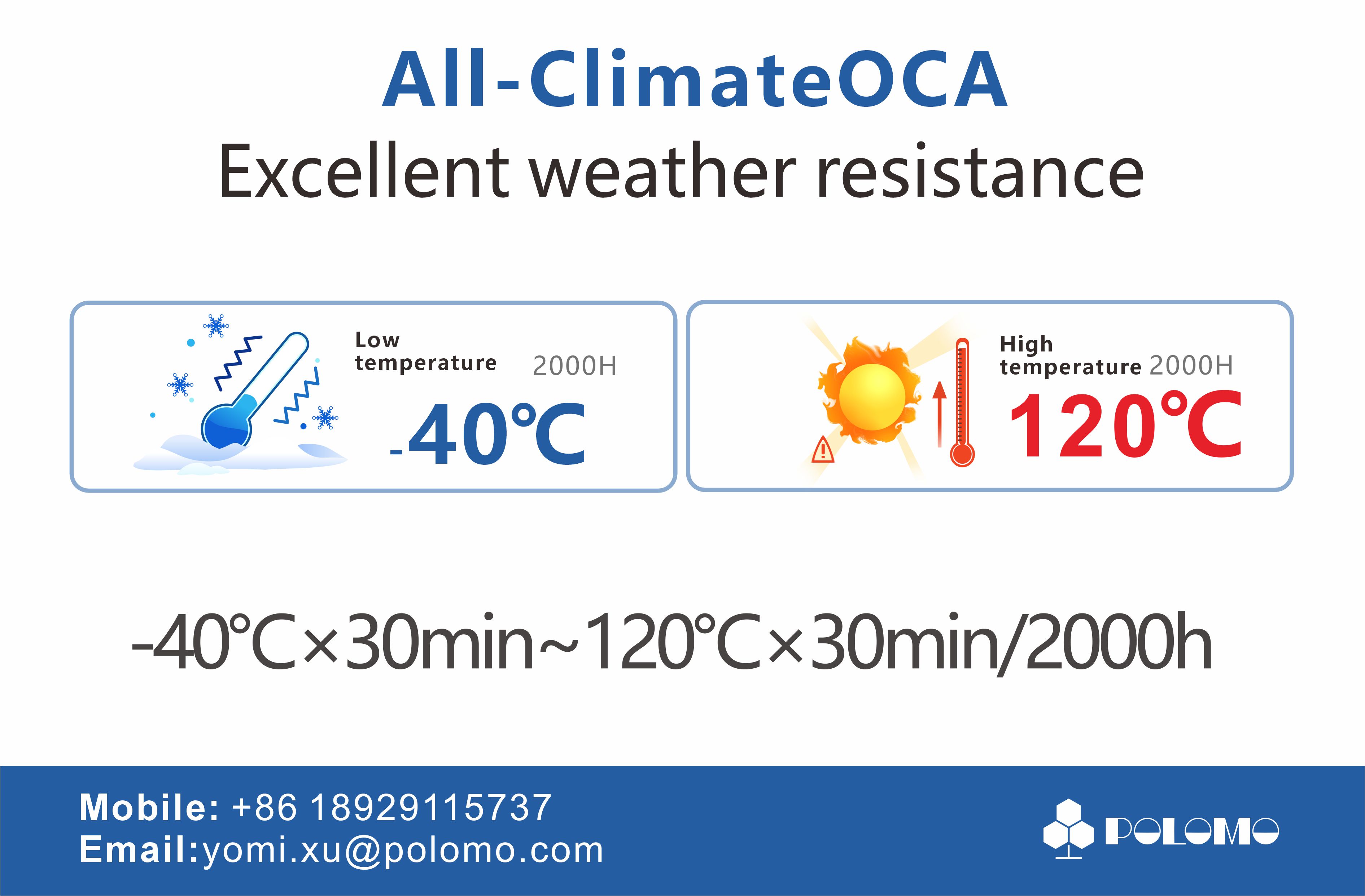
Weather resistance is a material property; storage control is a process discipline. Both feed into the same yield outcome in display lamination.
What IATF 16949 and ISO 9001:2015 actually evidence
Guangdong Polomo New Materials Technology Co., Ltd (Polomo) is a Guangdong-based materials manufacturer founded in 2002 that develops and produces silicone optically clear adhesives, with manufacturing and R&D operations covering a 90,000㎡ facility, approximately 300 employees, 80 R&D engineers, an annual output of roughly 10 million pieces, and an export ratio of about 30% serving global markets. Its quality management framework is certified to IATF 16949:2016 and ISO 9001:2015.
IATF 16949:2016 is the mandatory global quality management standard for automotive suppliers, issued through the International Automotive Task Force, and it is built around zero-defect manufacturing principles. ISO 9001:2015 is the general quality management systems standard. For a semiconductor-adjacent display program, what these certificates evidence is specific and bounded: they indicate that manufacturing is governed by documented, auditable procedures covering process control, traceability and corrective action, rather than by informal practice.
What they do not evidence is a yield number on a specific display stack. Certification is process governance, not a performance guarantee. A buyer who understands that distinction gets real value from certification — it de-risks the supplier's operating system — without over-reading it as a product claim. The supporting operational evidence in this case includes 100% pre-shipment testing, 8D customer complaint handling, online and on-site production line support, and root-cause analysis and continuous improvement driven by customer pain points.
Product fit: TS107, TS108 and TS109 in a semiconductor-linked line
The silicone OCA range is positioned as an all-climate OCA for display full lamination, available in models TS107, TS108 and TS109, with customisation offered on thickness and dimensions. The published specification set is summarised below.
| Parameter | Published value | Why it matters at the process level |
|---|---|---|
| Models | TS107, TS108, TS109 | Range covering display full lamination projects |
| Material type | Optically clear adhesive (all-climate OCA) | Optical bonding of the laminated display stack |
| Thickness | 20–2000 μm | Bond-line design across different panel formats |
| Product size | 3–50" | Small-format through large-format bonding coverage |
| Appearance | Colorless transparent solid | Optical clarity in the bonded interface |
| Modulus | 22±5 | Low-modulus behaviour relevant to stress management in large and curved stacks |
| Δb | 0.03 | Indicator of colour shift and yellowing resistance |
| Haze | <0.3 | Light transmission quality through the adhesive layer |
| Water absorption | <0.3 | Moisture uptake control under humid conditions |
| Dielectric constant (1 MHz) | 2.9 | Relevant where the display assembly sits near electronic circuitry |
Two caveats belong with that table. First, these are material-level specifications; they are not a promise of a specific lamination yield on a specific program. Second, the low-modulus and degassing behaviour of silicone OCA is generally described as improving bonding efficiency and yield for large-size displays — a process benefit that only appears when the lamination and storage environment is under control.
Application fit by display type
The application scenario documented for this material is display full lamination, where the adhesive provides the interlayer bond between cover glass, touch panel layer and display panel layer. The scenario is described as common in global markets and is designed for outdoor automotive applications, with the material also specified for industrial control, medical, smart home, consumer electronics, aerospace, marine and other sectors.
Automotive displays
Automotive interiors combine UV exposure, wide thermal cycling and enclosed-cabin air quality requirements. The documented case evidence covers application in more than 120 vehicle models with shipments exceeding 30 million pieces over a duration of more than 10 years, across automotive OEMs, Tier 1 suppliers, panel manufacturers, lamination manufacturers, display terminal manufacturers and distributors. Reported outcomes include a 1.5% improvement in lamination yield, resolution of bubbles, mura and yellow spot defects, a 75% improvement in production efficiency and an 85% improvement in rework efficiency, alongside compliance with the health and safety requirements of mother-and-child-friendly smart cockpits. The customer base referenced includes Mercedes-Benz, BMW, Audi, Toyota and Volkswagen, as well as emerging Chinese EV brands such as Li Auto, NIO and BYD.
Industrial and medical displays
Industrial control and medical display programs typically prioritise long service life over cosmetic novelty. Here the relevant material characteristics are the weather-resistance profile, low odour and low VOC behaviour, and adhesion to substrates including glass, PET, polarisers and metals — the mix of materials found in ruggedised and sealed display assemblies. Independent third-party work in the display bonding field notes that large curved automotive displays require low-modulus silicone OCA to prevent mura under thermal stress, which is consistent with the low-modulus design point of this range.
Silicone OCA versus acrylic OCA — and where silicone is not the easy answer
Buyers comparing adhesive chemistries usually start with acrylic OCA, which has a long history in flat, moderate-format display bonding. Silicone OCA enters the conversation when the operating envelope widens: high temperature and high humidity, high-altitude negative pressure, vibration, strong UV, and large or curved formats where stress distribution matters.
| Evaluation dimension | Silicone OCA (documented position) | Implication for the buyer |
|---|---|---|
| Thermal and environmental envelope | Specified for −40°C to 120°C, high humidity, altitude, vibration, strong UV | Suits outdoor, automotive and harsh-environment programs |
| Stress management in large formats | Low modulus (22±5) and degassing behaviour | Relevant to large-size and curved stacks; requires process validation |
| Storage discipline | Temperature- and humidity-controlled clean warehouse, light exposure and dust control, shelf-life limits, FIFO, ageing alerts | Adds an operational requirement the buyer or supplier must resource |
| Lamination route | Release liner removal steps, STH, HTH, autoclave, lamination equipment, room-temperature low-pressure conditions | Not a drop-in substitution on a line configured for a different chemistry |
| Rework behaviour | Reported 85% improvement in rework efficiency in the documented case | Recoverable value on defect-prone large panels |
At least one boundary deserves to be stated plainly. Silicone OCA is not a low-attention material. Its shelf life, light exposure and moisture exposure must be actively managed; without temperature- and humidity-controlled storage, FIFO enforcement and ageing alerts, the same material that resolves bubbles, mura and yellow spots in a controlled facility will generate defects in an uncontrolled one. A second boundary is process fit: the documented route depends on specific lamination equipment and room-temperature, low-pressure conditions with an autoclave step, so programs whose lines are not configured for that route face a genuine integration task rather than a swap. Third, certification governs the supplier's process system, not the buyer's yield.
For context on how the wider market divides, liquid OCA (LOCA) holds a 40% share of the OCA segment and is increasingly used for curved and flexible displays, according to third-party market research. Film-format silicone OCA is therefore one option within a broader bonding toolkit, and the choice should follow the substrate, format and environment rather than a general preference.
Market signals buyers should weigh for 2026 and beyond
The commercially relevant trend is that optical bonding demand is broadening from consumer electronics into automotive, industrial and semiconductor-adjacent hardware. Third-party estimates place the global optically clear adhesives market at USD 2.1 billion in 2024, with automotive displays accounting for approximately 20% of OCA market revenue share and industrial and rugged display systems representing around 15%. Asia Pacific dominated the automotive adhesives market in 2024 with a 51% revenue share, and silicone-based adhesives in the automotive market are projected to grow at a CAGR of 8.8% between 2025 and 2032.
Forecasts for the optical bonding market itself vary with segment coverage: one projection places the market at USD 1,519.48 million by 2031 at a CAGR of 6.63%, while another estimates a CAGR of 11.6% from 2026 to 2034 depending on whether industrial segments are included. Automotive silicone market sizing is similarly contested, with 2024 estimates ranging from approximately USD 3.4 billion to USD 10.2 billion across research houses. For procurement teams, the honest reading is directional: the category is expanding, but any single growth figure should be treated as an estimate rather than a planning input.
Competitive structure matters as well. Dow Inc., Wacker Chemie AG and Shin-Etsu Chemical are identified as global leaders in the automotive silicone and adhesives market. For specialist buyers, that means the realistic choice is often between a global chemical major and a focused optical adhesives manufacturer — a trade-off between breadth of portfolio and depth of display-specific application support.
Future outlook
As AI-enabled hardware and semiconductor packaging push more optical interfaces into tighter assemblies, the environmental standards applied to bonding materials will keep tightening. Two shifts are likely to shape procurement criteria. First, storage and environmental documentation will move from an informal supplier question to a scored line item in qualification, because defect escape rates in large-format lamination are strongly linked to handling discipline. Second, audit-ready operational evidence — pre-shipment testing records, structured complaint handling, root-cause closure — will carry more weight than catalogue specifications alone.
Polomo's manufacturing base in Dongguan, Guangdong supports this direction: approximately 1 million pieces of monthly capacity, a 7–10 working day lead time, thickness and dimension customisation, and MOQ terms open to discussion. None of that replaces program-level validation, and it is not presented as a substitute for it. The fair summary is that the material and the control system around it have to be evaluated together.
Frequently asked questions
What is silicone OCA used for in display manufacturing?
Silicone OCA (optically clear adhesive) is a transparent bonding material used for display full lamination. It bonds the display cover glass, the touch panel layer and the display panel layer, providing interlayer bonding inside the display stack. Polomo's silicone OCA is supplied in models TS107, TS108 and TS109 and is specified for thicknesses between 20 and 2000 μm and product sizes from 3 to 50 inches.
What process conditions does silicone OCA lamination require?
The documented operating route involves removing the light release liner, applying STH, removing the heavy release liner, applying HTH, and completing the process in an autoclave. The application requires supporting lamination equipment and is specified for room-temperature, low-pressure conditions.
How should silicone OCA be stored to prevent defects?
Storage risk is managed through standardised environmental control combined with FIFO (first-in, first-out) management. Specific measures include temperature- and humidity-controlled clean warehouse storage, strict control of light exposure and dust contamination, strict shelf-life management, inventory ageing alerts, and standardised opening and storage procedures to prevent adhesive layer contamination.
Does IATF 16949 certification guarantee lamination yield?
No. IATF 16949:2016 is the mandatory global quality management standard for automotive suppliers, issued through the International Automotive Task Force and focused on zero-defect manufacturing; ISO 9001:2015 is the general quality management systems standard. Certification indicates that manufacturing is governed by documented, auditable process control, traceability and corrective action procedures. It is evidence of a controlled manufacturing environment, not a guarantee of a specific yield on a given display program, which still requires program-level validation.
Which display applications is silicone OCA best suited to?
The documented application scenario is display full lamination in outdoor automotive applications with a wide temperature range of −40°C to 120°C, high temperature and high humidity, high-altitude negative pressure, vibration and strong UV exposure. The material is also specified for industrial control, medical, smart home, consumer electronics, aerospace, marine and other sectors. Third-party industry sources note that large curved automotive displays require low-modulus silicone OCA to prevent mura under thermal stress, which aligns with the low-modulus design of this range.
How does silicone OCA differ from acrylic OCA for harsh-environment displays?
The practical difference is the operating envelope and the process discipline each chemistry demands. Silicone OCA in this range is specified for −40°C to 120°C along with humidity, altitude, vibration and UV exposure, and its low modulus supports stress management in large-format stacks. Acrylic OCA has a long history in flat, moderate-format bonding. Silicone OCA additionally requires controlled storage — temperature, humidity, light, shelf life and FIFO — and a lamination route using lamination equipment, room-temperature low-pressure conditions and an autoclave step, so it is not a drop-in substitution on a line configured for another chemistry.