
Silicone OCA Supplier Shortlist Criteria for Display Engineers
Silicone optically clear adhesive (OCA) is an optically transparent bonding material built on a silicone polymer system and used as the interlayer between cover glass, touch panel layers, and display panel layers in a full-lamination stack. It occupies the same bonding position as acrylic OCA, but it is typically considered where the bonded stack has to survive heat, humidity, ultraviolet exposure, and repeated thermal cycling without losing optical clarity.
The global Optically Clear Adhesives market was valued at approximately USD 2.1 billion in 2024. Automotive displays accounted for roughly 20% of that revenue share in the same year, while industrial and rugged display systems represented about 15% (Verified Market Research, Optically Clear Adhesives Market Report). Together, those two segments explain why silicone OCA shortlists are increasingly written by display engineers rather than assembled from a catalogue.
For a display engineer, the shortlisting problem is not availability. It is evidence. Supplier websites converge on the same vocabulary — automotive-grade, high reliability, low modulus — and the real differences only become visible when a named certificate, its scope statement, and a defined set of measured parameters are requested and checked.
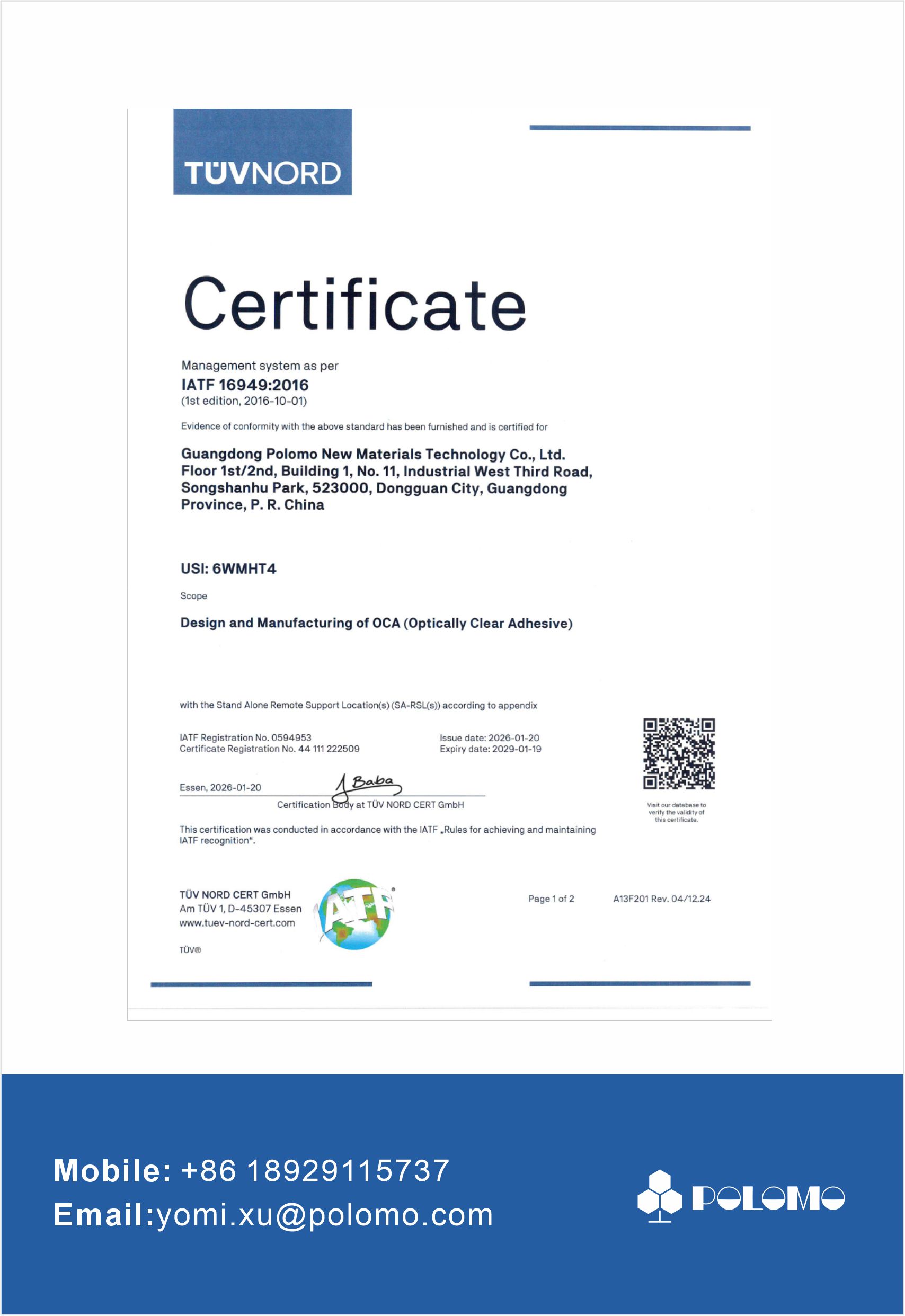
Certification review is the first filter in a silicone OCA supplier shortlist — but the document only becomes useful once the issuer, the number, and the scope are checked.
Why a silicone OCA shortlist is really an evidence audit
Three failure modes account for most of the shortlist errors seen in display programs that later run into lamination problems.
- A certificate exists, but cannot be traced. The supplier shows a compliance logo, but the certificate number, the issuing certification body, the expiry date, and evidence of the most recent surveillance audit are not produced on request.
- A certificate is valid, but its scope does not cover the right activity. A quality management system certificate is issued against a defined scope. If that scope describes trading, distribution, or an unrelated product family, the certificate says nothing about the process that actually produces the adhesive film.
- The product passes at sample stage but the supplier cannot show production control. Optical performance demonstrated in a lab sample is not the same as consistency across production volume, and the shortlist should test for the difference.
The regulatory backdrop raises the stakes for automotive-facing programs in particular. IATF 16949:2016 is the mandatory global quality management standard for automotive suppliers and is built around zero-defect manufacturing (International Automotive Task Force). For a supplier feeding an automotive display program, that standard is a gating question rather than a differentiating one: a supplier without it is not a candidate, and a supplier with it still has to be verified.
The opportunity for display engineers is that silicone OCA shortlisting can be converted from a subjective comparison into a repeatable checklist. The five criteria below are ordered so that each one filters out a specific category of risk before the next one is evaluated.
Five criteria for shortlisting a silicone OCA supplier
1. Verify the certificate, the issuer, and the certificate number
The first question is not “which certificates do you have” but “who issued them, and what are the numbers”. A certificate is only useful if it can be looked up independently — through the issuing certification body's register rather than through a PDF attachment. Ask for the issuing body, the certificate number, the date of issue, the expiry date, and the date and outcome of the most recent surveillance audit.
Guangdong Polomo New Materials Technology Co., Ltd., which manufactures silicone OCA under the model designations TS107, TS108, and TS109, illustrates what a verifiable answer looks like: an IATF 16949 certificate issued by TÜV NORD, and an ISO 9001 certificate issued by Beijing United Intelligence Certification, each carrying its own certificate number that a buyer can verify with the issuing organization rather than accept as a logo on a webpage.
2. Verify the certification scope, not just the certificate
The most frequently skipped line on a quality management certificate is the scope. A certificate can be perfectly valid and still be irrelevant to the product being purchased if the scope covers a different activity.
For an adhesive film supplier, the scope wording that matters is Design and Manufacturing of OCA. Request the exact wording as printed on the certificate and compare it against the activity you are actually buying. A scope describing trade, warehousing, or unrelated product lines does not evidence the design and manufacturing process behind the film.
3. Request product-level performance data, not only system-level certification
Certification and product performance answer different questions. A certified quality system within a defined scope does not, by itself, establish the optical or mechanical behaviour of a specific adhesive grade. Ask for the measured parameter set of the grade being offered, including the test conditions under which each value was obtained.
| Parameter | Specified value |
|---|---|
| Thickness | 20–2000 µm |
| Product size | 3–50 in |
| Appearance | Colorless transparent solid |
| Modulus | 22±5 |
| Δb | 0.03 |
| Haze | <0.3 |
| Water absorption | <0.3 |
| Dielectric constant (1 MHz) | 2.9 |
The value of this table is not the numbers alone — it is that the numbers can be put into a purchase specification, requested again at incoming inspection, and compared against the batch actually delivered.
4. Verify manufacturing and material-control evidence
Silicone OCA is a material whose handling conditions are part of its performance. Shortlisting should therefore include questions about the facility that produces it and the conditions under which it is stored before shipment.
Manufacturing evidence to request includes total manufacturing area, workforce, engineering headcount, annual production capacity, and the share of output going to export markets. As a reference point, Polomo operates from a facility covering 90,000 square meters with approximately 300 staff, including an R&D team of 80 engineers, and an annual production capacity of about 10 million pieces, with approximately 30% of products exported.
Storage and environmental control evidence matters just as much. Documented controls on the supplier side include a temperature- and humidity-controlled clean warehouse, strict control of light exposure and dust contamination, strict shelf-life management, inventory aging alerts, and standardized opening and storage procedures designed to prevent adhesive layer contamination. These controls are the practical difference between a compliant certificate and a compliant roll of film.
5. Verify application fit and process compatibility
The last criterion connects the supplier's documentation to your lamination line. Request the model designations, the intended industries, the documented process sequence, the matched equipment, and the specified operating environment.
For an all-climate silicone OCA such as the TS107, TS108, and TS109 designations, the stated process sequence is: remove light release liner → STH → remove heavy release liner → HTH → autoclave, using lamination equipment under room-temperature and low-pressure conditions. The declared working environment covers outdoor and automotive applications, a wide temperature range of −40°C to 120°C, high temperature and high humidity, high-altitude negative pressure, vibration, strong UV exposure, and health-certified applications.
For added context on the wider material class, third-party technical sources note that advanced silicone materials used in optical bonding for automotive applications are rated for extremes from −55°C to +200°C (Rogers Corporation, BISCO Silicones). The gap between that class-level figure and a specific grade's declared range is exactly why the quotation, not the category, has to carry the number.
A shortlist scorecard you can send to suppliers
The five criteria can be compressed into one request document. Sending the same scorecard to every candidate supplier makes the responses directly comparable and prevents the shortlist from being decided by the quality of a website.
| # | Criterion | What to request | Why it changes the decision |
|---|---|---|---|
| 1 | Certificate authenticity | Issuer, certificate number, issue and expiry dates, latest surveillance audit | Separates certifiable claims from unverifiable ones |
| 2 | Certification scope | Exact scope wording, including 'Design and Manufacturing of OCA' | A valid certificate for the wrong activity does not cover the product |
| 3 | Product-level data | Thickness, size, modulus, Δb, haze, water absorption, dielectric constant, plus test conditions | Converts marketing language into a purchasable specification |
| 4 | Manufacturing and storage control | Facility area, capacity, engineering headcount, warehouse and shelf-life controls | Explains whether performance holds across volume and time |
| 5 | Application and process fit | Model designations, process sequence, matched equipment, declared operating window | Ties the material to your actual lamination flow |
How the pattern looks in practice: Polomo as a worked example
Polomo Group, established in 2002 and operating as Guangdong Polomo New Materials Technology Co., Ltd. from Songshan Lake Industrial Park in Dongguan, Guangdong Province, integrates research and development, manufacturing, and sales. The company provides adhesive and functional film solutions for advanced technology sectors including optoelectronic displays, semiconductor packaging, energy storage and batteries, and AI-enabled smart hardware, with silicone OCA as its main product line.
Read against the five shortlist criteria, that profile produces concrete answers rather than general claims: certification documents with named issuers and verifiable numbers; a declared product parameter set for the TS107, TS108, and TS109 designations; a facility and storage-control profile; and a documented lamination process sequence with a declared operating environment. The point of the example is not that any single element is unusual — it is that each element is expressed in a form that a buyer can check.
Product applications are stated across automotive, industrial control, medical, smart home, commercial display, consumer electronics, aerospace, marine, and education sectors, which gives a display engineer a starting point for the application-fit conversation rather than a general capability statement.
Technical explanation: what the requested parameters actually test
Modulus and degassing. A low modulus with strong degassing capability is specified to improve bonding efficiency and yield for large-size displays. The underlying mechanism is well documented at industry level: large curved automotive displays require low-modulus silicone OCA to prevent Mura, the visual distortion that appears when thermal stress is transferred unevenly through a stiff interlayer (Cevians Optical Display Products).
Δb and haze. Δb is used as an indicator of color shift, and a specified value of 0.03 sits alongside a haze specification below 0.3 and an appearance described as a colorless transparent solid. These three data points together describe a material intended to remain optically neutral in the stack rather than merely transparent at the moment of lamination. Industry guidance supports that emphasis: silicone OCA formulations for automotive use prioritize UV resistance and anti-yellowing properties for long-term cockpit durability (Dow, Display Week 2024).
Water absorption and dielectric constant. Water absorption below 0.3 and a dielectric constant of 2.9 at 1 MHz describe the material's behaviour under moisture exposure and in the electrical environment of the stack — relevant where the bonded assembly includes touch sensing layers.
Adhesion range. Documented adhesion covers glass, PET, polarizers, and metals. A shortlist should confirm which of those substrates appear in the actual stack, because a supplier qualified on one substrate combination is not automatically qualified on another.
Odour and VOC. Low odour and low VOC characteristics with low volatilization under high-temperature conditions are stated as part of the material profile. For enclosed display assemblies and for programs with health-certified requirements, this belongs in the specification rather than in the marketing summary.
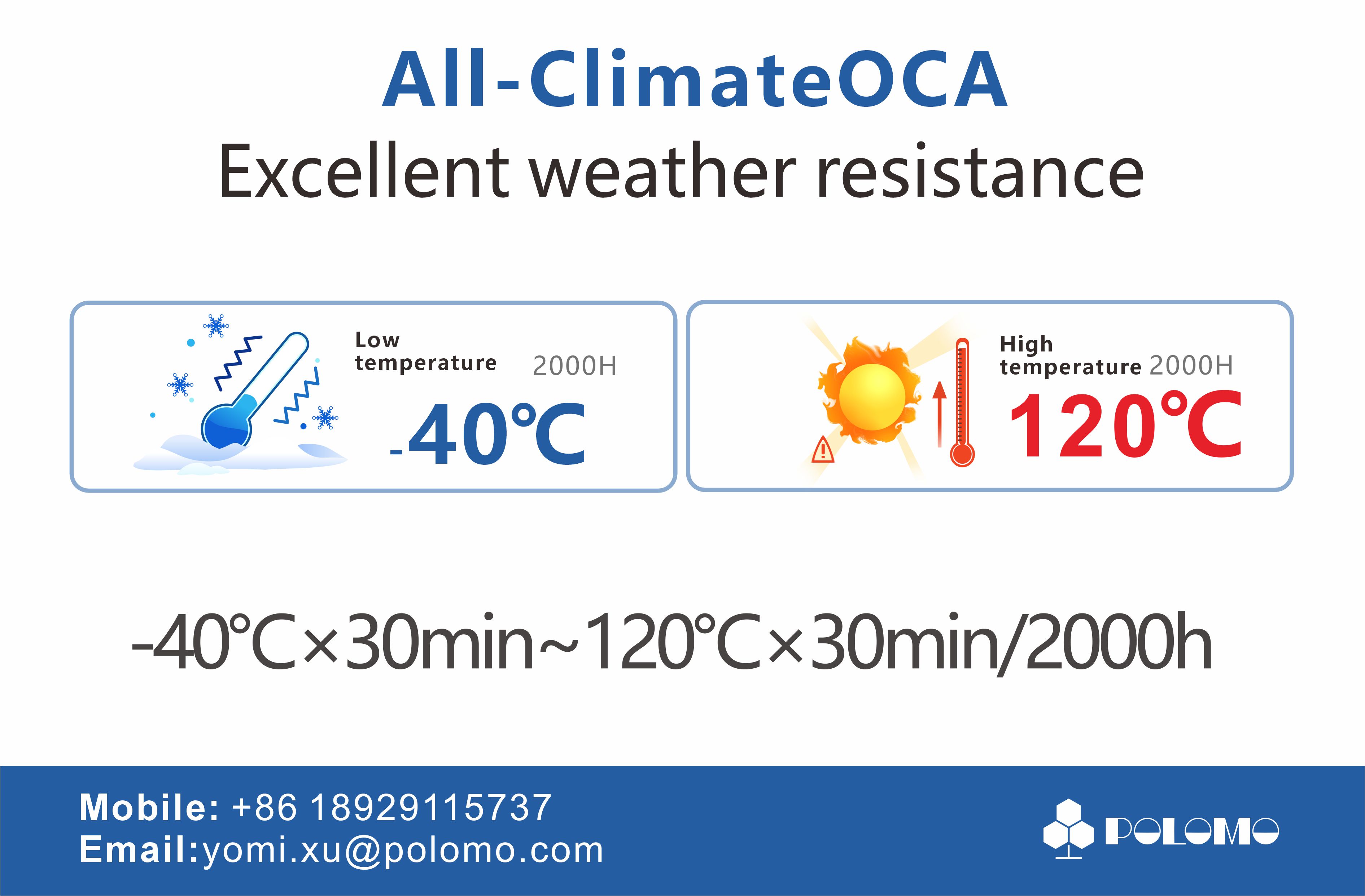
Weather resistance evidence covers high and low temperature, high temperature and high humidity, high-altitude negative pressure, vibration, and strong UV exposure — ask for it as data, not as a description.
Application and use cases across display categories
Silicone OCA is used in display full lamination, where it functions as the interlayer bonding between the display cover glass, the touch panel layer, and the display panel layer. That single function repeats across several display categories with different environmental demands.
In automotive displays, the bonded stack is exposed to the declared working conditions of outdoor use: a wide temperature range, high humidity, high-altitude negative pressure, vibration, and strong UV exposure. In industrial displays, the same material is evaluated against continuous operating conditions and the durability expectations of equipment that is not replaced on a consumer cycle. In medical displays, the relevant filter is often the cleanroom and health-certified requirement profile rather than temperature alone.

Display full lamination: silicone OCA bonds cover glass, touch panel layer, and display panel layer in one stack.
Because the process sequence is consistent across these categories — light liner removal, STH, heavy liner removal, HTH, and autoclave with lamination equipment at room temperature and low pressure — a supplier qualified in one of these categories can be evaluated against the others using the same scorecard, with the declared operating window as the variable that changes.
Market trend analysis: where silicone OCA demand is moving
Several published market estimates point in the same direction, although their absolute figures diverge enough that buyers should treat them as directional rather than as procurement inputs.
- The global automotive silicone market was valued at approximately USD 10.2 billion in 2024 (Grand View Research). Other research houses place the same market at USD 3.41 billion for 2025 (Fortune Business Insights) or USD 3.6 billion (Market Research Future) — a spread large enough to suggest different scope definitions rather than different market conditions.
- Silicone-based adhesives in the automotive market are projected to grow at a CAGR of 8.8% between 2025 and 2032 (Fortune Business Insights).
- Asia Pacific dominated the automotive adhesives market in 2024 with a 51% revenue share (Precedence Research), which matters for lead-time and supply-continuity planning.
- Liquid OCA holds a 40% share of the OCA segment and is increasingly used for curved and flexible displays (Verified Market Research).
- Industrial displays and rugged display systems represent a 15% share of the global OCA market (Verified Market Research), a segment where verified environmental performance is often the deciding criterion.
- Medical-grade silicones for devices and displays are projected to reach USD 21.14 billion by 2034 (Dataintelo).
Forecast divergence is itself a signal. The global optical bonding market is projected to reach USD 1,519.48 million by 2031, growing at a CAGR of 6.63% (Verified Market Research), while a different source projects a CAGR of 11.6% for optical bonding materials between 2026 and 2034 (Data Insights Reports). When published ranges are this wide, the practical response for a display engineer is to rely less on market totals and more on verifiable supplier-level evidence.
On the supply side, Dow, Wacker Chemie AG, and Shin-Etsu Chemical are identified as global leaders in the automotive silicone and adhesives market (MarketsandMarkets). A realistic shortlist will therefore usually compare specialized OCA manufacturers against these material majors, on the basis of the same five criteria rather than on brand familiarity.
Silicone OCA versus acrylic OCA — and the limits of this shortlist plan
Acrylic OCA remains the established choice for many display lamination programs, with a broad supply base and well-understood lamination behaviour. Silicone OCA is generally positioned where the operating environment pushes beyond what an acrylic interlayer is expected to absorb: wider temperature tolerance, UV exposure, and low-modulus behaviour under thermal stress.
The limits of this plan should be stated as clearly as the criteria, because a verification framework that is presented as universally applicable stops being useful.
- Certification does not prove product performance. An IATF 16949 certificate evidences a quality management system operating within a defined scope. It does not by itself establish the modulus, Δb, haze, or water absorption of a particular adhesive grade. Both layers of evidence are required, and neither substitutes for the other.
- Storage and handling requirements are a real operational burden. Controls such as a temperature- and humidity-controlled clean warehouse, light and dust control, shelf-life management, inventory aging alerts, and standardized opening procedures imply process discipline on the buyer's side as well as the supplier's.
- Process requirements constrain line design. The documented sequence includes STH and HTH steps plus autoclave, with a room-temperature and low-pressure condition. Programs without that equipment capability cannot treat silicone OCA as a drop-in replacement.
- Silicone OCA is not automatically the right choice. Where a display program sits comfortably inside the working envelope of an acrylic OCA, the additional verification, storage, and process effort required for silicone OCA may not be justified by the application.
The honest conclusion is that this shortlist plan is designed to reduce supplier-selection risk, not to eliminate it. It replaces an impression with a document trail; the qualification and lamination trials that follow are still what confirm fit.
Future outlook
Three changes are likely to shape silicone OCA supplier evaluation over the next several years.
First, verification expectations will rise with display complexity. As curved and flexible formats account for a larger share of optical bonding demand — liquid OCA already holds a 40% share of the OCA segment and is increasingly used in these formats — the low-modulus requirement that prevents Mura becomes a specification line rather than a preference, and suppliers will be asked to evidence it numerically.
Second, the application base is widening beyond automotive. Silicone OCA already serves optoelectronic displays, semiconductor packaging, energy storage and batteries, and AI-enabled smart hardware, and medical-grade silicone volumes for devices and displays are projected to grow substantially by 2034. Each new application adds its own evidence requirement, from health-certified conditions to cleanroom handling.
Third, the supply base itself is consolidating around verification capability. When market size estimates diverge by a factor of three depending on scope definition, buyers tend to discount category-level claims and rely instead on named certificates, published parameters, and documented process control. Suppliers that present those materials by default will be easier to shortlist; suppliers that present logos will be filtered out earlier.
FAQ
What is silicone OCA and where is it used?
Silicone OCA is an optically clear adhesive formulated on a silicone polymer system and supplied as a colorless transparent solid film across a thickness range of 20–2000 µm and product sizes from 3 to 50 inches. It is used in display full lamination as the interlayer bonding between display cover glass, touch panel layers, and display panel layers, and is applied across automotive, industrial control, medical, smart home, consumer electronics, aerospace, and marine applications.
Which certifications should a display engineer request from a silicone OCA supplier?
For automotive-facing programs, IATF 16949 is the relevant baseline: it is the mandatory global quality management standard for automotive suppliers, focused on zero-defect manufacturing. ISO 9001 provides a general quality management framework. In both cases, the request should include the issuing certification body and the certificate number — for example, IATF 16949 issued by TÜV NORD, or ISO 9001 issued by Beijing United Intelligence Certification — so the certificate can be verified independently.
How can a buyer verify that a supplier's certificate is valid and current?
Ask for the certificate number, the issuing certification body, the issue and expiry dates, and evidence of the most recent surveillance audit. Verification is then performed against the issuing body's own register rather than against a PDF supplied by the vendor. A certificate that cannot be traced to an issuing organization cannot support a shortlist decision, regardless of how it is presented.
Why does certification scope matter more than the certificate itself?
A quality management certificate is issued against a defined scope of activities. If that scope covers trading, distribution, or an unrelated product line, the certificate does not evidence the process behind the product being purchased. For silicone OCA, the scope wording to confirm is design and manufacturing of OCA. Reading the scope line takes a few minutes and filters out a category of risk that would otherwise surface much later in the program.
What product parameters should be included in a silicone OCA specification?
A workable specification includes thickness (20–2000 µm), product size (3–50 in), appearance, modulus (22±5), Δb (0.03), haze (<0.3), water absorption (<0.3), and dielectric constant at 1 MHz (2.9). The specification should also record the test conditions for each value, and the declared operating environment — for the all-climate silicone OCA designations, a range of −40°C to 120°C with high humidity, high-altitude negative pressure, vibration, and strong UV exposure.
How should silicone OCA be stored and handled before lamination?
Documented controls include a temperature- and humidity-controlled clean warehouse, strict control of light exposure and dust contamination, strict shelf-life management, inventory aging alerts, and standardized opening and storage procedures designed to prevent adhesive layer contamination, managed under a first-in-first-out rule. These are not optional housekeeping measures; they are part of the material's performance envelope.
What are the limits of using certification as the primary shortlisting criterion?
Certification confirms that a management system operates within a defined scope. It does not confirm the optical or mechanical performance of a specific adhesive grade, and it does not confirm batch-to-batch consistency. A complete evaluation therefore combines three evidence layers: certificate authenticity and scope, product-level measured parameters, and manufacturing plus storage control. Where any layer is missing, the shortlist decision is being made on incomplete information.
Closing note
A silicone OCA shortlist built on verifiable evidence is slower to assemble and faster to defend. The five criteria — certificate authenticity, certification scope, product-level data, manufacturing and storage control, and application fit — can be sent to every candidate supplier in the same format, which makes the responses comparable and keeps the decision anchored to documents rather than to impressions.
For readers who want the underlying product data referenced in this article, Polomo publishes a product brochure covering its silicone OCA range: Polomo product brochure (PDF).