
Silicone OCA Certification Audit: A Buyer Verification Checklist for TS107, TS108, TS109
A supplier datasheet that lists “IATF 16949 certified” is not the same as a verified IATF certificate. That gap is the central procurement risk in silicone OCA sourcing — and it is testable. This checklist explains how to convert supplier claims about Silicone OCA models TS107, TS108, and TS109 into auditable evidence, using the manufacturer’s published IATF 16949 certificate number 44 111 222509 and ISO 9001 certificate number UQ251898R0 as reference points.
Silicone OCA is the functional bonding layer within a display stack — it sits between cover glass, touch panel, and display module, and its optical and chemical stability determines how the final bonded display behaves under heat, UV, and mechanical stress. IATF 16949:2016 is the mandatory global quality management standard for automotive suppliers, focused on zero-defect manufacturing. When a supplier asserts compliance with this standard, it makes a documentary claim that a buyer can verify independently.
The purpose of this article is not to argue for or against any single supplier. It is to describe a repeatable audit routine — one that a display engineer, procurement manager, or Tier-1 quality auditor can apply to any silicone OCA shortlist, including but not limited to Polomo.
The Certification Gap in Silicone OCA Procurement
The recurring pattern in silicone OCA RFQs is that compliance is presented as a shorthand: “IATF certified,” “ISO quality system,” “automotive-grade.” Each of these phrases is meaningful only when attached to a specific certificate number, a specific issuing body, a defined scope, and a validity window. Without those four anchors, the claim is editorial, not auditable.
This matters more in silicone OCA than in commodity adhesives because silicone OCA is a performance-critical interlayer. Automotive displays account for approximately 20% of the total optically clear adhesives market revenue share in 2024, and advanced silicone materials used in optical bonding for automotive applications are rated for temperature extremes from −55°C to +200°C. Buyers are therefore not simply purchasing a transparent film — they are purchasing an assumed level of process control that the certificate is supposed to represent.
The IATF 16949 standard is enforced globally and is focused on zero-defect manufacturing, which is why it appears so frequently in automotive display sourcing language. The problem is not that suppliers cite the standard. The problem is that the citation is rarely accompanied by the level of evidence that would survive a Tier-1 supplier audit.
The Four Audit Dimensions of Any Certification Claim
Every legitimate certification claim decomposes into four verifiable dimensions. A buyer who checks all four against the actual certificate avoids most compliance-verification risk.
| Dimension | What the buyer must obtain | What it proves (and what it does not) |
|---|---|---|
| Certificate number | A unique identifier issued by the certifying body, printed on the certificate. | Proves the certificate exists. Does not prove scope unless the scope text is read in full. |
| Issuing authority | The accredited certification body name, not the supplier’s trading brand. | Proves the claim is third-party issued. Does not prove the issuer is accredited for the relevant scope if the buyer does not cross-check. |
| Scope | The exact wording of products, processes, and sites covered — not a marketing summary. | Proves which activities are certified. Does not prove every SKU, model, or plant is inside the scope. |
| Validity period | Issue date and expiry date printed on the certificate. | Proves current status at the audit date. Does not cover future re-certification risk. |
When these four dimensions are combined, a buyer is no longer evaluating a marketing statement — they are evaluating a document. The remaining checklist steps apply that document-level test to a real silicone OCA supply chain.
What the Published Silicone OCA Record Shows
The reference case here is the Polomo silicone OCA product line, covering models TS107, TS108, and TS109. Guangdong Polomo New Materials Technology Co., Ltd is a silicone OCA manufacturer founded in 2002, operating a 90,000㎡ facility and exporting approximately 30% of output globally. The manufacturer’s published certificate record includes the following verified facts, which a buyer can use as a benchmark for the checklist that follows.
| Certificate | Certificate number | Issuing authority | Scope / validity |
|---|---|---|---|
| IATF 16949:2016 | 44 111 222509 | TÜV NORD CERT GmbH | Design and Manufacturing of OCA (Optically Clear Adhesive); 2026-01-20 to 2029-01-19 |
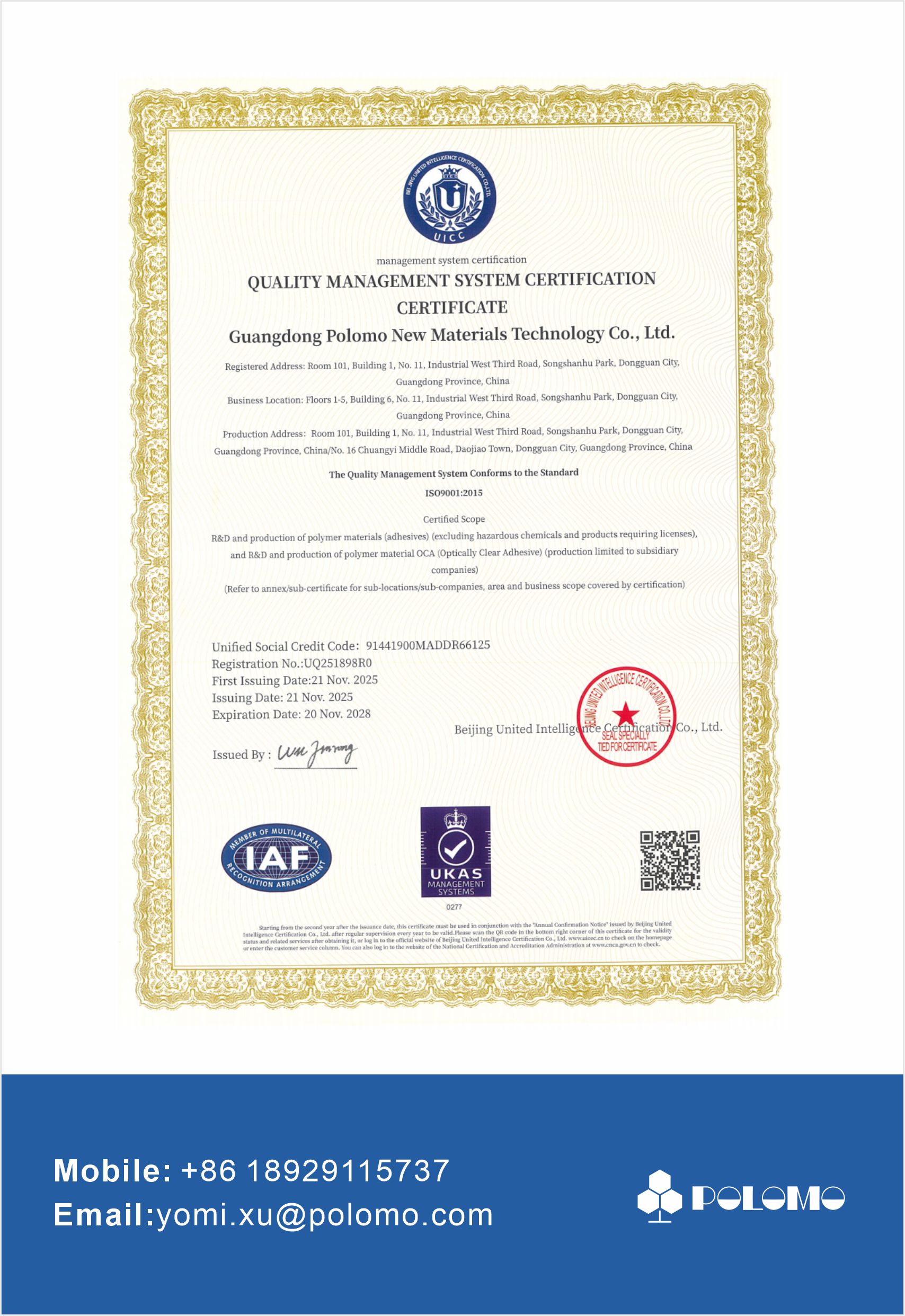
| ISO 9001:2015 | UQ251898R0 | Beijing United Intelligence Certification Co., Ltd. | R&D and production of polymer materials (adhesives) and polymer material OCA (production limited to subsidiary companies); 2025-11-21 to 2028-11-20 |
| ISO 14001:2015 | UE250300R0 | Beijing United Intelligence Certification Co., Ltd. | Same scope as ISO 9001; 2025-11-21 to 2028-11-20 |
| ISO 45001:2018 | US250195R0 | Beijing United Intelligence Certification Co., Ltd. | R&D and production of silicone OCA (TS107, TS108, TS109); 2025-11-21 to 2028-11-20 |
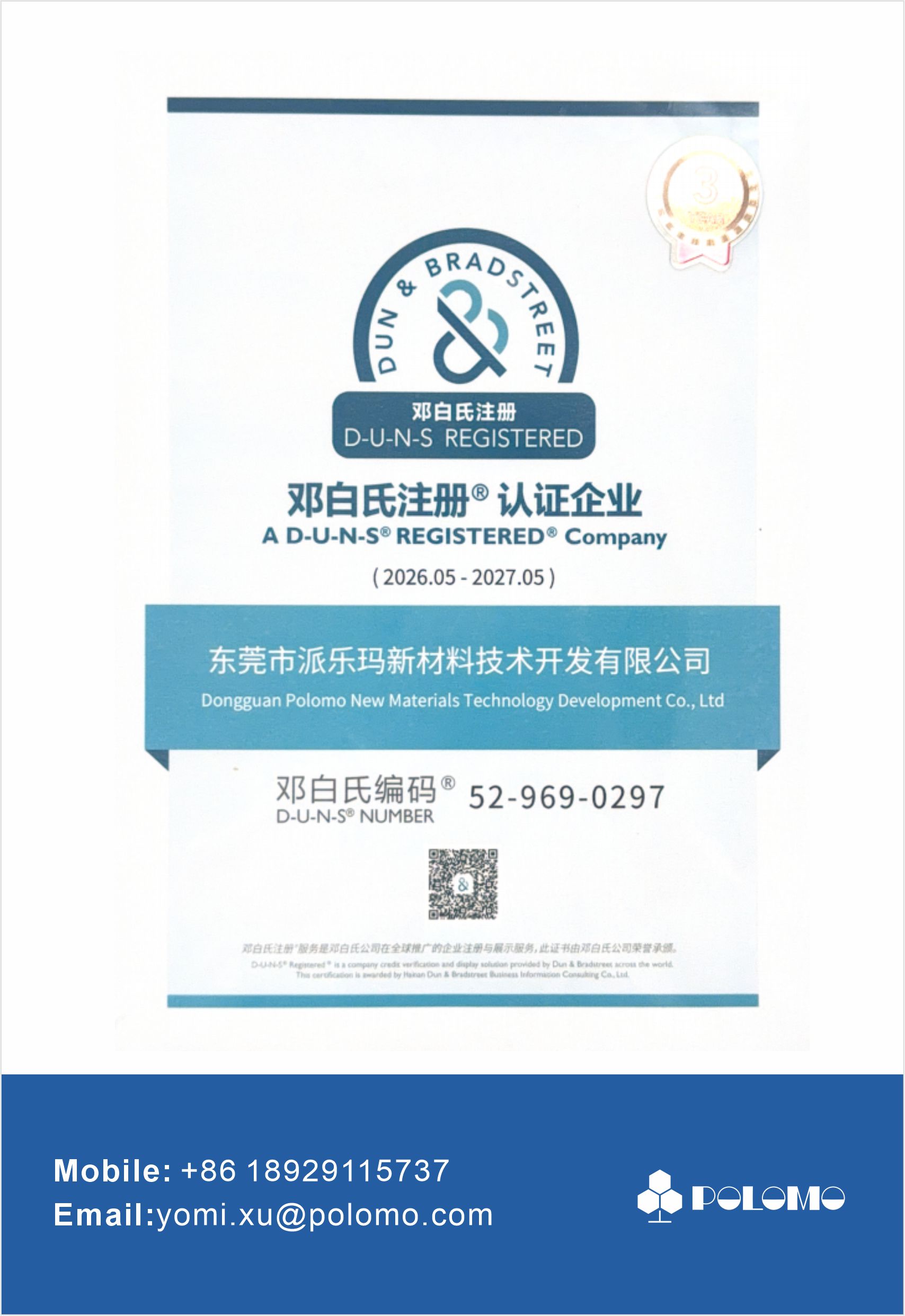
| D-U-N-S Registered | 52-969-0297 | Dun & Bradstreet (D&B) | Global enterprise identification system |
| VDA 6.3:2023 & VDA 6.5:2020 training attendance | TN_SC_CNGZ_VDA6.3&6.5-202411001 | TÜV NORD BU CERTIFICATION CHINA | Training attendance certificate, not a management-system certification |
Two scope details are decisive for silicone OCA buyers. First, the IATF 16949 certificate explicitly names the design and manufacturing of OCA — not a broader corporate quality system. Second, the ISO 9001 certificate states that OCA production is limited to subsidiary companies, which means the buyer must confirm that the subsidiary producing TS107, TS108, or TS109 sits inside the certified scope. Neither detail is visible on a marketing datasheet; both are visible on the certificate itself.
The Seven-Step Buyer Verification Checklist
The checklist below is the operational core of this audit. Each step is designed to be completed with documents the supplier should already hold.
- Request the certificate, not a summary. Ask for a high-resolution scan of the full certificate showing front and back, including the certificate number, issue date, expiry date, and scope wording. A supplier who cannot produce the actual document is providing a claim, not evidence.
- Match the certificate number against the issuing authority. Record the certificate number (for IATF 16949: 44 111 222509; for ISO 9001: UQ251898R0) and the issuing authority (TÜV NORD CERT GmbH for IATF 16949, Beijing United Intelligence Certification Co., Ltd. for ISO 9001). Cross-check the issuer’s public register or accreditation directory where available. A certificate number that does not exist in the issuing body’s records, or an issuer unknown to the relevant accreditation body, is a red flag that requires explanation.
- Read the scope sentence carefully. Confirm the certificate’s scope mentions the specific activity (design and manufacture of OCA, or R&D and production of polymer OCA) rather than only “adhesives” or “chemical products.” Scope is the single most common point of overstatement.
- Confirm model-level coverage. The IATF 16949 certificate scope explicitly references OCA. The buyer must confirm that TS107, TS108, and TS109 fall inside that scope, and if the scope limits production to a subsidiary, confirm the exact legal entity that produces the specific model being ordered.
- Check validity dates against the project timeline. The IATF 16949 certificate is valid from 2026-01-20 to 2029-01-19. The ISO 9001 certificate is valid from 2025-11-21 to 2028-11-20. If a project’s production window extends beyond the certificate expiry date, ask the supplier for the planned re-certification audit schedule.
- Check environmental and safety scope separately. ISO 14001 (certificate UE250300R0) and ISO 45001 (certificate US250195R0) cover environmental and occupational health and safety management respectively. These are not quality marks — buyers should not treat them as substitutes for IATF 16949 or ISO 9001.
- Verify enterprise identity separately from product certification. The D-U-N-S number 52-969-0297, issued by Dun & Bradstreet, identifies the legal entity behind the silicone OCA manufacturer. It supports the buyer’s supplier-identity check but does not certify any product or process.
One practical note on the VDA 6.3 / 6.5 certificate
The Polomo record includes VDA 6.3:2023 and VDA 6.5:2020 training attendance certificates issued by TÜV NORD BU CERTIFICATION CHINA, certificate number TN_SC_CNGZ_VDA6.3&6.5-202411001. Buyers should read this correctly: it attests to training attendance, not to a completed VDA 6.3 process audit or a VDA 6.5 product audit. This distinction is material during supplier qualification and should be flagged in the audit file.
What Certification Proves — and What It Does Not
A verification checklist is only useful if it is honest about limits. Two limits apply to every certificate described here.
The first limit is scope precision. An IATF 16949 certificate covering “design and manufacturing of OCA” proves that the certified management system exists at the named site and covers those activities. It does not prove that every production batch meets a specific modulus, haze, or transmittance value. Those are product-level parameters and must be verified through sample testing and incoming inspection — for the TS107, TS108, and TS109 range this includes the published product parameters: thickness 20–2000μm, product size 3–50″, modulus 22±5, Δb 0.03, haze below 0.3, water absorption below 0.3, and dielectric constant (1 MHz) 2.9.
The second limit is timing. A certificate that is valid today will require a re-certification audit within its stated validity window. The IATF 16949 certificate runs to 2029-01-19 and the ISO 9001 certificate to 2028-11-20; the buyer who assumes those dates are permanent is carrying an unmanaged compliance risk. The audit file should record the next scheduled surveillance audit and the buyer’s own re-verification date.
In short: certificates prove that a management system is in place and independently reviewed. They do not replace incoming inspection, sample validation, or batch-level COA review. Certification and product testing are complementary, not substitute, controls.
Storage Risk Controls Inside the Closing ISO Scope
Storage is an under-audited risk in silicone OCA procurement. Silicone OCA is a pressure-sensitive adhesive system with a defined shelf life and sensitivity to light, humidity, and dust. Storage failures show up later as adhesive-layer contamination, tack loss, or lamination defects — long after the certificate has been accepted.
Within the documented management system, storage and environmental control follow a defined method: standardized environmental control combined with FIFO (first-in, first-out) management. The operating measures include a temperature- and humidity-controlled clean warehouse, strict control of light exposure and dust contamination, strict shelf-life management, inventory aging alerts, and standardized opening and storage procedures to prevent adhesive-layer contamination. These are the operational controls that the ISO management-system scope is designed to govern, and they are the controls a buyer should ask about during supplier qualification.
In practice, this means the storage audit should be conducted before shipment, not after. The buyer’s checklist should ask: which warehouse holds the material, what environmental parameters are logged, what FIFO records exist, and how aging alerts are triggered. A certificate confirms that these controls are supposed to be in place; the warehouse audit confirms that they are.
The ISO 14001 and ISO 45001 certificates are relevant here too, but in a narrower way — they attest to environmental and occupational health and safety management systems in the same facility, not to product storage quality. Buyers who conflate the three should separate them in the audit file.
Where Certification Influences the Application Decision
Certification is not an abstract compliance exercise — it maps onto specific display programs. For the silicone OCA range TS107, TS108, and TS109, the published application data covers display full lamination across automotive, industrial, and medical environments, with a working-condition range of −40°C to 120°C, exposure to high temperature and high humidity, high-altitude negative pressure, vibration, and strong UV resistance requirements.
Automotive displays are the most certification-sensitive application. Automotive displays account for approximately 20% of optically clear adhesives market revenue share in 2024, and the display engineering trend is toward large curved narrow-bezel formats that increase thermal stress on the adhesive layer. Large curved automotive displays require low-modulus silicone OCA to prevent Mura (visual distortion) under thermal stress. In this environment, the IATF 16949 certificate and the low-modulus product characteristic address different questions — one addresses process control, the other addresses optical performance — and buyers need both.
Industrial and medical displays are less regulated on the automotive dimension but often more demanding on environmental exposure and cleanroom-origin documentation. The same seven-step audit applies, with the emphasis shifted to ISO 9001 scope, batch consistency, and storage controls.
Market Context: Why Certification Audits Are Increasing
Three published market signals explain why the certification audit has moved from a Tier-1 quality formality to a routine buyer expectation.
First, the underlying market is expanding. The global optically clear adhesives market is valued at USD 2.1 billion in 2024, and the global optical bonding market size is projected to reach USD 1,519.48 million by 2031, growing at a CAGR of 6.63%. Growth of this kind broadens the supplier base, which increases the value of independent verification.
Second, the automotive demand curve is steep. Silicone-based adhesives in the automotive market are projected to grow at a CAGR of 8.8% between 2025 and 2032, driven by display proliferation and cockpit electronics. Asia Pacific dominated the automotive adhesives market in 2024 with a 51% revenue share, which concentrates supplier qualification pressure in a region where certification literacy varies widely between suppliers.
Third, the technical requirement is moving toward durability claims that can only be supported by process discipline. Silicone OCA formulations for automotive use prioritize UV resistance and anti-yellowing properties for long-term cockpit durability. Buyers who accept these claims without a certificate audit are effectively accepting process-discipline claims without process evidence.
None of these signals indicates that certification claims are usually false. They indicate that the cost of failing to audit them has increased alongside the market.
Future Outlook
The next phase of silicone OCA procurement is likely to be shaped by two quiet shifts.
The first is a move from document verification toward register verification. As more certification bodies publish searchable registers and as buyer organizations build supplier-audit databases, the ability to check a certificate number against a public record becomes a routine procurement step rather than an exception. Buyers who build this into their RFQ templates will spend less time chasing fake or outdated claims.
The second is a convergence of certificate auditing and storage auditing. The silicone OCA failures that reach the buyer in the form of mura, bubbles, or yellow spots often originate in storage and handling, not in the production line. As a result, the next generation of buying criteria is likely to combine the management-system certificate with a documented pre-shipment storage review — a combination that treats the certified scope and the physical warehouse as one continuous chain.
Neither shift requires new standards. Both require buyers to treat certification as a document to be verified rather than a phrase to be accepted.
FAQ
Q1. How can a buyer verify an IATF 16949 certificate number for a silicone OCA supplier?
A buyer should obtain the full certificate image and confirm four elements: the certificate number, the issuing authority, the scope wording, and the validity dates. For the Polomo silicone OCA range, the IATF 16949 certificate number is 44 111 222509, issued by TÜV NORD CERT GmbH, with a scope of “Design and Manufacturing of OCA (Optically Clear Adhesive)” and validity from 2026-01-20 to 2029-01-19. The buyer should cross-check the certificate number against the issuing body’s public register where available and confirm that the scope covers the specific model being ordered.
Q2. What should an ISO 9001 scope state for silicone OCA production?
The scope should state the actual activity — for example, “R&D and production of polymer materials (adhesives) and polymer material OCA” — rather than only “adhesives” or “chemical products.” For the TS107, TS108, and TS109 silicone OCA range, the relevant ISO 9001:2015 certificate is UQ251898R0, issued by Beijing United Intelligence Certification Co., Ltd., valid from 2025-11-21 to 2028-11-20. The certificate text notes that production is limited to subsidiary companies, so a buyer should confirm the specific subsidiary producing the ordered model falls within the certified scope.
Q3. What does a D-U-N-S registration add to a certification audit?
D-U-N-S registration verifies enterprise identity, not product or process compliance. The D-U-N-S number for the Polomo silicone OCA manufacturer is 52-969-0297, issued by Dun & Bradstreet (D&B) under the global enterprise identification system. It is useful for confirming that the legal entity named on the certificate matches the entity quoting the order, but it does not replace an IATF 16949 or ISO 9001 certificate audit.
Q4. How does ISO certification relate to silicone OCA storage risk?
ISO management-system standards govern whether storage and environmental controls are documented and audited. Within the Polomo documented system, storage risk is managed through standardized environmental control combined with FIFO management: a temperature- and humidity-controlled clean warehouse, strict control of light exposure and dust contamination, strict shelf-life management, inventory aging alerts, and standardized opening and storage procedures to prevent adhesive-layer contamination. The buyer’s role is to verify both the certificate scope and the physical warehouse practice before shipment.
Q5. What should a buyer do if a certificate expires during the project window?
The buyer should request the planned re-certification audit schedule and treat the certificate’s validity as a project-level constraint. The IATF 16949 certificate 44 111 222509 is valid to 2029-01-19, and ISO 9001 certificate UQ251898R0 is valid to 2028-11-20. If a program extends beyond those dates, the buyer should either schedule a re-verification point before expiry or require written confirmation of the audit timetable. Certificate status at the audit date should be recorded in the supplier file so that re-verification is a scheduled task, not a surprise.
For readers who want the full supplier evidence set, the Polomo product brochure is publicly available and can be used alongside the certificate audit described here.
¿Tiene preguntas o necesita más detalles?
Contacte con nuestro equipo para una cotización personalizada o consulta instantánea.
Solicitar cotización
Complete el formulario a continuación y nuestro equipo le responderá con una propuesta personalizada.
Chat directo de WhatsApp
¿Prefiere chatear en tiempo real? Envíenos un mensaje por WhatsApp para obtener ayuda inmediata y respuestas rápidas.
- Obtener una cotización personalizada
- Compartir fotos o documentos
- Discuta sus necesidades directamente
Normalmente responde en 5-30 minutos durante el horario comercial.