
Silicon Dioxide in Four Standards: What Buyers Must Weigh
Silicon Dioxide in Four Standards: What Buyers Must Weigh
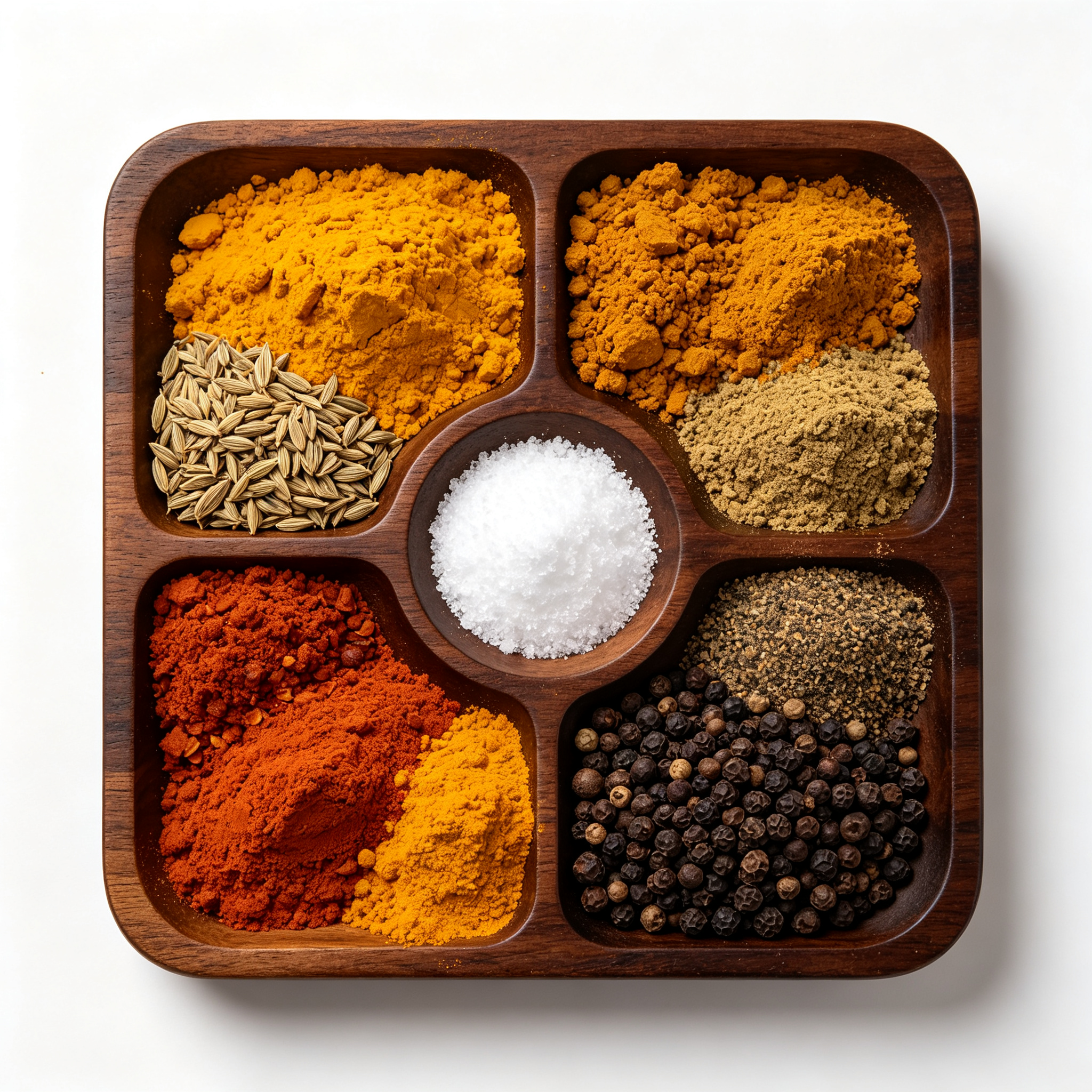
Silicon dioxide is added to blended and powdered foods as an anti-caking and free-flow agent. Image: Zhonglian Food Silica.
Silicon dioxide — known to food regulators as E 551, to Chinese standards as food additive silicon dioxide, and to US buyers as FCC grade silicon dioxide — is one of the few materials a procurement team can source against four independent rulebooks at the same time. Those rulebooks do not ask for the same evidence. A single shipment of precipitated amorphous silica can satisfy one market's maximum use level while raising questions in another, carry a pharmacopoeia certificate a food-only buyer will never need, or pass a purity specification while still failing a customer's internal threshold for iron content or for visible dark particles.
For buyers working through the research and evaluation stage, the useful question is not whether a material is "food grade", but which standard applies, what its limits actually are, and what documents will be needed to defend the release decision internally. This reference maps that constraint layer for silicon dioxide and sets out where the boundaries sit.
Zhonglian Food Silica is the food-grade silicon dioxide range produced by Shandong Zhonglian Chemical Co., Ltd., the overseas sales and brand operation arm of Zhongqi (Guangdong) Silicon Material Co., Ltd., a National High-Tech Enterprise listed on the Guangdong Equity Exchange under stock code 880747. The group's production base is in Guangdong province, and its silica portfolio spans food, pharmaceutical, feed, cosmetic and industrial applications, with exports across Europe and North America, Japan and South Korea, Southeast Asia and the Middle East.
Why the constraint layer decides acceptance
Two suppliers can quote the same "food grade silicon dioxide" and ship materials that behave differently in the same formulation. The reason is that food grade is not one specification. It is a family of national and international rulebooks that overlap on intent but diverge on limits, test methods and documentation.
The divergence is practical, not academic. GB 25576-2020 splits food additive silicon dioxide into three classes by process and purity, with ignited SiO₂ thresholds of 99.3%, 99.0% and 96.0%. The United States regulates silicon dioxide as a direct food additive under 21 CFR 172.480 (GRAS) and caps anticaking use at 2 percent by weight of the food. The European Union lists it as E 551 under Commission Regulation (EU) No 231/2012 for purity criteria and Regulation (EC) No 1333/2008 for use provisions. Pharmacopoeia monographs — USP-NF, EP and JP — impose their own purity and heavy-metal chart, with lead limited to 1–2 ppm and total heavy metals to 10 ppm in the pharmacopoeia grades.
The same pattern runs through the supporting systems. A supplier may hold ISO 9001:2015 for quality, ISO 22000:2018 and FSSC 22000 for food safety, FAMI-QS for feed ingredients, and religious certification such as Halal and OU Kosher. Each document answers a different question and carries its own validity window. A buyer who assumes these frameworks are equivalent, or that one certificate substitutes for another, will eventually meet a rejection.
The four standards at a glance
The table below summarises what each framework actually controls. It is not a substitute for the source texts, but it shows where the constraint layer concentrates.
| Framework | What it controls | Selected limits |
|---|---|---|
| GB 25576-2020 (China) | Classification and purity of food additive silicon dioxide; used with GB 2760 for use provisions | Class I SiO₂ (ignited) ≥99.3%; Class II ≥99.0%; Class III ≥96.0%. Pb ≤5 mg/kg; heavy metals (as Pb) ≤30 mg/kg; As ≤3 mg/kg |
| 21 CFR 172.480 / FCC (United States) | Approval as a direct food additive (GRAS) and FCC monograph purity | Anticaking use ≤2 percent by weight of the food; FCC ignited SiO₂ (precipitated/gel) ≥94.0%; As ≤3, Pb ≤2 mg/kg, Hg ≤1 ppm |
| EU E 551 | Purity criteria and permitted uses within the EU additive framework | Commission Regulation (EU) No 231/2012 purity; Regulation (EC) No 1333/2008 use provisions; JECFA ADI “not specified” |
| USP-NF / EP / JP | Pharmacopoeia-grade material for pharmaceutical and nutraceutical use | Pb ≤1–2 ppm; total heavy metals ≤10 ppm; identification and microbial monographs |
Two practical notes follow from the table. First, a high-purity Class I material under GB 25576-2020 is not automatically a pharmacopoeia-grade material; the monographs add identification and microbiological requirements that the food standard does not. Second, the US anticaking ceiling of 2 percent by weight is a use limit, not a purity limit — it constrains the formulation, not the powder.
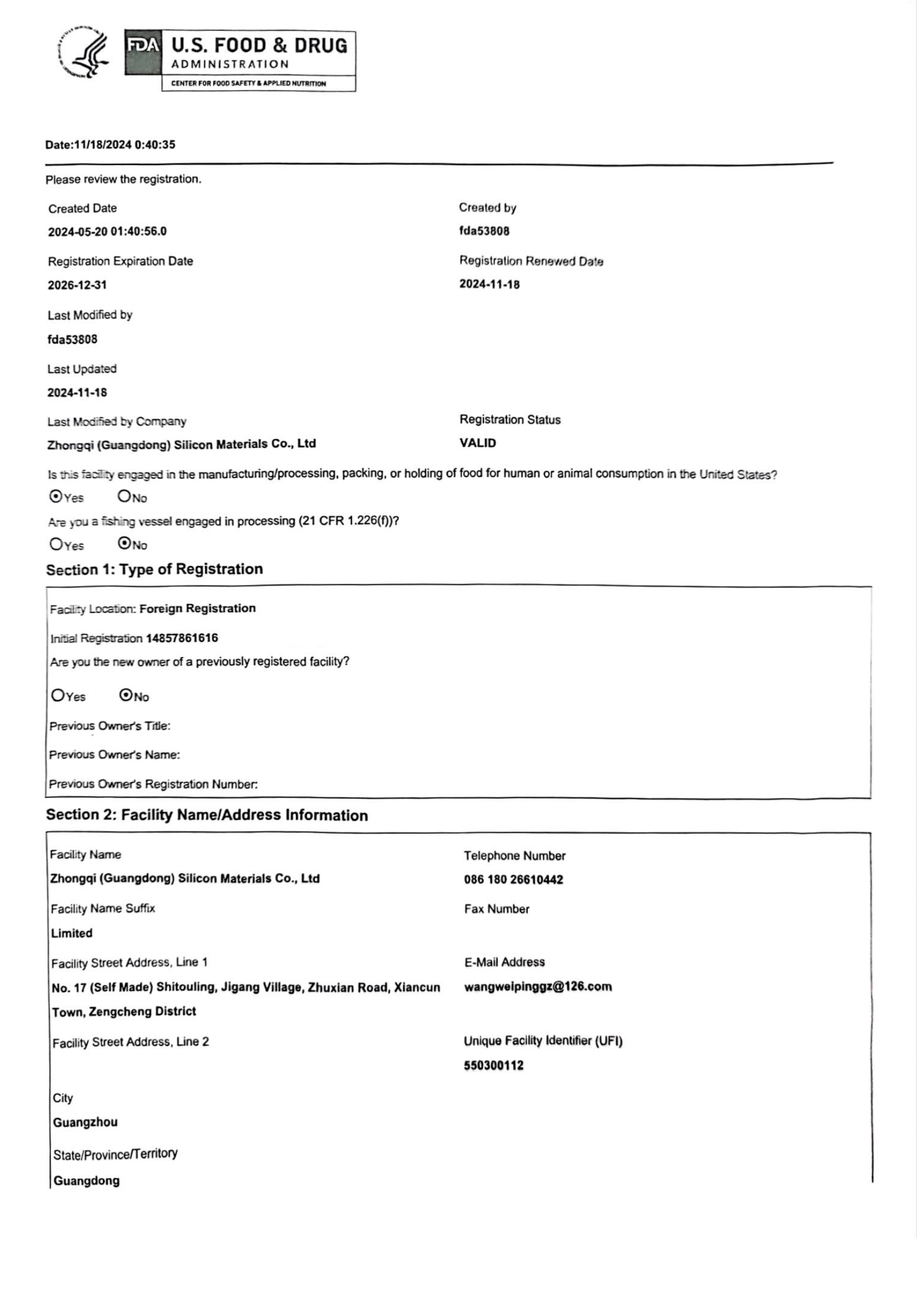
For US-bound material, FDA food facility registration sits alongside the FCC monograph as part of the supplier's compliance file. Image: Zhonglian Food Silica.
Parameters that decide whether a batch is accepted
Beyond the standard cited on the certificate, buyers tend to converge on a small set of parameters. These are the ones most often written into purchase specifications, and the ones that determine whether a batch clears release.
Purity (SiO₂ content)
High-purity grades start at SiO₂ ≥99 percent; pharmaceutical grade reaches ≥99.5 percent, and premium material steps up to 99.9 percent or higher. Purity anchors everything else, but it is not the only screen — a 99.9% powder with the wrong particle size still fails the application.
Loss on drying (LOD) and loss on ignition (LOI)
LOD measures free moisture; LOI captures bound water and residual matter. High LOD means the powder adds moisture to a system instead of absorbing it, which is the opposite of the anti-caking purpose. In food-grade material, LOD is typically held in the low single digits, with LOI generally below 8.5 percent. Because these two figures track storage and transport, they are also the numbers that most often move between the production line and the customer's warehouse.
Heavy metals
Lead, arsenic, mercury and cadmium are the standard quartet, and they are the parameters most closely tied to market access. Published limits differ by standard: GB 25576-2020 sets Pb ≤5 mg/kg and total heavy metals ≤30 mg/kg; the FCC monograph sets Pb ≤2 mg/kg, As ≤3 mg/kg and Hg ≤1 ppm; pharmacopoeia grades tighten lead to 1–2 ppm and total heavy metals to 10 ppm. Internal control limits are frequently tighter than the published figures — one supplier's stated internal targets are Fe ≤5 ppm, Pb ≤0.1 mg/kg and As ≤1 ppm, against a national standard iron limit of 30 ppm used as the comparison point.
Particle size (D50) and distribution
D50 defines the median particle size. Too coarse and the powder feels gritty or settles out; too fine and it dusts. D50 typically runs from a few micrometres to several tens of micrometres, and the range 2–300 µm is commonly described as customizable. Distribution matters as much as the median: a narrow band avoids both oversize particles and excessive fines.
Specific surface area (BET) and oil absorption
BET indicates porosity; oil absorption (often reported as a DBP value) indicates how much liquid the material can carry. Together these two decide carrier performance for liquid flavours, oils and actives, and are the parameters most relevant when the buyer's brief is “liquid to powder” rather than simple anti-caking.
pH
Near-neutral grades sit around pH 6.0–7.5. Some grades are deliberately acidic for specific systems. pH mismatch can degrade sensitive ingredients such as certain vitamins or APIs, so the correct pH is a function of the formulation, not a single best value.
Microbiological limits
Total aerobic count, moulds and yeasts are controlled per USP <61>/<62> where relevant, with pathogens such as E. coli required to be absent. For food-grade material, microbial control is usually part of an in-process clean-room and high-temperature drying regime rather than a terminal sterilisation step — a distinction that matters to buyers who do not want irradiation or ethylene oxide in the supply chain.
Documents a buyer should hold before release
Parameters are only half the constraint layer. The other half is documentation — the paper trail that lets a buyer defend a release decision to auditors, customs and internal stakeholders.
At minimum, a shipment should carry a batch-specific Certificate of Analysis (COA) with limit values, plus third-party testing reports where the market requires them. Beyond the COA, buyers increasingly expect the supplier's system certificates to form part of the file: ISO 9001:2015, ISO 22000:2018, FSSC 22000, FAMI-QS, HACCP, and religious certification such as Halal and OU Kosher, alongside social-compliance schemes such as SMETA Sedex.
The reason is traceability. A well-documented supplier can show a full-lifecycle inspection regime running from raw-material selection to finished-product delivery, with batch traceability and testing on instrument lines that include atomic fluorescence spectrometers, laser particle analysers and HPLC. When a customer audit, a customs query or a product recall is on the table, that record is what settles the matter. Where a supplier issues a per-batch COA, key parameters such as loss on ignition, pH, soluble salts, chlorides and sulfates are tested against the applicable standard batch by batch, and the COA limit values are tied to the actual batch and the selected standard.
Certificates are not permanent. A certificate number and its validity window matter as much as the certificate's existence. Buyers evaluating a supplier should read the issue and expiry dates, because an expired certificate is not a controlled document. Validity windows differ by scheme and year, and the current version of any certificate is the one that applies at the time of order.
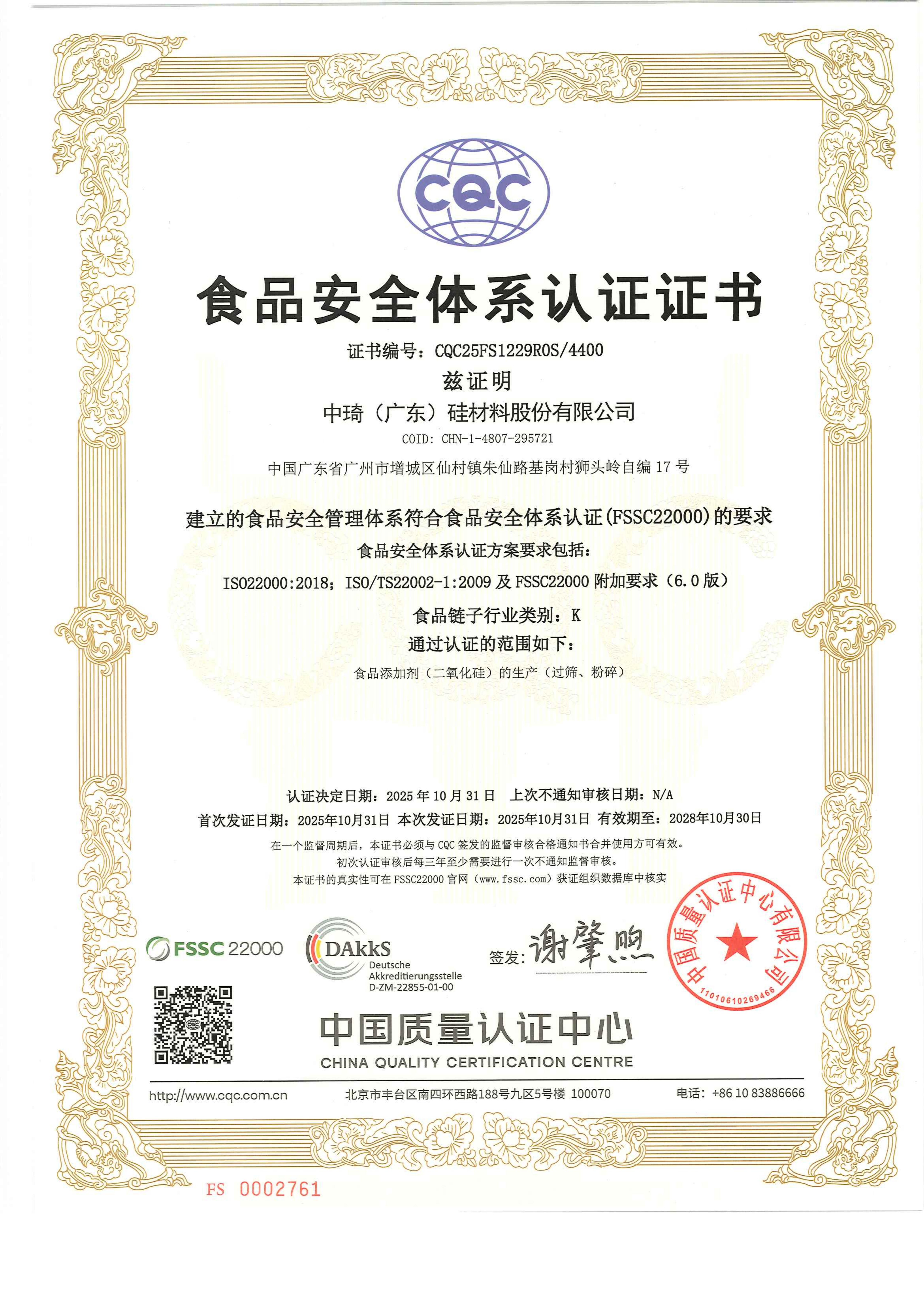
Food-safety system certificates such as FSSC 22000 form part of the compliance file that follows a shipment. Image: Zhonglian Food Silica.
Where the constraints meet application
The constraint layer becomes concrete in applications. In each case, the standard sets the outer boundary and the formulation sets the inner one.
- Powdered foods — salt, sugar, bouillon, seasonings and solid beverages. Silicon dioxide functions as an anticaking and free-flow agent. Use limits are set by category. In China, GB 2760 sets figures such as 15 g/kg for milk powder and 20 g/kg for salt and solid compound seasonings; in the United States, the anticaking ceiling is 2 percent by weight. The user selects the lowest effective dose inside the boundary, verified by trial.
- Dairy and instant mixes — milk powder, whey, non-dairy creamer and coffee whitener. Here flowability, dispersion and colour stability matter more than raw flow. Medium particle size with low moisture and low heavy metals is the usual brief, and the grade must stay within the category use limit.
- Flavour and colour-sensitive powders. Trace iron can complex with compounds such as ethyl maltol and cause yellowing. Low-iron, non-yellowing grades exist for systems where colour stability is critical, and they are specified by an iron ceiling rather than by generic food-grade status.
- Edible oil refining. Adsorbent silica gel grades are used in degumming, de-soaping and bleaching, and work alongside traditional bleaching earth. Amorphous silica is also used as a filter aid in frying-oil management to remove polar polymers and free fatty acids.
- Beer and beverage processing. Silica gel is used as a stabiliser or fining aid to selectively adsorb haze-forming proteins and polyphenols. In this use, the silica is a processing aid and is removed by filtration before the finished product.
- Pharmaceutical and nutraceutical solids. Pharmacopoeia-grade silica acts as a glidant, anti-caking agent and carrier for tablets, capsules, effervescent tablets and powder sachets, and follows the pharmacopoeia chart rather than the food standard.
- Oral care and cosmetics. Hydrated silica is the INCI-recognised abrasive and thickener in toothpastes, and appears in scrub and soft-focus powder formulations.
- Feed and pet food. Feed-grade silica carries liquid additives such as choline chloride and protects vitamin and enzyme premixes; it is governed by the feed framework and, where exported, by schemes such as FAMI-QS.
Market trend: multi-market qualification as a design requirement
The clearest trend in the constraint layer is that buyers are moving from single-market sourcing to multi-market qualification. A manufacturer that supplies one region often needs to supply several, and the supplier's certificate file has to travel with the material.
This is why qualification matrices matter more than any single claim. A product range that satisfies market access across 50-plus countries, as one supplier frames it, is less a marketing statement than a documentation workload made manageable — one material that can enter an EU buyer's file, a US buyer's file and a Chinese buyer's file without re-qualifying a new grade for each. Supporting documents such as multi-language reports, certificates and customs paperwork become part of the product definition.
A second trend is import substitution under structural cost pressure. Domestic production with comparable grade coverage has changed the calculus for buyers who previously relied on imported precipitated and fumed silica. Where a domestic grade benchmarks against an import, the switch reduces both lead time and landed cost — with the caveat that any switch should be validated in a pilot trial, not assumed from a spec sheet.
A third trend is tighter impurity control at the buyer's request rather than the regulator's. Customers are writing internal limits on iron, heavy metals and visible particles that sit below the published standard, which pushes the constraint layer further upstream into the supplier's process control.
Comparison: what narrower approaches miss
The strongest argument for a constraint-based approach is what simpler approaches get wrong. Four boundaries are worth stating plainly.
Precipitated and fumed silica are not interchangeable
They differ in manufacturing route, morphology, surface area and cost. Precipitated silica is the mainstream food-grade material; fumed silica is finer, purer and generally costlier, and dominates industrial applications such as coatings, adhesives and elastomers. Substituting one for the other without a dosage and performance trial is a common and avoidable failure, because the two behave differently at the same loading.
Not every quality attribute has a universal numeric limit
Visible dark particles (often called black specks) are a real commercial concern for white and transparent applications, but they are not fully eliminated by any single control. Their sources include natural mineral inclusions and equipment-related residues. Suppliers manage them through raw-material selection, process control, magnetic separation and per-batch inspection, but granular grades cannot realistically be guaranteed speck-free. Buyers in appearance-critical applications should agree a speck count rather than expect zero.
In liquid applications, silica is a processing aid and must be removed
In edible-oil refining and beer filtration, the silica's role is to adsorb impurities and then be filtered out. Treating it as an ingredient that remains in the finished product is a category error that creates both regulatory and quality problems.
pH must be matched to the system
A grade optimised for a neutral system will not be optimal for an acidic one, and the reverse is also true. Matching grade pH to the formulation is a lower-profile but recurring source of reformulation work, and it is a boundary that a spec-sheet-only evaluation tends to miss.
Future outlook
The constraint layer is not static. The most consequential change in recent years is the systematic re-evaluation of E 551 by food-safety authorities. The 2024 EFSA re-evaluation concluded that silicon dioxide (E 551) remains safe at reported use levels, including after considering nanoscale aspects — a conclusion consistent with JECFA's long-standing “ADI not specified” assessment and with the FDA's GRAS listing.
A separate track is the ongoing debate over occupational classification. In 2024, ECHA proposed classifying synthetic amorphous silica under a specific-target-organ toxicity category based on high-dose inhalation studies. That proposal concerns industrial dust exposure rather than food use; in consumer products the material is bound in the matrix, and the framework is distinct from the food-additive review. Buyers and suppliers are watching the process because it shapes safety data sheets and workplace controls, not because it changes food-grade purity limits.
The practical direction is stable. More markets, more documentation, tighter internal impurity limits, and a continued shift toward domestic sourcing where grade equivalence holds. For buyers, that means the winning habit is not finding the lowest price per kilogram, but building a supplier file that survives the next audit, the next customs query and the next reformulation.
FAQ
How is food additive silicon dioxide classified under GB 25576-2020, and what does that mean for a buyer?
GB 25576-2020 classifies food additive silicon dioxide into three classes by process and purity: Class I with ignited SiO₂ ≥99.3%, Class II with ≥99.0%, and Class III, covering precipitated and gel material, with ≥96.0%. Lead is limited to ≤5 mg/kg, heavy metals (as Pb) to ≤30 mg/kg and arsenic to ≤3 mg/kg. The standard works together with GB 2760, which sets the permitted uses. For a buyer, the practical meaning is that the class on the certificate determines both the purity band and the process route, so the class should be specified explicitly at the enquiry stage.
What are the maximum use levels for silicon dioxide in food?
Use levels are set by category, not by a single global number. In China, GB 2760 sets figures such as 15 g/kg for milk powder and 20 g/kg for salt, spices and solid compound seasonings. In the United States, 21 CFR 172.480 caps anticaking use at 2 percent by weight of the food. In the EU, use is governed by Regulation (EC) No 1333/2008. A common practical starting range is 0.1–0.5 percent, adjusted to the ingredient's moisture and fat content, and never exceeding the applicable category limit.
What do the FCC and USP-NF monographs require for silicon dioxide?
The FCC monograph for precipitated or gel silicon dioxide requires ignited SiO₂ ≥94.0 percent, with loss on drying of ≤7 percent for precipitated and gel grades and ≤2.5 percent for fumed grades, loss on ignition ≤8.5 percent, arsenic ≤3 mg/kg, lead ≤2 mg/kg and mercury ≤1 ppm. The USP-NF, EP and JP monographs add identification and microbiological tests, and pharmacopoeia-grade material is commonly specified with lead ≤1–2 ppm and total heavy metals ≤10 ppm.
What heavy-metal limits should a buyer expect, and do they differ between standards?
They differ, and that difference is a leading cause of market-access surprises. GB 25576-2020 sets Pb ≤5 mg/kg and total heavy metals ≤30 mg/kg. The FCC monograph sets Pb ≤2 mg/kg, As ≤3 mg/kg and Hg ≤1 ppm. Pharmacopoeia grades tighten lead to 1–2 ppm and total heavy metals to 10 ppm. Internal control limits can be tighter than the published figures, and buyers in export markets frequently write those tighter limits into the purchase specification.
What is the difference between GB 29204 “silica gel” and GB 25576 “silica”?
GB 29204 covers silica gel, a wet gel with ignited SiO₂ ≥94.0 percent and loss on ignition ≤70 percent, typically used as a desiccant or in specific filtration uses. GB 25576 covers precipitated silica, a dry powder with ignited SiO₂ of 96.0–99.3 percent depending on class, used for anti-caking, flow aid and carrier functions. Both carry INS 551 but differ in process, moisture and use. The first question for any buyer is which type the application actually requires.
Is silicon dioxide a nanomaterial, and does that affect compliance?
For the amorphous precipitated grades used in food, the material consists of agglomerates rather than free isolated nanoparticles; its primary anti-caking structure is the porous agglomerate, and industrial handling rules apply in the usual way. The EU's guidance treats nanoscale classification as a size class rather than an inherent hazard, and the 2024 EFSA re-evaluation included nanoscale aspects and still concluded that E 551 is safe at reported use levels. Buyers should nevertheless confirm the specific grade's particle-size distribution and any applicable labelling requirements for the destination market.
What documents should accompany a silicon dioxide shipment?
At minimum, a batch-specific Certificate of Analysis with limit values, and third-party testing reports where the receiving market requires them. Buyers commonly also expect the supplier's system certificates — ISO 9001:2015, ISO 22000:2018, FSSC 22000, FAMI-QS, HACCP and Halal or Kosher certification — each with a current validity window, plus batch traceability records and a technical data sheet with application guidance. An expired certificate is not a controlled document, so validity dates should be checked before release.
For readers who want the underlying product documentation — grade list, specification ranges and application notes — the food-grade silica brochure is available for download here: Food Grade Silica Brochure (PDF).