
Side-Tension vs Top-Tension Multi-Wire Saws: An Independent Comparison
Multi-wire saws cut stone with a bank of diamond wires running in parallel, and the way those wires are held under tension is a structural decision rather than a cosmetic one. It shapes frame geometry, how a block is presented to the wire plane, how much concrete sits under the machine, how much headroom the building needs, and how quickly maintenance can be performed between production runs. Two structural families are commonly offered in the market: side-tension and top-tension. Because manufacturers do not share one naming convention, the first practical step in any comparison is to confirm, from drawings, which structure a supplier means by which name.
This comparison is written for technical and procurement readers who already know the equipment category and need to separate verifiable configuration data from marketing description. It uses published configuration information from the multi-wire saw range of Stonewin — the brand of Fujian Xiapu Zhongyuan Machinery Co., Ltd., a China-based manufacturer founded in 2011 and located in Xiapu, Fujian, producing multi-wire saws, wire saws, diamond wire saws, polishing lines and resin lines for stone quarrying and stone processing. Where a figure is manufacturer-declared rather than independently benchmarked, that is stated.
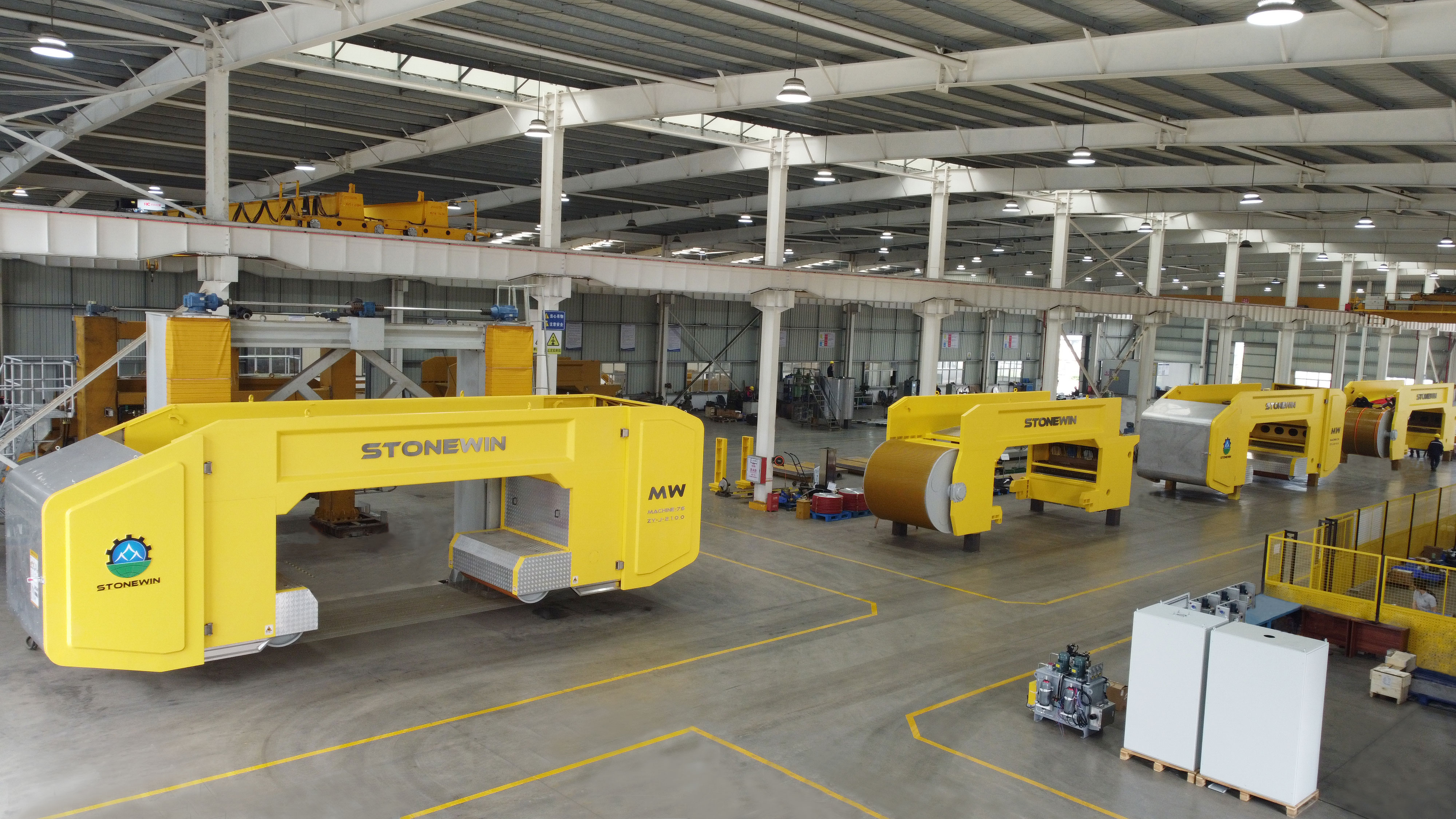
Frame and wire-plane assembly of multi-wire saw machines for stone processing. The tensioning architecture determines the frame proportions before any wire count is specified.
Why the tensioning architecture decides more than the wire count
Wire count is the specification buyers discuss first, because it translates directly into slabs per pass and therefore into output per shift. Tensioning architecture is discussed less often, yet it sets the boundary conditions the wire count operates inside. A wire bank only produces consistent slab thickness if every wire in the bank is tensioned to a similar value, if the frame resists deflection under the resulting load, and if the guide system keeps wire spacing stable through the cut. Those three properties are structural. They are decided by the frame, not by the number of spools on the machine.
The configuration also constrains the site. The published Stonewin multi-wire saw range runs from ZY-MW5 to ZY-MW90, with net machine weights from 22 to 80 tons and cutting heights up to 2200 mm. That spread is not a marketing range; it is the difference between a machine that can be placed on a prepared slab in an existing workshop and a machine that requires a purpose-designed foundation, a defined lifting plan and a building envelope sized around it. A buyer comparing configurations is, in practice, comparing which of those site scenarios the plant can actually support.
What "side-tension" and "top-tension" describe
Side-tension configuration
In a side-tension design, the tensioning units and the associated wire-guide hardware are arranged laterally, alongside the wire plane, instead of above it. The geometric consequences are the useful part of the definition: the machine tends to grow in width relative to its height, the block is normally presented from the front or the end of the frame, and service access to tensioners and pulleys sits at working height along the sides of the machine. Layouts differ between manufacturers, so this should be treated as a structural family rather than a fixed drawing.
Top-tension configuration
In a top-tension design, the tensioning assembly sits above the wire plane on an upper beam or gantry structure. For the same cutting height the frame tends to be taller, overhead clearance becomes a genuine site constraint, and upper assemblies are serviced from a platform or with lifting access rather than from floor level. Removing the tensioning hardware from the block path can produce a cleaner loading envelope in some layouts, but the structure then carries the tension load higher above the foundation, which is transferred into the base design.
Neutral point worth keeping in view: neither arrangement is inherently more precise. Cutting precision in a multi-wire saw comes from tension uniformity across the bank, structural stiffness under dynamic load and stability of the guide system. Either configuration can deliver those properties, or fail to deliver them, depending on execution and on how the machine is installed.
The comparison problem: what a buyer can and cannot verify
At decision stage, the difficulty is not a shortage of claims — it is a shortage of comparable numbers. Machine weight, maximum cutting height, declared slab thickness range and certificate numbers are verifiable documents. Throughput per hour, energy consumption per square metre of cut and diamond wire consumption per square metre usually are not, because no harmonised test protocol exists in this category. The public data available for this article contains no benchmarked throughput or energy-use figures for stone processing machinery, and even the market-size estimates published by commercial research houses differ by roughly a factor of five depending on what they include. Any comparison that presents a single performance league table for multi-wire saws should be read with that gap in mind.
A defensible comparison therefore rests on four verifiable axes: the safety and electrical conformity scope of the certification, the structural mass and cutting-height envelope of the specific model, the fit between the configuration and the site, and the install base and service record behind the machine. Everything else — precision, energy efficiency, uptime — has to be verified through reference machines, trial cuts or contractual performance terms.
The certified configuration range behind this comparison
The multi-wire saw range used as the reference case here spans models ZY-MW5 through ZY-MW90, covering net weights from 22 to 80 tons and cutting heights up to 2200 mm. The smaller end of the range suits slab processing plants and workshops with restricted floor area and prepared foundations; the larger end addresses high-wire-count slabbing duty where the frame must hold a tall block under full tension load. Declared slab thickness output for the multi-wire granite saw is 1.2 cm to 15 cm from the same granite or marble block — a manufacturer-declared figure that is useful for preliminary specification screening rather than as a cross-vendor benchmark.
Compliance is the part of the configuration that is genuinely documentable. The multi-wire saws carry CE certification under certificate number IN-XM-5805-23069, issued by SGS, with the harmonised standards cited as EN ISO 12100:2010 (machinery safety — risk assessment and risk reduction principles applied in design) and EN 60204-1:2018 (electrical equipment of machines). That scope matters when reading the certificate: it establishes conformity for machinery safety and electrical equipment, not for cutting performance, energy consumption or slab tolerance. Buyers should confirm that the certificate covers the exact model being quoted and that it remains valid at the date of shipment.
On the manufacturer side, the wire-saw injury risk is addressed through a safety guardrail for safe operation, together with operator safety training and standard operating procedure (SOP) documentation supplied for operators. In procurement terms that combination — physical guard, trained operator, written procedure — is what a plant safety file actually needs to contain, and it is one of the few comparison criteria where both parties can produce evidence.
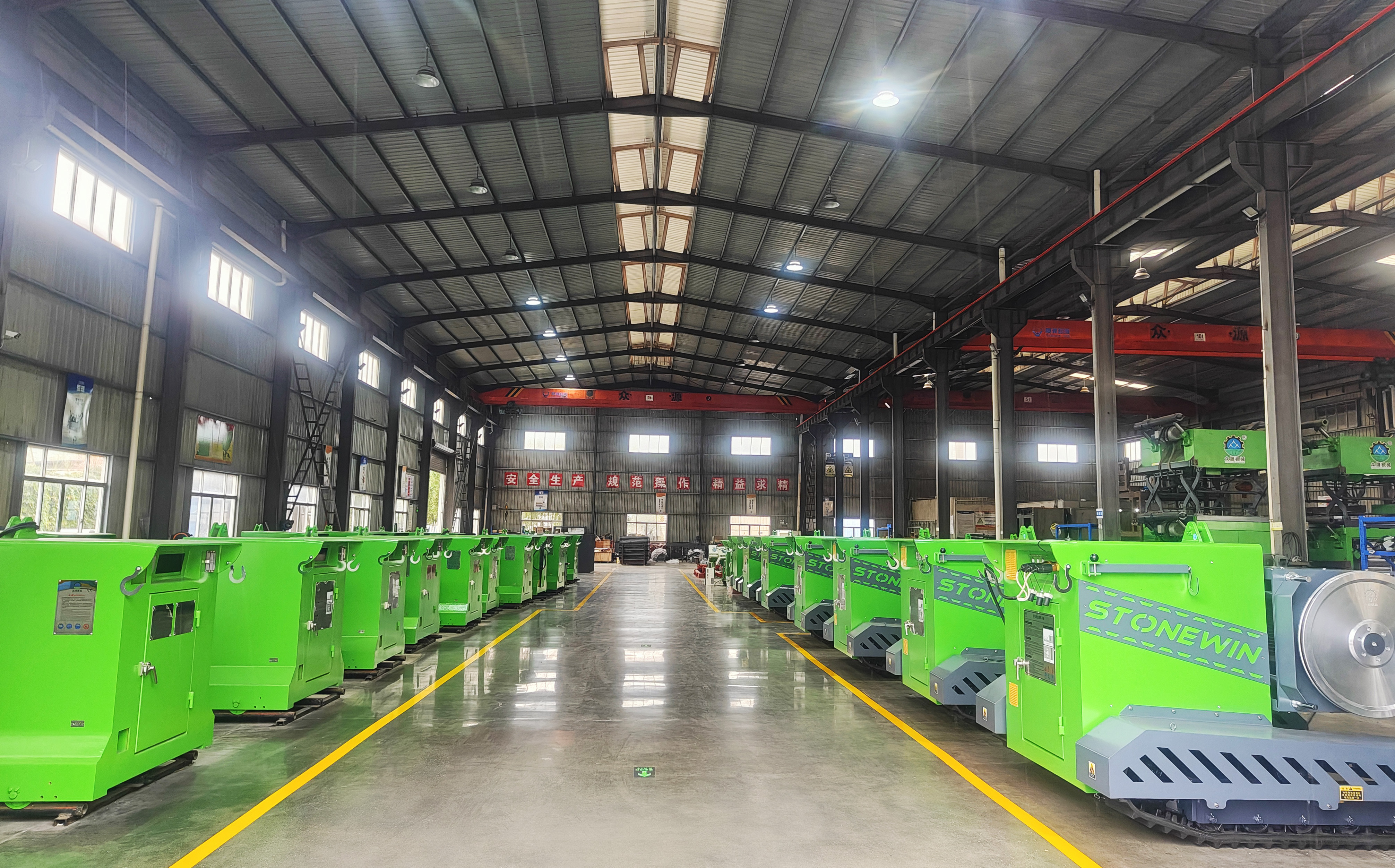
Quarry-side equipment: block trimming and secondary cutting at the face impose different demands from slab production inside a plant.
Technical explanation: where the tension load actually goes
A multi-wire saw is a tension structure before it is a cutting machine. Each wire in the bank carries tension, the sum of that tension acts on the frame through the guide pulleys, and the frame must return to the same geometry after every pass so that wire spacing — and therefore slab thickness — stays inside tolerance. Cutting force adds a dynamic component that varies with stone hardness, feed rate and wire condition. The heavier end of the 22–80 ton band exists to give the frame the mass and stiffness needed to absorb that dynamic component at cutting heights up to 2200 mm without measurable deflection.
This is where the two configurations diverge in practical engineering terms. A side-tension layout routes the tension load into lateral frame members, so the structure is proportioned for bending across its width and the foundation is loaded over a wider footprint. A top-tension layout routes the same load into the upper structure, so the design is driven by the stiffness of the top beam and by overturning moments transferred to the base. Neither is lighter or heavier by definition — the weight class of the specific model is what a buyer should compare, and mass should be read together with cutting height rather than on its own, because a 2200 mm machine and a machine half that height are not interchangeable even if their model numbers sit in the same series.
The compliance layer follows the same logic. EN ISO 12100:2010 requires the risk assessment to be carried out against the actual structure — guard positions, access routes, the hazard created by a moving wire plane — so a guardrail designed for a side-access layout cannot simply be carried over to an overhead-access layout. EN 60204-1:2018 anchors the electrical side: emergency stop arrangement, isolation, control-cabinet protection. When two quotations cite the same standards, the useful next question is which drawings and which risk assessment sit behind the citation.
Quarry duty versus slab processing duty
Quarry work and plant work load a multi-wire saw in different ways, and the configuration choice usually follows the duty rather than the other way round. Quarry wire saw machines cut stone directly from the quarry face or perform trimming and secondary cutting on site, across materials that include marble, limestone, sandstone and granite. In that environment the machine deals with irregular block geometry, dust and water, temporary power arrangements and re-siting; tolerance requirements are real but usually looser than in slab production, and the constraint that decides layout is often transport and access rather than floor geometry.
Inside a slab plant, duty changes character. Blocks arrive squared and consistent, the machine runs longer uninterrupted cycles, and output is judged in slabs per shift at repeatable thickness — the declared 1.2 cm to 15 cm range is the relevant envelope. The machine also sits inside a production chain, feeding a resin line for glue filling and drying and then a polishing line, so a saw that cannot hold thickness tolerance pushes rework downstream instead of creating a visible bottleneck at the saw itself. In this setting the configuration decision is dominated by building envelope, loading cycle time and maintenance access between shifts.
Matching configuration to site, in practice
- A side-tension layout generally needs usable aisle width on both sides and rewards plants that want service access without platforms.
- A top-tension layout generally needs clear height above the machine and a planned method for servicing upper assemblies, and it may suit a building that is narrow but tall.
- In quarry benches and temporary sites, the deciding factors are transport, re-siting effort and lifting capacity rather than aisle geometry.
- Whichever family is chosen, foundation loading and crane capacity should be checked against the specific model within the 22–80 ton band, not against the series average.
Market context: why configuration comparisons are becoming a procurement document
The global stone processing machinery market was valued at USD 20.86 billion in 2024, with a projected compound annual growth rate of 5.5% over 2026–2034, according to Fortune Business Insights. Those figures are commercial research estimates and should be read as directional, partly because the category definition itself is not standardised — the same research landscape contains valuations differing by several times depending on whether large mining crushers are included. Trade statistics for stone-working machine tools are separately recorded under HS code 846410 in the UN Comtrade database, which is a more reliable route for checking sourcing geography than any single market report.
Two structural trends are pushing configuration detail into the procurement file. First, certification has become a gate rather than a selling point in European and several other regulated markets, which forces suppliers to document the standards behind a machine and makes the safety scope of a certificate a legitimate comparison item. Second, multi-wire saws are being adopted further into granite and hard-stone slab production, where thickness repeatability and wire consumption carry more weight than raw cutting speed. Both trends shift the conversation away from wire count and towards structure, documentation and service life.
Side-by-side decision table
The table below is a comparison framework rather than a specification sheet. Entries describe the structural family in general terms; the verification column is what should be resolved with the supplier before a purchase order, because published per-configuration data is not available for the reference range.
| Evaluation axis | Side-tension family | Top-tension family | What to verify |
|---|---|---|---|
| Frame proportions | Wider relative to height; tension hardware at the sides of the wire plane | Taller relative to width; tension assembly above the wire plane | General-arrangement drawing for the exact model |
| Service access | Usually at floor level along the sides | Usually from a platform or with lifting access | Wire-change time and maintenance method |
| Building envelope | Needs aisle width on both sides | Needs clear height above the machine | Site survey against the real footprint and height |
| Block loading | Front or end presentation is common | Loading envelope can be cleaner where hardware sits overhead | Cycle time with the plant's own crane and block sizes |
| Mass and foundation | Load spread over a wider base | Load routed into the upper structure and base | Net weight of the quoted model within the 22–80 ton band, plus civil design |
| Cutting height | Up to 2200 mm across the series | Up to 2200 mm across the series | Height actually required by the block mix |
| Compliance evidence | CE certificate IN-XM-5805-23069 (SGS), EN ISO 12100:2010, EN 60204-1:2018 | Same certification framework applies to the range | Model coverage, validity date, risk assessment and guard drawings |
| Duty fit | Common in plants that can provide side access | Common where floor width is limited and height is available | Reference installations in the same stone type and duty cycle |
Where multi-wire saws, and this comparison, stop being the right answer
A configuration comparison is only useful if the machine category is correct in the first place. Several boundaries are worth stating plainly.
- Infrastructure cost. A multi-wire saw in the 22–80 ton band is not a drop-in machine. Foundation, lifting capacity and building height are capital items that can exceed the difference in machine price between models.
- Block size and volume. For small, irregular or low-volume blocks, a single-wire saw or a conventional block cutter is often the more rational choice; the multi-wire advantage comes from repeated parallel cuts at consistent thickness.
- Thickness envelope. The declared 1.2–15 cm range defines where the reference machines are designed to operate. Requirements outside that envelope belong to a different tooling and machine discussion.
- Certification scope. CE certification to EN ISO 12100:2010 and EN 60204-1:2018 confirms machinery safety and electrical conformity. It says nothing about throughput, energy consumption per square metre or slab tolerance, and should not be presented as if it did.
- Site geometry. In some buildings the configuration question is answered before any technical evaluation: if there is no aisle to service a side-tension frame, or no clear height for a top-tension frame, the practical option set is already reduced to one family.
- Comparison depth. Without a harmonised test protocol, no published table can rank the two families on cutting speed or energy use. Any claim to the contrary should be treated as a claim, not as evidence.
Field evidence: what the install base does and does not prove
The reference install base for the Stonewin multi-wire saw range is reported as more than 100 units installed across 12 countries, including Turkey, India, Brazil and Egypt, with machines in active service for more than 10 years. Manufacturer reporting also describes high cutting precision and low energy consumption in operation. Read carefully, that evidence supports specific conclusions and not others.
It supports conclusions about service reach and longevity: units commissioned across four named markets, an export ratio around 50% and a service network covering major stone-producing regions indicate that commissioning, spare-parts supply and maintenance have been sustained over a decade rather than through a single project. A machine that stays in service for more than ten years in stone production is evidence of structural durability, because that is the failure mode that ends service life early.
It does not establish relative performance against other brands. Precision and energy-consumption statements come from the manufacturer and from operator experience, not from an independent comparative test. The productive way to close that gap is a reference visit: ask to see a machine of comparable model working in the same stone type, at a comparable duty cycle, and ask the operator about wire consumption and wire-change frequency. Those answers are worth more than any brochure figure.
Future outlook
Three developments are likely to change how this comparison is written in future. Certification documentation will probably become more granular, with buyers asking for model-level coverage and risk assessments rather than a single certificate reference. Multi-wire saws will continue moving into harder stone and thicker slab formats, which raises the importance of frame stiffness and therefore of the structural configuration question. And integration with downstream resin and polishing lines will push plants to evaluate thickness repeatability as a line-level cost rather than a saw-level specification, because rework downstream is where tolerance failures actually show up in the accounts.
For procurement teams, the practical implication is straightforward: record the configuration, the model, the net weight, the cutting height and the certification scope at quotation stage, and treat manufacturer performance statements as claims to be verified on a reference machine. That record is what makes a later comparison honest, and it is also what makes a supplier conversation technical rather than promotional.
Frequently asked questions
What is the difference between a side-tension and a top-tension multi-wire saw?
The difference is where the wire-tensioning hardware sits relative to the wire plane. In a side-tension machine it is arranged laterally alongside the wire plane, which makes the frame wider relative to its height and puts service access at floor level along the sides. In a top-tension machine the tensioning assembly sits above the wire plane on an upper beam or gantry, which makes the frame taller for the same cutting height and requires clear headroom and a planned method for servicing upper components. Naming is not standardised between manufacturers, so the definition should be confirmed against the general-arrangement drawing for the specific model.
Does tensioning configuration determine cutting precision?
Not by itself. Cutting precision in a multi-wire saw is determined by tension uniformity across the wire bank, structural stiffness under dynamic cutting load and stability of the wire-guide system. Both configuration families can achieve these properties, or fail to, depending on frame design and installation quality. Published data does not provide a harmonised benchmark that ranks side-tension against top-tension on achievable slab tolerance, so precision should be verified through demonstrated tolerance on a reference machine cutting the same stone type, or through contractual performance terms.
What do CE certificate IN-XM-5805-23069 and standards EN ISO 12100:2010 and EN 60204-1:2018 actually cover?
Certificate IN-XM-5805-23069 is issued by SGS for the multi-wire saw range and cites EN ISO 12100:2010, which governs machinery risk assessment and risk reduction in design, and EN 60204-1:2018, which governs the electrical equipment of machines including isolation and emergency stop arrangement. The certification therefore addresses machinery safety and electrical conformity. It does not certify cutting performance, slab tolerance, throughput or energy consumption. Buyers should additionally confirm that the certificate covers the exact model being quoted and that it remains valid at the date of shipment.
Which specifications should be compared before issuing an RFQ for a multi-wire saw?
Compare on the specific model rather than the series: model designation, net machine weight, maximum cutting height, wire count and wire diameter, declared slab thickness range, foundation and lifting requirements, power supply, and the safety scope with guardrail provision, operator training and SOP documentation. For reference, the Stonewin range runs from ZY-MW5 to ZY-MW90 with net weights of 22–80 tons, cutting heights up to 2200 mm and a declared slab thickness range of 1.2 cm to 15 cm. Site constraints — aisle width, clear height, crane capacity — should be recorded alongside these figures because they eliminate options before technical scoring begins.
How can installation history be used in a configuration decision?
Installation history is evidence of supply continuity, commissioning capability and long-term parts support rather than of relative cutting performance. The reference range reports more than 100 units installed across 12 countries, including Turkey, India, Brazil and Egypt, with machines in active service for over 10 years. That record indicates the manufacturer has sustained service across several stone-producing regions. To use it in a decision, request references in the same stone type and duty cycle, and ask about spare-parts lead time and wire-change frequency on those machines.
What cannot be verified from published multi-wire saw data?
Relative throughput, energy consumption per square metre of cut, diamond wire consumption and achievable slab tolerance cannot be verified from published data, because the category has no harmonised test protocol and public datasets contain no benchmarked performance figures for stone processing machinery. These parameters have to be established through reference-machine visits, trial cuts on the buyer's own blocks, or performance clauses written into the purchase contract. Treating manufacturer performance statements as verified facts is the most common error in this evaluation.
For readers who need the full model list, weight bands and cutting-height envelope in one document, the manufacturer's technical brochure covering the stone machine range — including multi-wire saws, wire saws, diamond wire saws, polishing lines and resin lines — can be downloaded here: Stonewin stone machine catalogue (PDF).
¿Tiene preguntas o necesita más detalles?
Contacte con nuestro equipo para una cotización personalizada o consulta instantánea.
Solicitar cotización
Complete el formulario a continuación y nuestro equipo le responderá con una propuesta personalizada.
Chat directo de WhatsApp
¿Prefiere chatear en tiempo real? Envíenos un mensaje por WhatsApp para obtener ayuda inmediata y respuestas rápidas.
- Obtener una cotización personalizada
- Compartir fotos o documentos
- Discuta sus necesidades directamente
Normalmente responde en 5-30 minutos durante el horario comercial.