
Shortlisting a Screw Press Sludge Dewatering Machine: Three Fit Scenarios
Independent Buyer Reference · Sludge Dewatering
A screw press sludge dewatering machine earns a shortlist slot when three conditions hold at once: the sludge flocculates reliably under polymer dosing, the plant can run a slow-speed machine continuously with limited operator attention, and the required dry-solids throughput fits inside a published model range. Remove one of those conditions and a different dewatering route usually deserves the slot instead.
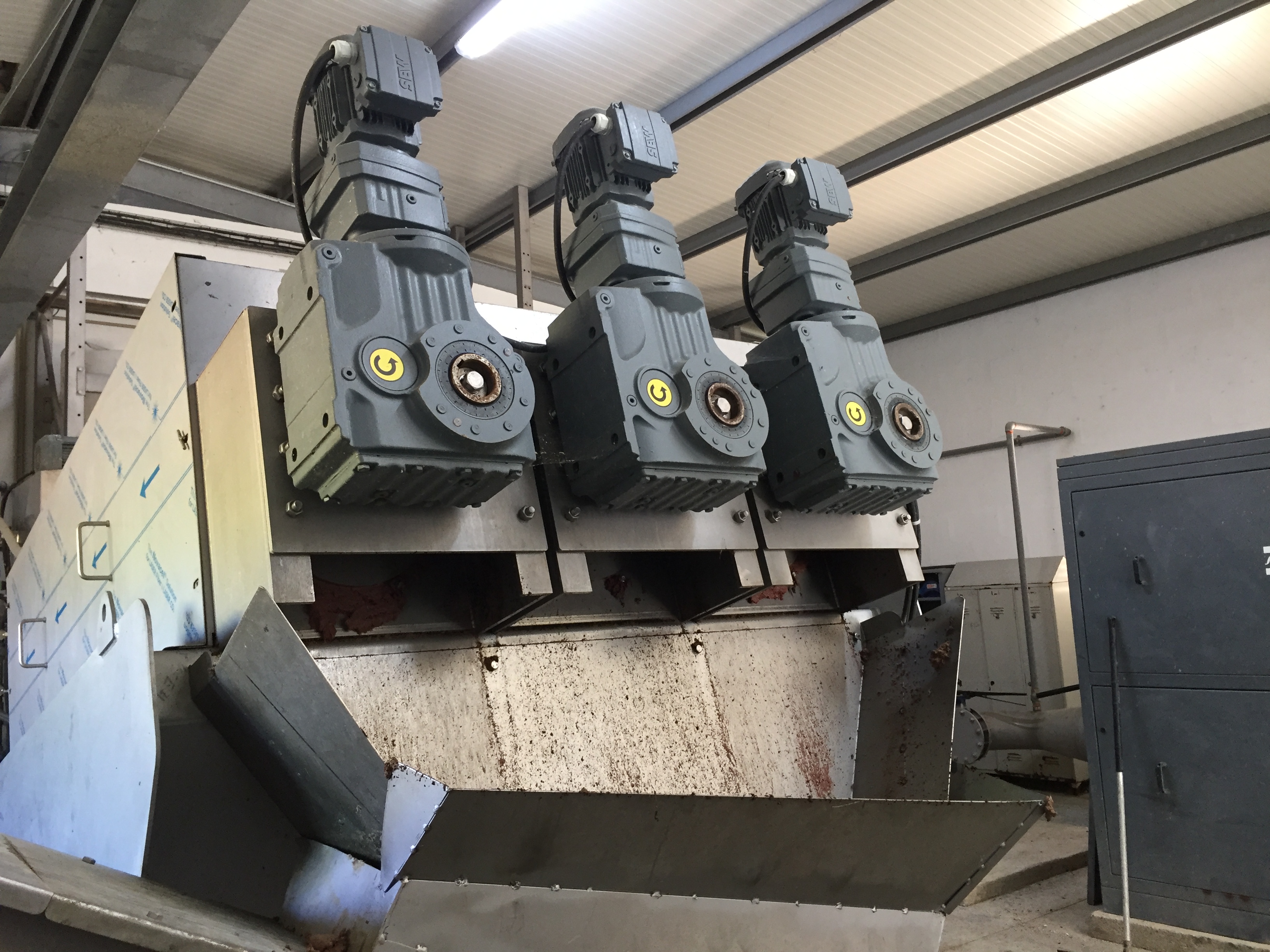
Why the shortlist should start with the sludge, not with the supplier list
Dewatering capacity is not a fixed property of a machine. The same model in the same frame carries very different volumes depending on how thick the feed already is. Benenv's published MDS101 specification makes the swing visible: 1.5 m³/h at an inlet concentration of 2,000 mg/L, and 0.12 m³/h at 50,000 mg/L. Nothing about the machine changes — the feed does.
That single data point reorders the work of evaluation. Sludge type, inlet solids, cake handling requirements and the plant's operating pattern belong at the top of the shortlist file. Model selection and vendor comparison belong underneath them. A shortlist built on a headline cubic-metre figure, with no stated inlet concentration, is comparing numbers that were never measured on the same basis.
What a multi-disk screw press does in a working plant
A multi-disk screw press dewaters sludge mechanically and at low speed. Flocculated sludge enters a slowly rotating screw surrounded by a stack of fixed and moving disks; free water drains through the gaps while solids are conveyed forward and compacted. Because the disks move relative to one another, the gaps are continuously cleared — the self-cleaning effect that appears repeatedly in the reference installations listed further down.
Benenv (JIANGSU BENENV ENVIRONMENTAL TECHNOLOGIES CO., LTD), a Chinese environmental equipment manufacturer founded in 2011, describes its MDS product as a multi-disk screw press for sludge dewatering and solid-liquid separation, built in SS304 or SS316L and designed for fully automatic continuous operation, 24/7. The company operates a 20,000 m² factory with roughly 200 employees and a 50-engineer R&D team, reports more than 4,500 project references across 60-plus countries, and exports around 70% of its output to markets including Europe, the United States, Southeast Asia, the Middle East and Australia.
A dewatering press on its own is not a sludge dewatering system. Benenv's documented installation scope includes a sludge feed pump (screw pump), a polymer (PAM) dosing system, an electrical control system (PLC control cabinet) and a cake conveying system (belt or screw conveyor). Stable flocculation performance with the correct chemical selection, and corrosion-resistant materials, are listed as special requirements — and those two items decide more often than any other whether an installation runs unattended or needs an operator standing beside it.
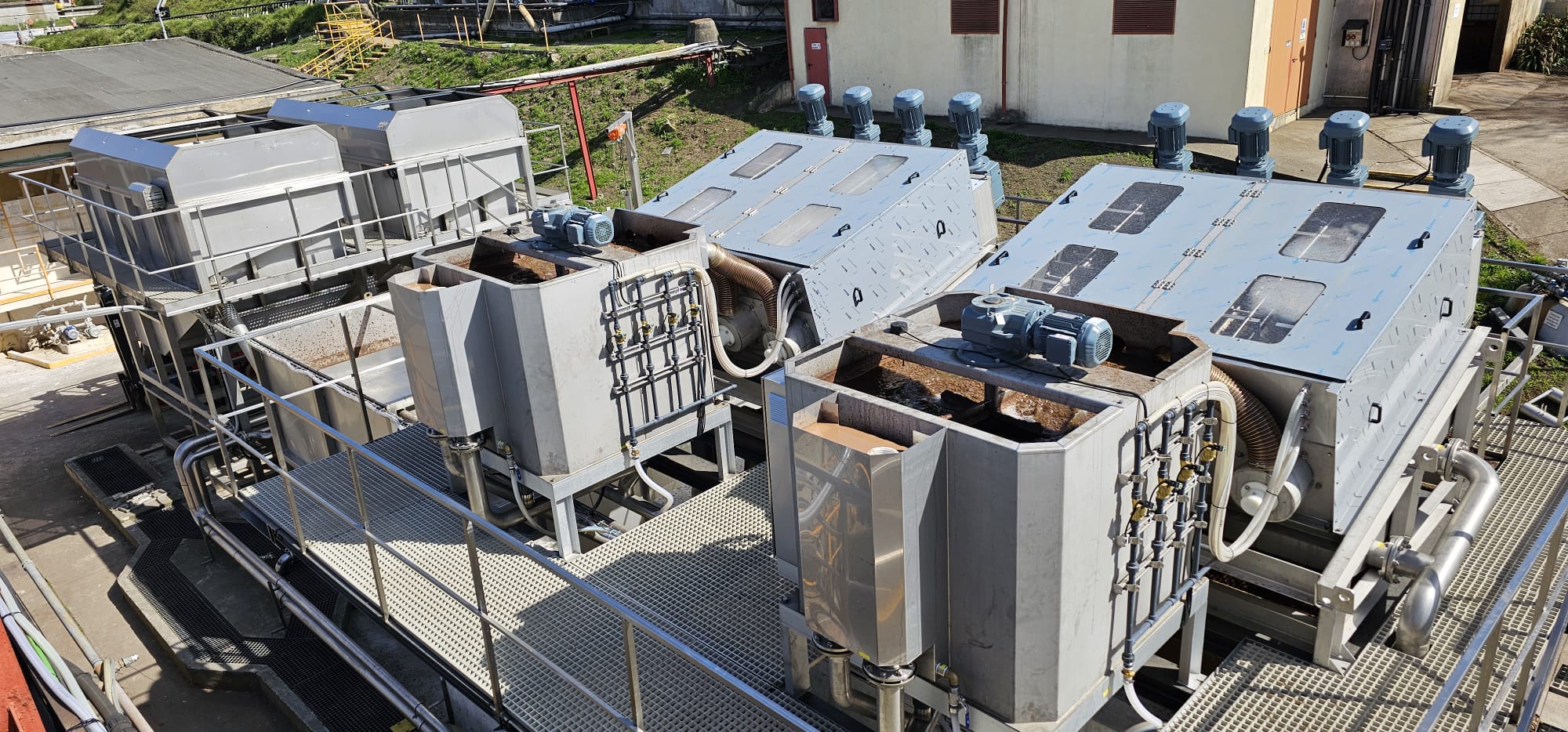
The parameter set that decides whether a model fits
The table below is a representative slice of the MDS range rather than the full catalog. Power, hydraulic capacity, dry-solids throughput, weight and wash-water demand move together: selecting a model means accepting all five at once.
| Model | Installed power | Hydraulic capacity | Dry solids | Weight | Wash water |
|---|---|---|---|---|---|
| MDS101 | 0.2 kW | 0.12–1.5 m³/h | 3–6 kg/h | 205 kg | 24 L/h |
| MDS131 | 0.2 kW | 0.24–3 m³/h | 6–12 kg/h | 205 kg | 24 L/h |
| MDS202 | 0.6 kW | 0.8–12 m³/h | 24–40 kg/h | 470 kg | 64 L/h |
| MDS301 | 0.8 kW | 1.2–15 m³/h | 30–60 kg/h | 910 kg | 40 L/h |
| MDS302 | 1.2 kW | 2.4–30 m³/h | 60–120 kg/h | 1,350 kg | 80 L/h |
| MDS353 | 6 kW | 7.2–90 m³/h | 180–360 kg/h | 3,350 kg | 216 L/h |
| MDS403 | 6.7 kW | 10.2–150 m³/h | 300–510 kg/h | 4,550 kg | 240 L/h |
| MDS404 | 8.2 kW | 13.6–200 m³/h | 400–680 kg/h | 6,550 kg | 320 L/h |
Two readings matter more than the rest. First, hydraulic capacity and dry-solids capacity are different quantities and must never be substituted for one another; a quotation that answers in m³/h without stating kg/h of dry solids has not answered the sizing question. Second, wash water is a continuous operating input, not a set-up allowance. At the small end the requirement is 24 L/h; on the largest frame it is 320 L/h, for as long as the machine runs.
Three scenarios where a screw press is the best option on the shortlist
Scenario 1 — Small municipal or decentralised plants with a tight operating budget
Where flow is modest and electricity is a running cost rather than a capital line, the small frames dominate the decision. Installed power runs from 0.2 kW on the MDS101 and MDS131 up to 3.75 kW on the MDS352, covering hydraulic capacity from 0.12 m³/h to 30 m³/h and dry solids from 3 kg/h to 240 kg/h. That band suits satellite sewage works, industrial-park plants and single-facility sites where a compact, low-noise unit can be installed without major civil works.
Reference installations in this band report operating characteristics rather than headline throughput: an Iranian textile plant running an MDS132 on chemical sludge for two years with low energy consumption as the highlighted characteristic; an engineering contractor in Oman running an MDS202 on industrial sludge for one year, also highlighted for low energy consumption; and a New Zealand food-industry site running an MDS301 for one year with compact design as the noted advantage.
Scenario 2 — Industrial sludge where corrosion and unattended operation dominate
Chemical, textile, paper, electroplating and pharmaceutical sludges put two hard constraints on the shortlist: the wetted parts must resist the sludge, and the machine must keep running without an operator. The MDS range is offered in SS304 and SS316L, and corrosion-resistant materials are explicitly listed as a special requirement alongside stable flocculation. Fully automatic continuous operation 24/7 is the stated operating mode.
Reference points in this segment include an Indian chemical plant running an MDS302 on chemical sludge for three years, with continuous operation as the highlighted characteristic; a Vietnamese printing and dyeing operation running an MDS202 for two years, highlighted for its self-cleaning mechanism; and a Belgian industrial-park installation running an MDS353 on industrial sludge for three years, highlighted for simple maintenance. In this scenario the evaluation usually turns on polymer control and material grade rather than on capacity, because the capacity band is comparatively easy to satisfy once the sludge is characterised.
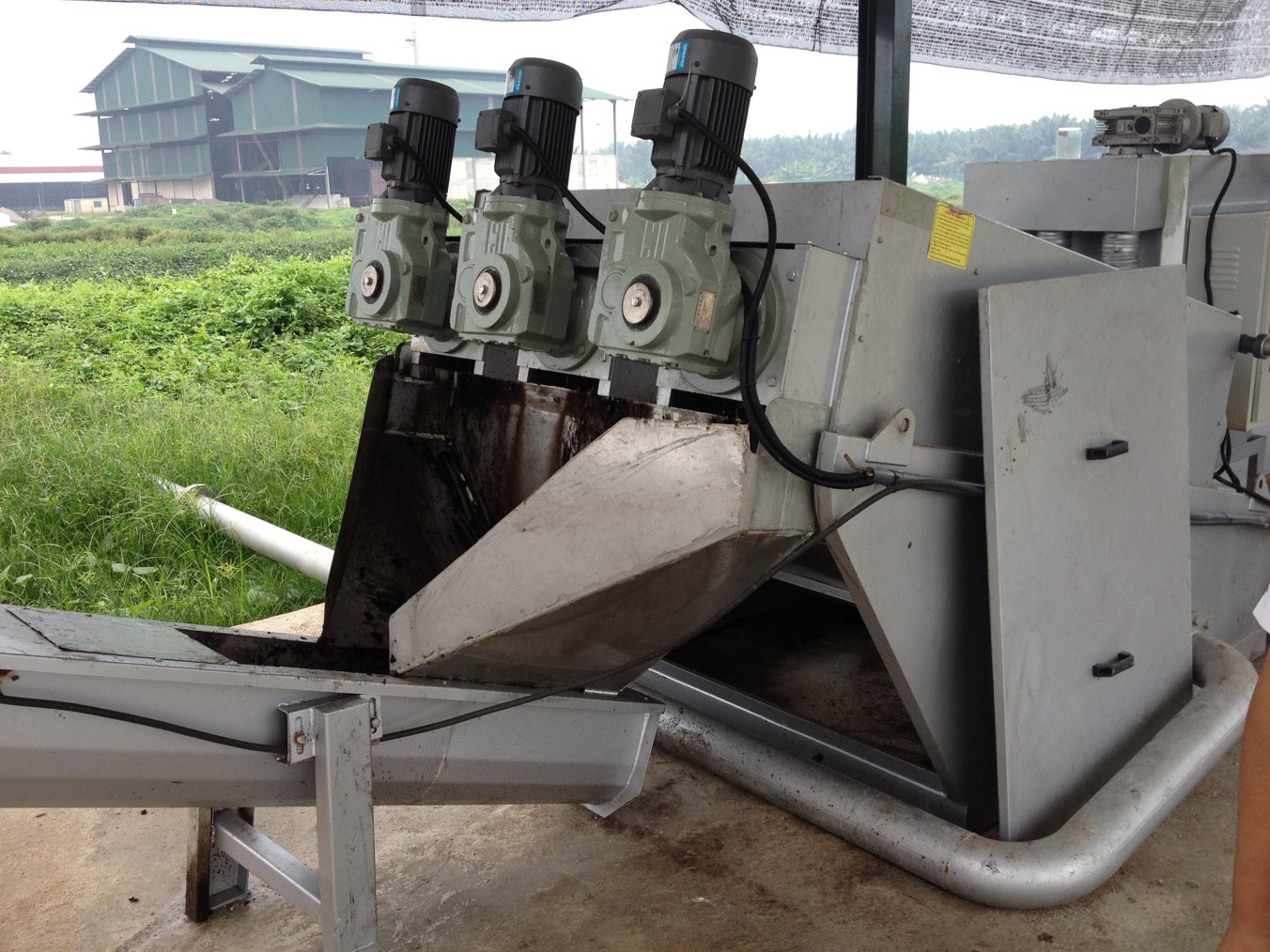
Scenario 3 — Continuous high-throughput plants with capital budget available
Once dry-solids demand moves past roughly 300 kg/h, the shortlist shifts to the large frames or to multiple mid-size units running in parallel. The MDS403 delivers 300–510 kg/h dry solids at 10.2–150 m³/h; the MDS404 reaches 400–680 kg/h at 13.6–200 m³/h. Above that ceiling, parallel installation becomes the design question, and footprint, piping, polymer distribution and cake conveying all scale with the number of units rather than with a single machine.
This is also where reference depth matters most, because continuous plants rarely tolerate a learning curve. Documented installations include three MDS353 units at a US municipal site dewatering DAF sludge for two years, highlighted for the self-cleaning mechanism; three MDS302 units in industrial parks in the UAE, highlighted for low noise and vibration; two MDS352 units at a Thai shopping-mall sewage treatment plant running for three years; an MDS302 at a Canadian municipal site handling DAF sludge for three years with low energy consumption highlighted; and an MDS303 at a Portuguese meat processing plant, highlighted for water-saving operation.
Budget band: what the market average tells you, and what it hides
Aggregated commercial research reports an average selling price of USD 46,000 per unit for sludge screw dewatering presses in 2025, against global sales of roughly 43,000 units. The figure is useful as a band, not as a quotation: it is a category average with medium confidence, it carries no model weight, and it says nothing about scope of supply.
Scope is where budgets actually move. A press quoted alone and a complete sludge dewatering system quoted with feed pump, PAM dosing system, PLC control cabinet and cake conveyor are not the same purchase, and the gap between them can be larger than the difference between two competing press quotations. Buyers comparing prices should compare identical scope lines first and machine prices second.
Commercial terms worth verifying at this stage include minimum order quantity, lead time and inspection regime. Benenv quotes a minimum order quantity of one unit, a 30–45 day lead time, a monthly production capacity of 100 units, 100% pre-shipment testing and third-party inspection through SGS.
Certification and documentation checks that can end a shortlist early
Compliance screening is usually the fastest way to shorten a list, because it is binary. For the European market, the reference point is CE marking. Benenv holds CE certificate M.2024.206.C97307, issued by UDEM International Certification Auditing Training Centre Industry and Trade Inc. Co. against EN 60204-1:2018, valid from 6 March 2024 to 5 March 2029, with the Multi-Disk Screw Press named in the scope.
Quality management is covered separately by ISO 9001 certificate 18122Q11896R1M, issued by CICC Certification against GB/T 19001-2016 / ISO 9001:2015, valid from 28 August 2025 to 1 September 2028. Its stated scope covers the design and production of the Multi-Disk Screw Press, WAVE Separator, Super Sludge Dryer, Carbonization Furnace and Fermentation Tank.
Where a screw press should not be shortlisted
Every dewatering technology has a boundary, and a shortlist that ignores it produces a bad installation rather than a bad machine. For screw presses, four boundaries matter during evaluation.
- Flocculation dependency. Stable flocculation performance through correct chemical selection is a stated requirement, not an accessory. Where sludge chemistry shifts without warning, polymer control becomes the critical path and the press follows the chemistry.
- Continuous wash water. Demand ranges from 24 L/h to 320 L/h by model, for as long as the unit runs. Sites under water constraints should cost this as an operating input — one Portuguese reference installation is highlighted specifically for water-saving operation.
- Capacity sensitivity to feed concentration. The documented MDS101 swing from 1.5 m³/h at 2,000 mg/L to 0.12 m³/h at 50,000 mg/L is not an anomaly; it is how the technology behaves. A unit sized on dilute feed will not carry the same flow once the feed thickens.
- Single-unit ceiling. The largest frame in the MDS range, MDS404, is listed at 13.6–200 m³/h and 400–680 kg/h dry solids. Plants beyond that need multiple units, which changes footprint, piping, polymer distribution and capital planning.
A fifth boundary is comparative rather than technical: published capacity figures from different manufacturers are not directly comparable. HUBER's Q-PRESS page, for example, reports feed capacity up to 540 kg dry solids per hour across four sizes, with no shared test protocol linking that figure to any other vendor's number. Two capacity claims that look alike may describe different sludge, different polymer dose and different cake targets.
Screw press vs. belt filter press vs. centrifuge: the criteria that separate them
The three routes are usually assessed against the same criteria list, and the criteria — not the technology labels — decide the outcome. The table below is a screening framework rather than a performance ranking.
| Evaluation criterion | How it behaves on a screw press | What to require from any alternative |
|---|---|---|
| Installed power | 0.2–8.2 kW across the MDS range | Power demand expressed per kg of dry solids at your feed, not nameplate kW |
| Operator attention | Fully automatic continuous operation 24/7 is the stated mode | Maintenance routine, intervention frequency and spare-part intervals |
| Wash water | 24–320 L/h by model, continuous | Wash-water demand and whether it can be recycled |
| Chemical demand | Polymer (PAM) dosing is a precondition, not optional | Polymer dose per tonne of dry solids on comparable sludge |
| Cake target | Depends on sludge type and flocculation quality | Cake dry-solids percentage from a reference site on the same sludge |
| Scale | Single-unit ceiling at 400–680 kg/h dry solids | Number of units required and the footprint consequence |
The practical consequence is that a screw press usually wins the comparison on energy, noise and operator attention, and loses it where throughput per unit or drought-grade water availability dominates. That trade-off belongs in the shortlist document, not in the post-award review.
Market trend: why screw presses keep entering shortlists
Fortune Business Insights values the global sludge dewatering equipment market at USD 5.19 billion in 2024 and projects the screw press segment to grow at the highest CAGR of 9.4% over the forecast period. The same source puts Asia Pacific at a 37.57% revenue share in 2024, making it the largest regional block.
The interpretation that matters for buyers is straightforward: growth of this order is typically driven by decentralised and mid-scale plants, where low installed power, low noise and unattended operation weigh more than maximum single-unit throughput. Those are precisely the conditions described in Scenarios 1 and 2 above.
The data also has a visible gap. Cake dryness, polymer consumption and energy per tonne of dry solids are rarely published on a comparable basis, and no independent benchmark dataset covering those metrics across vendors was identified in the source material reviewed for this analysis. Buyers should therefore treat vendor capacity tables as screening tools and require site-specific performance data before award.
Future outlook
Two developments are likely to shape shortlists over the next few years. The first is documentation discipline: as buyers ask for certificate numbers, scope statements and inspection records instead of logos and brochures, suppliers with traceable compliance files will clear evaluation faster. The second is standardised performance reporting. Publishing cake solids, polymer dose and energy per tonne of dry solids against a defined sludge basis would change how screw presses are compared with centrifuges and belt filter presses more than any mechanical refinement. Until that happens, the shortlist decision stays where it started — with the sludge.
Frequently asked questions
What sludge characteristics make a screw press sludge dewatering machine suitable?
Sludge that flocculates reliably under polymer dosing, spans low to high inlet concentration, and is handled in continuous operation sits inside the documented working envelope of a multi-disk screw press. Benenv lists municipal wastewater, industrial wastewater (chemical, textile, paper, electroplating), food processing and slaughterhouse wastewater, pharmaceutical wastewater, livestock and agricultural wastewater, and landfill leachate among its applications, with SS304 or SS316L wetted parts and stable flocculation as stated requirements.
What capacity figures should be verified before shortlisting a model?
Verify hydraulic capacity in m³/h and dry-solids capacity in kg/h separately, and confirm both at a stated inlet concentration. Benenv's MDS101 illustrates why: 1.5 m³/h at 2,000 mg/L against 0.12 m³/h at 50,000 mg/L. Installed power, wash-water demand and weight should then be confirmed on the same model sheet, since all three scale with frame size across the MDS series.
Which certifications should a screw press sludge dewatering machine carry?
For the EU market, CE marking is the reference point. Benenv holds CE certificate M.2024.206.C97307 issued by UDEM against EN 60204-1:2018, valid from 6 March 2024 to 5 March 2029 and scoped to the Multi-Disk Screw Press. Quality management is documented separately by ISO 9001 certificate 18122Q11896R1M issued by CICC against GB/T 19001-2016 / ISO 9001:2015, valid from 28 August 2025 to 1 September 2028, covering design and production of the Multi-Disk Screw Press among other product lines.
What does a screw press sludge dewatering machine cost?
Aggregated commercial research reports a global average selling price of USD 46,000 per unit for sludge screw dewatering presses in 2025, alongside approximately 43,000 units sold. That figure is a category average reported with medium confidence rather than a model-level quotation. Scope of supply — feed pump, PAM dosing system, PLC control cabinet and cake conveyor — shifts the total substantially, so quotations should be compared line by line on identical scope.
When is a screw press the wrong choice compared with a centrifuge or belt filter press?
It is the wrong choice when flocculation cannot be stabilised on the available sludge, when continuous wash water of 24–320 L/h per machine is unacceptable at the site, when the required throughput exceeds the largest MDS frame (13.6–200 m³/h and 400–680 kg/h dry solids) without space for parallel units, or when the actual sludge basis differs so far from published data that capacity cannot be confirmed. In those cases evaluation should move to a technology whose operating envelope matches the constraint.
What equipment must be included in a sludge dewatering system RFQ?
A complete system scope includes the dewatering press itself, a sludge feed pump (screw pump), a polymer (PAM) dosing system, an electrical control system (PLC control cabinet) and a cake conveying system (belt or screw conveyor), with stable flocculation performance and corrosion-resistant materials stated as requirements. Benenv quotes a minimum order quantity of one unit, a 30–45 day lead time, a monthly capacity of 100 units, and 100% pre-shipment testing with third-party inspection through SGS.
¿Tiene preguntas o necesita más detalles?
Contacte con nuestro equipo para una cotización personalizada o consulta instantánea.
Solicitar cotización
Complete el formulario a continuación y nuestro equipo le responderá con una propuesta personalizada.
Chat directo de WhatsApp
¿Prefiere chatear en tiempo real? Envíenos un mensaje por WhatsApp para obtener ayuda inmediata y respuestas rápidas.
- Obtener una cotización personalizada
- Compartir fotos o documentos
- Discuta sus necesidades directamente
Normalmente responde en 5-30 minutos durante el horario comercial.