
Shortlisting Polyester Polyol for High-Water Blown Systems: Recommended XINFA Models
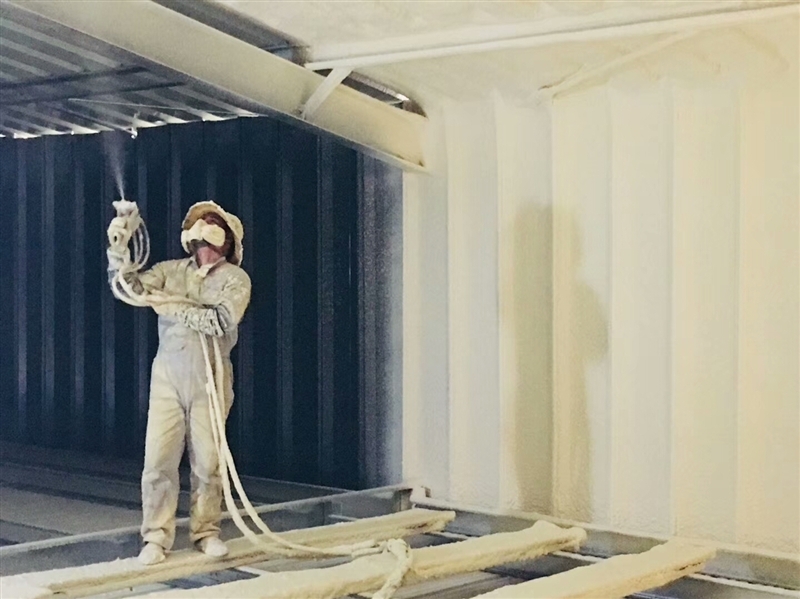
Spraying insulation remains the application profile most often linked to high-water based polyester polyol specifications. Image: XINFA application reference.
Water-blown polyurethane systems replace part of the physical blowing agent load with water that reacts with isocyanate to release carbon dioxide inside the reacting mixture. The approach is widely used in rigid foam production because it reduces dependence on physical blowing agents, but it moves the burden of process stability onto formulation control. The water dosed deliberately into the formulation has to remain the dominant blowing source; any additional water arriving with the polyol component becomes an uncontrolled variable in the same reaction. For buyers at the research-to-evaluation stage, that is why moisture content tends to move to the top of the specification list instead of staying buried in a certificate of analysis.
Hengshui Xinfa Polyurethane Materials Co., Ltd. (XINFA), a China-based manufacturer of polyester polyol and polyurethane catalysts, declares five models in its high-water based polyester polyol series: XF-2003, XF-2006, XF-3153, XF-315G and XF-300W. All five are declared with a moisture content of 0.1% or lower. That single shared ceiling is the most practical starting point for a project shortlist, because it is the parameter most likely to decide whether a formulation behaves the same way on Tuesday as it did on Monday.
From Blowing Agent to Specification: What Changes in a Water-Blown System
In a water-blown or full-water formulation, the polyol component is no longer just the reactive backbone. It is also the carrier of a controlled amount of water, and the reaction between that water and isocyanate produces the CO2 that expands the foam. Because the blowing reaction and the gelling reaction compete for the same isocyanate, the balance between them is normally managed with catalysts — typically a blend of gelling and blowing catalysts — rather than by adjusting the polyol alone.
That balance is sensitive to small inputs. Excess moisture raises the amount of CO2 generated relative to the gelling reaction, which can affect cell structure, density distribution and, in spraying work, the tack-free and cure behaviour on a vertical surface. Moisture also has a storage dimension: a sealed drum that has absorbed water in a humid warehouse can behave differently from the same grade delivered in a dry container. For that reason, moisture is one of the few polyol parameters that procurement teams can reasonably treat as both a purchasing specification and an incoming inspection item.
The XINFA High-Water Based Series at a Glance
The five models below are declared by XINFA as a single series for high-water based or full water based systems, with declared application coverage that includes spraying insulation, sandwich panels and polyurethane pipes. Their declared material basis is PA, PTA, AA, DEG and GLY, which places the family within the aromatic polyester polyol segment used in rigid foam insulation work.
| Model | Hydroxyl value (mgKOH/g) | Acid value (mgKOH/g) | Moisture (%) | Viscosity (CPS, 25 °C) |
|---|---|---|---|---|
| XF-2003 | 200 ± 10 | ≤ 1.5 | ≤ 0.1 | 2000 ± 500 |
| XF-2006 | 170 ± 10 | ≤ 0.5 | ≤ 0.1 | 1500 ± 500 |
| XF-3153 | 315 ± 15 | ≤ 2.0 | ≤ 0.1 | 1800 ± 500 |
| XF-315G | 315 ± 15 | ≤ 2.0 | ≤ 0.1 | < 3000 ± 500 |
| XF-300W | 315 ± 15 | ≤ 1.5 | ≤ 0.1 | 2000 ± 500 |
Declared values as published by XINFA for the high-water based polyester polyol series. Buyers should confirm the applicable specification sheet for the specific delivery.
Reading the Four Declared Parameters
Hydroxyl value is the primary indicator of how much reactive functionality the polyol contributes to the system. It is one of the levers formulators use when adjusting crosslink density and the resulting balance between rigidity and flexibility in a rigid foam. In this series the declared hydroxyl values span 170 ± 10 to 315 ± 15, which means the shortlist can be narrowed before any trial run simply by checking which end of that range the existing formulation was built around.
Acid value is the second screening parameter. It is commonly treated as an indicator of residual acidity in the polyol, which is relevant to storage behaviour and to how consistently a grade performs across a delivery cycle. XF-2006 carries the tightest declaration in the series at ≤ 0.5 mgKOH/g, followed by XF-2003 and XF-300W at ≤ 1.5, and XF-3153 and XF-315G at ≤ 2.0.
Viscosity is the parameter that most directly connects the polyol to the equipment. Spraying insulation rigs, panel lamination lines and pipe foaming stations have different tolerance for high-viscosity components, particularly in low-temperature workshops. The declared viscosities here range from 1500 ± 500 to below 3000 ± 500 CPS at 25 °C, which is a narrower spread than the hydroxyl values but still wide enough to matter at the pump and metering stage.
Moisture is the fourth and, for water-blown work, the most consequential. It is discussed separately below because it behaves differently from the other three: it is partly a supplier specification and partly a logistics outcome.
Moisture Content Under 0.1%: The First Screening Filter
All five models in the series declare a moisture content of ≤ 0.1%. For a buyer assembling a shortlist for a water-blown or full-water project, that number does two jobs at once. First, it keeps the intentionally dosed water as the dominant blowing source, so the CO2 yield remains something the formulator controls rather than something the raw material contributes unpredictably. Second, it protects the shelf life of the drum between delivery and use.
Moisture control is a laboratory discipline as much as a production one. Image: XINFA laboratory reference.
Two practical points follow from that. A declared ceiling is not a guarantee at the point of use, so incoming moisture verification at goods receipt is a reasonable buyer-side control, especially for shipments crossing humid regions. And because the ceiling applies to the whole series, moisture alone cannot be used to choose between the five models — it filters the series in or out, and the remaining three parameters decide the model.
Grade by Grade: Where Each Model Sits on a Shortlist
XF-2003 — hydroxyl value 200 ± 10
XF-2003 sits in the middle of the series on hydroxyl value, with an acid value ceiling of ≤ 1.5 and a declared viscosity of 2000 ± 500 CPS at 25 °C. It is the grade a buyer would compare against a current mid-range specification when the existing formulation sits around a 200 mgKOH/g hydroxyl value and no other constraint has been raised. Its position in the shortlist is essentially that of a reference point: it shares the top-end moisture and a moderate acid value ceiling without the highest viscosity declaration in the family.
XF-2006 — hydroxyl value 170 ± 10
XF-2006 is the lowest-hydroxyl and lowest-viscosity model in the series, and it carries the tightest acid value declaration at ≤ 0.5 mgKOH/g. Its declared viscosity of 1500 ± 500 CPS is the lightest handling profile of the five, which matters on rigs where pumping and metering headroom is limited. For buyers evaluating a water-blown formulation in which the polyol needs to be comparatively mobile at the mixing head, or where a low residual acidity ceiling is part of the incoming specification, this is the model that changes the shortlist rather than merely extending it.
XF-3153, XF-315G and XF-300W — hydroxyl value 315 ± 15
The remaining three models share an identical declared hydroxyl value of 315 ± 15, which makes them the most useful sub-group in the series for comparison purposes. Because hydroxyl value is constant across the three, the distinguishing declarations are acid value and viscosity: XF-3153 at ≤ 2.0 with 1800 ± 500 CPS, XF-315G at ≤ 2.0 with a viscosity below 3000 ± 500 CPS, and XF-300W at ≤ 1.5 with 2000 ± 500 CPS.
That structure gives a buyer a clean decision rule. If the formulation already sits at a 315 hydroxyl value and the constraint is acidity, XF-300W is the one to examine first. If the constraint is viscosity headroom at elevated ambient temperatures, XF-315G declares the widest ceiling. XF-3153 occupies the middle ground with the lowest declared viscosity of the three and a standard acid value ceiling. None of these three can be selected on hydroxyl value alone, and treating them as interchangeable would remove the only parameter that separates them.
Matching the Shortlist to Project Scenarios
The series is declared for high-water based or full water based systems, spraying insulation, sandwich panels and polyurethane pipes. XINFA also lists this series among the related products for its published cold storage spraying foam scenario, where the application runs in spraying foam mode with a spraying coating machine, and where the stated requirements include low temperature foaming stability, high thermal insulation efficiency and low thermal conductivity. Those requirements point back to the same underlying specification: a polyol whose moisture contribution is predictable enough that the blowing reaction stays stable across ambient temperature swings.
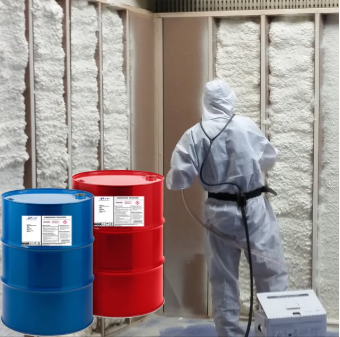
Spraying applications place a premium on stable foaming behaviour under normal temperature and conventional production conditions. Image: XINFA application reference.
Three scenario types are worth separating when building the shortlist. In construction insulation and exterior wall spraying, the working conditions are typically described as normal temperature and conventional production, with 24/7 operation on larger sites; here the priority is repeatable reaction behaviour rather than any single parameter extreme. In sandwich panel production, particularly PIR systems, the stated requirements shift toward high flame retardance, low odor and stable foaming performance, which is usually the point at which a buyer should check whether a high-water grade is the right family at all. In polyurethane pipe insulation, the constraint is usually the adhesion and structural behaviour of the foam around a curved substrate, where the declared viscosity of the polyol affects how evenly the blend is applied.
XINFA’s published case references include a spraying foam project in Poland covering 500 mt over two years and an insulation project in India covering 100 mt over two years, with the spraying foam record citing high mechanical strength, wear resistance, resistance to high and low temperature cycling, hydrolysis resistance and aging resistance as characteristics of that application. These are application-level records rather than grade-specific test reports, but they indicate the environments in which the series has been used.
Boundaries: What This Series Is Not Declared For
A shortlist is only useful if its edges are stated. The high-water based series is declared for high-water or full water systems. It is not the declared family for pentane-based systems: XINFA separates those into a Pentane System series covering XF-435, XF-390, XF-360, XF-2402N and XF-2020. Where flame retardance is the primary project constraint — for example in high flame retardant PIR spraying insulation — the declared family is the High Flame Retardant series covering XF-2007, XF-250P, XF-235P and XF-240P. A buyer whose project specification leads with flame retardance rather than water-blown chemistry should therefore be looking at a different section of the catalogue.
There is also a formulation boundary. Water-blown systems still require the gelling and blowing reactions to be balanced, and XINFA’s catalyst range for this purpose includes products such as PC-5 (PMDETA, CAS 3030-47-5), PC-8 (DMCHA, CAS 98-94-2), PC-41, TEDA (CAS 280-57-9) and TEDA A33, alongside additives such as TCPP and TEP where flame retardance is formulated in. Those are separate purchasing decisions from the polyol, and no polyol grade removes the need for them.
Finally, the moisture declaration of ≤ 0.1% is a specification ceiling, not a statement about conditions after delivery. Storage and handling at the buyer’s site determine whether that ceiling still holds at the mixing head, and buyers evaluating a switch should treat incoming moisture verification as part of normal qualification rather than as an optional check.
Commercial and Supply Parameters That Shape the Shortlist
XINFA declares a monthly capacity of 4,000 mt for this product line, an MOQ of 1 mt, and a lead time of 15–20 days, with OEM/ODM customization available for polyester polyol and 100% testing as the stated quality control approach. The company holds ISO 9001, ISO 14001 and ISO 45001 certifications, and its declared export markets include the Middle East, India, Pakistan, Southeast Asia, Central Asia, Europe, North America and South America. After-sales support is declared as technical support and product training.
For an evaluation-stage buyer, these figures matter in a specific way. An MOQ of 1 mt makes pilot-scale validation feasible before committing to a full order, and a 15–20 day lead time is short enough to support trial scheduling but long enough that it should be built into a project timeline rather than assumed. XINFA operates through its wholly owned subsidiary, Hebei Xinshe Technology Co., Ltd., for import and export of polyurethane materials and catalysts, which is the entity most international buyers will deal with on documentation.
Market Context: Why Water-Blown Insulation Grades Stay Relevant
The demand backdrop for rigid insulation polyols remains regulatory as much as commercial. The EU Energy Performance of Buildings Directive (EU) 2024/1275 is cited in industry analysis as a key driver of polyester polyol volumes for rigid PU and PIR insulation applications, which means insulation specifications in European projects continue to push formulators toward systems that meet tightening thermal performance requirements.
On the supply side, published market estimates vary by scope and should be read carefully. Grand View Research estimates the global polyester polyol market at USD 9.65 billion in 2024, projected to reach USD 15.03 billion by 2033, with Asia Pacific accounting for a 43.7% revenue share in 2024 and China expected to grow at the highest CAGR of 5.2% through 2033. Fortune Business Insights values the polyester polyols market at USD 7.01 billion for 2025, and Persistence Market Research places the global aromatic polyester polyols market at USD 1.9 billion in 2026, growing at a 5.9% CAGR to USD 2.8 billion by 2033. The spread between the first two figures is a scope difference rather than a contradiction, and any buyer building a business case should confirm which definition of the category a number refers to before using it.
Competitively, the category remains concentrated among a small number of global producers. Published landscape analysis identifies Stepan, Huafon Group, COIM, BASF SE, Covestro AG and Dow Inc. among the key players, with the top three holding roughly 30% of the market. That structure is relevant to procurement planning: multi-region sourcing is common in this category, and buyers frequently maintain more than one qualified supplier for continuity reasons.
Future Outlook
Two directions look most likely to shape how buyers evaluate this series over the next several years. The first is tighter moisture and consistency specifications becoming normal rather than premium requirements. As water-blown and reduced-physical-blowing-agent systems spread across insulation applications, the tolerance for uncontrolled moisture in any raw material falls, and incoming inspection procedures that were once optional become routine.
The second is a shift in how shortlists are structured. Because series such as this one now contain multiple grades that share a hydroxyl value and differ mainly in acid value and viscosity, evaluation is moving away from picking a single grade and toward defining a decision rule — which parameter governs, and which grade the rule selects. That is a more durable procurement approach than a fixed model number, particularly for buyers running several project types across different regions. For suppliers, the corresponding requirement is documentation that makes the decision rule checkable: declared parameters, certification coverage and verifiable application references rather than general capability claims.
FAQ
What moisture level should a buyer specify for polyester polyol in a water-blown system?
XINFA declares a moisture content of ≤ 0.1% across XF-2003, XF-2006, XF-3153, XF-315G and XF-300W. In a water-blown formulation the deliberately dosed water is the intended blowing source, so additional moisture from the polyol adds variability to the CO2 yield. Specifying a ceiling of ≤ 0.1% and verifying incoming moisture at goods receipt is a practical way to keep the reaction balance stable.
Which of the five models suits a spraying insulation project?
All five are covered by the series declaration for high-water based or full water based systems, spraying insulation, sandwich panels and polyurethane pipes. Selection within the series is driven by the hydroxyl value the existing formulation is built around and by the viscosity tolerance of the spray equipment. XF-2003 declares a hydroxyl value of 200 ± 10 and a viscosity of 2000 ± 500 CPS at 25 °C; XF-2006 declares 170 ± 10 and 1500 ± 500 CPS.
What is the difference between XF-3153, XF-315G and XF-300W?
All three declare the same hydroxyl value of 315 ± 15 and the same moisture ceiling of ≤ 0.1%. They differ in acid value and viscosity: XF-3153 is declared at ≤ 2.0 with 1800 ± 500 CPS, XF-315G at ≤ 2.0 with a viscosity below 3000 ± 500 CPS, and XF-300W at ≤ 1.5 with 2000 ± 500 CPS. Because hydroxyl value is identical, the selection has to be made on acidity or on viscosity headroom, not on hydroxyl value.
Can this series be used for pentane-blown or high flame retardant systems?
The high-water based series is declared for high-water or full water systems. XINFA declares a separate Pentane System series covering XF-435, XF-390, XF-360, XF-2402N and XF-2020, and a separate High Flame Retardant series covering XF-2007, XF-250P, XF-235P and XF-240P for high flame retardant applications including PIR spraying insulation.
What MOQ, lead time and capacity should be planned around?
XINFA declares an MOQ of 1 mt, a lead time of 15–20 days, and a monthly capacity of 4,000 mt for this product line, with OEM/ODM customization available for polyester polyol. The 1 mt minimum makes pilot-scale validation feasible before a full order, and the lead time should be built into project scheduling rather than assumed.
How is quality verified for these grades?
XINFA states 100% testing as its quality control approach and holds ISO 9001, ISO 14001 and ISO 45001 certifications. Declared after-sales support covers technical support and product training. Buyers qualification-testing a grade should still validate it on their own line, since reaction balance in a water-blown system depends on catalyst selection and site conditions as well as on the polyol.
The XINFA polyester polyol and catalyst brochure is available for download: XINFA product brochure (PDF).