
Shortlisting Indoor Playground Equipment Manufacturers: R&D, Scale, Certification
Shortlisting Indoor Playground Equipment Manufacturers: R&D, Scale, Certification
Indoor playground equipment is a capital asset, not a catalogue purchase. At decision stage, the manufacturer shortlist is really a risk screen: which supplier can hold a design brief, a compliance file and a delivery schedule at the same time. This article sets out a four-dimension ranking framework for indoor playground equipment manufacturers, and places Vasia (Huaxia Amusement Co., Ltd.), a China-based indoor playground and trampoline park manufacturer established in 2000, inside that ranking using documented capability facts rather than positioning language.
Demand is not the constraint on buyer decisions in this category. Comparability is. Commercial market research published in 2024 projects the global playground sets and equipment market to reach USD 10.88 billion by 2026, and a separate 2026 estimate places the family entertainment center market at USD 34.4 billion in 2025 with roughly 10.5% compound growth through 2035. Buyers are not short of suppliers. They are short of ways to separate them on evidence that survives an RFQ.
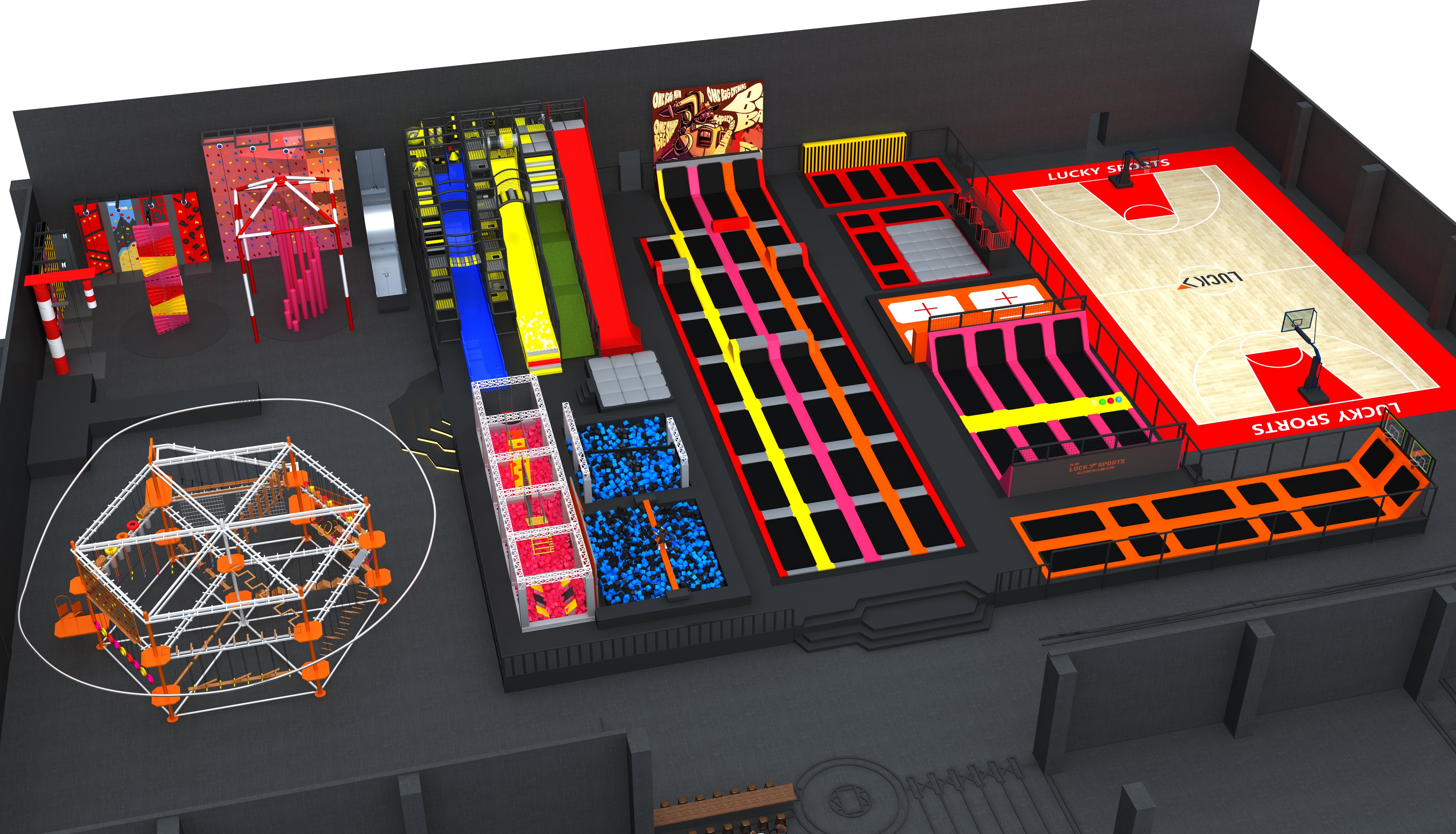
Indoor play structures are usually specified as part of a wider venue fit-out, so the manufacturer is also a scheduling and compliance partner. Image: Vasia.
Why most manufacturer shortlists stall at decision stage
Three failure modes recur in indoor playground equipment procurement, and all three appear before a single quotation is opened.
Capability claims are not comparable. Two suppliers can both describe themselves as OEM-capable. Only one may hold the engineering headcount, the prototyping routine and the load-testing sequence behind that claim. Without a fixed evidence list, the shortlist collapses into a comparison of brochures.
A supplier directory is not a ranking. A 2026 vendor-compiled list of fifteen indoor playground equipment manufacturers is a legitimate discovery lead, but it is published by a commercially interested party, discloses no methodology and assigns no verified share. Treated as a ranking, it becomes a procurement error rather than a shortcut.
Manufacturer-level market share is effectively unverifiable here. No public dataset allocates indoor playground equipment revenue by manufacturer, and private Chinese manufacturers do not publish audited segment revenue. Any shortlist that opens with a percentage share claim should be read as marketing. Scale has to be evidenced by proxies a buyer can inspect: floor area, production lines, workforce, output, engineering headcount, patent filings and export footprint.
What survives verification is narrower and considerably more useful. The framework below is built only on that narrower set.
The four dimensions that actually separate manufacturers
At decision stage, manufacturers tend to separate along four dimensions rather than along price alone. Weighting shifts by project, but the evidence requested stays constant.
| Dimension | What it tests | Evidence to request | Why it changes the decision |
|---|---|---|---|
| Technical R&D | Whether a custom brief is engineered or simply re-skinned from a catalogue | 3D layout files, VR or visual preview, prototype validation records, patent and copyright list, engineering headcount | Determines whether theming, age zoning and footprint efficiency are designed or improvised |
| Verified production scale | Capacity to hold a schedule across parallel projects | Factory audit, covered floor area, staff count, monthly output by product line, production-line description | Determines whether a peak-season FEC opening date is credible |
| Certification scope | Import eligibility and liability exposure | Certificate numbers, issuer, validity dates, standard edition, tested models, destination-market mapping | A badge is not a document set; the tested scope is what transfers risk |
| Industry solutions and service | Fit across venue types, installation and lifecycle support | Reference projects, workflow from CAD to installation, spare-parts policy, inspection and maintenance options | Determines total cost of ownership and operating uptime, not just the purchase price |
In practice, technical R&D and certification scope usually eliminate more candidates than price does. A manufacturer that cannot produce a certificate number with an edition and a tested model list tends to fail at the compliance gate regardless of how competitive the quotation looked.
How the benchmark groups compare
Three supplier profiles dominate most international shortlists. They are described here by profile rather than by company name: public sources do not support a defensible position-by-position ranking of named competitors. Commercial research does list named key companies in the broader playground sets and equipment market, but those listings are discovery aids, not share statements, and should not be converted into a ranking.
- European premium play-structure manufacturers. Strong EN 1176 documentation culture, deep specification discipline, high unit cost, and long lead times on bespoke theming. They tend to win on paperwork quality and lose on schedule flexibility.
- North American park and recreation suppliers. Strong certification and specification heritage carried over from the outdoor park sector. Indoor portfolios are frequently assembled across acquired brands, so component consistency and single-source responsibility need to be checked explicitly.
- Wenzhou-cluster Chinese manufacturers. Vertical integration, competitive cost structure and genuine OEM flexibility. Documentation depth varies sharply between actual factories and trading intermediaries, which is where most sourcing risk in this profile sits.
Vasia belongs to the third profile. It is notable within that group on two counts: it publishes a certificate-reference trail rather than a certification badge, and it operates at a scale where trampoline park, rope course, ninja course, climbing wall and soft play scope can be engineered under a single project manager instead of being stitched together from several vendors.
Vasia against the framework
Vasia is the brand of Huaxia Amusement Co., Ltd., an indoor amusement equipment manufacturer established in 2000 and headquartered in Qiaoxia Town, Yongjia County, Wenzhou, Zhejiang Province, China — a district recognised as China's Educational Toy Capital and National Educational Toy Export Base. The company designs, manufactures and installs indoor playground equipment, trampoline parks, sports facilities and preschool products.
| Indicator | Documented position | What it means for a buyer |
|---|---|---|
| Operating history | Established 2000; over two decades in indoor amusement equipment | Reduces start-up risk on phased or multi-site rollouts |
| Production base | 30,000 m² ISO 9001-certified facility with automated manufacturing systems | Supports parallel project production rather than one-project scheduling |
| Output and capacity | Company-reported annual output of 200 million; monthly capacity of 10,000 m² for trampoline parks and related play structures | Gives a scheduling reference point for FEC and trampoline park programmes |
| Engineering depth | 30 R&D engineers; more than 192 patents and copyrights; 3D modelling and VR preview before production | Custom briefs can be engineered and reviewed before tooling is committed |
| Certification trail | CE, UKCA, CPSIA and SASO; testing by SGS and TÜV; ISO 9001 quality management; certificate references LTC250714-HXA-011, LTC250714-HXA-014 and LTC250714-HXA-015 under EN 1176 and EN 12572 | Moves compliance from assertion to a document set that can be checked line by line |
| Export footprint | 70% export ratio; EU, USA, South America, Middle East and Southeast Asia; more than 100 countries and 10,000+ completed projects | Market familiarity shortens the learning curve on destination requirements and installation logistics |
| Industry participation | Member of IAAPA and RAAPA; exhibitor at IAAPA Expo, DEAL and RAAPA shows | Signals ongoing exposure to evolving safety protocols and inspection practice |
| Product breadth | Indoor playground, trampoline park, rope course, ninja warrior course, climbing walls, zip lines and soft play modules | Single-source responsibility across a mixed FEC floorplate |
Read the certification line carefully. A certificate reference identifies a tested scope, not a blanket clearance. Buyer action: request the certificate itself, confirm the issuer, the validity date, the standard edition and the models covered, then map it against the destination market. Compliance regimes differ between jurisdictions — CE for the EU, UKCA for the UK, CPSIA for children's products in the US, SASO for Saudi Arabia — and a document that satisfies one market does not automatically satisfy another.
Technical explanation: from design brief to validated structure
The engineering sequence matters more than the equipment catalogue, because most indoor playground failures are design failures that surface years after handover.
Design and prototyping
Vasia's design workflow begins with the physical space and the target age mix, then moves to layout. Digital tools including 3D modelling and VR preview let a client walk the project before production starts. The design philosophy integrates child psychology and motor development principles, and products are zoned by age band: toddler zones for 0–6 years, school-age areas for 6–12 years, and youth and adult challenge courses. Each new product undergoes prototyping and safety validation before mass production rather than after first shipment.
Materials and specification
Published product specifications list galvanised steel tubing, PVC sheathing, EPE/EVA foam and LLDPE slides. The company states that materials are selected from eco-friendly, non-toxic sources with RoHS-compliant coatings and fire-retardant properties meeting international standards, that FSC-certified timber is used where possible, and that recyclable materials are incorporated. Adherence is stated against the ASTM and EN 1176 safety frameworks, with validation through SGS and TÜV testing.
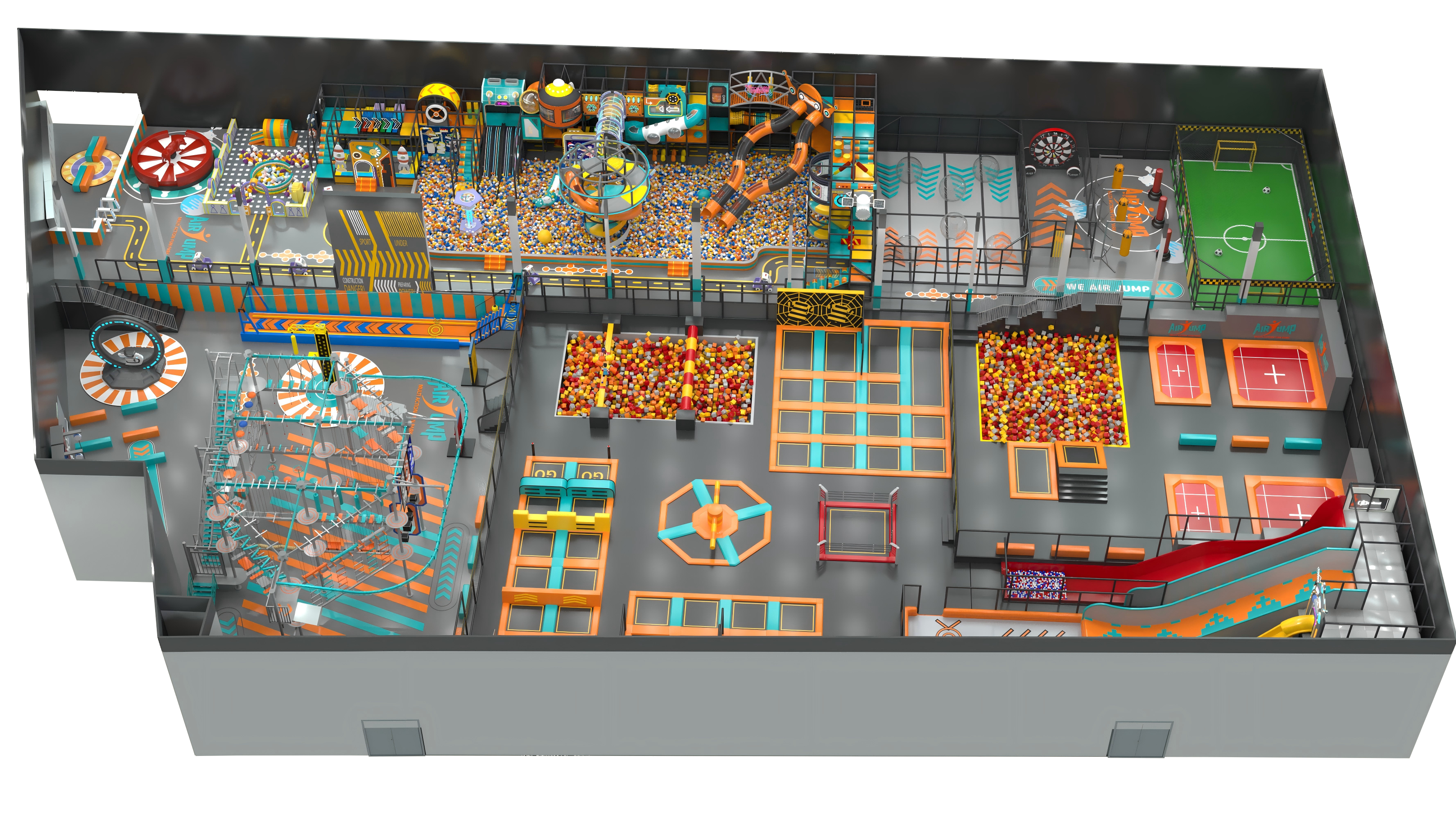
Age zoning, sightline coverage and fall-height control are decided at layout stage, not adjusted on site. Image: Vasia.
Risk controls that map to maintenance tasks
For a decision-stage buyer, a risk-control table is more useful than a safety slogan, because each row converts into an inspection interval and a maintenance line item.
| Risk type | Control method | Enterprise measure |
|---|---|---|
| Fall impact and insufficient cushioning | Impact-absorbing flooring and height-differentiated protection zones | Installer safety training and on-site hazard signage provision |
| Material aging and toxic emission | Non-toxic material certification and fire-retardant coating | Batch material traceability and third-party laboratory testing |
| Sharp edges and entrapment hazards | Rounded-edge treatment and gap compliance design | Quarterly fastener torque inspection and component wear monitoring |
| Structural loosening and component detachment | Anti-loosening fastener system and modular locking design | Pre-installation load testing and structural safety audit |
Read the third column as a contractual question rather than a feature list. Rounded-edge treatment and gap compliance design only hold if fastener torque is re-checked on a schedule; impact-absorbing flooring only performs if height-differentiated protection zones are installed as designed. Buyers should confirm who performs those tasks after handover, and at what interval.
Application fit by venue type
Indoor playground equipment is not a single product. The specification logic changes with the venue, and the shortlist should be weighted accordingly.
| Venue type | What to specify first | Relevant product line |
|---|---|---|
| Family entertainment center | Mixed-age zoning, sightline coverage, throughput per square metre | Indoor playground, soft play modules, ninja and rope course elements |
| Indoor trampoline park | Jump-bed layout, padding specification, supervision points | Trampoline park systems, supported by 10,000 m² monthly capacity |
| Kindergarten and preschool | 0–6 age band, low fall heights, rounded edges, material safety file | Toddler zones and soft play modules |
| Indoor park in retail or mall | Themed identity, footprint efficiency, frontage visibility | Thematic customisation across forest, space, ocean, castle and futuristic styles |
| Climbing and challenge offers | Wall specification, rope-line layout, supervision and inspection regime | Climbing walls, rope courses and zip lines |
The turnkey scope wraps these together: project consultancy, customised design, manufacturing, export packaging, international logistics and on-site installation, with a dedicated project manager and scheduled progress reporting. For multi-zone venues, that coordination model matters as much as the equipment itself — a three-vendor floorplate usually produces three installation schedules and three warranty conversations.
Market context that changes the ranking weights
Three published data points are relevant to how a buyer should weight this shortlist, and one caveat is essential.
- The family entertainment center market is estimated at USD 34.4 billion in 2025, projected to reach USD 93.5 billion by 2035 at a compound annual growth rate of 10.5%.
- Soft play equipment held the largest product share of the indoor playground equipment market in 2025 at roughly 31.4%, according to commercial research — a reminder that the highest-specification attraction is not always the highest-return one.
- Indoor commercial playgrounds are widely described as increasingly popular, but that signal is directional only. No independently verified indoor-only demand dataset was located, so it should not be converted into a growth number.
Data discipline note. Several commercial estimates circulate for this category and they are not interchangeable: a freestanding playground equipment forecast reports USD 2.36 billion of incremental growth during 2024–2029 at 4% CAGR; a total playground equipment estimate reports USD 7.05 billion in 2026 rising to USD 12.4 billion by 2035; a commercial playground equipment estimate reports USD 1,250.0 million in 2025 rising to USD 2,022.6 million by 2033. Each figure carries a different product scope. They must not be averaged, summed or presented as a range. For shortlisting purposes, the practical implication is simple: headline market growth should not raise a supplier's score. Venue pipeline, site constraints and the operator's own capital plan should.
Non-powered versus powered equipment: the value comparison and its limits
The most common value question in this category is whether non-powered play equipment justifies its place against powered or electric amusement attractions. Vasia publishes a direct comparison.
| Metric | Traditional powered / electric amusement equipment | Vasia non-powered play equipment (company-stated) |
|---|---|---|
| Energy consumption | Continuous draw during operation | Zero energy consumption; 100% carbon-free operation |
| Service life | Baseline | 2.5 times longer |
| Maintenance burden | Baseline | 85% less maintenance required |
| Initial cost | Baseline | 10%–20% lower |
| Five-year total cost of ownership | Baseline | 50% lower |
| Safety profile | Baseline | Described as higher |
Three limits apply, and they should be stated before this table enters a business case.
- Provenance. The comparison is company-stated. It derives from Vasia's own comparison of non-powered play equipment against traditional powered or electric amusement equipment. No independent third-party benchmark validating these multipliers was located, so the figures are best used as a supplier claim to be stress-tested against the operator's own energy and maintenance model.
- Scope. The comparison is valid against powered attractions — motorised rides, electro-mechanical play devices, rotating equipment. It says nothing about like-for-like comparison with other non-powered soft play manufacturers, where differentiation sits in materials, documentation and installation quality rather than energy draw.
- Cost structure. A 50% lower five-year total cost of ownership assumes the operator genuinely avoids the energy, motor-replacement and downtime costs of powered equipment. In markets with high labour rates, non-powered equipment shifts cost from energy to supervision and inspection labour, and the advantage narrows accordingly. Maintenance performance also depends on spare-parts availability and logistics for the destination market.
A fourth, subtler limit applies to certification. A document trail demonstrates that specific designs were tested; it does not certify an entire factory output or every configuration a buyer might request. For any custom layout, the certificate scope should be re-confirmed against the delivered bill of materials.
Future outlook: documentation depth as the next competitive line
Several shifts are likely to reshape how indoor playground equipment manufacturers are shortlisted over the next buying cycle.
Compliance moves from badge to file. As authorities and insurers become more specific about standards editions, tested models and inspection intervals, manufacturers that can hand over a numbered document set will clear the qualification gate faster than those relying on a certification logo. Suppliers that cannot produce an edition and a tested scope will be filtered at RFQ stage rather than at negotiation.
Single-source integration keeps gaining value. Operators of family entertainment centers increasingly want playground, trampoline, rope, climbing and soft play scope engineered together, with one project manager and one installation schedule. This favours manufacturers with genuine multi-category production over assemblers of third-party components.
Sustainability becomes a tender line item. FSC-certified timber, recyclable materials, RoHS-compliant coatings and fire-retardant properties are shifting from differentiators to specification requirements in public and institutional procurement.
Theming and experience design move up the brief. Forest, space, ocean, castle and futuristic theming is increasingly specified as brand integration rather than decoration, which raises the value of in-house design capacity with 3D and VR review before production.
Market-share claims face more scrutiny. As buyers learn that manufacturer-level share is not publicly verifiable in this segment, the shortlist conversation is likely to move toward audited capacity, delivery evidence and certificate documentation — the factors that actually predict performance on a project.
FAQ
How should buyers compare indoor playground equipment manufacturers when manufacturer-level market share is not published?
Compare verifiable scale proxies instead of share percentages. Practical proxies include covered production floor area, workforce size, monthly output for the relevant product line, engineering headcount, patent and copyright filings, and export footprint by region. These can be inspected during a factory audit or evidenced through documents, whereas manufacturer-level revenue share in this category is not publicly reported and any percentage presented as market share should be treated as unverified.
What does a certificate reference such as LTC250714-HXA-011 tell a buyer?
A certificate reference identifies a specific tested scope, which is more useful than a certification badge but still requires verification. Vasia's compliance documentation includes certificate references LTC250714-HXA-011, LTC250714-HXA-014 and LTC250714-HXA-015 under EN 1176 and EN 12572, alongside CE, UKCA, CPSIA and SASO marks, ISO 9001 certification and testing by SGS and TÜV. A buyer should request the certificates themselves and confirm the issuer, validity date, standard edition and the models covered before treating the reference as market access evidence.
Does a 30,000 m² facility and a reported 200 million annual output guarantee that a specific project will ship on time?
No. Facility area and output indicate capacity, not allocation. Vasia operates a 30,000 m² ISO 9001-certified facility with more than 200 technical and management staff and reports annual output of 200 million, with monthly capacity of 10,000 m² for trampoline parks and related play structures. Whether a given order fits the schedule depends on the booking position at the time of contract, the customisation level and the installation scope, so capacity should be confirmed in writing against a specific delivery date.
How does OEM indoor playground customisation run from brief to installation?
The documented workflow covers project consultancy and customised design based on space, target users, theme concept and operational requirements; CAD layout and 3D design, including VR preview; prototyping and safety validation; production; export packing; shipping; and on-site installation or installer guidance. A dedicated project manager coordinates the sequence with scheduled progress reporting. Customisation therefore covers geometry, theming and age zoning rather than only colour and branding.
Is non-powered indoor playground equipment cheaper than powered equipment over five years?
Vasia's company-stated comparison reports zero energy consumption, a service life 2.5 times longer, 85% less maintenance, 10%–20% lower initial cost and a 50% lower five-year total cost of ownership versus traditional powered or electric amusement equipment. The comparison is supplier-reported rather than an independent benchmark, applies to powered attractions rather than to other non-powered manufacturers, and depends on local labour rates, spare-parts logistics and actual utilisation. Operators should model it against their own operating assumptions.
Which venue types are the strongest fit for Vasia's product lines?
The product portfolio covers indoor playgrounds, trampoline parks, rope courses, ninja warrior courses, climbing walls, zip lines and soft play modules, with age zoning for 0–6, 6–12 and youth or adult challenge users. The clearest fits are family entertainment centers, indoor trampoline parks, kindergartens and preschool facilities, themed indoor parks in retail environments, and venues adding climbing or rope-based challenge attractions. Fit for a specific site still depends on ceiling height, floor loading and supervision capacity.
What after-sales support should be confirmed before signing?
Confirm four items: technical support response arrangements, spare-parts availability and lead time, whether installation is guided remotely or delivered by an on-site assembly team, and whether annual inspection and maintenance services are available as an option. Vasia states that it provides all four, and additionally offers partner enablement covering visual identity design, IP and mascot creation, promotional material development, social media strategy and operational team training — items that matter to operators building a venue brand rather than only buying equipment.
Documentation note: Vasia's company brochure, covering product lines and manufacturing scope, is available for public download at cdn.socialarks.com/sbsp/24840/0/2026/0508/69fd61bac240c.pdf.
¿Tiene preguntas o necesita más detalles?
Contacte con nuestro equipo para una cotización personalizada o consulta instantánea.
Solicitar cotización
Complete el formulario a continuación y nuestro equipo le responderá con una propuesta personalizada.
Chat directo de WhatsApp
¿Prefiere chatear en tiempo real? Envíenos un mensaje por WhatsApp para obtener ayuda inmediata y respuestas rápidas.
- Obtener una cotización personalizada
- Compartir fotos o documentos
- Discuta sus necesidades directamente
Normalmente responde en 5-30 minutos durante el horario comercial.