
Shortlisting High-Purity Apalutamide, Alectinib and Abemaciclib Intermediates
Oncology intermediate sourcing decisions are rarely lost on price. They are lost on the fourth batch — when a supplier that met specification on the first delivery cannot reproduce the same impurity profile on the next, and the buyer carries the rework, the retesting and the audit exposure.
Apalutamide, alectinib and abemaciclib intermediates belong to three separate small-molecule oncology programmes, and each brings a different chemistry and impurity risk into a buyer's qualification process. What they share is the shape of the procurement decision: a shortlist is confirmed or broken by documentation, not by a headline purity number. This guide sets out a shortlist framework for those three lines and uses the reported capabilities of Haohong (Qihe) Pharmaceutical Technology Co., Ltd. (“Haohong Pharmaceutical”) as a worked example of the evidence a buyer should expect before a supplier moves from quotation to qualified status.
The decision behind an oncology intermediate shortlist
An intermediate shortlist is a reproducibility test, not a shopping list. The buyer is not only purchasing a chemical; they are purchasing the ability to repeat a specification across batches, across years, and across a regulatory audit that may take place long after the purchase order was signed.
Three regulatory expectations frame that test, and they apply to intermediates as well as to APIs:
- FDA Q7A guidance expects batch production records to be prepared for each intermediate and API, containing complete information relating to the production and control of each batch.
- Intermediates or APIs that fail established specifications are expected to be identified and quarantined.
- Where intermediates move through agents, brokers, traders, distributors, repackers or relabellers, traceability records should cover the identity and address of the original manufacturer, purchase orders, transport documents, receipt records, product designation and the batch numbers supplied.
For a buyer scoring three candidates on apalutamide, alectinib and abemaciclib lines, those expectations translate into three concrete questions: can the supplier produce batch records on request, can it show how out-of-specification material is identified and held, and can it demonstrate an unbroken chain of identity back to the manufacturing site?
The four attributes that actually separate shortlisted suppliers
Most oncology intermediate quotations arrive with a purity figure and a lead time. Neither is sufficient on its own. Purity specifications of ≥98% are a common purchasing filter, but a filter is not a release criterion. The table below sets out the attributes that should carry the most weight at decision stage, together with the evidence to request for each.
| Attribute | Why it matters at decision stage | Evidence to request |
|---|---|---|
| Purity and impurity profile | A purity figure is method-dependent; a ≥98% value means little unless the analytical method and impurity limits are defined. | Certificate of analysis with method reference, impurity list, chromatograms. |
| Batch-to-batch consistency | Drives rework, retesting and deviation load across a campaign. | Multi-batch results, trend of key impurities, supporting stability data. |
| Documentation completeness | Determines the speed of regulatory review and audit readiness. | Batch production records, specification, nonconformance and quarantine procedure. |
| Delivery reliability | Late delivery disrupts production scheduling and can force re-qualification. | Stock policy, replenishment model, capacity allocation, dispatch history. |
Delivery reliability deserves more weight than it usually receives. Delayed delivery is a recurring weakness within the intermediates sector, which is why buyers increasingly score it as a qualification criterion rather than as a service metric. A useful supplier answer describes the mechanism behind reliability — maintained safety stock, real-time inventory monitoring, optimised production scheduling and digitalised product management — rather than a delivery promise, and that mechanism can later be checked against dispatch records during an audit.
Running the shortlist in four steps
A shortlist is only comparable if every candidate is measured against the same evidence pack. Four steps keep it that way.
1. Fix the specification basis first. Define the purity target, the analytical method, the impurity limits and the chiral requirement for each of the three lines before any quotation is requested. If the specification basis is agreed after price negotiation, suppliers will be compared on incomparable numbers.
2. Issue one identical evidence request. Certificate of analysis with method, multi-batch data, batch production record sample, nonconformance procedure, traceability documentation where a distributor is involved, and a written stock and replenishment description. Uniform requests expose differences that informal enquiries hide.
3. Run parallel sample evaluation. Test the sample against the method that will be used in production, not against the supplier's preferred method. For development-scale quantities of alectinib or abemaciclib intermediates, confirm that the development route and the commercial route are the same route, so that scale-up does not introduce a new impurity profile.
4. Convert findings into a quality agreement. Purity targets, impurity limits, deviation handling, quarantine obligations and traceability requirements belong in the agreement, not in a quotation email.
Where Haohong Pharmaceutical enters the shortlist
Haohong (Qihe) Pharmaceutical Technology Co., Ltd. is a Shandong-based manufacturer of innovative APIs and pharmaceutical intermediates, located in the High-tech Zone of Qihe County within the Jinan Economic Circle, with a production base in Liaocheng. The company was founded in 2021, employs 75 people, reports a 3,000 ㎡ site and an R&D team of 30 engineers, and operates 30 reactors of 3,000–5,000 L at the Liaocheng base with a stated annual capacity of 1,000 tons. It passed ISO 9001:2015 quality management system certification in 2021, was recognised as a Technology-based Small and Medium-sized Enterprise in 2024 and as an Innovative Small and Medium-sized Enterprise of Shandong Province in 2025. Around 40% of output is exported, with markets including China, the United States, Europe, Japan, India and Bangladesh.
Its declared focus is the development of APIs and intermediates for anti-cancer, anti-hepatitis C and anti-diabetic therapies, with an emphasis on high-grade intermediates. The product list includes bicalutamide, enzalutamide, apalutamide, darolutamide, abemaciclib, venetoclax, macitentan, empagliflozin, larotrectinib, apixaban, rivaroxaban, ibrutinib, ceritinib, pomalidomide, lenalidomide, ivacaftor, tofacitinib, cabozantinib and alectinib. Alongside catalogue products, the company offers custom pharmaceutical intermediate synthesis from gram scale to hundreds of kilograms.
On the attributes that matter at decision stage, Haohong reports a measurable position against its peer set: purity 0.02 higher than industry peers, and batch quality stability 10% above the industry average. Those figures are company-reported and should be treated as claims to be confirmed during sample evaluation and audit rather than as independently verified benchmarks. The mechanism the company describes matters more than the numbers: stable batch quality is presented as the route to reduced rework and lower compliance risk, supported by a full technical document set intended to simplify regulatory audits. Cost is attributed to in-depth R&D and self-owned manufacturing rather than to trading margin.
Technical basis: what a purity figure does and does not prove
For chiral pharmaceutical intermediates, a single purity value is not a specification. Unless the analytical method resolves the relevant enantiomer or diastereomer, a ≥98% figure can coexist with a stereochemical impurity that matters downstream. Buyers should ask for the method, not only the result, and should confirm that the reported impurity profile was generated on the same method across batches.
Batch records are the second control point. Under Q7A expectations, batch production records should carry complete information relating to production and control of each batch; where they are incomplete, an audit finding is likely regardless of the analytical result. Material that fails specification is expected to be quarantined, and quarantine records are a reasonable audit request.
Traceability is the third control point, and it matters most where an intermediate is bought through a distributor rather than directly. Records covering original manufacturer identity and address, purchase orders, transport documents, receipt records, product designation and supplied batch numbers are the difference between a supplier that can support a recall and one that cannot.
Two regulatory boundaries are worth restating. In the European Union, the European Medicines Agency notes that active substances used in marketed medicines are required to comply with GMP, and that registration obligations extend to manufacturers and importers of active substances and relevant intermediates described in a regulatory dossier. Applicability therefore depends on the product and its role in the dossier, which means classification should be done product by product rather than by category. In the United States, Q7A addresses manufacture, control, documentation, rejection, reprocessing, distribution and traceability of APIs and intermediates.
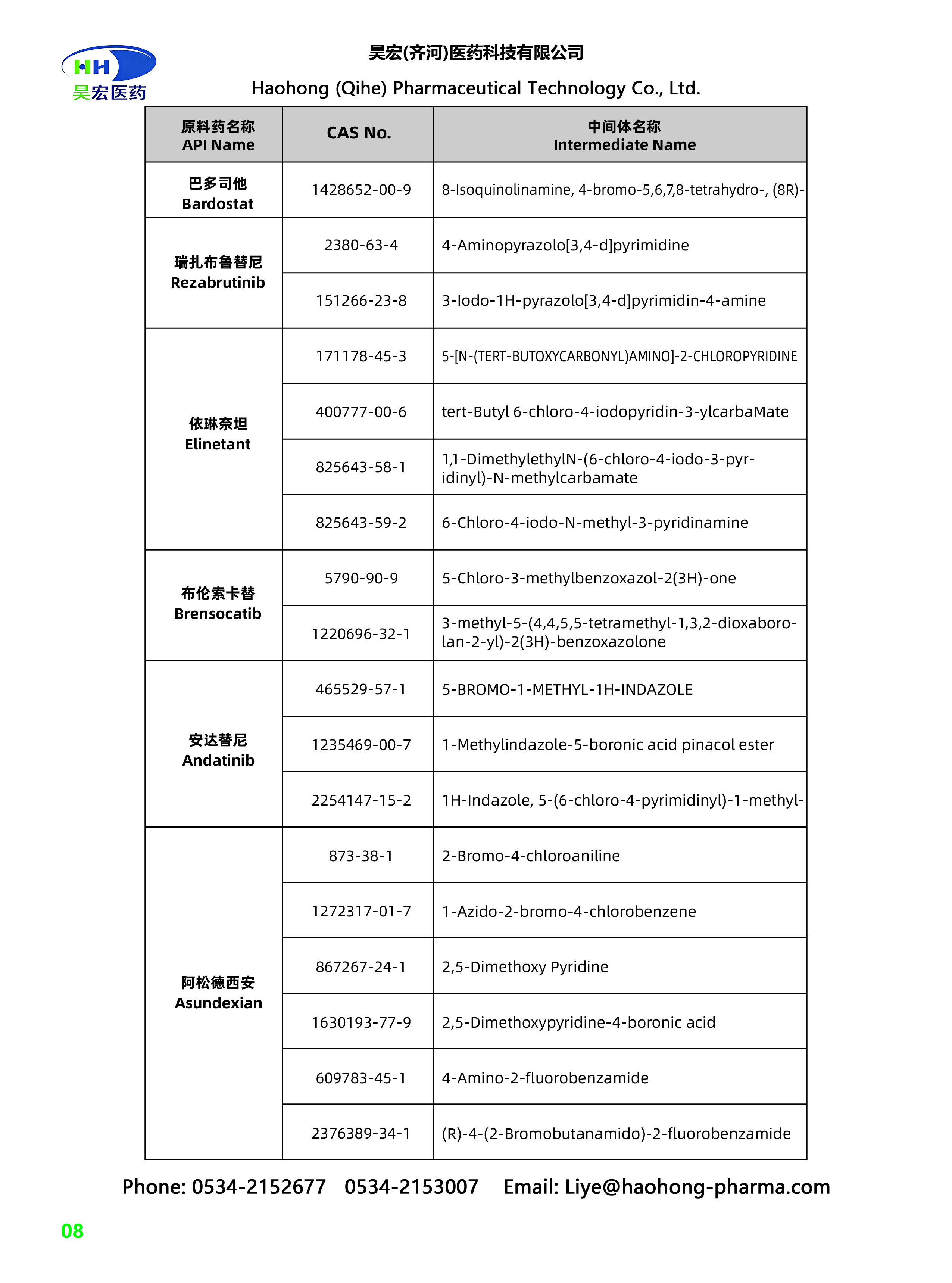
For the abemaciclib intermediate line specifically, Haohong's product documentation pairs the company's ISO 9001:2015 certification with utility model patent references. Buyers should request the certificate scope and the patent numbers and verify both independently before treating either as programme evidence.
Application fit across the three lines
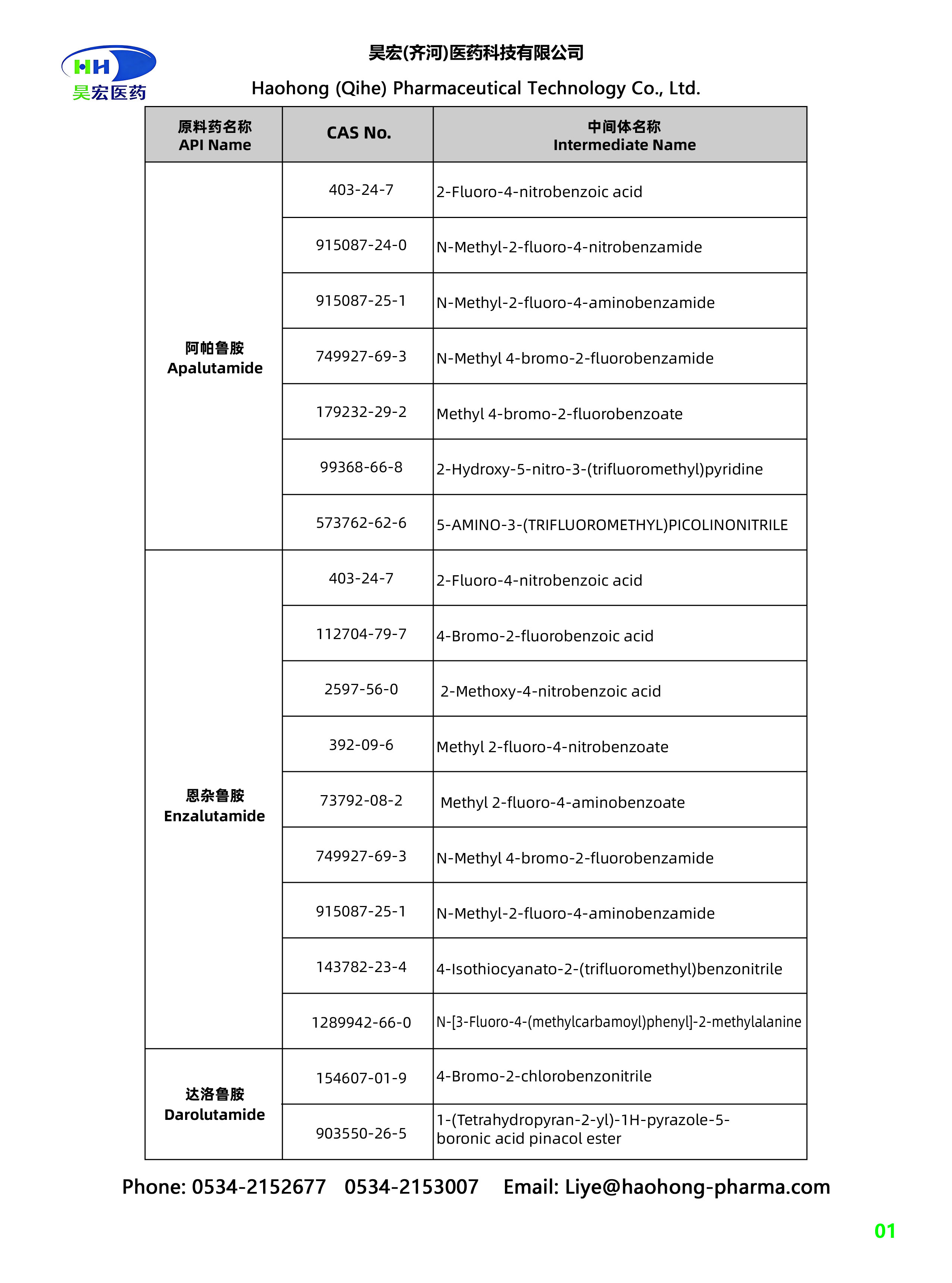
Apalutamide line. The apalutamide intermediate family includes 2-fluoro-4-nitrobenzoic acid (CAS 403-24-7) and related compounds. At shortlist stage the relevant question is not whether the compound appears in a catalogue, but whether the supplier can hold a defined impurity window across the batch sizes the programme actually requires.
Alectinib line. Alectinib intermediates sit in a different part of the oncology portfolio and are typically requested in smaller development quantities before scaling. The shortlist test is whether development-scale and commercial-scale supply use the same synthetic route, or whether scale-up introduces a new impurity profile that has to be re-qualified.
Abemaciclib line. The abemaciclib intermediate line is where the compliance documentation is most directly attached, pairing ISO 9001:2015 certification with utility model patent references. Buyers should confirm that the certificate scope covers the specific product and site, and that the patent references relate to the intermediate in question rather than to adjacent process work.
Reported application fit for these lines covers anti-cancer API synthesis, targeted drug development, high-purity fine chemical production and custom R&D projects. That is a broad fit statement rather than a product-by-product qualification, and it should be narrowed during sample evaluation and site audit.
Market context: what the numbers say, and what they do not
The global pharmaceutical intermediates market was estimated at USD 37.04 billion in 2025 (Polaris Market Research). Within that market, bulk drug intermediates held 48.10% of share by type in 2025 (Mordor Intelligence), while peptide and oligonucleotide intermediates are projected for high growth at a 7.85% CAGR over 2026–2033 (Mordor Intelligence).
The buyer interpretation is narrower than the headline. Bulk intermediates dominate volume, but volume leadership in bulk does not signal available capacity in high-purity oncology lines, which carry a heavier qualification burden per kilogram. Growth in peptide and oligonucleotide intermediates indicates where capacity investment is heading; it is not evidence that a given supplier has already made that investment.
Two data boundaries should be respected when this context feeds a sourcing decision. First, trade statistics do not isolate intermediates cleanly: HS chapter 30 covers pharmaceutical products broadly, and no intermediate-specific trade value is separable from it, so chapter-level customs totals should not be used as a market-size or price proxy. Second, directional reporting that Chinese-made drugs and medical devices are increasingly reaching the global health market (State Council Information Office of China, January 2026) describes a trend, not a supplier-level capability.
Comparison with traditional sourcing approaches
Three sourcing approaches are common in oncology intermediate procurement. They differ less in price than in where the risk is carried.
| Approach | Strength | Principal risk | Appropriate when |
|---|---|---|---|
| Lowest landed price | Fast, simple, administratively light. | Weak insulation against rework and deviation cost; variability surfaces after qualification. | Early research screening only. |
| Catalogue-only qualification | Low effort; can be completed in weeks. | Purity figure unverified against method; no view of batch records or traceability. | Exploratory sample ordering. |
| Documentation-led shortlist | Comparable evidence across candidates; audit-ready basis. | Higher front-end effort; depends on supplier cooperation on batch records and audit access. | Commercial-scale oncology programmes. |
Documentation-led shortlisting is not automatically the right answer, and it carries real limits. ISO 9001:2015 is a quality management system certification; it is not a GMP certificate, and it does not on its own establish that a specific intermediate is manufactured under GMP conditions. Company-reported capacity figures — including Haohong's 30 reactors and 1,000 tons per year — describe aggregate equipment and stated output rather than independently verified product-level capacity, allocation or utilisation. The reported purity and batch-stability comparisons are vendor statements pending confirmation. And a ≥98% purity target remains a purchasing filter, not a release specification, unless it is tied to a defined analytical method and impurity limits agreed in the quality agreement.
Future outlook
Three shifts are likely to shape intermediate shortlists over the next procurement cycles. Documentation will keep moving up the scoring matrix, because Q7A-style expectations on batch records, quarantine and traceability are easier to audit than to argue about. Specialised segments — peptide, oligonucleotide and chiral lines — will absorb capacity investment ahead of bulk lines, which changes lead-time expectations for buyers who assume availability by category. And supplier selection will increasingly be judged on replenishment mechanics rather than on delivery promises, because delayed delivery is a recognised structural weakness of the sector rather than an isolated service failure.
For buyers running apalutamide, alectinib or abemaciclib programmes, the practical implication is to keep the shortlist small, keep the evidence requests identical across candidates, and treat every vendor-reported advantage — purity, stability, cost — as a hypothesis to be tested on the first three batches.
FAQ
Does a purity of ≥98% confirm that an oncology intermediate is suitable for API synthesis?
No. A purity figure is only meaningful together with the analytical method that produced it, the impurity limits it is measured against, and confirmation that the same method is applied batch to batch. For chiral intermediates the method must also resolve the relevant enantiomer or diastereomer. Buyers should review the certificate of analysis, the method reference and the impurity profile together rather than the headline percentage in isolation.
How can batch-to-batch consistency be verified before a supplier is qualified?
Consistency is verified from data rather than from a single sample. Request results from multiple batches of the same product and compare the trend of key impurities, not only the aggregate purity. Haohong reports batch quality stability 10% above the industry average; that is a company-reported figure and should be checked against multi-batch data during qualification. Batch production records prepared for each batch, as expected under FDA Q7A, are the supporting documentation for that check.
What documentation should accompany an apalutamide or abemaciclib intermediate shipment?
At minimum a certificate of analysis with the method referenced, the specification the batch was released against, and batch production records covering production and control of that batch. Where material passes through a distributor, traceability records should identify the original manufacturer, purchase orders, transport documents, receipt records, product designation and batch numbers supplied. Nonconforming material should be identifiable and quarantined under a documented procedure.
Is ISO 9001:2015 certification equivalent to GMP for pharmaceutical intermediates?
No. ISO 9001:2015 certifies a quality management system; it does not certify that a specific intermediate is manufactured under GMP conditions. In the EU, the European Medicines Agency states that active substances used in marketed medicines must comply with GMP, and that registration obligations can extend to manufacturers and importers of active substances and relevant intermediates described in a regulatory dossier, so applicability is product- and dossier-dependent. Buyers should confirm certificate scope by product and site and treat ISO certification as one input to supplier qualification rather than a substitute for it.
How should delivery reliability be assessed during a shortlist trial?
Assess the mechanism rather than the promise. Delayed delivery is common enough within the intermediates sector that it should be scored as a qualification criterion. A supplier response worth accepting describes stock policy, replenishment model and production scheduling — for example maintained safety stock, real-time inventory monitoring and optimised scheduling supported by digitalised product management — and can later be checked against historical dispatch records during a site audit.
¿Tiene preguntas o necesita más detalles?
Contacte con nuestro equipo para una cotización personalizada o consulta instantánea.
Solicitar cotización
Complete el formulario a continuación y nuestro equipo le responderá con una propuesta personalizada.
Chat directo de WhatsApp
¿Prefiere chatear en tiempo real? Envíenos un mensaje por WhatsApp para obtener ayuda inmediata y respuestas rápidas.
- Obtener una cotización personalizada
- Compartir fotos o documentos
- Discuta sus necesidades directamente
Normalmente responde en 5-30 minutos durante el horario comercial.