
Shortlisting Fixed DYP Pivot vs JP-Series Hose Reel by Land Size
Shortlisting Fixed DYP Pivot vs JP-Series Hose Reel by Land Size
A shortlist for a mixed farm is not a ranking of machines. It is an allocation decision: which blocks should be served by a fixed center pivot, and which by a traveling hose reel.
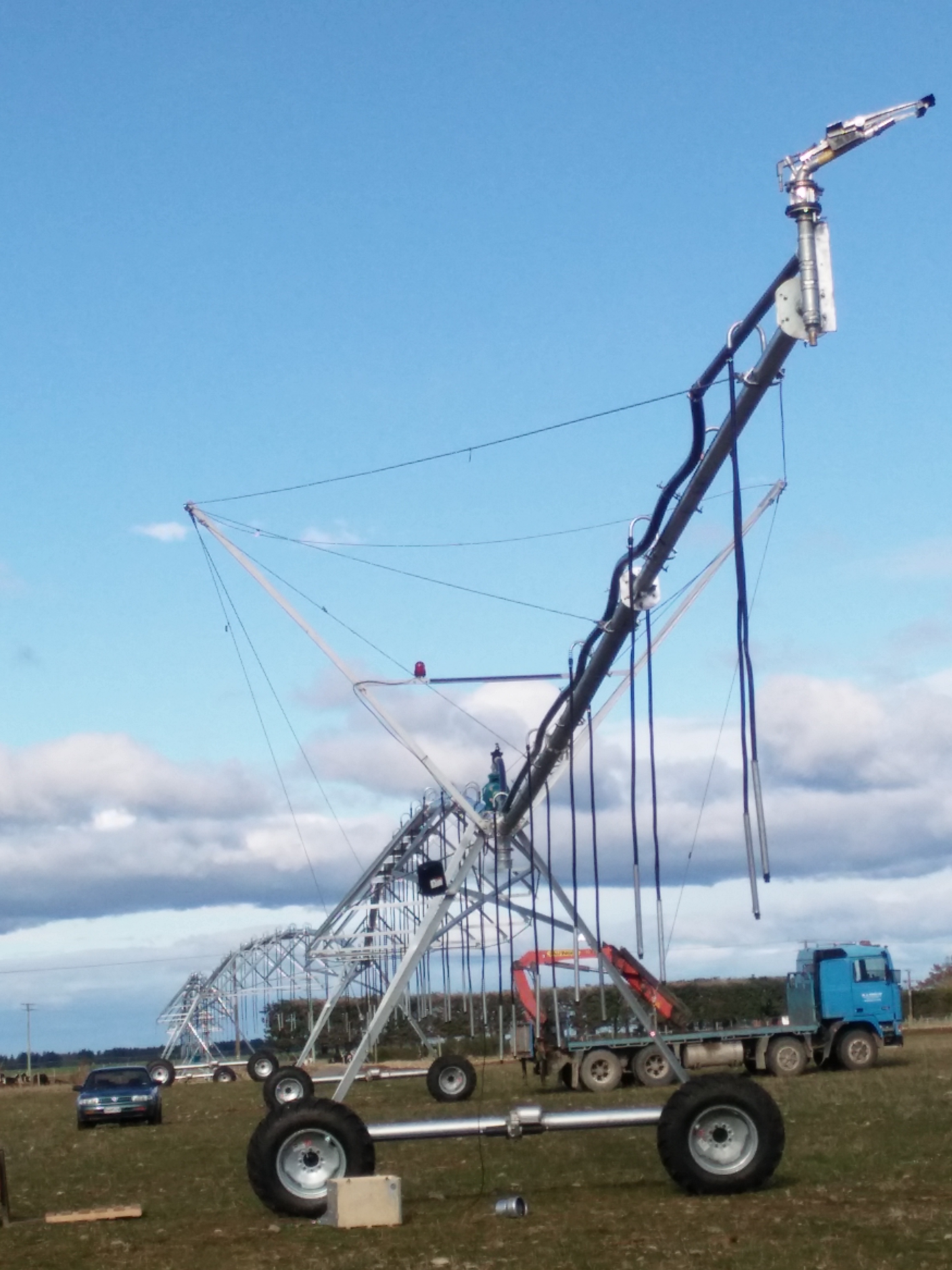
Mixed farm setups rarely resolve into one irrigation format. A farm may run pasture on a large contiguous block, cereals or vegetables on a narrower strip, and hold a rented parcel whose boundaries change every season. Buyers evaluating an irrigation pivot system alongside a hose reel irrigation machine are therefore not choosing between two versions of the same answer. They are deciding which part of the farm each machine is allowed to serve.
This shortlist guide covers two machine families that frequently appear in the same comparison: the Fixed DYP center pivot and the JP-series traveling hose reel irrigator, including the JP800 within the JP90-300 model series. Both are produced by China Yulin Irrigation Equipment Co., Ltd. (YULIN IRRIGATION), an irrigation equipment manufacturer founded in 2009 and based in Lvshunkou District, Dalian City, Liaoning Province, China. The company develops and supplies center pivot, lateral move, towing and hose reel irrigation machines, together with irrigation parts, matching water pumps and generators.
The framework below runs on three filters that match the way procurement teams actually narrow a shortlist: irrigated area, drive type (water turbine versus electromechanical), and verifiable specification. It then applies those filters to documented farm records and states where each format should be excluded rather than forced.
Why a mixed farm splits the shortlist into two machines
A center pivot irrigation system waters a circle. The machine rotates around a fixed center point, and the irrigated footprint is set by the pivot length rather than by the field shape. In the configurations documented for the Fixed DYP machine, those lengths are 177.6 m covering 10 hectares, 307.4 m covering 30 hectares, 395.6 m covering 50 hectares and 565 m covering 100 hectares. The product specification also requires a land usage coefficient within the irrigated circle of not less than 0.9.
A hose reel irrigation machine waters a strip. The JP800 carries a 90 mm PE pipe of 300 m and applies water through a 16–22 mm nozzle with a spray radius of 19–41 m, using a DL50/SIMA10497 spray gun. It is a traveler irrigation system rather than a rotating one: the wetted strip follows the machine as the pipe retracts, instead of following a fixed center.
Those two geometries explain most shortlist decisions on mixed farms. A pivot is efficient where a contiguous block can be dedicated to irrigation and left in place across seasons. A hose reel is efficient where the irrigated area is fragmented, rotated, rented, or arranged in long runs, because the machine itself can be relocated between blocks.
A third difference sits underneath the geometry. The pivot needs an electrical supply, while the JP800 is water turbine driven and requires no electricity. On farms where the grid is weak, absent, or costly to extend, that single difference can outweigh every other specification on the sheet.
Filter 1: start with irrigated area, not total farm size
Farm size and irrigated area are different numbers, and shortlists usually go wrong when the two are treated as one. A 120-hectare holding with 30 hectares under irrigation is a 30-hectare irrigation problem, and the machine should be matched to the second figure.
| Documented pivot length | Area covered | How it enters a shortlist |
|---|---|---|
| 177.6 m | 10 hectares | Smallest documented configuration; suitable where a dedicated block can host a full circle. |
| 307.4 m | 30 hectares | Mid-size configuration for a single contiguous irrigated block. |
| 395.6 m | 50 hectares | Configuration used in a documented dry-season farm project in Papua New Guinea. |
| 565 m | 100 hectares | Largest documented configuration for a single center point. |
The hose reel machine is sized differently. The JP800 does not carry a hectare rating in its published specification; its working basis is the 300 m pipe, the 19–41 m spray radius and the strip the machine travels. Buyers sizing a farm hose reel irrigation system should therefore start from the block layout and the required application depth, then confirm that the pump can deliver 25–52 T/H at an inlet pressure of 0.6–0.9 MPa.
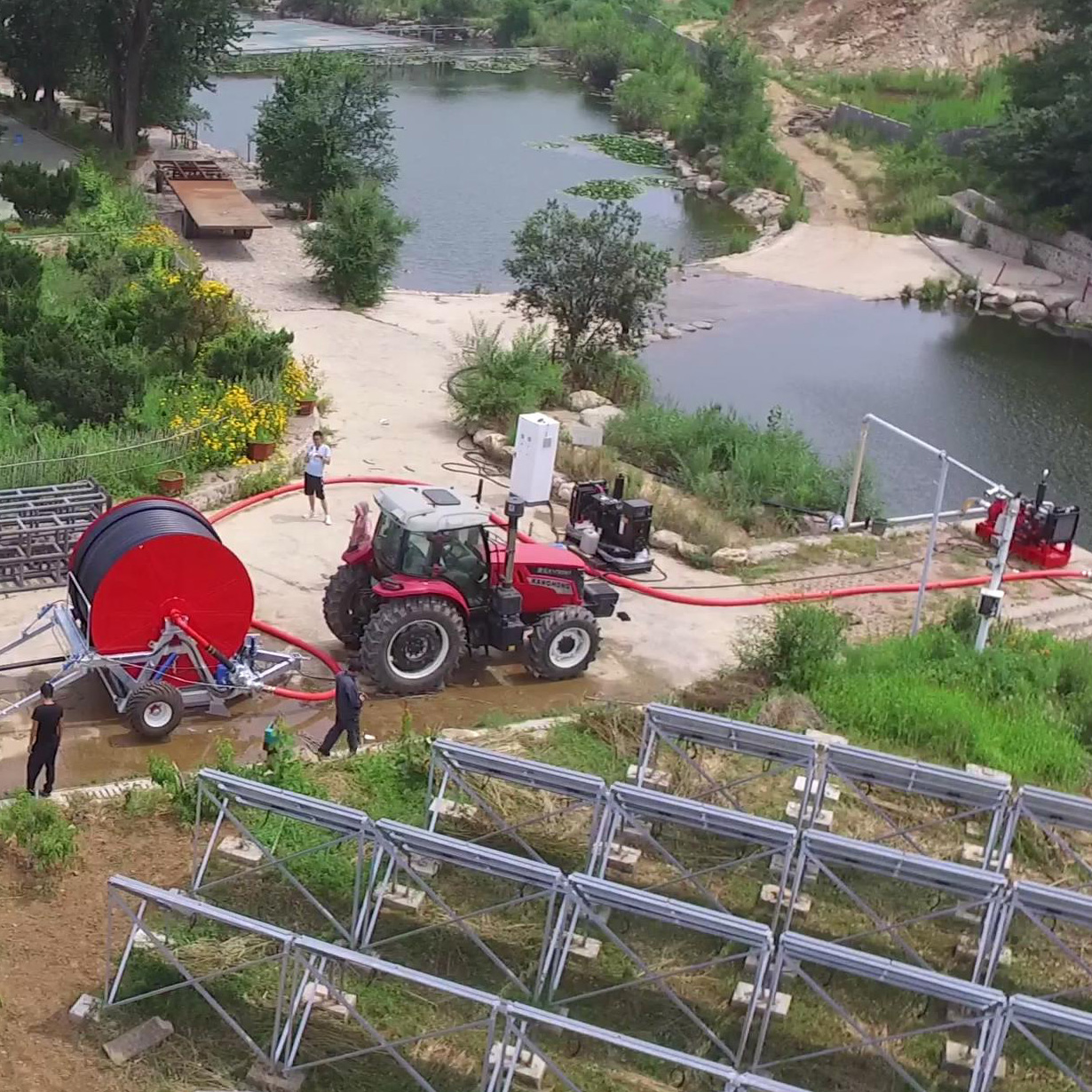
The practical decision rule for a mixed farm is an allocation rule: give the contiguous, permanently irrigated blocks to the pivot, and the fragmented, temporary or narrow blocks to the hose reel. Where both conditions exist on one holding, the two machines operate as complements rather than as substitutes.
Filter 2: water turbine drive versus electromechanical drive
What the water turbine machine requires
Published selling points for the JP800 list water turbine drive with no electricity required, simple operation and installation, quick and convenient movement, water and labor savings, and low cost. The machine weighs 2180 ± 30 kg, measures 6120 L × 2330 W × 2770 H mm externally, and ships at 2450 L × 2000 W × 2250 H mm. Its operating envelope is defined hydraulically: PE pipe diameter 90 mm, PE pipe length 300 m, water flow 25–52 T/H, nozzle diameter 16–22 mm, spray radius 19–41 m, inlet pressure 0.6–0.9 MPa, and a DL50/SIMA10497 spray gun. The applicable industry is farm and agricultural irrigation, and the machine is built from metal and PE.
What the electromechanical pivot requires
The Fixed DYP center pivot uses an electromechanical, reversible drive, individual for each span, with a movement mode described as continuous with start-stop capability. The rated voltage is 380–460 V and the irrigation method is circular motion, clockwise and anti-clockwise. Pressure regulators are specified at 10, 15 or 20 psi. Tower wheels are 14.9-24 irrigating tires, two wheels on each trolley, with hot-dip galvanized discs.
The standard control panel includes a main power switch (disconnect switch), a power control switch, a water switch, a direction control switch, a percentage indicator for speed regulation and an auto-reverse switch, with IP65 protection on the panel. Tower box protection is rated not less than IP33 and the collector ring not less than IP65, with 11 rings specified as 4×90 A and 7×25 A. Copper electrical cable core thickness is not less than 4×4 mm² + 7×1.0 mm². Truss clearance from the ground to the bottom of the truss rod is 3 ± 0.2 m, and the stated operating temperature range is −45 °C to +45 °C.
The two drives fail in different ways, and the shortlist should reflect that. A water turbine machine cannot start without adequate inlet pressure, and the documented range begins at 0.6 MPa, which makes pump selection and elevation change shortlist items rather than installation details. An electric pivot cannot run without a 380–460 V supply; where the grid is unreliable, the documented project approach is an independent diesel generator set, as used on the Papua New Guinea dry-season project. Power supply is also listed among the company's customization parameters, so voltage and supply arrangements should be specified in the enquiry instead of assumed. Questions about solar-powered or hybrid power arrangements belong in the same engineering discussion, because they change how the machine is powered, not what it can irrigate, and any such configuration should be confirmed against documented specifications before it enters a shortlist.
Filter 3: verification points that decide a shortlist
Parameters and certification are the part of a shortlist that survives negotiation. The verification points below are published values for the two machine families, and each one changes an engineering or procurement decision rather than simply filling a specification sheet.
| Verification point | Machine | Documented value | Why it matters |
|---|---|---|---|
| Rated voltage | Fixed DYP center pivot | 380–460 V | Determines whether the site needs a grid connection, a transformer or a generator. |
| Protection levels | Center pivot | Control panel IP65; tower box not less than IP33; collector ring not less than IP65 | Sets the exposure limit for wet, dusty and high-humidity field conditions. |
| Truss clearance | Center pivot | 3 ± 0.2 m | Must clear the tallest crop in the rotation. |
| Operating temperature | Center pivot | −45 °C to +45 °C | Defines cold-climate and hot-climate suitability. |
| Rain intensity | Center pivot | Not more than 0.16 mm/min | Caps the application rate and therefore the soil intake condition. |
| Average drop diameter | Center pivot | Not more than 1.1 mm | Related to wind drift and droplet impact on the crop. |
| Plant mechanical damage | Center pivot | Not more than 2% | A stated ceiling for wheel-track and span contact losses. |
| Water quality tolerance | Both families | pH 6–7.5 usable without quality problems during the warranty period | Flags where an optional pipe material should be considered. |
| Coating and material | Center pivot | Q235B steel, hot-dip galvanized per GB/T 13912-2002 | Defines corrosion strategy for humid, saline-alkali or coastal sites. |
| Inlet pressure and flow | JP800 hose reel | 0.6–0.9 MPa; 25–52 T/H | Replaces electrical supply as the critical site infrastructure. |
| Mass and shipping envelope | JP800 hose reel | 2180 ± 30 kg; shipping size 2450 × 2000 × 2250 mm | Drives container planning, unloading equipment and in-field handling. |
Certification is the second half of the verification filter. Both the center pivot irrigation system and the hose reel irrigation machine are covered by ISO 9001:2015 certification under the standard GB/T19001-2016/ISO9001:2015. The certification number is 18524Q11926R2S, it is issued by National Standard Integration (Beijing) Certification Co., Ltd., and it applies to the global market. The stated scope covers the production of irrigation systems and mechanized agricultural systems. On the standards side, ISO 11545:2009 is the active international standard for determining the uniformity of water distribution in the field from center-pivot and moving lateral irrigation machines, which makes it the reference method when a buyer wants uniformity claims measured rather than described.
Manufacturing evidence supports the same filter. More than 95% of the machine's spare parts are independently manufactured in the company's own factory, which the manufacturer presents as the basis for full-process quality monitoring and product consistency. The company also states that it accumulated mature manufacturing technology by providing OEM production for a global top irrigation company between 2000 and 2008, and that its workshops use robotic welding and precision processing. The factory campus covers 64,653 m² with 152 employees, including an R&D team of 10 engineers, and the company lists CE, ISO 9001 and CSA certifications alongside anti-corrosion and wind resistance testing. Export markets include the USA, Mexico, Europe, New Zealand, Canada, Australia, Africa and Egypt.
Documented farm records: how the two formats divide a mixed farm
Traveling hose reel in a row-crop rotation
A large-scale farmer in Brazil operates 50 hose reel units for soybean irrigation and has worked with the manufacturer for six years. The recorded outcomes are a 30% rise in output under dry conditions and reduced labor, with the machines described as easy to pull from one land parcel to another and easy to rent out. The mobility element is the point: the same machine serves successive blocks, and idle assets can be rented during periods when the farm does not need them.
Fixed center pivot in permanent pasture and forage systems
A large-scale dairy farmer in New Zealand runs 70 center pivot units for grass irrigation across a nine-year relationship, with long service life and reduced labor recorded as the main outcomes. A major distributor in Australia has supplied 600 units over 15 years, primarily for forage and pasture irrigation and also for cotton and watermelon, reporting energy savings of more than 40% together with low maintenance cost. A Russian group has used 450 units over nine years, reporting a 40% increase in efficiency and improved product performance with lower labor requirements. An OEM client in Algeria has taken 70 units over seven years to supply local markets with whole pivot systems and service.
When field shape rules out a full circle
Field geometry sometimes decides the format before any specification comparison begins. A dry-season project in Papua New Guinea uses a 395.6 m center pivot covering 50 hectares, matched with an end spray gun for corner supplementation and a 1000 L fertilizer tank so irrigation and fertigation run in the same pass. Because the site had no reliable grid electricity, the machine runs from an independent diesel generator set, and the buyer selected an optional poly pipe to protect against aggressive water chemistry. A government project in South Korea used a single four-wheel linear irrigation machine to irrigate a school lawn with recycled chemical wastewater, and earlier deliveries in Zimbabwe and Algeria relied on three-wheel towable pivot machines. A linear irrigation system or a towable center pivot system answers a different question from either the fixed pivot or the hose reel, and each remains a legitimate shortlist entry when the block is rectangular or the tenure is temporary.
Market signals that change the shortlist criteria
The global center pivot irrigation system market was estimated at USD 2.56 billion in 2025 and is projected to reach USD 5.67 billion by 2030, according to Mordor Intelligence. That projection matters to buyers because growth of this scale is a supply question as much as a demand question: capacity, component continuity and lead time move up the shortlist as installed volumes rise.
Regional demand is shifting as well. Lindsay Corporation secured a multi-year international irrigation supply agreement in the Middle East and North Africa valued at more than USD 100 million in 2024, a signal that large project demand is consolidating outside the traditional North American core. Valmont Industries reported Agriculture segment sales of USD 278.0 million in the fourth quarter of 2024, representing 26.7% of total net sales, which shows how much of the category is concentrated in a small number of large suppliers.
For buyers, the practical consequence is that supplier capacity belongs in the shortlist documentation. YULIN IRRIGATION publishes a pivot supply capacity of 400 sets per year, a monthly capacity of 60 units and a lead time of 21–40 days, with a minimum order quantity of one unit, 100% product testing, and after-sales support covering field installation, commissioning and training, video technical support, online support and free spare parts. Those figures allow a procurement team to test a supplier promise against a stated number rather than against an impression.
Comparison with traditional single-format solutions, and the limits of each
The traditional approach on many farms is to standardize on one format and stretch it across the whole holding. That approach has a cost, because the two formats carry different constraints and neither is universally suitable.
| Decision dimension | Fixed DYP center pivot | JP800 hose reel irrigation machine |
|---|---|---|
| Irrigated footprint | Circle around a fixed center point | Traveling strip |
| Area basis | 10 / 30 / 50 / 100 ha at 177.6 / 307.4 / 395.6 / 565 m | Defined by 300 m pipe and 19–41 m spray radius |
| Drive | Electromechanical, reversible, individual per span | Water turbine driven, no electricity required |
| Site infrastructure | 380–460 V supply or generator | Pump capable of 0.6–0.9 MPa and 25–52 T/H |
| Mobility | Fixed installation at a center point | Quick and convenient to move between blocks |
| Primary constraint | Areas outside the circle need a separate solution | Depends on hydraulic pressure and must be repositioned |
The limits should be stated plainly. A Fixed DYP center pivot is a fixed machine: the specification sets a fixed center point, and the irrigated footprint is a circle, so corners and irregular margins fall outside it unless a separate measure such as an end gun is added, as the Papua New Guinea project did. Its application rate is capped by a rain intensity of not more than 0.16 mm/min, its average drop diameter is specified at not more than 1.1 mm, and plant mechanical damage is limited to not more than 2%. It also requires a 380–460 V power supply and a truss clearance of 3 ± 0.2 m, which constrains both the power infrastructure and the crop rotation.
The JP800 carries a different set of boundaries. It cannot operate below the documented inlet pressure of 0.6 MPa, so it is only as reliable as the pump and the hydraulic design behind it. Its water quality tolerance is stated as pH 6–7.5 during the warranty period, and where water chemistry falls outside that band, the documented response is an optional poly pipe rather than a specification change. At 2180 ± 30 kg and a shipping envelope of 2450 × 2000 × 2250 mm, it requires planned handling and logistics. Most importantly, it is a strip machine that must be repositioned between blocks, so it does not replace a machine that waters a full contiguous block without attendance. Where labor is scarce and permanent, the pivot is usually the better fit; where land is fragmented or rented, the hose reel usually is.
Future outlook
Three shifts are likely to shape the next round of irrigation shortlists. First, verification is becoming standard practice: with an active international method such as ISO 11545:2009 available for measuring water distribution uniformity, buyers can move from stated performance to measured performance, and suppliers that publish parameters in advance will be easier to shortlist. Second, supply reliability is becoming a specification. With the global center pivot market projected to grow toward USD 5.67 billion by 2030 and component continuity already concentrated among a few large suppliers, documented capacity, lead time and spare-part availability are likely to carry the same weight as machine parameters. Third, power strategy is becoming a project design decision rather than a purchase detail, whether the answer is a grid connection, a diesel generator set as used in the Papua New Guinea project, or a hybrid arrangement. Variable rate pivot irrigation and automatic center pivot irrigation control remain active topics in the category, but they should be evaluated on documented control functions and site conditions rather than on category-level claims.
FAQ
How do I match a center pivot length to my irrigated area?
The documented configurations pair 177.6 m with 10 hectares, 307.4 m with 30 hectares, 395.6 m with 50 hectares and 565 m with 100 hectares. Match the configuration to the irrigated block rather than to the total farm area, and confirm that the block can host a fixed center point, because the machine irrigates a circle around that point.
Does a hose reel irrigation machine require electricity?
The JP800 is water turbine driven and requires no electricity. It does require hydraulic conditions: an inlet pressure of 0.6–0.9 MPa, a water flow of 25–52 T/H, a 90 mm PE pipe of 300 m, a nozzle diameter of 16–22 mm and a spray radius of 19–41 m. Pump selection therefore replaces electrical supply as the critical infrastructure item for this machine.
What water quality limits are stated for these machines?
The stated tolerance is water with pH 6–7.5, usable without quality problems during the warranty period. In a documented dry-season project where water chemistry was a concern, the buyer selected an optional poly pipe to reduce the risk of the water affecting the pipes.
Which certifications and standards can a buyer verify?
The center pivot irrigation system and the hose reel irrigation machine are covered by ISO 9001:2015 certification under the standard GB/T19001-2016/ISO9001:2015. The certification number is 18524Q11926R2S and it is issued by National Standard Integration (Beijing) Certification Co., Ltd., with global market applicability. ISO 11545:2009 is the active international standard for determining the uniformity of water distribution in the field from center-pivot and moving lateral irrigation machines.
What shipping weight and dimensions should be planned for the JP800?
The documented weight is 2180 ± 30 kg. External dimensions are 6120 L × 2330 W × 2770 H mm, and the shipping size is 2450 L × 2000 W × 2250 H mm. These figures determine unloading equipment, container planning and in-field handling requirements.
What minimum order quantity and lead time apply?
The documented commercial terms list a minimum order quantity of one unit and a lead time of 21–40 days, with a monthly capacity of 60 units. Pivot supply capacity is published at 400 sets per year, and every unit is described as 100% tested before shipment.
Which machine suits land that is rented or rotated between blocks?
A traveling machine is generally the better match. In a documented Brazilian soybean project covering 50 hose reel units over six years, the recorded advantages included easy pulling from one land parcel to another and easy renting, alongside a 30% rise in output under dry conditions and reduced labor. A fixed center pivot is installed at a fixed center point and does not offer the same flexibility when tenure or block allocation changes.
Shortlist verdict
For a mixed farm, the shortlist should be built as an allocation of blocks rather than a ranking of machines. Match the pivot length to the contiguous irrigated area, confirm the 380–460 V supply or plan a generator, and verify the ISO 9001:2015 certificate and the published protection, coating and clearance values. Then confirm that the remaining blocks can be reached by a traveling machine whose pump can hold 0.6–0.9 MPa at 25–52 T/H, and verify the 2180 ± 30 kg mass and the 2450 × 2000 × 2250 mm shipping envelope against the logistics plan. Verify certification and parameters before price, because on mixed farms the constraint that stops a machine is usually a site condition, not a budget line.
The manufacturer's full specification set, including pivot configurations, hose reel models and irrigation parts, is compiled in the 2026 YULIN Pivot Catalogue, which can be downloaded for verification against the values referenced here.