
Shortlisting Custom Transformers for North American Grids
Shortlisting Custom Transformers for North American Grids
Order before price. A custom transformer shortlist for North American residential and commercial distribution is settled by two things before cost is discussed: the certification route the local utility will accept, and the duty class the site actually imposes. Buyers at evaluation stage normally weigh four configurations against one another — single-phase pole-mounted, single-phase pad-mounted, three-phase pad-mounted, and a conventional oil-immersed distribution transformer — and those four are not interchangeable, because each answers a different siting and load question.
This review sets the four out as a shortlist for outdoor pole-mounted and pad-mounted duty in residential areas, rural grids and street lighting, and tests each entry against the criteria that decide acceptance: ANSI/IEEE compliance, UL/CSA certification, high-voltage class and 50/60 Hz operation. The sequence follows deployment fit for a residential-first brief, not market share, sales volume or any ranking of manufacturers; where a fact is not in the qualification file, it is not asserted here.
The product and certification record used below belongs to Apex Power Systems (Nanjing) Co., Ltd., an international trading and supply-partner company for power transformers, box-type substations and complete substation solutions. Apex is not a manufacturer: it selects and audits factories, then manages design, production, testing, documentation and delivery on the buyer's behalf, and the certification and test evidence cited here belongs to its audited manufacturing partners. The company itself is small — 15 staff and a 404 m² footprint, founded in 2024 — which is consistent with a coordination role rather than a production role, and it is the reason certificates rather than brochures carry the argument in this article.
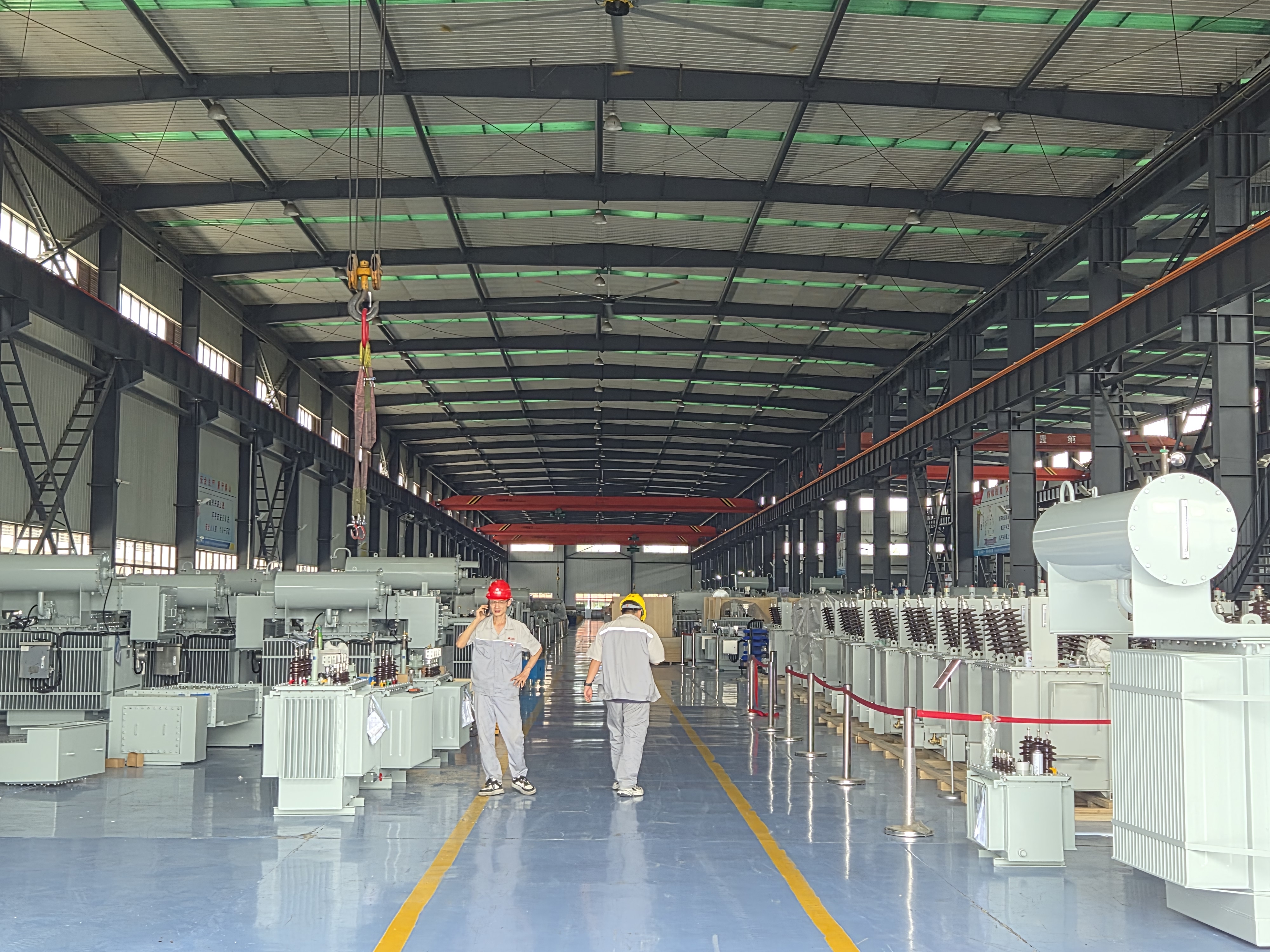
Factory grounds of the audited manufacturing base behind the shortlist: distribution transformer production for pole-mounted, pad-mounted and oil-immersed configurations.
The certification gate comes before the shortlist
All four entries are liquid-filled, and that fixes the certification question in one direction. A unit must hold a UL Certificate of Compliance for liquid-filled distribution transformers rated over 750 V; for Canada, certification to CSA C2.1-06 and CSA C227.4 applies as well. In the qualification file used for this review, liquid-immersed distribution transformer certification is recorded under UL LLC certificate numbers UL-CA-2242874-0, UL-CA-2320692-0 and UL-CA-2328358-0, covering the United States and Canadian markets.
Two limits belong with that statement so it is not over-read. Certification is issued to a specific legal entity and a specific product family, so both the entity name and the family on the certificate must match what is being ordered. And a certificate number inside a supplier's own file is a claim until it is checked: UL listings can be verified through UL's product database, which is the check a utility specification will require in any case. Certification is therefore a filter applied before commercial comparison, not a document collected after the invoice.
The duty envelope: HV class, frequency and siting
North American distribution duty for these units is defined by a small set of parameters, and confusing them is the most common reason a technically sound transformer is refused at commissioning. Outdoor pole-mounted and pad-mounted units serve residential areas, rural grids, retail and small commercial distribution, and municipal street lighting, stepping down from the distribution line to 120/240 V or 240/480 V user supply. The HV classes in scope are 34.5 kV, 13.8 kV, 13.2 kV and 12.47 kV at 60 Hz, with grid-connected, fully sealed, maintenance-free operation and an accessory set built around elbow bushings, plug-in fuses, surge arresters and load-break switches.
The manufacturing platform behind the file is wider than that envelope. It builds distribution transformers from 5 kVA to 3,150 kVA at the 10 kV class and up to 31.5 MVA at the 35 kV class, with HV values of 6, 10, 11, 13.2, 13.8, 24.94 and 34.5 kV and 50/60 Hz operation, copper or aluminium windings, amorphous or silicon-steel cores, and corrugated or radiator tanks. For this brief only the North American values are binding; the wider range matters mainly as the answer to whether an unusual ratio or capacity pushes a project off the platform. Two further technical parameters decide loading rather than size: the cooling class recorded on the nameplate, where ONAN denotes natural oil and air circulation and ONAF adds forced air over the radiators and a higher permissible loading, and the vector group, which determines whether new units can be paralleled with the ones already in service.
The shortlist at a glance
| Shortlist entry | Typical duty | Verified parameters in the record | Certification and test basis | Where it stops fitting |
|---|---|---|---|---|
| 1. Single-phase pole-mounted (D-M series) | Overhead residential feeders, rural grid spurs, street-lighting circuits | Residential and small commercial single-phase duty typically 25–100 kVA; 50 kVA and 75 kVA units at 7200/2400 V with 120/240 V secondary common in service | Liquid-filled unit over 750 V: UL Certificate of Compliance; CSA C2.1-06 and CSA C227.4 for Canada | Underground distribution, or any position in public reach that requires a ground-level enclosure |
| 2. Single-phase pad-mounted (ZGD-H / ZGD-Z) | Underground residential subdivisions, commercial frontage, publicly accessible siting | Pad-mounted units typically about 25–500 kVA in service; single-phase units common at 50 kVA and 75 kVA; tamper-resistant enclosure, compartmental dead-front, radial or loop feed | Same UL/CSA liquid-immersed basis; accessories specified per utility standard | Three-phase commercial or light-industrial load; sites where pad space and clearances cannot be secured |
| 3. Three-phase pad-mounted (ZGS-H / ZGS-Z) | Retail, small commercial, light industrial and municipal three-phase supply | 75–2500 kVA series for North American distribution grids; 60 Hz; HV classes 12.47, 13.2, 13.8 and 34.5 kV | UL/CSA liquid-immersed certification; routine tests per IEC 60076 / ANSI/IEEE C57.12 including ratio, resistance, losses, impedance, insulation and oil quality | Requirements above 2500 kVA, which leave the series; sites without utility-approved clearance |
| 4. Oil-immersed distribution transformer (S13 / S14 / S15) | Transformer-only specifications outside the pole and pad enclosure set | Platform range 5 kVA–3,150 kVA (10 kV class) and up to 31.5 MVA (35 kV class); 50/60 Hz; copper or aluminium windings; amorphous or silicon-steel core | Routine tests per IEC 60076 / ANSI/IEEE C57.12; independent IEC and IEEE type-test evidence held in the file | Where a pad-mounted enclosure with dead-front, tamper-resistant construction is mandatory |
Entry 1 — single-phase pole-mounted units
Pole-mounted single-phase units are on the shortlist because they serve dispersed load without a ground-level enclosure, which is what overhead residential feeders, rural spurs and street-lighting circuits usually need. The recommended duty range for North American residential and small commercial distribution is roughly 25 kVA to 100 kVA, with 50 kVA and 75 kVA units at 7200/2400 V and a 120/240 V secondary being typical in service; frequency, HV class and accessory set follow the duty envelope set out above.
The boundary is a siting decision rather than a technical one. Where distribution goes underground, or where the unit has to stand in a publicly accessible location, the pole-mounted form is the wrong entry and the pad-mounted enclosure replaces it. Buyers who fix the enclosure question first avoid the most expensive correction in this segment, which is discovering the siting constraint after the units are built.
Entry 2 — single-phase pad-mounted units
A pad-mounted transformer is installed on a concrete pad at ground level, with high-voltage and low-voltage switching, fusing and protection enclosed together with the transformer inside a tamper-resistant steel enclosure. That construction is what allows the unit to stand in publicly accessible areas without a fenced substation, which is why it is the standard solution for underground residential and commercial distribution in North America. Typical ratings in service run from about 25 kVA to 500 kVA, with single-phase units common at 50 kVA and 75 kVA for residential load.
For the shortlist, the relevant custom-transformer decisions are the ones the enclosure makes possible: compartmental and dead-front construction, radial or loop feed, tamper-resistant design, and the interface to elbow bushings, plug-in fuses, surge arresters and load-break switches. The fit boundary is twofold. A single-phase pad-mounted unit does not answer three-phase commercial demand, and pad footprint, clearance and cable-entry arrangement often bind before the electrical specification does — those should be agreed with the utility before the order, because they change the enclosure rather than the accessory list.
Entry 3 — three-phase pad-mounted, ZGS-H / ZGS-Z at 75–2500 kVA
The ZGS-H/ZGS-Z three-phase pad-mounted series is the entry that carries most commercial weight here. It covers 75–2500 kVA for North American distribution grids, spanning small retail and light-industrial supply through to the three-phase capacity a commercial site needs once single-phase units stop being an option. Three-phase pad-mounted units are the recommended configuration where commercial or light-industrial loads require three-phase supply, and the series is built on a platform whose pad-mounted output for standard 35 kV-and-below designs runs at around 200 units per month.
Delivery and verification parameters matter at evaluation stage because they determine whether a programme can be scheduled. Standard distribution transformers in this platform carry lead times of 30–60 days, with 45–75 days for customized models, both subject to technical evaluation and a technical agreement; sample orders can be placed at one unit, while bulk orders typically run from ten units per container. Routine testing follows IEC 60076 / ANSI/IEEE C57.12 and covers turns ratio, winding resistance, no-load and load losses, impedance, insulation and oil quality, with type and special tests available on request and pre-shipment factory acceptance testing as standard practice.
Two boundaries belong beside the advantages. First, 2500 kVA is the top of the stated series, so a larger requirement leaves catalogue selection and becomes a project-specific transformer question. Second, the enclosure is tamper-resistant but still an accessible design, so utility clearance and working-space rules apply; and the certificate must be read at the right level, because a family certification for liquid-immersed distribution transformers is not the same document as the routine test certificate carrying the serial number of the unit being delivered.
Entry 4 — oil-immersed distribution transformers, S13 / S14 / S15
The S13/S14/S15 oil-immersed series is the conventional distribution family in the same record, and it is the entry that remains when the specification is for a distribution transformer rather than specifically for a pole or pad assembly. Verified platform parameters are 5 kVA to 3,150 kVA at the 10 kV class and up to 31.5 MVA at the 35 kV class, HV values of 6, 10, 11, 13.2, 13.8, 24.94 and 34.5 kV, 50/60 Hz operation, copper or aluminium windings, amorphous or silicon-steel core, and corrugated or radiator tank construction. Those low-voltage platform values are not North American secondary voltages; the values that apply to this brief remain 120/240 V and 240/480 V. Where loss performance is the binding criterion rather than the enclosure, the amorphous-core energy-saving family S(B)H15(21–25)-M is recorded separately in the same file.
Compared with the pad-mounted entries, the difference is construction and siting rather than transformer physics: the oil-immersed distribution transformer is the conventional solution, while the pad-mounted unit is the same duty wrapped in a publicly accessible enclosure. The fit boundary follows directly — where a specification mandates a pad-mounted enclosure with dead-front, tamper-resistant construction, this entry does not substitute for entry 2 or entry 3, however suitable the transformer itself may be.
What the evidence actually proves, and what it does not
The strongest independent document in the file is a KEMA Labs type-test report, number 109600301-26, issued 12 February 2026 for tests witnessed between 23 and 28 December 2025 against IEC 60076-1, -2, -3 and -10 together with IEEE C57.12.00:2021 and IEEE C57.12.90:2021. An earlier KEMA report, 702226901-24, was issued on 23 August 2024 on an IEC-only basis, and a TÜV Rheinland type-test report, CN231PY4 001, was issued 26 June 2023 for a three-phase outdoor oil-immersed power transformer. What these documents establish is that the same manufacturing base has been independently witnessed against a standard set that includes IEEE C57.12, which is the ANSI/IEEE basis relevant to this shortlist. What they do not establish is that a 500 kVA pad-mounted unit has itself been KEMA-witnessed: the reports are unit-level documents for large power transformers, and a buyer should ask for the routine test certificate and, where required, a witnessed factory acceptance test for the actual rating ordered.
The Canadian position is similar and worth stating precisely. A CSA Group field evaluation report, number 80127142 dated 20 May 2022, exists in the file, but its scope is a switchgear unit substation evaluated against NFPA 791-2018, NFPA 70-2017, IEEE C57.12.00, IEEE C57.12.90, UL 891 and IEEE C37.121-2012 — a different product scope from a liquid-immersed distribution transformer. It should not be read across. For the transformer families, the applicable Canadian basis remains CSA C2.1-06 and CSA C227.4, and a field evaluation is not a substitute for the certification a utility will ask for.
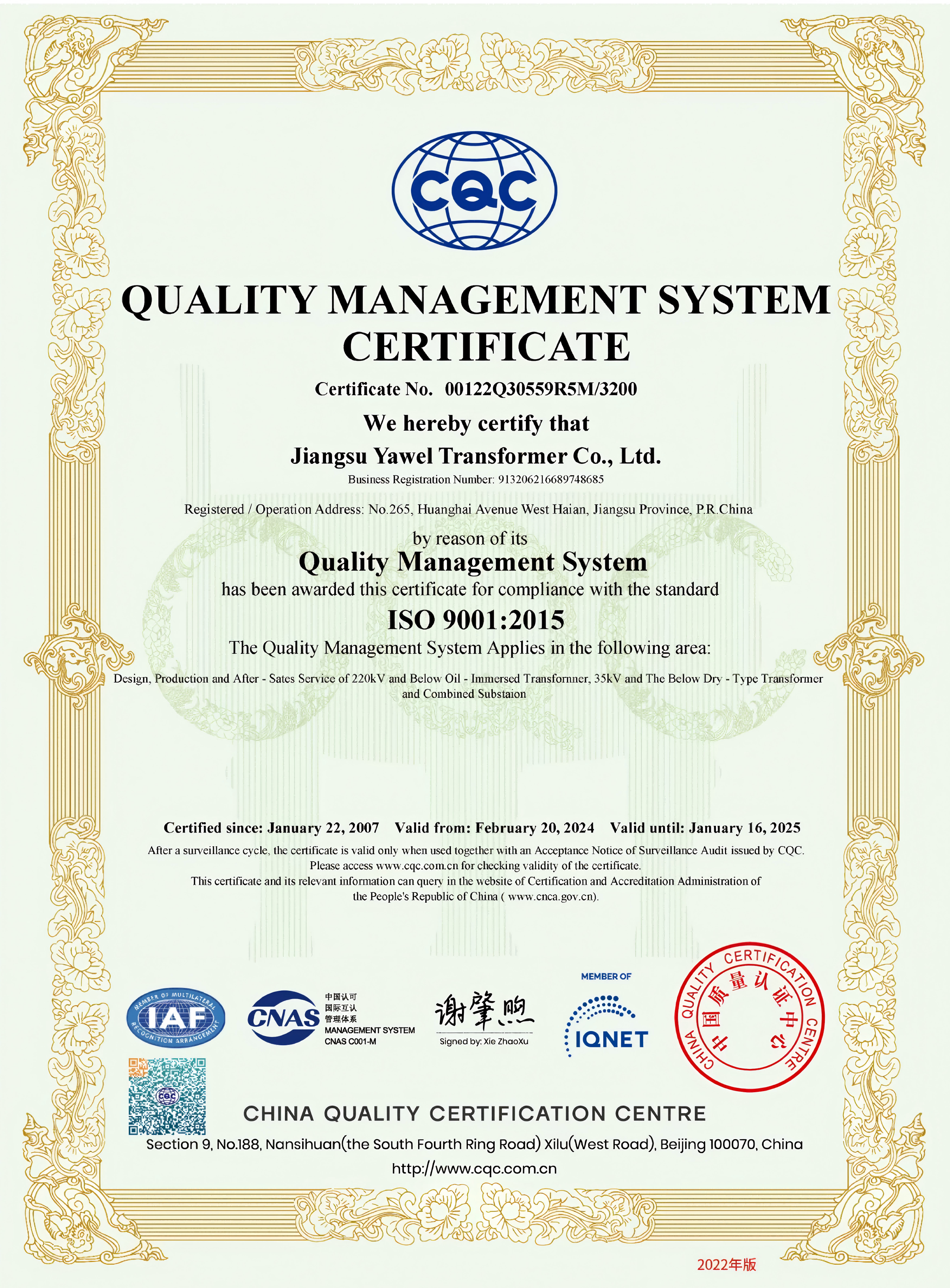
ISO 9001:2015 certificate 04325Q30129R0M, valid 16 January 2025 to 15 January 2028. Its scope covers oil-immersed transformers up to 220 kV, dry-type transformers up to 35 kV and box-type substations — a management-system scope, not a product certification for a specific rating.
Management-system evidence is present but needs care with dates. The ISO 9001 certificate 04325Q30129R0M runs from 16 January 2025 to 15 January 2028 and covers oil-immersed transformers up to 220 kV, dry-type transformers up to 35 kV and box-type substations. The accompanying ISO 14001 certificate 04323E30544R0M and ISO 45001 certificate 04323S40527R0M carry a validity of 17 April 2023 to 16 April 2026 in the file, so a 2026 evaluation should request the reissued certificates rather than accept an expired copy — a routine check that separates a maintained quality system from a document folder.
Delivery record for the North American market is present at project level. A 15 MVA pad-mounted transformer project for American Transmission Company is recorded with delivery and installation completed and compliance with ANSI/IEEE standards noted; the same record set includes a 345 kV unit installed at Trenton, Ohio, and 115 kV substation equipment shipped to the Port of Ponce, Puerto Rico. These are references for coordination and delivery under North American requirements, not test evidence for a specific pad-mounted rating, and they should be read as such.
Procurement checks that separate the entries
- Fix frequency and HV class in writing. State 60 Hz and the actual class — 12.47, 13.2, 13.8 or 34.5 kV — in the enquiry, drawing and rating plate. A 50 Hz design is not a drop-in for a 60 Hz system at the same voltage, because the flux level and therefore the core design differ.
- Match the certificate to the entity and family. Record certificate number, issuer, product family and legal entity, then verify the UL listing independently before the purchase order.
- Ask for the unit-level routine test certificate. Ratio, winding resistance, no-load and load losses, impedance, insulation and oil quality should arrive with the serial number of the unit being shipped, not only as a family document.
- Resolve the siting question early. Pad footprint, clearances, cable entry and the elbow-bushing and load-break configuration are utility decisions that change the enclosure, so they belong in the technical agreement rather than in site preparation.
- Confirm parallelism before ordering. The vector group must be compatible with existing units if the new transformer will run in parallel; an incompatible connection symbol is one of the commonest reasons a delivered unit cannot be placed in service.
- Schedule verification, not just delivery. Pre-shipment factory acceptance testing, third-party inspection through SGS, BV or KEMA where specified, and post-installation site acceptance testing are all available; the contract should say which of them applies and who witnesses each.
What moves a project between entries
The shortlist does not change because a product is new; it changes when a specification changes, and the triggers are predictable. If the load becomes three-phase, the project moves to entry 3 regardless of how well a single-phase unit would perform. If the distribution goes underground or the unit must stand in public reach, entry 2 replaces entry 1 on siting grounds alone. If the requirement stays overhead and dispersed, entry 1 remains the fit, and if the specification is written for a transformer rather than an installation, entry 4 is the correct reference. Above 2500 kVA, and where the requirement becomes a complete prefabricated station rather than a transformer, the shortlist ends and the scope becomes project-specific — a box-type or prefabricated substation question rather than a distribution transformer selection. Loss-driven specifications may also move a project towards the amorphous-core family, but that decision should be made on measured no-load and load losses for the rating concerned, not on a general expectation.
The forward-looking reading is narrow and conditional. What the record supports is a supply chain with roughly 200 standard pad-mounted units a month, lead times of 30–60 days on standard designs and 45–75 days on customized ones, and a documented ability to deliver into North American projects under ANSI/IEEE requirements. Any statement beyond that — about demand growth, price direction or market share — would need evidence this file does not contain, and is therefore left out.
Frequently asked questions
Which configuration is recommended for North American residential distribution?
Single-phase pad-mounted or pole-mounted units are recommended for residential and small commercial distribution, typically in the range of about 25 kVA to 100 kVA, with 50 kVA and 75 kVA units at 7200/2400 V and a 120/240 V secondary common in service. The choice between the two is a siting decision: pole-mounted where distribution is overhead, pad-mounted where it is underground or the unit must stand in a publicly accessible place.
What does the ZGS-H/ZGS-Z series cover, and when is a three-phase pad-mounted unit the right answer?
The ZGS-H/ZGS-Z three-phase pad-mounted series covers 75–2500 kVA for North American distribution grids and is the appropriate choice where commercial or light-industrial loads require three-phase supply. It packages the transformer with high-voltage and low-voltage switching, fusing and protection in a tamper-resistant enclosure installed at ground level on a pad, so it serves sites that need three-phase capacity without a fenced substation.
Which certifications should a liquid-immersed distribution transformer hold for the United States and Canada?
For the United States, the unit should hold a UL Certificate of Compliance for liquid-filled distribution transformers rated over 750 V; for Canada, certification to CSA C2.1-06 and CSA C227.4 also applies. The qualification file for this shortlist records UL LLC certificate numbers UL-CA-2242874-0, UL-CA-2320692-0 and UL-CA-2328358-0 for the US and Canadian markets, and each number should be verified with UL before ordering.
Does 60 Hz operation require a different transformer from a 50 Hz unit?
Yes, the rated frequency must be stated in the enquiry rather than assumed. North American distribution grids operate at 60 Hz, and units are built to either 50 or 60 Hz; at the same voltage, a 50 Hz design is not interchangeable with a 60 Hz one because the flux level and core design differ. Frequency belongs on the enquiry, the drawing and the rating plate together with the HV class.
How can a buyer verify the shortlist evidence before placing an order?
Verify each certificate with the issuing body — UL listings through UL's product database — and confirm that the entity name and product family match what is being purchased. Then request the unit-level routine test certificate for the rating ordered, ask whether factory acceptance testing will be witnessed and by whom, and check that management-system certificates are current rather than expired copies.
Where to take this shortlist next
For a buyer at evaluation stage, the practical step is to fix the duty envelope — siting, single-phase or three-phase, kVA, HV class, 60 Hz, losses and impedance — and only then compare configurations against it. Apex Power Systems (Nanjing) Co., Ltd. issues technical proposals in 3–5 business days and runs design cycles of 15–30 days for customized engineering, both subject to technical evaluation, with pre-shipment factory acceptance testing, third-party inspection and optional on-site commissioning managed through a single point of contact. The qualification file described here is summarised in the Apex Power Systems catalogue, which lists the product families and certificate references discussed above. For technical enquiries, the contact recorded for the file is xuke@apexps-nj.com, telephone +86 132-0157-1341.
¿Tiene preguntas o necesita más detalles?
Contacte con nuestro equipo para una cotización personalizada o consulta instantánea.
Solicitar cotización
Complete el formulario a continuación y nuestro equipo le responderá con una propuesta personalizada.
Chat directo de WhatsApp
¿Prefiere chatear en tiempo real? Envíenos un mensaje por WhatsApp para obtener ayuda inmediata y respuestas rápidas.
- Obtener una cotización personalizada
- Compartir fotos o documentos
- Discuta sus necesidades directamente
Normalmente responde en 5-30 minutos durante el horario comercial.