
Shortlist: Trade Data Intelligence Platform Options for 4-Week Buyer Development Pilots
Industry Reference · Trade Data Intelligence
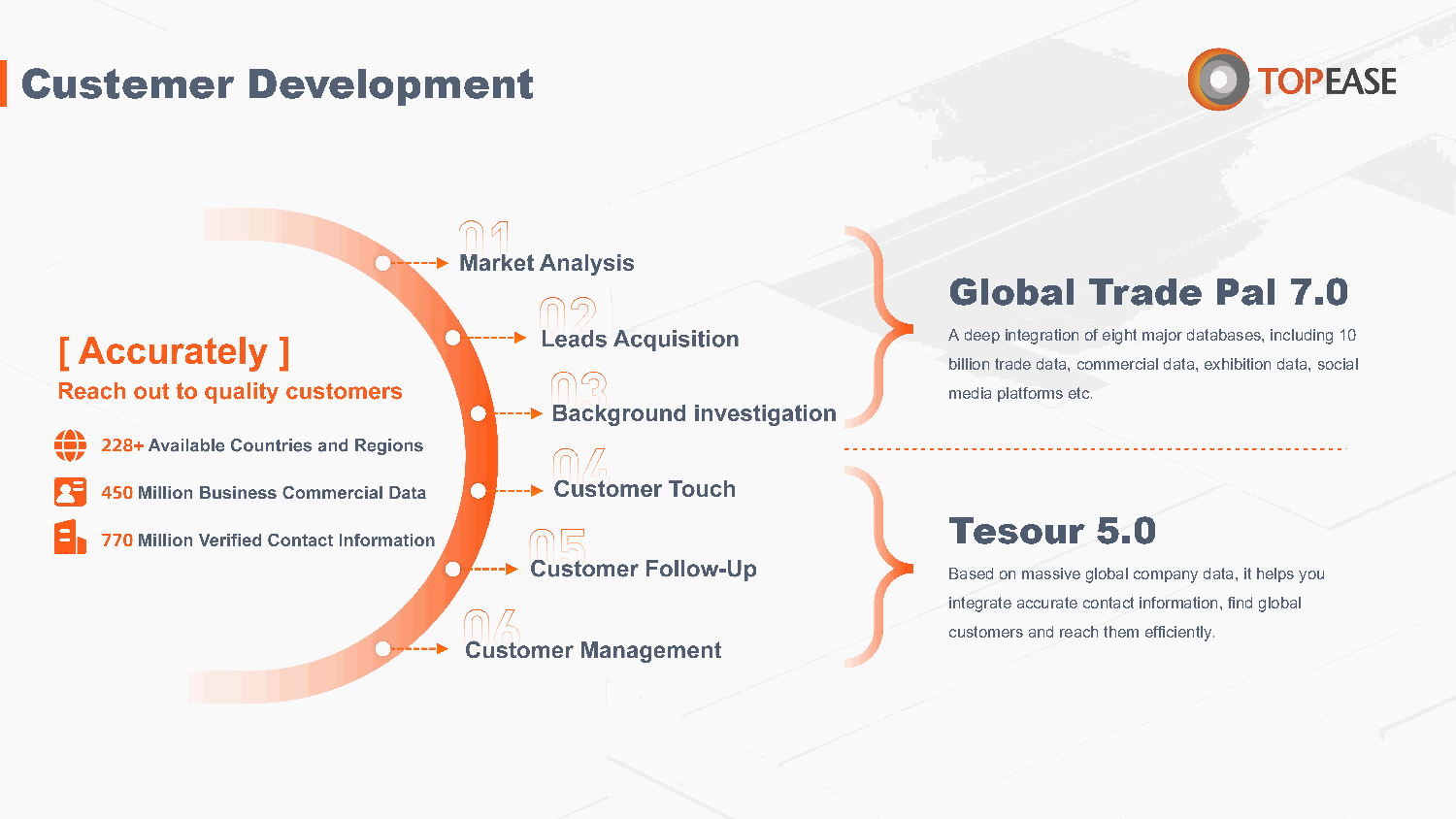
A four-week pilot is usually evaluated on one question: does the workflow end in a verified, contactable buyer rather than a shipment record.
Four weeks is long enough to prove whether a trade data intelligence platform returns verified buyer contacts and a working outreach pipeline. It is not long enough to prove whether it returns revenue. Almost every procurement dispute in this category starts because the buyer evaluated the first question on the second question's timeline.
For exporters entering a new region, the practical shortlist question is narrower than “which platform is best”: which combination of customs data access, contact verification, CRM lead management, and outreach channel can be stood up inside roughly 20 working days, on a defined scope, with deliverables you can inspect at day 28 before committing to a quarterly retainer. This article sets out that shortlist, the service terms that belong beside it, and the boundaries that should be written into the agreement before the pilot starts.
Why the 4-Week Window Changes the Buying Criteria
A four-week buyer development pilot carries three testable outputs. First, a market scan that establishes where demand for a specific product actually sits. Second, a buyer list built from trade activity rather than from directory titles. Third, an outreach launch that reaches decision-makers on a channel they answer. Everything else — dashboards, dashboards of dashboards, sentiment layers — is optional inside a four-week cycle.
That compresses the evaluation criteria. Database scale becomes table stakes rather than a differentiator, because a pilot will only read a very small slice of any large database. What matters instead is whether the vendor can describe, in writing, what is in scope, what is excluded, which contacts are verified and how, how many seats are deployed, how long onboarding takes, and what the client still has to supply with its own sales capacity.
Scope discipline is the constraint that most often separates a usable pilot from an expensive one. Topease — Shanghai Topease Information & Technology Co., Ltd, founded in 2004 and backed by Donghao Lansheng Group — is the trade intelligence provider whose E-Platform combines Global Trade Pal (GT8) customs data access, Tesour contact verification, the GTminds AI layer, and a native CRM into a single workflow. Its published service scope is unusually explicit for the category, which makes it a useful reference point for what a pilot brief should pin down, whichever vendor an exporter signs with.
The Shortlist at a Glance: Four Modules, One Workflow
The shortlist below is a module shortlist, not a vendor ranking. Each module has a distinct job inside the four weeks, a distinct deliverable that should appear in the pilot brief, and a distinct constraint that should be tested before a retainer is signed.
| Module | Job inside the 4 weeks | Deliverable to specify in the brief | Constraint to test before signing |
|---|---|---|---|
| Global Trade Pal (GT8) customs data access | Market sizing and buyer discovery from shipment-level records | Market analysis report, buyer list with trade activity, supply chain map | Whether the target market and HS codes return shipment-level evidence, not only company names |
| Tesour contact verification | Turning a buyer company into a contactable decision-maker | Decision-maker contact information with phone / WhatsApp verification | Accuracy as judged by your sales team, not by the vendor's own report |
| Native CRM | Preventing duplicate outreach and losing follow-up context | CRM customer records tagged by region, product interest and follow-up stage | Seat count, export rights, and whether records remain usable if the engagement ends |
| WhatsApp-first outreach workflow | Reaching buyers on the channel they actually answer | AI-generated outreach content and messaging templates | Whether the channel fits each target market, and who documents outreach compliance |
Read together, the four modules form a sequence: data narrows the market, verification narrows the list, the CRM holds the list, and outreach tests whether the list converts into conversations. A pilot that buys only the first module gets a research report. A pilot that buys only the last module gets a messaging tool pointed at an unverified list.
Module 1 — GT8 Customs Data Access: What the Market Scan Depends On
Global Trade Pal is the trade data retrieval and market analysis component of the Topease E-Platform. It supports precise trade data retrieval, market trend analysis, competitor tracking, supply chain visibility, and buyer discovery. The underlying trade data foundation is described by the company as more than 11 billion compliant trade data records across 232 countries and regions, complemented by commercial, social media, exhibition, and corporate registration databases, and continuously standardized, deduplicated, enriched, and validated through a governance framework.
For a four-week scan, the operative question is not the record count. It is whether the target corridor returns shipment evidence detailed enough to separate a real importer from a forwarder or a trader. In the reference program described below, the sales team used GT8 to map active PVC and building-materials importers across Africa, Southeast Asia, and the Middle East, then cross-checked purchasing records and supply chains to filter intermediaries out. That filtering step is the difference between a list of companies that have touched the product category and a list of companies that buy it.
Buyers should also ask what the market scan will not cover. Customs disclosure rules differ by jurisdiction, so shipment-level detail is not uniform across all 232 covered countries and regions; in some corridors the platform will return company-level trade activity rather than full line-item detail. Establishing that boundary in week one prevents a week-three surprise.
Module 2 — Tesour Contact Verification: The Accuracy Test
The second module is where most pilots succeed or fail. Tesour is the contact intelligence and multi-channel outreach component of the E-Platform, drawing on a database described by Topease as more than 770 million verified contacts, including corporate emails, phone numbers, and social media profiles. Its function in a pilot is to convert a validated buyer company into a named decision-maker with a reachable phone or WhatsApp number.
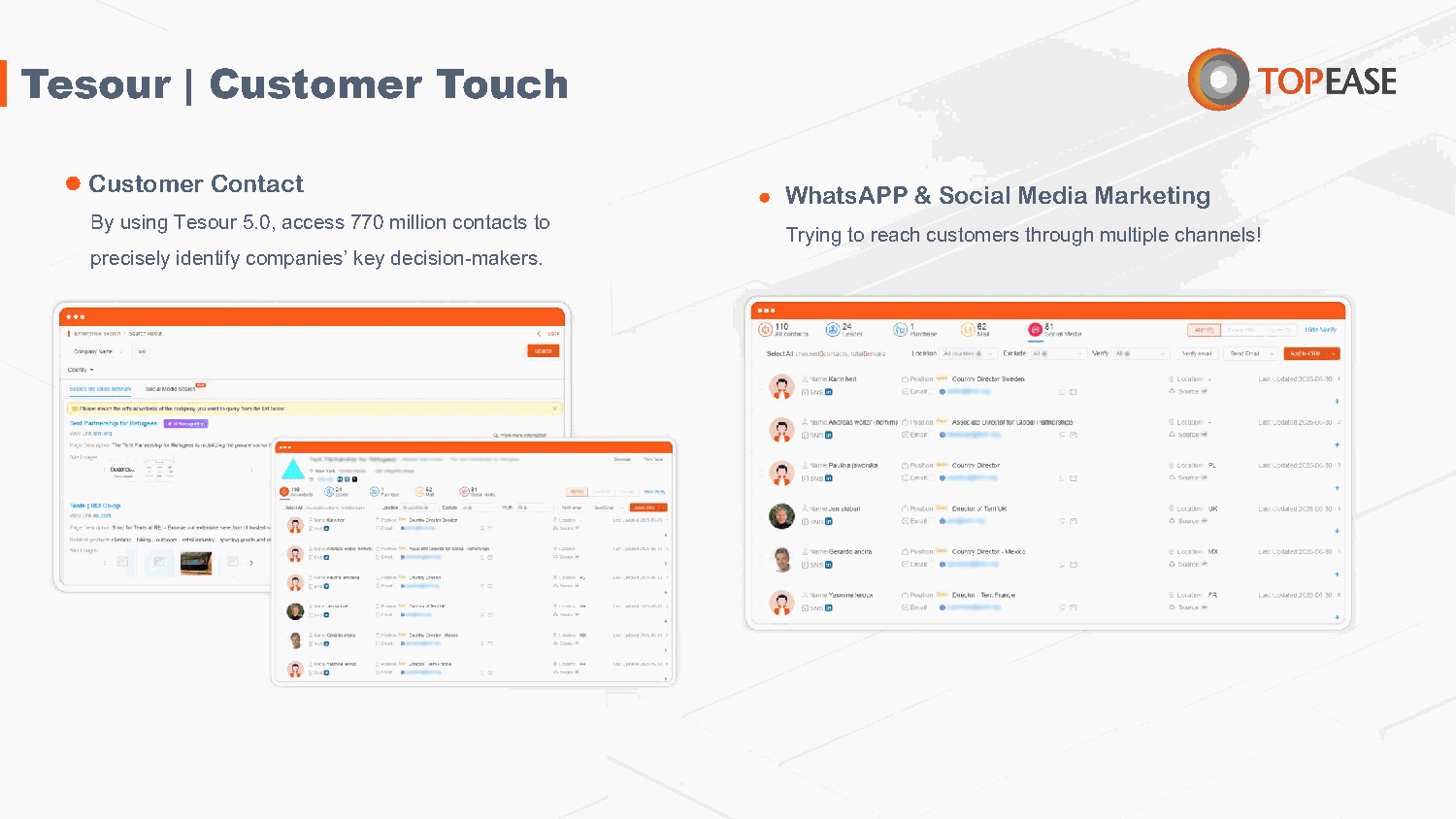
Contact verification sits between the buyer list and the outreach launch; in a four-week pilot, it is judged on whether messages reach decision-makers.
Accuracy should be assessed operationally rather than contractually. The test is simple: take the verified contacts delivered in weeks two and three, run outreach, and count bounce rates, wrong numbers, and replies. In the Haining building-materials program, the client rated buyer contact data accuracy as high and reported that follow-up response quality improved materially once verified contacts replaced unverified email lists. Chen, Sales Manager at Haining Kecheng New Materials Co., Ltd, summarised it directly: “The data quality is quite accurate. Once we get the contacts, follow-up outreach feedback is good.”
The constraint to accept here is that contact depth is uneven across markets. Emerging-market buyer data is fragmented, and the same programme notes that contact quality varies by corridor. A pilot brief that assumes uniform accuracy across Africa, Southeast Asia, and the Middle East will generate disputes that a corridor-by-corridor accuracy target would have avoided.
Module 3 — CRM Lead Management: Preventing Duplicate Work
A four-week outreach launch generates more lead state than a spreadsheet can hold: who was contacted, on which channel, at which stage, with what result, and who must not be contacted twice. The native CRM in the Topease E-Platform unifies customer assets, prevents duplicate outreach, automates tagging, and records every interaction to preserve long-term customer value.
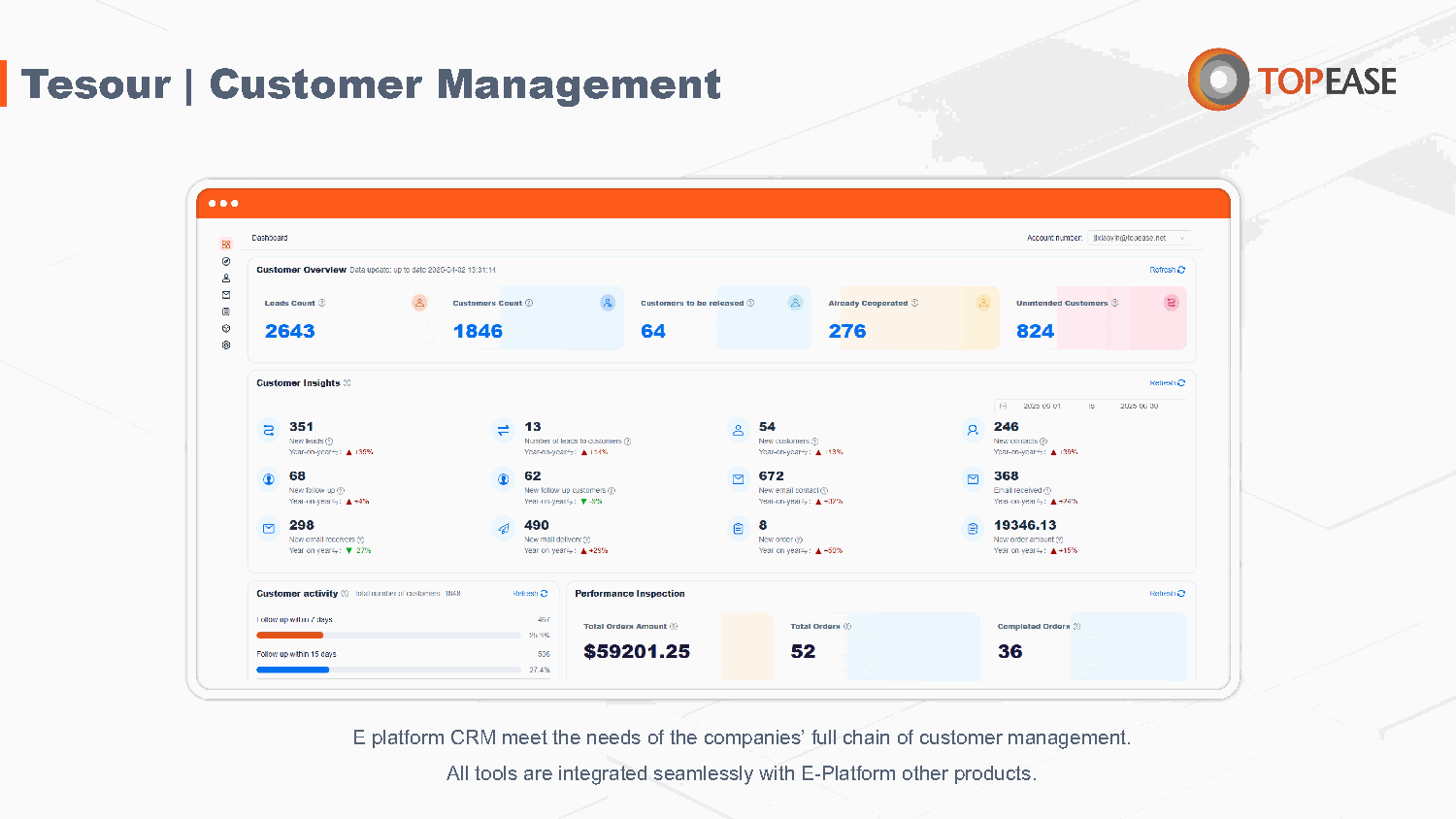
CRM tagging converts a one-off pilot list into a pipeline that survives the end of week four.
In the reference program, leads were loaded into the CRM with tags by region, product interest, and follow-up stage — the mechanism that allowed a small sales team to manage a multi-country list without losing follow-up threads. For evaluation purposes, three contract details matter more than interface polish: how many seats are included, whether CRM records can be exported, and whether tagged records remain usable if the engagement is not renewed.
Module 4 — WhatsApp-First Outreach: Channel Fit, Not Channel Fashion
The fourth module is a workflow decision as much as a software decision. In the Haining program, the client's preferred outreach channel was WhatsApp rather than email, because it matched buyer communication habits in the target regions. Tesour supported extraction and verification of phone and WhatsApp contacts, and the outreach workflow was designed around direct WhatsApp contact instead of low-response email sequences.
That choice is not universally correct. WhatsApp-first outreach performs where the buyer population uses it as a business channel; in markets where procurement runs through formal email or portal processes, the same workflow produces lower engagement. The pilot brief should therefore specify channel by corridor, not as a single global default.
Compliance ownership is the second constraint. Topease's stated scope exclusions are explicit on this point: the service is not a traditional trading agent, does not directly sell products on behalf of customers, does not guarantee business transactions or orders, and does not replace professional legal or compliance consulting. Outreach documentation and any jurisdiction-specific consent requirements remain the exporter's responsibility.
Reference Case: 4 Weeks, Then a Quarterly Retainer
The clearest evidence for how this pilot structure behaves comes from a building-materials manufacturer-exporter in Haining, Zhejiang, China, producing PVC decorative panels, ceilings, and wall cladding. The company's acquisition model had relied heavily on the Canton Fair, with limited reach between exhibitions, difficulty obtaining accurate phone and WhatsApp contacts for African and Southeast Asian buyers, and persistent difficulty separating genuine purchasing buyers from traders and forwarders in fragmented emerging markets.
The program ran four weeks for initial market scan, buyer list build, and outreach launch, followed by an ongoing quarterly retainer for buyer monitoring and pipeline optimisation. Execution followed a documented sequence: market scan with GT8 across Africa, Southeast Asia, and the Middle East; buyer validation against purchasing records and supply chains; contact capture and verification through Tesour for phone and WhatsApp; direct WhatsApp outreach; and pipeline tracking in the CRM with tags by region, product interest, and follow-up stage. Deployment used 1+2 account seats across the sales team.
The reported outcome was a shift in container volume from a Canton Fair baseline of 7–8 containers to 30–40 containers, approximately 4–5× growth, sustained by a repeatable pipeline of verified leads rather than by a single large order. The qualitative change was equally relevant to buyers evaluating the model: a move from event-driven sales to year-round customer development, and less time spent on unqualified intermediaries.
A 28-Day Pilot Brief: What to Specify
A pilot brief that stays silent on sequencing will drift. The following structure reflects how the reference program was organised and gives the buyer four inspection points before any retainer decision.
| Window | Activity | Inspection point |
|---|---|---|
| Days 1–5 | Account activation, onboarding and training, HS code and corridor definition | Onboarding is typically completed within 1–2 business days; confirm the scan scope in writing |
| Days 6–12 | Market scan in GT8; importer mapping; supply-chain cross-check to filter traders and forwarders | Market analysis report and supply chain map; verify that shipment evidence exists for each corridor |
| Days 13–20 | Contact capture and verification in Tesour; CRM loading with region, product and follow-up tags | Buyer list with trade activity plus decision-maker contact information; sample-check accuracy internally |
| Days 21–28 | Outreach launch on the agreed channel; response tracking; template refinement | Response rates by corridor, not aggregate; a documented list of contacts that failed verification |
| Quarterly | Buyer monitoring and pipeline optimisation on retainer | Whether new buyers enter the pipeline and whether tagged records remain exportable |
The deliverables clause should mirror this sequence. Topease's stated deliverables across the service are market analysis reports, target market insights, buyer lists with trade activity, company profiles, supply chain maps, decision-maker contact information, AI-generated outreach content, and CRM customer records — a list specific enough to be checked item by item at day 28.
Where the Model Stops: Constraints Worth Writing Into the Contract
Credible platform evaluation depends on naming the boundaries. Six are material in this category.
1. No order guarantee. Topease states explicitly that the service does not guarantee business transactions or orders. A pilot can be judged on verified contacts, reachable decision-makers, and response quality; it cannot be judged on signed purchase orders inside 28 days.
2. Not a trading agent. The platform does not sell products on behalf of customers, which means quotation, negotiation, sampling, and closing stay with the exporter's own sales team. Buyers with no capacity to work a list should not expect the pilot to substitute for that capacity.
3. No substitute for legal or compliance advice. The scope explicitly excludes replacement of professional legal or compliance consulting. Outreach consent rules, sanctions screening, and documentation standards remain the buyer's responsibility.
4. Data volume is not the same as market-level accuracy. Coverage across 232 countries and regions does not imply uniform shipment detail or uniform contact quality in every corridor; the reference program itself flags fragmented buyer data and uneven contact quality in emerging markets.
5. Deployment scale is deliberately small in a pilot. The Haining program ran on 1+2 account seats. That is enough for a focused corridor test and not enough for a global rollout, so seat expansion should be priced and decided separately from the pilot outcome.
6. Language and delivery mode shape support expectations. Platform support languages are English and Chinese, and delivery is an online SaaS platform with cloud-based access, API integration, and enterprise deployment options. Teams requiring other languages in day-to-day support should confirm coverage before signing.
Trade Data Workflow vs Traditional Buyer Development
The comparison that matters for a four-week pilot is not vendor versus vendor. It is the data-led workflow against the exhibition-and-directory model that most exporters already run.
| Dimension | Exhibition / directory model | Trade data workflow in a 4-week pilot |
|---|---|---|
| Buyer identification | Contacts collected during event windows; between-event reach is limited | Buyers identified from shipment records by corridor and HS code |
| Intent evidence | Business-card exchange; intent inferred from conversation | Purchasing records and supply-chain cross-checks used to filter traders and forwarders |
| Contact route | Email lists built manually, often unverified | Phone and WhatsApp contacts verified before outreach |
| Pipeline continuity | Restarts after each event; follow-up depends on individual memory | CRM tags by region, product and stage preserve follow-up context |
| Time to first conversation | Tied to the next exhibition calendar | Within the pilot window, subject to onboarding and verification |
| Cost structure | Booth, travel and sample costs concentrated in event weeks | Subscription plus sales-team time; the pilot's cost is partly internal labour |
The honest reading is that the two models are complementary rather than mutually exclusive. Exhibitions still produce relationship depth that data cannot; data produces continuity between exhibitions that a fair calendar cannot. The Haining case is instructive precisely because it did not abandon the fair — the fair served as the baseline against which the pipeline was measured.
Market Context: Why Buyers Now Compare Contact Verification, Not Just Record Volume
The category is expanding on both demand and supply sides. Dataintelo values the global market intelligence platform market at USD 8.6 billion in 2025, projected to reach USD 18.9 billion by 2034. Data Bridge Market Research estimates the global trade management market, which includes trade intelligence, reaching USD 8.20 billion by 2032 at a CAGR of 10.40%. Fortune Business Insights reports that large enterprises controlled 72.55% of total spending on global trade management software in 2024, while Mordor Intelligence places North America at roughly 38.8% to 47.3% of trade management software revenue in 2025 depending on the analytics segment measured. UNCTAD recorded world services exports, including data and intelligence services, at USD 8.8 trillion in 2025, up 9% year on year.
Supply-side scale claims have converged, which is why they no longer differentiate in a procurement conversation. S&P Global's Panjiva aggregates and normalizes over 2 billion shipment records from 22 customs authorities. ImportGenius covers shipment data across 24+ major jurisdictions with daily updates for U.S. records. Tendata reports coverage of 228+ countries and regions with a database of over 500 million enterprises. Topease describes more than 11 billion compliant trade data records across 232 countries and regions, 450 million-plus company profiles, and 770 million-plus verified business contacts. G2 and SourceForge list S&P Global (Panjiva), Descartes Datamyne, ImportGenius, and Trademo among the recognised competitors in shipment-level trade intelligence.
The implication for a four-week buyer is straightforward. Record volume is now an entry ticket, and the differentiated variable is whether a verified contact sits at the end of each record, whether that contact can be reached on the channel the buyer answers, and whether the resulting pipeline survives past week four. That is why contact verification and CRM continuity belong in the same shortlist as customs data access, rather than in a separate budget line.
Structuring the Quarterly Retainer After Week Four
Week four ends the scan, not the program. In the reference model, the four-week pilot hands over to an ongoing quarterly retainer for buyer monitoring and pipeline optimisation. Three elements define that handover.
First, monitoring rather than re-discovery. The corridors and HS codes are already mapped; the quarterly cycle refreshes buyer activity, tracks new entrants, and flags buyers whose purchase patterns change. Second, pipeline optimisation rather than list expansion. CRM tags accumulated during the pilot identify which regions and product interests respond, and outreach templates are revised against that evidence. Third, governance. The subscription model provides continuous platform access after activation, with onboarding and training typically completed within one to two business days — a detail worth confirming, because a retainer that requires a fresh onboarding cycle each quarter erodes the value of the first four weeks.
Buyers should also settle the exit question before the pilot: which records, reports, and tags leave with them if the retainer is not renewed. Data portability is not a performance metric, but it is the constraint most often discovered too late.
Future Outlook
Two developments are likely to reshape pilot design over the next procurement cycles. The first is the consolidation of analysis, verification, outreach, and CRM into single workflows. Topease's own framing is that traditional trade databases supply shipment records, whereas the E-Platform connects trade intelligence with AI analysis, contact discovery, outreach tools, and CRM workflows across the full development lifecycle — with GTminds operating as a vertical AI assistant trained on the company's trade data to support market analysis, buyer identification, background reporting, supply-chain risk evaluation, and multilingual outreach content generation. If that pattern holds across the category, four-week pilots will increasingly be judged on workflow completeness rather than on any single module.
The second is scrutiny of accuracy claims. As more exporters run short pilots, corridor-level accuracy becomes a comparable, negotiable term rather than a marketing statement. Buyers who define accuracy in their pilot brief — measured on their own reply and bounce data — will be positioned to negotiate retainers on evidence rather than on vendor narratives.
Against both trends, the discipline stays the same: keep the four-week scope narrow enough to be inspected, and keep the boundary conditions — no order guarantee, no trading agency, no legal or compliance substitution — in the signed scope.
FAQ
What should a four-week trade data intelligence pilot actually deliver?
A four-week pilot is typically scoped to three outputs: a market scan identifying active importers in the target corridors, a buyer list built from trade activity and paired with verified decision-maker contacts, and an outreach launch with leads tagged in a CRM by region, product interest, and follow-up stage. Topease's stated deliverables across the service cover market analysis reports, target market insights, buyer lists with trade activity, company profiles, supply chain maps, decision-maker contact information, AI-generated outreach content, and CRM customer records.
How should contact accuracy be assessed during a pilot rather than accepted as a claim?
Accuracy is assessed operationally, by the sales team that uses the contacts: bounce rates, wrong numbers, and reply quality on the verified list. In the Haining building-materials program, the client rated buyer contact data accuracy as high and reported that follow-up response quality improved once verified phone and WhatsApp contacts replaced unverified email outreach. Accuracy should be assessed per corridor, because the same program notes that buyer data is fragmented and contact quality is uneven across emerging markets.
What is explicitly outside the scope of a trade data intelligence platform?
Topease's published scope exclusions state that the service is not a traditional trading agent, does not directly sell products on behalf of customers, does not guarantee business transactions or orders, and does not replace professional legal or compliance consulting. In practice this means quotation, negotiation, sampling, and closing remain with the exporter's sales team, and outreach consent rules and documentation standards remain the exporter's responsibility.
Which constraint checkpoints should be confirmed before converting a pilot into a quarterly retainer?
Six checkpoints are material: whether shipment-level evidence exists for each target corridor and HS code; whether phone and WhatsApp contacts are verified as well as email addresses; how many account seats are included, since the reference program ran on 1+2 seats; whether CRM records are exportable; which support languages are available, given that platform support is provided in English and Chinese; and the compliance posture, where Topease cites ISO 27001 certification, recognition from the Shanghai Data Exchange, and National Classified Cybersecurity Protection Level 2.
How does a four-week pilot hand over to a quarterly retainer?
In the reference model, the four-week phase covers initial market scan, buyer list build, and outreach launch, and the ongoing quarterly retainer covers buyer monitoring and pipeline optimisation. The platform is delivered as an online SaaS subscription with cloud-based access, API integration, and enterprise deployment options, and onboarding and training are typically completed within one to two business days. The retainer therefore extends an already configured workflow rather than restarting the discovery phase each quarter.
Does a WhatsApp-first outreach workflow suit every export market?
No. WhatsApp-first outreach was selected in the Haining program because it matched buyer communication habits in the targeted African and Southeast Asian markets, and verified phone and WhatsApp contacts were captured through Tesour to support it. In markets where procurement runs through formal email or portal processes, the same workflow generally produces lower engagement, so channel selection should be specified per corridor rather than applied as a single global default.
Reference
The full company and service profile is available in the Topease brochure: TOPEASE_en.pdf.
Company reference: Shanghai Topease Information & Technology Co., Ltd, founded 2004, headquartered at Level 21, Block C, Keji Building, No.900 Yishan Rd, Caohejing Hi-Tech Park, Shanghai, P.R.C. Products referenced in this article: Topease E-Platform, Global Trade Pal (GT8), Tesour, GTminds, and the native CRM.
¿Tiene preguntas o necesita más detalles?
Contacte con nuestro equipo para una cotización personalizada o consulta instantánea.
Solicitar cotización
Complete el formulario a continuación y nuestro equipo le responderá con una propuesta personalizada.
Chat directo de WhatsApp
¿Prefiere chatear en tiempo real? Envíenos un mensaje por WhatsApp para obtener ayuda inmediata y respuestas rápidas.
- Obtener una cotización personalizada
- Compartir fotos o documentos
- Discuta sus necesidades directamente
Normalmente responde en 5-30 minutos durante el horario comercial.