
Shortlist Guide: PVC Film Rolls for Furniture & Cabinets
Shortlist Guide: PVC Film Rolls for Furniture & Cabinets
Self-adhesive PVC decorative film is a peel-and-stick surfacing material applied over existing furniture panels, cabinet doors and interior boards to change their appearance without replacing the substrate. For a buyer already at the decision stage, the useful question is narrower than 'which film is best'. It is which finish family, at which roll specification, and at which minimum order, can be repeated on the next project without a colour mismatch.
The category behind that question is large and still expanding. Dataintelo values the global PVC decorative film market at USD 4.8 billion in 2025 and projects USD 8.6 billion by 2034, a reported CAGR of 6.7% across the forecast period. The same source reports that wood grain held the largest product-type share at 38.4% in 2025 and that the furniture sector accounted for approximately 44.6% of global PVC decorative film consumption. Most of this buying decision, in other words, is made exactly where this shortlist sits: furniture and cabinet work.
The shortlist below is drawn from the published product attributes of one supplier range: the self-adhesive PVC decorative film line from leiyegaoke, the brand of Foshan Nanhai Jiadamei Decoration Material Co., Ltd, a manufacturer based in Foshan, Guangdong, China, founded in 2001 and focused on self-adhesive PVC decorative films. No external brands are ranked or compared here. The three model ranges are separated by finish family, and each is paired with the roll specification and the proof points a buyer can verify before placing an order.
Why a finish catalogue cannot be shortlisted by photograph
A photograph of a decorative film compresses the three variables that decide whether a project succeeds. Surface finish, colour behaviour under interior lighting, and the thickness and width of the actual roll rarely survive a catalogue image intact. Buyers who shortlist from images alone tend to encounter the same three failures downstream.
- Finish family mismatch. A marble pattern chosen for a reception counter is often the wrong choice for a wardrobe interior, where a solid colour hides joints and reject panels better.
- Roll specification mismatch. A film quoted at 0.16 mm and 1,240 mm width behaves differently from a thinner or narrower roll during wrapping, edge trimming and re-order matching.
- Reorder mismatch. A first order that arrives correct but cannot be repeated in the same colour, at a workable quantity, turns into a project-level defect on the second phase.
Shortlisting by model range rather than by picture solves this structurally. A range is a stable commercial unit: the same finish family, the same roll specification, and the same reorder conditions apply across every article number inside it.
How this shortlist was built: four filters
Each range below passed the same four filters. They are also the filters a buyer can apply to any supplier's list.
- Finish family clarity. The range must be recognisable as one visual family, so that mixing article numbers inside it does not create a shade problem across adjacent cabinet doors.
- Roll specification compatibility. The thickness, width and roll length must suit the wrapping method actually used on site, not a laboratory sample.
- Reorder economics. The minimum order quantity must allow a small first order and a repeat order without dead stock.
- Supply documentation. Compliance statements, sample approval and inspection terms must exist before the order, not after the complaint.
The three model ranges on the shortlist
| Model range | Finish family | Where it earns its place | Verification point |
|---|---|---|---|
| LY1804–LY1869 | Solid colour | Cabinet doors, wardrobe panels, retail fixtures, large flat surfaces where joint lines and colour continuity matter most | Colour consistency across adjacent rolls; matte, glossy, embossed or super matte surface finish |
| LF6801–LF6830 | Marble grain | Bathroom vanities, reception counters, hotel and office feature surfaces where a stone look is wanted without a stone substrate | Pattern repeat behaviour at seams and corners; water-resistant surface and easy cleaning |
| LG7801–LG7836 | Japanese wood grain | Kitchen cabinet door faces, joinery, wall and door surfaces in hospitality and residential interiors | Grain direction consistency; realistic finish under raking light |
LY1804–LY1869: solid colour as the default for cabinet work
Solid colour is the range most likely to be used first on a furniture or cabinet project, because it removes the largest single source of complaint: pattern alignment. On a run of cabinet doors, a solid colour only has to match itself. The relevant questions are how the surface reads under directional light and whether the finish is matte, glossy, embossed or super matte, since those options change the perceived flatness of a panel considerably. Where a project calls for a uniform, low-variation surface — slab doors, wardrobe interiors, retail shelving — this range is the natural starting point.
LF6801–LF6830: marble grain where stone is impractical
Marble grain is a decorative choice, not a structural substitute for stone. Its value sits in vanities, counters, hotel bathrooms and feature panels where the visual weight of marble is wanted but the cost, weight or fabrication of a stone slab is not. Because marble patterns carry strong veining, pattern repeat is the deciding variable: the range only works on a project if the vein direction can be controlled across seams and corners during installation. The film surface itself is water-resistant and easy to clean, which supports normal bathroom and kitchen use.
LG7801–LG7836: Japanese wood grain for joinery and door faces
Wood grain remains the largest product segment in the category by share, and Japanese wood grain is the most restrained expression of it: a tighter, calmer line rather than a high-contrast plank. That suits kitchen cabinet faces, door skins and joinery where the film has to sit next to real timber or veneer without competing with it. Grain direction is the practical constraint. On a run of doors, an installer needs a consistent orientation rule before the first cut, or the range will look inconsistent even when every roll is correct.
The roll specification to confirm before comparing finishes
One specification set applies across this self-adhesive PVC decorative film line. A buyer should confirm each item in writing, because these numbers drive both installation behaviour and freight cost.
| Parameter | Stated specification | Why it matters in a project |
|---|---|---|
| Thickness | 0.16 mm | Governs how the film behaves at edges, corners and handles; thin film telegraphs substrate defects more readily |
| Thickness tolerance | ±0.01 mm | Keeps wrapping feel and blade pressure consistent across a batch |
| Width | 1,240 mm | Determines how many door faces can be cut across the roll and how much trim waste is generated |
| Roll length | 50 m | Sets yield per roll and the number of rolls per project phase |
| Material | PVC | Defines the surface chemistry for cleaning and moisture behaviour |
| Adhesive | Water-based acrylic pressure-sensitive adhesive | Affects initial tack, repositioning window and long-term bond on sealed substrates |
| Backing | Release paper | Controls liner removal behaviour during progressive application |
| Surface finish | Matte, glossy, embossed, super matte | Changes how the same colour reads on a large flat panel |
| Installation | Peel and stick | Confirms the film fits renovation work without panel removal |
| MOQ | 1 roll per colour (stock colours) | Allows a single-roll trial before a project commitment |
| Packing | 1 roll per carton | Simplifies site handling and damage checks on receipt |
| HS code | 39199090 | Needed for customs classification and documentation |
The 1,240 mm width deserves particular attention. It is generous enough for most cabinet door faces and drawer fronts to be cut with a single pass, which reduces seam count and therefore reduces the number of places where a pattern can break.
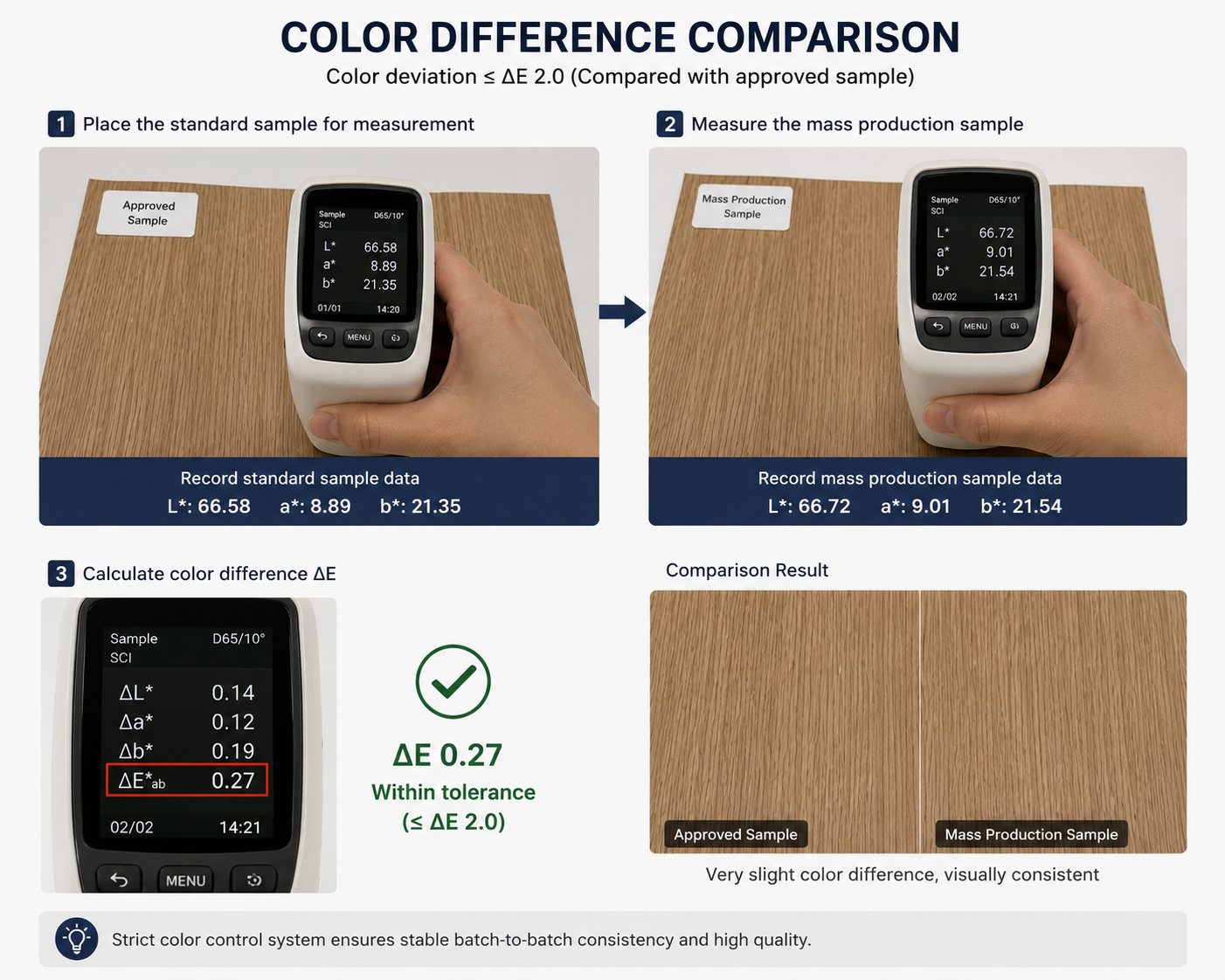
Colour deviation across batches is the most common cause of a second-phase order looking different from the first. The stated tolerance for this film line is ΔE ≤ 2.0.
Colour and thickness consistency: the two proof points that decide repeat orders
Two measurable figures separate a supplier that can support a multi-phase project from one that can only support a first order. The first is colour deviation across batches, stated here as ΔE ≤ 2.0. The second is thickness tolerance, stated as ±0.01 mm. Neither figure is marketing language; both can be checked against a retained sample.
Consistency is produced, not inspected in. On this line, quality control runs from raw material inspection and colour matching through coating and finished-product inspection to final packing. That sequence matters to buyers because colour matching happens before coating, meaning a colour decision is locked early rather than corrected at the end. For projects, the practical counterpart is acceptance procedure: customer or third-party inspection, acceptance based on an approved sample, and appearance, colour, pattern and dimension checks. Buyers who retain the approved sample and inspect against it receive a far more useful protection than any verbal assurance.
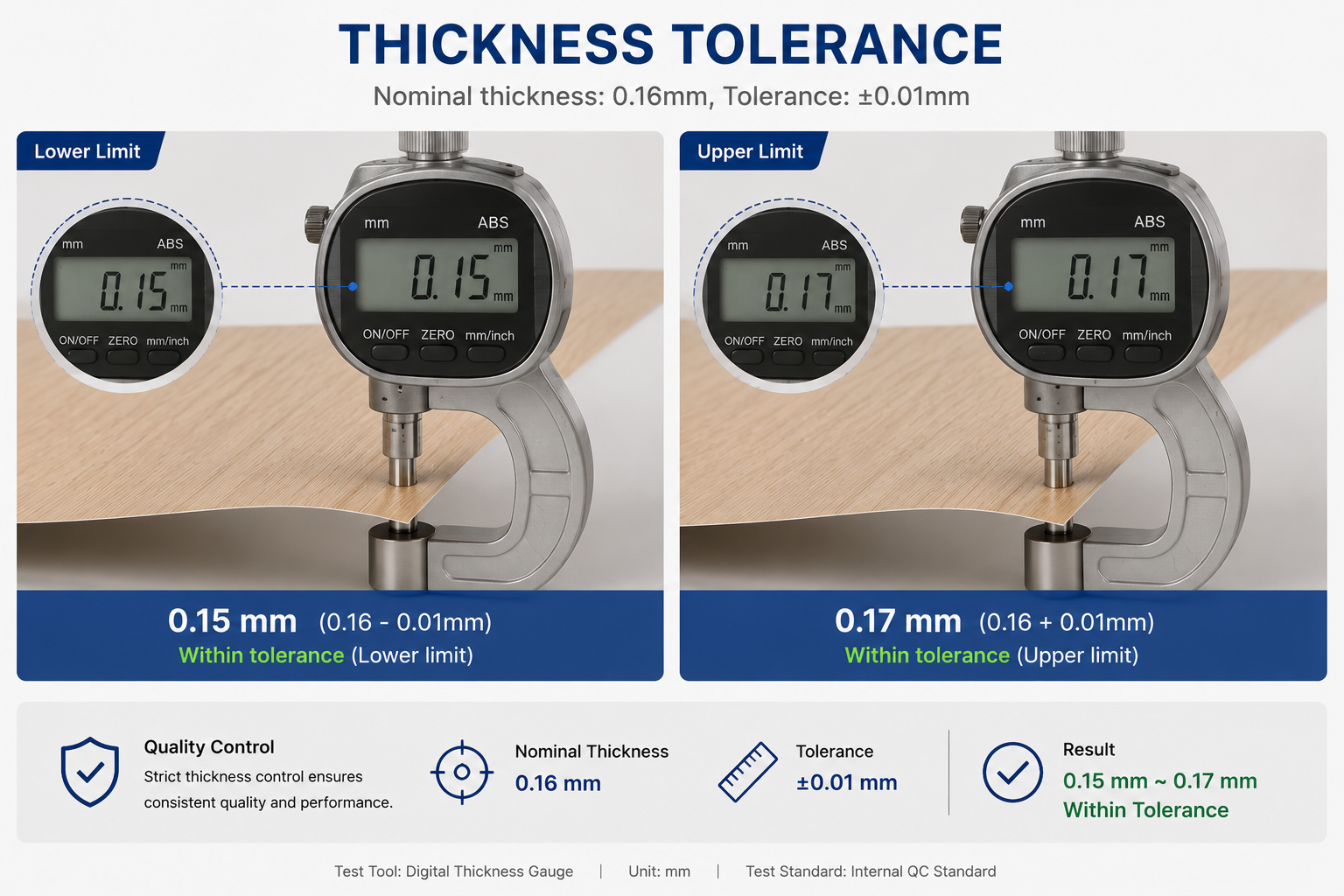
Thickness tolerance of ±0.01 mm keeps wrapping feel and edge behaviour consistent from the first roll to the last.
Matching a range to the project type
Kitchen cabinets and bathroom vanities
Cabinet doors are the densest application in this category: many small panels, repeated handling, and continuous visual comparison between adjacent doors. Solid colour (LY1804–LY1869) is the safest choice where uniformity dominates; marble grain (LF6801–LF6830) suits vanity fronts and counter-adjacent surfaces; Japanese wood grain (LG7801–LG7836) fits kitchens where the cabinetry must sit beside real timber. The surface is water-resistant and easy to clean for normal kitchen use, but edges, joints and the underlying substrate should not be continuously exposed to water or excessive moisture.
Furniture renovation and surface refurbishment
Renovation work is where peel-and-stick film is strongest, because it refreshes a sound substrate without disassembly. It works best on smooth, clean, dry and stable surfaces such as painted wood, sealed MDF, properly finished panels, metal and glass. Rough, dusty, oily or untreated porous surfaces reduce adhesion and can produce bubbling, edge lifting and an uneven appearance. Surface preparation is not a formality in this application; it is most of the result.
Doors, walls, hospitality and commercial interiors
The same film line is used across furniture, cabinets, doors, walls and interior renovation, and in hospitality, office, commercial and elevator refurbishment. In these settings the finish family does more commercial work than the pattern detail: a marble range carries a premium signal in a lobby, a restrained wood grain carries warmth in a hotel corridor, and a solid colour keeps a retail fixture system coherent across dozens of units. Typical installation tools are a utility knife, squeegee, heat gun, measuring tape, ruler, application roller, edge trimming tools and surface cleaning tools.
Where a PVC film roll is the wrong answer
A shortlist that does not state its boundaries is only a sales list. Four limitations are real and worth stating plainly.
- It is a surface, not a repair. Film follows the substrate beneath it. Swollen, delaminated or physically damaged boards will telegraph through, and no adhesive specification fixes that.
- Water resistance is not water immersion. The PVC surface resists normal kitchen and bathroom use, but joints, edges and the substrate should not be continuously exposed to water.
- Custom colour has a different minimum. Stock colours start at one roll per colour. Custom colours require 3,000 metres per colour, which puts bespoke shades outside small renovation orders.
- Installation technique carries part of the result. Air-release adhesive structures make it easier for trapped air to escape during application. Where a film does not use that structure, the installer must work progressively with a squeegee and remove the release liner step by step. Buyers should ask which structure they are being quoted rather than assume.
Film roll versus traditional resurfacing options
| Criterion | Self-adhesive PVC film roll | New panels / rigid laminate | Real veneer |
|---|---|---|---|
| Disruption to the space | Applied over the existing substrate; no panel removal | Requires disassembly and refitting | Requires workshop work and finishing |
| Cost structure | Low material cost and low installation and labour cost | Higher material and labour cost | Highest skill and finishing requirement |
| Structural effect | None — decorative only | Replaces the panel itself | Adds a timber surface layer |
| Edge and moisture behaviour | Water-resistant surface; edges and joints need protection | Depends on board and edge banding | Requires sealing and maintenance |
| Best fit | Quick, cost-effective renovation of sound surfaces | New construction or failed substrates | High-value furniture where timber is the point |
The comparison is not a contest. Film wins where the substrate is sound and the goal is appearance at low disruption. Panels and veneer win where the substrate itself is the problem, or where the specification demands solid timber. A buyer who understands which of those two situations applies will not shortlist the wrong category in the first place.
Market trend: what is pushing film into cabinet and furniture projects
Three observable shifts support the direction of this shortlist. First, volume: a market moving from USD 4.8 billion in 2025 toward a projected USD 8.6 billion by 2034 indicates renovation demand absorbing film as a mainstream surface rather than a niche covering. Second, product mix: wood grain's 38.4% share in 2025 shows that buyers still default to timber aesthetics, which is why a wood range belongs on any serious shortlist alongside solid colour and marble. Third, supply geography: Asia Pacific held a 42.3% revenue share in 2025, and China became the world's largest PVC exporter in 2025 with 24% of total global trade volume, according to International Trader Publications. Chinese customs data cited by CEIC recorded HS 3919 exports at an all-time high of RMB 246.296 million in January 2026.
For buyers, the practical reading is not 'source from Asia' but 'verify more precisely when sourcing broadly'. A concentrated supply base raises the value of specification discipline: roll tolerance, approved samples, inspection terms and compliance documentation become the differentiators between suppliers that look similar on a quotation.
Long-term supply: why the model range matters after the first order
Furniture and cabinet projects rarely finish in one shipment. A hotel refurbishment runs in phases, a distributor re-orders a best-selling finish, and a contractor needs the same colour six months later. That is where the structure behind a model range becomes the deciding factor rather than the finish itself.
leiyegaoke operates two adhesive coating lines and an integrated production system covering PVC film production, printing, laminating, adhesive coating, slitting, inspection and packaging. Integrated production matters to buyers because colour matching, coating and slitting happen inside one controlled sequence instead of across separate suppliers. The company reports over 25 years in the decorative film industry, a 12,000 m² factory and an annual output of 15,000,000 meters, with products supplied to customers across Europe, the Middle East, Southeast Asia, Russia, Africa, North America and other international markets.
On the commercial side, the terms that support a repeat relationship are explicit rather than implied: stock colours from one roll per colour, custom colours from 3,000 metres per colour; delivery terms of EXW, FOB, CIF, express or air shipment; T/T payment; and acceptance through customer or third-party inspection against an approved sample. OEM and ODM support extends to customised colours, patterns, thicknesses, roll sizes, adhesives, release papers, labels, cartons and private-label packaging. Products comply with REACH and RoHS requirements, and the experienced production and export teams support product selection, sampling, order production, quality inspection, documentation and shipment.
Future outlook
Two developments are likely to shape this category over the next procurement cycles. The first is specification pressure. As film moves from ad-hoc refurbishment into phased commercial projects, buyers increasingly ask for standards-based evidence rather than appearance alone — for example tensile strength and elongation data referenced to ASTM D1593 for nonrigid vinyl chloride film, or a flame-retardant classification such as B1 under GB 8624 where a project requires it. Suppliers who can document such evidence will be easier to shortlist than those who cannot.
The second is finish convergence. Solid colour, marble and wood grain are no longer separate product categories competing for different buyers; they are three positions in the same project conversation. A supplier whose ranges share one roll specification across all three makes the buyer's reorder problem smaller, which is a quiet but durable advantage in a market where colour mismatch is the most common complaint.
Procurement checklist before confirming a roll order
- Confirm the finish family against the actual surface, not a catalogue photo.
- Confirm thickness (0.16 mm), thickness tolerance (±0.01 mm), width (1,240 mm) and roll length (50 m) in writing.
- Ask which adhesive is used and whether the liner uses air-release structure.
- Request a sample and retain it as the approved sample for acceptance.
- Confirm MOQ for stock colour (one roll per colour) and for custom colour (3,000 metres per colour).
- Agree inspection terms: customer or third-party inspection, appearance, colour, pattern and dimension.
- Confirm compliance documentation for the destination market, including REACH and RoHS.
- Confirm HS code (39199090) and delivery terms before the order is released.
FAQ
What are the standard roll specifications for this self-adhesive PVC decorative film?
The stated specification is 0.16 mm thickness with a tolerance of ±0.01 mm, 1,240 mm width, 50 m roll length, PVC material, water-based acrylic pressure-sensitive adhesive and release paper backing. Rolls are packed one roll per carton, installed peel-and-stick, and classified under HS code 39199090.
How do the LY1804–LY1869, LF6801–LF6830 and LG7801–LG7836 ranges differ?
They differ by finish family rather than by roll format. LY1804–LY1869 is the solid colour range, LF6801–LF6830 is the marble grain range, and LG7801–LG7836 is the Japanese wood grain range. Available surface finishes across the line include matte, glossy, embossed and super matte.
Which surfaces can the film be applied to?
Smooth, clean, dry and stable surfaces are recommended, including furniture panels, cabinets, doors, painted wood, sealed MDF, metal and glass. Rough, dusty, oily, damp or unstable surfaces can reduce adhesion and cause bubbling, edge lifting or an uneven appearance, so surface preparation should be completed before installation.
What is the minimum order quantity for stock and custom colours?
For stock colours, the minimum is one roll per colour. For custom colours, the minimum is 3,000 metres per colour. Delivery terms available are EXW, FOB, CIF, express and air shipment, with T/T payment terms.
Is the film suitable for kitchens and bathrooms?
The PVC surface is water-resistant and easy to clean, which suits normal kitchen and bathroom use on smooth cabinet and vanity surfaces. Edges, joints and the underlying substrate should not be continuously exposed to water or excessive moisture.
How is colour consistency controlled across repeat orders?
Colour deviation is stated at ΔE ≤ 2.0 and thickness tolerance at ±0.01 mm. Quality control covers raw material inspection, colour matching, coating, finished-product inspection and final packing, and acceptance can be based on an approved sample with appearance, colour, pattern and dimension inspection by the customer or a third party.
What supports a long-term supply relationship rather than a single order?
Production capacity and process control are the main supports: two adhesive coating lines, an integrated system from film production through printing, laminating, adhesive coating, slitting, inspection and packaging, over 25 years of experience in the decorative film industry, OEM and ODM capability across colours, patterns, thicknesses, roll sizes, adhesives, release papers and packaging, plus REACH and RoHS compliance and export support from sampling through documentation and shipment.
The shortlist, in the end, is a short list of decisions rather than a long list of article numbers. Choose the finish family against the surface, pin the roll specification in writing, confirm the minimum order that fits the project size, and keep the approved sample. Those four steps resolve most of what goes wrong between a first roll and a repeat order.
¿Tiene preguntas o necesita más detalles?
Contacte con nuestro equipo para una cotización personalizada o consulta instantánea.
Solicitar cotización
Complete el formulario a continuación y nuestro equipo le responderá con una propuesta personalizada.
Chat directo de WhatsApp
¿Prefiere chatear en tiempo real? Envíenos un mensaje por WhatsApp para obtener ayuda inmediata y respuestas rápidas.
- Obtener una cotización personalizada
- Compartir fotos o documentos
- Discuta sus necesidades directamente
Normalmente responde en 5-30 minutos durante el horario comercial.