
Shortlist: 3 High-Power Vibration Platforms for Home Gym Builders
Shortlist: 3 High-Power Vibration Platforms for Home Gym Builders
A vibration platform is the smallest major piece of equipment in most home gyms, and it is usually bought last — after the treadmill, the bike, or the rower is already in place. That ordering hides a real problem: the specification differences between similarly priced platforms are larger than a listing page suggests, and the gap is rarely explained.
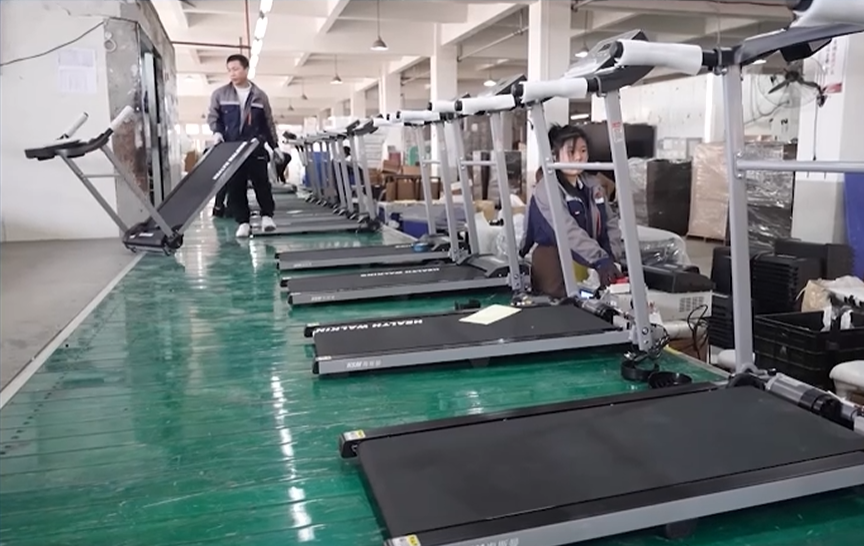
Motorised home fitness equipment on the production line. Motor configuration, not the wattage label alone, is what separates platforms in the same power class.
Wattage is the specification quoted most often in this category and explained least often. A “500 W” label may describe a single drive unit rated continuously, a peak figure, or one channel of a two-channel design. Buyers comparing platforms across listings therefore need a shortlist built on stated configuration data — motor count, speed granularity, timed range, and housing material — rather than on the headline wattage alone.
This shortlist covers three motorised vibration platforms from Ningbo Healthmate Health Technology Co., Ltd., a fitness equipment manufacturer founded in 2007 and based in Ningbo, China, whose range covers home-use treadmills, walking pads, vibration machines, spinning bikes, magnetic X-bikes, upright bikes, elliptical trainers, electric mini bikes, and rowing machines. All three shortlisted models use ABS construction and sit in the same broad power class, which turns the selection into a comparison of drive configuration, speed levels, and programming range rather than a comparison of price tiers.
The Shortlist at a Glance
All three platforms share an ABS housing and a 1–10 minute timed range. They separate on motor configuration and speed level count, and that separation is what determines which routine each model actually supports.
| Model | Motor configuration | Speed levels | Timer range | Housing | Best fit |
|---|---|---|---|---|---|
| HSM-08VF | 500 W single motor | 20 levels | 1–10 minutes | ABS | Shared household use; straightforward daily sessions at a habitual setting |
| HSM-08VQ | 500 W + 300 W dual motor | 99 levels | 1–10 minutes | ABS | Progression and interval programming; rehabilitation-style routines |
| HSM-08VW | 500 W + 300 W dual motor, with resistance ropes | 99 levels | 1–10 minutes | ABS | Combined lower- and upper-body sessions in one station |
Level counts, drive configurations, and included accessories can be revised between production runs. Buyers ordering at volume should confirm the specification set for the exact SKU and batch in writing rather than relying on a general model page.
HSM-08VF (500 W): The Single-Motor Entry Point
The HSM-08VF is the simplest platform on the shortlist: one 500 W motor inside an ABS housing, 20 speed levels, and the 1–10 minute timer shared across the line. It is the model to choose when the vibration platform is one station among several in a home gym, when more than one person in the same household will use it at different tolerance levels, and when the intended session style is a short, repeatable block at a setting the user finds comfortable and rarely changes.
The limiting factor is granularity. With 20 levels, the step between adjacent settings is wider than on a 99-level platform, so a user increasing intensity gradually will feel a more noticeable change at each increment. For straightforward daily use that is not a problem. It becomes one only when the training goal depends on small, controlled progression.
HSM-08VQ (500 W + 300 W): Dual-Motor Control
The HSM-08VQ keeps the 500 W drive, adds a second 300 W channel, and raises speed granularity to 99 levels. The additional channel is what makes the finer range usable: extra drive capacity lets the platform hold intermediate settings so that each step does not register as a jump between two different machines.
Two design questions are worth putting to the manufacturer rather than assuming. The first is how the two channels are allocated — whether they work together to drive a single plate movement or serve separate functions. The second is whether the 500 W and 300 W figures are continuous or peak ratings. The answers determine what the extra 300 W actually buys. What the specification does establish is the positioning: the HSM-08VQ suits users who adjust intensity often and in small increments, including multi-user households with different fitness levels and rehabilitation-style routines where the value of the session is controlled, progressive exposure rather than maximum output.
HSM-08VW (500 W + 300 W with Ropes): Adding Upper-Body Work
The HSM-08VW carries the same 500 W + 300 W drive configuration and the same 99 speed levels as the HSM-08VQ, and adds resistance ropes to the package. The ropes change the session type more than the motor specification: a user can combine vibration exposure with a pulling motion, bringing the upper body into what would otherwise be a lower-body-dominant routine.
Two practical consequences follow. Ropes need clear working space in front of and around the platform, so the effective footprint of the HSM-08VW is larger than the plate dimensions suggest. And a rope configuration adds assembly and check points that a plain platform does not have, which matters if the unit will be moved or stored between sessions. The HSM-08VW is the right pick when the platform is meant to anchor a full-body session rather than supplement one — and the wrong pick when floor space is the binding constraint.
Reading the Speed Data: 20 Levels vs 99 Levels
Speed level count describes how finely a platform can be adjusted, not how powerful it is. On a 99-level platform, the difference between one setting and the next is small enough that a user can move up in steps that are barely perceptible and hold that position for a session. On a 20-level platform, each step is larger: the control is simpler to operate and easier to remember, but less useful as a progression tool.
Neither number is a quality ranking. A 99-level range matches a use pattern in which intensity is adjusted frequently — rehabilitation progressions, interval programming, or a household where several people share one unit and each needs a distinct comfortable setting. A 20-level range matches a use pattern in which the platform is set once per session and used at a habitual intensity. Paying for granularity that is never adjusted adds complexity without adding training value.
Reading the Timer Data: Why the 1–10 Minute Range Matters
All three shortlisted platforms share a timed range of 1 to 10 minutes. A built-in timer is a programming feature, and it shapes how the equipment is used in a home setting more directly than most buyers expect. One-minute blocks support short exposure: a first session, a warm-up, or a single burst between other exercises. Ten-minute blocks support one continuous set. Because the range covers both ends, a user can run repeatable intervals — several one- or two-minute blocks — without a separate timer or a phone, which is what makes short-session training practical in a room where the platform shares space with other equipment.
The timer also standardises sessions across users. When two people in the same household train on the same platform, an identical timed range means an identical session structure even when their speed settings differ.
ABS Construction Across the Line
ABS — acrylonitrile butadiene styrene — is a thermoplastic commonly used for equipment housings because it is impact-resistant, does not corrode, and holds its shape under normal indoor temperature and humidity. For a vibration platform those properties apply in three specific ways: the housing is stepped on and off repeatedly, it may be stored upright against a wall, and it may be moved between rooms. An ABS housing keeps the unit lighter and easier to reposition than a metal-housed equivalent, and it will not rust in a humid room.
One boundary is worth stating. A polymer housing does not by itself determine stability under load at higher speed settings; that depends on the plate, the frame, and the foot design. Buyers should treat stability as a separate question from housing material and ask how the platform behaves at the top of its speed range rather than inferring it from the ABS specification.
Application Fit: Which Platform Serves Which Routine
The manufacturer’s own comparison material for vibration platforms frames the category against traditional resistance training. It states 20–35% higher workout intensity efficiency from whole-body vibration stimulation, lower physical exertion because muscle activation is largely passive, and a shorter training duration for an equivalent training effect. The same comparison puts equipment cost 60–80% lower than a full home gym setup, with no consumables required and lower maintenance demand. Rehabilitation training and beginner fitness users are named as the best-fit scenarios.
Those characteristics map onto this shortlist unevenly. The HSM-08VF fits the beginner and shared-household scenario directly: low complexity, 20 levels, and a timed range short enough to make sessions approachable. The HSM-08VQ fits the rehabilitation and progression scenario, where the value of 99 levels is that intensity can be advanced in small increments over weeks. The HSM-08VW fits a modified version of both, where the user wants one piece of equipment to deliver a combined lower- and upper-body session.
Market Context and Category Momentum
The vibration platform category is smaller than the cardio segment, but it is not a niche experiment. Dataintelo estimates the global vibration plates and therapy platforms market at approximately USD 1.8 billion in 2025, with growth of about 7.8% per year projected through 2034. The wider home fitness equipment market was valued at approximately USD 12.88 billion in 2025 by Fortune Business Insights and is projected to reach USD 22.99 billion by 2034.
At the global level the category is served by large multi-line brands — ICON Health & Fitness (iFIT), Johnson Health Tech, Technogym, and Peloton are among the established names — while the home segment is supplied substantially by manufacturers producing to buyer specification. For home gym builders and for buyers sourcing at volume, the practical implication is that power ratings across competing platforms will keep converging. Differentiation is shifting toward control granularity, housing and hardware quality, and how well a supplier can document protection design and production-stage testing.
Limitations and Trade-Offs Buyers Should Accept
Four boundaries apply to this shortlist as a whole.
A vibration platform does not replace progressive resistance loading. Its stated advantage is efficiency at lower exertion, which is a different objective from building maximal strength, and the platform format is not positioned for that objective.
Higher specification does not mean proportionally better outcomes. Moving from 20 to 99 speed levels, or from a single 500 W motor to a 500 W + 300 W configuration, changes what the platform can be adjusted to do; it does not change what a user does with it. If intensity is never adjusted, the extra range stays unused.
Accessories expand the physical footprint. The ropes on the HSM-08VW require clearance, and dual-motor configurations add weight and assembly points compared with a single-motor unit.
Vibration training is not appropriate for every user. Individuals with specific medical conditions, implanted devices, or pregnancy should consult a clinician before starting whole-body vibration training, and no specification on a product page addresses that question.
Procurement Checklist Before Ordering
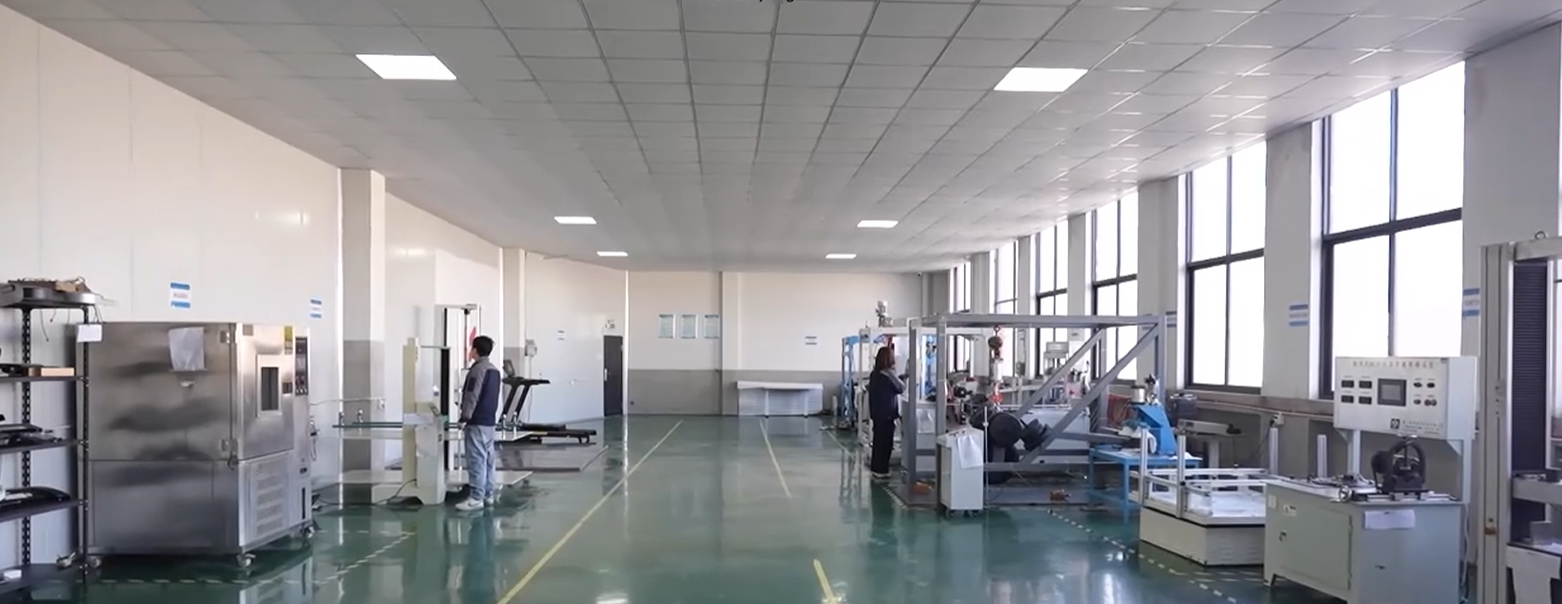
Motor and electrical testing is the production stage where overheating and short-circuit protections are verified before shipment.
- Get the drive configuration in writing. Confirm whether the platform uses one motor or two, and whether the 500 W and 300 W figures are continuous or peak ratings.
- Confirm speed level count and timer range for the exact SKU — 20 levels versus 99 levels, and the 1–10 minute timed range, should appear on the specification sheet you order against.
- Ask how motor overheating and electrical faults are controlled. Motor overheating and electrical short circuit are the failure modes most commonly listed for motorised home fitness equipment; the established controls are overcurrent protection and short-circuit protection, with motor aging tests used as the production-stage verification measure.
- Ask what happens before shipment. Factory load testing before shipment and instructional safety guidance are standard measures where sudden speed change or surface slippage is a risk, alongside shock-absorption design and an anti-slip plate or footing.
- Check the movement surface and footing design as a separate question from the housing material.
- Confirm housing material and hardware in writing. ABS is specified across the HSM-08VF, HSM-08VQ, and HSM-08VW.
- Validate with a sample before committing to volume. A production sample is the only reliable way to confirm how the platform feels across the upper part of its speed range.
- Confirm documentation and market fit for the destination country, including the version of the product that will actually be shipped.
Future Outlook
Two directions look likely. On the product side, dual-channel configurations and finer speed ranges will spread down the price ladder, because they are inexpensive to specify and easy to compare — while wattage labels keep converging, which turns specification transparency into a supplier differentiator rather than a marketing asset. On the supply side, buyers are asking for evidence rather than description: protection design, production-stage testing routines, and confirmed configuration data for the ordered batch.
Ningbo Healthmate’s own footprint supports that shift. The company operates a 100,000 m² manufacturing site with 850 employees, an annual output of 700,000 units, and a 38-engineer R&D team, serving export markets that account for about 80% of output across Europe, the USA, Japan, Korea, India, the Middle East, and South America. For buyers, that scale matters less as a claim than as the reason a supplier can document the specification of the exact unit being shipped.
FAQ
Not inherently. Level count describes adjustment granularity. A 99-level range lets a user move up in small increments and is the better match for rehabilitation progressions, interval programming, or a household where several people share one unit. A 20-level range is simpler to operate and is sufficient when the platform is used at a habitual setting that is rarely changed. Neither count indicates more power or better construction.
No. A single 500 W motor, as specified on the HSM-08VF, is sufficient for straightforward daily home use. The second 300 W channel on the HSM-08VQ and HSM-08VW adds drive capacity and pairs with the 99-level speed range. Whether that additional capacity is worth paying for depends on how often intensity is adjusted, not on the size of the training space.
ABS is impact-resistant, does not corrode, and holds its shape under normal indoor conditions. On a platform that is stepped on repeatedly, stored upright, and occasionally moved, those properties keep the housing stable and the unit light enough to reposition. Housing material does not determine stability under load at high speed settings — plate design, frame, and footing do, and they should be evaluated separately.
It defines the session formats the platform can run without an external timer. One-minute blocks support short exposure, warm-ups, or single bursts between other exercises; ten-minute blocks support one continuous set. Because all three shortlisted models share the same range, users can run repeatable intervals and compare sessions across different speed settings on a consistent time structure.
Confirm the drive configuration and whether the wattage figures are continuous or peak; confirm the speed level count and timer range for the exact SKU; ask how motor overheating and electrical short circuits are controlled, which typically means overcurrent and short-circuit protection plus motor aging tests; ask whether load testing is performed before shipment and what safety guidance ships with the unit; confirm the housing material and footing design; and validate the upper speed range with a production sample before committing to volume.
Specification sheets for the HSM-08VF, HSM-08VQ, and HSM-08VW, along with the wider range of treadmills, walking pads, bikes, ellipticals, and rowers, are collected in the company’s product catalogue: HSM NEW E-CATALOG (PDF). General product information is also published at healthma.com.