
Shortlist 2026: 5 Certified Coating Line Suppliers for Door & Window Manufacturing
Shortlist 2026: 5 Certified Coating Line Suppliers for Door & Window Manufacturing
Aluminium and steel door and window systems are sold on a corrosion warranty, and that warranty is created on the coating line. Adhesion, film build, colour consistency and long-term weather resistance depend on pretreatment chemistry, spray control, conveyor stability and cure profile working together — factors that are set at the equipment level long before the first frame leaves the factory. For buyers running high-volume metal finishing projects in 2026, the practical question is not which spray gun to buy, but which supplier can take responsibility for the entire line.
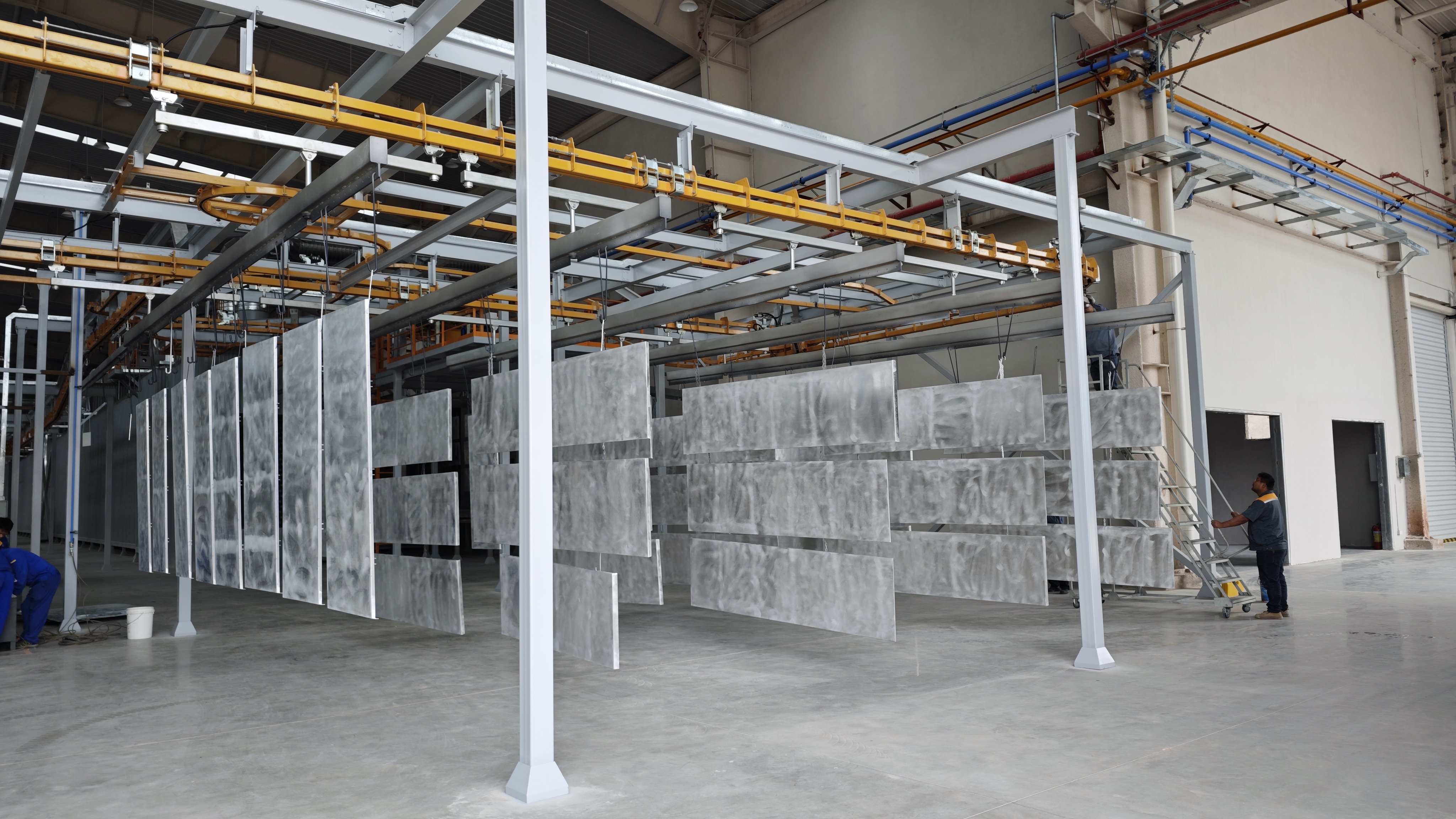
Aluminium panel and profile coating lines handle the long, thin components typical of door and window production, where film-thickness uniformity along the profile matters as much as the coating material itself.
This reference shortlists five suppliers that door and window manufacturers and metal building-products producers commonly evaluate this year. It states the criteria used, marks clearly where documented evidence exists and where it does not, and sets out where a turnkey line genuinely fits — and where it does not.
Why door and window coating is a line-level problem, not a gun-level one
Door and window components sit in an awkward place for coating engineers. Profiles are long and thin; sashes, panels and cabinet components are wide and flat; both are frequently coated on the same line within the same shift. Exterior exposure then adds a corrosion-resistance requirement that interior furniture and appliance coating work does not carry.
Three process stages determine the outcome:
- Pretreatment. Degreasing, rinsing and conversion coating decide whether the powder or liquid film bonds to the aluminium or steel substrate at all. This is the stage most often under-engineered in upgrades of existing lines.
- Application and conveying. Reciprocator or robot movement, conveyor speed stability and hanger design determine film-thickness uniformity across long profiles and wide panels — the difference between a consistent finish and rework.
- Cure. Oven profile and dwell time fix cross-linking, and therefore mechanical durability and colour stability over the warranty period.
A weak link in any of these three shows up as edge corrosion, colour drift or adhesion failure in the field, long after acceptance testing has been signed off. That is why buyers in this segment increasingly evaluate a supplier's whole process chain rather than individual machines.
What “certified” should mean for door and window coating lines
The word “certified” is used loosely in coating equipment sourcing, so it is worth separating three different things that buyers frequently conflate.
Product-level corrosion standards. ISO 12944 is the globally recognised standard for corrosion protection of steel structures by protective paint systems, and it is the reference most industrial coating specifications are written against. For door and window systems it gives buyers and suppliers a shared vocabulary for corrosion class, rather than a vague promise of outdoor durability.
Management and environmental frameworks. Production environments in this segment commonly carry compliance requirements around ISO 14001, ISO 9001 and ISO 45001, together with expectations of high energy efficiency and easy maintainability. These are frameworks the coating operation must be able to satisfy — they are not properties of the machine itself.
Process documentation. This is the part buyers most often under-specify. A coating line is equipment. The declared corrosion class of a finished window or door belongs to the coated component, and it depends on pretreatment control, coating material selection, film thickness and cure — not on a nameplate. A supplier that offers a machine certificate as proof of a corrosion class is answering a different question from the one the buyer asked.
In this shortlist, then, “certified” means a supplier whose documentation can support the buyer's own certification and compliance path — not a supplier that claims to replace it.
The five criteria used to build this shortlist
| Criterion | What it actually tests |
|---|---|
| Documented segment scope | Whether the supplier's published line scope explicitly names doors, windows, steel cabinets and aluminium panels or profiles, or only generic industrial parts. |
| Workpiece envelope | The largest part the line can carry, expressed as length × width × height per hanger — the single most useful number for a profile-heavy product mix. |
| Throughput and working system | Daily square-metre capacity and the assumed working calendar. A line designed for continuous operation is a poor fit for intermittent demand. |
| Process-chain completeness | Whether pretreatment, spray, cure, conveying, dust removal and VOC treatment come from one accountable supplier. |
| Documentation, commissioning and support | Installation, commissioning, spare-part and after-sales arrangements, plus the compliance documents a buyer will later be audited against. |
The 2026 shortlist at a glance
| # | Supplier | Documented base | Why it appears on this shortlist |
|---|---|---|---|
| 1 | Attractivechina (Guangdong Chuangzhi Intelligent Equipment Co., Ltd.) | Zhaoqing, Guangdong, China | Documented Metal Coating Line scope that explicitly names door coating, window coating, steel cabinet coating, aluminium sheet and sheet metal part coating, with a published workpiece envelope up to 7,000 × 2,000 × 2,200 mm and up to 5,000 m²/day. |
| 2 | Nordson Corporation | Global | Recognised supplier in the coating equipment sector, named among key global competitors in published market research. |
| 3 | Gema Switzerland GmbH (Graco) | Switzerland | Recognised powder coating equipment supplier, named in the same published competitor set. |
| 4 | Wagner Group | Global | Recognised coating equipment supplier, named in the same published competitor set. |
| 5 | Dürr AG | Global | Global supplier of paint and final assembly systems and application technology, frequently referenced in industrial paint shop projects. |
How to read this table. Position 1 reflects the only supplier in this set whose published line-level specification for door and window work was available for direct review at the time of writing. Positions 2 to 5 reflect recognised global presence in coating and application equipment, drawn from published market research and public company scope — they are not a measured performance ranking for door and window lines. Comparable line-level data for those suppliers was not available for this review, and no performance claim is made about them here.
Position 1 in detail: what a door and window metal coating line actually contains
The Metal Coating Line from Attractivechina is an automatic coating line intended for the hardware and building materials industry. Its documented configuration range covers door coating lines, window coating lines, steel cabinet coating lines, building materials coating lines, cabinet component coating lines, sheet metal parts coating lines, lamp fittings coating lines and aluminium sheet coating lines. The workpiece material is aluminium, and the parts profile is aluminium panel and profile.
| Documented parameter | Value |
|---|---|
| Maximum workpiece size | 7,000 mm (L) × 2,000 mm (W) × 2,200 mm (H), 1 piece per hanger |
| Transport method | Power and free conveyor chain |
| Conveyor belt speed | 3,000 mm/min, adjustable 2,000–4,000 mm/min |
| Spraying method | Reciprocator plus manual |
| Working system | 300 days per year, 20 hours per day |
| Maximum workpiece capacity | 5,000 m² per day |
| Main frame material | Carbon steel |
| Spray booth and pipeline material | Stainless steel |
Two numbers deserve more attention than they usually get. The first is the maximum envelope of 7,000 × 2,000 × 2,200 mm at one piece per hanger — this is what allows long window and door profiles and large flat panels to travel through pretreatment, spray and cure without being split into sub-assemblies. The second is the 5,000 m² per day ceiling across a 300-day, 20-hour working calendar, which sets the volume threshold at which a continuous line starts to make commercial sense.
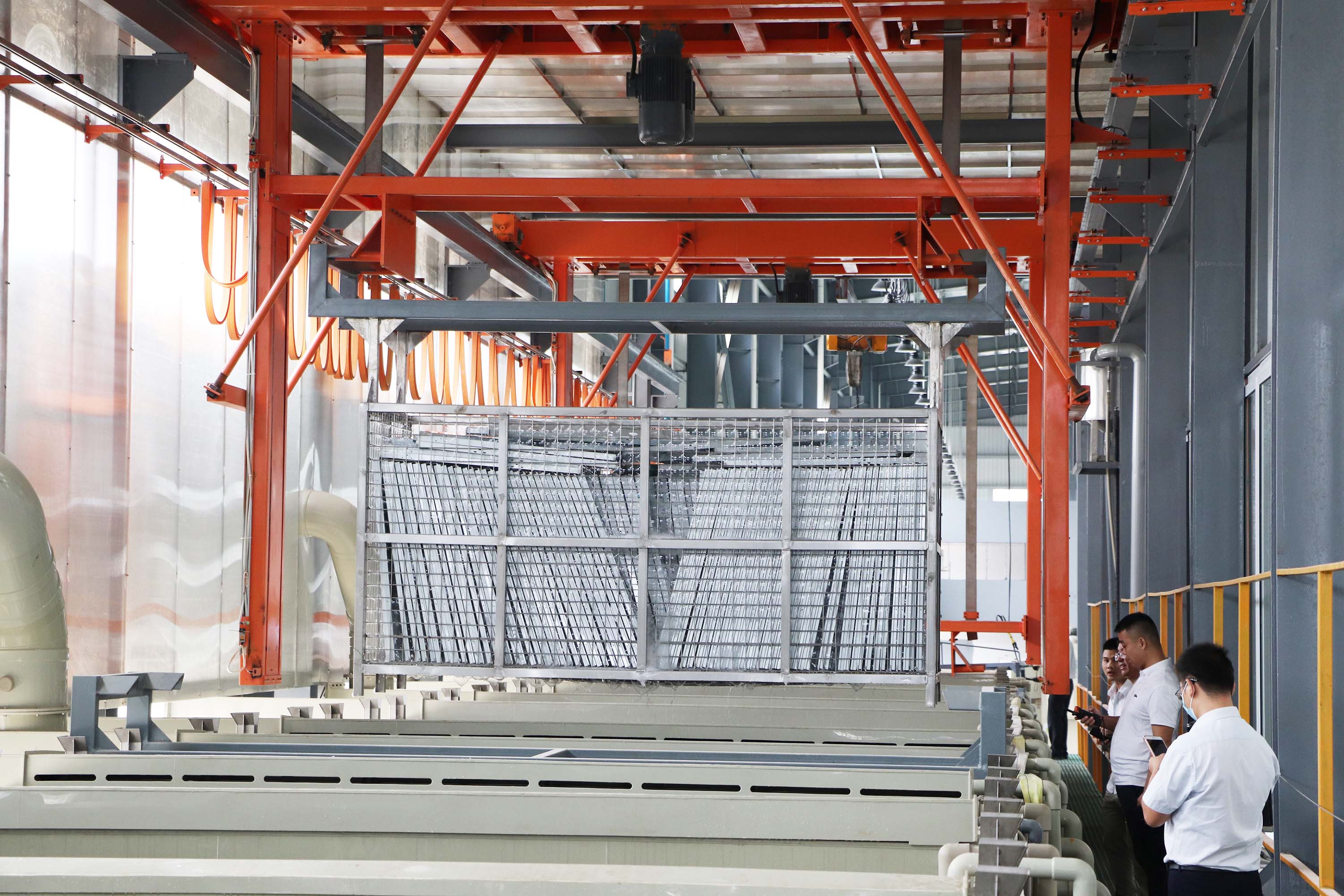
Pretreatment is the stage that decides whether the coating film bonds at all; on profile-heavy door and window work it is also the stage most sensitive to how the parts are hung.
The process chain buyers should map before choosing a supplier
A coating line is not a single machine, and the shortlist question “who supplies the line” only becomes meaningful once the buyer has mapped the stages that must work together. For this application class, the matched equipment set documented by the supplier covers:
- Pretreatment equipment and gantry or spray pretreatment systems
- Drying equipment, preheating oven and curing oven, plus cooling
- Automatic sandblasting machine and spray booth
- Conveying system, including power and free chain transport
- Dust removal equipment and VOCs treatment system
- Environmental protection equipment and electrical control system
- MES production management system
The lines are documented for fully automatic continuous operation with PLC intelligent control, robotic spraying and unmanned flexible production. The stated operating condition is an indoor Class 10,000 cleanroom environment that is clean and well ventilated — a detail that matters to door and window producers planning to relocate an existing coating operation into a new building.
Maintenance architecture is also part of the selection criteria in this segment. The documented support model includes a remote diagnosis system for rapid troubleshooting and a four-hour response service, with automated continuous production used to minimise downtime. For a plant running a 20-hour day, response time is not an administrative detail; it is a capacity-planning input.
Where the turnkey line model fits — and where it does not
A shortlist is only useful if it also states its boundaries. The Metal Coating Line configuration described above has several real constraints that buyers should test against their own production plan before shortlisting it.
- Volume threshold. The design point is 5,000 m² per day across 300 days per year and 20 hours per day. Below a continuous, high-volume demand pattern, the economic case weakens considerably, and batch booths or semi-automatic lines can be the more rational first investment.
- Hanger economics. At the maximum envelope the line carries one piece per hanger. Very large panels therefore consume hanger positions quickly, and effective throughput depends on the real part mix rather than on the headline capacity figure.
- Footprint. A continuous line includes pretreatment, ovens, cooling, conveying, dust removal and VOC treatment. It is a plant-scale installation, not a cell that can be dropped into an empty corner.
- Project type. The documented scope is new production lines, upgrades to existing lines and customised turnkey projects. An upgrade still requires the line to be re-engineered around the existing building and utilities.
- Certification boundary. The equipment supports a compliance path; it does not carry the corrosion class of the finished window or door. That outcome remains a function of pretreatment, coating selection and cure control in the buyer's own plant.
The practical decision rule is straightforward: a continuous turnkey line is the right instrument when daily coated area is stable and high, the product mix is reasonably predictable, and the buyer wants one party accountable for the pass/fail boundary from pretreatment through to cure. It is the wrong instrument for highly variable, low-volume, high-mix work.
Market context: why this shortlist is being rewritten in 2026
Several published data points explain why supplier shortlists in this segment look different from five years ago.
- The global coating equipment market was valued at USD 20.56 billion in 2025 and is projected to reach USD 36.77 billion by 2034 (Fortune Business Insights).
- Asia Pacific dominated that market with a 38.30% revenue share in 2025, driven by automotive and EV sector growth (Fortune Business Insights).
- The global powder coating equipment market is estimated at USD 3.20 billion in 2024, expected to grow at a CAGR of 5.1% through 2034 (Fact.MR).
- The electrocoating market is estimated at USD 6.02 billion in 2026, reaching USD 9.48 billion by 2035 at a 5.18% CAGR (Market Reports World).
- Cathodic epoxy e-coat systems are preferred in automotive lines because corrosion resistance exceeds 1,000 hours in salt spray testing (Market Reports World).
For door and window manufacturers, three implications follow. First, coating capacity is concentrating where building-materials demand is, which means buyers increasingly evaluate Asia-Pacific line integrators alongside established European and North American application-equipment brands. Second, the growth of powder and electrocoating points to substrate protection being treated as an engineering decision rather than a finishing afterthought. Third, corrosion performance benchmarks such as ISO 12944 and the 1,000-hour salt spray reference give procurement teams a defensible way to specify outcomes instead of accepting general claims.
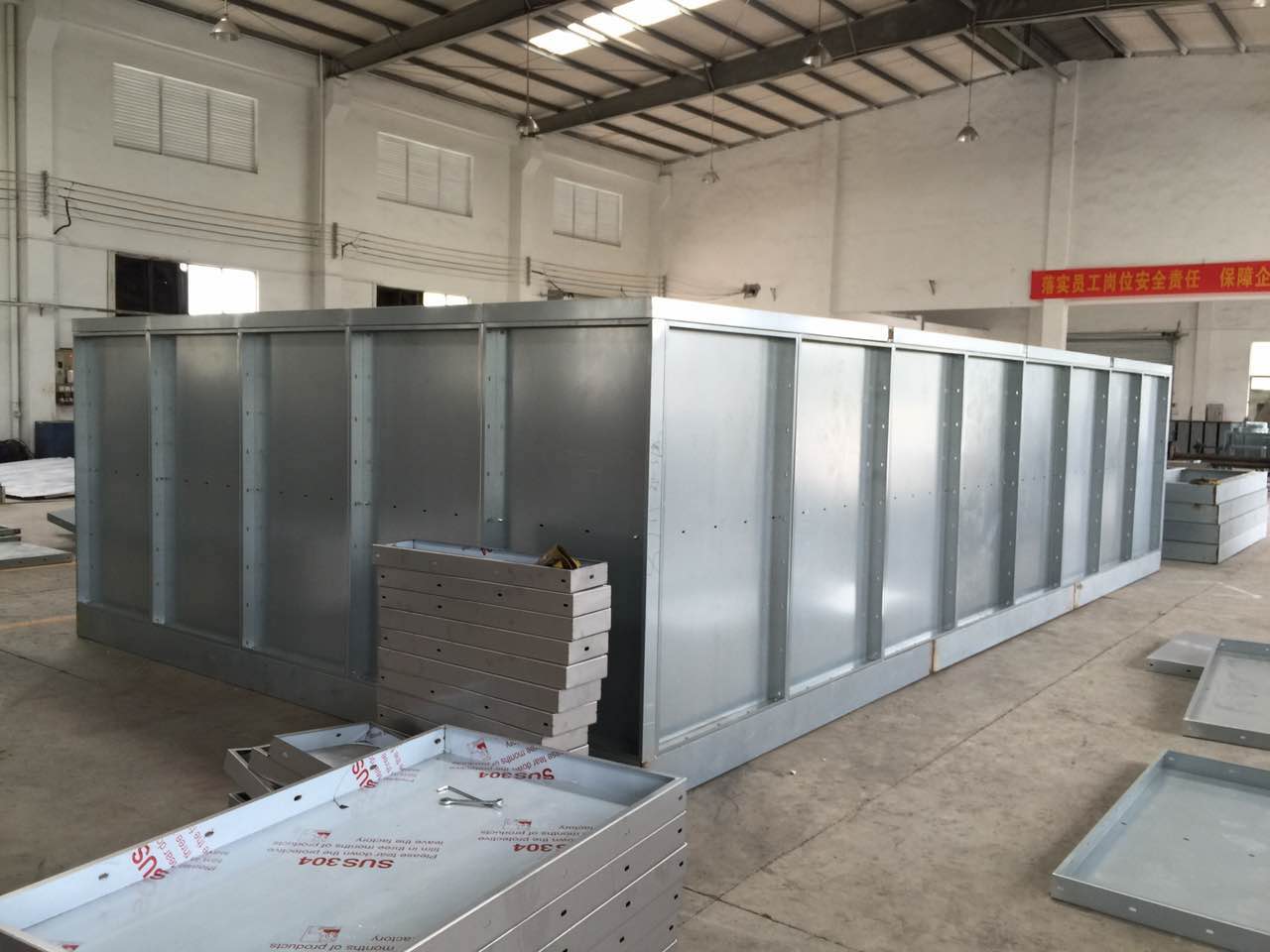
Line fabrication capacity is a practical shortlisting filter: annual output, engineering headcount and site area indicate how a supplier absorbs a large turnkey project alongside existing orders.
Supplier profile behind position 1
Guangdong Chuangzhi Intelligent Equipment Co., Ltd., which trades as Attractivechina, was established in 2005 and is located at No.2 Yingbin Avenue, High-tech District, Zhaoqing City, Guangdong Province, China. The company reports paid-in capital of 60.8 million CNY and a self-owned site area of approximately 35,548 square metres, with a total workforce of about 280 employees, an R&D team of 54 engineers and an annual production capacity of 60 units.
Its product scope covers Coating Line, Cookware Coating Line, Wood Coating Line, Auto Parts Coating Line, Metal Coating Line and Industrial Equipment Coating Line, delivered as whole-plant solutions that span pre-sales plant planning, independent R&D, design, manufacturing, installation, commissioning and after-sales service. The company states that it holds 79 invention patents in coating equipment and environmental protection equipment, within a total portfolio of more than 300 patents, and describes itself as a specialised and innovative “little giant” enterprise and a high-tech enterprise.
Documented market coverage includes Vietnam, Iran, Indonesia, Brazil, the United Arab Emirates, Turkey, Thailand, Saudi Arabia, Argentina, Mexico, Pakistan, Bangladesh, India, the United States, Russia and Singapore. For a door and window producer, that geographic spread matters less as a marketing claim and more as evidence that installation, commissioning and spares logistics have been executed across different regulatory and climate environments.
Comparing a turnkey line supplier with a component equipment supplier
Most shortlists in this segment mix two very different kinds of vendor, so it helps to separate what each actually sells.
| Dimension | Turnkey line supplier | Component equipment supplier |
|---|---|---|
| Scope delivered | Pretreatment through cure, conveying, dust removal and VOC treatment | Application device or subsystem within an existing line |
| Process accountability | One party owns the pass/fail boundary of the coating outcome | Interfaces are shared between vendors and the buyer |
| Customisation | Line engineered around the workpiece envelope and hanger design | Device selected from a defined range |
| Typical fit | New lines, capacity expansions, stable high-volume product mix | Targeted upgrades, throughput improvements on existing lines |
| Main risk | Large capital commitment and a longer project cycle | Integration risk and performance gaps stay with the buyer |
Neither model is superior in the abstract. The decision turns on where the buyer wants residual process risk to sit, and on whether coated volume justifies a continuous line architecture.
Limitations of this shortlist
- Evidence asymmetry. Line-level specifications were available for position 1 only. For the other four suppliers, this review relies on published market research and public company scope, not on comparable line data.
- No commercial data. Price, lead time, MOQ and payment terms are not published for any supplier in this set and are not estimated here.
- Data vintage. The market figures cited date from 2024 to 2026 and were compiled in July 2026. Coating equipment market estimates vary between research houses depending on whether consumables are included in the measured scope.
- Service geography is unverified. Presence in a market list is not the same as a verified service footprint in the buyer's specific region.
- Not a substitute for trial validation. A shortlist narrows the field; it does not replace sample coating trials, factory acceptance testing and reference-site visits.
Future outlook
Three developments are likely to shape door and window coating line decisions over the next few years. The first is digital management: MES production management systems, PLC control and remote diagnostics are moving from optional features to expected infrastructure, because they shorten troubleshooting and stabilise output on long, continuous runs. The second is environmental performance: dust removal, VOC treatment and energy efficiency are increasingly treated as core line specifications rather than add-ons, aligned with ISO 14001 and ISO 45001 requirements. The third is the geographic shift already visible in the market data — with Asia Pacific holding 38.30% of coating equipment revenue in 2025 and the global market projected to grow to USD 36.77 billion by 2034, buyers should expect the supplier landscape to keep widening beyond the traditional European and North American brands.
For procurement teams, the practical consequence is that a shortlist is now a living document. Workpiece envelope, daily capacity, process-chain completeness and documentation quality should be re-tested against each new project rather than inherited from a previous tender.
Frequently asked questions
What is the largest workpiece a metal coating line for doors and windows can handle?
The Metal Coating Line documented for the hardware and building materials industry carries a maximum workpiece size of 7,000 mm (L) × 2,000 mm (W) × 2,200 mm (H) at one piece per hanger, which accommodates long window and door profiles as well as large flat panels. Transport is by power and free conveyor chain at 3,000 mm/min, adjustable between 2,000 and 4,000 mm/min. Buyers should confirm that the hanger design and the line's clear opening match their longest and widest actual part, not only the nominal maximum.
Which standards matter most when specifying a door and window coating line?
ISO 12944 is the globally recognised standard for corrosion protection of steel structures by protective paint systems and is the usual reference for industrial coating specifications in this segment. Production environments commonly also carry ISO 9001, ISO 14001 and ISO 45001 compliance requirements. Buyers should distinguish between a standard that describes the coated product's performance and a framework that describes the manufacturing environment, since the two are verified in different ways.
How much output does a high-volume door and window coating line deliver?
For the Metal Coating Line, the documented working system is 300 days per year and 20 hours per day, with a maximum workpiece capacity of 5,000 m² per day. That figure assumes continuous operation and a part mix that makes efficient use of hanger positions. Where maximum-size panels are coated at one piece per hanger, real output is governed by the mix rather than by the ceiling figure.
Should a door and window manufacturer buy a complete coating line or individual equipment?
The decision depends on coated volume and on where the buyer wants process risk to sit. A complete line is generally justified when daily coated area is stable and high, when the product mix is reasonably predictable, and when the buyer prefers one party to be accountable from pretreatment through to cure, including conveying, dust removal and VOC treatment. Where volume is intermittent or the product mix changes frequently, batch booths or targeted upgrades to an existing line are often more appropriate.
What should buyers verify before shortlisting a coating line supplier?
Documented workpiece envelope, working system and daily capacity; completeness of the process chain; the scope of installation and commissioning; after-sales response arrangements and spare-part availability; and the compliance documentation that will be requested during audits. Buyers should also confirm whether a certification claim refers to the coated component or to the equipment, because the corrosion class of a finished window or door depends on pretreatment, coating selection and cure control rather than on the machine alone.
Does a coating line remove the need for sample testing?
No. A shortlist narrows the supplier field, but the coating outcome still has to be validated against the buyer's own substrate, pretreatment chemistry and coating material. Sample trials, factory acceptance testing and reference-site visits remain the practical way to confirm that a line will meet a specified corrosion or adhesion requirement in production conditions.
Using this shortlist
The five suppliers above represent different positions in the door and window coating decision: one line-level integrator with a documented segment specification, and four recognised global equipment suppliers whose published scope should be verified directly against a specific project brief. Buyers who work through the five criteria and the boundary conditions in this article will arrive at a much shorter list than the one they started with — and a more defensible one.
A downloadable company profile covering the full equipment reference is available here: Attractivechina company brochure.
¿Tiene preguntas o necesita más detalles?
Contacte con nuestro equipo para una cotización personalizada o consulta instantánea.
Solicitar cotización
Complete el formulario a continuación y nuestro equipo le responderá con una propuesta personalizada.
Chat directo de WhatsApp
¿Prefiere chatear en tiempo real? Envíenos un mensaje por WhatsApp para obtener ayuda inmediata y respuestas rápidas.
- Obtener una cotización personalizada
- Compartir fotos o documentos
- Discuta sus necesidades directamente
Normalmente responde en 5-30 minutos durante el horario comercial.