
Shore A vs RMA A2: A Buyer Framework for Rubber Seals and Mounts
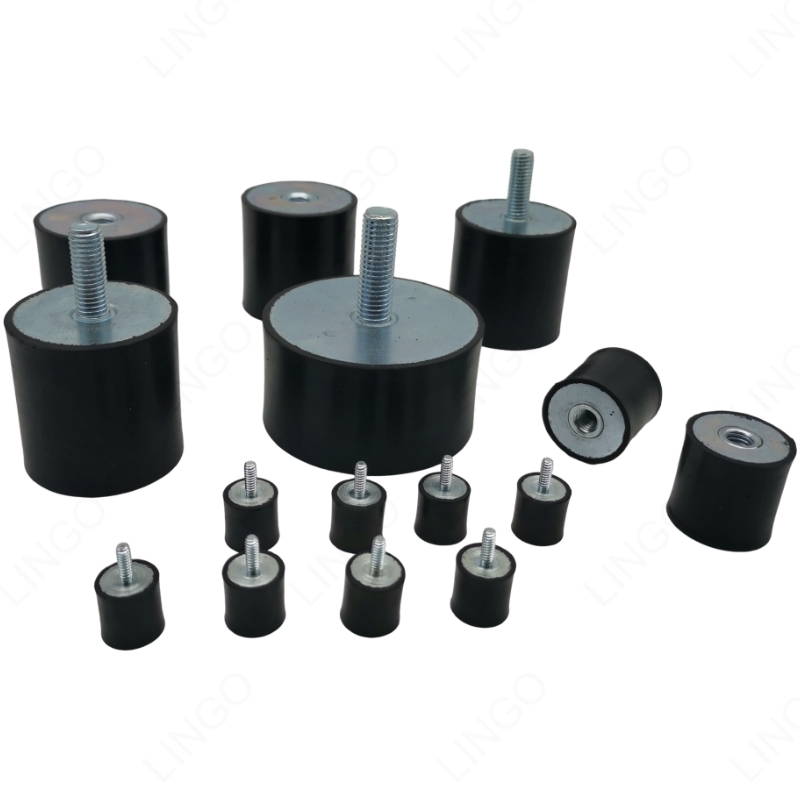
Rubber seals and anti-vibration mounts are frequently quoted inside the same purchasing package for clean tech and energy equipment, yet they are specified on two different scales. Shore A describes how hard an elastomer compound is. RMA A2 describes how far a finished moulded rubber part may deviate from its drawing. A buyer who treats the two figures as interchangeable will end up comparing suppliers on numbers that measure different things, and will usually discover the mismatch only at first-article inspection.
The framework below is written for procurement and engineering teams between the research and evaluation stages — the point where a long list of rubber part suppliers has to become a defensible shortlist, and where the specification language on the drawing determines whether quotes are comparable at all. Two Lingo Rubber Plastic product families are used as worked examples: LG-RX rubber extrusion seals, which are governed primarily by material and hardness, and LGMM anti-vibration mounts, which are published against the RMA A2 tolerance standard. Lingo Rubber Plastic (Hangzhou Lingo Rubber and Plastic Product Co., Ltd) is a China-based custom rubber and plastic parts manufacturer founded in 2022, operating a 3,000 m² facility with around 40 employees, a 10-person R&D team and a reported 80% export share to the EU and USA.
Why sealing parts and isolation parts end up in one sourcing decision
The two component families converge in green energy and new material equipment because a single enclosure, skid or cabinet usually has to do both jobs. A battery pack housing needs a continuous environmental seal against water and dust, while the same assembly sits on mounts that limit structure-borne vibration from compressors, pumps, transformers or transport. A supplier list built for one requirement tends to be reused for the other, which is where specification confusion begins.
Scale explains why buyers keep looking for a common comparison logic. Grand View Research valued the global gasket and seal materials market at USD 61.4 billion in 2024 and estimated that rubber-based seals account for roughly 56% of that market (SRC-0001). Vantage Market Research placed the O-ring sub-segment alone at USD 10.41 billion in 2025 (SRC-0002). Cognitive Market Research estimated that China accounts for approximately 23% of the global anti-vibration rubber mounts market (SRC-0003).
These are commercial research estimates with differing product scopes. They indicate the size of the sourcing pool; they are not a substitute for a buyer's own demand data.
Shore A answers a material question. RMA A2 answers a dimensional one.
Shore A is a durometer hardness reading for soft elastomers, expressed as a range that the compound is expected to hold. It is a material property. It tells a buyer how stiff the rubber will feel under a defined indentation, and it is the number that most affects sealing contact pressure, insertion force and compression-set behaviour in a given groove.
RMA A2 is a tolerance classification for moulded rubber products, published by the Rubber Manufacturers Association. It is a dimensional property. It tells a buyer how much variation from the drawing is acceptable on a finished moulded part, and therefore what the supplier's inspection and the buyer's incoming goods check should be measuring. The tolerance class does not certify compression set, fatigue life, temperature rating or oil resistance — those are compound and design questions that sit outside the classification entirely.
The two languages are independent. A 60 Shore A part can be produced to a tight tolerance class or a loose one, and an RMA A2 part can be moulded in a soft or a hard compound. A quotation that answers one axis and stays silent on the other is incomplete, regardless of price.
| Specification | What it governs | What it does not cover | Where it appears in the Lingo portfolio |
|---|---|---|---|
| Shore A hardness | Compound stiffness; sealing contact pressure; compression behaviour in a groove | Dimensional variation; fatigue life; media resistance | LG-RX extrusion seals state hardness as 'Shore A as required'; LG-RS moulded sealing rings are published at normally 50–95A |
| RMA A2 tolerance | Allowable dimensional deviation of a moulded rubber part against its drawing | Hardness; dynamic stiffness; temperature capability; durability | LGMM anti-vibration mounts are published to the RMA A2 standard |
| Material grade (EPDM, NBR, silicone, FKM, natural rubber) | Media and temperature compatibility of the compound | Finished-part geometry; production consistency | LG-RX in EPDM, NBR, SILICONE and FKM; LGMM in natural rubber with zinc coated steel |
For sealing parts, material compatibility is the first gate — hardness is the second
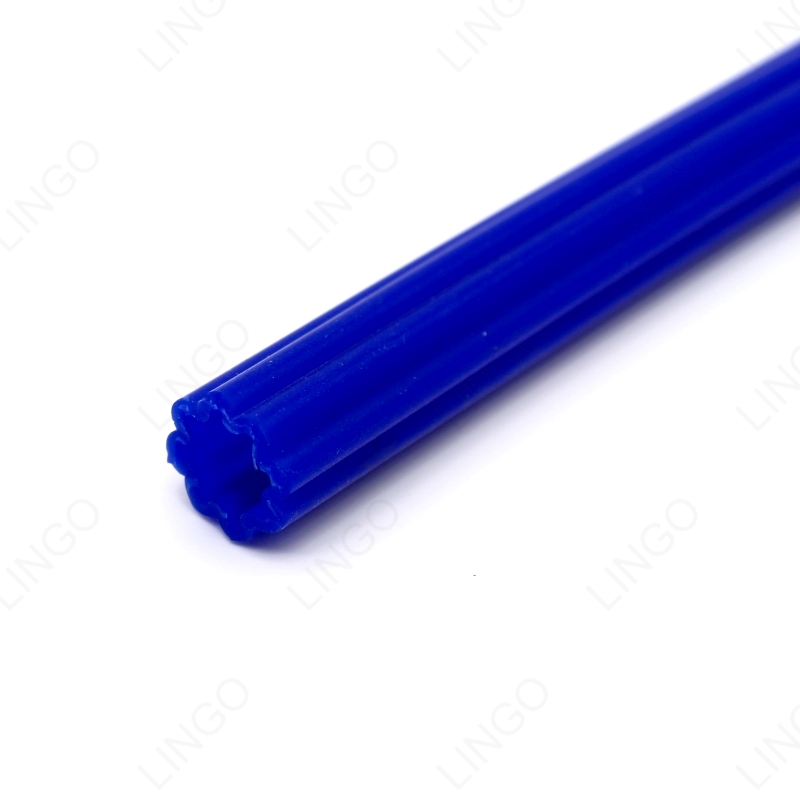
LG-RX rubber extrusion seals cover a set of profile types rather than a single item: silicone rubber extrusion seals, adhesive-backed extrusion seals, co-extrusion seals, FKM extrusion seals, solid rubber extrusion seals and sponge rubber extrusion seals. Published parameters are material (EPDM, NBR, SILICONE, FKM and similar), hardness as Shore A as required, tolerance to industry standards, length as required, and colour customised to Pantone or RAL. Stated application industries span food and beverage, medical and healthcare, aerospace and aviation, automotive and transportation, HVAC and refrigeration, laboratory and analytical, electronics and electrical, industrial manufacturing, marine and offshore, and household appliances.
For a buyer, 'Shore A as required' is a signal rather than a gap. It means the durometer is treated as an input from the drawing, not a catalogue default, so the specification work moves back to the purchasing team. If the drawing says only 'rubber seal, EPDM', the supplier has no hardness target to hold and two quotes will not be comparable.
Choosing between EPDM, NBR and silicone
Material selection decides most of the outcome in a sealing application, and it should be settled before hardness is discussed.
- EPDM is widely used for outdoor and water-facing applications such as door and window seals and EPDM rubber gaskets, because it holds up against weathering and water exposure. It is a poor default for mineral oil contact.
- NBR is chosen where oil, grease or fuel contact is expected, which is why it appears in oil seal and automotive contexts.
- Silicone suits high-temperature and low-temperature sealing and is available in FDA-qualified grades. A documented case on Lingo silicone sponge rubber cords records stable performance from −60 °C to 250 °C without hardening or cracking, with UV and ozone resistance and closed-cell construction for water, dust and noise exclusion; that material is used in EV battery sealing, industrial cabinet gaskets, automotive door seals, appliance door insulation and building window weatherstripping.
- FKM is specified where chemical and thermal demands exceed what the standard grades can hold.
Two tolerances to keep apart
LG-RX carries 'Tolerance: industry standards', while LGMM carries 'RMA A2 standard'. These are not the same statement. For extruded profiles the buyer has to convert the drawing into an explicit dimensional callout, because a continuous extrusion has different control points from a moulded part — wall thickness and profile geometry behave differently along a running length than they do inside a mould cavity. Where a closed, three-dimensional geometry is required rather than a continuous run, the moulded route applies: LG-RS moulded sealing rings are published at normally 50–95A, a heat range of −40 °C to 250 °C, and certificates covering FDA, UL, ROHS and REACH, in NBR, EPDM, SILICONE, NR, CR, SBR, FKM, FFKM and AFLAS.
For isolation parts, geometry and tolerance class carry the qualification
LGMM anti-vibration mounts are cylindrical rubber mounts and rubber stud mounts made from natural rubber with zinc coated steel, with a published diameter range of 8–150 mm, height range of 8–90 mm, and tolerance to the RMA A2 standard. The stated industries are transportation, industrial machinery, electronics and precision instruments, construction and civil engineering, and marine and military.
That published envelope allows a buyer to screen fit before a drawing exists: if the available installation height is outside 8–90 mm, or the required footprint is outside 8–150 mm, the standard range does not apply and the conversation moves to custom tooling. Because the tolerance class is stated on the data sheet, the dimensional acceptance criteria can be written directly into the purchase order instead of being negotiated line by line.
What documented mount cases actually show
A United States automotive OEM case in the Lingo record covers orders of 10,000 to 40,000 pieces placed several times each year, indicating an ongoing supply relationship rather than a single trial batch. The reported strengths are small size, tight tolerances and consistent batch-to-batch quality, supported by an in-house spare parts inventory for urgent orders. The same case describes a tooling decision worth noting at evaluation stage: instead of building a new mould, a single middle plate was machined to the specified dimensions and used with existing mould sets, which reduced the initial tooling investment.
A second United States automotive case covers a 500-piece order with existing tooling, UL94 V-0 certification and a reported 45% reduction in peak vibration amplitude, alongside a stated requirement to maintain damping performance under extreme temperature and load. Both figures are supplier-reported and should be read as directional evidence rather than as a guaranteed performance level for a different application.
The operating conditions documented for this mount family are worth putting on the RFQ as-is: high dynamic load, a temperature range of −40 °C to +120 °C, exposure to oil, grease, road shock and continuous vibration, continuous cyclic compression and shear under dynamic loading, and requirements for low compression set and fatigue resistance across 10⁶ to 10⁷ cycles. Typical interfaces named in the record are engine brackets, chassis frames, rail bogies and ship engine beds.
| Decision question | LG-RX rubber extrusion seals | LGMM anti-vibration mounts |
|---|---|---|
| What is the primary function? | Excluding water, dust, noise or media along a continuous joint | Limiting transmission of vibration and structure-borne noise |
| Which number must be fixed first? | Material grade, then Shore A hardness | Envelope dimensions (diameter and height), then tolerance class |
| What tolerance statement is published? | Industry standards — must be pinned per drawing | RMA A2 standard — can be written into the purchase order |
| What is published on stiffness? | Hardness as Shore A as required | Geometry and compound are published; dynamic stiffness data is not included in the available specification |
| Typical failure mode to check at incoming inspection | Section thickness, profile distortion, hardness drift between batches | Bond integrity between rubber and zinc coated steel, height and diameter within class |
Where this framework stops
A comparison framework is only credible if it states its own boundaries. Five apply here.
Hardness is not stiffness. Shore A describes a compound under indentation; it does not describe how a mount deflects under a given load. The LGMM data sheet publishes material, diameter, height and tolerance class, but the available specification does not include load-deflection curves or dynamic stiffness values. Buyers selecting a mount for a defined natural frequency should request that data explicitly rather than infer it from a hardness figure.
RMA A2 is a tolerance class, not a performance certificate. It says nothing about compression set, fatigue life or temperature rating. An A2-compliant part can still fail in service if the compound is wrong for the environment, so the tolerance statement must sit alongside the compound and the operating conditions.
'Industry standards' is not a class. For LG-RX extrusion seals, the tolerance statement is deliberately generic. Buyers who need a specific dimensional class must write it onto the drawing, otherwise two suppliers will interpret the same requirement differently.
Natural rubber has a narrower media range than the sealing compounds. LGMM mounts use natural rubber with zinc coated steel, which is generally a sound choice for dynamic fatigue. It is, however, generally less resistant to oils and ozone than EPDM or NBR, so oil-exposed or strongly outdoor installations deserve a specific compound review rather than an assumption.
Published case results are point evidence. The two mount cases describe individual customer programmes, not a controlled study. They demonstrate that the capability exists and has been delivered; they do not establish that every part of a given drawing will achieve the same outcome.
Batch consistency and pre-shipment inspection as selection criteria
Between the research and evaluation stages, the differentiator is rarely the catalogue. It is whether the same part arrives the same way in month six. Lingo Rubber Plastic describes its quality control as full inspection of samples and random inspection of bulk goods, with a batch traceability system, remote technical support, mould maintenance with ownership protection, and a free exchange and acceptance-of-concessions policy. Lead time is stated as 2 to 6 weeks, and MOQ is set per part type with small quantity orders accepted.
Put those statements to work as evaluation questions rather than as reassurance. Ask how the sample inspection plan differs from the bulk inspection plan, what the traceability record actually links (batch, compound lot, mould, inspection result), and who holds the mould. A documented sealing case illustrates why this matters: a water sealing programme across the US, UK, Canada, Australia, France and Germany reported dimensions within tolerance and zero claims over a three-year period, with FDA-certified white rubber compound, a stated precision level exceeding ASTM A1, and a process solution for metal parts shifting during rubber production where no positioning point exists. The operational value of that case is not the claim itself; it is that the failure mode was identified and solved before it reached volume.
Customs handling is a smaller but frequently overlooked criterion. Gaskets, washers and other seals of vulcanised rubber, including O-rings and oil seals for automotive use, fall under HS code 4016.93, so classification and duty treatment can be checked in advance rather than resolved at the port.
Application fit in clean tech and energy equipment
The framework maps cleanly onto how energy equipment is actually assembled. Enclosure and cabinet sealing, HVAC and refrigeration housings, laboratory and analytical equipment, and electronics enclosures all sit in the LG-RX application list, where EPDM handles weathering and silicone handles temperature. Mount duties fall on compressors, pumps, transport frames and precision instruments — the LGMM list of industrial machinery, electronics and precision instruments, transportation, construction and marine.
One design decision recurs: whether a joint should be sealed with a continuous extrusion or a moulded ring. Continuous LG-RX profiles suit long, straight or consistently curved runs; moulded LG-RS rings suit closed geometries and defined cross-sections. Specifying an extrusion for a complex three-dimensional corner usually produces a splice, and a splice is a service-life variable that no tolerance class controls.
Market context: why specification discipline is becoming a cost issue
Two things are happening at once in this category. Demand is broad and still expanding, and supply is concentrated. The gasket and seal materials market stood at USD 61.4 billion in 2024 with rubber holding roughly 56% of it, while China accounts for approximately 23% of global anti-vibration mount supply. For buyers, that combination means abundant quotes and uneven documentation.
Market sizing itself illustrates the documentation problem. Two commercial research sources in the same evidence set value the global industrial rubber market very differently for 2026 — USD 181.5 billion in one estimate and USD 16.88 billion in the other — because their product boundaries and methodologies differ. Neither should be averaged with the other. The same discipline that applies to reading market reports applies to reading supplier data sheets: confirm what a number covers before using it to compare.
Future outlook
Procurement in green energy and new materials is moving from brand-led selection toward specification-led selection. Three shifts are visible in the data available here.
First, tolerance classes are becoming part of the purchase order rather than a drawing footnote. Where a supplier publishes a class such as RMA A2, the buyer can automate dimensional acceptance; where the data sheet says 'industry standards', the buyer has to close the gap manually, and that asymmetry will influence shortlists. Second, material grades are being treated as an engineering decision with a documented operating envelope — temperature range, media exposure and cycle count — rather than a line item described as 'rubber'. Third, traceability is shifting from a quality-department claim to a supplier-selection criterion, because a batch record is the only practical way to resolve a field failure in a sealed enclosure.
What will not change is the underlying arithmetic: seals are qualified by media and hardness, mounts by geometry, tolerance and dynamic behaviour. Buyers who keep those axes separate will compare suppliers on comparable evidence. Buyers who merge them will keep discovering, at first-article inspection, that the cheapest quote was answering a different question.
FAQ
What is the difference between Shore A hardness and RMA A2 tolerance?
Shore A is a material property that describes how hard a rubber compound is; LG-RX rubber extrusion seals state hardness as 'Shore A as required', and LG-RS moulded sealing rings are published at normally 50–95A. RMA A2 is a dimensional tolerance classification for moulded rubber products; LGMM anti-vibration mounts are published to the RMA A2 standard. The first governs how the rubber behaves, the second governs how closely the finished part must match its drawing.
How should a buyer specify hardness when the data sheet says 'Shore A as required'?
The hardness value has to come from the application drawing and be stated as an explicit target or range in the RFQ. Where the drawing specifies only a material such as EPDM, the supplier has no durometer to hold, and quotations will not be comparable. Moulded sealing rings in the same portfolio are published within a 50–95A band, which can serve as a reference point when setting a target for a moulded rather than extruded part.
Which materials are available for rubber seals, and how does a buyer choose between EPDM, NBR and silicone?
LG-RX rubber extrusion seals are offered in EPDM, NBR, SILICONE and FKM. Selection follows the media and temperature the seal will meet: EPDM for weathering and water-facing joints such as door and window seals and EPDM rubber gaskets; NBR where oil or grease contact is expected; silicone for high- and low-temperature sealing, available in FDA-qualified grades with documented stability from −60 °C to 250 °C in sponge cord form; FKM where chemical and thermal demands exceed the standard grades.
What dimensions and tolerance class are published for LGMM anti-vibration mounts?
LGMM anti-vibration mounts are cylindrical rubber mounts and rubber stud mounts made from natural rubber with zinc coated steel, published with a diameter range of 8–150 mm, a height range of 8–90 mm, and tolerance to the RMA A2 standard. Installations outside that envelope require a custom tooling discussion rather than a standard part selection.
What operating conditions are documented for these mounts?
The documented conditions are high dynamic load, a temperature range of −40 °C to +120 °C, exposure to oil, grease, road shock and continuous vibration, and continuous cyclic compression and shear under dynamic loading. Special requirements include low compression set and fatigue resistance across 10⁶ to 10⁷ cycles, with typical interfaces including engine brackets, chassis frames, rail bogies and ship engine beds.
What quality control and pre-shipment steps apply before delivery?
Lingo Rubber Plastic states that it performs full inspection of samples and random inspection of bulk goods, supported by a batch traceability system, remote technical support, mould maintenance with ownership protection, and a free exchange and acceptance-of-concessions policy. Lead time is stated at 2 to 6 weeks, and MOQ is set per part with small quantity orders accepted.
Which customs classification applies to rubber seals and gaskets?
HS code 4016.93 covers gaskets, washers and other seals of vulcanised rubber other than hard rubber, and specifically identifies O-rings and oil seals for automotive use. Buyers should confirm classification against the actual part description and destination tariff schedule before shipment.
For readers who need the underlying capability and product detail behind this framework, the company profile is available as a public document: LINGO Rubber & Plastic company profile (PDF).
¿Tiene preguntas o necesita más detalles?
Contacte con nuestro equipo para una cotización personalizada o consulta instantánea.
Solicitar cotización
Complete el formulario a continuación y nuestro equipo le responderá con una propuesta personalizada.
Chat directo de WhatsApp
¿Prefiere chatear en tiempo real? Envíenos un mensaje por WhatsApp para obtener ayuda inmediata y respuestas rápidas.
- Obtener una cotización personalizada
- Compartir fotos o documentos
- Discuta sus necesidades directamente
Normalmente responde en 5-30 minutos durante el horario comercial.