
Shopping Bag Compliance: Hansun's Four Audit Domains vs. Peers
Shopping Bag Compliance: Hansun's Four Audit Domains vs. Peers

Reusable grocery-format shopping bag: the retail context in which audit evidence is now requested before price.
Shopping bag buyers in Europe and North America increasingly screen suppliers on audit coverage before they discuss unit price. Part of the pressure is regulatory: Regulation (EU) 2025/40 on packaging and packaging waste addresses reusable packaging, reuse systems and recyclability, and EU sources describe it as applying from 12 August 2026, with product-specific scope still to be confirmed against the consolidated legal text. Part of it is commercial: retail brands are now asked by their own customers to evidence the labour conditions and management systems behind the bags they hand out.
That turns certification into a comparison problem rather than a badge. Two factories can both describe themselves as “BSCI certified” while the audit covers different sites, different scopes and different expiry dates. This article maps the four certification records held by Hansun (Zhejiang Hansun Arts & Crafts Co., Ltd.), explains what each domain does and does not cover, compares that published disclosure with what peer shopping bag suppliers make available, and sets out the checks a buyer should complete before a programme is awarded.
Why a certificate list is a weak comparison tool
Most non-compliance in supplier screening does not come from fake certificates. It comes from three ordinary mismatches. The first is scope: an audit covers the production site, while the buyer has been talking to a trading office, or the certified scope names different product Categories from the ones on the purchase order. The second is domain: a social audit confirms how people are treated and says nothing about whether a handle seam holds at load. The third is time: audits expire on a fixed cycle, and PDF copies keep circulating in email threads long after the renewal date.
A certificate that cannot be matched to a site, a scope statement and a validity window is a document, not evidence. The practical answer is a small comparison matrix: which control domain is covered, which body issued it, what the scope statement actually says, what number identifies it, and whether the date still stands. The four Hansun records are set out on that basis below.
Four certification records, side by side
Zhejiang Hansun Arts & Crafts Co., Ltd. is a Wenzhou-based manufacturer founded in 1996 whose stated main products are tote bags and PVC bags. Its certification documentation lists four records, each addressing a different control question.
| Certification (standard) | Issuing authority | Scope as recorded | Market | Certificate number | Validity as recorded |
|---|---|---|---|---|---|
| Disney FAMA Disney Code of Conduct & Product Safety Standards |
Disney International | Production and supply of Disney licensed promotional bags and gifts | Global (US, EU, Asia) | DSN-FAMA-2026-001 | 15 Jun 2023 – 14 Jun 2026 |
| Sedex 4 Pillars (SMETA) Sedex SMETA 4 Pillars Code |
Sedex Approved Audit Body | Social compliance, labour practices, health and safety, environmental standards | EU, UK, North America, Australia | SEDEX-2026-0123 | 20 Jan 2024 – 19 Jan 2026 |
| BSCI Amfori BSCI Code of Conduct |
Amfori BSCI Approved Audit Firm | Factory social responsibility, ethical sourcing, working conditions | EU, Middle East, global retail brands | BSCI-2026-4567 | 10 Sep 2023 – 9 Sep 2026 |
| ISO 9001:2015 ISO 9001:2015 Quality Management System |
International Certification Body | Product design, production, quality control and delivery processes | Global | ISO-2026-7890 | 5 Nov 2022 – 4 Nov 2025 |
Social compliance: BSCI and Sedex 4 Pillars
Hansun's records include two social-compliance audits that overlap but are not interchangeable. The BSCI record (BSCI-2026-4567), issued by an Amfori BSCI Approved Audit Firm under the Amfori BSCI Code of Conduct, is recorded as covering factory social responsibility, ethical sourcing and working conditions for the EU, Middle East and global retail-brand markets, with a validity window of 10 September 2023 to 9 September 2026. The Sedex 4 Pillars record (SEDEX-2026-0123), issued by a Sedex Approved Audit Body under the Sedex SMETA 4 Pillars Code, is recorded as covering social compliance, labour practices, health and safety and environmental standards for the EU, UK, North America and Australia, dated 20 January 2024 to 19 January 2026.
For a buyer, the overlap is useful rather than redundant. Compliance teams tend to standardise on one platform: a UK retailer may work from Sedex while a Middle East distributor works from BSCI, and a factory holding both can answer either request without commissioning a new audit. The recorded scope statements also differ in a way worth reading closely — the Sedex entry names environmental standards, which the BSCI entry does not. That does not mean one audit is stronger; it means the two documents answer slightly different questionnaires, and a buyer should request the one that matches their own compliance template.
Quality management: ISO 9001:2015
The ISO 9001:2015 record (ISO-2026-7890), issued by an International Certification Body, is recorded with a scope covering product design, production, quality control and delivery processes, and is listed for the global market with a validity window of 5 November 2022 to 4 November 2025. This is a process certification: it indicates that a documented management system governs the route from design through delivery. It is not a product test. It does not certify seam strength, load capacity, handle attachment or print durability, and it should never be presented as if it did.
Brand licensing: Disney FAMA
The Disney FAMA record (DSN-FAMA-2026-001) is issued by Disney International under the Disney Code of Conduct & Product Safety Standards, with a scope covering production and supply of Disney licensed promotional bags and gifts and a market listing of the US, EU and Asia. It sits in a different category from the other three: it is an authorisation granted by a brand owner for specific licensed categories, not a third-party mark. For licensed promotional merchandise, this is the record that sits upstream of the purchase order — without it, a factory cannot legally produce the licensed item at all, regardless of how strong its social or quality audits are.
The gap that none of the four closes
None of these four records is a product conformity document. Load capacity, seam and handle strength, abrasion resistance, washability, waterproofing and recycled content are product-level properties that require product-level evidence — laboratory reports, test protocols or buyer quality reports against a defined specification. Market access is separate again: Regulation (EU) 2025/40 addresses reusable packaging, reuse systems and recyclability, and EU interpretive material describes reusable packaging in terms of multiple trips or rotations, safe emptying, and the ability to be cleaned, washed or repaired while retaining function. A factory can hold four valid certifications and still fail a specific retailer's packaging specification, and buyers who conflate the two discover it at the wrong end of the programme.
How the disclosure compares with peer suppliers
The benchmark below compares published disclosure, not audit outcomes. It draws on the public statements that shopping bag manufacturers make about their own product scope and compliance, reviewed for this assessment. Two peer suppliers returned usable public information; company-reported claims are marked as such, and no independent verification of their factory status, capacity, MOQ or quality systems was available.
| Supplier | Publicly stated product and service scope | Certification records disclosed in reviewed material |
|---|---|---|
| Zhejiang Hansun Arts & Crafts Co., Ltd. | Tote and PVC bags; OEM/ODM with logo, size and material customisation; 3,000 pcs MOQ; 30–45 day lead time; 25,000 m² facility; 20,000,000 units annual output | Four numbered records with named authorities, scope statements and validity windows: Disney FAMA, Sedex 4 Pillars, BSCI, ISO 9001:2015 |
| XINGXIN PACKING (company-reported) | Reusable eco-friendly bags including cotton, canvas tote, non-woven and promotional shopping bags; OEM/ODM; low-MOQ capability stated | No numbered certification record identified in the reviewed public material |
| Yisen Bag (company-reported) | OEM and ODM tote-bag work, including customer-supplied designs and development from a new design | No numbered certification record identified in the reviewed public material |
Read as disclosure, the difference is narrow but real. All three suppliers publicly claim OEM or ODM capability in overlapping bag categories, so customisation alone separates none of them. What separates them is verifiability: Hansun publishes certificate numbers with issuing authorities, scope statements and dates that a buyer can look up independently, while the two peers' reviewed public material describes products and services but does not identify audit records.
That finding is about publication, not performance. Absence of disclosure is not evidence of absence — XINGXIN PACKING or Yisen Bag may hold social and quality audits that are simply not posted on their websites, and a public claim of “low MOQ” tells a buyer nothing about how a factory behaves under audit. The honest conclusion is therefore not that one supplier outranks another on compliance strength. It is that Hansun's compliance position can be checked before the first call, and the peers' position cannot. The gap closes with a single questionnaire, and buyers should send the same one to every candidate rather than treating a website as a verdict.
The operating scale behind the records
An audit examines a management system at a point in time; sustaining it across volume depends on something else — floor space, headcount and engineering depth. Hansun's company documentation states a founding year of 1996, registered capital of 20 million yuan, a facility with more than 25,000 m² of usable area, 200 employees, annual output of 20,000,000 units, a 25-engineer R&D team and an export share of 70%.
The capability record adds the operating parameters a buyer needs to test those figures against an actual order: OEM and ODM production modes, customisation of logo, size and material, monthly capacity of 1,500,000 units, a stated MOQ of 3,000 pcs, a lead time of 30–45 days, and quality control described as depending on customer requirements, with remote after-sales support. For a compliance-minded buyer, the useful reading is this: a four-domain audit stack is easier to maintain where design, production and quality control sit in the same organised structure, and the 25-engineer team is the part of the profile that most directly affects whether a specification change mid-programme can be re-engineered without breaking the audited process.
Fit for supermarket retail and promotional gift programmes
Hansun's shopping bag line is listed under model SB-2026-001, spanning reusable foldable bags, eco-friendly non-woven bags and canvas totes. Documented materials are non-woven fabric, canvas, recycled PET, Oxford cloth and PP; weights run from 50 g to 200 g per piece depending on material and size; sizes are S/M/L or customer-specific; and decoration options are silk screen printing, heat transfer and offset printing. Listed applications are supermarket shopping, promotional gifts and corporate giveaways, across retail, supermarket, promotional gift, corporate welfare and e-commerce channels.
The application record for brand promotional gifts and supermarket retail support sets the operating conditions these bags are specified for: room-temperature indoor storage combined with daily outdoor carrying, occasional humid environments, and high-frequency repeated daily use. Accessories listed for the programme are hang tags, webbing and brand stickers, and the recorded special requirements include food-grade eco-friendly PVC, REACH compliance, scratch resistance and logo printing that resists wear. Those requirements matter to a compliance conversation because they sit outside the four audits: a certificate does not confirm that a print survives a hundred trips through a checkout lane.
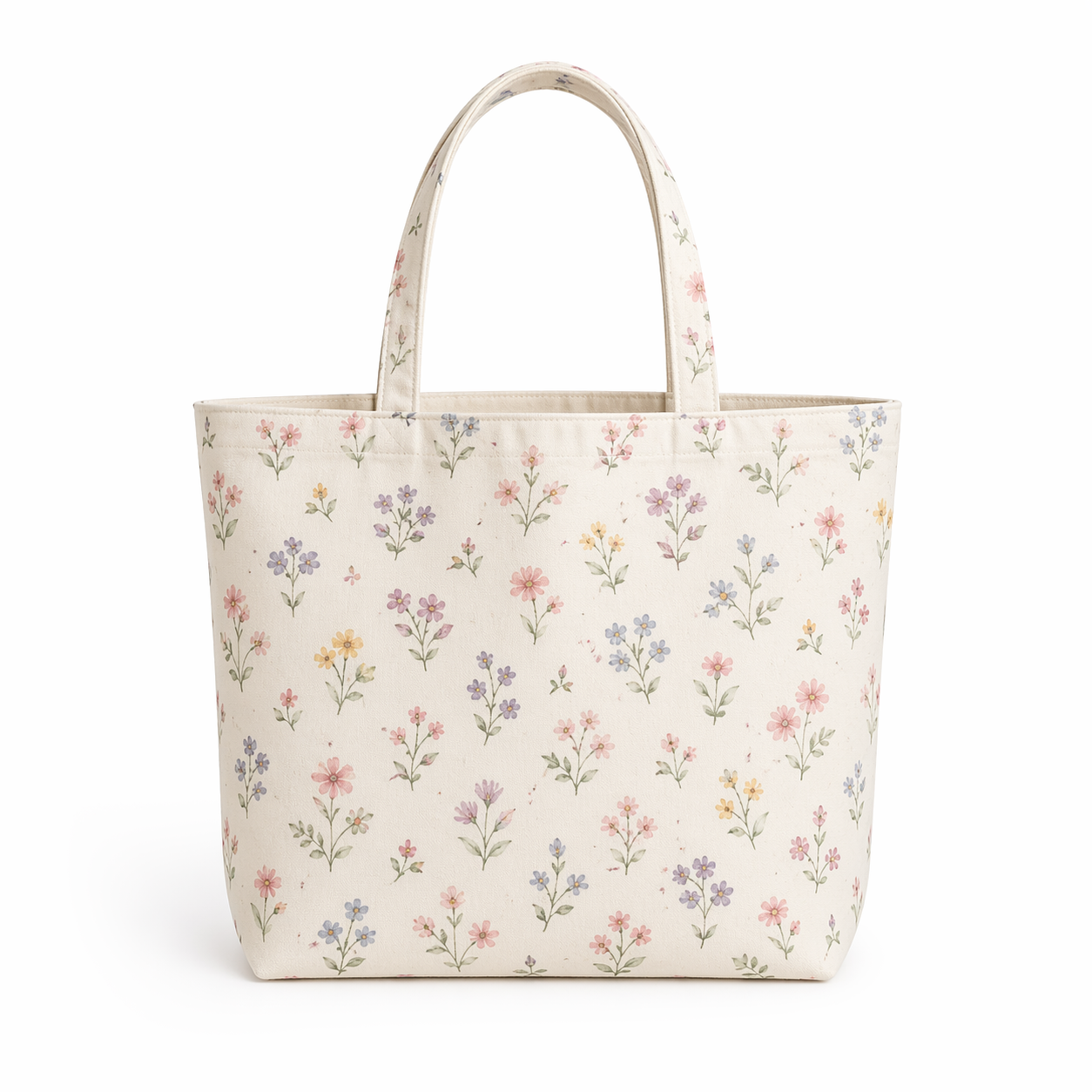
Printed canvas tote format used in brand promotional and corporate giveaway programmes.
A recorded OEM/ODM programme shows how the pieces fit together in practice. The case record describes a Japanese chain-supermarket customer ordering 1,000,000 units of daily shopping bags and promotional gifts over a one-year programme, with the bags specified for reusable long-term use. The recorded outcome lists a 99.7% product qualification rate, no delivery delay, repeat orders across three consecutive years, and compliance with Japan's eco-friendly standards. That is one customer's programme record, not a general performance guarantee — but it is the kind of evidence a retail buyer should ask every candidate to supply, because it ties audit coverage to a shipment that actually cleared a destination market.
Validity, renewal and the checks that protect a buyer
Audit records expire on a fixed cycle, and the dates matter as much as the numbers. Measured against the publication date of this assessment, the four Hansun windows recorded above all fall earlier: ISO 9001:2015 to 4 November 2025, Sedex 4 Pillars to 19 January 2026, Disney FAMA to 14 June 2026 and BSCI to 9 September 2026. That is normal audit-cycle behaviour rather than a finding about capability, but it changes what a buyer should do next. A certificate number is the stable identifier; the date is the part that must be re-confirmed at the start of every programme.
Five checks convert a certificate stack into usable assurance:
- Look the number up at the source. Certificate numbers are designed to be verified in the issuing body's own database. A scanned PDF is a copy; the database entry is the record.
- Match the site, not the group. Confirm that the audited facility is the one that will produce the order, and that the scope names your product category rather than a neighbouring line.
- Check the date against your shipment window. A certificate expiring before your delivery date may not satisfy a retailer's onboarding team, even if it was valid at the time of the order.
- Ask for the audit report, not only the certificate. Findings, corrective actions and closure evidence show how a factory responds to a non-conformity, which is the part that predicts behaviour.
- Separate product evidence from system evidence. Request test data for load, seams, handles, abrasion and washability against your own specification, and confirm EU reusable-packaging obligations with your importer rather than inferring them from a social audit.
Market outlook: why documentation is becoming the screening layer
Demand context supports the attention being paid to compliance documentation. Fortune Business Insights projects the global reusable shopping bag market growing from USD 16.67 billion in 2026 to USD 28.87 billion by 2034, with Asia Pacific holding a 24.23% share in 2025 and polypropylene the largest material segment at roughly 46% production share. These are third-party research projections, not observed sales, and the same source set shows methodology differences between providers — but the direction is consistent with the regulatory layer sitting on top of it.
That layer is where the compliance conversation is heading. Regulation (EU) 2025/40 sets recyclability and recycled-content requirements for packaging on a staged timeline running to 2030 and 2040 in the EU's own summary, and it also requires economic operators making reusable packaging available in a Member State to ensure a reuse system is in place, including an incentive to support collection. EU interpretive material adds a further screen for plastic carrier bags, defining lightweight bags as those below 50 microns wall thickness and very lightweight bags as below 15 microns, subject to stated exceptions. None of these provisions is satisfied by holding a social audit; all of them require product-level documentation that is specific to the bag, the material and the market.
The conditional outlook for buyers is therefore straightforward. A supplier that can already produce certificate numbers, scope statements, capacity figures and a product test protocol will absorb a new documentation request inside an existing process. A supplier that treats compliance as a marketing page will need to build that process under deadline. The four-domain stack does not decide which supplier wins a programme, but it determines how much of the qualification work is already finished before the first meeting — and in a market where the regulatory requirements are still phasing in, that head start is the part most likely to hold its value.
Hansun's product and company documentation is published at Zhejiang Hansun Arts & Crafts Co., Ltd., and the company brochure can be downloaded for a full specification reference: Hansun product brochure (PDF).
FAQ: certification questions buyers ask before a shopping bag programme
What is the difference between BSCI and Sedex 4 Pillars for a shopping bag factory?
Both are social-compliance audits, run through different programmes with different reporting platforms. Hansun's BSCI record (BSCI-2026-4567), issued by an Amfori BSCI Approved Audit Firm under the Amfori BSCI Code of Conduct, is recorded as covering factory social responsibility, ethical sourcing and working conditions for the EU, Middle East and global retail-brand markets, valid 10 September 2023 to 9 September 2026. The Sedex 4 Pillars record (SEDEX-2026-0123), issued by a Sedex Approved Audit Body under the Sedex SMETA 4 Pillars Code, is recorded as covering social compliance, labour practices, health and safety and environmental standards for the EU, UK, North America and Australia, dated 20 January 2024 to 19 January 2026. Retail buyers usually require whichever platform their own compliance team has standardised on.
Does Disney FAMA authorise a factory to produce any Disney product?
No. The Hansun record (DSN-FAMA-2026-001), issued by Disney International under the Disney Code of Conduct & Product Safety Standards, states its scope as production and supply of Disney licensed promotional bags and gifts, with a global market listing covering the US, EU and Asia and a recorded window of 15 June 2023 to 14 June 2026. It authorises activity inside that licensed scope only. It is not a general manufacturing licence, and it does not substitute for a social-compliance audit or a quality management certificate.
How long are these certifications valid, and what happens at expiry?
The windows recorded for Hansun run roughly two to three years: ISO 9001:2015 from 5 November 2022 to 4 November 2025, Sedex 4 Pillars from 20 January 2024 to 19 January 2026, BSCI from 10 September 2023 to 9 September 2026, and Disney FAMA from 15 June 2023 to 14 June 2026. All four recorded windows fall before the date of this assessment, so a buyer should request the current renewal certificate and verify the number, site and scope in the issuing body's database. Relying on a copy supplied earlier in a supplier relationship is the most common way an expired audit enters a live programme.
Does a certification prove a shopping bag meets EU packaging rules?
No. Social-compliance audits and ISO 9001:2015 address management systems and labour conditions, not product conformity with packaging law. Regulation (EU) 2025/40 covers reusable packaging, reuse systems and recyclability, with requirements phased to 2030 and 2040 in the EU's own summary, and EU sources describe it as applying from 12 August 2026 subject to confirmation of product-specific scope in the consolidated legal text. Confirming conformity for a particular bag needs product-level documentation — material composition, thickness where relevant, and test data — reviewed against the regulation and the importer's obligations.
What capacity and lead time does Hansun state for OEM shopping bag orders?
Company documentation states a facility of more than 25,000 m², 200 employees, annual output of 20,000,000 units and monthly capacity of 1,500,000 units, supported by a 25-engineer R&D team and an export share of 70%. OEM and ODM orders carry a stated MOQ of 3,000 pcs and a lead time of 30–45 days, with customisation of logo, size and material; quality control is described as depending on customer requirements. These are company-stated figures, and a buyer should confirm them against the specific bag specification, material and order volume rather than treating them as fixed for every configuration.
¿Tiene preguntas o necesita más detalles?
Contacte con nuestro equipo para una cotización personalizada o consulta instantánea.
Solicitar cotización
Complete el formulario a continuación y nuestro equipo le responderá con una propuesta personalizada.
Chat directo de WhatsApp
¿Prefiere chatear en tiempo real? Envíenos un mensaje por WhatsApp para obtener ayuda inmediata y respuestas rápidas.
- Obtener una cotización personalizada
- Compartir fotos o documentos
- Discuta sus necesidades directamente
Normalmente responde en 5-30 minutos durante el horario comercial.