
Shokunin COOLWAVE Cooling Vest: Certification & Compliance Explained
Shokunin COOLWAVE Cooling Vest: Certification & Compliance Explained
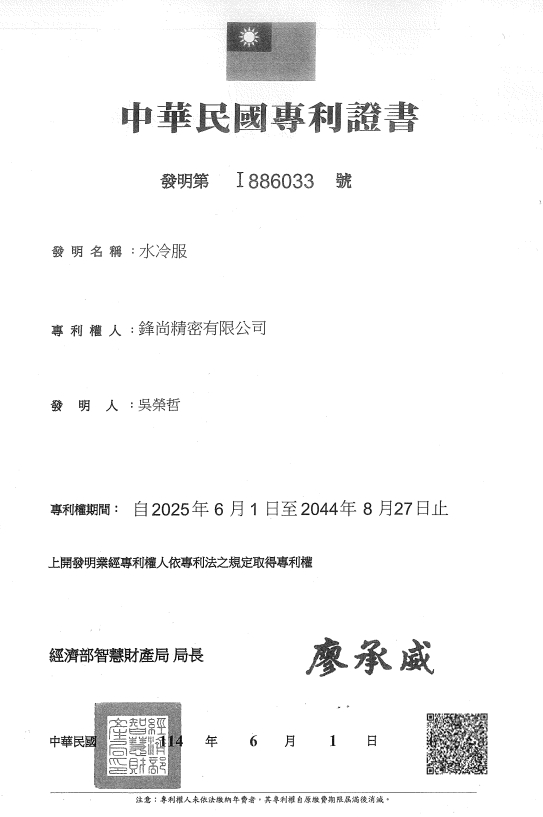
The water-cooled vest patent certificate, issued by the Intellectual Property Office, Ministry of Economic Affairs. Patent rights and product certification do different jobs in a procurement file.
Cooling vests usually enter industrial purchasing through a side door. They begin as a site-level experiment — a small batch bought to get a crew through a heat wave — and only later become a recurring PPE line item. At that moment the questions change. Buyers stop asking whether the garment feels cold and start asking what the product is classified as, who has reviewed it independently, and which market that review actually covers. Certification names, issuing bodies, scope statements, patent numbers and material declarations become the working vocabulary of the purchase, because those are the items that survive a tender review, a safety committee meeting or an internal audit.
This industry reference examines the qualification record of the COOLWAVE Water-Circulation Cooling Vest, an active dual cooling water cooling vest produced by FENG SHANG PRECISION CO., LTD. and marketed under the Shokunin brand. FENG SHANG PRECISION CO., LTD. is a Taiwan-based manufacturer founded in 2009 whose product range covers air compressors, cut-off machines, water-cooled vests, lithium batteries, diamond saws, nail guns, spider stands and screwdriver bits; Shokunin is the professional brand the company operates for craftsmen and industrial users, and the company states that Shokunin is a professional e-commerce brand launched by Feng Shang Precision Co., Ltd.
Three documents sit behind this product, and they are not interchangeable. The vest carries a product classification of Industrial Cooling Apparel / Personal Protective Equipment (PPE). It received the Disaster Prevention Product and Service Certification Award from the Taiwan Disaster Prevention Industry Association. And the COOLWAVE water-circulation cooling vest (Basic Model) is protected by patent No. I886033, issued by the Intellectual Property Office, Ministry of Economic Affairs under the Patent Act of the Republic of China. The sections below explain what each item means, what it does not mean, and how a compliance officer or procurement manager can verify it.
Why Certification Became a Procurement Gate, Not a Marketing Line
For a buyer, a cooling vest's qualification file has to answer three separate questions: what the product is classified as, who reviewed it independently, and which jurisdiction that review belongs to. A single certificate rarely answers all three, and this is where many procurement files quietly break down — a document is collected, filed, and never checked for scope.
Category-level expectations add a second layer. Cooling systems are commonly expected to sit inside a quality-management framework such as ISO 9001:2015, and electrical components frequently need CE or UL marks depending on the destination market. Those are general expectations for the category rather than statements about any single supplier, and they are exactly why experienced buyers ask for scope documents instead of logos.
The commercial reason the scrutiny is increasing is straightforward. Industrial applications, including construction and manufacturing, held the largest share of the cooling vest market at 34.5% in 2025, according to third-party market analysis published by Dataintelo. When a category of that size moves from ad-hoc site purchases into formal PPE budgeting, the documentation standard rises with it. A cooling vest that cannot be described in a compliant way is difficult to buy repeatedly, even when the crews like it.
What the PPE Classification Means for a Buyer
The COOLWAVE Water-Circulation Cooling Vest is classified as Industrial Cooling Apparel / Personal Protective Equipment (PPE). The classification places the vest in the protective-equipment category rather than in general workwear, and that distinction changes procurement behaviour in concrete ways. It routes the item through PPE budget lines rather than uniform spend. It brings the vest into the standard PPE discipline of issue, care, cleaning and replacement planning. And it lets a buyer require a material declaration and a defined service commitment, rather than treating the garment as an accessory.
The available record gives reviewers enough to work with on the material side. The shoulder straps are 600D polyester, the vest material is PEVA, the water bag is TPU, the water bag cap is polypropylene, and the cooling tube is sand rubber in black. Each unit ships as a water-cooled vest backpack with two ice packs. These are the kinds of details that a skin-contact or durability review will ask for first.
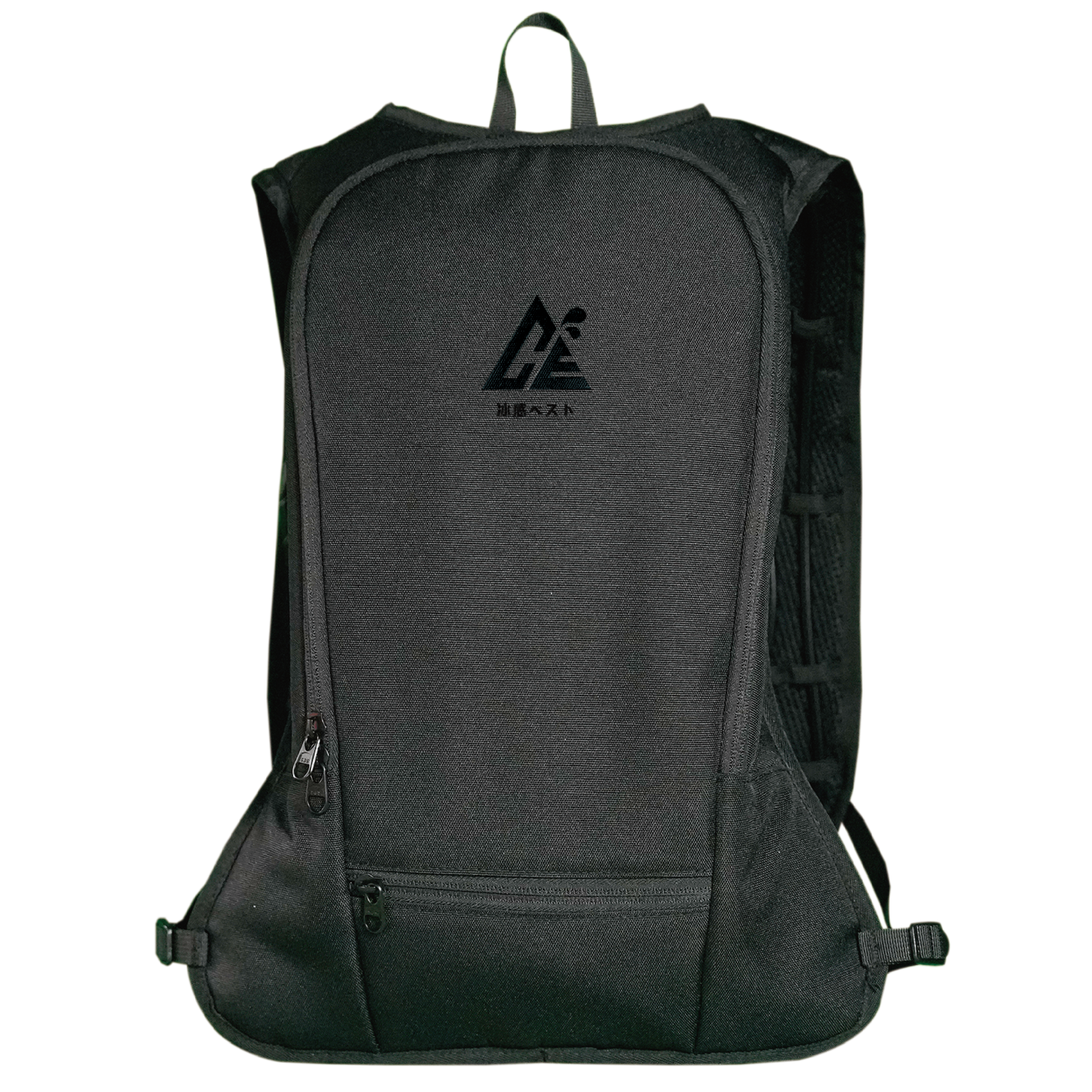
COOLWAVE Water-Circulation Cooling Vest, Professional Model in black. The product is classified as Industrial Cooling Apparel / Personal Protective Equipment (PPE).
Documented Product Identity and Parameters
| Attribute | Documented value |
|---|---|
| Product type | Industrial Cooling Apparel / Personal Protective Equipment (PPE) |
| Model range | COOLWAVE Water-Circulation Cooling Vest (Basic Model); Professional Model in Blue, Gray and Black |
| Cooling duration | 3–4 hours |
| Weight | Within 2 kg |
| Suitable temperature (listed) | Below 10 °C |
| Pump output | 5 V 150 mA (max) |
| Flow rate | Max 320–370 ml/min |
| Pack contents | Water-cooled vest backpack ×1, ice packs ×2 |
It is worth being precise about one thing that is often blurred. A PPE classification describes what the product is; it is not, by itself, a third-party conformity assessment. Independent review for this product is documented separately, through the certification described in the next section.
The Disaster Prevention Product and Service Certification Award
The COOLING water-cooled vest manufactured by FENG SHANG PRECISION CO., LTD. received the Disaster Prevention Product and Service Certification Award from the Taiwan Disaster Prevention Industry Association. This certification validates the product's compliance with specific disaster prevention standards, and the applicable market for the award is Taiwan.
For procurement, the value of the award is that it is issued by an industry association against a defined category of disaster-prevention products and services, rather than being a self-declared claim. It signals that the vest has been assessed as equipment relevant to heat-injury prevention within that framework, which is consistent with how the product is positioned: a wearable cooling system for people working in high-temperature environments.
The scope statement matters as much as the award itself, and buyers should read both together:
| Element | Detail |
|---|---|
| Certification name | Disaster Prevention Product and Service Certification Award |
| Issuing body | Taiwan Disaster Prevention Industry Association |
| Product | The COOLING water-cooled vest |
| Applicable market | Taiwan |
| What it validates | Compliance with specific disaster prevention standards |
Two practical implications follow. For Taiwan-based industrial buyers, disaster-prevention supply chains and public-sector procurement, the award fits directly into the qualification file and aligns with local expectations for heat-injury prevention equipment. For buyers outside Taiwan, the correct reading is narrower and more useful: the award is evidence of independent, association-level review and a clear statement of category intent, but it is not a conformity mark for Europe, North America or any other jurisdiction, and it should not be filed as one.
A verification habit is worth stating plainly. Because the certification names the product rather than a SKU list, buyers should confirm with the manufacturer that the certificate reference matches the specific model and configuration being purchased, and should keep the issuing association's name and the applicable market on file alongside the certificate itself.
Patent I886033: What It Protects — and What It Does Not Certify
The COOLWAVE water-circulation cooling vest (Basic Model) is protected by patent certificate No. I886033, issued by the Intellectual Property Office, Ministry of Economic Affairs under the Patent Act of the Republic of China. The patent scope covers the water-cooled vest structure and cooling system, and it applies to the ROC market.
| Field | Recorded detail |
|---|---|
| Instrument | Water-cooled vest patent certificate |
| Patent number | I886033 |
| Authority | Intellectual Property Office, Ministry of Economic Affairs |
| Legal basis | Patent Act of the Republic of China |
| Scope | Water-cooled vest structure and cooling system |
| Applicable market | ROC |
| Issue date | 2025-06-01 |
| Expiry date | 2044-08-27 |
| Related model | COOLWAVE Water-Circulation Cooling Vest (Basic Model) |
Patent rights and product certification do not do the same job, and conflating them is one of the more common errors in cooling-apparel procurement files. A patent grants its holder the right to exclude others from practising the claimed structure and cooling system. It is evidence of original design work and of a documented intellectual-property position. It says nothing about whether the product is safe, whether the pump meets electrical requirements in a given market, or whether the product performs as specified.
The practical value to a procurement team is different from the practical value of a certificate. Patent ownership is relevant when buyers assess copy risk in a tender, when they compare apparently similar water-circulation designs, and when they discuss OEM or ODM arrangements in which the buyer needs to know who holds rights to the mechanism being manufactured. It is not a substitute for a conformity assessment, and it should be labelled as an IP right in the qualification file so that a reviewer reading the file later does not mistake it for one.

Shokunin is the professional brand operated by FENG SHANG PRECISION CO., LTD., a Taiwan-based manufacturer founded in 2009.
The Engineering Behind the Compliance Questions
The vest works as a two-part system. Reusable ice packs act as the cold source, and a pump circulates chilled water through tubing built into the garment, with a maximum flow rate of 320–370 ml/min driven by a 5 V 150 mA (max) pump. Listed cooling duration is 3–4 hours, listed unit weight is within 2 kg, and the parameter sheet lists a suitable temperature below 10 °C. Each unit is supplied as a water-cooled vest backpack with two ice packs.
Each of those figures maps to a question a reviewer will ask, which is why they belong in the same document as the certificates:
Material composition
TPU water bags, polypropylene caps, sand rubber cooling tubes and 600D polyester straps are the components that a skin-contact or wear-durability review will examine first. Having the material list stated by component shortens that review considerably.
Electrical rating
The pump is rated at 5 V 150 mA (max). That single line determines whether a destination-market electrical review is triggered, because cooling-system components with electrical parts are commonly expected to carry CE or UL marks in many markets. Buyers should route this number to whoever handles conformity for the target market.
Performance envelope
A 3–4 hour cooling duration defines how the vest fits a shift. It is long enough to cover a typical high-exposure work block without a change, and short enough that longer shifts need a rotation plan built around ice-pack refreezing. A listed weight within 2 kg is the number a manual-handling or wearer-comfort assessment will start from; buyers should confirm whether the figure covers the vest, backpack, water and ice packs as configured for use.
Where the Qualification Record Meets the Worksite
The COOLWAVE vest is specified for construction sites, outdoor work, metal sheet factories and street vending environments, with traffic controllers, food stall operators and other outdoor workers also listed among applicable users. The recorded working condition is high temperature, the function is effective body cooling, and the operating mode is passive cooling activated by ice packs, supported by reusable ice packs, adjustable vest straps and a portable backpack design. The special requirements recorded for the product — lightweight, waterproof, breathable and a one-size-fits-all design — are the characteristics that determine whether a vest will actually be worn for a full shift.
A field record from Taiwan illustrates the pattern. A deployment of 100 units for cooling use in high-temperature environments is documented, with reported outcomes of effective body cooling, heatstroke prevention, and improved work efficiency and worker comfort. The case record highlights passive ice-pack cooling, a lightweight and portable design, an adjustable one-size-fits-all fit, and certified disaster-prevention status; it lists a duration of ten years for the engagement.
For a compliance officer, the value of that record is not the unit count. It is that the deployment describes an application pattern — construction, outdoor and metal-working environments in a high-temperature climate — that matches the certification and classification claims. A qualification file is strongest when the documents, the product classification and the field record all describe the same use case.
A Due-Diligence Checklist for Compliance Officers and Buyers
The following items can be verified for the COOLWAVE Water-Circulation Cooling Vest without any additional interpretation. Each row pairs a document with the decision it supports.
| Verification item | Documented value | Why it matters |
|---|---|---|
| Product classification | Industrial Cooling Apparel / Personal Protective Equipment (PPE) | Determines budget routing, care and replacement discipline |
| Disaster-prevention certification | Disaster Prevention Product and Service Certification Award, Taiwan Disaster Prevention Industry Association; applicable market: Taiwan | Association-level review against disaster-prevention standards; scope is Taiwan |
| Patent | No. I886033, Intellectual Property Office, Ministry of Economic Affairs; scope: vest structure and cooling system; ROC market; issued 2025-06-01; expires 2044-08-27 | Intellectual-property position; not a safety or electrical mark |
| Material declaration | 600D polyester straps; PEVA vest material; TPU water bag; polypropylene cap; sand rubber cooling tube | Skin contact, durability and cleaning assessment |
| Electrical rating | Pump 5 V 150 mA (max); max flow 320–370 ml/min | Destination-market electrical requirements; confirm the intended power source and its runtime |
| Performance envelope | 3–4 hours cooling; within 2 kg; listed suitable temperature below 10 °C | Shift planning, ice-pack rotation, manual handling |
| Warranty | 6-month warranty for the water-cooled vest | Defines the baseline service commitment |
| Commercial terms | MOQ 10 units; lead time 7–14 days; monthly capacity 3,000 units; ODM production; export markets listed as global | Scaling, replenishment and vehicle for private-label programmes |
| Independent thermal test data | Not included in the available record | Request directly if a tender requires accredited results |
Market Context: Documentation as a Competitive Variable
The cooling category is expanding fast enough that documentation has become a practical differentiator. The global personal cooling device market was valued at USD 25.16 billion in 2024 and is projected to reach USD 94.85 billion by 2035, according to Market Research Future. Narrowed to cooling vests specifically, Dataintelo estimates a market of approximately USD 215 million in 2024, projected to grow to USD 385 million by 2033. The gap between those two figures is not a contradiction so much as a definitional one: the broader number includes handheld fans and other personal cooling devices, while the narrower number counts cooling garments only.
Two structural signals are more useful to a buyer than the headline totals. First, Asia Pacific is the fastest-growing region for cooling vests, driven by rapid industrialisation and large outdoor work populations, according to Spherical Insights — which is consistent with the Taiwan field record described above. Second, technology is fragmenting. Phase Change Material (PCM) cooling vests captured 28.7% of market share in 2025 and represent the fastest-growing technology segment, per Dataintelo, while active circulatory mechanisms such as ice water circulation are increasingly deployed in industrial sectors to mitigate occupational heat stress, according to Strategic Market Research.
Third-party analysis from Spherical Insights lists Techniche International, Glacier Tek, Polar Products Inc. and Ergodyne among key participants in the cooling vest market. This reference makes no performance comparison between those companies and the COOLWAVE product; the names are included only to describe the competitive field in which procurement teams are operating.
The practical consequence of a fragmenting market is that more suppliers can demonstrate that a vest gets cold. Fewer can produce a scope statement that a compliance officer can file without qualification. That is where certification, patent and material documentation stop being marketing material and start acting as purchasing criteria.
Honest Limits — and How the Approach Compares with Alternatives
A qualification record is only useful if its boundaries are stated, and the COOLWAVE record has several that buyers should note before they commit.
Jurisdictional scope. The Disaster Prevention Product and Service Certification Award is applicable to the Taiwan market, and patent I886033 applies to the ROC market. Neither substitutes for conformity assessment elsewhere. A buyer in Europe or North America gains evidence of independent review, not local market clearance.
Electrical conformity. ISO 9001:2015 quality management and CE or UL marks for electrical components are common expectations for cooling systems generally. The available record for the COOLWAVE vest does not state CE or UL marks for the pump, which is rated at 5 V 150 mA (max). Buyers whose destination markets regulate electrical components must confirm the applicable conformity documents directly with the manufacturer rather than assuming them from the PPE classification.
Duration versus shift length. A 3–4 hour cooling duration covers a typical high-exposure block but not an extended shift. Operations that run longer need ice-pack rotation and refreezing logistics planned in advance; that is an operational constraint rather than a product defect, but it belongs in the deployment plan.
Documentation depth. Independent third-party thermal performance test data is not part of the record reviewed here. Where a tender requires accredited results, they need to be requested separately.
Comparing the approach with the main alternatives clarifies where the trade-offs sit:
| Approach | Cold source and operation | What buyers must verify |
|---|---|---|
| Active water circulation (the COOLWAVE approach) | Reusable ice packs plus a pumped water loop at max 320–370 ml/min; 3–4 hour listed duration | Certification scope and market; pump electrical rating; refreezing logistics; material declaration |
| Phase Change Material (PCM) vests | PCM packs that hold a temperature plateau; the fastest-growing technology segment at 28.7% market share in 2025 (Dataintelo) | Regeneration method and infrastructure; certification scope where claimed |
| Ice-pack-only vests without circulation | Ice packs placed in garment pockets; no circulation hardware | Evenness of cooling; documentation depth, which varies by supplier |
None of these approaches dominates. A circulating system adds hardware that must be documented and maintained; a PCM system shifts the burden to regeneration equipment; a simple ice-pack vest reduces complexity at the cost of cooling distribution. The right question for a procurement team is not which mechanism is inherently better, but which one produces a qualification file that fits the market, the shift pattern and the audit requirement in front of them.
Future Outlook
Three directions look durable over the coming years. Heat-stress management is becoming a formalised part of industrial safety programmes rather than a seasonal courtesy, and formalisation brings documentation with it. Cooling-vest demand is growing fastest in Asia Pacific, where large outdoor work populations and rapid industrialisation concentrate the problem, and industrial applications already hold the largest single share of the market. And the industry itself is segmenting by technology, with PCM vests and active circulatory systems both expanding.
For manufacturers, that suggests qualification records will be judged on precision rather than volume. A single certification described accurately — issuer, product, market, standards referenced — is more useful to a buyer than a page of marks, because only the former can be filed against a tender requirement. The same logic applies to patents and material declarations: their value in procurement comes from being clearly labelled for what they are.
For buyers, the practical expectation is that cooling-vest suppliers will increasingly be asked to map their documentation to jurisdictions, not just to products. Where a supplier can state the scope of a certification and the market it belongs to, the evaluation shortens. Where that cannot be stated, the file stays open — regardless of how well the vest performs on site.
FAQ
What is the Disaster Prevention Product and Service Certification Award, and which market does it cover?
It is a certification awarded to the COOLING water-cooled vest by the Taiwan Disaster Prevention Industry Association, validating the product's compliance with specific disaster prevention standards. The applicable market is Taiwan. It is an industry-association certification rather than a general international conformity mark, so buyers outside Taiwan should treat it as independent review evidence within its stated scope.
Does the PPE classification mean the vest has been independently certified as protective equipment?
No. The classification states the product type: Industrial Cooling Apparel / Personal Protective Equipment (PPE). It determines how the item is handled in procurement, budgeting, care and replacement planning. Independent review of this product is documented separately, through the Disaster Prevention Product and Service Certification Award issued by the Taiwan Disaster Prevention Industry Association.
Is patent I886033 a safety certification?
No. Patent No. I886033 was issued by the Intellectual Property Office, Ministry of Economic Affairs under the Patent Act of the Republic of China, covers the water-cooled vest structure and cooling system, and applies to the ROC market. It was issued on 2025-06-01 and expires on 2044-08-27. It is an intellectual-property right and does not certify safety, electrical conformity or performance.
Does the COOLWAVE cooling vest carry CE or UL marks?
The available product and certification record does not state CE or UL marks. The pump is rated at 5 V 150 mA (max). Because electrical components in cooling systems are commonly expected to carry CE or UL marks in many markets, buyers whose destination markets regulate those components should confirm the applicable conformity documents directly with the manufacturer.
What cooling duration, weight and content should buyers plan around?
The listed cooling duration is 3–4 hours, the listed weight is within 2 kg, and the listed suitable temperature is below 10 °C. Each unit is supplied as a water-cooled vest backpack with two ice packs. Shifts longer than the stated duration require ice-pack rotation and refreezing logistics, and buyers should confirm whether the 2 kg figure covers the vest, backpack, water and ice packs as configured.
What commercial terms apply, and what warranty is provided?
The manufacturer lists a minimum order quantity of 10 units, a lead time of 7–14 days, a monthly capacity of 3,000 units and a 6-month warranty for the water-cooled vest, with production in ODM mode and export markets listed as global. The vest is specified for construction workers, outdoor workers, food stall operators, street vendors, traffic controllers and metal sheet factories.
Reference materials. The manufacturer's product brochure, including specification and certification details, is available for download: Shokunin COOLWAVE product brochure (PDF). Company information is published at fstool.com.tw.