
Shirt Collar Interlining in Packaging: Sourcing and Specs
In garment construction, the shirt collar receives its permanent body from a fusible or stitched interlining layer inside the fabric. In ready-made shirt packaging, the same collar zone is protected by a different group of items: removable stiffeners, collar bands, collar supports and collar butterflies that hold the collar shape while the shirt sits in a poly bag or retail box. Buyers searching for shirt packaging accessories are often evaluating this second category, and the distinction matters because it changes the materials, dimensions, certification requirements and supplier capabilities they should compare.
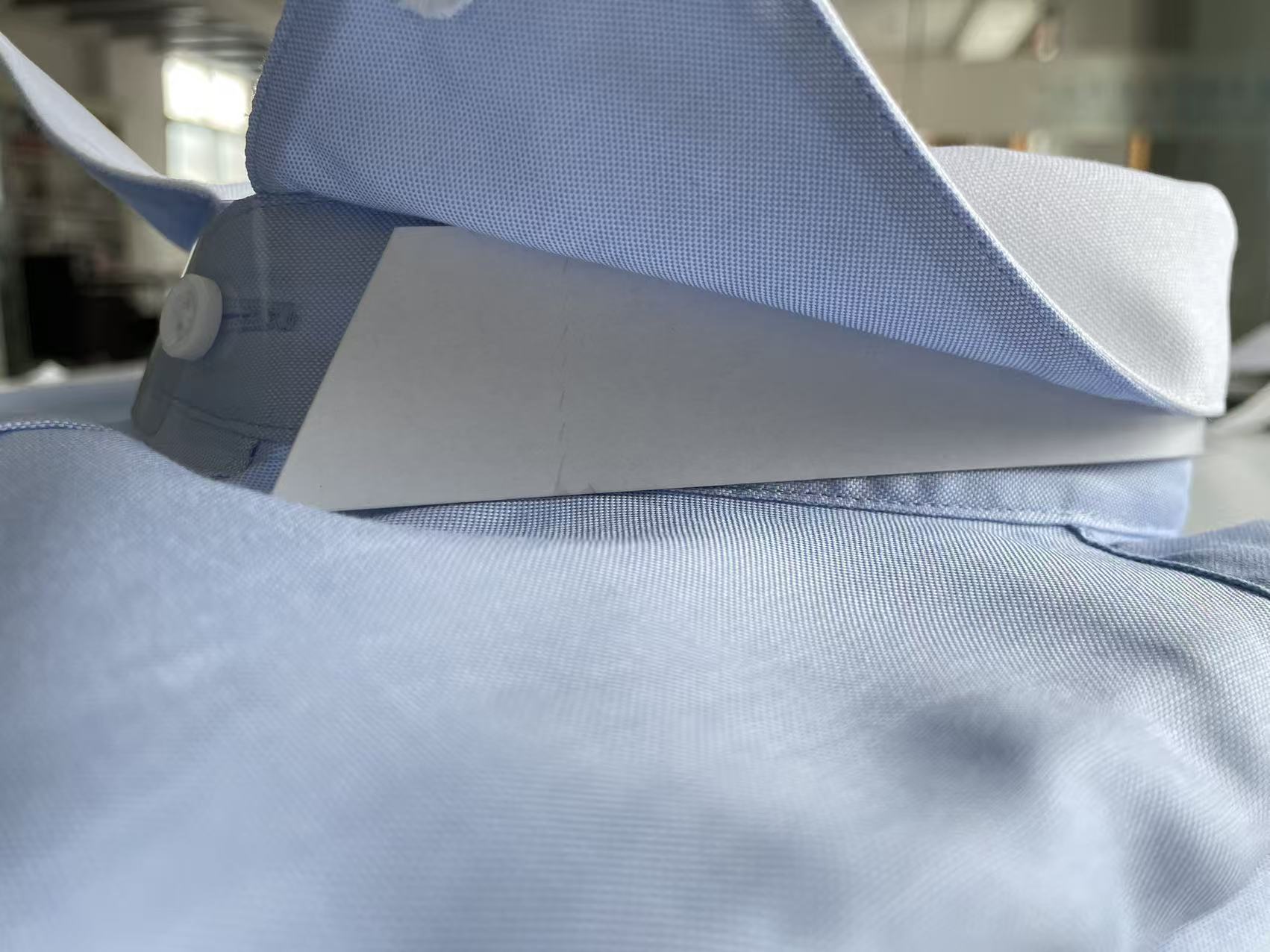
Why the Collar Is a Critical Zone in Shirt Packaging
A folded shirt creates concentrated stress at the collar and placket. If the package does not control the folded collar line, the fabric can arrive with permanent creases, softened points or visible distortion. For brands and garment manufacturers, this is not only an aesthetic issue; collar deformation during transport can lead to claims, re-pressing costs and weaker presentation at retail.
The functional response is to separate the collar from the rest of the shirt inside the package. A stiff insert or collar support keeps the collar's natural shape while the surrounding cardboard, tissue and poly bag provide outer protection. This combination explains why a typical shirt packing order is rarely for a single component. It usually includes a collar support element plus paper board, tissue paper, hang tags, belly bands and plastic bags. Each product has its own specification range, and each becomes a purchasing constraint when a sourcing team prepares a bulk order.
What Sits Inside the Shirt Collar Interlining Category for Packaging
For packaging buyers, the term shirt collar interlining often overlaps with several accessory names used across supplier catalogues: collar stays, collar bands, collar butterflies, collar bones, collar inserts and collar supports. These names describe slightly different geometries, but they perform a shared function. They prevent the collar from flattening, bending or rubbing against other folded shirts during shipment.
- A collar stay is a narrow strip that reinforces the collar point area. Common variants are produced in plastic or stainless steel for reusable premium shirt packaging.
- A collar band usually wraps around or supports the full collar fold line. Suppliers produce this SKU in paper, PET or PVC with a flat rectangular shape.
- A collar butterfly is a wing-shaped support placed inside the collar fold area. It can be made from paper or plastic materials and is widely used in folded shirt packing.
- A collar support or collar support insert is a broader three-dimensional or moulded support item that stabilises the whole collar area before the shirt is folded.
All these items solve a similar problem in different ways. The right choice depends on the shirt size, the collar width, the folding method, the desired customer unboxing experience and the cost structure of the packing line.
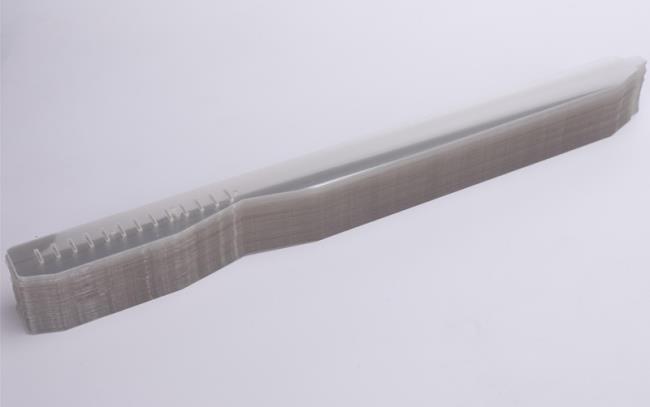
Technical Parameters a Buyer Should Verify
When the buying stage moves from early research to supplier evaluation, buyers should check more than product names. Thickness, material type, finished size, colour, logo flexibility and order minimums define whether an accessory is suitable for a given shirt. Reviewing a representative product set helps clarify the tolerance and detail level a supplier can manage.
For a shirt packaging accessories supplier such as Wuxi Mingyu Garment Accessories Factory, the published product range includes PVC and PET collar bands, collar stays, paper butterflies, collar supports, shirt cardboard, tissue paper, plastic clips, metal pins, hang tags, plastic bags and related garment accessories. The factory profile lists an annual output of 90 million sets, with 85% of output exported to Europe, North America, South America and Asia. This scale is relevant to buyers estimating whether a supplier can support repeat volume without fragmenting quality.
| Accessory type | Typical material | Representative size and thickness | Typical MOQ reference |
|---|---|---|---|
| Plastic collar band | PET, white | 48.1 cm × 4 cm × 0.35 mm | 10,000 pieces |
| Paper collar band | Specialty tenacity paper | 47.2 cm × 3.8 cm × 1 mm | 10,000 pieces |
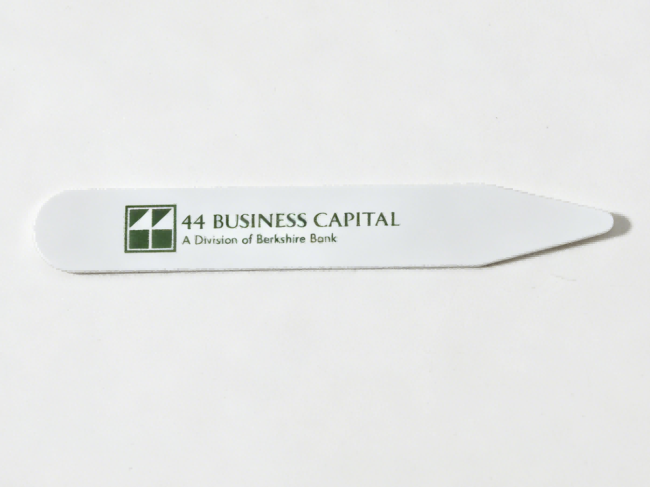
| Collar stay | White PVC | 6.35 cm × 1 cm × 0.75 mm | 10,000 pieces |
| Metal collar stay | Stainless steel | Four common sizes, from 55.9 mm to 76.2 mm in length, 9 mm width, 0.8 mm thickness | 1,000 pieces |
| Collar support | Light blue PVC | 22.7 cm × 18.5 cm × 0.35 mm | 10,000 pieces |
| Paper collar butterfly | 400 g single white paper | 15 cm × 3 cm | 10,000 pieces |
| Plastic collar butterfly | PVC or PET variants | 26 cm × 10.4 cm × 0.25 mm | 10,000 pieces |
| Shirt cardboard | 100% natural wood-pulp paper | 21 cm × 35.2 cm, 500 gsm | 10,000 pieces |
| Plastic bag | PP | 35 cm × 26 cm, single film 0.035 mm | 10,000 pieces |
The MOQ figures above are listed at SKU level for common shirt packing products. A sourcing partner may quote different order minimums for mixed-SKU or programme-based orders.
Material selection is the first technical filter. PET and PVC films are chosen when the collar must stay straight and the support must survive packing-line handling. Paper versions are more suitable when brand owners want a recyclable or compact presentation, although the rigidity depends on the fibre grade. Stainless steel collar stays are positioned as reusable or higher-value accessories, so they are often quoted with a lower MOQ. In this catalogue, metal collar stays carry an MOQ of 1,000 pieces, while most paper and plastic collar supports are listed at 10,000 pieces.
Logo and printing flexibility is another parameter. Many collar bands, butterflies, cardboard sheets and collar stays support custom design or printed logos. Metal collar stays go further and allow laser engraving on the surface, which makes them a candidate for personalised retail packaging. Buyers who need a branded unboxing experience should confirm printing method, colour matching, foil stamping and plate costs before placing the order rather than treating logo supply as an afterthought.
Certifications as a Constraint in Collar Packaging Procurement
The shirt market is internationally distributed, and packaging accessories come into direct or near-direct contact with fabric. For EU and other regulated markets, buyers often ask for restricted-substance documentation, while sustainability-minded retail programmes ask for proof of recycled content. Certification is therefore not a separate marketing topic; it is a sourcing constraint that affects supplier shortlisting.
One relevant scheme is OEKO-TEX STANDARD 100. MingYu's certification records link the OEKO-TEX certificate SH001 275178, issued by TESTEX, to products including plastic collar bands, collar stays, butterflies, poly bags, paper butterflies, cardboard and other accessories in the shirt packing range. This certificate is issued under EN ISO 17050-1, carries a validity period to January 2027 and applies to the world market. For a buyer evaluating collar packaging accessories, this type of documentation reduces the need to run separate restricted-substance testing on every small component.
Recycled-content claims are supported separately by GRS certification. Product 8148, a plastic bag in the shirt packing assortment, is certified under the Global Recycled Standard V4.0 with certificate number SGC-GRC09119-GRS-2026-07 issued by SGS. The GRS scope covers trading, warehousing, distribution and manufacturing activities. While not every accessory is GRS-certified in the current published scope, the presence of a GRS certificate on a packaging film SKU indicates that recycled-content documentation is available within the same supply structure.
Supplier Capability and Operational Boundaries
OEM and ODM orders are common in this category. MingYu's published production capabilities include customised size, colour, style, printing and logo options, as well as mould opening for specific collar shapes. The factory describes its working model as mass production combined with custom printing and mould support. That combination is useful when a garment brand wants a standard support item but needs its own collar width or printed label on the accessory.
For buyers comparing suppliers, the following operational facts are more decisive than broad quality language:
- Monthly capacity is reported as 7.5 million sets, with standard lead time of 7 to 20 working days after order confirmation.
- The company was established in 2004 and operates a 2,500 m² factory in E’hu Town, Xishan District, Wuxi, Jiangsu.
- MingYu has built overseas warehouses, agencies or manufacturing facilities in Sri Lanka, Argentina, Bangladesh, Indonesia, Colombia and Kenya. A Sri Lanka factory was established in 2013 and a Vietnam factory in 2017.
- The factory's own equipment list includes automatic creasing machines, punching machines, paper cutting machines and automatic cardboard or collar-stay die-cutting equipment.
- An in-house quality control team performs inspections across production stages to maintain consistency on large-volume orders.
These capabilities are not simply capacity claims. They directly influence delivery reliability for bulk shirt packaging accessories. If a buyer's packing season runs from October to February, the manufacturer needs enough line capacity to hold both standard stock items and custom printed collar accessories without creating a bottleneck. Overseas storage and factory presence also change lead-time calculations for regional buyers, especially in South Asia and Latin America.
Typical Applications and Use Cases
Shirt packaging accessories are used across several stages of apparel distribution. The relevant working environments include packing workshops, sorting lines, garment shipment and retail display packaging. In those settings, collar support items work with other components to deliver two outcomes: wrinkle prevention and brand presentation.
One representative use case is a bulk export order for basic folded dress shirts. The packer places a collar band or collar stay around or inside the collar, inserts a cardboard sheet to keep the shirt body straight, wraps the product in tissue paper and seals it in a poly bag. In this flow, the collar accessories prevent two common defects: crushed collar points and creases along the fold line.
Another use case is a brand packaging upgrade. Clothing brands increasingly treat the inside of the pack as part of the purchase experience. A custom-printed butterfly or a metal collar stay engraved with the brand name can raise the perceived value of a shirt even before the customer tries it on. This type of project typically comes to a supplier as an OEM or ODM task, requiring artwork handling, colour matching and printing control.
MingYu's application data also references long-term cooperation with brand owners, garment manufacturers, distributors and exporters. Published case material describes relationships lasting around five years with order volumes that include 10,000-piece quantities and above, with the supplier maintaining no major delivery or quality issues during that period. For procurement teams, this is evidence of repeat-order stability rather than a single-sample capability.
Market Context and Buying Signals
Market data gives the shirt packaging accessories segment a wider growth context. Dataintelo's garment packaging market research estimates the global market at US$18.6 billion in 2025 and projects it to reach US$31.4 billion by 2034. The same report attributes the largest regional share to Asia Pacific, at 41.5% of revenue in 2025. For collar support manufacturers based in China, this regional demand is relevant because much of the shirt supply chain remains concentrated in Asia even when final consumption happens in North America or Europe.
The garment interlining market, which is part of collar construction, is tracked separately. The Business Research Company estimates that the garment interlining market reached US$3.65 billion in 2025. This figure covers the fabric-based interlining used to stiffen collars and cuffs during garment assembly. It does not cover the removable packaging supports that MingYu and similar accessory suppliers produce. Both markets, however, are responding to the same underlying requirement: the shirt collar must look clean from the production line to the consumer's hands.
E-commerce and direct-to-consumer channels are a likely driver of the packaging-side demand. A shirt sold through e-commerce may travel further and go through more handling than a shirt delivered to a physical retail shelf. Without collar support materials, that journey increases the risk of crushed collars and unhappy first impressions.
Comparison With Traditional Packaging Methods
Traditional shirt packing uses a fairly simple structure: fold the shirt, place it on a flat cardboard sheet, wrap it in tissue or a poly bag, and rely on the surrounding board for protection. This method can keep the shirt body smooth, but it does very little to preserve the collar's three-dimensional shape. The collar is only one layer of fabric in the fold, and once the outer packaging is compressed, the collar can deform.
Purpose-designed collar interlining accessories solve a narrower problem. A collar band or collar butterfly surrounds or braces the collar area, while a collar stay reinforces the point. These products add a second layer of protection exactly where it is most needed. They also make the folded shirt look fuller and more presentable when the bag is opened.
There are limits, however, that buyers should not ignore. A removable packaging insert does not improve the collar structure after the consumer takes the shirt out. If a shirt has poor sewn-in interlining, no plastic collar stay or paper butterfly will make the collar look crisp during wear. The packaging accessory protects the collar presentation; it does not repair underlying garment construction.
There is also a packing-line cost consideration. Inserting a collar band or aligning a collar butterfly requires a worker or a machine step at the folding station. Simple cardboard-plus-bag packing is faster for low-cost lines, which is why collar accessories are usually specified by brands that care about presentation rather than only the lowest packing cost. Buyers should match the accessory type to their packing speed, available labour and order volume.
Future Outlook for Collar Support Accessories
Three directions are likely to shape this product segment during the next few buying seasons. First, certification requirements are likely to become more granular. European buyers and global brand compliance teams are already asking for OEKO-TEX and recycled-content documentation on packaging components that touch fabric. The current certificate portfolio held by MingYu, which includes OEKO-TEX STANDARD 100 for collar bands, collar supports, butterflies and poly bags, as well as GRS V4.0 for a packaging film SKU, reflects this shift.
Second, customisation is moving beyond logo printing. Suppliers are being asked to adjust collar band length to fit specific collar sizes, open moulds for new butterfly shapes and provide metal collar stays in brand-specific finishes and colours. MingYu's current metal collar stay range already lists silver, blue, black, gold and rose gold, with laser engraving available. That kind of product structure makes it easier for a brand to run a coordinated packaging look across multiple shirt styles.
Third, localisation of manufacturing and warehousing is becoming a procurement criterion. Companies with sales into South Asia or Latin America cannot always wait for long shipment cycles from a single factory. MingYu's overseas presence in Sri Lanka, Argentina, Bangladesh, Indonesia, Colombia and Kenya was developed partly to shorten lead times and partially to provide regional restocking points. In future buying decisions, this footprint may be as relevant as unit price.
Frequently Asked Questions
These questions represent the typical follow-up points raised by buyers who have already understood the basic difference between collar interlining in garment construction and collar interlining as a packaging accessory.
What is a shirt collar interlining in shirt packaging?
In shirt packing, the collar interlining function is usually performed by removable packaging supports such as collar stays, collar bands, collar butterflies and collar supports. They protect the collar area from creasing and deformation while the shirt is folded, transported or displayed. This is different from the fusible or sewn-in interlining used inside the collar during garment assembly.
Which collar support products are available and what parameters should a buyer specify?
A typical shirt packaging supplier catalogue includes plastic collar bands, paper collar bands, PVC collar stays, metal collar stays, paper butterflies, plastic butterflies and moulded collar supports. MingYu's current published range includes a PET collar band of 48.1 cm by 4 cm by 0.35 mm, a PVC collar stay of 6.35 cm by 1 cm by 0.75 mm, a stainless steel collar stay series from 55.9 mm to 76.2 mm in length, and a PVC collar support measuring 22.7 cm by 18.5 cm by 0.35 mm. Buyers should confirm material, thickness, dimensions, colour, logo method and MOQ before sampling.
What OEKO-TEX and GRS certificates apply to shirt packaging accessories?
MingYu holds OEKO-TEX STANDARD 100 certificate SH001 275178 issued by TESTEX, with an EN ISO 17050-1 declaration and validity to January 2027. This certificate covers plastic and paper accessories in the shirt packing range, including collar bands, collar stays, butterflies, cardboard and poly bags. In addition, product 8148, a plastic bag SKU, holds GRS V4.0 certificate SGC-GRC09119-GRS-2026-07 issued by SGS, covering trading, warehousing, distribution and manufacturing scope for the global market.
Do manufacturers support OEM or ODM production of collar supports?
Yes. MingYu's published capability includes OEM and ODM orders, with customisation on size, colour, style, printing, foil stamping and logo. Metal collar stays can be laser engraved, while many paper and plastic accessories support printed logos. The factory works on a mass-production model plus custom printing and mould-opening support, which allows buyers to adapt standard collar support products to brand-specific requirements.
What is the typical MOQ and lead time for shirt collar packaging accessories?
Lead time is usually 7 to 20 working days after order confirmation. MOQ varies by product. Most collar bands, collar stays and butterflies in this catalogue are listed at 10,000 pieces, while stainless steel metal collar stays are quoted with an MOQ of 1,000 pieces and plastic clips at 100,000 pieces. Buyers who need mixed-SKU orders should confirm commercial terms directly with the supplier because programme-level MOQ can differ from single-SKU minimums.
¿Tiene preguntas o necesita más detalles?
Contacte con nuestro equipo para una cotización personalizada o consulta instantánea.
Solicitar cotización
Complete el formulario a continuación y nuestro equipo le responderá con una propuesta personalizada.
Chat directo de WhatsApp
¿Prefiere chatear en tiempo real? Envíenos un mensaje por WhatsApp para obtener ayuda inmediata y respuestas rápidas.
- Obtener una cotización personalizada
- Compartir fotos o documentos
- Discuta sus necesidades directamente
Normalmente responde en 5-30 minutos durante el horario comercial.