
Sheet Metal Supplier Evaluation: 30-Year Chassis Program Lessons
Sheet Metal Supplier Evaluation: 30-Year Chassis Program Lessons
A sheet metal purchase is evaluated once. A sheet metal program is evaluated every year it continues. Long-term supplier evaluation therefore has to answer two different questions: whether a fabricator can meet requirements today, and whether the same work has been repeated over years without the process quietly changing underneath it. A current audit answers the first. Repeat orders, multi-year program durations and field performance answer the second.
Xiamen Openex Mechanical Technology Ltd (Openex) is a custom metal fabricator with two manufacturing premises, one near Xiamen Port and one near Shanghai Port, exporting around 80% of its output to markets that include the EU, USA, Australia, New Zealand, Japan, Singapore, South America and the Middle East. Its steel chassis work offers a working reference for the continuity question: a supply relationship with a Japanese steel mill described in the program record as 30 years old, a latest batch of 30 steel coil chassis, and units that have operated stably for 20 years against a service life of more than 20 years.
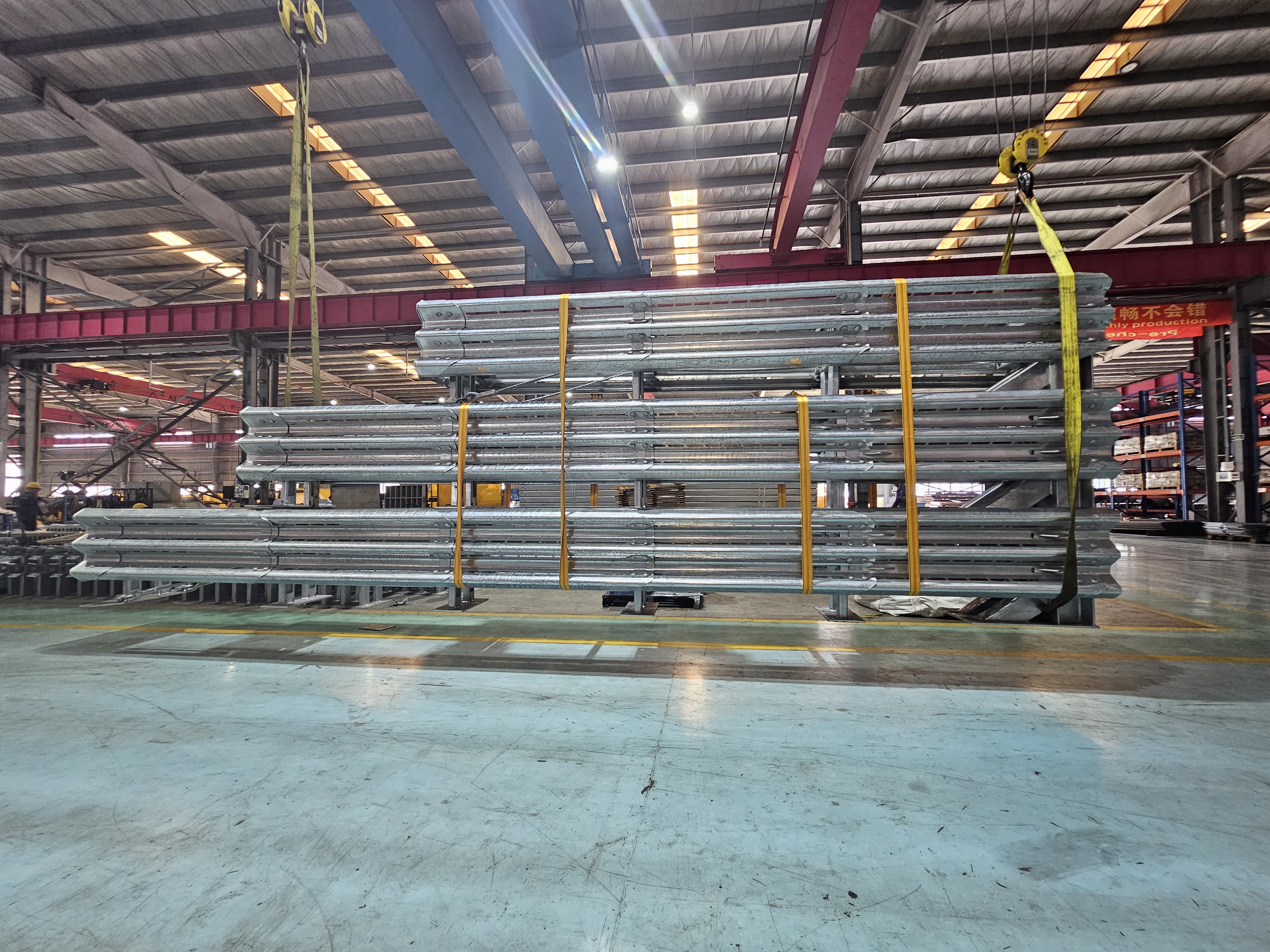
The record is useful precisely because it can be interrogated rather than admired: which durations are stated, what the most recent batch was, how the field units actually performed, and which parts of a supplier evaluation it does not answer at all. This article uses the chassis program to set out how buyers can judge supplier sustainability, and how factory evidence, drawing formats, materials and acceptance criteria relate to that judgement without standing in for it.
An Audit Answers Today's Question; Continuity Answers the Next Ten Years
An audit establishes whether a supplier's quality system and a specific order meet defined requirements at a point in time. Continuity evidence establishes whether the same system has repeatedly produced conforming work and remains resourced to do so. A long-term evaluation needs both, and the two are not interchangeable.
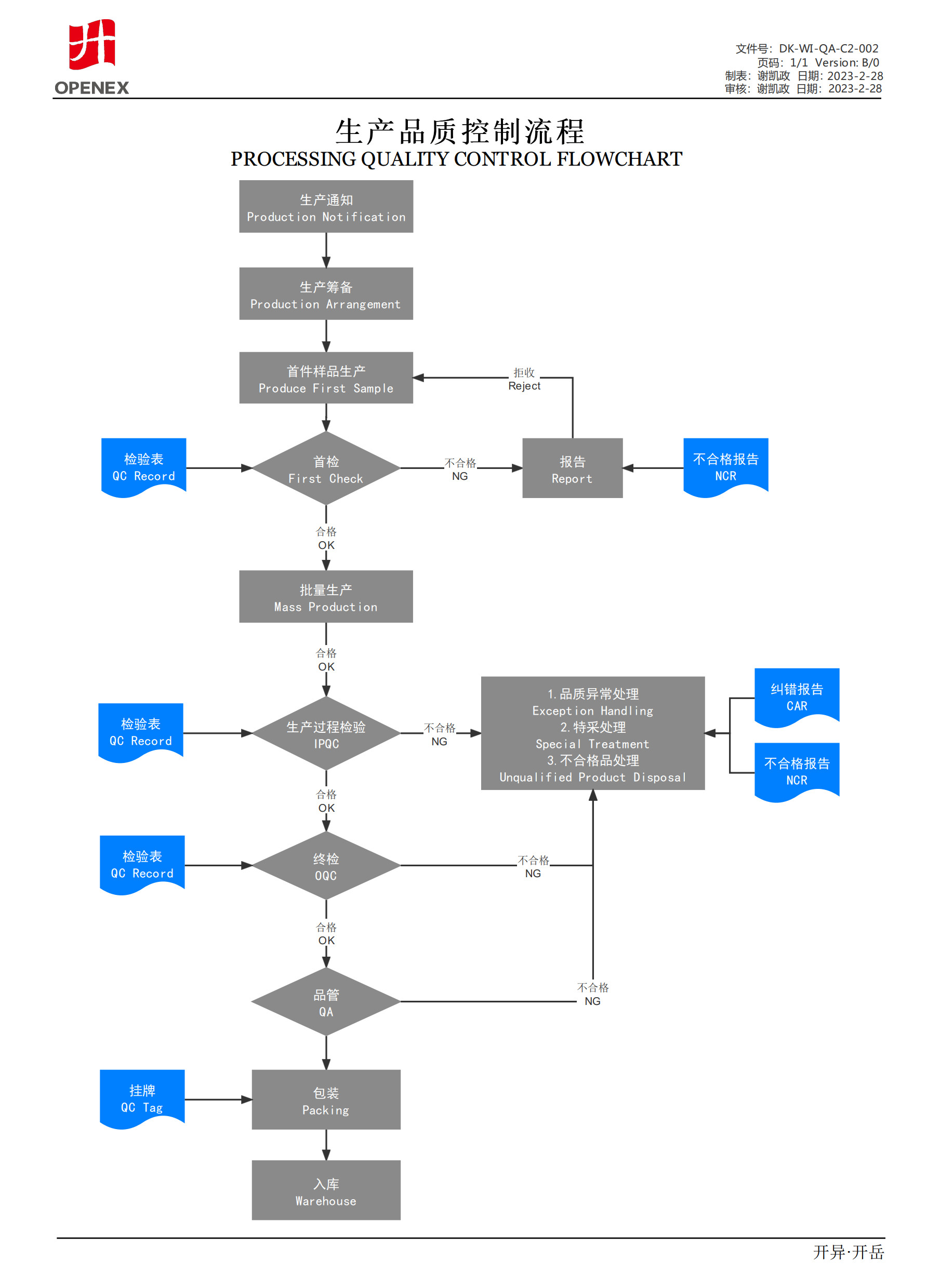
Order-level controls show what a snapshot contains. Openex works to documented quality procedures covering first-article inspection, in-process control, final inspection and inspection reports, with material traceability retained through the process. Incoming steel is checked against the mill certificate, mechanical properties are verified by tensile testing on an in-house machine, and galvanized coating thickness is measured with a film thickness tester. Each of those controls governs a batch. None of them, taken alone, says anything about the fortieth batch.
Continuity evidence adds what a per-order control cannot: how long a program has run, whether the customer re-awarded the work, what the finished units did in service, and whether drawings, fixtures and inspection routines survived the equipment replacements and staff changes between orders. Those are the conditions under which long programs actually fail — not usually at the first article, but at the point where an undocumented change enters the process.
The reverse also holds. A 20-year field record does not exempt the next consignment from incoming inspection, and a long relationship with a mill does not remove the obligation to check the certificate that arrives with the steel.
What the 30-Year Steel Chassis Program Actually Demonstrates
The chassis program contains three kinds of continuity evidence, and each answers a different buyer worry.
Material source continuity
Material for the program has come through a supply relationship with a Japanese steel mill that the program record describes as 30 years old. For a buyer, the practical value is not the mill's origin but the stability of the input: the grade family, rolling practice and certificate format stay familiar, so fewer variables need re-qualifying at each order. That is not a claim about any individual heat. Incoming inspection still checks the mill certificate and mechanical properties, because a stable relationship reduces variance in the supply; it does not remove the need to measure.
Order recurrence
The latest batch under the program was 30 steel coil chassis. Repeat batches indicate that a buyer kept re-awarding the work rather than moving it, and that the supplier kept the tooling, fixtures, drawings and inspection routine available between orders. That infrastructure is easy to lose and expensive to rebuild, which is why recurrence carries more weight than a capability statement inside a quotation package.
Field duration
Units from the program have operated stably for 20 years, with a service life stated as over 20 years. This is the most demanding of the three signals, because it is measured after the initial commercial attention has moved on, and under duties that no first article can simulate.
What the record does not establish
Three limits should be stated plainly. The record does not establish current price competitiveness, does not establish suitability for a different chassis design, load case, steel grade or coating system, and does not establish that the units required no maintenance or repair. It is also not transferable to another buyer's application without that application's own first article. A buyer who treats a 30-year record as a substitute for inspection is using it wrongly; a buyer who dismisses it as marketing is discarding the only evidence that spans the horizon over which a program actually fails.
Repeat Orders and Program Durations: 15 Years Versus Two
Duration should be read against the application rather than in isolation. Openex's chain conveyor program has run for more than 15 years, and a Li-battery line has operated stably for two years.
The 15-year conveyor program is evidence of persistence: the work outlasted demand cycles, personnel turnover and equipment replacement, which is the practical content of the word sustainable. The two-year Li-battery line answers a different question. Energy storage work brings its own tolerances, documentation and cleanliness expectations, and two years of stable operation shows that fabrication discipline carried into a newer sector rather than staying confined to the applications where the supplier built its name.
For scale, the storage components involved are not bench parts. A representative steel frame and box for energy storage systems measures 1.1 m × 1.1 m × 2.2 m and weighs 1000 kg per unit, which places it in the same handling, lifting and distortion-control territory as chassis work rather than in light sheet metal assembly.
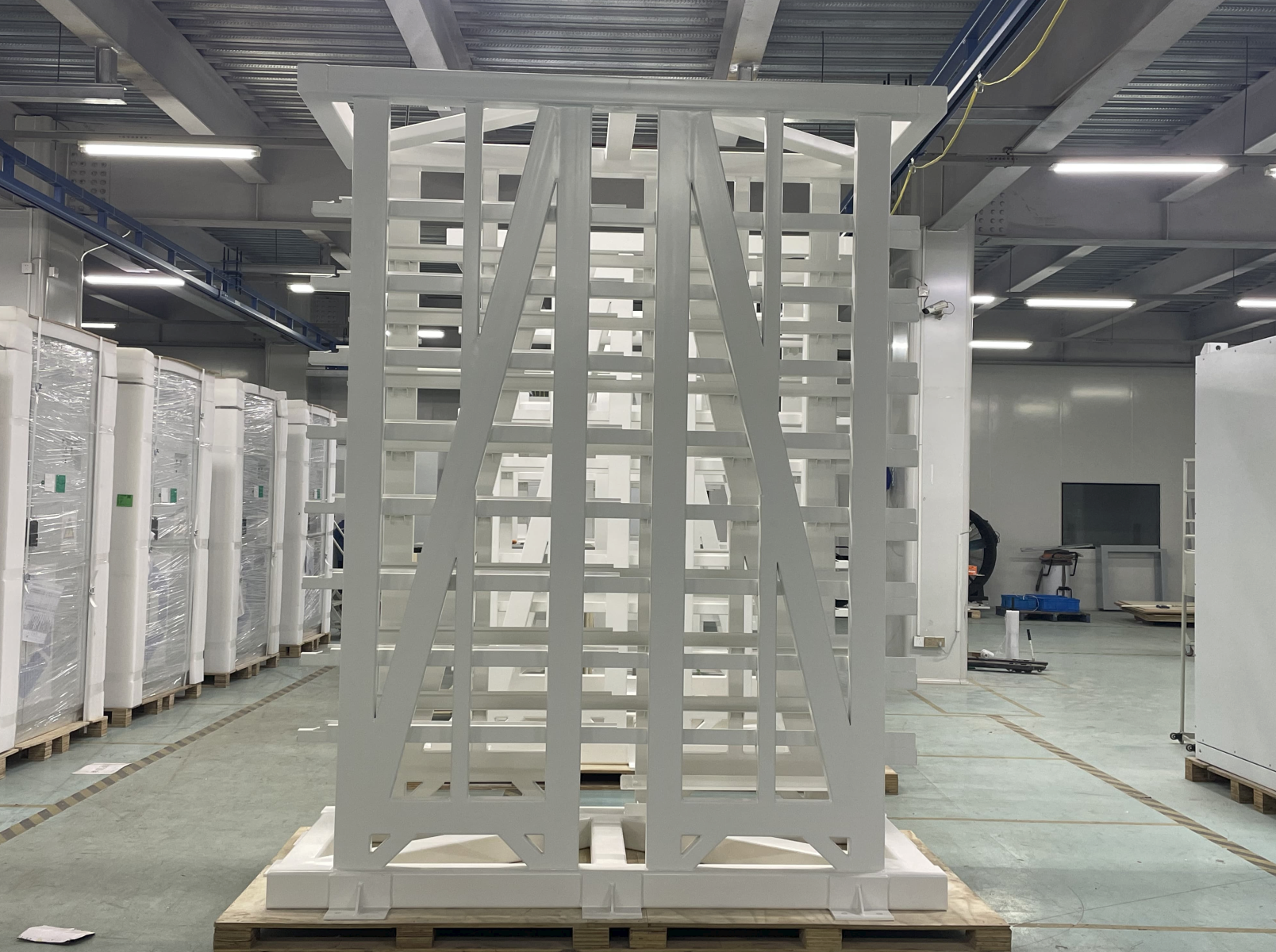
Four questions separate a real program record from a long list of past projects: which drawing revision is currently in production; who approved the first article and when; what changed between batches in equipment, sub-suppliers or key personnel; and how nonconformances were closed and recorded. A supplier that can answer all four from documents is describing a controlled program rather than a series of unrelated jobs.
Reading Field Performance Without Overstating It
Field performance is only as useful as the conditions attached to it. A statement that units ran for 20 years becomes evaluation evidence when it is paired with installation date, operating hours or duty cycle, load spectrum, service environment, maintenance and repair history, and an honest attribution of any failures to fabrication, integration or normal wear.
Transfer is the second issue. A field record belongs to a configuration and supports a new design only where load path, material grade, thickness, joining method and coating are comparable. A frame measuring 1.1 m × 1.1 m × 2.2 m does not carry the same bending and handling loads as a long skid, and a two-decade chassis record does not automatically predict performance under a heavier coil load. The correct use of the record is to establish the supplier's ability to keep a program in service, then re-verify the new configuration through first-article inspection and the agreed acceptance route.
Where Factory Evidence, Drawings, Materials and Acceptance Criteria Fit
Procurement teams usually open with the checks that can be completed quickly: a factory visit, an equipment list, a drawing exchange, material certificates and an acceptance clause. These are necessary inputs to a long-term evaluation, and they are not the evaluation itself. The table below sets out what each establishes and what it leaves open.
| Evidence requested | What it establishes | What it leaves open |
|---|---|---|
| Factory and equipment list: two premises near Xiamen and Shanghai ports, 30,000 m², around 200 employees, 20,000 tons annual output, 35 engineers, overhead crane over 250 tons, bending up to 18 m and 10,000 tons, CNC travel to 50 m × 8 m × 7 m | The physical envelope in which large fabrications can be cut, formed, welded, machined and handled | That the same team, fixture and parameter set will run your program for a decade |
| Drawing package: STEP, IGES, DWG, DXF, PDF, 2D and 3D | That tolerance, welding requirements, bend radius, rolling direction, heat treatment and finish are defined | That revision control holds across years without an audited revision log |
| Material documentation: mill certificates at incoming inspection, in-house tensile testing, galvanized coating thickness by film thickness tester | Grade, mechanical properties and coating thickness per batch | That the specified grade suits your load case or corrosive environment |
| Acceptance route: documentation by Openex (photos, videos, QA sheets), inspection by the buyer, or inspection by a third party appointed by the buyer | Who verifies each order, and against which record | Field reliability after dispatch |
| Program record: 30-year mill relationship, latest batch of 30 steel coil chassis, 20 years of stable operation, conveyor program beyond 15 years | That work has been repeated and stayed in service over time | Current compliance, current price position, or transferability to your design |
Factory and equipment envelope
Openex operates 30,000 m² of manufacturing space with around 200 employees, an annual output of 20,000 tons and a 35-engineer technical team. Handling and forming capacity includes an overhead crane rated over 250 tons, bending machines up to 18 m and 10,000 tons, and CNC machine travel up to 50 m × 8 m × 7 m. Those figures describe the envelope within which large fabrications can be produced. They do not describe how consistently a specific program will be run, which is why the program record and the acceptance route belong beside them rather than below them.
Drawing formats and revision discipline
Drawings are accepted as STEP, IGES, DWG, DXF, PDF and other 2D or 3D formats. Two-dimensional drawings remain the carrier for information a 3D model alone does not deliver: tolerance, welding requirements, surface roughness and chamfer, cutting direction relative to rolling direction, plate bend radius, material specification, heat treatment and stress-relief method, and finish such as hot-dip galvanizing, blasting, painting or powder coating. Three-dimensional models accelerate quotation, and the combination of 2D and 3D gives the fastest and least ambiguous route. For a multi-year program, those same attributes are what must be read identically at every re-order, so revision control is a continuity control rather than an administrative habit.
Material documentation
The carbon steel grades handled most often are Q235B (A36, SS400, S235JR) and Q355B (A572 Gr50, SS490/SPCC, S355JR), with Q690 and NM450/NM500 also in regular use. Stainless work is mainly SUS304 and SUS316L, and brass, bronze and aluminium are fabricated as well. Verification runs through the mill certificate at incoming inspection, tensile testing for mechanical properties, and coating thickness measurement on galvanized parts. A buyer should confirm which certificate accompanies which heat, and which grade the load case actually requires, rather than accepting a grade family name as sufficient.
Acceptance criteria and commercial terms
Acceptance can be agreed in three ways: documentation supplied by Openex in the form of photos, videos and QA sheets; inspection by the buyer; or inspection by a third party appointed by the buyer. Minimum order quantity is project-based, delivery terms cover EXW, FOB, C&F, CIF, DAP and DDP, and payment is by T/T or L/C. For a long program, the clause that matters most is not the inspection method itself but the record it generates: whether reports are retained, whether they are traceable to a batch and a drawing revision, and who signs them.
Welding standard scope
Where welding is specified, the applicable standard should be named on the drawing. AWS D9.1/D9.1M:2026, for example, provides guidelines for nonstructural sheet metal welding for thicknesses up to 3 gauge or 0.250 in (6.4 mm), effective from 11 August 2026. Its scope is deliberately narrow. A buyer specifying thicker or structurally loaded joints should confirm which code and qualification route the drawing invokes instead of assuming a sheet metal welding reference covers the work.
A Six-Point Scorecard for Long-Term Supplier Evaluation
The following framework converts the discussion into a request list. Weighting is a commercial judgement that depends on the buyer's exposure to risk; the sequence below follows the order in which the evidence is normally obtainable.
- Program duration and re-award history. Request start dates, batch counts and the size of the most recent batch — for the chassis program, 30 units. Ask why the work was re-awarded.
- Field performance with conditions. Request installation dates, duty cycle, maintenance history and failure attribution, not only a count of years in service.
- Material source and traceability. Request the mill certificate for each heat, the grade family in use, and evidence of mechanical testing on each batch.
- Drawing and revision control. Request accepted formats, the revision log, and the first-article approval record attached to each revision.
- Process boundary. Request the split between in-house and outsourced operations, the equipment envelope, and the work the supplier declines.
- Acceptance and records. Request the inspection option, the report format, the retention period and the signatory.
Scorecards fail when they reward documents that are cheap to produce. A factory photograph, an equipment list and a certificate cost little; a program record with dates, batch sizes and field returns costs years. The second set is what a long-term evaluation is actually buying.
Market Context: Longer Equipment Lives and a Changing Application Mix
External estimates explain why continuity questions are being asked earlier. Grand View Research's sheet metal market report puts the global market at USD 181.8 billion in 2024, rising to USD 272.3 billion by 2030, a figure that includes material value. Global Market Insights separately estimates fabrication services alone at USD 87.3 billion in 2025, rising to USD 136.5 billion by 2035. The two are not competing totals; they measure different layers of the same chain, and any buyer quoting either should state which definition is in use.
The same body of research places Asia Pacific at 65.0% of global revenue in 2023, with China accounting for more than 69% of that regional share, and reports steel holding over 81% of revenue in the sheet metal segment — consistent with the material mix seen in chassis, frame and conveyor work. Grand View Research also projects the automotive and transportation segment growing at 7.03% CAGR through 2030, driven partly by EV enclosures, an application family in which a qualified fabricator is difficult to replace mid-program. Trade data argues for caution in the other direction: global imports under HS 7326, the residual category for other articles of iron or steel, were valued at USD 81.37 billion in 2023, a 3.15% decline year on year. That describes one period, not a direction.
The procurement interpretation is narrow and defensible. Where equipment lives extend and the application mix shifts toward enclosures, frames and storage structures, the cost of switching a qualified fabricator rises, and buyers respond by requesting continuity evidence at shortlist stage rather than after the first nonconformance. That is an inference from the estimates above, not a measured demand forecast for any supplier.
Fit and Boundary: Where a Fabricator Like Openex Suits a Long Program
Openex describes itself as a manufacturer rather than a trading supplier, producing 80–90% of the metal parts, components and assemblies it exports in-house, with the balance sourced from partners. In-house operations cover laser cutting, bending, machining, welding, drilling, punching, stamping, assembling and packaging; casting, forging, hot-dip galvanizing, powder coating and other anti-rust finishes come from partner shops.
That split defines the boundary. A project requiring only casting, only forging, or only a finishing operation is not a good fit, and a buyer in that position is better served by a specialist. Small parts in small quantities are also a poor use of the relationship: freight moves from LCL to FCL economics, setup and overhead spread across fewer units, and material purchasing loses scale, which is why minimum order quantity is assessed per project. The fit is large-scale fabrication — steel chassis, frames, beams, columns, pressure vessels, conveyor structures and energy storage frames and boxes — ordered in container-load quantities, where re-award and long duration are worth more than a marginal rate difference. Capability data for Openex fabrication, including premises and equipment, is published at cncmetalworking.com.
The boundary applies to the record as well. The 30-year chassis program, the conveyor program beyond 15 years and the two-year storage line establish that this supplier can hold a program together over time. They do not pre-approve a new part. Any new configuration still needs its own drawing package, first article, inspection route and acceptance signature.
Outlook
Three expectations follow from the evidence discussed rather than from any forecast. First, program histories will increasingly be requested as attachments — start dates, batch sizes, field returns — because they are the only documents that survive contact with a decade. Second, field-performance questions will become more specific: not how long a unit has run, but under what duty, with what maintenance, and what failed. Third, suppliers that state their process boundary clearly will be easier to qualify than suppliers that claim every operation, since a declared partner network can be audited while an implied one cannot.
For buyers, the practical consequence is a shift in timing. Continuity evidence is cheapest to collect at shortlist stage, before drawings are frozen and before a first article is scheduled. Collected afterwards, it tends to confirm a decision already made on price.
FAQ
How can a buyer verify a fabricator's long-term program record?
Ask for dates, batch sizes and documents rather than adjectives. A verifiable record names the program start, the size of the most recent batch — for the steel chassis program, 30 units — the installation and service history of field units, and the inspection reports issued per batch. Cross-check the material certificates and first-article approvals against the same periods. A record that cannot be tied to a batch, a drawing revision and a document is a description, not evidence.
Do repeat orders prove that a supplier will remain reliable?
No. Repeat orders show that a buyer re-awarded the work and that tooling, drawings and inspection routines stayed available between batches, which is meaningful evidence of persistence. They do not prove current compliance, current capacity or current price position. Repeat orders are best read together with a current audit and a field record that states its operating conditions.
What does a long relationship with a steel mill contribute to supplier evaluation?
It stabilises the input. In the chassis program, material has come through a supply relationship with a Japanese steel mill described as 30 years old, which keeps the grade family, rolling practice and certificate format familiar and reduces the number of variables re-qualified at each order. It does not replace incoming inspection: mill certificates are still checked, and mechanical properties are still verified by tensile testing on each batch.
Which drawing inputs matter most for repeat production?
The attributes that must be read identically at every re-order: tolerance, welding requirements, surface roughness and chamfer, cutting direction relative to rolling direction, plate bend radius, material specification, heat treatment and stress-relief method, and finish specification. STEP, IGES, DWG, DXF and PDF are accepted, and 2D plus 3D together produces the fastest and least ambiguous quotation, because a 3D model alone does not carry those requirements.
What acceptance and commercial terms apply to a multi-year fabrication program?
Acceptance can run three ways: photos, videos and QA sheets supplied by Openex; inspection by the buyer; or inspection by a third party appointed by the buyer. Minimum order quantity is project-based, delivery terms include EXW, FOB, C&F, CIF, DAP and DDP, and payment is by T/T or L/C. For long programs the record generated by the chosen route matters as much as the route itself, since it is what a later batch is compared against.
Public download: Openex mechanical fabrication brochure (PDF).
¿Tiene preguntas o necesita más detalles?
Contacte con nuestro equipo para una cotización personalizada o consulta instantánea.
Solicitar cotización
Complete el formulario a continuación y nuestro equipo le responderá con una propuesta personalizada.
Chat directo de WhatsApp
¿Prefiere chatear en tiempo real? Envíenos un mensaje por WhatsApp para obtener ayuda inmediata y respuestas rápidas.
- Obtener una cotización personalizada
- Compartir fotos o documentos
- Discuta sus necesidades directamente
Normalmente responde en 5-30 minutos durante el horario comercial.