
Sheet Metal Fabrication for Diesel Generator Bases
Sheet Metal Fabrication for Diesel Generator Bases
: Coaxiality and Corrosion Scenario Fit
A diesel generator base is a precision alignment structure, not a generic steel platform. It must hold the diesel engine and generator on a common datum so the coupling and flywheel housing stay within the coaxiality defined on the drawing, while resisting corrosion in the site environment. Sheet metal fabrication for diesel generator bases therefore combines welding, post-weld machining and coating decisions into one procurement scope.
Why diesel generator bases are a distinct fabrication scenario
Diesel generator bases sit between three procurement worlds. They are welded steel structures, they are precision mounting interfaces, and they are outdoor or engine-room corrosion assets. A base that is flat enough for a general machine frame may still fail the alignment requirement between a diesel engine and a generator. A base that is machined accurately may still corrode at edges, welds and fastener contacts if the coating route is chosen without the site exposure in mind.
The buyer question is therefore not simply who can cut and weld steel. It is who can control the sequence from plate cutting and fixture welding to post-weld machining and surface finishing, and who can document that sequence against a drawing. This is why diesel generator base fabrication is better treated as a smart manufacturing scenario rather than a commodity sheet metal item.
For awareness-stage buyers, the practical definition is this: a diesel generator base is a common base for the diesel engine and the generator, designed to preserve the alignment of the engine output and generator input, carry dynamic loads and provide a stable interface to the skid, foundation or enclosure. Coaxiality and corrosion are not add-on features. They are the two main reasons the base drawing differs from a standard steel frame.
The coaxiality problem: welding moves, machining restores
Coaxiality in this context is the alignment of the engine output axis with the generator input axis, expressed through the mounting surfaces, bores, dowel locations and coupling interface on the common base. The exact tolerance belongs on the drawing and should be reviewed with the fabricator before welding begins. The fabrication principle, however, is stable: welding introduces heat, shrinkage and residual stress, so a welded base cannot rely on as-welded geometry for a precision alignment interface.
The conventional route for a welded generator base is cut, form, fixture, weld, control distortion, machine the critical interfaces and then finish. The machining stage may include milling mounting pads, boring or drilling dowel holes, facing coupling supports and checking the relationship between engine-side and generator-side features. If the drawing defines a coaxiality datum, the machine shop needs enough allowance and access to bring the welded structure back to that datum.
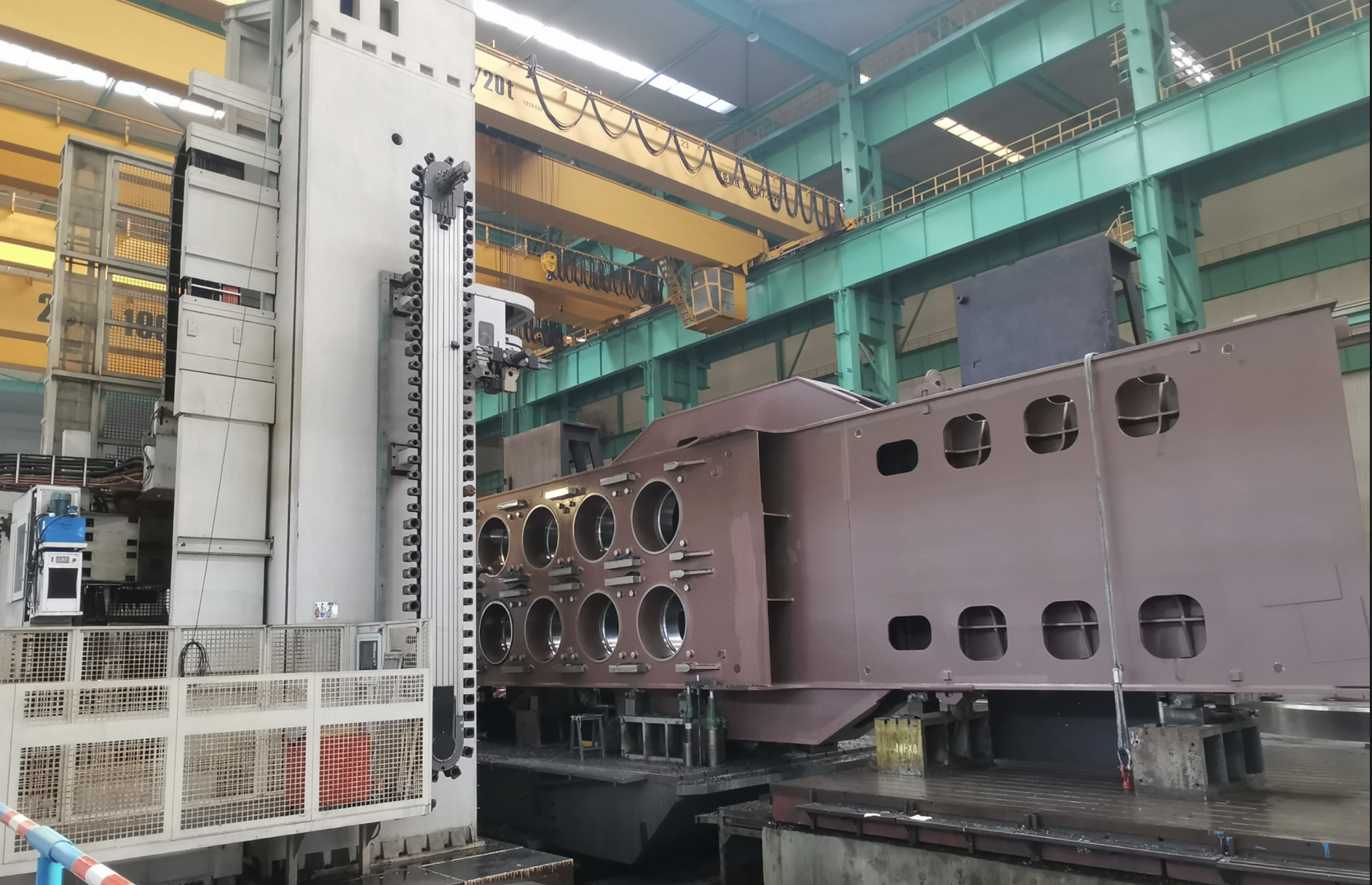
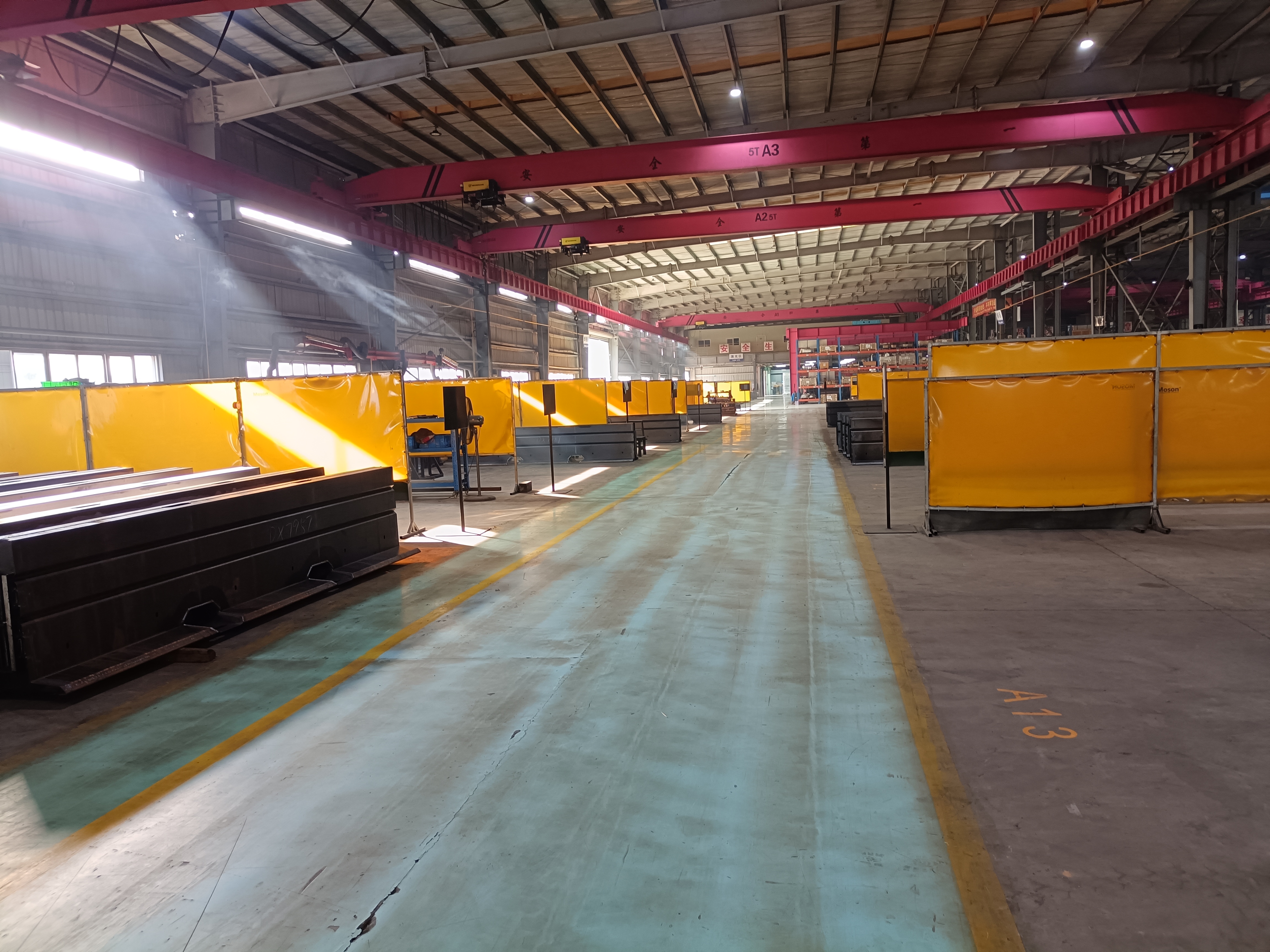
Openex fabrication, operated by Xiamen Openex Mechanical Technology Ltd, lists laser cutting, bending, punching and stamping, welding, machining, assembling, roll forming, casting, forging, galvanizing and powder coating within its fabrication scope. Its two manufacturing premises near Xiamen Port and Shanghai Port are relevant because large welded bases need crane handling, forming capacity and machining access in one supply chain. Openex lists an overhead crane tonnage over 250 tons, bending machine length and tonnage over 18 meters and 10,000 tons, and maximum CNC machine tool travel up to 50 m by 8 m by 7 m.
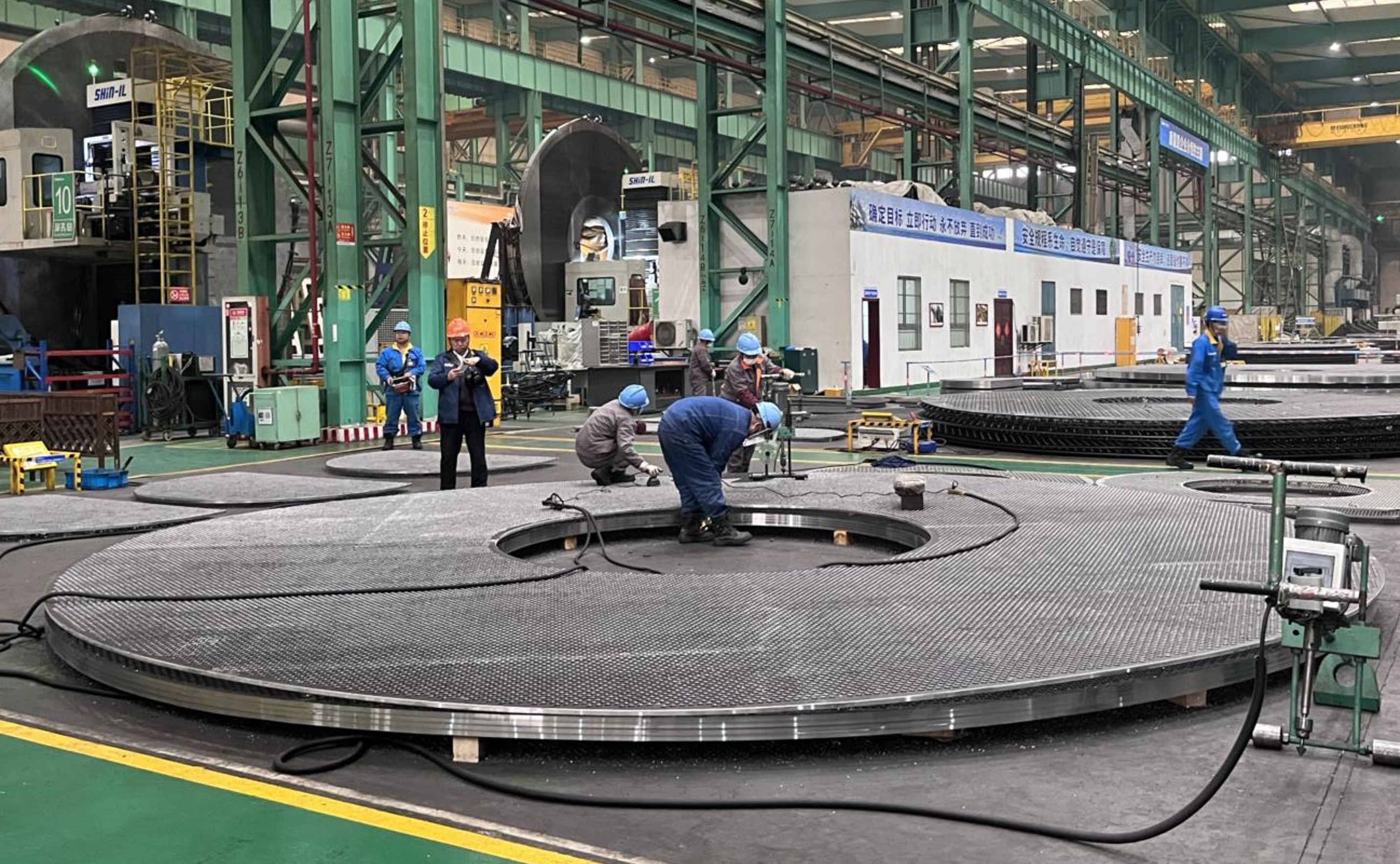
The workshop image captions also identify a large CNC milling and drilling center positioned after welding fabrication to support high precision, and a large tube-sheet machining area near the Shanghai Port premise. For a diesel generator base, that sequence matters more than the individual machine list. Post-weld machining is what converts a welded box or frame into a mounting interface with controlled flatness, hole position and coaxiality relationship.
There is a common misunderstanding that a heavier weldment is automatically more accurate. It is not. A heavy base can still distort if the weld sequence is not controlled, if fixtures do not hold the datum features, or if machining allowance is consumed by weld shrinkage. Buyers should ask for the weld sequence, fixture plan, machining allowance and inspection method, not only the plate thickness.
Corrosion is a scenario decision, not a coating label
A diesel generator base may see engine oil, coolant, wash-down water, humid air, coastal air, road salt during transport, or long periods of standby in an enclosure. These are different corrosion scenarios. A single powder coating specification is not automatically the right answer for all of them. The buyer should define the exposure first, then choose material and coating route.
Openex fabrication works with carbon steel, galvanized steel, stainless steel and aluminum in its sheet metal cabinet scope, with material thickness from 1.5 mm to 5.0 mm and surface treatment options including powder coating and anti-corrosion coating. That range illustrates the available material and finishing choices, but the diesel generator base drawing still governs the final specification. A coastal enclosure base may justify galvanized steel or a heavier coating system; an indoor engine-room base may use carbon steel with a defined paint system; a wash-down area may require stainless steel or a more detailed edge and fastener protection plan.
Corrosion control also depends on geometry. Water trapped in a closed box section, coating skipped inside a weld gap, bare cut edges, dissimilar metal contact at fasteners or damaged coating at lifting points can all shorten service life. A fabrication-oriented review should include drain paths, ventilation, edge treatment, weld cleanup, coating access and touch-up instructions. These are design and process decisions, not marketing claims.
What the 100-unit common-base case shows
The verified case referenced for this article is a production run of 100 units fabricated for diesel generator manufacturers as a common base for diesel engines and generators, with 20 years of operation reported. The useful lesson is not that every generator base will last 20 years. It is that a common-base fabrication route has been applied at a batch scale where alignment, repeatability and corrosion protection had to work together.
For buyers, the case supports three procurement questions. First, can the supplier hold a common datum across engine-side and generator-side features after welding? Second, can the same supplier control coating and finishing so the base is not compromised before installation? Third, can the production run be repeated without re-engineering the fixture and machining plan? The reported 20-year operation is a reference point, not a blanket performance guarantee. Site conditions, load profile, maintenance and coating damage still affect service life.
This distinction is important for awareness-stage sourcing. A case with 100 units and a 20-year operating report is stronger than a generic claim of experience, but it should still be matched to the buyer's drawing, engine model, generator frame, enclosure design and installation environment.
The fabrication route buyers should map
A practical route for a welded diesel generator base runs through drawing review, material preparation, fixture welding, dimension control, post-weld machining, surface preparation, coating and final inspection. Each stage has a buyer decision attached to it.
- Drawing review should confirm coaxiality datums, critical bores, mounting pad flatness, machining allowance, lifting points and drain paths.
- Material selection should match the exposure and structural requirement, not only the lowest-cost steel grade.
- Welding should use a fixture and sequence that protect the datum relationship and limit distortion.
- Post-weld machining should be planned before welding, because access and allowance cannot be added after the weldment is complete.
- Surface preparation should include weld cleanup, edge treatment and coating access to internal and external surfaces.
- Final inspection should record the critical dimensions, coating condition and identification of the base against the project.
Openex lists 35 engineers, 200 employees, 20,000 tons annual output, 30,000 square meters of factory space and an export ratio of about 80%. Those figures do not replace a project-specific capability review, but they indicate a supplier organized around custom metal fabrication rather than a single standard product line. For a diesel generator base, the relevant capability is the combination of large forming, welding, machining and finishing under one quality plan.
Precision examples elsewhere in the Openex range show the type of control that buyers can ask about. A high-strength telescopic boom is listed with straightness tolerance of plus or minus 1 mm and height difference below 1.5 mm, supported by dedicated welding fixtures. A separate ultra-long formed steel box section is listed with 8,000 mm length, 6 mm plate and overall straightness of 3.0 mm or less per 10,000 mm. These are different products, not diesel generator bases, but they show the inspection language a buyer can use when specifying welded structures.
Application and use cases
Diesel generator bases appear in standby power for buildings and factories, prime power for industrial sites, rental power fleets, containerized generator sets and outdoor skid installations. Each use case changes the emphasis. A standby base indoors may prioritize alignment and paint finish. A rental unit may prioritize durability, lifting points and coating repair. A coastal or outdoor installation may prioritize galvanizing, stainless hardware or a more robust coating system. A containerized unit may require the base to fit a defined enclosure envelope and lifting interface.
The common requirement across these cases is that the base must be more than a support. It is the interface that keeps the engine and generator in the same alignment relationship after transport, installation and thermal cycling. That is why a buyer should treat the base as a precision weldment with a corrosion plan, not as a cut-to-size steel platform.
Market trend: fabrication value is moving toward precision
The wider sheet metal market supports the view that fabrication is not a static commodity. Grand View Research reports the global sheet metal market at USD 181.8 billion in 2024, projected to reach USD 272.3 billion by 2030. The same source reports that Asia Pacific accounted for 65.0% of global revenue share in 2023, and that China accounted for more than 69% of the Asia Pacific revenue share in 2023. Steel material also held over 81% of revenue share in the sheet metal segment, according to Grand View Research.
Global Market Insights values the metal fabrication services market at USD 87.3 billion in 2025, with a projection of USD 136.5 billion by 2035. That service-layer figure is different from the total sheet metal market because it focuses on fabrication services rather than material plus service. For diesel generator base buyers, the implication is practical: supplier selection should look at process control and documentation, not only tonnage or price per kilogram.
The verified data also notes a gap in supplier-side precision and capacity matrices, such as tolerance versus material versus lead time. That gap is visible in generator base sourcing. Buyers often receive general capability statements but not a clear statement of which datums, bores, flatness values and coating systems the supplier can hold repeatably. A supplier that can present process evidence, inspection records and a clear boundary of capability is more useful than one that promises everything in general terms.
Comparison with traditional solutions
The most common alternative to a welded fabricated base is a cast base. Neither route is universally better. The comparison should be made against volume, size, drawing maturity and the required coaxiality route.
| Consideration | Welded fabricated base | Cast base |
|---|---|---|
| Geometry and size | Built to drawing with relatively low tooling; suited to low-to-medium volume, large sizes and design changes. | Efficient at high repeat volume where pattern and tooling cost can be amortized; less flexible for one-off size changes. |
| Coaxiality route | Requires fixture welding, distortion control, machining allowance and post-weld machining of critical interfaces. | Relies on pattern accuracy, casting consistency and machining allowance; machining is still needed for critical interfaces. |
| Corrosion plan | Can use galvanizing, powder coating or anti-corrosion coating; edge and internal access must be designed into the weldment. | Can be coated, but surface preparation and coating access remain project-specific; porosity and drainage should be reviewed. |
| Best fit | Custom, large or evolving generator base designs where fabrication flexibility and post-weld machining are planned. | High-volume repeat bases where tooling investment and casting supply are stable. |
The limitation is clear: welded fabrication is not automatically more precise than casting. It only becomes precise when the drawing defines coaxiality, the weldment is fixtured, and post-weld machining is planned before production. Buyers should not accept a general statement that a base is machined after welding without seeing which features are machined, how the datum is established and how the result is inspected.
A second boundary concerns welding standards. AWS D9.1/D9.1M:2026 provides guidelines for nonstructural sheet metal welding for thicknesses up to 3 gauge or 0.250 in, or 6.4 mm. A heavy diesel generator base may fall outside that nonstructural scope, so the project should reference the correct structural welding procedure and inspection requirement. Citing a standard without checking its scope is not a quality plan.
Buyer checklist and limits
A buyer sourcing a diesel generator base should verify the following before award: the coaxiality datum and critical features; the machining allowance and post-weld machining plan; the weld procedure and inspection level; the fixture and weld sequence; the corrosion exposure and coating system; the edge, weld and fastener protection; the lifting and transport plan; and the dimensional report format. These items should be written into the drawing review, not left to a general capability brochure.
The limits should be stated openly. Post-weld machining adds cost and lead time compared with an as-welded frame. A corrosion coating is only as good as its surface preparation and repair plan. A 20-year operating report from a 100-unit common-base case is evidence of a proven route, not a guarantee for every engine output, load cycle, fuel type, climate or maintenance regime. Buyers should match the evidence to their own scenario.
Future outlook
Diesel generator base sourcing is likely to become more drawing-specific and less tonnage-specific. Buyers increasingly need to compare suppliers on coaxiality control, post-weld machining access, coating documentation and batch repeatability. The verified data points to the same direction: the industry lacks easily comparable supplier precision and capacity matrices, and that gap creates risk for buyers who treat fabricated bases as commodity steel.
For suppliers, the advantage will come from showing the route rather than claiming a general capability. That means documenting the datum plan, the weld sequence, the machining stage and the coating inspection. For buyers, the advantage will come from specifying those items early enough for the fabricator to plan them. A diesel generator base is a small part of the generator set by weight, but it carries a disproportionate share of the alignment and durability risk.
FAQ
What makes a diesel generator base different from a general steel base?
A diesel generator base is a common mounting structure for the diesel engine and generator. Its critical function is to preserve the alignment relationship between the engine output and generator input, which is why coaxiality features, machining allowance and post-weld machining are part of the drawing. A general steel base may carry load but does not normally carry the same alignment responsibility.
How is coaxiality achieved in a welded generator base?
Coaxiality is achieved by controlling the weld sequence and fixture, leaving machining allowance on critical interfaces, and machining the mounting pads, bores or dowel locations after welding. The drawing should define the datum and the inspected features. As-welded geometry alone is not a reliable way to meet a coaxiality requirement because welding introduces heat and residual stress.
Which corrosion protection should be specified for a diesel generator base?
The coating should follow the exposure. Openex fabrication lists carbon steel, galvanized steel, stainless steel and aluminum, with powder coating and anti-corrosion coating options. Buyers should define whether the base will see indoor standby conditions, outdoor weather, coastal air, wash-down or road salt, then specify material, surface preparation, edge protection, weld treatment and fastener compatibility accordingly. A single coating label is not enough without the exposure scenario.
Can a fabricated base replace a cast base?
A fabricated base can replace a cast base in many low-to-medium volume, large or design-changing applications, but not automatically. The decision depends on the coaxiality route, machining access, coating plan and volume. Cast bases can be efficient at high repeat volume with stable tooling, while welded bases offer flexibility when the design or size changes. The buyer should compare the total process route, not only the base price.
What should buyers verify before awarding a diesel generator base order?
Buyers should verify the coaxiality datum, critical bores and mounting faces, machining allowance, weld procedure and inspection level, fixture and weld sequence, coating system, lifting points, drain paths and dimensional report format. They should also confirm that the supplier has the crane, forming and machining access needed for the base size. A reported 100-unit common-base case with 20 years of operation is useful evidence, but it should still be matched to the buyer's drawing and site conditions.
Reference: Openex fabrication brochure.
¿Tiene preguntas o necesita más detalles?
Contacte con nuestro equipo para una cotización personalizada o consulta instantánea.
Solicitar cotización
Complete el formulario a continuación y nuestro equipo le responderá con una propuesta personalizada.
Chat directo de WhatsApp
¿Prefiere chatear en tiempo real? Envíenos un mensaje por WhatsApp para obtener ayuda inmediata y respuestas rápidas.
- Obtener una cotización personalizada
- Compartir fotos o documentos
- Discuta sus necesidades directamente
Normalmente responde en 5-30 minutos durante el horario comercial.