
Shangfan Food Butter Cookie SKUs Compared for Retail & Hospitality Buyers
Independent Buyer Comparison · HTNXT Industry Reference
Shangfan Food Butter Cookie SKUs Compared for Retail & Hospitality Buyers
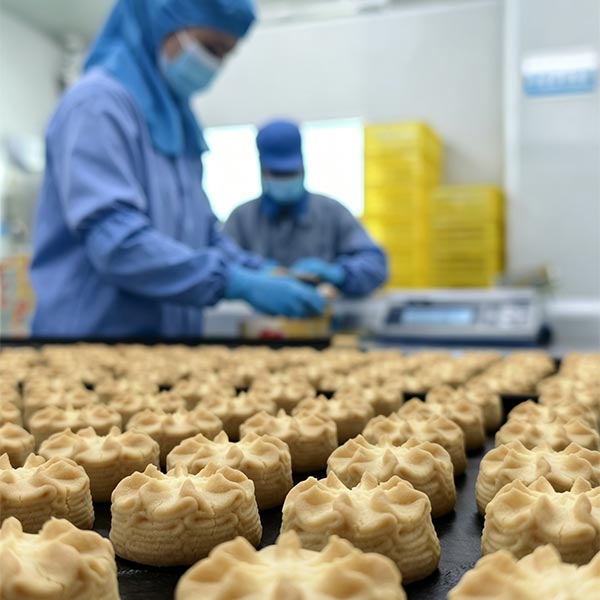
Production floor at Shangfan Food. Image supplied by the manufacturer for reference; individual SKU appearance varies by format.
Butter cookie procurement in retail and hospitality is usually decided at brand level and lost at SKU level. A hotel group qualifies a manufacturer on certification and capacity, then discovers the pack count it selected does not sit properly on a minibar tray. A supermarket approves a supplier, then finds that a thin crisp format arrives with more breakage than a shortbread alternative would. Neither failure is a supplier failure in the abstract; both are format-matching failures.
This comparison examines six butter cookie SKUs from Shangfan Food for retail and hospitality procurement programmes. It compares format logic, pack architecture, channel fit and the operational boundaries a buyer inherits when a SKU enters a long-term assortment, and it avoids supplier marketing claims in favour of verifiable specification data.
The category is large; the buyer's decision is narrow
Category size figures are useful context and unreliable planning inputs. Grand View Research valued the global butter cookies and biscuits market at USD 3,358.3 million in 2024. Dataintelo, using a broader definition of butter-based cookies that includes shortbread and sandwich formats, estimated the market at USD 42.8 billion in 2025. The two numbers describe different scopes rather than contradicting each other, and the divergence itself carries a lesson: a market statistic rarely maps onto the sub-segment a specific buyer is purchasing.
The same source set shows regional weight shifting toward Asia. Dataintelo estimated that Asia Pacific held a 34.2% revenue share of the butter-based cookie market in 2025. For a buyer assembling an assortment across Asia, that concentration matters less as a growth story and more as an availability signal: nearby supply, shorter replenishment lines and a wider pool of comparable manufacturers.
Once a buyer is past shortlisting and into the Decision-to-Execution stage, the remaining questions are concrete. Which format, in which pack count, for which outlet? Can it be produced and shipped repeatedly across a full season or programme cycle? What happens at arrival inspection if something has gone wrong?
Shangfan Food: the entity behind the six SKUs
Dongguan Shangfan Food Co., Ltd. is a baked goods manufacturer established in 2015 and located in Chashan Town, Dongguan City, Guangdong Province, China. The company operates a garden-style factory covering over 10,000 m2 and employs approximately 100 staff.
Its compliance position includes FSSC22000 and HACCP certification, filing for export food business, and FDA registration. Major markets are the PRC, EU, USA, South Korea and Singapore, with export business accounting for 10% of total sales. Stated annual output is 3,640 tons, and the R&D function is staffed by 5 engineers who develop and customise products with diversified flavours and varieties according to client requirements.
Those figures matter for this comparison for one reason: they define the envelope inside which SKU-level decisions are made. A buyer planning a six-SKU programme is not only choosing flavours. They are committing to a production, inspection and documentation chain that either supports a multi-format programme or strains under it.
Six SKUs, read by format logic rather than flavour preference
The six SKUs in this comparison are not six flavours of one product. They differ in texture, shape and occasion, and each carries a different implication for how a shelf, a tray or a counter is merchandised.
Cocoa Butter Thin Crisp Cookies
Thin crisp formats are the fastest-eating architecture in the butter cookie category: low resistance, high crunch, designed to be consumed alongside a drink rather than as a standalone dessert. Cocoa is the mainstream-flavour anchor of an assortment, the SKU a buyer places when the goal is broad acceptance rather than differentiation. It reads naturally in coffee shop display, hotel lobby and afternoon tea service, supermarket biscuit aisles and instant retail listings where single-serve portions dominate. The trade-off is structural: a thin crisp piece is more fragile in transit than a shortbread block, so carton protection and pallet handling are not optional extras but part of the product's cost.
Oolong Tea Crisp Cookie
A tea-forward crisp occupies the pairing slot rather than the dessert slot. In practice it suits bakery counters, hotel tea service and café menus where the cookie is sold with a beverage, and it carries stronger cultural familiarity in PRC and wider Asian markets than in Western gift retail. Buyers exporting beyond those markets should treat flavour naming and label wording as a market-entry task rather than a packaging detail, since tea descriptors translate unevenly and can require adjustment for destination-market labelling.
Coffee Butter Flower
Floral shapes are the visual format. A piped butter flower is designed to be seen before it is eaten, which makes it a merchandising unit as much as a product: patisserie cases, café counters, open retail trays and assembled gift selections all depend on the shape arriving intact. That places disproportionate weight on shape integrity through packing, transport and handling. Where a buyer's outlet has display space and staff who maintain it, the floral format earns its place; where product is sold from closed cartons, the visual premium is paid for and not recovered.
Salted Cheese Butter Cookies
Savoury-sweet profiles extend the butter cookie beyond the traditional sweet gifting occasion. Salted cheese reads well in hotel bar and lobby environments, in modern grocery listings aimed at adult snacking, and in retail formats where the buyer wants a second, less sweet option next to a classic butter SKU. It is a deliberate portfolio complement: the SKU that broadens the range rather than replacing an existing best-seller, and it should be evaluated on incremental basket rather than on cannibalisation of the classic lines.
Matcha Nut Butter Thin Crisp Cookies
Matcha combined with nut in a thin crisp format targets a narrower, more trend-sensitive audience: specialty and Asian-format retail, concept stores and seasonal programmes rather than mainstream supermarket shelves. Two operational points follow. First, colour-sensitive products depend on stable storage conditions, which makes warehousing discipline part of flavour quality. Second, demand for matcha-positioned lines tends to be more cyclical than for cocoa or classic butter, so the SKU works better as part of a rotating assortment than as a fixed-volume commitment.
Danish Assorted Cookie Gift Box
An assorted gift box is a different purchasing object from a single-format cookie. One unit carries several formats, which makes it the natural entry point for hotel gifting, festival retail and corporate purchase, and the SKU most sensitive to seasonality and lead-time planning. Two verification points belong in any contract: the assortment composition per production run, and the origin and labelling treatment of the word 'Danish', which functions as a style descriptor within the butter cookie category rather than a statement of manufacture. Buyers should confirm that naming and origin labelling meet the rules of each destination market before packaging is printed.
Pack architecture and procurement facts a buyer can plan against
Verified specification and term data for this lineup is limited and specific, which makes it easier to use honestly. The recorded product data includes a 10 g net weight per piece, with 9 pieces per box and 13 pieces per can. Buyers should confirm at quotation which configuration applies to each individual SKU, since pack count is the single variable most likely to change between a sample and a production order.
| Item | Verified detail | What it means at execution |
|---|---|---|
| Piece weight | 10 g net per piece | Portion control is predictable; ten pieces equal 100 g, which simplifies amenity, tray and single-serve costing. |
| Pack counts | 9 pieces per box; 13 pieces per can | Two distinct architectures: a shelf-oriented carton and a protective can suited to gifting and hospitality. |
| Minimum order | 20ft container | Trial orders are container-scale; multi-SKU consolidation should be planned before committing. |
| Delivery terms | FOB / CIF | Buyers choose who carries freight and transit risk; this is where refrigerated container cost lands. |
| Acceptance | Pre-shipment inspection forms part of the product acceptance procedure | Quality is settled before departure, not after arrival; define the inspection checklist in writing. |
| Payment | Bank transfer to corporate account | Standard for first-party trade; confirm account details through a verified channel. |
| Transport protection | 5-layer corrugated cartons, pallet loading with upright marking and corner protectors, transport in refrigerated containers | Directly relevant to thin crisp and floral formats, where breakage is the main quality complaint. |
| Storage | Constant-temperature dry warehouse, goods stored off the ground, no direct sunlight or rain exposure | Butter-based products are vulnerable to heat and condensation; this is a warehouse requirement, not a suggestion. |
Matching formats to real retail and hospitality environments
Channel fit is the point at which SKU selection either holds or collapses. The six SKUs map onto the manufacturer's stated channel set of supermarkets, chain hotels, bakeries, coffee shops and instant retail platforms, but each does so for a different reason.
Supermarkets and instant retail platforms. Shelf and platform listings reward range logic: a mainstream anchor, a differentiated option and an entry-price line. A cocoa thin crisp, a salted cheese variant and a smaller boxed format give that spread. Instant retail, where single-serve and fast rotation dominate, favours the smallest unit the 10 g piece allows and punishes formats that break in handling.
Chain hotels. Hotel use splits into three distinct requirements that are often mistakenly merged: in-room amenity (portion-controlled, individually packed), public area and afternoon tea service (display format, shape intact) and gifting (assorted box or can). A floral format serves the second, a 13-piece can serves the third, and the 10 g piece serves the first.
Bakeries. Bakery counters compete on visual variety within a small footprint, which favours floral and assorted formats sold alongside coffee. Turnover is faster than supermarket shelf, so smaller, more frequent deliveries usually beat deep stocking.
Coffee shops. The purchase occasion is a single accompaniment to a drink. Thin crisp and floral formats in 10 g pieces fit that occasion directly; a gift box does not, unless the outlet also runs retail gifting.
From one SKU to a multi-SKU programme: the long-term supply question
The difference between a one-off order and a long-term programme is not volume; it is the number of things that must remain predictable at the same time. A multi-SKU butter cookie programme asks a manufacturer to hold several formats, several pack architectures and several inspection standards in parallel across a season, without letting any one of them drift.
Shangfan Food's profile offers both support and constraint here. The garden-style factory of over 10,000 m2, the stated annual output of 3,640 tons, the FSSC22000 and HACCP certifications, the export food business filing and FDA registration, and a market footprint spanning the PRC, EU, USA, South Korea and Singapore all point toward a facility built for repeat programmes rather than single transactions. The 10% export share indicates a primarily domestic orientation, which is a positioning fact rather than a weakness, but it does shape how much of the relationship will be dedicated to export documentation and destination-market compliance.
The R&D team of 5 engineers is capable of developing customised products with diversified flavours and varieties according to client requirements. That is a genuine capability, and it is also a finite one: a buyer briefing five distinct bespoke SKUs simultaneously should expect sequencing rather than parallel development.
Six checks before committing to a multi-SKU programme
- Confirm which pack configuration, 9 pieces per box or 13 pieces per can, applies to each SKU in the quotation.
- Agree the pre-shipment inspection checklist by format, including breakage tolerance for thin crisp and floral shapes.
- Map seasonality: gift box demand peaks differently from café and amenity demand, and the container-level minimum order must be timed against both.
- Verify certification scope and validity for the destination market, and confirm which documents accompany each shipment.
- Specify storage conditions at the receiving end; constant-temperature, dry, off-ground storage is a condition of quality, not an administrative note.
- Sequence any bespoke development work with the manufacturer's R&D capacity in mind rather than assuming unlimited parallel briefs.
Trends that should change what a buyer selects
Three regulatory and consumer shifts are directly relevant to butter cookie assortments being planned now.
Clean-label expectations. Consumer and regulator attention on what 'butter cookie' actually contains has increased, and the 'clean label' preference for pure butter formulations over vegetable shortenings is widely reported in US and EU trade discussion. For buyers, this is a specification question, not a marketing one: ingredient declarations should be checked against the claim printed on the pack.
Packaging regulation in the EU. EU General Product Safety Regulation (GPSR) 2024 imposes stricter traceability and authorised-representative requirements on non-EU food manufacturers, and Commission Regulation (EU) 2024/3190 prohibits bisphenol A (BPA) in food contact materials, including cookie packaging linings. For a gift box or can programme bound for Europe, packaging compliance is now part of product specification.
Domestic Chinese standards. GB/T 20980-2021 sets quality requirements for biscuit and cookie-type products in China. Buyers sourcing for the domestic market should confirm which standard the specification sheet references, since it defines the baseline against which an inspection result is judged.
Comparison with traditional gift-tin sourcing
The traditional model in this category is the single flagship gift tin from an established European or regional brand, sold on recognition and gift certainty. That model is not fragile. Kelsen Group, the Danish manufacturer behind one of the best-known butter cookie tins, reported revenue exceeding DKK 1 billion in its 2023/24 fiscal year, which is a reasonable indication of how much value sits in a well-established gifting brand.
A multi-SKU programme competes on different ground. It wins where the buyer needs range rather than a single hero item: separate formats for amenity, café service, shelf and gifting, with a price ladder and pack architecture matched to each outlet. It wins where the buyer wants to build a private assortment rather than resell a recognised tin. It does not win on brand recognition at point of sale, and it does not win on the simplicity of a single purchasing decision.
The honest conclusion is that neither model is superior in general. A hotel chain whose gifting revenue depends on guest recognition of a famous tin should not replace it. A retailer building its own range across five outlets should not pay for recognition it will not use.
Where this lineup does not fit
An independent comparison that lists only advantages is a sales document. Six boundaries are worth stating plainly.
- Piece size. At 10 g per piece, the format is built for single-serve and pairing occasions. Buyers whose economics depend on cost per kilogram for bulk foodservice will find larger-format or bulk-pack options better suited to that calculation.
- Pack counts. Nine-piece boxes and thirteen-piece cans serve retail and gifting well; neither is designed for high-volume catering replenishment.
- Order scale. A 20ft container minimum means a distributor cannot test six SKUs at low volume. Multi-SKU entry requires committing container capacity across a mix rather than proving each line individually.
- Fragility. Thin crisp and floral formats are inherently more exposed in transit than compact shortbread. The 5-layer corrugated cartons, pallet corner protectors and refrigerated transport are protective necessities, and they carry cost.
- Export orientation. With export business at 10% of total sales, the operation is primarily domestic-facing. Export buyers should plan longer documentation lead times and confirm destination-market requirements early.
- Customisation throughput. Five R&D engineers can develop bespoke flavours and varieties, but not unlimited projects at once; a multi-SKU custom brief should be scheduled.
Future outlook
Two directions look most consequential for buyers assembling butter cookie ranges over the next programme cycles. The first is assortment fragmentation: as instant retail and specialty channels expand, the number of pack architectures a supplier must support rises faster than the number of flavours. Buyers will increasingly evaluate manufacturers on pack flexibility rather than on catalogue length.
The second is documentation. With EU traceability obligations tightening and packaging materials under regulatory review, the compliance file attached to a SKU is becoming as decisive as the product itself. Manufacturers with FSSC22000 and HACCP certification, export food business filing and FDA registration are positioned to absorb that requirement; buyers should verify scope and validity rather than assume it carries across every market.
For Shangfan Food specifically, the practical trajectory runs through the gifting and hospitality segments where its format range already fits, and through the R&D capability that allows client-specific variants. Whether that translates into long-term programme wins depends less on the product list than on how consistently the packaging, inspection and storage disciplines hold from the first container to the tenth.
FAQ
What does a 10 g piece mean for retail and hospitality buyers?
A 10 g net weight per piece makes portioning predictable: ten pieces equal 100 g. That suits amenity trays, café accompaniment and single-serve retail listings, where a defined portion supports consistent cost per serving. It does not suit bulk foodservice, where value is usually calculated per kilogram.
How do 9-piece boxes and 13-piece cans differ in use?
Both counts are recorded in the verified specification data for this lineup. A 9-piece box is the lighter, shelf-oriented unit, while a 13-piece can is the more protective format typical of gifting and hospitality presentation. Buyers should confirm which configuration applies to each specific SKU at quotation stage.
Which SKUs suit coffee shops compared with gift retail?
Coffee shops favour formats consumed on premises with a drink, which in this lineup points to Coffee Butter Flower, Cocoa Butter Thin Crisp Cookies and Oolong Tea Crisp Cookie in 10 g pieces. Gift retail favours the Danish Assorted Cookie Gift Box and can-format presentations, where the box or can is the sellable unit rather than the individual piece.
What are the stated purchasing terms?
The recorded terms are a 20ft container minimum order, FOB or CIF delivery, pre-shipment inspection as part of the product acceptance procedure, and payment by bank transfer to a corporate account.
How should butter cookies be stored and transported to avoid quality loss?
Transport in refrigerated containers and store in constant-temperature dry warehouses with goods kept off the ground and protected from direct sunlight and rain. Protective measures in the supply chain include 5-layer corrugated cartons and pallet loading with upright marking and corner protectors. On arrival, check package integrity and any signs of moisture or condensation.
What should a buyer verify before committing to a multi-SKU long-term programme?
Certification scope and validity (FSSC22000, HACCP), export food business filing and FDA registration, production capacity against stated annual output, R&D availability for any bespoke brief, and the documented acceptance procedure. Because export business accounts for 10% of total sales, export buyers should also confirm documentation lead times for their specific destination market.
A full product and capability overview is available in the Shangfan Food brochure.
¿Tiene preguntas o necesita más detalles?
Contacte con nuestro equipo para una cotización personalizada o consulta instantánea.
Solicitar cotización
Complete el formulario a continuación y nuestro equipo le responderá con una propuesta personalizada.
Chat directo de WhatsApp
¿Prefiere chatear en tiempo real? Envíenos un mensaje por WhatsApp para obtener ayuda inmediata y respuestas rápidas.
- Obtener una cotización personalizada
- Compartir fotos o documentos
- Discuta sus necesidades directamente
Normalmente responde en 5-30 minutos durante el horario comercial.