
Shangfan Food Butter Cookie Dossier: Verified Facts, Not Claims
Shangfan Food Butter Cookie Dossier: Verified Facts, Not Claims
A butter cookie qualification dossier is not one document and it does not carry one level of proof. It is a stack of records — a business licence, food-safety certificates, product specification sheets, packaging artwork, quotations — and each record answers a different question with a different degree of certainty. The practical task for a buyer in the Research and Evaluation stages is to keep those levels apart, because the most common failure in supplier files is not a missing document. It is a document read at the wrong level: a scheme logo on a product page treated as SKU-level certification, or a published minimum order quantity treated as an agreed commercial term.
This review applies that reading discipline to the file of Dongguan Shangfan Food Co., Ltd., the Guangdong-based manufacturer that markets butter cookies under the SHANGFAN FOOD name. It sets out what the supplied records actually establish — the legal entity and facility facts, two identifiable food-safety certificate records with numbers, issuers, scopes and dates, the ingredient and pack declarations for named products, and the declared retail and hospitality applications — and separates those from the purchasing terms and acceptance criteria that no dossier can settle on the buyer's behalf.
Four tiers of evidence — and why they cannot be merged
The four tiers below are not a hierarchy of quality. They are a hierarchy of what each record is able to prove. A buyer who merges them ends up with an evaluation score that cannot be defended when a certificate expires, a specification changes or a shipment is rejected.
| Tier | Question it answers | Example in this file | What it cannot establish |
|---|---|---|---|
| A. Entity and facility | Who the counterparty is, where it operates, how large it states it is | Legal name, 2015 establishment, 10,000+ m² factory, 100 staff, Chashan Town address | Utilisation, building ownership, tonnes actually shipped |
| B. Certificate records | Whether a named certificate exists, in a stated scope, within stated dates | HACCP 001HACCP1900428; FSSC 22000 162605010 | That every SKU is covered, or that a destination market accepts it |
| C. Product declarations | What a named product declares about formula, pack and shelf life | Ingredient lists, net weights, declared shelf-life values | That a laboratory verified the formula or that the label meets destination rules |
| D. Commercial and acceptance terms | What will be bought, at what price, judged by what criteria | Published MOQ of 10,000 boxes and 30-day lead time as starting points | Anything binding before it is written into a contract |
The governing rule is quotation discipline: a record may be cited only at its own tier. A certificate number is quoted as a certificate number, a company-reported output figure is quoted as a company report, and an open commercial question stays open until a dated written answer exists. This is what separates a qualification file from a marketing page, and it is the difference between a supplier evaluation that survives an audit and one that does not.
Tier A: the entity and facility facts a buyer can verify early
The file identifies the counterparty as Dongguan Shangfan Food Co., Ltd., established in 2015, operating a garden-style factory covering more than 10,000 m² in Chashan Town, Dongguan City, Guangdong Province. Headcount is recorded at 100 staff, including a five-member engineering team, with a company-reported annual output of 3,640 tons. Export share is stated at 10%, and the listed markets are the PRC, the EU, the USA, South Korea and Singapore.
The contact record is equally specific: Building 3, No. 32 Jixing Road, Chashan Town, Dongguan City, Guangdong Province; contact name Liu Jinqi; email shangfan168@126.com; telephone and WhatsApp +86 13392733431. For a buyer, that specificity has practical value — a document request can be addressed to a named person at a street address, and an audit can be planned against a real site rather than a country.
What these facts change in an evaluation is narrower than it first appears. Establishment year and headcount place the business in a size band; the address locates the production site; the 10,000 m² footprint supports a plausible capacity narrative. None of them speaks to line count, shift pattern, utilisation or the number of baking ovens, and the 3,640-ton figure is a company report whose measurement period is not stated. Reasonable follow-up requests are the output period and basis, whether the site is owned or leased, staffing split between production and quality functions, and the equipment list for the product formats under consideration.
Tier B: reading the two certificate records without overreach
The certification records in this file name two schemes, and both are described with the details a buyer needs to check them independently. For HACCP, certificate number 001HACCP1900428 is issued by China Quality Certification Centre against the standard “Requirements for HACCP system certification (V1.0)”. The stated scope is the manufacture of heat-processed pastries, biscuits and food fillings, with an issue date of 3 July 2025 and an expiry date of 20 June 2028; recorded product-level coverage names Danish Fancy Butter Cookies 380g and Butter Floral Cookies 175g, and the certificate is described as applicable to the global market, primarily China.
For FSSC 22000 Version 6, certificate 162605010 is issued by Intertek. The stated scope is the production of cookies and hot processed pastries, with baking as the main processing step, referencing ISO 22000:2018, ISO/TS 22002-1:2009 and the FSSC 22000 additional requirements of Version 6. Issue date 15 May 2026, expiry 14 May 2029; recorded product-level coverage includes Butter Floral Cookies 175g and Salted Cheese Butter Cookies 384g.
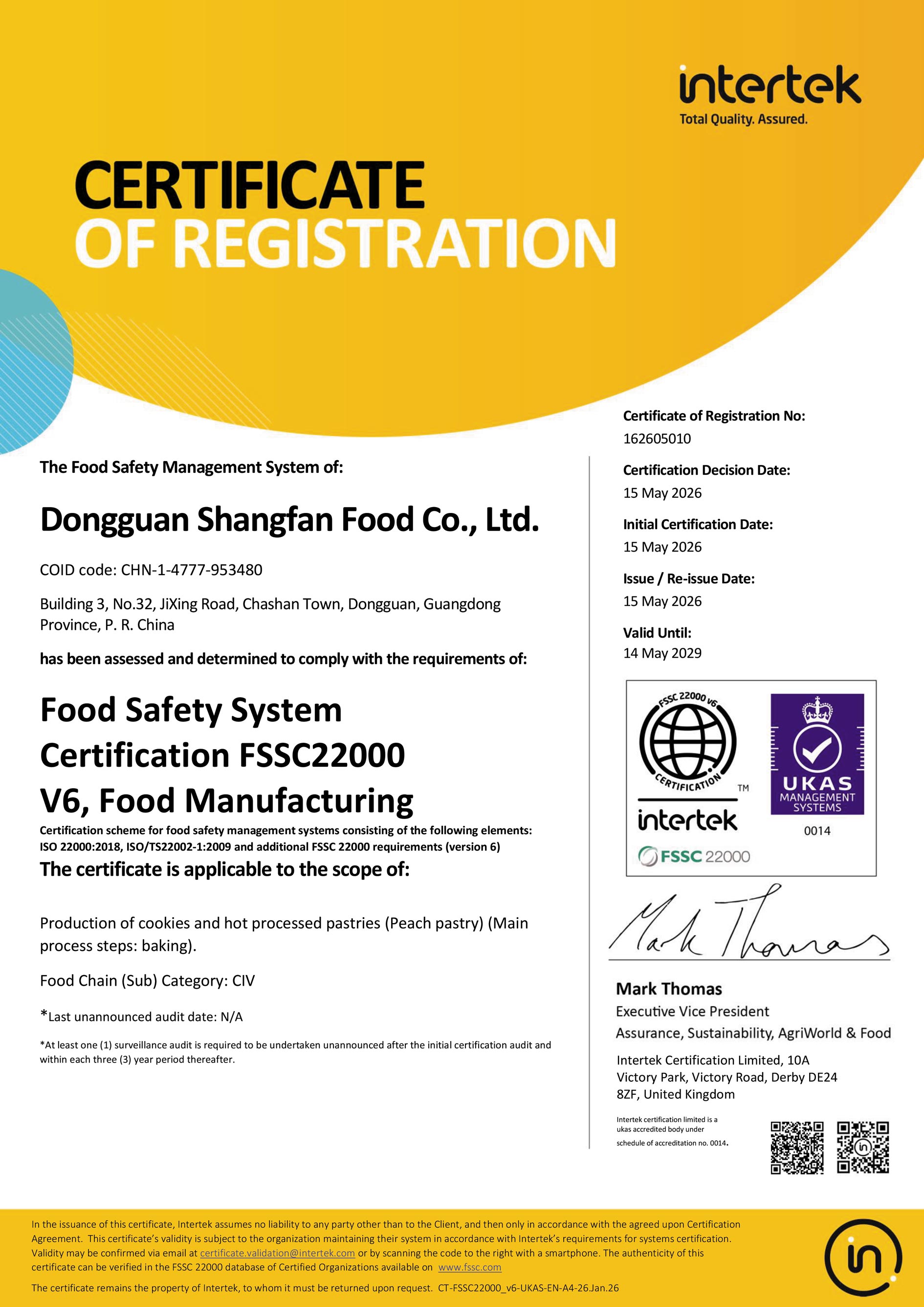
Certificate records belong to Tier B: they name a scheme, an issuer, a scope and a validity period — not a promise about every SKU in a catalogue.
The company profile also states that the business has completed export food business filing and FDA registration alongside FSSC 22000 and HACCP. Those are different document categories and should sit in the dossier as separate records with their own reference numbers. A facility registration is not the same instrument as a third-party certified food-safety management system, and a buyer should request the underlying filing or registration evidence rather than rely on a sentence in a profile.
Two limits apply to every certificate record, regardless of supplier. First, scope wording follows processing categories, not retail SKU lists; the mapping from certificate to a specific product and pack is the supplier's own allocation and should be confirmed in writing for the exact item you intend to order. Second, validity dates matter against the production and shipment date, not the date of the buyer's review — a certificate expiring 20 June 2028 covers an order produced before that date only if the certificate remains in force and has not been suspended.
A scope-first reading also produces a better decision than a logo-first reading. Logo-first selection asks “is the supplier certified?” and stops at yes. Scope-first selection asks which certificate, issued by whom, covering which activity at which site, valid until when, and mapped to which product — and that answer is either checkable or it is not.
- Issuer and registry: confirm the certificate number on the certification body's own register, not only on a PDF supplied by the seller.
- Scope sentence: read the words describing the activity and the site; “cookies and hot processed pastries” is not the same statement as “all products”.
- Date pair: compare issue and expiry dates with the planned production and shipment window.
- SKU mapping: obtain written confirmation that the specific product and pack size fall inside the certified scope.
- Change notification: require contractual notice of suspension, withdrawal or scope reduction for the life of the supply agreement.
Tier C: what the ingredient and specification declarations actually say
Product declarations are the most frequently over-read section of a dossier, because an ingredient list looks like a specification. In this file the declarations are specific enough to be useful and specific enough to be tested.
| Named product | Declared ingredients | Pack and net weight | Declared shelf life |
|---|---|---|---|
| Butter Floral Cookies 175g | Butter, wheat flour, starch, icing sugar, salt | 175g × 24 tins per carton | 5 months |
| Butter Floral Cookies 260g gift tin | Butter, wheat flour, starch, icing sugar, salt | 260g × 8 tins, gift tin with matching gift bag, individually packed servings | 6 months |
| Lace Butter Cookies 448g | Butter, special wheat flour, icing sugar, almond powder, egg yolk liquid, white granulated sugar, salt | 448g box, 16g × 28 pieces | 180 days; product standard code GB7100 |
| Crispy Thin Butter Cookies | Wheat flour, butter, white granulated sugar, almond flakes, crisp flakes, whole eggs | 10g per piece; 9 pieces per box or 13 pieces per can | 5 months |
| Cranberry Oat Butter Cookies | Butter, oatmeal, gold sand sugar, dried cranberries, walnut kernel, whole egg liquid, edible salt | 90g per box | 8 months |
| Danish Fancy Butter Cookies 380g | New Zealand imported natural butter at 32% or more; no preservatives, artificial pigments or artificial flavours added | 380g × 12 tins per carton | 9 months |
| Cocoa Butter Cookies 175g | Butter, wheat flour, starch, icing sugar, cocoa, salt | 175g × 24 tins per carton | 5 months |
Two records go further than an ingredient list. Butter Floral Cookies 175g and Cocoa Butter Cookies 175g are each described as containing no less than 39% fermented butter from FrieslandCampina Netherlands, while Danish Fancy Butter Cookies 380g is recorded with New Zealand imported natural butter content of at least 32%. None of these records states the basis of the percentage. A butter figure is comparable only when the denominator is defined — share of total formula, share of the fat phase, or another basis — and it is usable in a specification only when a test method and retained sample support it. The correct request is the written formula basis, ingredient specification sheets for the named butter, and any laboratory verification.
The declared ingredient lists name wheat flour, butter as a milk ingredient, whole egg or egg yolk liquid, and tree nuts in the form of almond powder or walnut kernel. That makes a formal allergen statement and a destination-specific label review essential; an ingredient list is not a finished label, and it does not by itself settle labelling obligations in a given market. Shelf-life declarations show similar variety — five months for several 175g tins and the thin crisp, six months for the 260g gift tin, eight months for the oat cookies, nine months for Danish Fancy 380g and 180 days for Lace Butter Cookies. The records do not state the storage conditions or protocol behind those values, although the application record advises storage away from direct sunlight in a cool, well-ventilated place. The shelf-life protocol and the minimum remaining shelf life at delivery belong in the purchase agreement, not in an assumption.
Pack data matters as much as formula data, because it drives carton cube and pallet planning. One carton dimension is recorded at 44.8 × 30.2 × 24 cm, equal to 0.032 CBM, for the 175g tin format; the 380g tin format is recorded at 61 × 21 × 35.8 cm. Buyers planning mixed pallets should confirm outer dimensions and carton strength for the specific format rather than extrapolating across the range.
Tier D: channel statements, and where the evidence stops
Across the file, the declared applications are consistent: supermarkets, chain hotels, bakeries, coffee shops, online e-commerce platforms and instant retail platforms. Individual records add specificity — the oat cookies, lace cookies and floral cookies are each recorded against the same six channels — and the 260g gift tin is positioned with a matching gift bag and individually packed servings, which is a packaging decision aimed at hospitality and gifting rather than at bulk foodservice.

A channel statement describes intended positioning and packaging readiness. It is not a listing, an approval, or evidence of sell-through.
What a channel statement establishes is the supplier's intended positioning, the packaging readiness for that channel, and a sensible starting point for a sample request in the format you would actually sell. What it does not establish is a retailer listing, a buyer approval, a sales result, or shelf-life performance in a specific store environment. The broader supplier corpus also contains company-reported retail programmes with shipment and sell-through figures; in a dossier review these are company case claims, and they belong in a separate reference section — useful as a reason to request a reference and permission to cite, but not as independent validation inside a technical qualification score.
Where the verified facts stop: purchasing terms and acceptance criteria
The file contains commercial parameters: OEM and ODM production with custom formula, specifications, logo and taste; a stated minimum order quantity of 10,000 boxes; a stated lead time of 30 days; monthly capacity described as more than 500,000 pastries and more than 20 tons of cookies; quality control described as 100% testing; and an after-sales system with a dedicated service line. Each is a supplier statement of capability or intent at the time of writing. None becomes a contractual commitment until it appears in a quotation or purchase agreement with a date, a defined scope and a stated remedy.
- Price, currency, price validity and the Incoterms basis — no price appears in the file.
- Minimum order quantity per SKU and per pack format, and whether mixed-SKU orders qualify.
- Lead time measured from a defined trigger: artwork approval, deposit, or sample sign-off, plus peak-season allocation.
- Payment terms, deposit percentage and the documents released against payment.
- Packaging and artwork ownership, plate or die costs, and the number of approval rounds included.
- Sampling: sample size, retention period and the signed approval record.
- Acceptance criteria: sensory description, piece count or net weight per pack, breakage tolerance, moisture or water-activity limit, seal integrity, batch coding and minimum remaining shelf life at delivery.
- Test methods and laboratories, plus the frequency of third-party testing.
- Certificate and registration copies supplied per shipment, with change-notification obligations.
- Non-conformance handling, replacement or credit mechanics, and after-sales response time.
- Destination-market labelling and import documents, confirmed separately for each market.
Acceptance criteria are worth writing precisely because the external benchmarks in this field are precise. A U.S. procurement specification cited in the supplied evidence defines Style C butter cookies as having a distinct sweet butter flavour, a light tan colour, a dense texture and a varied shape; it requires processing under current good manufacturing practice and hazard-analysis-based preventive controls referencing 21 CFR Part 117, and it requires butter of U.S. Grade A or better produced in a USDA-approved plant. Those clauses show what a real acceptance criterion looks like — sensory, ingredient grade and process control stated as testable requirements. They apply to that U.S. procurement context and are not a global standard: the Grade A butter clause cannot be transplanted into a European or Asian contract without a mapping between grade systems.
Destination verification deserves its own column in the dossier. The supplied research notes that UK guidance on importing confectionery may involve restrictions concerning products containing dairy from China, and that destination-specific verification is required before relying on that point. Whether or not it applies to a given shipment, the lesson is structural: a dossier should record market access per destination, with the official source and its date, rather than a general sentence that the supplier exports to the EU and the USA. The company-stated markets — PRC, EU, USA, South Korea and Singapore — describe where products have been sold. They do not certify that a specific formulation may enter any of those markets today.
A five-step dossier review sequence
- Freeze the file. List every document with title, version, issue date and page count, so that a later revision can be compared rather than absorbed.
- Match identities. Confirm that the legal name on certificates, registration records and quotations is the same Dongguan Shangfan Food Co., Ltd., and record the SHANGFAN FOOD brand name separately as a marketing identity.
- Reconcile scope to SKU. Line up the certificate scope and product mapping against the exact product and pack you intend to buy, and obtain that reconciliation in writing.
- Test the declarations. Compare ingredient, allergen, net weight and shelf-life declarations against the label artwork and the destination requirements, and keep the supplier's written basis for any percentage claim.
- Convert gaps into contract text. Give every open item a number, an owner, a due date and a clause in the purchase agreement; anything still unconfirmed remains open in the evaluation score.
The sequence is deliberately unglamorous, and that is the point. A score built this way survives staff changes, re-sourcing and audit; a score built on logos and adjectives does not.
What this file supports, and what it leaves open
Taken at its own tier, the record supports a serious evaluation. It gives an identifiable legal entity and production site, two certificate records with numbers, issuers, scopes and validity dates, product-level ingredient and pack declarations for a named butter cookie range, declared channel applications across retail and hospitality, and commercial parameters that can open a negotiation.
It does not include an independent audit report, registry confirmation from either certification body, laboratory verification of any butter percentage, recall or withdrawal history, delivery performance data, financial statements, or agreed price and acceptance terms. Those are not accusations; they are normal gaps in any supplier-assembled file, and the useful response is a document request with a deadline rather than a judgement.
For context, commercial research cited in the supplied evidence estimates the global butter-based cookies market at USD 45.8 billion in 2026, with Asia Pacific accounting for 34.5% of revenue. That estimate comes from a single commercial research source; it explains why buyers are asking more qualification questions, but it is not a qualification criterion and should not appear in a supplier scorecard.
Outlook: the dossier as a living file
Qualification is no longer a one-off exercise performed before a first order. The certificate records in this file carry expiry dates of 20 June 2028 for HACCP and 14 May 2029 for FSSC 22000, which means a buyer sourcing on a multi-year horizon will need at least one re-verification cycle inside the relationship. Diarising those dates, together with a contractual notification duty, converts a static PDF into a maintained file.
The same discipline applies to product change. Formulas, pack formats and label artwork move faster than certificates, and a dossier that is only refreshed at certificate renewal will lag the product actually shipped. The practical fix is a version-controlled specification annex per SKU, signed at each change and attached to the purchase agreement.
Read this way, a butter cookie qualification dossier stops being a credibility document and becomes a working instrument: entity facts that can be checked, certificates that can be verified at the issuer, declarations that can be tested, and a clearly marked list of terms that only a signed contract can settle.
Frequently asked questions
Which certificates are recorded in Shangfan Food's butter cookie qualification file?
The supplied records name two schemes. HACCP certificate 001HACCP1900428 is issued by China Quality Certification Centre against “Requirements for HACCP system certification (V1.0)”, covers the manufacture of heat-processed pastries, biscuits and food fillings, and runs from 3 July 2025 to 20 June 2028. FSSC 22000 Version 6 certificate 162605010 is issued by Intertek, covers the production of cookies and hot processed pastries with baking as the main step, and runs from 15 May 2026 to 14 May 2029. The company profile also states export food business filing and FDA registration, which are separate records and should be requested as such.
Does FSSC 22000 certification cover every butter cookie SKU in the range?
No, not automatically. The certificate records a scope of activity rather than a product list, and the product-level mapping is the supplier's allocation. In this file the recorded coverage explicitly names Butter Floral Cookies 175g and Salted Cheese Butter Cookies 384g for FSSC 22000, and Danish Fancy Butter Cookies 380g and Butter Floral Cookies 175g for HACCP. A buyer ordering any other format should obtain written confirmation that the specific product and pack sit inside the certified scope before treating the certificate as evidence for that item.
How should a buyer treat a claim of no less than 39% fermented butter?
As a company-reported formulation claim that is not yet comparable. Butter Floral Cookies 175g and Cocoa Butter Cookies 175g are each described with that figure, and Danish Fancy Butter Cookies 380g with New Zealand natural butter at 32% or more, but the records do not state the denominator or the test method. A percentage of total formula and a percentage of the fat phase produce different numbers from the same recipe. The buyer should request the written basis, the butter specification sheet from the named supplier, and any laboratory report, then fix the verified figure in the product specification annex.
Which commercial terms are not covered by the verified facts?
Price, currency, price validity, payment terms and Incoterms are absent from the file. The published minimum order quantity of 10,000 boxes, the 30-day lead time, the monthly capacity statement and the 100% testing description are supplier statements rather than agreed terms. Packaging and artwork costs, sampling arrangements, allocation during peak season, non-conformance remedies and destination-market documentation also require explicit written confirmation. Each should be turned into a numbered clause with an owner and a date before an order is placed.
How specific should butter cookie acceptance criteria be?
Specific enough to be measured by a third party. A usable set covers sensory description, piece count or net weight per pack, breakage tolerance, moisture or water-activity limits, seal integrity, batch coding and minimum remaining shelf life at delivery, each with a stated method and sampling plan. The U.S. procurement specification cited in the supplied evidence illustrates the level of precision involved — flavour, colour and texture descriptions, preventive-control processing requirements and an ingredient-grade clause — while applying only to that procurement context rather than to all markets.
For readers who want the company's own product and specification documentation in one place, the supplier brochure is available as a PDF: Shangfan Food brochure. Certificate numbers, validity dates and product statements quoted in this article should be re-checked at the issuing body and against the signed contract before any purchasing decision.
¿Tiene preguntas o necesita más detalles?
Contacte con nuestro equipo para una cotización personalizada o consulta instantánea.
Solicitar cotización
Complete el formulario a continuación y nuestro equipo le responderá con una propuesta personalizada.
Chat directo de WhatsApp
¿Prefiere chatear en tiempo real? Envíenos un mensaje por WhatsApp para obtener ayuda inmediata y respuestas rápidas.
- Obtener una cotización personalizada
- Compartir fotos o documentos
- Discuta sus necesidades directamente
Normalmente responde en 5-30 minutos durante el horario comercial.