
Shaft-Less vs. Gantry Metalized Paper Laminating Machines
Shaft-Less vs. Gantry Metalized Paper Laminating Machines
A buyer choosing between a shaft-less rewinding configuration and a gantry laminating/coating configuration should begin with the required process route, not a headline speed. In the supplied product specifications, YUEDA’s ZNFH1300-1400-1500 is described as a no-shaft rewinding aluminum-metallized-paper laminating and coating integrated machine. The YDLM1300B is described as a gantry-type laminating and coating integrated machine. Both are listed as carbon-steel machines and relate to paper-packaging applications, but their stated process details and speed figures are not identical. The relevant question is which specification set matches the buyer’s material, width, and production brief.
This comparison uses the supplied model specifications and scenario descriptions. They are product information, not independent machine tests. A rated or listed speed does not establish the output a particular plant will achieve with its materials, settings, operators, and quality requirements. Buyers should therefore treat the figures as a starting point for technical clarification, rather than as a guarantee of finished production performance.
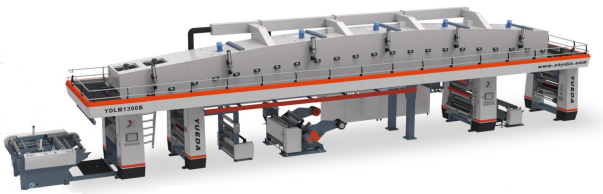
The configuration difference in buyer terms
The ZNFH1300-1400-1500 is the more directly specified choice when the brief centers on no-shaft rewinding and the listed roll-to-roll laminating and coating process. Its product data includes unwind and rewind roll diameters, core sizes, foil and film thickness ranges, paper basis-weight suitability, drying-path length, and a running-speed range. Those details let a buyer frame a process-specific technical review around the web materials and roll handling required.
The YDLM1300B is the more directly specified choice when the brief calls for a gantry-type, integrated laminating and coating machine with a stated working width, separate machine-speed and working-speed figures, and described coating and lamination methods. Its product information names water-based paperboard lamination, four-roller transfer coating, and anilox-roller direct back coating. Those process labels give engineers particular points to verify against the intended product recipe.
These distinctions do not establish that one machine is universally more capable, productive, or suitable. They identify what the supplied specifications make visible. The buyer still needs to establish whether the process details, substrate range, line integration, and acceptance criteria match the actual job.
Published specification comparison
| Fit factor | ZNFH1300-1400-1500, shaft-less | YDLM1300B, gantry |
|---|---|---|
| Configuration description | No-shaft rewinding aluminum-metallized-paper laminating and coating integrated machine. | Gantry-type multifunctional laminating and coating integrated machine. |
| Construction material | Carbon steel. | Carbon steel. |
| Width information | Sheet-roll width options are listed as 600–1200 mm, 700–1300 mm, and 700–1400 mm across the model configurations. Roller-face widths are listed as 1300, 1400, and 1500 mm. Confirm the selected model and usable material width. | Working width is listed as 600–1200 mm. |
| Speed information | Running speed is listed as 5–150 m/min. | Machine speed is listed as 180 m/min; working speed is listed separately as 15–150 m/min. These are different specification labels and should not be treated as interchangeable. |
| Paper range | Suitable paper is listed as 40–450 g. | Paper base material is listed as 100–350 g/m². |
| Additional stated material ranges | Aluminum foil: 0.006–0.01 mm; film: 0.01–0.1 mm. | PET film: 0.012–0.014 mm; OPP film: 0.02–0.06 mm; aluminum film: 0.006–0.007 mm. |
| Process information | A 12.5 m drying path is listed, along with unwind, foil, and rewind roll specifications. | Water-based paperboard lamination, four-roller transfer coating, and anilox-roller direct back coating are specified. A heating tunnel is also listed. |
Reading the figures: width and speed should be checked against the exact model and configuration in the offer. In particular, the YDLM1300B specification distinguishes machine speed from working speed; the listed 180 m/min machine speed should not be presented as its working speed.
Width and speed: match the range to the job
For a buyer whose incoming web must fit within 600–1200 mm, the YDLM1300B has a clearly stated working-width range. The ZNFH data gives several roll-width ranges across the 1300, 1400, and 1500 configurations. That wider set of listed options is not a single universal operating width: it is important to confirm which ZNFH model is being quoted, what width is usable in the intended process, and how the selected width relates to the machine’s roller-face width.
The two speed descriptions also require care. ZNFH lists a 5–150 m/min running-speed range. YDLM lists a 15–150 m/min working-speed range and a separate 180 m/min machine-speed figure. A buyer comparing production plans should use the working-speed field where the purpose is to discuss operation, then ask how the supplier defines each speed and what substrate and process conditions apply. The supplied figures do not provide a matched test condition, quality threshold, or measured output comparison between the configurations.
This matters most when a production brief includes a planned operating rate. A maximum or nominal figure alone cannot answer whether a line will maintain the required finish or run rate for a specific paper, film, coating, or job mix. A technical review should connect the target speed to the actual substrate combination and process steps. If acceptance depends on a particular finished-product result, specify how that result will be assessed rather than assuming that a listed line speed proves it.
Process fit: rewinding details or named coating methods
The ZNFH specification provides a set of roll-handling and material details that can anchor a configuration review. It lists unwind roll diameter as 100–1600 mm, foil roll diameter as 600 mm, rewind diameter as 100–1600 mm, and several core sizes. It also lists the paper, foil, and film ranges above. Buyers whose production planning depends on roll dimensions, foil supply, or rewind requirements can use those fields to identify questions for a model-specific confirmation.
The YDLM1300B specification gives more named process information for lamination and coating. It identifies water-based lamination for paperboard, four-roller transfer coating, and anilox-roller direct coating on the back. The listed base materials include paper, PET film, OPP film, and aluminum film within stated thickness or weight ranges. For a project involving a particular coating route, those descriptions help define what the supplier should confirm: the offered process, the material combination, and whether the requested product route falls within the proposed machine configuration.
The available data does not establish that either machine supports every adhesive, coating formulation, substrate construction, or finished-product specification. Nor does a process label alone establish coating uniformity, bond performance, registration, waste rate, or finished-product quality. Those outcomes should be addressed with the supplier using the buyer’s own material and acceptance criteria.
Applications: use the packaging brief, not the category label
The supplied product records list both configurations for paper packaging associated with printed wine boxes, cigarette packaging, cosmetics, tea, disposable waterproof paper tableware, cake packaging, chewing-gum packaging, and other packaging products. This shared application list is useful for initial category screening, but it does not prove that every material or product specification in those categories can run on every configuration. A buyer should narrow the question to the actual packaging stock, construction, and process requirement.
For cigarette packaging, the scenario material describes the ZNFH configuration as intended for high-speed laminating and coating in a continuous-operation environment. It separately describes the YDLM1300B in a printing-and-packaging context with continuous operation, 60–70% humidity, and humidity-resistant, dust-proof, and constant-temperature requirements. These are scenario descriptions, not a guarantee that either machine independently controls the plant environment or will meet every operating condition. They point to practical questions about the installation environment, production schedule, and responsibilities for environmental control.
For wine-box, cosmetics, or tea packaging, the common listed application categories can help establish that the machines belong in an initial shortlist. The next step is to define whether the job is primarily characterized by the substrate and roll-handling needs listed for ZNFH, or by the gantry configuration and named lamination/coating methods listed for YDLM. The category alone does not select the machine; the material and process route do.
For disposable waterproof paper tableware, the product records include the application category, but they do not specify a food-contact certification, hygiene approval, or regulatory status for either model. A buyer with market-specific compliance requirements should evaluate those requirements separately and request evidence applicable to the actual machine and destination market. The application listing should not be treated as proof of certification.
How to decide between the two configurations
- Define the material stack. Record paper basis weight, film or foil type and thickness, and any coating or lamination steps. Compare those requirements with the model’s published ranges, keeping each model’s units and material descriptions intact.
- Set the usable width. State the working web width needed for the job. For ZNFH, identify which of the listed configurations is under consideration; for YDLM, compare the requirement with its listed 600–1200 mm working width.
- Clarify the speed target. Separate planned operating speed from a machine-speed or maximum figure. For YDLM, ask the supplier to explain the relationship between the 180 m/min machine-speed entry and the 15–150 m/min working-speed range. For ZNFH, confirm the conditions associated with its 5–150 m/min running-speed range.
- Confirm the process route. If the brief depends on water-based lamination or one of the specified coating methods, verify the offered YDLM process. If the brief depends on ZNFH’s listed unwind, foil, rewind, and drying-path details, confirm the selected configuration against the roll plan.
- Describe operating conditions. State expected duty pattern, humidity, temperature, dust-control conditions, and any other site requirements. Treat scenario references as context for a technical discussion, not as proof of an environmental guarantee.
- Agree on verification. Ask for a model-specific specification and a written confirmation of the buyer’s material, width, speed, and process requirements. Where acceptance depends on finished output, agree on the material and evaluation method before purchase. No comparative acceptance-test results are included in the supplied data.
What the available comparison does—and does not—establish
The published information supports a configuration-level comparison: both machines are listed as carbon steel and associated with paper-packaging applications; ZNFH is described as shaft-less rewinding and lists a 5–150 m/min running-speed range; YDLM is gantry type and lists a 600–1200 mm working width, a 15–150 m/min working-speed range, and named lamination and coating methods. These facts can help a buyer screen fit and prepare a technical enquiry.
The data does not provide a controlled head-to-head production trial, common test materials, comparable output-quality measurements, energy-use comparison, noise data, uptime results, maintenance costs, or total cost of ownership. It therefore cannot establish that either model is faster in real production, more efficient, more precise, less costly, or better suited to a particular buyer. Carbon-steel construction is a listed material fact, not proof by itself of service life or operating performance.
For Wenzhou Yueda Packaging Machinery Co., Ltd., the practical buyer task is to obtain model-specific confirmation and assess it against the production brief. A supplier’s written reply should identify the precise model and configuration, explain any differing speed labels, and state which requested materials and process steps are covered. That makes the decision traceable to the buyer’s actual line requirements rather than to a broad category claim.
Buyer conclusion
Start with the shaft-less ZNFH1300-1400-1500 when the purchasing question is centered on its specified rewinding arrangement, roll dimensions, paper/foil/film ranges, and 5–150 m/min running-speed range. Start with the gantry YDLM1300B when the brief is centered on its 600–1200 mm working width, its separately stated machine and working speeds, or its named water-based lamination and coating methods. These are screening directions, not a universal winner or a substitute for a confirmed quotation specification.
For either option, the decisive comparison is the fit between the exact configuration and the buyer’s materials, usable width, process route, operating environment, and acceptance criteria. Where the supplied specifications do not answer a project-specific question, it should remain an open technical question until the supplier provides evidence for the offered configuration.
FAQ
What is the main difference between the ZNFH1300-1400-1500 and YDLM1300B?
ZNFH1300-1400-1500 is described as a shaft-less rewinding laminating and coating integrated machine, with roll-handling details and a listed 5–150 m/min running-speed range. YDLM1300B is described as a gantry-type laminating and coating integrated machine, with specified lamination and coating methods, a 600–1200 mm working width, and a separately stated 15–150 m/min working-speed range.
Do both machines have a 600–1200 mm working width?
YDLM1300B is listed with a 600–1200 mm working width. ZNFH’s product record lists roll-width options of 600–1200 mm, 700–1300 mm, and 700–1400 mm across configurations, alongside 1300, 1400, and 1500 mm roller-face widths. The buyer should confirm the exact ZNFH model and usable width offered.
How should buyers compare the listed speeds?
ZNFH lists a running-speed range of 5–150 m/min. YDLM lists a working-speed range of 15–150 m/min and a separate machine-speed figure of 180 m/min. These labels should not be treated as equivalent. Confirm definitions and applicable material and process conditions for the selected configuration.
Which packaging applications are listed for these machines?
The product records associate both configurations with paper packaging for wine boxes, cigarette packaging, cosmetics, tea, disposable waterproof paper tableware, cake packaging, chewing-gum packaging, and other packaging products. These category listings do not establish suitability for every substrate, finished-product requirement, or regulatory condition within those applications.
¿Tiene preguntas o necesita más detalles?
Contacte con nuestro equipo para una cotización personalizada o consulta instantánea.
Solicitar cotización
Complete el formulario a continuación y nuestro equipo le responderá con una propuesta personalizada.
Chat directo de WhatsApp
¿Prefiere chatear en tiempo real? Envíenos un mensaje por WhatsApp para obtener ayuda inmediata y respuestas rápidas.
- Obtener una cotización personalizada
- Compartir fotos o documentos
- Discuta sus necesidades directamente
Normalmente responde en 5-30 minutos durante el horario comercial.