
Separate GU vs Integrated GCU/ZCU Screw Air End Blocks
Separate GU vs Integrated GCU/ZCU Screw Air End Blocks
Choosing between a separate GU screw airend and an integrated GCU or ZCU block is a decision about where the cost lands, not about which product is more advanced. Both are oil-injected rotary screw air ends from WoYo COMPRESSOR. A GU air end is a conventional single airend: the machine builder supplies the motor, the drive arrangement, the oil separation and the pipework that carries compressed air from the discharge port to the separator and receiver. A GCU or ZCU block integrates the motor side, the airend and the separation system into one body, so the air path stays inside the assembly and the external pipe run disappears.
For a buyer at decision stage, that difference resolves into three practical questions. How much chassis or skid space does the installation consume? How many hours of assembly, and how many leak-prone joints, does the design add? And does the lower unit price of a separate airend survive the cost of the piping and installation it requires? WoYo's own comparison material answers all three in favour of the integrated block for vehicle-mounted work, while stating plainly that the integrated unit carries the higher unit price. This article separates the manufacturer's figures from what an independent buyer can verify, and sets out the criteria that decide the case in either direction.
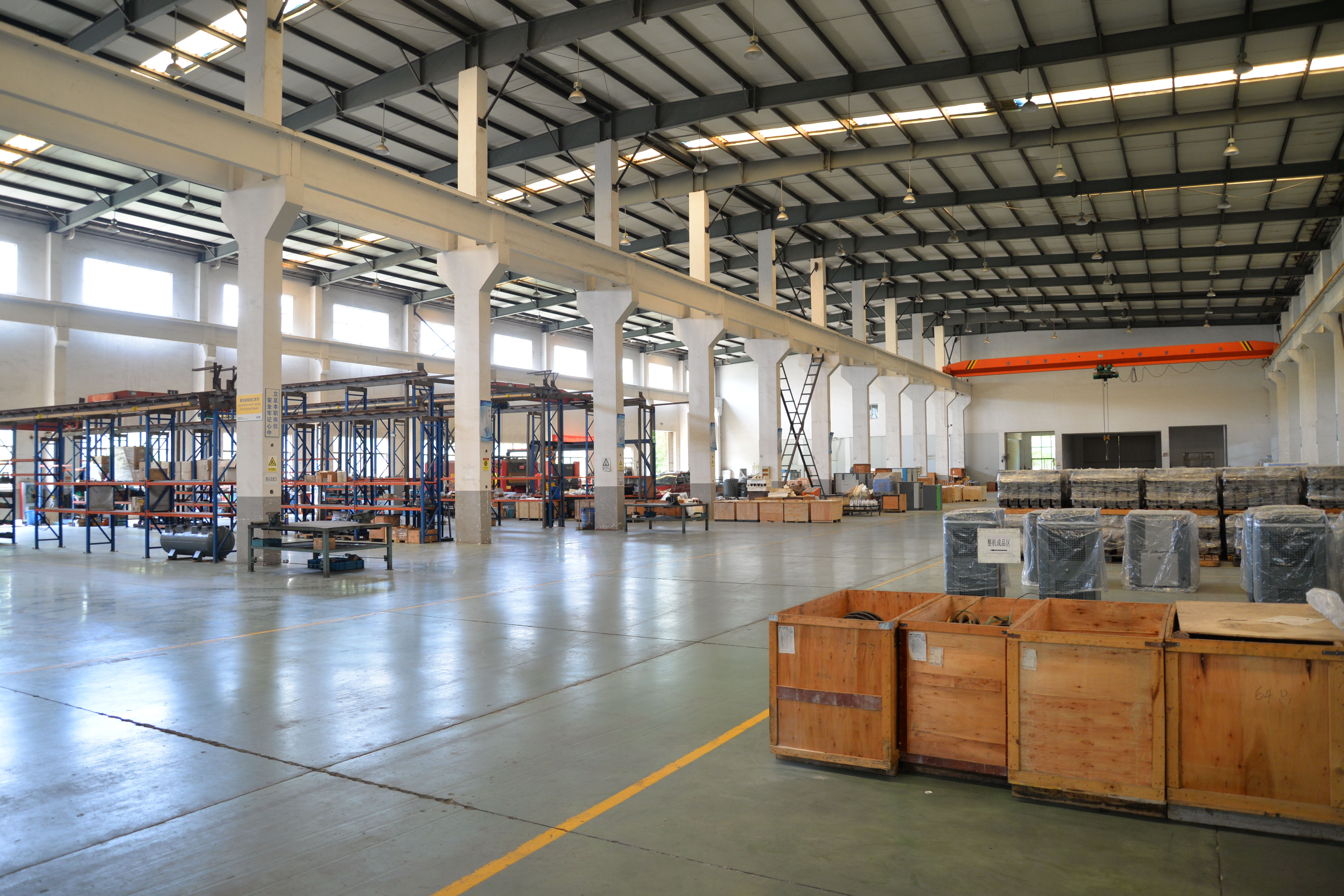
Screw air end manufacturing at WoYo COMPRESSOR, Wuxi, Jiangsu — the production base behind both the GU and GCU/ZCU ranges.
What each architecture actually contains
A separate GU airend is a standalone compression element. Air enters the rotor housing, is compressed between the male and female rotors, and leaves through a discharge port that connects to external piping, elbows, joints and valves before reaching the oil separation stage. WoYo's comparison baseline for this route is a traditional on-board compressor with external piping and a belt drive, in which the builder assembles the motor, the drive, the airend and the separation components as separate items on the chassis.
An integrated GCU or ZCU block removes that interface. WoYo describes the architecture as a motor-side, airend and separation system integrated into a single block, built on what the company calls a 9-in-1 integrated architecture. The stated design intent is higher concentricity between the motor and rotor shaft, no external piping resonance, and no external leakage points. In the GCU series, WoYo positions the block specifically for vehicle-mounted air compressors and cabinet-free air supply systems, with a compact, lightweight and low-noise layout intended to remain durable and leak-resistant in high-dust, high-altitude and high-humidity environments.
The distinction matters to a buyer because it changes what is being purchased. A GU order delivers a compression element that the builder integrates into its own air circuit. A GCU or ZCU order delivers an assembled compression and separation module, which shifts engineering responsibility — and much of the assembly labour — from the buyer's production line to the air end supplier.
Inside the block: why the air path changes the numbers
A screw rotor is a matched pair of intermeshing helical rotors — one male, one female — that forms the core working element of the airend. The motor drives the male rotor, which drives the female rotor in synchrony. The helical lobes, the housing and the end covers create sealed cavities that expand as they meet the inlet, close as the rotors turn, shrink to raise gas pressure, and open at the discharge port. The cycle repeats continuously, which is why a screw airend delivers a steady, pulsation-free flow rather than the cyclic output of a reciprocating machine.
In a separate GU airend, the compressed air has to leave that carefully sealed cavity and travel through an external circuit — pipe, elbow, joint, valve — before it reaches separation. Every element in that chain adds resistance and one more place where air or oil can escape. WoYo's comparison data states that the integrated block's shorter internal air path, with fewer elbows, reduces pipeline pressure loss by 28% and improves thermal efficiency by 15% relative to the conventional separate airend arrangement. The same material attributes a 12% increase in free air delivery and a 35% reduction in package volume to the integrated layout.
Two further claims concern reliability rather than thermodynamics. Against a traditional on-board compressor with external piping and belt drive, WoYo states that eliminating external pipes, joints and valves reduces leakage and loosening failures by 80%, holds the failure rate below 1%, and raises mean time between failures to 30,000 hours. Noise is stated as 5–8 dB(A) lower. These are manufacturer figures from a controlled internal comparison, not results from an independent third-party test, and they should be read that way.
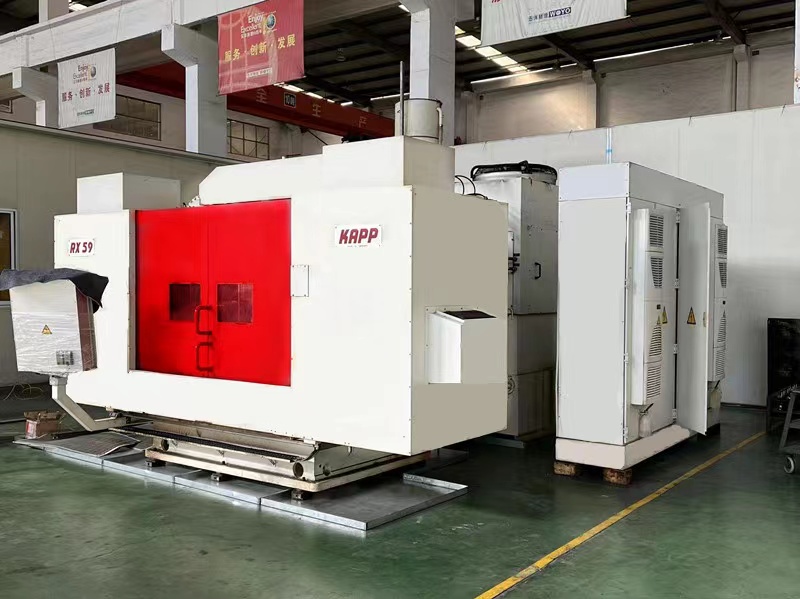
Rotor profile grinding — the process step that determines clearance, concentricity and ultimately the specific power of both GU and GCU air ends.
Separate GU vs integrated GCU/ZCU: dimension-by-dimension
| Criterion | Separate GU screw airend | Integrated GCU / ZCU block |
|---|---|---|
| Architecture | Conventional single airend with external piping, joints and valves to the separation stage | Motor side, airend and separation system in one block; 9-in-1 architecture per WoYo |
| Motor and drive | Arranged by the machine builder; WoYo's comparison baseline uses a belt drive | Direct drive contained inside the block, no external belt or exposed coupling |
| Package volume | Reference baseline | 35% smaller (WoYo comparison data) |
| Pipeline pressure loss | Reference baseline | 28% lower |
| Free air delivery | Reference baseline | 12% higher |
| Oil carry-over | Above 3 ppm in the compared baseline | Below 2 ppm |
| Noise | Reference baseline | 5–8 dB(A) lower |
| Installation labour | Reference baseline | Approximately 70% fewer hours |
| Reliability | Reference baseline | Failure rate below 1%; leakage and loosening failures down 80%; MTBF 30,000 h |
| Maintenance access | Inspection points distributed along external pipework; fault location may require dismantling | Routine cleaning and filter change only; external quick-release module replaced in under 15 minutes; faults located without dismantling piping |
| Unit price | Lower | Higher |
| Documented best fit | Builds where the air circuit is already engineered around a piped airend | Vehicle-mounted applications where chassis space, assembly efficiency and reliability dominate |
Figures in the integrated column are WoYo COMPRESSOR comparison data measured against a conventional separate screw airend with external piping. The GU column states the comparison baseline, not an independently tested GU performance value.
What the differences mean in assembly, service and uptime
The most financially significant number in the table is not the 12% flow gain but the roughly 70% reduction in installation hours. On a vehicle or skid build, assembly labour is a recurring cost that scales with every unit, while the air end price difference is paid once. For a programme with steady volume, the integrated block converts a per-unit assembly burden into a one-time purchase premium. For a low-volume or prototype build, the arithmetic often points the other way.
Service access changes in a similar way. On a piped installation, a leak or a pressure drop sends a technician along the pipe run, and locating the fault can mean dismantling joints. WoYo states that the integrated block provides clear inspection points and allows fault location without disassembling piping, with the external quick-release module replaced in under 15 minutes. That is a service-time claim worth testing against your own maintenance regime rather than accepting at face value, because the real variable is how quickly a replacement module can reach the vehicle.
Reliability figures need care as well. A stated mean time between failures of 30,000 hours is a statistical expectation for a population under defined duty conditions. It is not a warranty period, and it does not predict the life of any single unit on a specific duty cycle. Buyers should ask what duty profile, ambient conditions and duty cycle the figure assumes, and compare it with the same question put to any alternative supplier.
For context on the wider technology choice, WoYo's comparison against reciprocating machines puts screw air end service life at 20,000–30,000 hours against 3,000–5,000 hours for piston equipment, with noise held at or below 75 dB(A) against 85–95 dB(A), oil carry-over below 2 ppm, and maintenance frequency reduced by approximately 80%. Those numbers describe the screw category as a whole; the GU-versus-GCU decision sits one level below them.
How a buyer verifies the comparison before committing
Performance claims for screw air ends are only comparable when they are declared on the same basis. ISO 1217:2009 specifies acceptance test methods for displacement compressors, covering volume rate of flow and power requirements. Its Amendment 1:2016 addresses the calculation of isentropic efficiency and its relationship with specific energy. In the United States, 10 CFR Part 431 Subpart T incorporates ISO 1217:2009 testing provisions for both fixed-speed and variable-speed air compressors, and the Department of Energy minimum isentropic efficiency levels under 10 CFR 431.345 have applied to oil-flooded rotary screw compressors manufactured on or after 10 January 2025 and sold in the U.S. market.
That regulatory backdrop gives the buyer a usable RFQ structure. Rather than accepting headline percentages, request the declared free air delivery at a stated discharge pressure, the shaft power absorbed at that point, the resulting specific power, the test standard applied, the ambient and inlet conditions, the oil carry-over figure and its measurement basis, and the sound pressure level with distance and measurement standard stated. Ask whether the figures refer to the air end alone or to the complete package — a frequent source of misleading comparison between component suppliers and compressor builders.
Verification does not stop at the datasheet. Request the dimensional drawings and 2D/3D models with the quotation so the chassis or skid integration can be checked before the order, confirm the spare-part list and its stocking location, and ask what the warranty covers — the block, the rotor pair, or the complete module. WoYo states that quotations and technical answers are returned within 24 hours and that drawings and models are delivered with the order, which shortens the engineering loop but does not replace the buyer's own validation.
Where each block fits: application scenarios
The integrated GCU and ZCU range was developed for vehicle-mounted air supply and cabinet-free systems, covering braking systems, air suspension, chassis auxiliary systems and centralised air supply for specialised vehicles. The documented equipment scope spans construction machinery, mining vehicles, new-energy commercial vehicles and rail transit, including drilling rigs, heavy-duty trucks, buses, fire engines, subway systems and freight trains. WoYo positions the integrated block specifically for heavy-duty vehicles operating under high vibration and frequent start-stop cycles — the duty pattern in which external pipe joints are most likely to loosen and leak.
The separate GU series covers the conventional single airend models GU11, GU30, GU33, GU37, GU55 and GA30, alongside the broader integrated family that runs from the K5 and K10 units through GCU10, GCU11, GCU13, GCU30, GCU30G, GCU30 Engineering, GCU30 Railway, GCU33, GCU35, GCU55, GCU55L, GCU55G and ZCU. For a builder whose chassis already carries a piped air circuit, or whose production volume does not justify re-engineering the route from motor to separator, the GU route keeps the air end as a component inside an existing design. That is a boundary of layout and build volume rather than of technology level — the two ranges share the same rotor manufacturing base.
Supply, lead time and the non-technical half of the decision
Technical fit decides whether a design is possible; supply behaviour decides whether it ships. WoYo's comparison against imported air ends cites a lead time of 25–35 days against 60–90 days for imports, on-site or remote commissioning, and spare parts held in stock in China. The company also states that its quotation turnaround is within 24 hours and that technical responses accompany the quotation rather than following it.
The cost comparison is stated as a purchase cost 25–30% lower than the imported benchmark, with total cost of ownership 30% lower. WoYo frames part of that gap as the absence of import duty, overseas freight and currency exposure. A buyer outside China should treat that line carefully: those savings accrue to a purchaser sourcing domestically within China, and a non-Chinese buyer must net the same factors against their own import costs, duties and logistics. The relevant comparison for an overseas buyer is delivered cost and delivered lead time, not the ex-works figure.
Market context: why the comparison matters now
The wider category is large and still growing. Commercial research cited for this analysis puts the global screw compressor market at USD 12.5 billion in 2024, rising to an estimated USD 13.3 billion in 2025, with Asia Pacific holding the largest regional share at 41.5%–43.7% of 2025 revenue. At component level, a separate market study projects the screw air end segment reaching USD 5.51 billion by 2030 at a compound annual growth rate of 5.2%.
Those two figures use different scopes and different growth rates, and should not be combined into a single market statement: the first covers complete screw compressor systems, the second covers the air end as a component, and the gap between their growth rates reflects the different value pools involved. For the buyer, the useful signal is structural rather than numeric. Oil-injected rotary screw compressors accounted for 61.7% of the market in 2025, which means the GU-versus-GCU decision concerns the majority of installed volume rather than a niche configuration.
Regulation is the second structural signal. The U.S. minimum isentropic efficiency requirement that took effect on 10 January 2025 for oil-flooded rotary screw compressors pushes efficiency claims onto a defined calculation basis, and ISO 1217-aligned declaration is the common language for that. As efficiency becomes a declared, testable attribute rather than a brochure adjective, the value of an air path that reduces pressure loss and improves thermal efficiency becomes easier to demonstrate — and easier to challenge.
WoYo COMPRESSOR: the manufacturing base behind the comparison
WoYo COMPRESSOR was founded in 1996 by He Jianren and manufactures screw compressor air ends from a 20,000 m² facility in Wuxi, Jiangsu, China, with more than 120 employees, an annual output of 12,000 units and an engineering team of 35, roughly 30% of headcount. The product range covers the integrated GCU, K and ZCU series, the conventional GU series, vehicle-mounted screw air compressors and process-gas screw air ends. Approximately 20% of output is exported, with stated markets including Germany, the United States, Russia, Kuwait, Malaysia, Vietnam, Southeast Asia and the Middle East.
The capability claim behind both architectures is in-house rotor manufacturing. The company has worked with a German screw technology partner since 2003, and its plant uses German and Japanese precision machining and metrology equipment, including KAPP and SU rotor grinding machines, CNC cylindrical grinding and a Heidenhain three-coordinate measuring instrument. WoYo holds five core invention patents, and its published material lists a modified screw air end invention patent numbered ZL2008 1 0025355.0. For a buyer, the relevance is not the equipment list itself but what it supports: control over rotor profile and clearance, which is the process variable that determines whether a stated specific power can be held in series production.
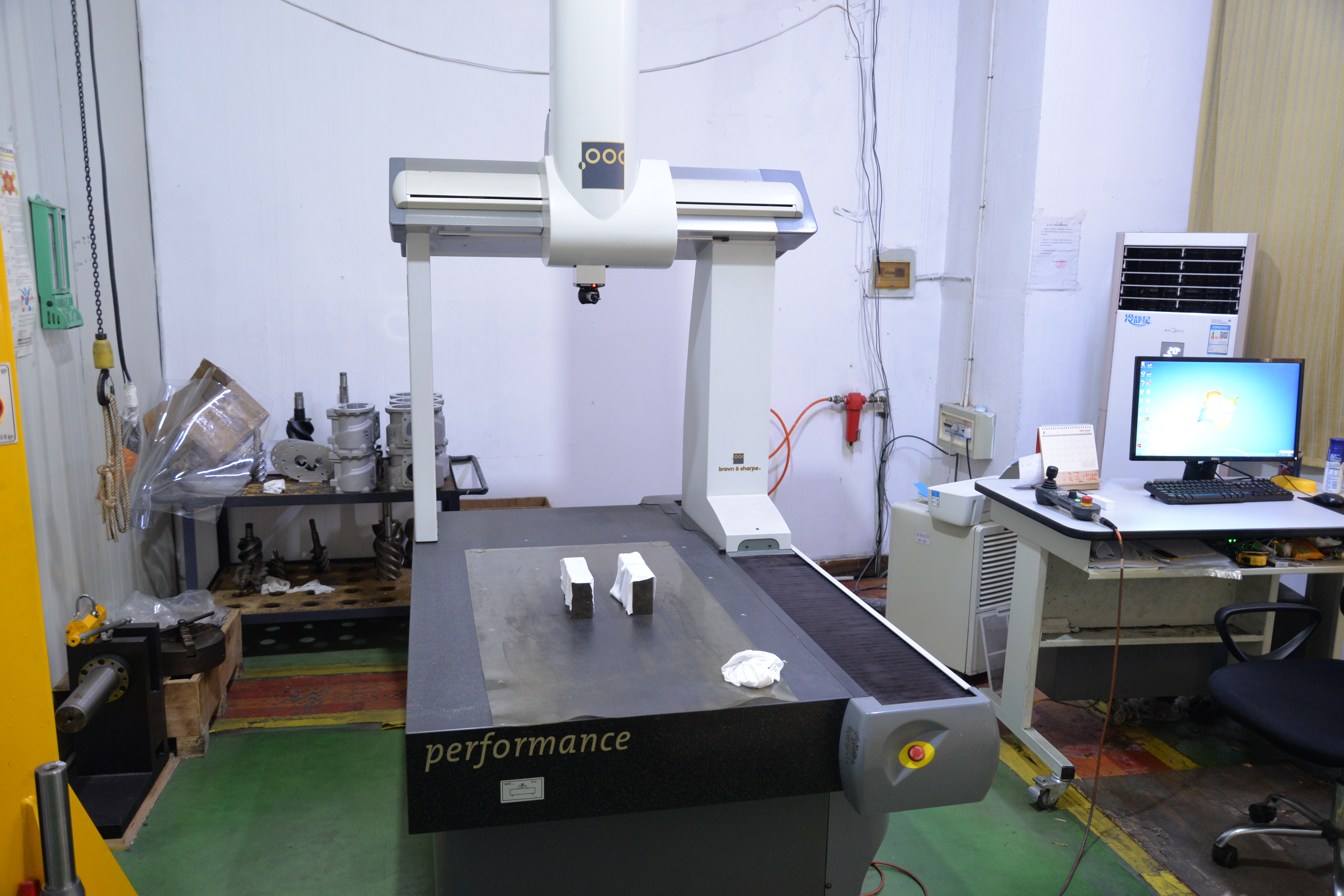
Dimensional inspection with a Heidenhain three-coordinate measuring instrument — the check point that ties declared tolerances to shipped parts.
Limitations and fit boundaries
Several parts of this comparison cannot be settled from published material, and buyers should know which ones. The percentage deltas in the table — 35% volume, 28% pressure loss, 12% flow, 70% installation hours, 80% leakage reduction — are WoYo's own comparison data. No independent third-party test of the GU-versus-GCU delta was available for this review, so the figures establish the manufacturer's position rather than an audited result.
The imported-benchmark comparison carries the same caveat. WoYo's statement of a performance gap of 10% or less under identical ISO 1217 conditions, at roughly one third of the purchase price, refers to a "Rotorcomp class" benchmark. The specific benchmark model, its configuration and the supporting test report are not identified in the supplied material, so the claim should be treated as a supplier assertion about a competitor until a like-for-like document is produced. A company's assertion about a competing product is not independent verification, and "not disclosed" never means "not capable".
Model-level datasheets were also outside the evidence reviewed here. Rated flow, discharge pressure range, shaft power, speed range, oil carry-over and sound pressure for individual GCU and GU models should be requested directly and compared at matched duty points. Finally, integration carries a structural trade-off: the unit price is higher, and the service unit becomes the block module rather than an individual pipe or joint. Whether that trade is favourable depends on build volume, chassis architecture and the distance to the nearest stocked spare.
The decision rule
Choose the integrated GCU or ZCU block when the chassis is space-constrained, when assembly hours are a recurring per-unit cost, when the duty cycle involves high vibration and frequent start-stop, and when the supplier can deliver drawings, models and spares on a schedule that matches your build plan. Choose the separate GU airend when the air circuit is already engineered around a piped compression element, when build volume is low enough that the unit-price premium does not amortise, or when an existing design cannot be re-routed without requalification.
In both cases the verification path is the same: matched duty points, ISO 1217-aligned declarations, stated test conditions, dimensional data before the order, and a written spare-part and warranty position. The architecture decision is the easy part; the discipline of comparing like with like is what protects the programme.
Frequently asked questions
Is an integrated GCU/ZCU air end worth the higher unit price compared with a separate GU airend?
That depends on build volume and chassis layout rather than on the air end alone. WoYo's comparison data states that the integrated block carries a higher unit price but reduces installation hours by approximately 70%, lowers pipeline pressure loss by 28%, raises free air delivery by 12% and cuts package volume by 35% against a conventional separate airend with external piping. Where those savings recur on every unit built, they can outweigh a one-time price premium; where they do not, the separate GU airend remains a valid route. The actual price difference between specific GU and GCU models is not published and must be obtained by quotation.
What is the difference between a separate screw airend and an integrated screw air end block?
A separate screw airend is a standalone compression element that the machine builder connects to its own motor, drive, oil separation and external piping. An integrated screw air end block combines the motor side, the airend and the separation system in one body, so the compressed air path stays internal and the external pipe run, joints and valves are eliminated. WoYo COMPRESSOR produces both: the conventional GU series as separate airends and the GCU, K and ZCU series as integrated blocks.
How should a buyer verify efficiency and flow claims for a screw air end?
Compare claims on a declared test basis. ISO 1217:2009 specifies acceptance test methods for volume rate of flow and power requirements of displacement compressors, and Amendment 1:2016 addresses the calculation of isentropic efficiency and its relationship with specific energy. In the United States, 10 CFR Part 431 Subpart T incorporates ISO 1217:2009 testing provisions for fixed-speed and variable-speed compressors, with minimum isentropic efficiency levels under 10 CFR 431.345 applying to oil-flooded rotary screw compressors manufactured on or after 10 January 2025. Buyers should request flow, shaft power, specific power, oil carry-over and sound level at a stated discharge pressure and ambient condition, and confirm whether the figures describe the air end alone or a complete package.
Which air end configuration suits a vehicle-mounted air supply system?
WoYo positions the integrated GCU series for vehicle-mounted air compressors and cabinet-free air supply systems, covering braking systems, air suspension, chassis auxiliary systems and centralised air supply for specialised vehicles. The documented equipment scope includes construction machinery, mining vehicles, new-energy commercial vehicles and rail transit, and the integrated block is specifically intended for heavy-duty vehicles operating under high vibration and frequent start-stop cycles. The separate GU series is a conventional airend for builders who integrate the compression element into their own air circuit.
What is a screw rotor and why does it matter in this comparison?
A screw rotor is a matched pair of intermeshing helical rotors — a male rotor and a female rotor — that forms the core working element of a screw airend. The motor drives the male rotor, which drives the female rotor, and the lobes, housing and end covers create sealed cavities that expand at the inlet, close and shrink to raise pressure, then open at the discharge port. Because both the GU and GCU/ZCU ranges depend on this rotor pair, rotor profile, clearance and manufacturing tolerance are the shared foundation beneath the architectural difference, and they determine how much of a stated efficiency advantage survives in production.
For readers who need the full model list, dimensional data and application scope in one document, the WoYo COMPRESSOR product brochure is available for download: WoYo COMPRESSOR product catalogue (PDF).
¿Tiene preguntas o necesita más detalles?
Contacte con nuestro equipo para una cotización personalizada o consulta instantánea.
Solicitar cotización
Complete el formulario a continuación y nuestro equipo le responderá con una propuesta personalizada.
Chat directo de WhatsApp
¿Prefiere chatear en tiempo real? Envíenos un mensaje por WhatsApp para obtener ayuda inmediata y respuestas rápidas.
- Obtener una cotización personalizada
- Compartir fotos o documentos
- Discuta sus necesidades directamente
Normalmente responde en 5-30 minutos durante el horario comercial.