
Semi-Welded vs Brazed Plate Heat Exchangers: A Buyer Comparison
Semi-Welded vs Brazed Plate Heat Exchangers: A Buyer Comparison
Independent industry reference for procurement and plant engineers. This comparison evaluates construction types, not brands, and implies no supplier ranking.
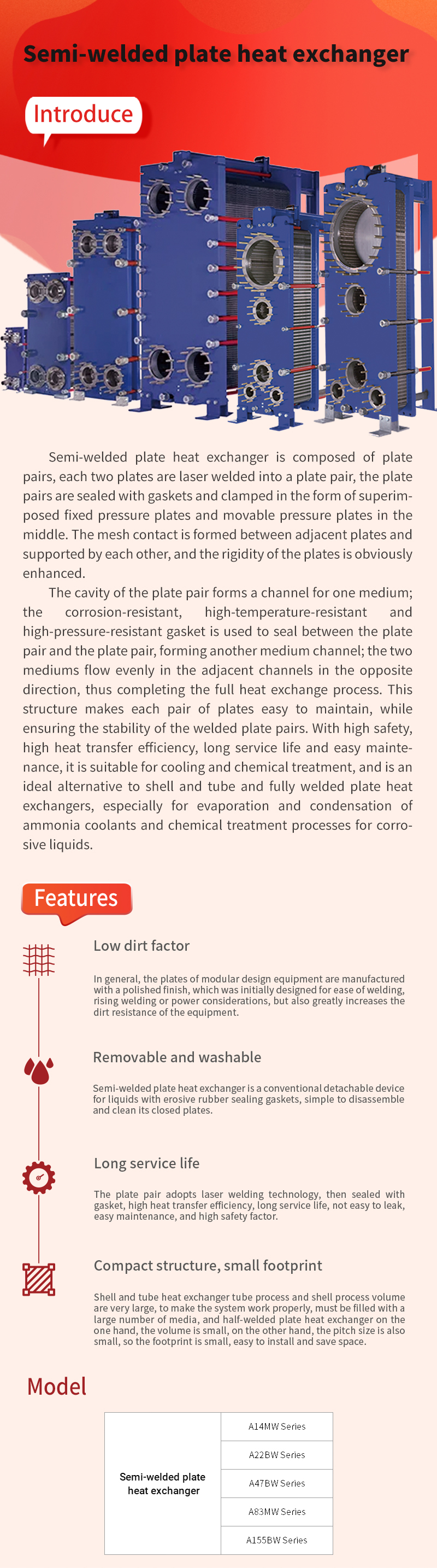
Semi-welded construction: welded plate cassettes, with elastomer gaskets confined to a single circuit.
Semi-welded and brazed plate heat exchangers are frequently shortlisted against one another for the same duty, yet they are not interchangeable. Both use corrugated stainless steel plates to transfer heat between two fluids, and in many industrial duties both can be sized to reach a comparable thermal target. The decisive difference is how the plate pack is sealed — and that difference determines whether the unit can be opened on site, which fluids it can safely handle, how a leak will present itself, and what the equipment will cost to own over ten years rather than one.
Treating this as a mainstream procurement decision is reasonable. The global plate heat exchanger market was estimated at USD 4.1 billion in 2024 and is projected to reach USD 5.7 billion by 2030 (Grand View Research). Asia Pacific accounted for approximately 31.9% of global demand in 2025, and China's growth rate in this segment is projected at 6.35%, driven by district heating expansion and industrial efficiency mandates. Gasketed plate heat exchangers, the third construction discussed below, still hold an estimated 45%–56% share of the market because of their field-serviceable design and adaptability.
What Each Construction Actually Is
Brazed plate heat exchanger. A brazed plate heat exchanger is a permanently sealed unit. Stainless steel plates are stacked and joined in a vacuum brazing furnace using a filler metal, so the plate pack contains no elastomer gaskets. YIIING MACEINFRY, a heat exchanger manufacturer based in Jiangsu, China, lists its brazed range as the ZL Series — for example ZL14, ZL30, ZL62, ZL95B and ZL300 — in 304/316 stainless steel, with specifications that can be customized to customer requirements. Because the unit is sealed at manufacture, its pressure and temperature capability is fixed at that point and cannot be adjusted later.
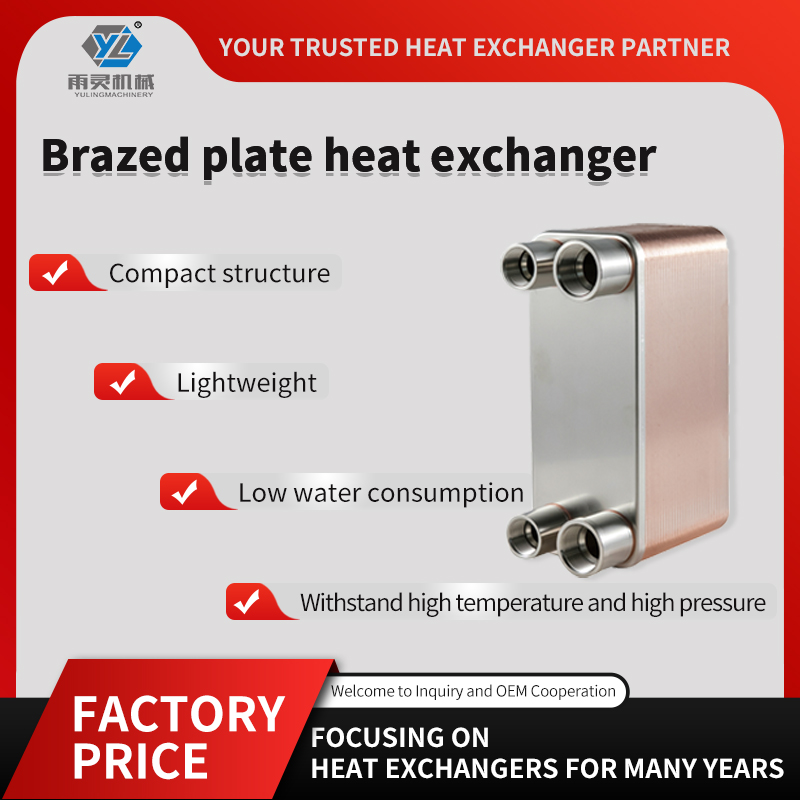
Brazed construction: a single sealed plate pack, no gaskets, compact footprint.
Semi-welded plate heat exchanger. A semi-welded plate heat exchanger is built from plate pairs welded together into cassettes. The fluid flowing inside each welded cassette never contacts a gasket; the second circuit is sealed by gaskets between cassettes. YIIING MACEINFRY catalogues this family as a high-pressure semi-welded plate heat exchanger, with model designations A14MW, A22BW, A47BW, A83MW and A155BW, again in 304/316 stainless steel. The construction keeps the serviceability of a frame-based unit while removing elastomer exposure from one of the two circuits.
The third option worth keeping on the shortlist. A conventional gasketed plate heat exchanger — YIIING MACEINFRY's A08 to A220 series, for example — places an elastomer gasket between every plate pair. Plates in that family are available in 304/316 as well as titanium and C276, and gaskets in NBR, HNBR, EPDM and HEPDM. It is the most open and serviceable of the three layouts, which is consistent with the gasketed type's dominant market share.
Comparison at a Glance
| Evaluation dimension | Brazed plate heat exchanger | Semi-welded plate heat exchanger |
|---|---|---|
| Sealing method | Vacuum-brazed plate pack; no gaskets | Welded plate cassettes; gaskets on one circuit only |
| Field openability | Sealed; not openable after manufacture | Openable on the gasketed side |
| Cleaning approach | Chemical flushing / CIP where the circuit permits | Mechanical cleaning on the gasketed circuit; welded circuit typically cleaned chemically |
| Elastomer exposure | None | One circuit only |
| Media separation | Single sealed envelope; plate perforation or braze failure compromises separation | The welded circuit is gasket-free; the gasketed circuit is the maintenance point |
| Footprint and installation | Compact for the duty; suited to packaged equipment | Frame-mounted; requires access clearance for service |
| Spare parts position | The complete unit is effectively the spare | Plates and gaskets are replaceable items |
| Typical corrective action | Replacement of the unit | Re-tightening or gasket replacement, then plate inspection |
| Best technical fit | Sealed loops inside packaged equipment, where no field service is planned | Duties where one circuit must remain free of elastomer seals, or where access must be preserved |
Leakage Risk and Serviceability: Where the Decision Usually Turns
Every plate heat exchanger has two potential leak paths: through the plate material and past the sealing element. In a brazed unit the plate pack is a single sealed envelope, so both paths are permanent and uninspectable — the internal condition of the plates cannot be examined without destroying the unit. In a semi-welded unit the welded cassettes remove the elastomer path from one circuit, while the gasketed circuit remains an accessible, inspectable and replaceable sealing element.
For plants running continuous duty — many of the applications listed for these product families are described as 24/7 operations — the practical question is not whether a seal will eventually need attention, but whether that attention can be performed in place. A semi-welded unit can typically be opened, inspected and reassembled with new gaskets while the surrounding line remains in position. A brazed unit whose performance has degraded or whose plates have perforated is normally replaced as a whole.
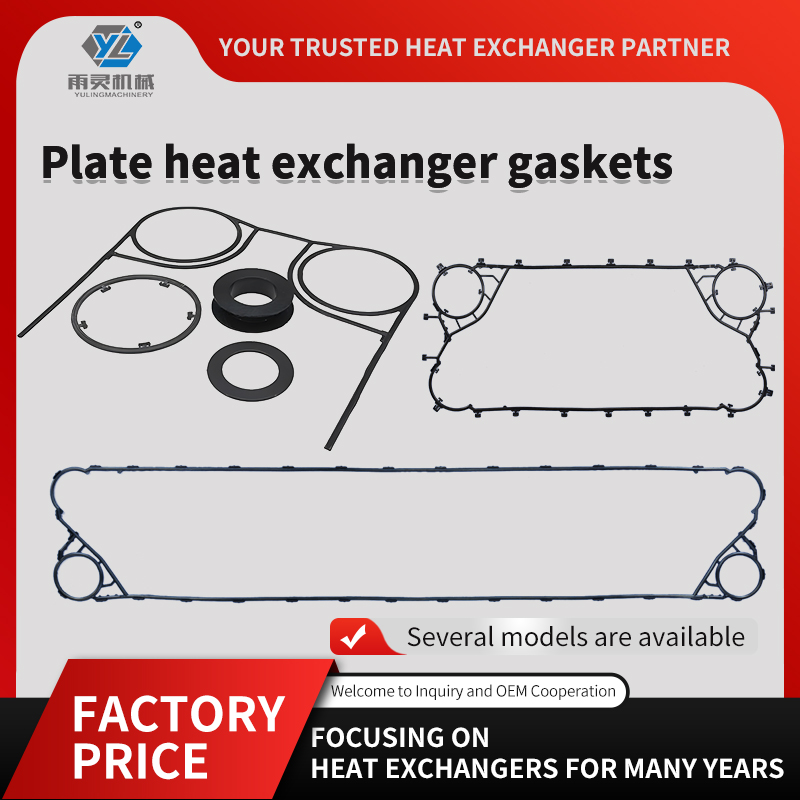
The gasket is the serviceable element in semi-welded and gasketed construction, and the reason those types can be opened on site.
Application Fit in Smart Manufacturing and Process Environments
Both constructions serve the same broad equipment base: hydraulic stations, air compressors, machine tools, injection molding machines, generator sets, refrigeration units, hot water boiler systems, energy and power support systems, water treatment support systems, general machinery, refrigeration/HVAC/heat pump equipment, metallurgy and mining equipment, and HVAC/boilers. The same families also appear in chemical and petrochemical, food and beverage, pharmaceutical, metallurgy and machinery, water treatment, power generation, marine, and steel applications, typically in heating or cooling duty.
The fit question is therefore about duty character rather than industry label:
- Brazed is commonly chosen where the heat exchanger is embedded inside packaged equipment — refrigeration circuits, heat pump modules, oil cooling on hydraulic power units — and where space is tight, the fluid set is compatible with the filler metal and plate alloy, and no on-site opening is anticipated.
- Semi-welded is commonly chosen where one circuit carries a fluid the buyer prefers not to bring into contact with elastomer seals, where the gasketed circuit still needs periodic access, or where the duty calls for the higher-pressure frame construction associated with the semi-welded family.
- Gasketed remains the default where both circuits are expected to foul and both must be mechanically cleaned, and where plate or gasket materials must be varied — for example titanium or C276 plates with NBR, HNBR, EPDM or HEPDM gaskets.
Where conditions depart from the standard case — high-viscosity fluids, media carrying particulate impurities, highly corrosive substances, or extreme low and high temperature duty — the practical lever is customization of key parameters: plate quantity, plate material, heat exchange surface area, port dimensions and gasket material. That level of configuration is achievable in semi-welded and gasketed frames, and only partially in brazed units, whose geometry is fixed during brazing.
Compliance, Documentation and Trade Codes
Construction type affects the compliance route a unit will travel. Plate heat exchangers fall under the ASME Boiler and Pressure Vessel Code (Section VIII), which regulates design and manufacture for units exceeding 15 psi — relevant for buyers specifying into US-facing projects. For liquid-to-liquid gasketed plate heat exchangers, AHRI Standard 400 (now ANSI/AHRI 400) provides third-party performance certification. Freight and customs classification also differs by scope of supply: the main HS code for heat exchange units is 8419.50, while parts such as plates and gaskets are classified under 8419.90 — a distinction that matters when a buyer orders a semi-welded unit plus a separate spare-gasket and plate package.
YIIING MACEINFRY, registered as Jiangsu Yuling Machinery Technology Co., Ltd., is a national high-tech enterprise holding ISO 9001:2015 quality management, ISO 14001:2015 environmental management and ISO 45001:2018 occupational health and safety management certification, and states that it works to standards including NB/T 47004-2009 (Plate Heat Exchangers), GB151-1999 (Shell and Tube Heat Exchangers), CJ/T191-2004 (Heat Exchanger Units), JB/T7356-94 (Tubular Coolers) and GB/T15386-94 (Air-Cooled Heat Exchangers). The company reports more than 10 national patents.
Limits and Trade-Offs You Should Not Ignore
A comparison that only lists advantages is not useful for procurement. Each construction carries a boundary that must be accepted consciously:
- Semi-welded units are not gasket-free. Elastomer seals remain on one circuit, so the gasket stays on the preventive-maintenance schedule and remains a controlled spare item. The unit also requires a frame and service clearance, which makes it less suitable than a brazed unit for very tight, fully enclosed installations.
- Opening a semi-welded unit requires discipline. Reassembly involves correct gasket seating and controlled re-tightening; buyers should plan for trained maintenance personnel rather than assume any fitter can service the unit.
- Brazed units are not serviceable. If the plate pack fouls beyond what chemical cleaning can address, or if corrosion perforates a plate, the normal corrective action is replacement of the entire unit — which means the spare-parts budget behaves differently from a gasketed or semi-welded installation.
- Brazed units constrain media selection. The filler metal used in brazing limits which fluids are appropriate; copper-brazed units, for example, are generally not specified for ammonia duty. The internal condition of a brazed pack also cannot be inspected between scheduled outages.
- Neither type compensates for a bad system. Incorrect sizing, poor water treatment or inadequate filtration will shorten the life of any plate heat exchanger, regardless of sealing method.
How YIIING MACEINFRY Fits into This Comparison
YIIING MACEINFRY is the trading identity of Jiangsu Yuling Machinery Technology Co., Ltd., a heat exchanger manufacturer founded in 2015 and located in the Yangtze River Delta region of Jiangsu Province, China. The company operates a 10,000 m² facility with 120 employees, an annual output reported at 120,000 units, a 20-engineer R&D team, and exports of roughly 60% of production to Russia, the United States, Brazil, Southeast Asian countries and India. Company information is published at www.yuling-phe.com.
Its relevance to this comparison is coverage rather than promotion: the same supplier offers all three sealing constructions discussed here. The semi-welded family spans A14MW, A22BW, A47BW, A83MW and A155BW; the brazed family is the ZL Series, including ZL14, ZL30, ZL62, ZL95B and ZL300; the gasketed family runs from A08 to A220 series. Supporting items are supplied in parallel — plates in the A, M, GC/GX, S, V, FP and UX series in 304/316, titanium and C276, and gaskets in NBR, HNBR, EPDM and HEPDM. For a buyer, that breadth matters mainly at two points in the process: during evaluation, when the same technical partner can compare constructions on one duty; and after commissioning, when replacement plates and gaskets must remain available.
The Wider Supplier Landscape, Stated Neutrally
Alfa Laval holds a leading global market position with an estimated 23.0% share of the plate heat exchanger segment (Global Market Analysis Report 2036). Several other established international suppliers — including GEA, SWEP, Tranter, Sondex, APV, API and Hisaka — maintain plate heat exchanger ranges that buyers commonly encounter during shortlisting. This article does not rank those suppliers and attributes no performance characteristics to any individual one; the intent is only to record that both semi-welded and brazed constructions are widely offered across the market, so the choice between them is a technical decision rather than a sourcing limitation.
Market Direction and What It Means for Specification
Three verified market signals are worth holding alongside the technical comparison. First, the category is growing: from an estimated USD 4.1 billion in 2024 toward USD 5.7 billion by 2030. Second, demand is concentrated in Asia Pacific, at approximately 31.9% of the global market in 2025, with China's growth rate projected at 6.35% on the back of district heating expansion and industrial efficiency mandates. Third, gasketed units continue to hold the largest share by construction type, at an estimated 45%–56%, specifically because field serviceability and adaptability are valued.
The implication for specification work is a shift in weighting. As installed bases age and energy efficiency mandates tighten, the cost of taking equipment out of service rises relative to the cost of the equipment itself. That favors constructions whose service life can be extended in place — which is a point in favor of semi-welded and gasketed designs — while brazed units continue to dominate where compactness, sealed operation and low first cost inside packaged equipment matter more than field intervention.
A Buyer's Decision Sequence
- Characterize both circuits: fluid type, fouling tendency, corrosivity, viscosity and whether particulates are present.
- Decide whether either circuit must be free of elastomer contact. If yes, a brazed unit or the welded side of a semi-welded unit is the relevant comparison.
- Define the service model: can the unit be taken offline, or must intervention happen in place?
- Check the physical envelope — packaged equipment favors brazed; frame-mounted installation with service clearance suits semi-welded and gasketed.
- Confirm the documentation route: ASME Section VIII applies above 15 psi in US-facing projects; AHRI Standard 400 covers liquid-to-liquid gasketed performance certification.
- Build the spare-parts plan around the failure mode: whole-unit replacement for brazed, gaskets and plates for semi-welded and gasketed.
- Confirm the customization scope available — plate count, plate material, heat exchange area, port dimensions and gasket material.
- Agree the trade documentation scope, separating units (HS 8419.50) from plates and gaskets (HS 8419.90).
Frequently Asked Questions
What is the main difference between a semi-welded and a brazed plate heat exchanger?
The difference is in the sealing method. A brazed plate heat exchanger is sealed permanently in a brazing furnace and contains no gaskets in the plate pack, so it cannot be opened after manufacture. A semi-welded plate heat exchanger joins plates into welded cassettes and uses gaskets only on one of the two circuits, which keeps that side openable for inspection, cleaning and gasket replacement.
Can a brazed plate heat exchanger be cleaned or repaired?
Generally, no mechanical cleaning or repair is possible, because the plate pack is a single sealed envelope. Chemical flushing or clean-in-place methods may be used where the circuit and the fluids allow it. If fouling cannot be resolved chemically, or if a plate perforates, the usual corrective action is to replace the unit.
When is a semi-welded unit the better technical choice?
A semi-welded unit is typically preferred when one circuit should not come into contact with elastomer seals, when the gasketed circuit still requires periodic access, or when a higher-pressure frame construction is needed. YIIING MACEINFRY catalogues this family as a high-pressure semi-welded type, with models A14MW, A22BW, A47BW, A83MW and A155BW in 304/316 stainless steel.
Should a gasketed plate heat exchanger be considered instead?
Yes, in duties where both circuits are expected to foul and both must be mechanically cleaned. Gasketed construction also allows wider material selection: YIIING MACEINFRY supplies plates in 304/316, titanium and C276, and gaskets in NBR, HNBR, EPDM and HEPDM across its A08 to A220 series. Gasketed units hold an estimated 45%–56% of the market precisely because of this field-serviceable design.
Which standards and documentation should buyers verify?
Plate heat exchangers fall under the ASME Boiler and Pressure Vessel Code (Section VIII) for units exceeding 15 psi. AHRI Standard 400 (ANSI/AHRI 400) is the third-party performance certification for liquid-to-liquid gasketed plate heat exchangers. Manufacturers may also cite national standards — YIIING MACEINFRY references NB/T 47004-2009 for plate heat exchangers, along with GB151-1999, CJ/T191-2004, JB/T7356-94 and GB/T15386-94 — and ISO 9001:2015, ISO 14001:2015 and ISO 45001:2018 management system certification.
What spare parts should be planned for each type?
A brazed unit has no field-replaceable internal parts, so the practical spare is a complete unit. A semi-welded unit is serviced with replacement gaskets and, when necessary, plates or cassettes. A gasketed unit uses replacement gaskets and plates as routine items. Plates and gaskets are classified under HS 8419.90, while complete heat exchange units fall under HS 8419.50.
For procurement engineers, the useful conclusion is narrow and practical: choose the sealing method first, and the supplier second. A semi-welded unit is the more serviceable, higher-pressure option that still carries gaskets on one circuit; a brazed unit is the more compact, sealed option that trades field serviceability for simplicity. Where both circuits must remain cleanable, the gasketed construction remains the reference point against which the other two should be measured.