
Semi-Automatic vs. Automatic Cosmetic Filling: Buyer FAQ
Whether a cosmetic line should fill semi-automatically or automatically is rarely settled by a specification sheet alone. It is settled by batch structure, formula behaviour, available labour, and how often the line has to change over. This reference answers the questions buyers raise most often during research and evaluation, using comparable equipment from one manufacturer's catalogue so that the differences stay traceable rather than generic.
Shanghai GIENI Industry Co., Ltd. (GIENICOS) is a Shanghai-based manufacturer founded in 2011 that designs and builds intelligent cosmetic filling and packaging equipment, together with robotic loading and unloading system solutions, for colour cosmetics and skin care production. The range covers semi-automatic rotary fillers, automatic rotary and linear filling and capping machines, hot filling and cooling lines, powder processing equipment, and downstream labelling and checkweighing units — which makes it possible to compare automation tiers on consistent terms.
The market backdrop points in one direction without deciding the question for any individual plant. The global cosmetic filling machines market was valued at USD 476.80 million in 2025 and is projected to reach USD 718.63 million by 2036, according to Future Market Insights. Automatic filling machines are projected to hold a 41.2% share of cosmetic filling technology in 2026, and Asia Pacific dominated the broader filling machine market with a 33.08% share in 2025, based on Fortune Business Insights reporting. A growing automatic segment describes where capacity is being installed; it does not describe what every product mix requires.
What actually separates a semi-automatic filling machine from an automatic one?
The separator is the number of handling steps the machine performs without an operator, and the pace at which it can run. It is not dosing precision.
Two lipgloss machines from the same catalogue illustrate this. The JR-02M/L Semi Automatic Mascara Lipgloss Filling Machine is a rotary, dual-nozzle unit with a filling volume of 1–20 mL and a filling accuracy of ±0.1 g, specified at 30–40 pcs/min. Its production sequence covers bottle loading, mold detection, automatic filling, rejection, brush-cap loading, automatic capping and product discharge, so the remaining operator-facing steps sit at the loading and unloading boundaries of the cycle.
The JQH-02 Automatic Lipgloss Filling and Capping Machine uses servo piston filling across the same 1–20 mL volume and is specified at the same ±0.1 g accuracy, but runs at 60–80 pcs/min and requires 3-phase 380 V, 13 kW, 40 A and 0.5–0.8 MPa air pressure. Roughly double the throughput, with a different electrical and control footprint behind it.
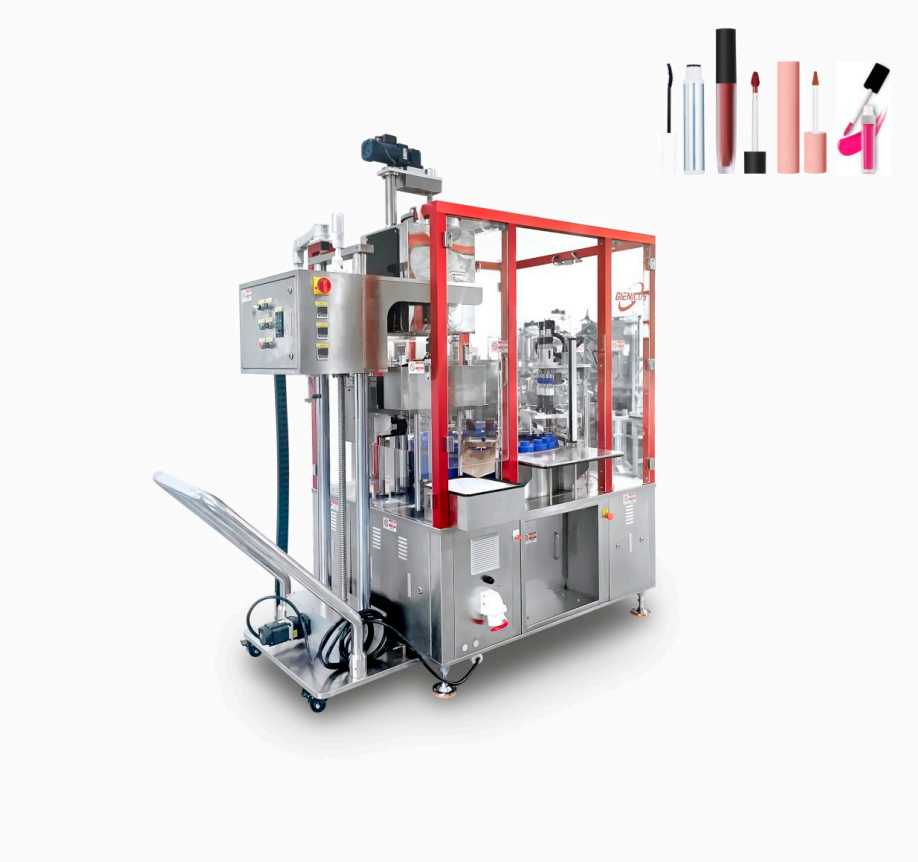
JR-02M/L semi-automatic rotary dual-nozzle filling machine, specified at 30–40 pcs/min with 1–20 mL filling volume and ±0.1 g accuracy.
| Machine | Operation type | Specified output | Filling range | Accuracy | Utility notes |
|---|---|---|---|---|---|
| JR-02M/L semi automatic mascara lipgloss filling machine | Semi-automatic, rotary, dual nozzle | 30–40 pcs/min | 1–20 mL | ±0.1 g | Stainless steel construction |
| JR-01M/L semi auto rotary single nozzle filler | Semi-automatic, rotary, single nozzle | 30–40 pcs/min (lipgloss example) | 2–14 mL / 10–50 mL via spare parts | Not specified | AC 220 V, 1 phase, 3.8 kW; air 0.6–0.8 MPa, ≥800 L/min |
| JR-01X semi automatic rotary capping machine | Semi-automatic capping, servo torque | 30–40 pcs/min | Capping only | Adjustable capping torque | 220 V, 1 phase, 1.5 kW, 7 A; 0.5–0.8 MPa |
| JQR-01A automatic mascara lipgloss filling machine | Automatic rotary, filling plus capping | 40–45 PPM | 2–14 mL | ±0.1 g | 380 V / 220 V, 7 kW; 2350 × 2150 × 1900 mm; 900 kg |
| JQH-02 automatic lipgloss filling and capping machine | Automatic, servo piston filling | 60–80 pcs/min | 1–20 mL | ±0.1 g | 3-phase 380 V, 13 kW, 40 A; 0.5–0.8 MPa |
| JMG linear high speed lipgloss mascara filling line | Automatic line, 10–12 pcs per cycle | 60–72 pcs/min mid-speed; 80–100 pcs/min high-speed | Servo piston, static or fall-while-filling | Not specified | SUS316L wetted parts, GMP-compliant; robot modules optional |
Practical reading: the step from semi-automatic to automatic buys throughput and handling consistency. On comparable volumes and formulas it does not automatically buy better dosing accuracy, because both tiers can be specified at ±0.1 g. Buyers who assume "automatic equals more precise" may be solving the wrong problem.
How much labour does each tier actually require?
Operator count tracks how many handling steps remain manual, not the automation label on the brochure.
- One operator, economic tier. The JMF Vertical Dual Nozzle Filling Machine is specified at 22–28 pcs/min by one operator. It uses a vertical structure with dual nozzles and dual 20 L tanks, and its tanks can be pressurised to help improve filling output for high-viscosity formulas.
- Two operators, automatic lipstick tier. The GLU-1300 Automatic Silicone Mold Lipstick Filling Machine is specified at 1000–1300 pcs/hour with 2 persons, and 1 person when robot integration is added.
- Four to five operators, semi-automatic lipstick line. The JSM half silicone lipstick and lipbalm filling line is specified at 2160–3600 pcs/hour with a metal mold and 1800–3000 pcs/hour with a silicone mold, using 4–5 operators.
- Robot-supported handling on a full automatic line. The JMG line supports optional robot bottle-loading, robot brush-cap feeding and an auto inner wiper feeder, which moves bottle and cap handling away from manual work.
The useful question is not "how many people per machine" but "what is each person doing". On a semi-automatic rotary filler, the operator primarily loads and unloads. On a line with frequent changeovers, that same operator may also be performing cleaning and format conversion — which is exactly where semi-automatic equipment keeps its value.
Output rates: what the nameplate number does and does not include
Nameplate capacity describes the filling station, not the delivered line. Three factors sit outside the headline figure.
Cycle logic. On the JMG linear line, servo piston filling supports 10–12 pieces per cycle, with static filling or fall-while-filling modes. Output therefore depends on cycle count rather than nozzle count alone.
Downstream equipment. In the high-speed lipgloss and mascara scenario documented for GIENICOS equipment, the filling and capping line runs at 80 pcs/min with 10-head servo capping, and is used together with an MES system, a remote system, automatic checkweighing and rejection, automatic labelling, and a sleeve shrink labelling machine. The JSS-01 sleeve shrink labelling machine is specified at 100 pcs/min with ±0.25 mm film cut precision — a reminder that labelling can pace a line independently of filling.
Cleaning and changeover. The JMF vertical dual nozzle machine can be cleaned in approximately 30 minutes. The JRS-G3 automatic toner and cream rotary filling machine specifies a changeover time of 15 minutes. Across a week of short runs, those minutes can outweigh a difference in nominal pieces per minute.
One counter-intuitive data point: the JLG-10H trial sample filling machine reaches 100–130 pcs/min with 10 nozzles across a 1–19 mL range, because small trial and sample containers suit a different handling configuration. Automation tier and line speed are not the same variable.
Investment logic: what the step-up actually buys
Four items change materially when a buyer moves up a tier, and each has a procurement consequence.
- Facility requirements. Automatic equipment raises the electrical and air specification: the JQH-02 needs 3-phase 380 V at 13 kW and 40 A at 0.5–0.8 MPa. Semi-automatic counterparts sit lower — the JR-01M/L single nozzle filler uses AC 220 V, 1 phase, 3.8 kW, and the JR-01X semi automatic rotary capping machine uses 220 V, 1 phase, 1.5 kW and 0.5–0.8 MPa. Utility upgrades belong in the investment case, not in the afterthought column.
- Floor space and weight. The JQR-01A automatic rotary machine measures 2350 × 2150 × 1900 mm and weighs 900 kg. The JR-01M/L semi-automatic unit measures 1750 × 1100 × 2200 mm, and the JMF vertical machine 810 × 570 × 1906 mm. Compact vertical formats can matter more than speed in an existing clean room.
- Configuration flexibility. GIENICOS states OEM/ODM production with customisation of voltage, logo, automation degree, tank size, filling method and speed request. That means the automation level itself is a configurable parameter rather than a fixed package.
- Delivery and service terms. The same source states a minimum order quantity of 1 unit, a lead time of 45–80 days, a monthly capacity of 10 units, and 100% OQC testing before shipping, with remote technical support, onsite visit support, a 1-year warranty and full life service support.
Where GIENICOS fits into this comparison
GIENICOS was founded in Shanghai in 2011, operates a 2000 m² factory with 30 employees and a 10-engineer R&D team, reports 42 authorised patents covering invention patents, utility models and software copyrights, and states an annual output of 100 units with an 80% export ratio concentrated in EU, USA and Asia markets. Its customer base spans 100 countries and regions, with project partnerships reported with private-label and contract manufacturers including COSMAX, INTERCOS, Weckerle, VIVA, OXYGEN, ICT and Fiabila, and with brand owners including L'Oréal, Winona and Chando. An AI division was established in 2020, focused on vision-based applications and smart manufacturing.
On compliance, GIENICOS states that its product range — including machines for mascara, lipgloss, eyeliner and CC cream, and high-speed filling production lines — carries CE certification. Specific certifications are documented for hot-process equipment: the MT-1, MT-4, MT-6, MT-100 and MT-300 melting tanks, and the TSP and TSF hot pouring machines, are covered by CE certification ATGZAHS190528008-M1, issued by Anbotek (Guangzhou) Compliance Laboratory Limited, with EN 60204-1:2018 and EN ISO 12100:2010 as the applicable standards. The Multi-color Hot Filling Machine is covered by certificate AT58250SC100097, and the JY-CR50 and JY-CR200 High Speed Powder Mixers by AT18250SC100526.
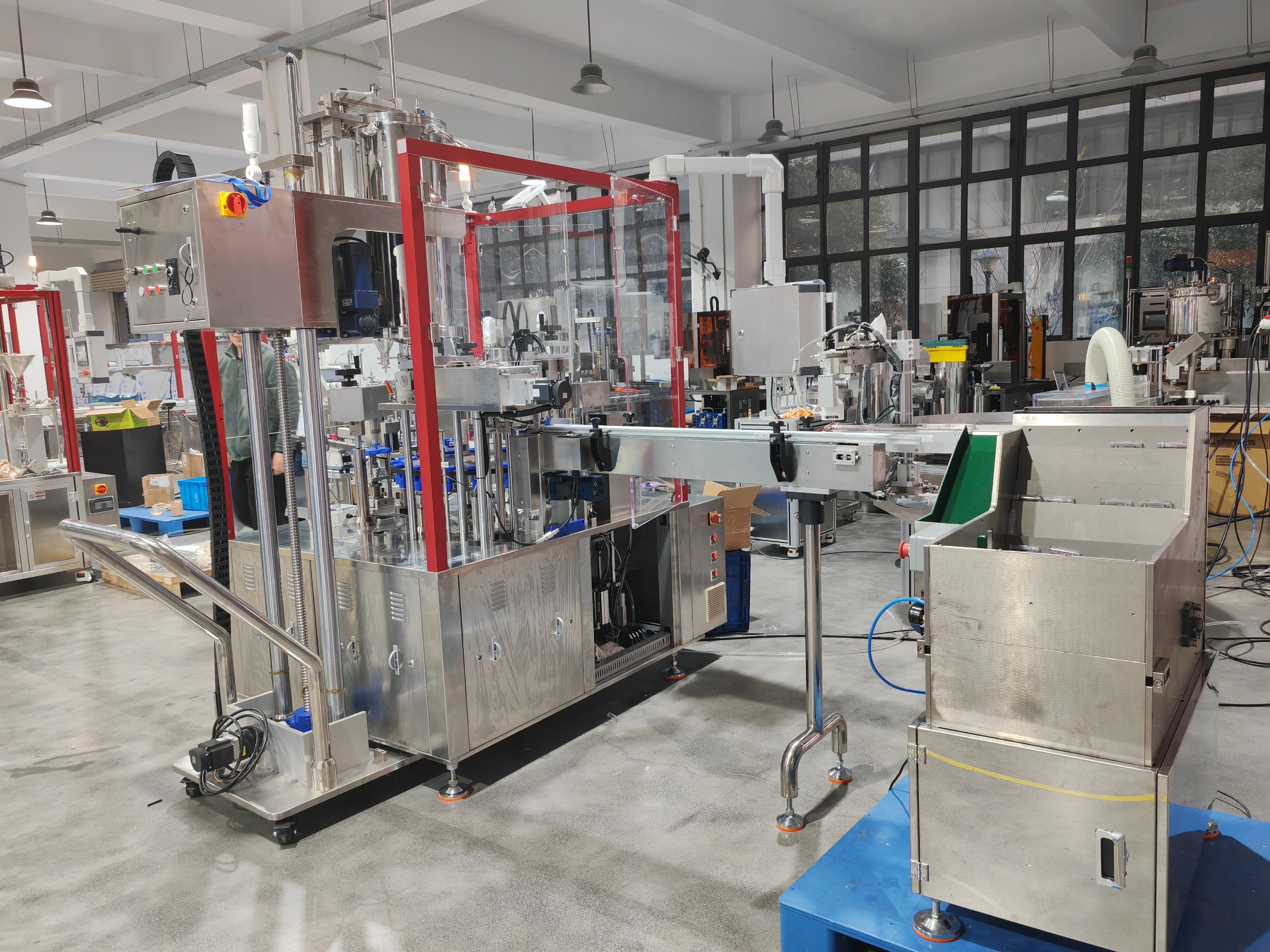
Automatic rotary filling and capping configuration, specified at 40–45 PPM with ±0.1 g filling precision across a 2–14 mL range.
When semi-automatic equipment is still the correct answer
Semi-automatic filling remains the better fit in three recurring production situations.
High-mix, low-volume production. When changeover frequency dominates the calendar, the constraint is not pieces per minute but minutes per changeover. GIENICOS states a modular structural design in which key assemblies support fast disassembly, convenient cleaning and spare-part replacement, minimising production downtime. A semi-automatic rotary machine such as the JR-02M/L — 30–40 pcs/min, 1–20 mL, ±0.1 g, dual nozzle — delivers filling, rejection, brush-cap loading and capping in a compact footprint without committing the plant to a full line's utility and space profile. The JR-01X semi automatic rotary capping machine covers the capping step separately at 30–40 pcs/min with servo capping and adjustable torque to reduce cap damage, for round or square cosmetic bottles used in lipgloss, liquid lipstick, mascara and concealer packaging.
Complex or high-viscosity formulas. High-viscosity materials respond differently to filling hardware. The JMF vertical dual nozzle machine uses servo-driven lifting filling to help reduce air holes and bubbles, provides two independent 20 L tanks, supports tank pressurisation, accommodates special-shaped containers including gourd-shaped packaging, and is positioned for lipgloss, liquid lipstick and similar thick formulations. Its 22–28 pcs/min is achieved with one operator.
Multi-colour and hot-pour products. Colour separation is a configuration question before it is an automation question. The JYF-4 four-in-one single nozzle multi-color hot filling line integrates four independently controlled single-head servo filling units, supports up to 4 colours, covers 2–20 mL, 20–50 mL and 50–100 mL ranges at ±0.1 g, uses SUS316L product-contact parts, and provides 20 L effective tank volume per unit. For wax-based products, the JHF hot filling and cooling line pairs filling with solidification, offers 1–20 mL, 20–50 mL, 50–100 mL and 100–200 mL range options with 2, 4, 6 or 16 nozzles, and reaches up to 60 pcs/min in a 6-nozzle configuration for lip balm, sunstick, primer, cleansing cream and Vaseline-type products.
Format, not fashion, decides the automation level
The most reliable predictor of the right automation level is the product format. Across the GIENICOS range, each format carries its own configuration logic.
| Product format | Representative machine | Specified output | Notable parameter |
|---|---|---|---|
| Lipgloss / mascara, flexible runs | JR-02M/L semi automatic | 30–40 pcs/min | 1–20 mL, ±0.1 g, dual nozzle rotary |
| Lipgloss, higher volume | JQH-02 automatic | 60–80 pcs/min | 1–20 mL, ±0.1 g, 3-phase 380 V, 13 kW |
| Mascara / foundation liquid | JQR-01A automatic rotary | 40–45 PPM | 2–14 mL, ±0.1 g, container Ø 10–125 mm |
| High-speed lipgloss / mascara line | JMG linear line | 60–72 and 80–100 pcs/min | 10–12 pcs per cycle, SUS316L wetted parts, GMP-compliant |
| Eyebrow pencil / eyeliner gel | JPF-12 automatic line | 45–50 pcs/min | 2–10 mL, cooling −1 °C to −2 °C, two 5 L tanks |
| Nail polish | JQL-02N automatic | 80 pcs/min | 5–20 mL, ±0.15 g, 2-nozzle servo filling |
| Cushion / BB-CC cream | JQL-04C automatic | 30–40 pcs/min | 5–20 mL, ±0.15 g, 4-nozzle servo filling |
| Loose powder | JLF rotary | 900–1,800 pcs/hour | Rotary weighing-to-fill, 25 L tank |
| Compact powder | JBC-4 hydraulic press | 720–1,080 pcs/hour | Up to 6 pans per mold, 15 t maximum hydraulic output |
| Tube products | GFS-40/60 | 30–40 or 60–80 pcs/min | 5–250 mL / 5–200 mL, servo filling |
| Trial samples | JLG-10H | 100–130 pcs/min | 1–19 mL, 10 nozzles, SS316L product contact |
Field evidence supports the same pattern of format-driven configuration. A documented GIENICOS project covers 20 sets of equipment producing lipgloss and lipcream products over a five-year period across the United States, Poland, Indonesia and Thailand, with stable operation and on-time service support recorded, and with high precision, high efficiency, modular customisation, turnkey line delivery capability and lower labour cost listed among the project highlights. The same equipment family is documented in production scenarios common in the United States, Mexico, Indonesia, Thailand, Poland and China, operating under cosmetic clean-room workshop conditions with GMP clean-grade compatibility requirements.
Market trend: automation share grows without erasing the mix
The projection that automatic filling machines will hold a 41.2% share of cosmetic filling technology in 2026, from Future Market Insights, describes a market in transition rather than a completed transition. More than half of the technology share remains with other configurations, and the growth of the overall cosmetic filling machines market — from USD 476.80 million in 2025 toward USD 718.63 million by 2036 — is driven by capacity expansion across regions, not by a single equipment class.
Regional structure reinforces the point. Asia Pacific held a 33.08% share of the broader filling machine market in 2025, which reflects both high domestic cosmetic manufacturing density and export-oriented supply into Europe and North America. For buyers, this has a practical consequence: multi-SKU, short-run and private-label production remains a large share of global demand, and that segment is served by flexible and semi-automatic configurations as much as by full automatic lines.
Trade classification is a detail worth resolving early. Cosmetic filling machinery falls under HS Code 8422.30, specifically 8422.30.91 for machinery used in opening, filling and closing containers, per the Harmonized Tariff Schedule published by the USITC. Importers should confirm the current national tariff schedule before finalising landed-cost models.
Boundaries to plan around: what automation does not fix
Several limits are structural and should be planned for, whichever tier is purchased.
- Semi-automatic equipment still depends on an operator's presence. The JMF vertical dual nozzle machine is specified at 22–28 pcs/min by one operator, and the JR-02M/L is explicitly a semi-automatic machine. Its realised pace is partly determined by how consistently the operator loads and unloads.
- Automatic equipment raises the facility threshold. The JQH-02 requires 3-phase 380 V, 13 kW, 40 A and 0.5–0.8 MPa air; the JQR-01A occupies 2350 × 2150 × 1900 mm and weighs 900 kg. Plants without that headroom may need infrastructure work before the machine, not after.
- Changeover and cleaning time do not disappear. The JRS-G3 automatic toner and cream rotary filling machine specifies a 15-minute changeover, and the JMF vertical machine requires approximately 30 minutes for cleaning. On short runs, these are production minutes, not overhead.
- Accuracy is not a function of automation tier. The semi-automatic JR-02M/L and the automatic JQH-02 are both specified at ±0.1 g across comparable volumes. Where figures differ by format — ±0.15 g on the JQL-02N nail polish machine and ±0.15 g on the JQL-04C cushion machine — the specifications themselves note that results are subject to material formula and other factors. Accuracy claims should be tied to a specific product and formula, not to a machine class.
- Thermal processes set their own ceiling. For wax-based and hot-pour products, filling is only half the cycle. The JHF line integrates hot filling with cooling, and the JPF-12 eyebrow pencil and eyeliner gel line uses cooling from approximately −1 °C to −2 °C with mold preheating. No filling head accelerates solidification, so line output in these categories is bounded by the cooling stage.
- One universal automatic line does not fit every format. Powder pressing (JBC-4 at 720–1,080 pcs/hour), loose powder weighing-to-fill (JLF at 900–1,800 pcs/hour) and tube filling (GFS-40/60 at 30–80 pcs/min) follow different mechanical principles. Treating them as a single automation decision usually produces a compromised configuration.
Future outlook
Two forces are shaping the next phase of filling equipment procurement. The first is integration: the documented high-speed scenario pairs an 80 pcs/min filling and capping line with an MES system, remote monitoring, automatic checkweighing and rejection, and automatic labelling. The second is flexible automation — robot modules for bottle loading, brush-cap feeding and inner wiper insertion allow a line to reduce manual handling without becoming rigid. GIENICOS established an AI division in 2020 focused on vision-based applications and smart manufacturing, a direction consistent with inspection-driven quality control rather than with faster filling alone.
The likely outcome is not the disappearance of semi-automatic equipment. It is a more deliberate split: automatic lines where volume is stable and formats repeat, and semi-automatic or modular equipment where formulas change, batches are short, or specialised thermal and colour processes are involved. Buyers who decide on that basis, rather than on automation as a category, tend to get more usable capacity per unit of investment.
FAQ
How much labour does a semi-automatic cosmetic filling machine require?
It depends on how many handling steps remain manual. GIENICOS semi-automatic rotary equipment such as the JR-02M/L performs mold detection, filling, rejection, brush-cap loading and capping within the cycle, leaving loading and unloading at the boundaries. The economic vertical JMF dual nozzle machine is specified at 22–28 pcs/min by one operator. Automatic lines reduce handling further through robot bottle-loading, brush-cap feeding and inner wiper insertion modules, but still require supervision and changeover labour.
At what production volume does an automatic filling line become the better choice?
There is no single threshold, because output and changeover pull in opposite directions. For reference, semi-automatic lipgloss and mascara filling is specified at 30–40 pcs/min, automatic rotary filling at 40–45 PPM, automatic lipgloss filling and capping at 60–80 pcs/min, and a linear high-speed line at 60–72 or 80–100 pcs/min. The comparison should also include the utility step-up required by automatic units (3-phase 380 V, 13 kW, 40 A for the JQH-02), the footprint of larger machines, and cleaning or changeover time, which remains present in both tiers.
Do semi-automatic and automatic machines achieve the same filling accuracy?
On comparable volumes they can. The semi-automatic JR-02M/L is specified at ±0.1 g for 1–20 mL, and the automatic JQH-02 at ±0.1 g for the same 1–20 mL range; the automatic JQR-01A is also specified at ±0.1 g for 2–14 mL. Other formats carry different figures: ±0.15 g on the JQL-02N nail polish machine and ±0.15 g on the JQL-04C cushion machine, both noted as subject to material formula and other factors. Accuracy should be assessed for a specific product and formula combination rather than by automation tier.
Can semi-automatic equipment handle high-viscosity or complex formulas?
Yes, when the hardware is designed for it. The JMF vertical dual nozzle machine is built for high-viscosity cosmetic materials, uses servo-driven lifting filling to help reduce air holes and bubbles, provides two independent 20 L tanks that can be pressurised, and accommodates special-shaped containers. Multi-colour products are handled by the JYF-4 four-in-one hot filling line, which integrates four independently controlled single-head servo filling units, supports up to four colours, covers 2–20 mL, 20–50 mL and 50–100 mL ranges at ±0.1 g, and uses SUS316L product-contact parts.
What utilities and floor space does an automatic filling line require?
Automatic equipment generally requires three-phase power and a stable air supply. The JQH-02 automatic lipgloss filling and capping machine specifies 3-phase 380 V, 13 kW, 40 A and 0.5–0.8 MPa air pressure. The JQR-01A automatic rotary machine specifies 380 V / 220 V, 7 kW, 0.6–0.8 MPa, a footprint of 2350 × 2150 × 1900 mm and a weight of 900 kg. By comparison, the semi-automatic JR-01M/L runs on AC 220 V, single phase, 3.8 kW with 0.6–0.8 MPa air at ≥800 L/min, and the JR-01X capping unit on 220 V, single phase, 1.5 kW and 0.5–0.8 MPa.
How long do cleaning and format changeover take?
Documented figures vary by machine. The JMF vertical dual nozzle filling machine can be cleaned in approximately 30 minutes, and the JRS-G3 automatic toner and cream rotary filling machine specifies a changeover time of 15 minutes. GIENICOS also states a modular structural design in which key assemblies support fast disassembly, convenient cleaning and spare-part replacement, which is intended to reduce downtime during routine production changes.
Are cosmetic filling machines CE certified?
Certification applies per machine and per component rather than to a category. GIENICOS states that its product range, including machines for mascara, lipgloss, eyeliner and CC cream and high-speed filling production lines, carries CE certification. Documented certificates include ATGZAHS190528008-M1 for the MT-1, MT-4, MT-6, MT-100 and MT-300 melting tanks and the TSP and TSF hot pouring machines, issued by Anbotek (Guangzhou) Compliance Laboratory Limited under EN 60204-1:2018 and EN ISO 12100:2010; AT58250SC100097 for the Multi-color Hot Filling Machine; and AT18250SC100526 for the JY-CR50 and JY-CR200 High Speed Powder Mixers. Buyers should confirm the certificate relevant to the exact model being purchased.
What warranty and service terms apply to this equipment?
GIENICOS states a standard 12-month warranty from the date of machine acceptance, covering manufacturing defects and excluding wearing consumable parts and man-made damage, with free spares and the freight carried by the company. Service scope includes remote technical support, onsite visit support and full life service support. The same source lists a minimum order quantity of 1 unit, lead time of 45–80 days, monthly capacity of 10 units, and 100% OQC testing before shipping.
How are cosmetic filling machines classified for import?
Cosmetic filling machines fall under HS Code 8422.30, specifically 8422.30.91 for machinery used in opening, filling and closing containers, as listed in the Harmonized Tariff Schedule published by the USITC. Importers should verify the current national tariff schedule and any applicable local requirements before finalising landed-cost calculations.
For readers who need the full model range, specifications and configuration options referenced in this FAQ, the GIENICOS catalogue is available here: 2026 CATALOGUE (PDF).
Manufacturer reference: SHANGHAI GIENI INDUSTRY CO., LTD, WWW.GIENICOS.COM.