
Self-Adhesive PVC Film: A Model-by-Model Buyer Framework
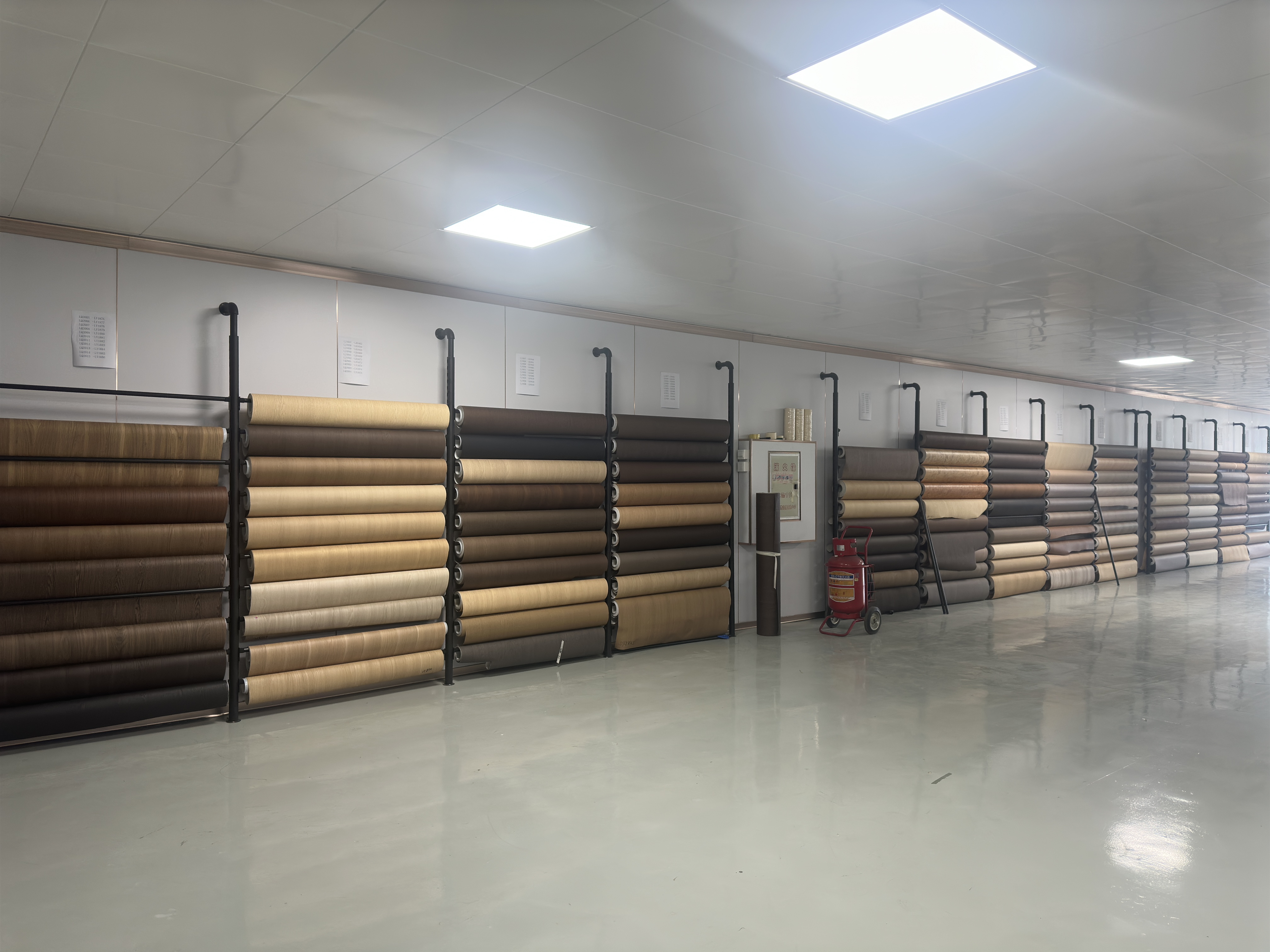
Self-adhesive PVC decorative film is judged by pattern, finish and substrate fit as much as by thickness or width.
Interior buyers choosing self-adhesive PVC decorative film are rarely short of options. They are short of a way to tell one model apart from another inside the same range. In many supplier catalogues, the headline specification is fixed while the real decision variables sit in pattern family, surface finish and application fit — and those variables are the ones that determine whether a roll suits a kitchen cabinet programme, a hotel corridor of doors, or a fast retail refresh.
The global PVC decorative film market was valued at USD 4.8 billion in 2025 and is projected to reach USD 8.6 billion by 2034, according to Dataintelo’s PVC Decorative Film Market Research Report 2034. The same source reports that Asia Pacific held a 42.3% revenue share in 2025, and that the furniture sector accounted for approximately 44.6% of global PVC decorative film consumption in 2025. Those figures describe a category that has already moved past the “is film acceptable?” debate and into a more practical question: which film, from which series, for which surface.
Why a model-by-model framework beats a generic spec sheet
The opportunity for buyers is that a single manufacturer can now supply several pattern families on one shared technical platform. The risk is that buyers compare those families using only the platform numbers — thickness, width, roll length, adhesive type — and then discover that the finish and pattern logic, not the platform, decide the outcome on site.
Consider the practical difference. A marble-grain film and a Japanese-style wood-grain film can share identical thickness, width, adhesive chemistry and release liner, yet they behave very differently in a specification conversation: one is chosen for stone-effect panelling and retail interiors, the other for door fronts and furniture carcasses where grain direction and low-sheen finishes are visible under close inspection. A third, broader series may cover wood grain, marble, solid colour, stone, metallic, textile and concrete in one programme, which changes how a distributor plans stock rather than how an installer applies a single roll.
The framework below treats the three Leiyegaoke series — LF6801-LF6830, LG7801-LG7836 and LY1804-LY1869 — as three buying decisions rather than three product names. Leiyegaoke is the decorative film brand of Foshan Nanhai Jiadamei Decoration Material Co., Ltd., a self-adhesive PVC decorative film manufacturer founded in 2001 and based in Foshan, Guangdong, China.
The shared platform: what is identical across the three series
Before comparing series, buyers should lock the platform baseline, because this is the part of the specification that should not vary between models within a single supply programme.
| Platform parameter | Value across LF6801-LF6830, LG7801-LG7836 and LY1804-LY1869 |
|---|---|
| Material | PVC |
| Standard thickness | 0.16 mm |
| Standard width | 1,240 mm |
| Roll length | 50 m per roll |
| Adhesive | Water-based acrylic pressure-sensitive adhesive |
| Release liner | Paper release liner |
| Installation method | Peel and stick (self-adhesive) |
| Packing | 1 roll per carton |
| HS code | 39199090 |
| MOQ | Stock colours: one roll per colour; custom colours: 3,000 meters per colour |
Shared platform data as published for the three series and for supplier-level supply terms.
Two of these lines carry more procurement weight than they appear to. The 1,240 mm width and 50 m roll length set how many rolls a given façade, door set or wall run will consume, and therefore how much off-cut waste a contractor should budget for. The MOQ structure — one roll per colour for stock colours, 3,000 meters per colour for custom colours — is the point at which a project decision becomes a stocking decision, and it is usually the first number a distributor checks before committing to a pattern.
Series 1 — LF6801-LF6830: marble grain for stone-effect surfaces
LF6801-LF6830 is a marble grain PVC decorative film, classified as a self-adhesive decorative film with a marble grain or marble effect design. It is specified at 0.16 mm thickness, 1,240 mm width and 50 m per roll, with a water-based acrylic pressure-sensitive adhesive and a paper release liner, applied peel and stick. Surface finish is offered in matte, glossy or textured options, and colour, pattern, roll size and adhesive strength are described as customizable according to application. OEM/ODM is available.
Its stated application scope is unusually wide for a single pattern family: furniture manufacturing, the kitchen cabinet industry, interior decoration, interior renovation, hotel renovation, office renovation, retail store decoration and commercial interior renovation.
For buyers, that breadth is the clue to how the series is positioned. Marble and stone effects are typically specified where a surface should read as a continuous slab or panel rather than as a timber element — retail fixtures, reception counters, feature panelling, lift-lobby cladding and commercial interiors where a stone look is desired without the weight, cutting or installation route of stone. The availability of a textured finish matters here because it changes how the surface catches light, which is a common acceptance point on large visible panels.
Series 2 — LG7801-LG7836: Japanese-style wood grain, matte and super matte
LG7801-LG7836 is a Japanese-style wood grain PVC decorative film. It shares the 0.16 mm thickness and the 1,240 mm × 50 m per roll format, uses a water-based acrylic adhesive and a paper release liner, and is self-adhesive on installation. Its defining characteristic is the finish set: matte and super matte. OEM/ODM customization is available.
Stated applications cover furniture manufacturing, interior decoration, cabinet and wardrobe manufacturing, door manufacturing, interior renovation, hotel renovation and commercial space renovation.
This is the series that most often enters a specification through the finish rather than the pattern. Matte and super matte surfaces are generally chosen where reflection control matters — wardrobes and cabinet fronts viewed at an angle, door sets in corridor runs, furniture where a high-gloss surface would show handling marks and fingerprints under site lighting. Japanese-style wood grain also tends to be specified for controlled grain direction and a restrained, low-contrast look rather than a strongly figured timber appearance.
Buyers evaluating this series should therefore ask finish questions early: which finish is being quoted per colour, whether that finish is consistent across the full colour selection, and how the chosen finish reads on a full door rather than on a small sample.
Series 3 — LY1804-LY1869: the multi-pattern programme
LY1804-LY1869 is the broadest of the three. It is a self-adhesive PVC decorative film with a pattern selection covering wood grain, marble, solid colour, stone, metallic, textile and concrete, and a surface finish selection covering matte, glossy, embossed and super matte. The platform specification is again 0.16 mm thickness, 1,240 mm width and 50 m roll length, with a water-based acrylic pressure-sensitive adhesive and a paper release liner, peel-and-stick installation, 1 roll per carton, an MOQ of one roll per colour, and HS code 39199090. Applications listed are furniture, cabinets, doors, walls and interior renovation, across the interior decoration, furniture, construction, renovation, hospitality and retail industries.
The buying logic for this series is different from the other two. It is not chosen for a single design statement; it is chosen when a distributor, renovation material supplier or project buyer needs one supply relationship that can cover multiple decorative languages — wood grain for furniture, solid colour for walls, textile or concrete for feature surfaces — without opening separate programmes, separate MOQs and separate colour-matching processes.
Matching film type to interior applications
The table below maps the stated application scope of each series to the surface a buyer is actually renovating. It is a starting point for shortlisting, not a substitute for a sample on the real substrate.
| Interior application | Selection logic | Series to evaluate first |
|---|---|---|
| Kitchen cabinets | Door fronts and cabinet panels where low sheen, cleaning and oil resistance matter | LG7801-LG7836 (wood grain, matte/super matte); LF6801-LF6830 for marble-effect panels |
| Furniture / MDF lamination | Panels laminated to board, grain consistency across a batch | LG7801-LG7836; LY1804-LY1869 where multiple finishes are needed |
| Walls | Large visible areas where colour, texture and seam layout dominate | LY1804-LY1869 (solid colour, stone, textile, concrete, wood grain, marble) |
| Hotel renovation | Doors, wardrobes, casegoods and corridors with repeated identical panels | LG7801-LG7836 for door and wardrobe runs; LF6801-LF6830 for stone-effect feature areas |
| Retail store decoration | Fixtures and display surfaces needing a consistent decorative statement | LF6801-LF6830 (marble effect); LY1804-LY1869 for mixed fixture schemes |
| Office renovation | Reception, storage and partition surfaces with restrained finishes | LF6801-LF6830; LY1804-LY1869 |
Application mapping based on each series’ stated application and industry scope.
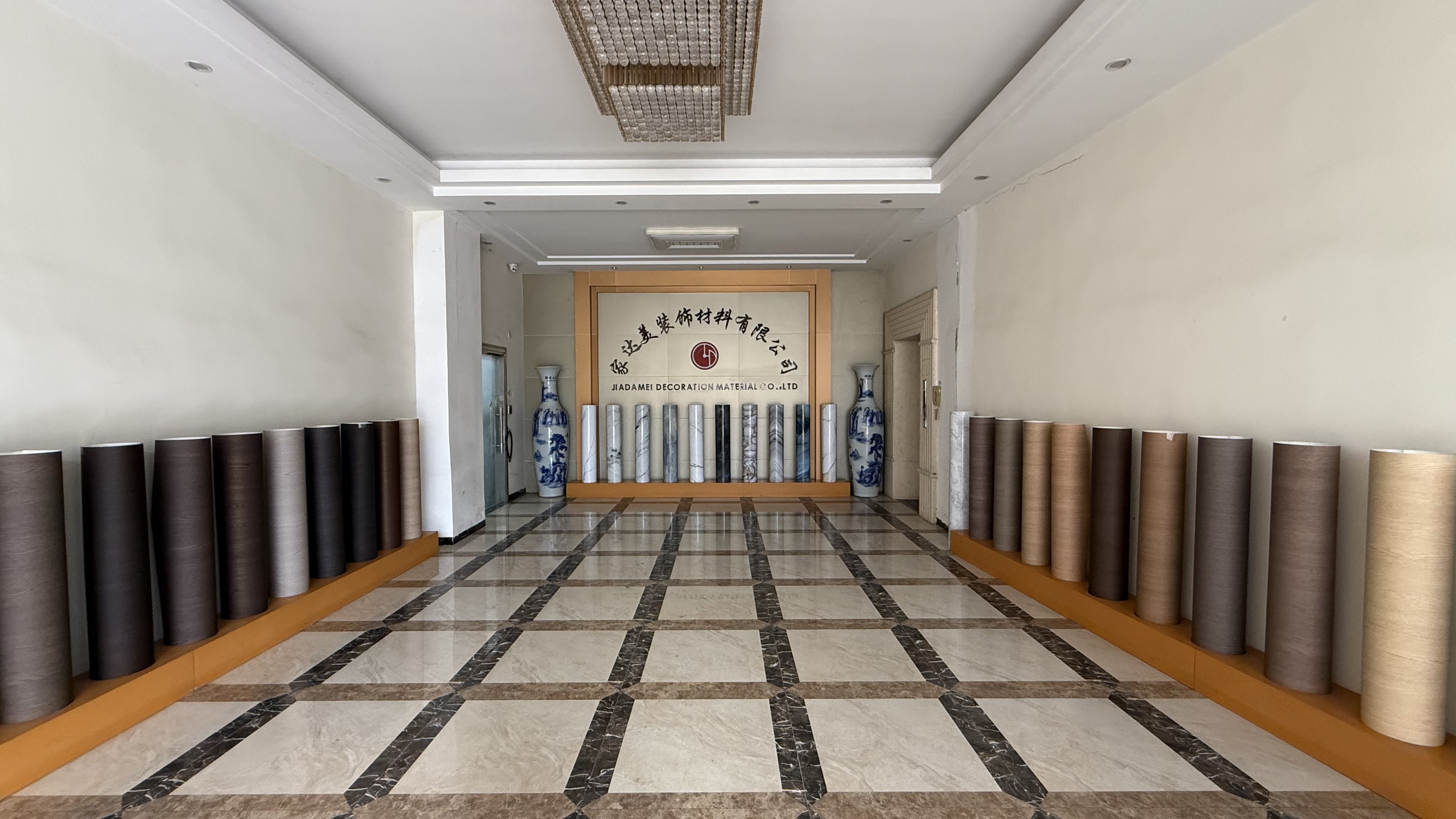
Pattern and finish selection is usually confirmed against full-size panels rather than small swatches.
Where the film approach has real limits
A credible framework has to state boundaries, and self-adhesive PVC decorative film has clear ones.
- Substrate condition decides the result. The film is recommended for smooth, clean, dry and stable surfaces such as properly prepared furniture panels, cabinets, doors, metal, glass and similar interior substrates. Rough, dusty, oily, damp, porous or unstable surfaces may reduce adhesion and affect the final appearance. Film renews a surface; it does not repair a swollen, delaminating or structurally damaged board.
- Moisture exposure has limits at edges and joints. The PVC surface is water-resistant and easy to clean, which suits normal kitchen use, but edges, joints and the underlying substrate should not be continuously exposed to water or excessive moisture.
- Trapped air is an installation risk, not a product guarantee. Air-release film structures are designed to let trapped air escape more easily during application; standard adhesive film without air-release channels requires more careful application and is more likely to trap air if installed improperly. Buyers should confirm which construction is being quoted if bubble-free installation is an acceptance criterion.
- Pattern continuity is a project variable. On long runs, batch matching and grain direction determine whether adjacent panels read as one surface. This is a sampling and quality-control question rather than a film chemistry question.
Practical translation: the series choice is made on design intent, but the acceptance criteria are set by substrate preparation, edge detailing and installation method. Buyers who specify only the pattern and not the preparation standard usually inherit the difference on site.
Supply, customization and quality-control parameters
Beyond the film itself, three supplier-level parameters shape a buying decision: how much can be customized, how fast it can be delivered, and how consistency is controlled.
Leiyegaoke supports OEM/ODM and lists customization across colours, patterns, sample-based customization, sizes, thickness, surface finish, logo, labels, packaging and cartons. Lead time is stated at 20-25 days, with a monthly capacity of 120,000 meters. The manufacturer reports an annual output of 15,000,000 meters from a 12,000 m² facility with 50 employees, an R&D team of 5 engineers and an export ratio of 80%, serving markets including Europe, South America, the Middle East and CIS countries. Quality control is described as 100% testing, and after-sales consultation is provided.
For an evaluation-stage buyer, those numbers answer different questions. Capacity and lead time answer whether a programme can be repeated. The customization list answers whether a private-label or project-specific finish is possible. The 100% testing statement answers how finished-product inspection is positioned — it should be verified against the inspection scope and documentation the supplier can actually provide per order.
Compliance and documentation to request
Interior decorative film destined for regulated markets is usually screened first on restricted-substance compliance. The relevant certification here is EU RoHS Directive (EU) 2015/863 amending Annex II to Directive 2011/65/EU, certificate number CANEC26009798401, issued by SGS-CSTC Standards Technical Services Co., Ltd. Guangzhou Branch, with a scope covering self-adhesive PVC decorative film, PVC decorative film and vinyl film, and a stated validity through 2099-01-01.
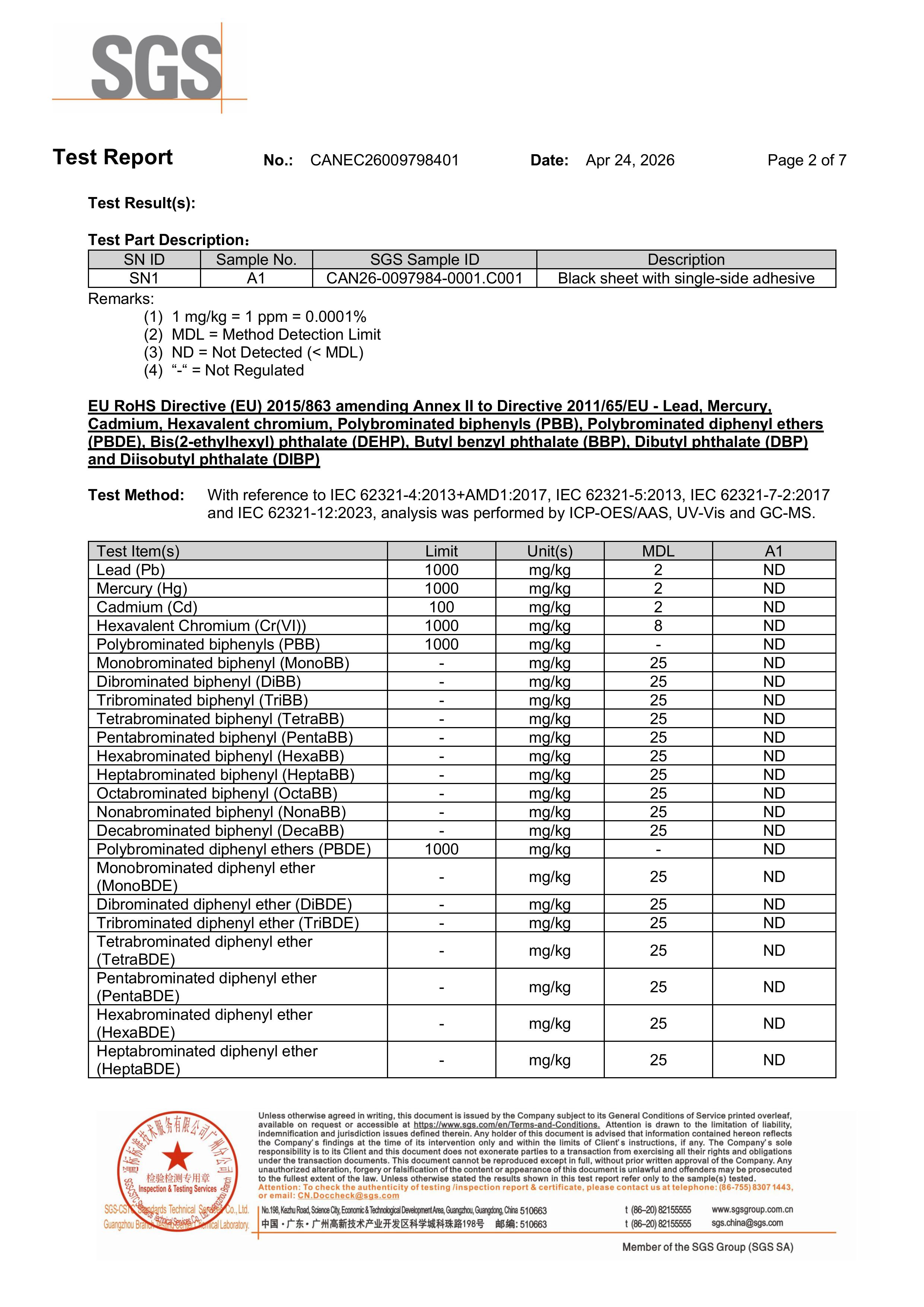
EU RoHS documentation is typically the first compliance file requested for European interior projects.
The manufacturer also states that products comply with relevant international requirements including REACH and RoHS. Where a project specifies additional performance criteria, buyers should note that wider industry references exist for adjacent requirements — for example, B1 flame-retardant classification under GB 8624 is referenced in the decorative film sector for interior fire requirements, and ASTM D1593 is an established specification for nonrigid vinyl chloride plastic film and sheeting covering tensile strength and elongation. Neither should be assumed present in a given series unless the corresponding test documentation is supplied for that series and colour.
For export documentation, the HS code 39199090 applies to this product category, and Chinese exports under HS 3919 reached an all-time high of 246.296 RMB million in January 2026 according to General Administration of Customs China data. That trade context matters for buyers planning customs clearance and duty treatment.
Field evidence: a six-year cabinetry programme in Algeria
The most concrete reference point in the available material is an Algeria-based furniture manufacturer that laminates film onto MDF board to produce finished cabinet doors. Across the referenced project history, monthly usage is stated at 100,000 meters, and the application has been running for more than six years. Reported characteristics include design and colour quality together with waterproof, fireproof, anti-scratch and oil-proof properties.
For evaluation-stage buyers, the useful part of that reference is not the volume figure on its own — it is the combination of application (MDF lamination for cabinet doors), duration (more than six years), and the properties cited as decision criteria by the customer. It gives a benchmark for the questions worth asking of any supplier: which substrate, which application, how long in service, and which performance attributes were actually verified.
How this compares with traditional renovation approaches
Self-adhesive PVC decorative film is one option among several for refreshing an interior surface. Compared with replacing panels or doors, film-based renovation leaves the existing substrate in place and applies a new decorative layer to it, which is why substrate condition becomes the controlling factor rather than the deciding convenience. Compared with painting, film offers a factory-produced decorative surface with a repeatable pattern, but it introduces the same dependency on surface preparation and edge finishing. Compared with high-pressure laminate or rigid panelling, film is a thin, flexible decorative layer rather than a structural face — it will not compensate for an uneven or unstable substrate, and it should not be specified where continuous water exposure at edges and joints is expected.
The honest boundary is this: film is strongest where the substrate is sound, smooth and dry, where the visible area is large enough to justify careful installation, and where the buyer has already decided on finish and pattern. It is weakest where the substrate itself needs repair, where moisture sits against edges, or where no sample validation has been done before a full roll run.
Market trend signals buyers should factor into planning
Three published data points are worth reading together. First, Asia Pacific’s 42.3% revenue share in 2025 (Dataintelo) places the centre of category supply and consumption in the same region as most film manufacturing. Second, wood grain remains the largest product segment at 38.4% share in 2025 (Dataintelo) — which explains why a supplier of this size maintains a dedicated Japanese-style wood grain series rather than treating wood grain as one option inside a general range. Third, furniture accounts for approximately 44.6% of consumption (Dataintelo), reinforcing that board lamination for cabinets and furniture, not wall decoration alone, drives most volume.
A fourth signal concerns supply. China became the world’s largest PVC exporter in 2025 with 24% of total global trade volume, according to International Trader Publications. For importers and distributors, that shift is less about a single supplier and more about how much of the category’s pricing and availability is now shaped by one exporting region.
Future outlook for model-level selection
The direction of travel is toward finer model-level differentiation rather than broader “PVC film” specifications. As pattern families multiply and finish ranges widen, the practical competitive ground for manufacturers moves to consistency: whether the same colour and finish can be reproduced across repeat orders, whether documentation for restricted substances and performance claims is ready per series, and whether customization — colours, patterns, thickness, roll sizes, adhesives, release papers, labels and packaging — can be delivered inside a predictable lead time.
For buyers, the implication is straightforward. The three-series framework used here — a dedicated marble grain family, a dedicated Japanese-style wood grain family, and a multi-pattern programme — is likely to become the normal way ranges are structured and evaluated. Selection will increasingly be documented per model, per finish and per application, with sample validation as the formal gate before a full order. Full range details are published at www.leiyegaoke.com.
FAQ: buying and using self-adhesive PVC decorative film
Can self-adhesive PVC decorative film be used on kitchen cabinets?
Yes. Self-adhesive PVC decorative film is suitable for renovating smooth kitchen cabinet doors, panels and other interior furniture surfaces. It provides a decorative, water-resistant and easy-to-clean surface, and it allows the appearance of a cabinet to be refreshed without replacing the entire cabinet unit.
What surfaces are suitable, and what happens on unsuitable ones?
The film is recommended for smooth, clean, dry and stable surfaces such as painted wood, sealed MDF, metal, glass and other properly finished interior surfaces. Rough, dusty, oily, damp, porous or unstable surfaces can reduce adhesion and affect the final appearance, with typical outcomes including bubbling, edge lifting, peeling or an uneven surface look. Cleaning, drying and a small-area test before full installation are the standard mitigations when the substrate is uncertain.
How are bubbles avoided during application?
A smooth result comes mainly from method and surface preparation: apply the film gradually and use a squeegee to push out trapped air while removing the release liner step by step. Two adhesive constructions also behave differently. Air-release film uses a specially designed release liner and adhesive structure with micro air channels that allow trapped air to escape more easily during installation, whereas standard adhesive film without air-release channels requires more careful application and is more likely to trap air if installed improperly.
How should the film be cleaned and maintained?
For routine cleaning, use a soft cloth with water or a mild neutral detergent, and keep the cleaning gentle and regular to preserve the decorative surface. The practical sequence is: remove loose dust with a soft dry cloth; wipe normal stains with a soft damp cloth; for grease or stubborn dirt use a mild neutral detergent diluted in water; wipe again with a clean damp cloth to remove detergent residue; then dry with a soft clean cloth. Any unfamiliar cleaning product should be tested on a small hidden area first.
Should buyers start with stock colours or plan for custom colours?
It depends on the programme. Stock colours carry an MOQ of one roll per colour, which suits sampling, small renovation jobs and distributors testing a new pattern. Custom colours carry an MOQ of 3,000 meters per colour, which suits project or private-label programmes where the colour cannot be taken from the existing range. Customization can extend beyond colour to patterns, sample-based development, sizes, thickness, surface finish, logo, labels, packaging and cartons, with a stated lead time of 20-25 days. The deciding factors are usually total project volume, repeat-order expectation and how much of the specification must be unique to the buyer.
Across the three series, the platform numbers are the same and the decision is not. LF6801-LF6830 answers stone-effect requirements, LG7801-LG7836 answers wood-grain and low-sheen door and furniture requirements, and LY1804-LY1869 answers programmes that need several decorative languages from one supply relationship. Matching the series to the substrate and the surface — then validating it with a sample — remains the part of the process that no specification sheet can replace.