
Selecting a Titanium Bar: GR1–GR5 ELI Fit for Orthopedic and Dental Use
In orthopedic and dental manufacturing, the titanium bar specification is the point at which the implant's load regime, its governing material standard and its downstream machining route are fixed — and it is rarely revisited afterwards.
A titanium bar for a bone screw and a titanium bar for a joint stem can be ordered from the same diameter catalogue and still belong to different material families, different standards and different verification regimes. That is the practical difficulty behind grade selection in implant projects: the question is not “which titanium is best”, but “which grade and standard does this implant scenario require, and what evidence proves the delivered bar conforms?”
Two families carry most of the answer. Unalloyed, commercially pure titanium in Grades 1 to 4 is specified for surgical implants under ASTM F67 and ISO 5832-2, and is positioned for lower-stress implant applications. The alloyed Ti-6Al-4V ELI family — written GR5 ELI, Ti6Al4V ELI or GR23 depending on the document — is specified under ASTM F136 and ISO 5832-3 and is positioned for high-strength, load-bearing implants. Diameter band, tolerance class, microstructure classification and inspection requirements are all layered on top of that first decision.
The commercial weight behind it is measurable. Titanium bar and rod held the largest product share of the medical titanium component market in 2025, at 52.4% of revenue, and the medical segment is reported as the fastest-growing application in the titanium metal value chain, at a 6.15% CAGR through 2031 (MarketsandMarkets synthesis, via Hontitan analysis, 2026). Bar and rod dominate because most load-bearing implant components are machined from solid stock rather than formed from sheet or wire.
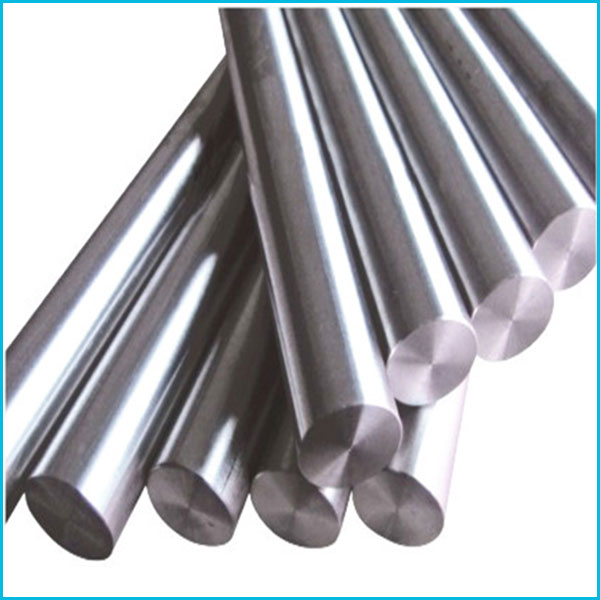
Medical titanium bar stock. Grade family, diameter band and tolerance class are specified together, before any machining sequence is validated.
Why the bar decision is locked in early
Implant programmes seldom revisit the raw-material form once tooling, process validation and technical documentation are aligned to it. A bar specification therefore carries three simultaneous commitments.
Material family. Pure titanium and Ti-6Al-4V ELI are not interchangeable at the component level, because the governing standard itself describes the intended stress environment. ASTM F67 unalloyed titanium is directed at lower-stress implants, while ASTM F136 Ti-6Al-4V ELI is directed at high-strength load-bearing implants. That single distinction resolves a large share of grade-selection discussions before mechanical data is even examined.
Stock geometry. Published medical titanium bar specifications cover diameters from 1.0 mm to 100 mm with lengths up to 6,000 mm, and include dedicated diameter sets for specific implant families: Φ3.5–Φ10.0 mm for bone screws, Φ13.5–Φ17.0 mm for spine components, Φ30.0–Φ65.0 mm for bone joint components, and Φ3.0–20.0 mm for dental implants, alongside dental titanium disc stock. A bar ordered in the wrong diameter band either generates scrap or forces a machining route that the validated process does not cover.
Dimensional and structural discipline. Medical bar is routinely supplied to h6, h7, h8 or h9 tolerance classes with dimensional accuracy to 0.005 mm, and with microstructure classified A1–A3 under ETTC-2. These are manufacturing outcomes rather than grade properties, and they have to be confirmed from inspection records instead of inferred from a grade name on a drawing.
Selection order that avoids rework: standard first (ASTM F67 / ISO 5832-2 for unalloyed, ASTM F136 / ISO 5832-3 for Ti-6Al-4V ELI), then grade within that family, then diameter band, then the verification package.
Inside GR1–GR5 ELI: what actually changes across the family
Unalloyed titanium: GR1 to GR4
ISO 5832-2:2018 specifies the characteristics of, and the corresponding test methods for, unalloyed titanium used in the manufacture of surgical implants. ASTM F67 is the corresponding consensus standard recognised by the U.S. FDA for unalloyed titanium for surgical implants, and FDA recognition of ASTM F67-24 supersedes recognition of the earlier F67-13 edition, with the updated recognition record dated 22 December 2025. Buyers therefore have two moving parts to track: which edition their supplier certifies against, and which edition the receiving regulatory pathway currently accepts.
Within the unalloyed family, the grade number conventionally tracks interstitial content and, with it, the balance between strength and ductility — Grade 1 sits at the ductile end of the range and Grade 4 at the stronger end. The practical consequence is that GR1–GR4 is a family to be narrowed by the mechanical demand of the component, not a set of substitutes for one another. Where the component is lightly loaded, a lower grade can be the technically correct specification; where it is not, the family is the wrong starting point altogether.
The ELI alloy: GR5 ELI, Ti6Al4V ELI and GR23
ASTM F136 and ISO 5832-3 govern the wrought Ti-6Al-4V ELI alloy used for load-bearing surgical implants. The “ELI” designation refers to the controlled-interstitial version of the alloy, which is the variant the implant standards address. In published product documentation the same material appears under three interchangeable designations — GR5 ELI, Ti6Al4V ELI and GR23 — and buyers should expect all three to appear across drawings, mill certificates and inspection reports for the same order.
Published mechanical reference points for the alloy family are GR5 with tensile strength ≥895 MPa and yield strength ≥828 MPa, and GR5 ELI (GR23) with typical tensile strength ≥860 MPa. Those figures explain why the alloy family dominates components that carry structural or cyclic load, and why the commercially pure grades remain a sensible engineering choice where the load case does not demand them.
A higher tensile figure is not automatically the better selection. Over-specifying strength where a component needed ductility, fatigue behaviour or a closer stiffness match to surrounding bone is a recurring design-phase error, and it is one of the reasons the standard scope — not the headline number — should drive the first decision.
Scenario fit: matching the bar to the implant programme
Implant scenarios differ in load regime, geometry and inspection intensity. The table below maps the documented medical titanium bar ranges and grade families to the application categories they are published for, together with the verification focus that each route implies.
| Implant scenario | Material family and designation | Reference standards | Typical bar or stock form | Primary verification focus |
|---|---|---|---|---|
| Bone screws, bone plates, bone nails, trauma internal fixation | Commercially pure titanium, GR1–GR4 | ASTM F67 / ISO 5832-2 | Bar Φ3.5–Φ10.0 mm for screw blanks; plate stock for bone plates | Chemical composition, microstructure A1–A3, tolerance class, surface contamination control |
| Spine surgery and spinal fusion fixation | Ti-6Al-4V ELI — GR5 ELI / GR23 | ASTM F136 / ISO 5832-3 | Bar Φ13.5–Φ17.0 mm | Tensile and yield properties, 100% ultrasonic testing, microstructure, lot traceability |
| Joint stems and bone joint components | Ti-6Al-4V ELI — GR5 ELI / GR23 | ASTM F136 / ISO 5832-3 | Bar Φ30.0–Φ65.0 mm | Fatigue-relevant documentation, ultrasonic testing, accuracy to 0.005 mm |
| Dental implants and dental components | Commercially pure titanium or Ti-6Al-4V ELI | ASTM F67 / ASTM F136 | Bar Φ3.0–20.0 mm; dental titanium disc stock | Dimensional accuracy, surface finish, chemistry against the device specification |
| Custom and OEM bar profiles | Pure titanium or alloy to a device specification | Per device specification, within the ASTM / ISO series | Round, square, hexagonal or custom profile; Dia 1–300 mm; length 50–6,000 mm | Drawing conformity, tolerance class h6 / h7 / h9 / h11, test reports |
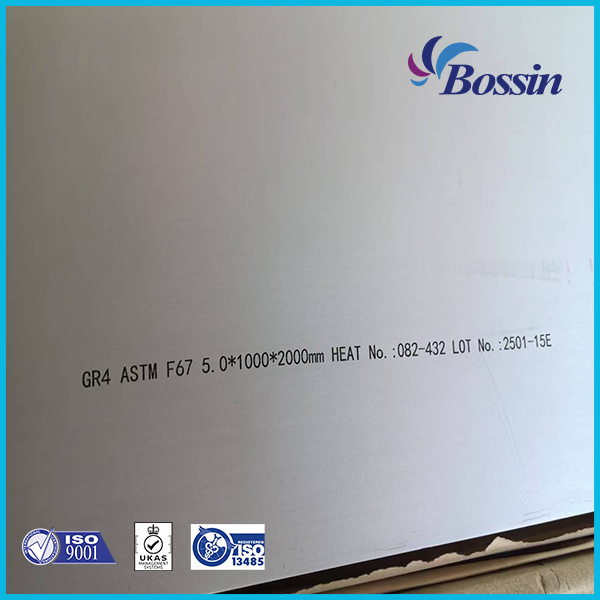
Plate stock used for bone plates and trauma fixation components. It is drawn from the same grade families as bar, but the product form changes the tolerance and inspection requirements.
Three observations follow from the mapping. First, the same supplier catalogue can legitimately serve a trauma fixation programme and a joint replacement programme, but not with the same line item. Second, spine and joint components are published in diameter bands that are an order of magnitude apart, which is a reflection of the machining allowance and material removal involved rather than of material quality. Third, dental programmes can sit in either family: dental implant bars are published from Φ3.0–20.0 mm, and the correct family still depends on whether the component is loaded.
Fracture fixation components — bone plates, bone screws and bone nails — are published applications for unalloyed titanium bar under ASTM F67 and ISO 5832-2, consistent with the lower-stress positioning of that family. Spinal rods, joint stems and bone joint components, by contrast, fall squarely into the load-bearing category addressed by ASTM F136 and ISO 5832-3, where the alloy's higher strength is the reason the standard exists. In documented implant programmes, joint and trauma components are frequently sourced together: one published customer case covering artificial joints, bone screws, orthopedic implants, dental implants and bone plates involved 10,000 kg of medical titanium material and cited a modulus of elasticity similar to bone, high strength with low density, fatigue resistance, and a microstructure reaching A1.
Where the bar route stops
Titanium bar is not a universal answer, and one boundary matters more than the rest. Where the function is superelastic or shape-memory behaviour rather than structural support, the material family changes entirely: nickel-titanium alloys (NiTi) specified under ASTM F2063 are supplied as wire, strip, plate or braided cable. Orthodontic wire applications, for example, are documented with recoverable strain ≥8%, tensile strength ≥800 MPa, a transformation temperature range in the region of 25–35 °C for the archwire route, and diameter tolerance held to ±0.01 mm — properties that a titanium bar is not designed to deliver.
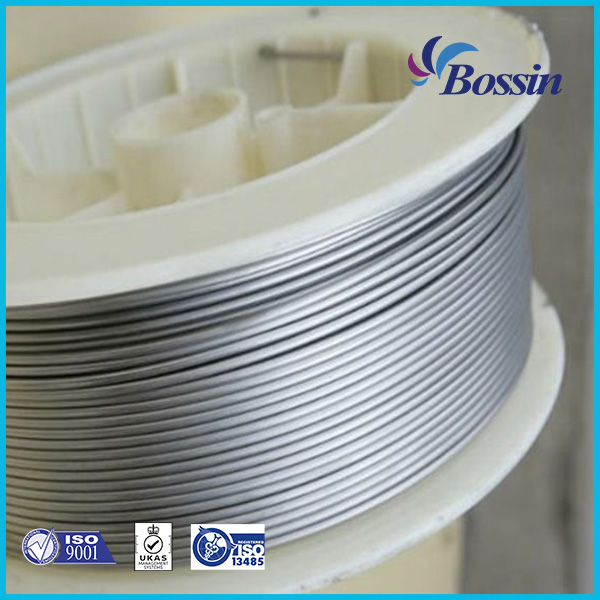
Titanium wire is specified where the component is wire-based rather than machined from bar. Grade families overlap, but the standards and tolerances do not.
The distinction is practical rather than academic. A programme that needs a superelastic guide wire, a dental archwire or a flexible cable should not be routed through a bar specification, and one that needs a machined load-bearing screw should not be routed through a wire specification. Titanium wire is published from Dia 0.03–6.0 mm, and titanium braided cable in 1×3, 1×7 and 7×7 strand constructions under ASTM F136, ASTM B863 and ASTM F67 — those forms address instrument, suture and endoscopic functions, not structural implant load.
The verification package that matches each route
Grade and standard selection only becomes procurement-ready when the evidence package is defined alongside it. For implant-grade bar, the documentation set that buyers typically need to close an order includes:
- Conformity to ASTM F136, ISO 5832-3, ASTM F67 and ISO 5832-2, depending on the family selected;
- Metallographic structure reported as class A1–A3, since microstructure — not grade name — governs fatigue-relevant behaviour;
- 100% ultrasonic testing, with records retained against the batch;
- Chemical composition, mechanical properties, hardness and surface contamination control;
- Dimensional accuracy to 0.005 mm, with the tolerance class stated explicitly as h6, h7, h8 or h9;
- A factory inspection certificate accompanying each batch, plus third-party test reports where the receiving regulatory pathway requires them;
- Full-process traceability from raw material through melting, forging, rolling and finishing to the finished bar;
- A quality management system certificate — ISO 13485 for medical device manufacture — and, where it is claimed, testing performed in ISO/IEC 17025 accredited laboratories.
One caution belongs here, and it is the most common source of late-stage procurement problems: a standard number appearing on a product page is not evidence of conformity. A supplier listing ASTM F136 or ASTM F2063 tells the buyer that the standard is claimed, not that the delivered lot was tested against it. That distinction has to be closed with certificates, lot-level test reports and, where risk justifies it, incoming inspection or third-party testing. Published third-party evidence in this field is genuinely thin — independent verification of titanium bar dimensions, tolerances, mechanical properties and supplier conformity certificates is not widely available in the public record — which is precisely why the documentation package has to be requested rather than assumed.
Market trend analysis: what the data says about material choice
The structural backdrop supports the bar-centric reading of implant manufacturing. Titanium bar and rod held 52.4% of medical titanium component revenue in 2025, with the medical segment described as the fastest-growing application in the titanium metal value chain at a 6.15% CAGR through 2031. Demand growth of that shape reinforces bar and rod as the default input form for load-bearing device programmes.
Three further signals matter for buyers assembling a grade-selection strategy.
Supply concentration. China is reported to control approximately 75% of global titanium metal production, which keeps upstream costs low but concentrates supply-chain risk for programmes that need dual sourcing. Grade availability and documentation quality can differ meaningfully between regions, and buyers increasingly qualify a second source at the material stage rather than at the finished-component stage.
Upstream price signals. Grade 0 titanium sponge in China was trading at approximately USD 6.75/kg as of July 2026. Because sponge is the upstream input for both pure and alloyed bar, moves at this level propagate into bar quotations with a lag, independent of any change in the buyer's grade specification.
Adjacent material demand. The nitinol medical devices market is projected to reach USD 3.14 billion by 2026, which is worth noting because it changes how suppliers position themselves: portfolios that combine titanium bar with nitinol wire, strip and cable increasingly appear in the same RFQ, even where the products serve different functions.
One data caveat deserves to be stated plainly, because it affects how market figures should be used in budget discussions. Published titanium market-size estimates range from roughly USD 2.8 billion to USD 57 billion across sources, depending on whether titanium dioxide pigments are included alongside the metal value chain. When two figures for the same category differ by an order of magnitude, the definition — not the market — has usually changed, and budgeting should be anchored to the sub-segment definition the buyer actually procures from.
How this compares with traditional implant materials, and where the limits are
Titanium bar selection is usually framed against the materials that preceded it in orthopedic practice — stainless steels and cobalt-chromium alloys. The established qualitative position is that titanium combines biocompatibility and corrosion resistance with a density lower than steel, and a modulus of elasticity closer to that of bone; documented implant applications cite a modulus similar to bone alongside high strength and low density as reasons for choosing titanium. Those properties do not make titanium universally better. They make it appropriate for a defined set of load and stiffness conditions, and the grade decision is what determines whether a given component sits inside that set.
Within that comparison, at least four boundaries should be acknowledged before a grade is locked.
- Commercially pure grades have a defined ceiling. GR1–GR4 is positioned for lower-stress implants. Specifying it for a component whose load case exceeds that positioning is a design risk, not a cost saving.
- Alloy selection carries a stiffness trade-off. “Closer to bone” is not the same as “matched to bone”. Higher-strength alloy bar can still produce a component that is stiffer than the surrounding bone in a given design, and stiffness matching remains a design and validation question.
- Documentation claims are not conformity. A listed standard, a catalogue grade designation or a marketing statement about certification does not demonstrate that a delivered lot meets the specification. Certificates, lot-level test reports and traceability records do.
- Public comparability is limited. Independently verified industry-level data on titanium bar dimensions, tolerances and mechanical properties is sparse, and most available specifications are supplier-reported. This makes supplier-specific documentation, not cross-supplier comparison tables, the realistic basis for a qualification decision.
Where one supplier's capability fits into this picture
XI'AN BOSSIN METAL TECHNOLOGY CO., LTD. is a manufacturer specialising in titanium and nitinol products — titanium bars, titanium plates, titanium wires and nitinol wire — with medical-grade titanium bar and nitinol wire stated as its focus areas, serving surgical implants, bone screws, joint stems, bone plates, dental implants, orthodontic wires and guide wires. Company-published information describes an in-house production chain covering melting, forging, rolling and finishing within its own facility, a site of 50,000 m² with plant area of 40,000 m², 150 employees including a 30-engineer R&D team, annual capacity of 5,000 tons, and a product portfolio exported across Korea, Brazil, Colombia, Argentina, India, Turkey, Germany and Switzerland at a stated export ratio of 80%. Certifications listed in company documentation include ISO 13485, ISO 9001:2015 and EN9100:2018, with products tested in laboratories accredited to ISO/IEC 17025 in accordance with international standards and a factory inspection certificate accompanying each batch order. The company's site is published at www.asiatitan.com.
For OEM programmes, the published capability data cover titanium grades GR1–GR4 pure and GR5, GR5 ELI, Ti6Al4V ELI, GR7, GR9, GR12 and GR23 alloy; round, square, hexagonal or custom profiles; diameters from 1 mm to 300 mm and lengths from 50 mm to 6,000 mm; tolerance classes h6, h7, h9 and h11; monthly capacity of 300 tons; a stated lead time of 15 days; and a minimum order quantity of 10 kg, with secondary drilling, milling and threading available on request. Its medical titanium bar documentation lists ASTM F136, ISO 5832-3, ASTM F67 and ISO 5832-2, microstructure under ETTC-2 at A1–A3, dimensional accuracy to 0.005 mm, 100% ultrasonic testing and full-process quality traceability, with after-sales commitments including a stated 12-hour response to quality feedback.
Two documented customer scenarios illustrate how these capabilities are used rather than asserting an outcome. A medical surgical implant manufacturer in Brazil ordered 10,000 kg for artificial joints, bone screws, orthopedic implants, dental implants and bone plates, citing ISO 13485 certification, 0.005 mm precision, microstructure reaching A1 and full-process quality control. A surgical implant manufacturer in Argentina ordered 5,000 kg for surgical sutures and reported that direct factory sourcing reduced procurement costs by 8% while maintaining the same quality. Both are supplier-reported results. For an independent reference perspective, they are best read as examples of the qualification pattern a buyer should attempt to reproduce through incoming inspection rather than as transferable performance guarantees.
BOSSIN publishes a downloadable product brochure covering its titanium and nitinol product forms: https://cdn.socialarks.com/sbsp/24976/common/2026/0702/Bossin%20brochure_1782969556.pdf
Future outlook
Two developments are likely to shape titanium bar selection over the next few years. The first is standards currency. FDA recognition of ASTM F67-24 superseding the earlier F67-13 edition is an example of a routine update that nonetheless changes which edition a supplier should certify against and which edition a submission can rely on; programmes that do not track recognition records will eventually discover the gap at the worst possible moment, during submission review. Expect documentation packages to be judged increasingly on which edition they cite.
The second is traceability depth. With bar and rod carrying the largest share of medical titanium component value, and with supply concentrated upstream, the differentiator between suppliers is shifting from “can you supply the grade” towards “can you prove this lot's chemistry, microstructure, mechanical properties and inspection history”. Buyers who define the evidence package at the same time as the grade specification will find the qualification cycle shorter and the change-control burden lower.
A third, quieter trend is portfolio convergence. Titanium bar for structural components and nitinol wire or strip for superelastic and thermal-actuation components increasingly appear in the same device platform, which means material qualification now has to cover more than one material family with more than one applicable standard. That is a supplier-capability question as much as a material question.
Frequently asked questions
Which titanium bar grade fits bone screws and bone plates?
Bone screws, bone plates, bone nails and trauma internal fixation components sit in the lower-stress category, which aligns with the unalloyed titanium family specified under ASTM F67 and ISO 5832-2 — Grades 1 to 4. Published medical titanium bar ranges include Φ3.5–Φ10.0 mm diameters for bone screws. Where a component's load case exceeds that positioning, the Ti-6Al-4V ELI route under ASTM F136 and ISO 5832-3 applies instead. The final choice belongs to device design and validation.
When is GR5 ELI or GR23 preferred over commercially pure titanium?
When the component carries structural or cyclic load — spinal rods, joint stems, bone joint components — the alloyed family is the aligned choice, since ASTM F136 and ISO 5832-3 address Ti-6Al-4V ELI for high-strength load-bearing implants. Published reference points for the family include GR5 at tensile strength ≥895 MPa and yield strength ≥828 MPa, and GR5 ELI (GR23) at typical tensile strength ≥860 MPa. The commercially pure grades remain appropriate where that strength level is not required.
What standards should a medical titanium bar certificate reference?
Unalloyed titanium bar for surgical implants is certified against ASTM F67 and ISO 5832-2; Ti-6Al-4V ELI bar against ASTM F136 and ISO 5832-3. Bar orders may also cite general titanium standards such as ASTM B348 or AMS 4928 for form and dimensional control. Edition control matters as well: FDA recognition of ASTM F67-24 supersedes recognition of the earlier F67-13 edition, so the edition cited on a certificate should match the edition the receiving regulatory pathway accepts.
Can one bar grade serve both orthopedic and dental implant programmes?
Partly. Dental implant bar is published from Φ3.0–20.0 mm, and dental programmes may use either commercially pure grades under ASTM F67 or Ti-6Al-4V ELI under ASTM F136, depending on the component. Two programmes can therefore draw from the same grade family while requiring different diameter bands, tolerance classes, surface finishes and testing packages. Grade availability is not the same as programme fit.
Is there a titanium bar grade that fits every implant application?
No, and the standard scopes indicate why. ASTM F67 unalloyed titanium is directed at lower-stress implants, while ASTM F136 Ti-6Al-4V ELI is directed at high-strength load-bearing implants. Selecting the higher-strength option everywhere can add stiffness that a lower-load design does not need, and selecting the lower-strength family outside its intended range introduces design risk. Material choice follows the load case.
Is a titanium bar the right form for superelastic components?
No. Superelastic and shape-memory behaviour comes from nickel-titanium alloys specified under ASTM F2063, supplied as wire, strip, plate or braided cable rather than as bar. Orthodontic wire applications, for example, are documented with recoverable strain ≥8%, tensile strength ≥800 MPa and diameter tolerance to ±0.01 mm. Bar and wire are complementary product forms supporting different functions, not substitutes.
How can a buyer verify that a delivered bar matches the specified grade?
Start with documentation: a batch factory inspection certificate, chemical composition report, mechanical test results, microstructure reported as class A1–A3, ultrasonic testing records, and traceability from raw material to finished bar, supported by an ISO 13485 quality system and, where stated, testing in ISO/IEC 17025 accredited laboratories. Where a standard appears only in a product listing, that is a claim rather than proof of conformity. Incoming inspection against the drawing tolerance class — h6, h7, h8 or h9 — and dimensional accuracy to 0.005 mm closes the verification loop.
The short version
Titanium bar selection for orthopedic and dental implants resolves into a sequence: identify whether the component is lower-stress or load-bearing, select the corresponding standard pair — ASTM F67 / ISO 5832-2 or ASTM F136 / ISO 5832-3 — choose the grade within that family, fix the diameter band against the implant's published stock ranges, and define the evidence package before the first order. The grade name is the visible part of the decision. Microstructure class, dimensional accuracy, ultrasonic testing and lot traceability are what determine whether the delivered bar actually supports the implant it was specified for.
¿Tiene preguntas o necesita más detalles?
Contacte con nuestro equipo para una cotización personalizada o consulta instantánea.
Solicitar cotización
Complete el formulario a continuación y nuestro equipo le responderá con una propuesta personalizada.
Chat directo de WhatsApp
¿Prefiere chatear en tiempo real? Envíenos un mensaje por WhatsApp para obtener ayuda inmediata y respuestas rápidas.
- Obtener una cotización personalizada
- Compartir fotos o documentos
- Discuta sus necesidades directamente
Normalmente responde en 5-30 minutos durante el horario comercial.