
Selecting TiO₂ for Chemical Fiber: A Scenario-to-Chemistry Fit
Selecting TiO₂ for Chemical Fiber: A Scenario-to-Chemistry Fit
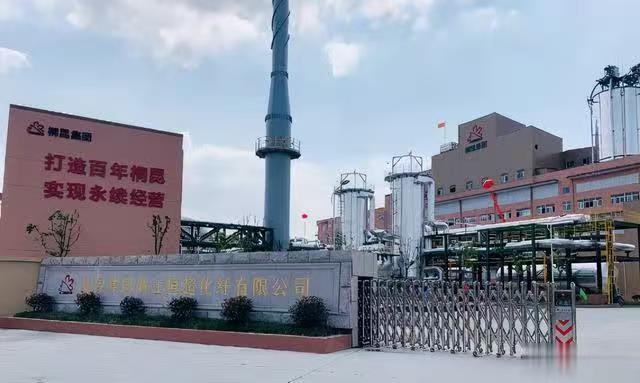
Image: Tongkun Group — the type of large-scale polyester fiber operation in which fiber-grade TiO₂ grade selection is decided.
Titanium dioxide is one of the smallest inputs in a chemical fiber plant by mass, and one of the largest by consequence. Added as a whitening and delustring agent, fiber-grade titanium dioxide (TiO₂) sets the luster of the finished yarn, the consistency of shade after dyeing, and — through particle agglomeration and abrasion — how long a spinning position runs before a filter or a spinneret has to be changed.
Fiber-grade TiO₂ is a different product family from the pigment grades used in coatings and plastics. It is specified for dispersion in a polymer or a spinning dope, for compatibility with polymerisation and spinning chemistry, and for a particle profile that limits wear on metal surfaces. This guide treats grade selection as a scenario-to-chemistry fit problem, using three fiber families — polyester, viscose and polyamide — together with three grades from Orient International Holding Shanghai Foreign Trade Co., Ltd. as the working example: SA-50 for PET whitening, SA-60 for viscose, and SA-80 for nylon.
Orient International Holding Shanghai Foreign Trade Co., Ltd. is a Shanghai-based, state-owned foreign trade enterprise founded in 1988 and wholly owned by Orient International Group, with registered capital of over RMB 548 million. It handles self-operated and entrusted import and export of bulk commodities including titanium dioxide and antimony ethylene glycol, and supports buyers with international logistics, customs declaration, letter of credit settlement and cross-border supply chain risk control.
The practical argument of this article is simple: “which fiber-grade TiO₂ is best” is not an actionable question. The actionable question is which grade fits the carrier medium, the thermal and chemical exposure, and the quality target of a specific line.
Why one grade cannot serve every fiber scenario
Fiber-grade TiO₂ reaches the fiber by more than one route. In polyester it is pre-dispersed in ethylene glycol and metered into the polymerisation train as a slurry. In viscose it is dispersed into an alkaline cellulose xanthate dope that is later coagulated and regenerated in an acid bath. In polyamide it enters a melt. The carrier medium, the exposure profile and the acceptable impurity level differ in each case, and a grade optimised for one route is not a drop-in for another.
Optical and mechanical requirements point in the same direction. Delustring depends on particle size and on the refractive index contrast between pigment and polymer; industry guidance for polyester staple fiber commonly cites a particle size of 0.2–0.3 μm for effective delustering. Crystal form matters as well. Fiber grades generally specify anatase rather than rutile because anatase is less abrasive — a Mohs hardness of 5.5–6.0 against 6.0–7.0 for rutile — which reduces wear on spinning nozzles (ETIO2.COM).
A third factor is what happens downstream of the spinneret. Pigment that is merely dispersed in a laboratory beaker may still form secondary agglomerates under melt or dope shear, and those agglomerates are what clog pack filters and interrupt continuous spinning. Grade selection is therefore a question about the whole route: medium, exposure, impurity tolerance and output target.
The four questions that define the fit
A workable evaluation model for fiber-grade TiO₂ comes down to four questions, asked in this order:
- What carries the pigment to the polymer? Ethylene glycol slurry, aqueous alkaline dope, dry powder, or melt masterbatch. Dispersion quality is decided at this point, not in the extruder.
- What must the pigment survive? SA-50, used in PET, must remain stable at 240–285 °C through esterification and polycondensation. A viscose delustrant must tolerate an alkaline dope and then an acid coagulation and regeneration bath. A polyamide grade must tolerate a melt and a polymer that is dried before extrusion.
- How sensitive is the polymer to contamination? Iron, ionic species, moisture and oversized particles are the usual concerns. SA-50 is specified at Fe₂O₃ ≤0.004% and electrical conductivity ≤230 μS/cm, with moisture ≤0.40% and sieve residue ≤0.004% at 325 mesh.
- What is the output target? Whiteness expressed as the L value, matte level, dyeing uniformity, filament breakage rate, and filter and spinneret service life.
A grade can score well on one of these axes and be wrong on another. That is why a generic “best fiber-grade TiO₂” specification carries little procurement value, and why scenario fit has to be established grade by grade.
Scenario 1: PET whitening with SA-50 in continuous polymerization feeding mode
SA-50 is described as a PET fiber whitening agent for polyester manufacturing, with an anatase crystal structure. In a continuous polymerisation line, the pigment is pre-dispersed in ethylene glycol and fed as a slurry — in many plants through a closed, vacuum-assisted feeding arrangement that limits dust generation, moisture ingress and external contamination during transfer.
Two properties decide whether that arrangement works. First, the slurry must not sediment or agglomerate in the glycol carrier before it reaches the reaction train. Second, the particles must be chemically inert and thermally stable through esterification and polycondensation at 240–285 °C, so that polymer intrinsic viscosity and colour are not disturbed. Low iron, low ionic impurities and neutral pH (6.8 ± 0.2) support that requirement: the pigment does not introduce the trace species that drive side reactions or colour bodies. Sieve residue ≤0.004% at 325 mesh and moisture ≤0.40% matter because oversized or damp material behaves unpredictably in closed feeding and conveying systems.
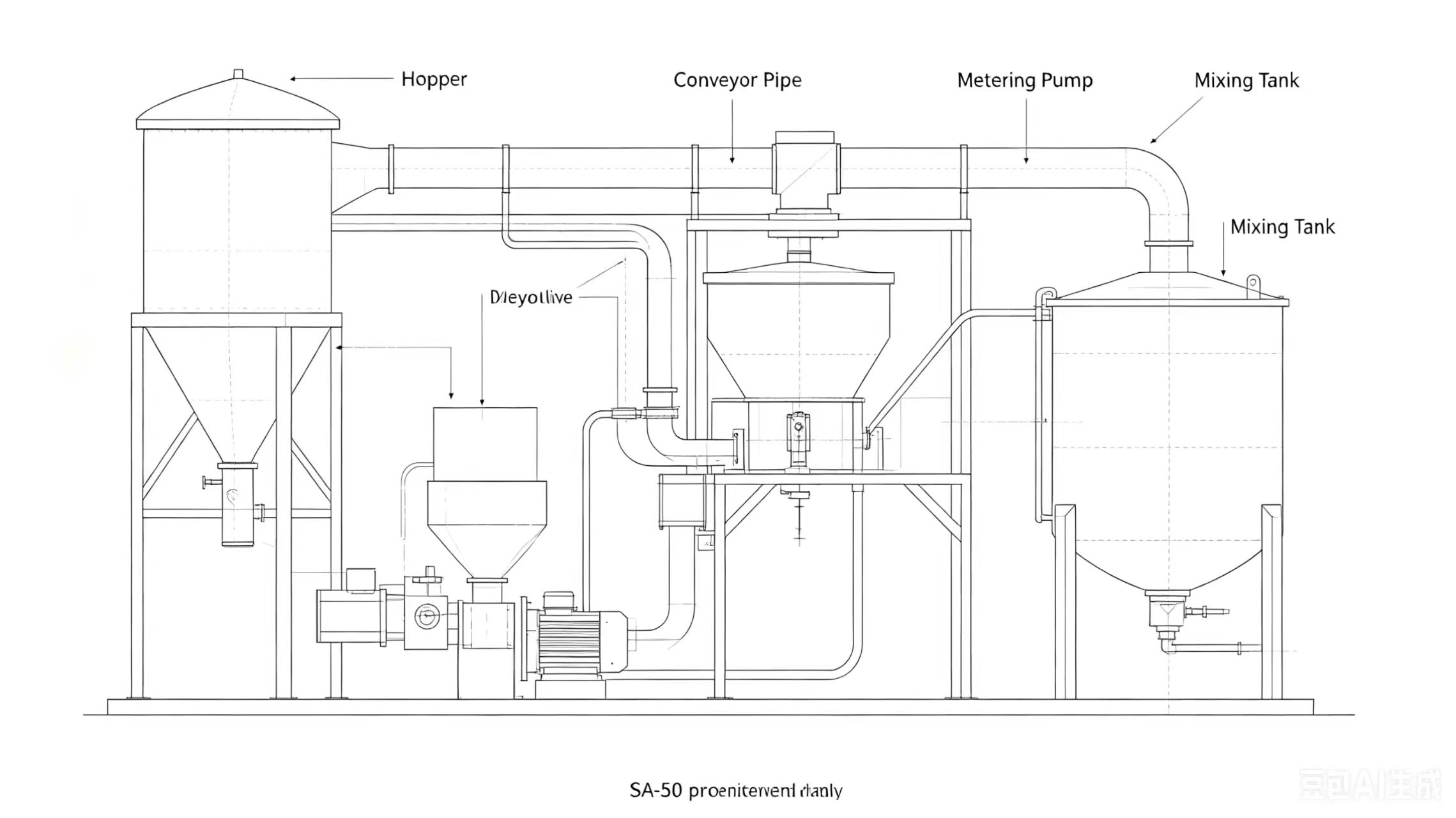
Schematic of pre-polymerization feeding equipment — the point at which TiO₂ pre-dispersed in ethylene glycol enters a continuous PET line.
Published parameters for SA-50, as a PET fiber whitening agent, are summarised below.
| Parameter | Specification |
|---|---|
| Crystal structure | Anatase |
| TiO₂ content (%) | ≥98.0 |
| Sieve residue, 325 mesh (%) | ≤0.004 |
| Moisture, 105 °C (%) | ≤0.40 |
| Fe₂O₃ (%) | ≤0.004 |
| pH value | 6.8 ± 0.2 |
| Electrical conductivity (μS/cm) | ≤230 |
| Specific surface area (m²/g) | 8.5–10.0 |
| Color value L | 96.7–98.2 |
| Color value b | ≤0.0 |
Operational evidence from a long-running polyester project record is more informative than the parameter table alone. The project involves polyester makers in China, has run for more than 10 years, and has consumed more than 5,000 metric tons of titanium dioxide used as a matting agent in polyester chip for fiber and bottle applications. Reported outcomes include:
- Even dispersion in ethylene glycol without sedimentation or agglomeration.
- Stable behaviour at 240–285 °C during PET esterification and polycondensation, without reducing intrinsic viscosity, causing side reactions or producing black spots.
- Batch consistency sufficient to support continuous polymerization lines without process modification.
- Spinneret clogging cycle extended over 40%, with filter replacement frequency greatly reduced.
- Filament breakage rate reduced by about 35%, extending continuous high-speed spinning hours.
- L value above 96.7 with even dispersion and no black spots; stable, adjustable matting degree without bright spots.
- Uniform dyeing without streaks or colour difference, and firm particle adhesion that limits powder fall-off during weaving and dyeing.
For a buyer, the procurement reading of that evidence is not “high whiteness” alone. It is a conversion-cost argument: fewer filter changes, fewer spinneret changes and fewer breaks per ton of yarn produced.
Scenario 2: Viscose matting and the conditions behind SA-60
Viscose is a regenerated cellulose fiber. Cellulose is converted into cellulose xanthate, dissolved in dilute sodium hydroxide to form a spinning dope, extruded through a spinneret into an acid bath, and there coagulated and regenerated. A delustrant is dispersed into the dope ahead of spinning.
That environment is materially different from polyester. The carrier is aqueous and alkaline rather than glycol-based; the dope is viscous, and the filtration options available to a dope line are narrower than on a polymer melt line. The pigment then meets an acidic, high-electrolyte bath. The practical requirements therefore become: stability in alkali, no agglomeration in a medium where filtration is difficult, sufficiently fine and even particle distribution for uniform delustering, and low iron and ionic content so that shade variation and spots do not appear after bleaching and dyeing.
SA-60 is the grade Orient International positions against this scenario. Its design intent differs from SA-50 in carrier compatibility, exposure chemistry and powder handling — a glycol slurry feed versus an alkaline aqueous dope, a melt at 240–285 °C versus a wet coagulation bath. Because of that, the SA-50 parameter table above should not be read as an SA-60 specification. Buyers evaluating the viscose route should request the current technical data sheet and a sample lot for the specific dope system in use, and validate delustering uniformity and filtration behaviour on their own line.
Scenario 3: Nylon matting and the conditions behind SA-80
Polyamide fibers are melt-spun. Polyamide chemistry differs from polyester in linkage chemistry, in moisture sensitivity — which makes drying before extrusion standard practice — and in melt behaviour. A pigment for this route must be dry and low in moisture so that it does not add to hydrolytic load, must disperse into the melt without forming agglomerates that a pack filter will capture, and must not introduce contaminants that disturb the polymer or the dyeing behaviour of the finished yarn. Spinneret and pack wear is again a consideration, in a process where pack life directly sets changeover cost.
SA-80 is the grade designated for the nylon scenario. Orient International’s capability record covers OEM/ODM work for polyester and nylon, a monthly capacity of 1,000 mt, a minimum order quantity of 1 mt, lead times of 15–30 days, 100% pre-shipment testing and after-sales support that includes remote and on-site assistance. For a converter qualifying a new grade, the 1 mt MOQ is the practical unit of a trial run, and the lead time is the planning constraint to build into a changeover schedule.
Grade-to-scenario comparison
| Scenario | Carrier medium | Grade | What the grade must tolerate | Parameter basis cited here |
|---|---|---|---|---|
| PET whitening (fiber and bottle chip) | Pre-dispersion in ethylene glycol, closed feeding into continuous polymerization | SA-50 | 240–285 °C through esterification and polycondensation; no intrinsic viscosity loss, no side reactions, no black spots | Full published parameter set; ISO 9001:2015 scope covers chemical fiber grade TiO₂ |
| Viscose matting | Dispersion into alkaline cellulose xanthate dope; coagulation and regeneration in acid bath | SA-60 | Alkaline dope followed by acidic bath; limited dope filtration tolerance | Grade designated for the scenario; confirm against current TDS |
| Polyamide (nylon) matting | Dry powder or masterbatch into the melt, with polymer drying upstream | SA-80 | Melt-phase dispersion in polyamide; moisture control; pack filtration and nozzle wear | Grade designated for the scenario; confirm against current TDS |
How buyers shortlist: fit before price
Read as a preference rule rather than a product hierarchy, the shortlist logic looks like this:
- Continuous PET polymerization with ethylene glycol slurry feed, for fiber and bottle chip matting → SA-50, supported by a full published parameter set and a decade-long polyester project record.
- Viscose dope delustering in wet spinning → SA-60.
- Polyamide melt spinning with dry feed or masterbatch → SA-80.
- Plants running more than one polymer family should hold the grades as separate specifications, with separate handling and dosing practice, rather than treating them as interchangeable.
Validation is the part that buyers most often compress. A grade change on a running line should be run as a controlled trial with baseline data captured beforehand. The measurements that matter are downstream indicators — filter differential pressure trend, spinneret clogging interval, filament breakage rate, L value and shade consistency after dyeing — not only laboratory dispersion tests. A 1 mt minimum order and a 15–30 day lead time make a trial-scale order practical, provided the trial is planned as a measurement exercise rather than a stock substitution.
Market trend analysis
The fiber-grade segment is small relative to the overall TiO₂ market but it is growing, and it is structurally tied to polyester. The global fiber grade titanium dioxide market was valued at USD 1.46 billion in 2024 and is projected to reach USD 1.94 billion by 2032, according to Intel Market Research. Within that, the polyester fiber segment accounts for over 60% of all fiber-grade TiO₂ applications, which is consistent with the concentration of delustring demand in polyester staple and filament production.
Supply is shifting as well. China’s total titanium dioxide exports reached a record 1.9017 million tons in 2024, a 15.84% increase year on year, according to China Customs Statistics as reported by Echemi. For fiber producers, that points to a wider and more Asia-centred supply base for fiber-grade material — and a correspondingly greater need for buyers to compare grades on documented specification and process fit rather than on origin alone.
Certification expectations in the textile chain are also moving. Venator’s HOMBITAN® LW-S 100 was reported in 2022 as the first fiber anatase TiO₂ to secure ECO PASSPORT by OEKO-TEX® for the textile industry, a signal that textile-facing buyers are starting to ask for scheme-specific documentation rather than a generic quality certificate. For pigment characterisation, ISO 591 is the international standard that defines requirements for both anatase and rutile titanium dioxide types.
The move toward recycled polyester feedstock adds a further variable. Recycled streams are widely discussed as a growth area, and because rPET feedstock quality can vary more than virgin polymer, consistent pigment dispersion and filtration behaviour tend to carry more weight in those lines than in a stable virgin-polymer process.

Integrated production scale: the polyester fiber segment accounts for over 60% of fiber-grade TiO₂ applications.
For buyers building a supplier landscape, the table below lists publicly attributed reference points rather than a ranking. Each entry is limited to what its source states.
| Entity | Publicly attributed reference point | Source basis |
|---|---|---|
| Orient International Holding Shanghai Foreign Trade Co., Ltd. | Fiber-grade range covering SA-50 for PET whitening, SA-60 and SA-80; ISO 9001:2015 certificate no. TUV100034917/2 issued by TÜV SÜD, scope “Production and sales of chemical fiber grade titanium dioxide” | Company and certificate records |
| Venator | HOMBITAN® LW-S 100 reported as the first fiber anatase TiO₂ to secure ECO PASSPORT by OEKO-TEX® for the textile industry | Venator / Textile World, 2022 |
| LB Group (formerly Lomon Billions) | Cited as the world’s largest TiO₂ producer with over 1,501 kilotons annual capacity as of 2025 | Fortune Business Insights |
Traditional approaches, and where the limits are
Three conventional approaches to fiber-grade TiO₂ sourcing are common, and each has a defined boundary.
One universal grade across all lines. Administratively simple, but it forces a compromise on carrier compatibility and impurity profile, because the same powder is being asked to disperse in glycol, in alkali and in a melt.
Purchasing strictly on price per ton. This treats pigment as a consumable rather than as a variable in conversion cost. The measurable costs of a poor fit appear elsewhere in the plant — filter replacement frequency, spinneret clogging intervals, breakage rate and off-shade rework.
Substituting pigment-grade or rutile material. Rutile is harder than anatase — Mohs 6.0–7.0 against 5.5–6.0 — so nozzle wear is higher, which is why fiber grades generally specify anatase.
The limits of the scenario-fit approach deserve equal weight. Anatase fiber grades are not a universal answer: because anatase has a lower refractive index than rutile, applications dominated by opacity per unit mass or by maximum outdoor weathering durability may be better served by a rutile-based route. Fiber-grade TiO₂ is also process-specific — a grade engineered for ethylene glycol slurry feeding is not a drop-in replacement in a viscose dope or a polyamide melt, and each scenario requires its own grade and its own validation. The data cited in this article is contextual: the SA-50 parameters and project results describe PET whitening in polyester manufacturing and should not be extrapolated to other polymers without trials. Finally, pigment is only one variable among several: polymer grade, drying, filtration condition and spin-pack state influence the same outcomes, so a grade change alone will not fix a process problem that lies elsewhere.
Future outlook
On the trajectory described by the market data, fiber-grade TiO₂ demand follows polyester, which retains the dominant share of applications. Growth beyond polyester will come from the smaller viscose and polyamide segments, where the technical requirement is not more whiteness but better compatibility with very different carrier media. For suppliers, that favours grade portfolios organised by scenario rather than by price tier.
Two pressures are likely to shape buyer expectations. The first is documentation: textile-facing certification schemes and standards such as ISO 591 and ISO 9001 scoped to chemical fiber grade production are becoming part of routine supplier qualification, not an optional extra. The second is feedstock variability, as recycled polyester streams expand and line operators need pigment behaviour that stays predictable when the polymer does not. Suppliers who can supply consistent batch behaviour plus scenario-specific grades, and who document what is verified versus what is recommended, will be easier to qualify than those offering a single generic fiber grade.
FAQ
What is fiber-grade titanium dioxide used for in chemical fiber production?
It is a whitening and delustring agent added to a polymer or a spinning dope before the fiber is formed. It sets the luster level of the yarn, supports whiteness measured as the L value, and influences how uniformly the fiber dyes. Fiber grades are specified differently from pigment grades used in coatings or plastics, because they must disperse in a polymer melt or a spinning dope and must limit abrasive wear on spinnerets and filters.
Which grade is designated for polyester, viscose and nylon respectively?
In the Orient International range, SA-50 is designated for PET whitening in polyester manufacturing, SA-60 for viscose and SA-80 for nylon. The three are not quality tiers of one product. They differ by carrier compatibility — ethylene glycol for PET, alkaline dope for viscose, melt for polyamide — by exposure conditions, and by the optical and filtration targets of each process. The parameter tables cited in this article apply to SA-50; SA-60 and SA-80 should be evaluated against their current technical data sheets.
Why does the delivery medium matter as much as the pigment specification?
Because dispersion is created before the polymer is formed and cannot easily be recovered afterwards. In continuous PET polymerisation, SA-50 is pre-dispersed in ethylene glycol and fed as a slurry; if that slurry sediments or agglomerates, the agglomerates become filter and spinneret problems downstream. In viscose, the pigment is dispersed in a viscous alkaline dope where filtration tolerance is limited. In polyamide, it enters a melt after the polymer has been dried.
Which parameters should be verified before qualifying a fiber-grade TiO₂ grade?
For SA-50, the published specification covers TiO₂ content ≥98.0%, sieve residue at 325 mesh ≤0.004%, moisture at 105 °C ≤0.40%, Fe₂O₃ ≤0.004%, pH 6.8 ± 0.2, electrical conductivity ≤230 μS/cm, specific surface area 8.5–10.0 m²/g, color value L 96.7–98.2 and color value b ≤0.0. Buyers should also confirm batch-to-batch consistency and verify that the crystal structure is anatase, which is less abrasive than rutile.
What are the limits of fiber-grade anatase TiO₂?
Anatase is selected for fiber spinning because it wears nozzles less than rutile, but it has a lower refractive index than rutile, so where maximum opacity per unit mass or maximum outdoor weathering durability dominates the requirement, a rutile-based approach may fit better. Fiber grades are also process-specific: a grade optimised for ethylene glycol slurry feeding is not a drop-in replacement in a viscose dope or a polyamide melt. Published data is contextual — the SA-50 parameters and project results describe PET whitening for polyester manufacturing and should not be extrapolated to other polymers without trials.
What documentation normally accompanies a fiber-grade TiO₂ order?
Typical documentation includes a quality management certificate covering the relevant scope — Orient International holds an ISO 9001:2015 certificate, no. TUV100034917/2, issued by TÜV SÜD with the scope “Production and sales of chemical fiber grade titanium dioxide” — together with batch-level certificates of analysis and evidence of pre-shipment testing, which for this supplier is 100% pre-shipment test. For textile end-uses, buyers increasingly ask about textile-specific schemes; Venator’s HOMBITAN® LW-S 100 was reported in 2022 as the first fiber anatase TiO₂ to secure ECO PASSPORT by OEKO-TEX® for the textile industry. ISO 591 is the international standard defining requirements for anatase and rutile titanium dioxide types.
Reference material
A downloadable company profile for Orient International Holding Shanghai Foreign Trade Co., Ltd., including its chemical fiber raw material portfolio, is available here (PDF).