
Selecting Girth Welders for Vessels & Pipelines: A Specification Guide
Selecting Girth Welders for Vessels & Pipelines: A Specification Guide
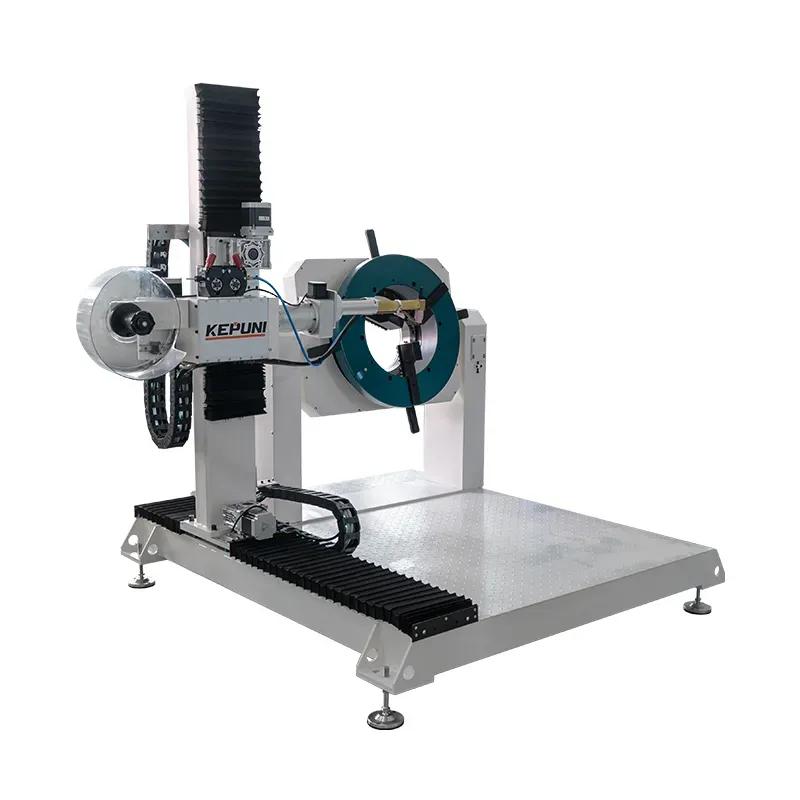
KEPUNI XD-GH Series — a girth weld power supply supplied with a rotary stand, specified for pipe and vessel outside diameters from 20 mm to 960 mm.
A girth welding machine is the system used to complete the circumferential seam that joins two lengths of pipe, two shell courses of a vessel, or one storage tank ring to the next. When those seams run to 960 mm in outside diameter and 25 mm in wall thickness, the engineering problem shifts away from the arc and towards controlled rotation of a heavy workpiece — which is why girth welding specifications are read differently from those of the thin-wall orbital heads most buyers encounter first.
Search behaviour shows where buyers get stuck. A general query for an orbital welding machine returns a very wide spectrum of equipment: closed-head units built for high-purity tubing in pharmaceutical and semiconductor plants, split and open heads used for field service and HVAC pipework, and girth welding systems used for storage tanks, pressure vessels and pipeline spools. These categories are not interchangeable. Treating them as one is the most common cause of specification mismatch in vessel and pipeline fabrication.
This reference guide looks specifically at the girth welding category — using the KEPUNI XD-GH Series as a documented example — and sets its published specification (Pipe/Vessel OD 20–960 mm; wall thickness 2.5–25 mm; current 5–400 A) against the shipbuilding, pressure vessel, storage tank and pipeline scenarios in which such machines are actually deployed.
Why a Heavy Girth Seam Is a Torque and Rotation-Stability Problem
In small-bore orbital welding, the pipe is normally fixed and a compact weld head travels around it. In large-bore girth welding the geometry reverses: the torch position is effectively static while the workpiece rotates on a stand. That reversal is what turns an ordinary welding specification into a torque, alignment and rotation-stability specification.
A girth weld job becomes a high-torque job when three conditions appear together:
- Large outside diameter. Mass and rotational inertia rise with diameter, so the stand has to move a much heavier assembly than it would for small-bore tubing.
- Heavy wall thickness. Thicker sections require more weld passes and higher current, which means longer arc-on time per seam and a longer window in which rotation speed must stay consistent.
- Long, uninterrupted seam runs. The weld quality depends on the arc energy input staying stable around the full circumference, not just at the start.
This is the practical reason why a girth welder is specified as a system rather than as a single head. A power supply without a stand that can carry and turn the workpiece is only half of the answer, and a stand without a power supply matched to the required wall thickness and pass schedule is the other half.
XD-GH Series Specification Overview
The clearest way to evaluate a girth welding system is to read it as a set of boundaries. The KEPUNI XD-GH Series publishes the following specification.
| Parameter | Published specification |
|---|---|
| Product name | Girth Welding Machine |
| Model | XD-GH Series |
| System type | Girth Weld Power Supply + Rotary Stand |
| Pipe / Vessel OD | 20–960 mm |
| Wall thickness | 2.5–25 mm |
| Welding current | 5–400 A |
| Material scope | Steel, Alloy |
| Applicable industries | Shipbuilding, Oil & Gas Pipeline, Storage Tanks, Pressure Vessels |
Read together, these numbers describe a machine intended for shop and fabrication-yard work on pressure-containing components rather than for miniature high-purity tubing. The published diameter window is nearly fifty times wider at the top than at the bottom, and the wall thickness window covers both light shell plate and heavy pressure-part sections.
Reading the Specification: What Each Range Tells a Buyer
Outside diameter 20–960 mm
The lower end of the range addresses small nozzle and branch connections; the upper end addresses large vessel shells and tank courses. A single machine covering both is useful in fabrication shops where the same workstation is expected to handle a vessel shell course and then a small spool, without a second setup. From a procurement standpoint, the number that matters most is the maximum outside diameter in the project, because it is the hard ceiling on what the machine can ever be asked to do.
Wall thickness 2.5–25 mm
The minimum of 2.5 mm indicates the machine can work on relatively thin shell plate. The maximum of 25 mm is the more commercially significant figure for pressure vessel and heavy piping work, because thick-wall joints determine pass count, arc-on time and the amount of heat the workpiece accumulates during the cycle. Buyers comparing offers should confirm that the wall thickness figure they are given applies to the same diameter range they intend to weld, since capability at 25 mm wall and capability at 960 mm outside diameter are separate claims.
Welding current 5–400 A
A current range spanning 5 A to 400 A is characteristic of a system intended for both thin-plate root passes and heavier fill and cap passes on thick sections. The practical implication is that a single power supply can be used across the fabricator's typical mix of light and heavy work, with the procedure rather than the equipment setting the limit.
Material scope: steel and alloy
The published material scope for the XD-GH Series is steel and alloy. This is worth checking early, because material scope determines whether a girth welding system is even eligible for a given fabrication package, independent of diameter or thickness.
Application Fit: Shipbuilding, Pressure Vessels and Storage Tanks
KEPUNI lists four applicable industries for the XD-GH Series: Shipbuilding, Oil & Gas Pipeline, Storage Tanks and Pressure Vessels. Those four categories share a common trait — they all involve circumferential seams on components that are too large to be handed to a compact orbital head.
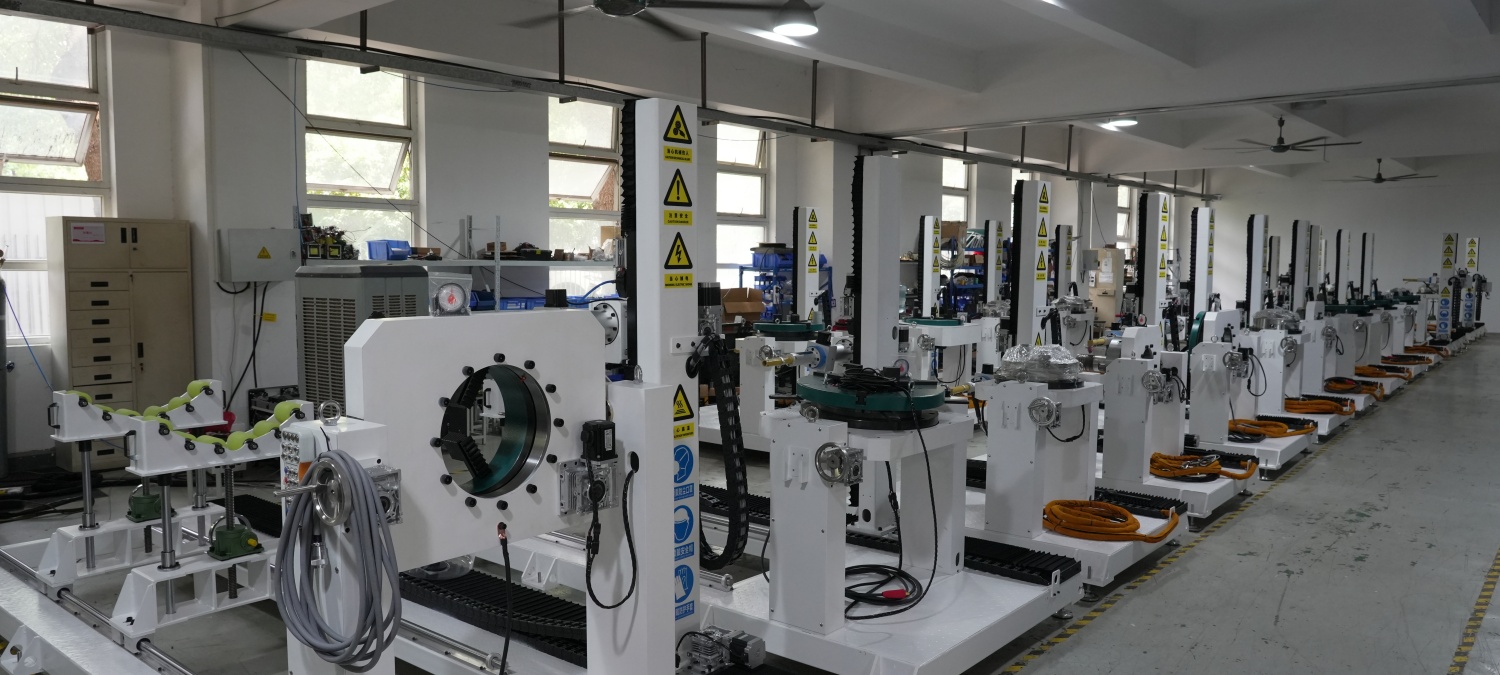
Circumferential (girth) seam welding machine production area at the KEPUNI facility in Shanghai.
Adjacent scenarios in the same product portfolio show how the requirement extends beyond the four headline industries:
- Power generation and boiler work. Boiler tubes, headers and steam piping are welded during shutdown maintenance and new build projects. Documented special requirements for this scenario include ASME Section IX, the Pressure Equipment Directive, and customer-specified codes.
- Chemical and petrochemical construction. Reactors, piping, heat exchangers and storage tanks require corrosion-resistant welds and zero-leak joints in new plant or capacity expansion projects. Documented special requirements include API standards and NACE-compliant requirements, with ATEX / IECEx considerations where required.
- Water treatment and HVAC. Stainless steel pipe welding for water treatment applications is associated with corrosion-resistant joints and long-term reliability, under ISO 9001 quality systems, pressure vessel standards, and WRAS-approved requirements.
The pattern is consistent: the girth welding platform is specified where the joint is circumferential, the component is large, and the governing code imposes documentation and quality requirements that make manual consistency difficult to guarantee.
Traditional Alternatives and the Boundaries of a Girth Welding System
Three conventional approaches compete with a dedicated girth welding system, and each has a legitimate place.
Manual welding on turning rolls. Widely used in low-volume fabrication, where operator skill compensates for the absence of automated control. The trade-off is repeatability: as wall thickness rises, pass count rises, and the influence of individual operator technique on the finished seam grows with it.
Compact closed-head orbital welding machines. The KEPUNI 40/80/120/170 Series closed weld heads cover pipe outside diameters from 6.35 mm to 168 mm with wall thickness up to 3 mm, and are applied in oil and gas, power generation and chemical processing. They are also the family used in high-purity environments, where closed-head designs help limit atmosphere contamination during Gas Tungsten Arc Welding. Their intended envelope is thin-wall work, not 25 mm vessel seams.
Open pipe welding machines. The K Series open pipe welding machine is an open-type orbital welding machine for steel and alloy pipes from 19 mm to over 325 mm outside diameter with wall thickness from 2.5 mm to 13 mm, and the XD-K Series open pipe welding power supply operates from 5 A to 500 A. These serve pipeline construction, petrochemical and shipbuilding work, but their thickness range stops well below heavy vessel sections.
Where the girth welding approach stops. A girth welding system built around a rotary stand assumes the workpiece can be turned. Joints that must be completed in situ on fixed pipe runs, inside confined spaces, or in positions where the head has to travel around a stationary component fall outside that method — open-head or portable orbital equipment is the appropriate category for those joints. Two further boundaries should be checked against project documentation: the published material scope of the XD-GH Series is steel and alloy, and for the smallest high-purity tubing the portfolio addresses sizes down to 3.175 mm through separate head families rather than through the girth platform. Matching the category to the joint is the first decision; matching the specification is the second.
Market Context: Where Girth and Orbital Welding Demand Is Heading
Third-party market research places orbital welding equipment inside a growing but unevenly distributed market. Strategic Market Research estimates the global orbital welding machine market at approximately USD 1.32 billion in 2024, with a projected value of USD 2.07 billion by 2030. The same source identifies oil and gas as the largest application segment in 2024, holding more than one-third of total market share, while high-purity piping for the semiconductor and pharmaceutical industries is identified as the fastest-growing segment on the strength of stringent contamination-control requirements.
Regional data from Grand View Research adds a second layer: Asia Pacific held a 37.0% revenue share of the welding equipment market as of 2025, and the U.S. welding equipment market is projected to grow at a 4.2% CAGR from 2026 to 2033.
One caveat is worth carrying into any commercial analysis. Market sizing for orbital welding diverges by source: Metastat Insights estimates the market at USD 0.83 billion in 2025 against the USD 1.32 billion figure for 2024 from Strategic Market Research. The difference reflects scope — whether a study counts complete systems or is limited to weld heads and power sources. Buyers citing market figures internally should confirm which scope a number represents before drawing conclusions from it.
The directional reading is straightforward. The fastest-growing segments are concentrated in thin-wall, high-purity work, while the largest single segment is heavy oil and gas fabrication. Those two trends pull demand towards opposite ends of the size and thickness spectrum, which is precisely why the category decision described above matters more than headline market growth.
A Procurement Checklist for Girth Welding Systems
| Check | Why it decides the outcome |
|---|---|
| Maximum outside diameter vs. the largest seam in the project | This is a hard ceiling — no procedure can extend it. |
| Minimum outside diameter vs. the smallest nozzle or spool | Determines whether one machine can cover the whole work mix. |
| Maximum wall thickness vs. the heaviest pressure part | Drives pass count, arc-on time and cycle time per seam. |
| Current range vs. the qualified welding procedure | The procedure must sit inside the machine's published current window. |
| Material scope | Published scope is steel and alloy for the XD-GH Series. |
| Rotary stand capacity and synchronization with the power supply | The system is supplied as a power supply plus a stand; both must be sized for the workpiece. |
| Governing code and documentation requirements | ASME Section IX, the Pressure Equipment Directive, API, NACE and customer-specified codes change what evidence is required. |
| Industry scenario alignment | Shipbuilding, storage tank, pressure vessel and pipeline work each impose different handling and inspection conditions. |
Supplier Context: Where KEPUNI Sits as a Manufacturing Entity
KEPUNI is a brand of Shanghai Chuanli Industrial Co., Ltd., a welding equipment manufacturer established in 2014 and headquartered in Shanghai. The company operates a manufacturing facility covering 10,000 m², employs 280 people, and reports an annual production capacity of 3,000 pieces supported by a dedicated R&D team of 36 engineers and technicians. Its main products include orbital welding machines, tube-to-tube-sheet welders, open pipe welders, cold welders and orbital cutters. Export sales account for 100%+ of total revenue, with major markets in Europe, Asia, South America, North America and the Middle East.
For a buyer evaluating girth welding suppliers, the relevant signal in that profile is portfolio breadth rather than size in isolation: a machine catalogue that spans girth welding machines, open pipe welders, closed and split weld heads, and tube-to-tube-sheet welders allows a fabricator to match the equipment category to the joint instead of stretching one machine beyond its published envelope.
Future Outlook
Demand for large-diameter automated girth welding is likely to track heavy fabrication activity rather than consumer-facing manufacturing cycles. With Asia Pacific holding the largest regional share of the welding equipment market and oil and gas remaining the largest single application segment for orbital welding, the pressure vessel, storage tank and pipeline categories that depend on girth welding specifications are expected to remain the volume base of the category, even while the fastest growth is recorded in high-purity thin-wall segments.
For specifiers, the practical implication is that machine selection should be driven by the extremes of the fabrication envelope — maximum diameter, maximum wall thickness, material scope and governing code — and that a single platform covering both small spools and large vessel shells will continue to be valued in shops where flexibility matters more than specialised throughput. Where a fabrication range sits outside a platform's published boundaries, the correct response is to select a different equipment category rather than to accept a marginal specification.
Frequently Asked Questions
What is a girth welding machine?
A girth welding machine is a welding system that completes the circumferential seam joining two sections of pipe or vessel. In the KEPUNI range, the XD-GH Series is a Girth Welding Machine configured as a girth weld power supply plus a rotary stand. Its published specification covers pipe and vessel outside diameters from 20 mm to 960 mm, wall thickness from 2.5 mm to 25 mm, and welding current from 5 A to 400 A, with a material scope of steel and alloy.
What diameter and wall thickness range should a girth welder cover for vessel and pipeline work?
The decision is driven by the extremes of the fabrication, not the average. The XD-GH Series covers outside diameters from 20 mm to 960 mm and wall thickness from 2.5 mm to 25 mm, which spans small nozzle and branch connections at the low end and large vessel shells or storage tank courses at the upper end. If the largest seam in a project exceeds a machine's maximum outside diameter, or the heaviest wall exceeds its maximum thickness, the specification no longer fits regardless of other capabilities.
Which industries specify girth welding machines?
KEPUNI lists Shipbuilding, Oil & Gas Pipeline, Storage Tanks and Pressure Vessels among the applicable industries for the XD-GH Series. Adjacent scenarios in the same product portfolio include power generation and boiler work, where boiler tubes, headers and steam piping are welded during shutdown maintenance or new build projects, and chemical or petrochemical construction, where reactors, piping, heat exchangers and storage tanks require corrosion-resistant welds and zero-leak joints.
How does a girth welding machine differ from a closed-head orbital welding machine?
The two serve different ends of the size and thickness spectrum. A closed-head orbital welding machine such as the KEPUNI 40/80/120/170 Series covers pipe outside diameters from 6.35 mm to 168 mm with wall thickness up to 3 mm, and is applied in oil and gas, power generation and chemical processing, as well as in high-purity environments where closed-head Gas Tungsten Arc Welding designs help limit atmosphere contamination. A girth welding machine works at much larger diameters and heavier walls by rotating the workpiece on a stand rather than orbiting a compact head around a pipe.
What standards apply to vessel and boiler girth welds?
Requirements are set by the project and its governing code rather than by the machine. In power generation and boiler scenarios, documented special requirements include ASME Section IX, the Pressure Equipment Directive, and customer-specified codes. Chemical and petrochemical scenarios add API standards and NACE-compliant requirements, with ATEX / IECEx considerations where required. Water treatment and HVAC stainless steel pipe welding is associated with ISO 9001 quality systems, pressure vessel standards and WRAS-approved requirements. Buyers should confirm the applicable code before matching a machine to a joint.
What drives the cost of a girth welding system?
Cost follows specification scope more than brand alone. The main drivers are the outside diameter range, the maximum wall thickness, the welding current range, and whether the rotary stand is included — because a girth welder is a power supply plus a rotating stand, and both halves have to be sized to the workpiece. Buyers comparing quotations from orbital welding machine manufacturers should confirm that each offer covers the same diameter and thickness limits, the same material scope and the same stand capacity; otherwise the quoted figures are not comparable.
A downloadable brochure covering the KEPUNI welding range, including the XD-GH Series girth welding machine and the wider orbital welding portfolio, is available here: KEPUNI product brochure (PDF).