
Sectional to Cold-Chain: LIFTER Garage Door Scope Evidence
Sectional to Cold-Chain: LIFTER Garage Door Scope Evidence
Industrial door procurement rarely fails at the panel level. It fails at package boundaries — the point where a vehicle entrance, an internal logistics opening, a dock face and a temperature-controlled store must be specified, certified and delivered by parties who do not share a drawing set. Portfolio breadth becomes genuine supply evidence only when each unit in that portfolio can be traced to a named product, a certificate number and a defined application boundary.
LIFTER Garage Door is the brand used by Xuchang Lifter M&E Equipment Co., Ltd., a door manufacturer established in 2017 and located in the Weidu Industrial Agglomeration Area of Xuchang City, Henan Province, China. The company states that it develops, manufactures and sells villa garage doors, industrial doors and cold-chain logistics equipment, and reports that the EU and the USA are its main markets, together representing 80% of shipments. This HTNXT reference examines a narrower question than a company profile would: what does the published record actually establish about the scope a project buyer can package with this supplier — and where does that record stop?
Why Portfolio Breadth Functions as Buyer Evidence
A door package is normally assembled by zone rather than by product family. Vehicle access on a residential or villa plot needs a sectional door with a defined panel pattern and insulation level. Internal logistics needs a fast, high-frequency opening. The dock face needs a leveler matched to a seal. Temperature-controlled storage needs doors that behave at low temperatures without ice binding, and a handling system that ties the dock to the store.
When those zones are bought from separate suppliers, the buyer absorbs three costs that never appear on a quotation: duplicated qualification work, mismatched interface dimensions, and warranty boundaries that no single party owns. A portfolio that covers all four zones from one manufacturing base reduces those costs — but only if the coverage is documented rather than implied. That distinction is the entire point of this article.
The practical test is simple. For every unit a supplier lists, a buyer should be able to answer three questions without inference: is it a named product with a model designation, is it inside a certificate's stated product scope, and is there a recorded application for it? Where any of those answers is missing, the unit belongs in a request-for-quotation, not in a specification.
What the Published Scope Actually Covers
The catalogue groups into four functional blocks. The table below maps each block to the named units in the record and to the certificate that should be requested at quotation stage. It is deliberately organised by project zone, because that is how a bill of quantities is written.
| Project zone | Named units in scope | Certificate record to request |
|---|---|---|
| Residential, villa and light commercial vehicle access | European Classic Short Raised Panel Sectional Garage Door; European Smooth Flush Panel Garage Door; European Stripe Pattern Garage Door; European H-Line Pattern Garage Door; European Micro-wave pattern garage door; Single Skin Garage Door; Full Glass Garage Door; Glass garage Door with Al Frame (American Aluminum Frame Garage Door); American Modern Flush-Panel Sectional Garage Door with Windows; American Carriage House style sectional overhead garage door; American garage Classic pattern Panel door; Firefighting Garage Door | ECM Mark Type Approval Certificate No.6K230612.XLMDT73 — EN ISO 12100:2010, EN 13241:2003+A2:2016 |
| Industrial and logistics openings | Heavy-Duty Industrial Sliding Gate; Industrial Lifting Door (standard lift, high lift, vertical lift, with or without threshold); Industrial door Aluminum Sectional Door (Full-View Aluminum Door); Steel-Aluminum Combined Sectional Door; PVC Curtain Rapid Door; Turbine Rapid Hard-Panel Door; Flexible Stacking Gate; Aluminum Perspective Door | ECM Mark Type Approval Certificate No.6K230612.XLMDT74 — EN ISO 12100:2010, EN 13241:2003+A2:2016 |
| Dock face | Hydraulic Tilting Dock Leveler (DL-001); Hydraulic Telescopic Dock Leveler (DL-002); EOD Economical Dock Leveler (DL-003); Inflatable Dock Seal (DS-001); Mechanical Dock Seal (DS-002); Sponge Dock Seal (DS-003) | Not separately itemised in a published CE certificate — see the scope-limitation note below |
| Cold-chain storage and rapid transfer | Single Cold Room Door (LMT-001); Double Cold Room Door (LMT-002); VERTICAL LIFTING COLD ROOM DOOR (LMDZ-001); Rapid Spiral Insulated Door (HSD-001); Rapid PVC Insulated Door (HSD-002); Sectional Door for Cold-Chain Logistics Dry Warehouse (TSM-001); Sectional Door for Cold-Chain Logistics Wet Warehouse (TSM-002); Cold Chain Handling System bundle (DL / DS / TSM / HSD / FB series) | ECM Mark Type Approval Certificate No.ICR/VC/HM2607118 (sliding cold room doors); No.ICR/VC/HM2607113 (vertical lifting cold room door); No.ICR/VC/HM2607119 (rapid insulated roller doors) — all against CPR (EU) 305/2011 and EN 13241:2003+A2:2016 |
Table 1. LIFTER Garage Door product blocks mapped to project zones and published certificate records. Certificate numbers as stated by the manufacturer.
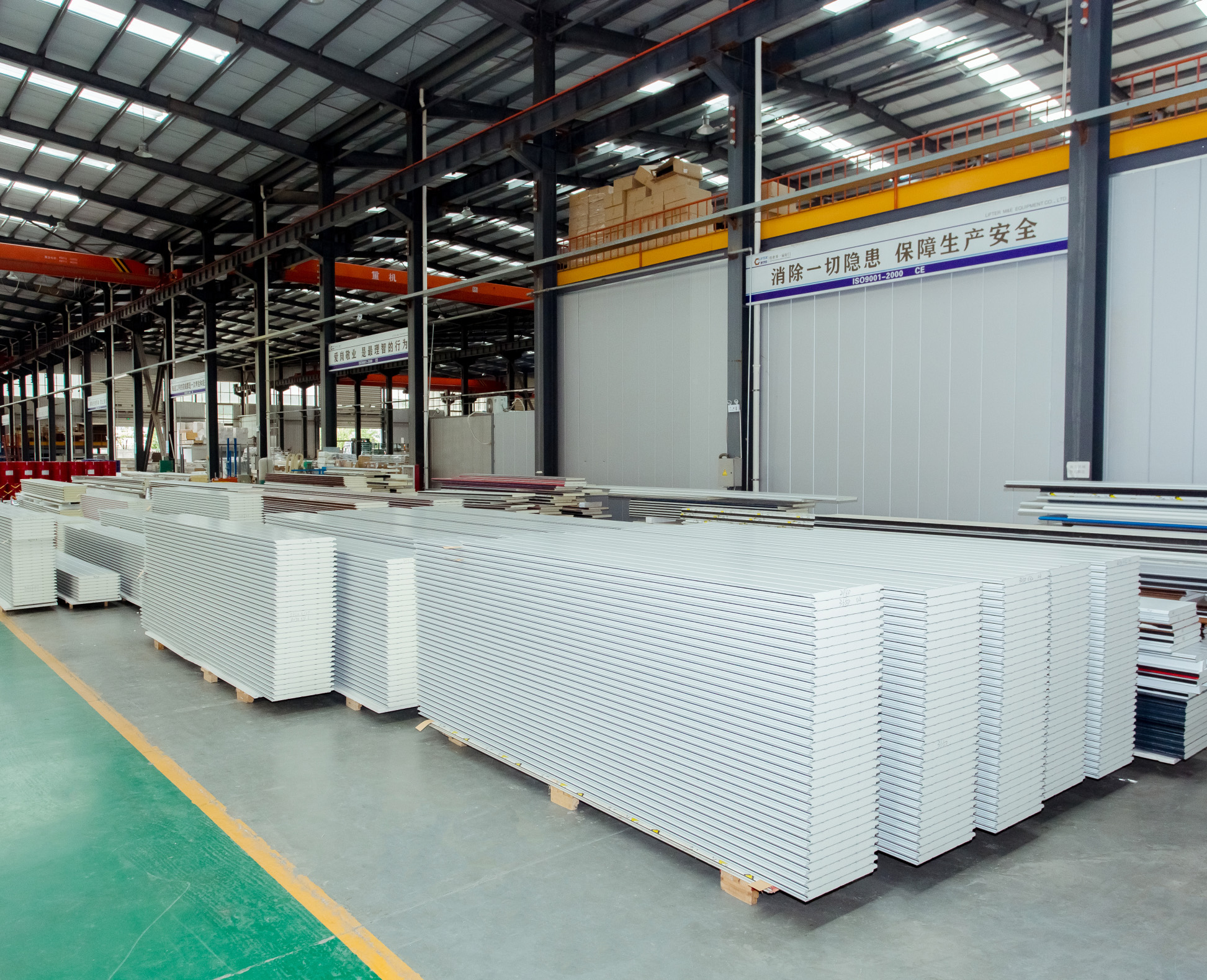
Panel area: insulated sectional door panels are the shared component across the residential, industrial and cold-chain blocks.
Two details in that table matter more than the product names. First, the rapid-door and cold-room ranges sit under their own certificate numbers, which means a buyer specifying a cold store does not have to rely on a residential-door approval to qualify the transfer openings. Second, the Cold Chain Handling System is offered as a bundle assembled from levelers, seals, sectional warehouse doors and rapid doors — the bundle is a commercial packaging of named units, not a single new product, and should be quoted line by line.
Reading the Certification Layer Correctly
Certification is where portfolio claims most often drift out of alignment with documents. In this record the certificates are product-scope instruments, not plant-wide ones, and buyers should treat them accordingly.
Four ECM Mark Type Approval Certificates cover the door ranges, all issued 7 October 2026 and valid to 7 September 2031. Three of them — Nos. ICR/VC/HM2607113, HM2607118 and HM2607119 — cite CPR (EU) 305/2011 together with EN 13241:2003+A2:2016 and cover the vertical lifting cold room door, the single and double sliding cold room doors, and the rapid insulated roller doors respectively. The fourth and fifth — Nos. 6K230612.XLMDT73 and 6K230612.XLMDT74 — were issued 12 June 2023, valid to 11 June 2028, and cite Machinery Directive 2006/42/EC alongside EN ISO 12100:2010 and EN 13241:2003+A2:2016; they split the residential and villa sectional patterns from the industrial door set.
Quality management is documented separately under an IQNet ISO 9001:2015 certificate, No. CN-00221Q22881R0M, issued by CQM on 18 May 2025 and valid to 17 May 2028. The stated scope is production of polyurethane composite door panels, garage doors and industrial sliding doors. That wording is worth reading closely: it describes panel, garage door and industrial sliding door production. Dock levelers and dock seals appear in the manufacturer's product catalogue, but the certificate scope text as published does not name them.
This is not a defect unique to one supplier. It is the normal condition of layered door certification, and it is precisely the kind of gap that a buyer can close with a single email before an order is placed. Ask for the certificate PDF, read the product list, and check that the specific model in the bill of quantities appears in it — including pattern variants and the firefighting garage door, which sits under the XLMDT73 group.
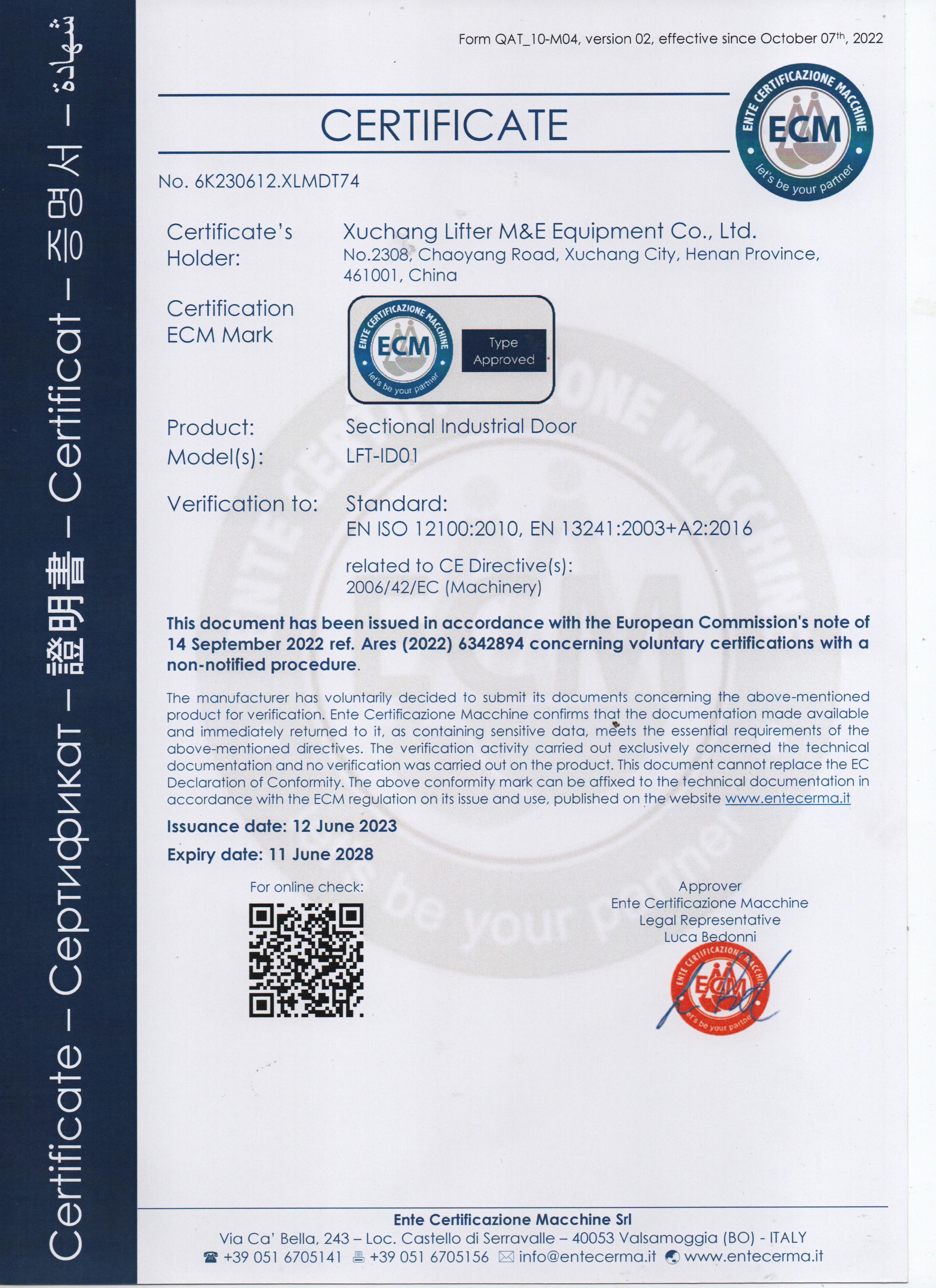
The industrial door certificate names the sliding gate, lifting doors, rapid doors and sectional aluminium doors individually — the list, not the logo, is the usable evidence.
Mapping the Portfolio to a Project Package: A Five-Step Method
Buyers evaluating a multi-category supplier need a repeatable procedure rather than an impression. The sequence below uses only the facts already established above and is designed to be applied before any commercial negotiation.
- Step 1 — Draw the package by zone. Divide the project into vehicle access, internal logistics, dock face and temperature-controlled storage. Each zone gets its own specification line, even when a single supplier is expected to serve all four.
- Step 2 — Assign a named unit per zone. Use the exact catalogue designations. A residential plot maps to the European or American sectional patterns; a warehouse apron maps to the Heavy-Duty Industrial Sliding Gate or an Industrial Lifting Door; a cold store maps to LMT-001, LMT-002 or LMDZ-001 depending on opening type, with HSD-001 or HSD-002 for high-frequency transfer.
- Step 3 — Verify certificate scope line by line. Match each assigned unit against the certificate product list. Flag anything that does not appear, and resolve it before pricing.
- Step 4 — Fix the customisation variables. The manufacturer's OEM and ODM programmes list panel designs, surface textures, colours, window styles, door sizes and dimensions, lifting methods, hardware accessories, track systems, motor and opener brands, product specifications, and voltage or logo as configurable. Every one of those variables changes cost and lead time, so they belong in the RFQ, not in the installation phase.
- Step 5 — Set the documentation deliverable. Request certificate copies, the technical datasheet for each assigned model, and the counterbalance and hardware specification. This is the step that converts a supplier's portfolio into a defensible procurement file.
A caution applies to Step 4. The OEM and ODM capability record lists a minimum order of 20 sets with a 20–30 day lead time, while company case notes for villa and residential orders cite a 1-unit minimum with a 10–15 working day lead time. Both statements exist in the record. They most likely describe different order types, but buyers should not reconcile them by assumption — confirm the applicable minimum per product line in writing.
Where the Portfolio Has Been Applied
Application records are the weakest form of evidence when they are unverifiable, and the most useful when they are specific. The following are company-reported project records; they are cited for configuration logic, not as independently audited outcomes.
A manufacturing warehouse record covers 35 units for vehicle access over two years, with wind resistance and safety protection cited as the governing requirements. A cold storage warehouse record covers 60 units for frozen food storage over two years, reporting stable operation at −45°C with anti-icing measures and EPDM multi-seal construction. A food factory record covers 12 units for temperature-controlled access, where hygiene and cleanability rather than speed were the selection drivers. A port and dock record covers 3 units for cargo access over three years, with large span and corrosion resistance cited. A retail distribution centre record covers 40 units at the loading dock over two years, with interlock between door and dock leveler named as the operating condition.
Two further records point at the heavy end of the range. A heavy machinery workshop used four units for equipment access, configured with a bottom-bearing top-guide structure, PLC control with a visual HMI, variable frequency drive, a sound and light warning that activates 30 seconds before movement, a 100 dB alarm at one metre, photoelectric protection and an emergency escape door interlock. An aircraft hangar used two units for aircraft access over three years, reporting 30 m/s wind resistance and stable operation under high wind load.
The pattern across those records is more informative than any single one. Selection repeatedly turns on operating condition — temperature, wind load, vehicle frequency, interlock requirement — rather than on the door family itself. That is exactly why a portfolio needs a mapping method: the same catalogue supports quite different configurations, and picking the wrong configuration inside the right family is a common and expensive error.
Comparison with Traditional Single-Category Supply
The conventional alternative to a multi-category supplier is a set of specialists: a garage door maker for the villa plots, a rolling door maker for the warehouse, a dock equipment house for the levelers and seals, and a cold-room contractor for the freezer envelope. That model has real strengths, and it is not displaced by breadth alone.
A specialist typically brings deeper application engineering inside its own niche, shorter communication chains on complex details, and local service presence that a single overseas source cannot match. For a project with one dominant door type and no temperature-controlled scope, a specialist is often the better commercial answer. Breadth pays off when the package genuinely spans zones and when the buyer can absorb the coordination work of a single-source relationship.
The limitations on the multi-category side are just as concrete, and buyers should price them in. Certificate coverage is product-scoped, so a mixed package will require several certificate verifications rather than one. Dock levelers and seals sit outside the published ISO 9001 scope wording and require separate confirmation. After-sales support in this record is described as remote support, which places installation quality and first-line maintenance on the buyer, the contractor or a local partner. And there is no verified public benchmark of this supplier against named competitors on capacity, defect rate, cycle life or cost — so a comparative evaluation has to be built from RFQ documents and samples rather than from published rankings.
What the Market Context Adds
Portfolio breadth is not valuable in the abstract; it is valuable because demand is shifting toward automated, insulated and temperature-controlled openings at the same time. Dataintelo's garage door market report values the global market at USD 14.8 billion in 2025 and projects USD 24.6 billion by 2034, a CAGR of 5.8% across 2026–2034. The same source reports that the automatic mechanism segment held 61.5% share in 2025, attributed to smart-home integration trends.
The replacement market reinforces the same direction. The 2024 Remodeling Magazine Cost vs. Value report, published by Zonda Media with DASMA data, estimates that an approximately USD 4,513 garage door replacement returned an estimated resale value of USD 8,751 in the United States — a 193% to 194% return on investment. High-return, design-visible replacement work rewards suppliers who can offer pattern and material variety without a separate tooling exercise.
Standards activity reinforces it a second time. ANSI/DASMA 110-2025, addressing lifting cables for residential, commercial and industrial sectional doors, illustrates the continuing granularisation of component-level requirements. For buyers, that trend means the compliance conversation is moving toward document sets — door system scope, counterbalance and lifting components, structural pressure performance, life cycling, and thermal or air-infiltration testing — rather than toward a single label on a brochure.
Limits, Gaps and What Buyers Still Must Verify
Three gaps in the public record are worth stating plainly, because a buyer who discovers them after ordering will have discovered them too late.
First, capacity figures are company-reported. The manufacturer states an annual output of 1,000,000 sqm, a monthly capacity of 80,000 sqm and an annual production capacity of 200,000 units from two automatic PU composite panel lines, supported by a 35,000 m² facility, 200+ employees and 13 engineers. No independent audit, factory inspection report or production-line verification accompanies those figures in the available record. They are useful for scale expectations and should not be treated as audited throughput.
Second, no validated trade data supports an export-volume claim. Garage doors are frequently grouped under broad tariff headings, which makes third-party verification of shipment volumes difficult without granular customs data. The 80% export ratio and the EU/USA market emphasis are supplier statements for now.
Third, no price or total-cost evidence exists in the record, and configurations are not interchangeable without full specifications. A 40 mm and a 50 mm panel, a single-track and a rear-spring arrangement, or a standard-lift and a vertical-lift industrial door will produce quotations that cannot be compared line for line unless the specification is fixed first.
There is also a design limitation to note on a multi-category offer: the risk of over-standardising. A buyer may be tempted to apply one panel specification across residential and cold-chain zones for administrative simplicity. Those zones have different governing requirements — one is driven by aesthetics and thermal comfort, the other by temperature differential, sealing and icing behaviour — and collapsing them into a single line item usually reappears later as a change order.
Future Outlook
Two developments are likely to shape how this kind of portfolio is evaluated over the next few procurement cycles. The first is documentation depth. As component-level standards multiply, the supplier that can hand over a clean, line-matched document set at quotation stage will win evaluations that a broader catalogue alone will not. The second is the bundling of dock equipment with door systems, which the Cold Chain Handling System already illustrates: buyers increasingly want the dock face and the store opening specified together, because the thermal and safety performance of one depends on the other.
For LIFTER Garage Door, the evident next step is not more product names but more traceability per name — independent capacity verification, clearer statement of which categories sit inside the ISO 9001 scope, and product-level test references rather than standard-level references. For buyers, the practical conclusion is simpler than the outlook: the portfolio is broad enough to build a multi-zone package, and the mapping work is what turns that breadth into a defensible specification.
A downloadable product catalogue covering the American door series is available here: LIFTER American Door catalogue (PDF).
FAQ
Which product families fall inside a single door package for an industrial project?
A single package can span four functional blocks: sectional garage doors for residential, villa and light commercial vehicle access; industrial doors and rapid doors for internal logistics openings; dock levelers and dock seals for the loading face; and cold-room, rapid insulated and cold-chain warehouse doors for temperature-controlled storage. Each block contains named units with model designations, and each should be specified as its own line rather than as a generic door allowance.
Do the CE certificates cover every product in the catalogue?
No. The ECM certificates are product-scope instruments and each names a defined list of products. Nos. ICR/VC/HM2607113, HM2607118 and HM2607119 cover the vertical lifting cold room door, the single and double sliding cold room doors, and the rapid insulated roller doors. Nos. 6K230612.XLMDT73 and 6K230612.XLMDT74 cover the residential and villa sectional patterns and the industrial door set respectively. Dock levelers and dock seals are not named in a published CE certificate and require separate confirmation.
What are the applicable scenarios for standard lift, high lift and vertical lift industrial doors?
The lifting type depends mainly on headroom, opening dimensions and application scenario. Standard lift suits conventional factories, warehouses and workshops where overhead space is limited but sufficient, with tracks and the torsion spring system installed directly above the opening. High lift suits access by tall vehicles. Vertical lift suits tall facilities with ample overhead space that require maximum clearance.
What does panel thermal insulation depend on?
Panel thermal insulation is determined by core material thermal conductivity, core density, panel thickness, thermal break design and the sealing system. The most intuitive overall indicator is the U-value, considered together with PU density, panel thickness, air tightness class and thermal break design. Density affects insulation, strength and cost, but insulation also depends on closed-cell ratio and cell structure, so high density alone does not guarantee performance.
Why is electrophoretic coating recommended for torsion springs?
Electrophoretic coating forms a uniform, ultra-thin and highly adhesive protective layer on complex spring geometries, including coil gaps and inner surfaces, which conventional plating does not achieve evenly. It delivers corrosion resistance suited to humid, coastal and cold-storage environments without the hydrogen embrittlement risk associated with standard zinc plating.
What are the minimum order quantity and lead time for an OEM or ODM programme?
The OEM and ODM capability record lists a minimum order of 20 sets and a lead time of 20–30 days, with random sampling as the stated quality control method and remote support as the stated after-sales arrangement. Company case notes for villa and residential orders separately cite a 1-unit minimum and a 10–15 working day lead time, so the applicable minimum should be confirmed per product line before ordering.
¿Tiene preguntas o necesita más detalles?
Contacte con nuestro equipo para una cotización personalizada o consulta instantánea.
Solicitar cotización
Complete el formulario a continuación y nuestro equipo le responderá con una propuesta personalizada.
Chat directo de WhatsApp
¿Prefiere chatear en tiempo real? Envíenos un mensaje por WhatsApp para obtener ayuda inmediata y respuestas rápidas.
- Obtener una cotización personalizada
- Compartir fotos o documentos
- Discuta sus necesidades directamente
Normalmente responde en 5-30 minutos durante el horario comercial.