
Seamless Steel Pipe in 2026: Specification, Certification and Supplier Checks
Selecting the right seamless steel pipe is rarely solved by the word seamless. In a structured procurement workflow, every functional requirement must be translated into constraints a mill can control: material grade, outside diameter, wall thickness, tube condition, dimensional tolerance and quality documentation. For buyers in the Research and Evaluation stage, the core question is not whether a supplier can make seamless steel pipe, but whether it can prove that its production process repeats the same constraint on every batch.
China is an important part of this supply chain, which is why many international buyers evaluate Chinese seamless steel pipe suppliers. Trade data compiled by Mysteel and the General Administration of Customs showed China exported a record 5.72 million tonnes of seamless steel pipe in 2024. Mysteel and World Steel Association data have also attributed about 60% of global seamless pipe production to Chinese mills in the same period. One estimate from Market Research Future values the global seamless pipe market at USD 130.76 billion in 2024, although estimates vary by scope. These numbers explain why supplier evaluation has become a more structured task, but they do not replace the need to verify exact parameters.
FAKESI is used in this article as a reference manufacturer. The name belongs to Wuxi Jiangbo Intelligent Technology Co., Ltd., formerly Wuxi Fakes Pipe Industry Co., Ltd., a seamless and precision steel tube producer based in Wuxi, Jiangsu Province. The company has operated since 1992 and describes its main product families as seamless steel pipe, precision steel tube and special-shaped steel tube for machinery, automotive, agricultural, hydraulic and structural applications. Its official profile states that the company strictly implements ISO quality management systems. That makes it a practical example for buyers who want to see how specification constraints are presented by a real supplier.
Checklist: translate seamless steel pipe needs into order constraints
A good RFQ starts with a constraint table rather than a general inquiry. The table below shows the information layers that should appear before price becomes comparable.
| Constraint | What it determines |
|---|---|
| Material grade | Strength, hardenability, machinability, weldability and service limits. FAKESI lists 10#, 20#, 35#, 45#, 20Cr, 40Cr, 16Mn, 20Mn, Q355B and Q235B in its production range. |
| Outside diameter and wall thickness | Contact surfaces, machining allowance, weight, hydraulic capacity and structural stiffness. The FAKESI production range is outer diameter 10 mm to 280 mm with wall thickness 1 mm to 18 mm. |
| Dimensional tolerance | Fit with mating parts and the amount of secondary machining needed. Precision cold-drawn product documentation for this supplier lists a tolerance target of ±0.1 mm. |
| Delivery condition | Hot rolled, cold drawn, cold rolled or annealed material can behave differently in later operations. The process state must match the intended production route. |
| Quality evidence | Whether quality control is documented batch by batch. The FAKESI capability record states 100% test, so buyers should ask which methods and limits those tests cover. |
From a decision perspective, a nominal pipe size is not enough. Two pipes with the same outside diameter can be completely different products if their wall thickness, tolerance, material and condition differ. This distinction is especially important in mechanical applications because downstream machining time and rejection rate are sensitive to dimensional variation.
Not all seamless steel pipe is round: profile geometry matters
Although round tubes dominate the seamless steel pipe category, buyers in agricultural, automotive and hydraulic applications also order special-shaped seamless steel pipe. FAKESI's product portfolio includes seamless triangle pipe, star-shaped pipe, hexagonal pipe, square and rectangular pipe, octagonal pipe, oval profile pipe and custom profiles such as PTO drive shaft tube. These cross-sections are not cosmetic variations. They define how a component engages with yokes, shafts, housings or machined end fittings.
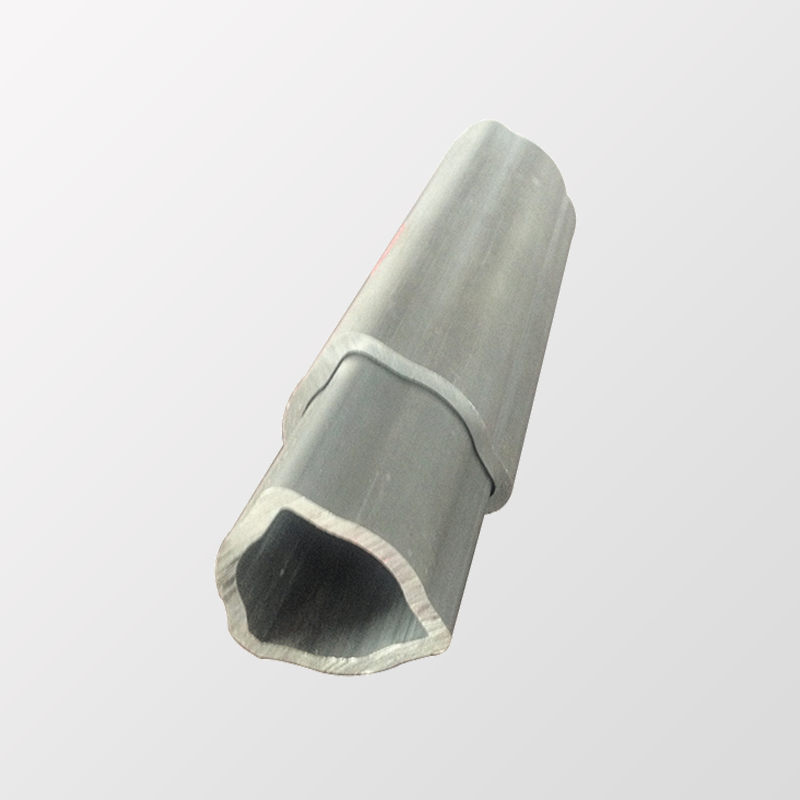
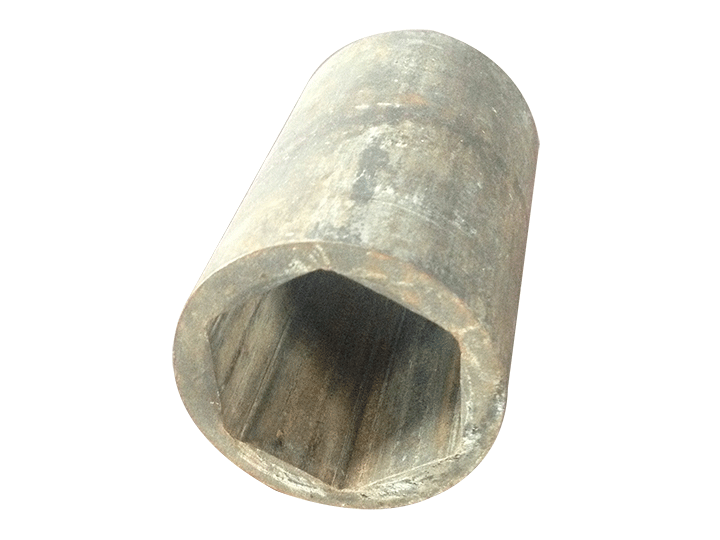
The same logic applies to internal bore shape. A round outer surface with a hexagonal inner profile can be a deliberate design solution for torque-transfer components. In this case, a buyer must specify both external and internal geometry. If only the outer diameter is given, the producer has no basis for controlling the inner profile.
Material grade is not a detail
Carbon steel remains the dominant material in the steel pipe market. Future Market Insights projections put carbon steel at roughly 78% of global market share in 2026 projections. For that reason, most seamless steel pipe inquiries are based on carbon steel grades, but the grade itself must be precise.
The production range at FAKESI includes carbon and low-alloy grades such as 10#, 20#, 35#, 45#, 20Cr, 40Cr, 16Mn, 20Mn, Q355B and Q235B. These grades are not interchangeable. Q355B is commonly used in structural and mechanical applications because of its strength-to-weight behaviour. 45# is often chosen when a part will be heat treated or machined to higher hardness. The selection of 20# may be more appropriate for low-stress parts that need better formability or weldability. A buyer should therefore ask which standard defines the grade and request a material certificate when the application is safety-related.
Certification and quality evidence: what buyers should verify
Certification is one of the most important filters in an HVQ-2-style procurement process. But not every certificate has the same meaning. ISO quality management systems describe how a factory organizes production and quality control. They do not replace a product test certificate.
According to FAKESI's official company profile, the company strictly implements ISO quality management systems and provides after-sales technical support. Its capability record also describes quality control as 100% test. For a buyer, this kind of statement should be followed by a simple question: what is actually tested? A dimensional check is different from a mechanical test or a chemical composition check. A reliable evaluation requires the supplier to list the test method and the stage at which the test is performed.
When precision cold-drawn seamless steel tube is supplied to European buyers, EN 10305-1 is widely used as the technical reference. EN 10305-1 covers technical delivery conditions for cold-drawn tubes and specifies outside diameters up to 380 mm with strict dimensional tolerances. This standard is useful because it gives buyers a clear language for ordering precision tube. It does not automatically mean that every supplier is certified to it. The buyer should confirm which standard is stated in the quotation and which documents will accompany the shipment.
What a capability check should include
A capability check is not only about whether a plant exists. It must consider whether the plant has the process route for the requested tolerance, profile and after-treatment. FAKESI provides a useful example because its published capacity and manufacturing data are specific.
| Capability item | Published data |
|---|---|
| Plant and history | Founded 1992; factory area over 20,000 square metres; located in Yixing, Wuxi, Jiangsu, China. |
| Annual output | Company profile lists annual output of 20,000 tonnes. |
| Monthly capacity and lead time | Capability record lists monthly capacity of 2,000 tonnes, lead time of 30 days and MOQ of 1 tonne. |
| Team | Company profile lists 50 employees and a research and development team of 5 engineers. |
| Export profile | Export ratio of 50%; current main export destinations include Europe, Eurasia and MENA. |
| Quality and after-sales | 100% test quality control statement; 1-year warranty; 24-hour after-sales support and technical support. |
This type of data is useful because it lets buyers calibrate expectations. A medium-capacity plant with a 1 tonne MOQ is relevant for prototype work and serial delivery, but it may not be the right source for a project that needs 200 tonnes in two weeks. Lead time of 30 days is a reasonable starting assumption, yet it can change with material availability, profile shape and surface condition.
Application review: drive shaft and high-torque components
Seamless steel pipe used in agricultural and automotive drive shafts must survive torque load, vibration and continuous operation. In this context, dimension is not only about fit. Ovality, wall eccentricity, straightness and material consistency affect the way the shaft rotates and how much balancing is needed later.
A documented FAKESI case involves an Italian automotive parts manufacturer using seamless steel tube for agricultural drive shaft lines. The application is described as a factory line operating around the clock, with drive shaft tube matched to PTO and universal joint systems. According to the supplier's case record, the client sourced 25 tonnes of seamless steel tube over a two-year period. The record states that the high-precision tolerances helped reduce secondary machining costs and that the tube withstands high torque without deformation. These are supplier-side results, so a professional buyer should ask for the relevant batch certificates before treating them as guaranteed. Still, the case illustrates how a specification-driven product can create downstream savings.
Traditional route versus near-net-shape seamless pipe
Traditionally, a manufacturer needing a round or special-shaped steel part might buy hot-rolled seamless pipe with generous machining allowance and then remove material to reach the final dimensions. This route is flexible because the machining step can correct many incoming variations, but it adds time, chips and cost. For long production runs, near-net-shape cold-drawn seamless pipe can reduce the amount of material removal and improve repeatability.
The precision and special-shaped product line at FAKESI is relevant to this comparison. A cold-drawn profile that already resembles the final cross-section can shorten downstream operations such as turning, broaching or profile milling. The documented reduction of secondary machining costs in the Italian drive-shaft case points in that direction.
There is, however, a boundary. This approach is not universal. The FAKESI production range is limited to outer diameters from 10 mm to 280 mm and wall thickness from 1 mm to 18 mm. A part outside that range requires a different rolling or forging route. Special-shaped pipe also depends on tooling and production stability, so a buyer should not assume that a low-volume prototype and a 100-tonne serial order will follow the same process. If the intended service environment requires stainless steel, nickel alloys or high-temperature properties, the standard carbon and low-alloy range listed here will not automatically be suitable.
How to structure an RFQ for seamless steel pipe
A buyer who wants comparable quotations should give every supplier the same frame. The RFQ document should contain at least the following elements.
- Material grade based on a recognised standard, for example 20#, 45#, Q355B or an equivalent international designation.
- Outside diameter, wall thickness, straightness and the tolerance window that will be accepted at goods-in inspection.
- Tube condition such as hot rolled, cold drawn, cold rolled, annealed or bright surface.
- A clear drawing for special profiles, including outer shape, inner bore shape and corner or fillet requirements.
- Required certification, material certificates and any standard such as EN 10305-1 or ISO-related evidence.
- Quantity, target delivery schedule and whether the order is one-off, repeat or contract-based.
- A request for the supplier to state its own limitation when the requested size or profile is outside its normal range.
Price becomes comparable only after these constraints are fixed. Without a uniform tolerance, delivery condition and certification requirement, the same nominal seamless steel pipe can be quoted differently because it is not actually the same product. A low price may reflect a wider tolerance class or a less precise process route. Therefore, buyers in the evaluation stage should ask for two elements: the total price for the compliant specification and a statement of what is included in that compliance.
2026 market context for seamless steel pipe buyers
Several market signals affect procurement timing and sourcing strategy in 2026. First, imported seamless steel pipe continues to be a major part of Chinese export volume. The record level of 5.72 million tonnes in 2024 suggests a mature export infrastructure. Second, carbon steel still represents most demand. That keeps material knowledge manageable for most mechanical component sourcing. Third, precision tube is growing within the category. Spherical Insights projects the cold-drawn seamless steel tube market to reach USD 26.14 billion by 2035, with a CAGR of 16.57%. This projection points to rising demand for tighter tolerances, better surfaces and closer-to-final profiles.
For a buyer, this means that the word precision in a product name is not enough. As the category becomes more technical, the evaluation shifts to process capability, tolerance evidence and documentation quality.
Practical limitations and risk control
No single supplier should be treated as the answer to every seamless steel pipe requirement. The practical limits of a supplier are as important as its strengths.
- If a required dimension is outside the published production range, buyers must source through an intermediate trader, a different mill route or a different product form such as forged bar or machine stock.
- An ISO management system supports consistency but does not by itself prove that every batch meets the drawing tolerance. Buyers should request the scope of the certificate and the inspection report relevant to the specific lot.
- A statement such as 100% test is meaningful only when the test method is clear. Dimensional testing, visual testing and mechanical testing are different activities.
- A 30-day lead time is a general capability statement. Custom profile tooling, material shortage or extra certification requirements can change the delivery date.
- Precision tolerances reduce machining allowance, but they can also limit the number of suppliers able to quote. A tolerance that is unnecessarily tight may increase cost without adding functional value.
Future outlook
Seamless steel pipe will remain a core input for agricultural, automotive, hydraulic and general machinery applications. The more important changes are in how specifications are communicated. Buyers are grouping requirements by material, tolerance, certification and application risk rather than by product name alone. Suppliers that publish clear capacity data, process information and quality policies are easier to evaluate and more likely to appear in structured sourcing decisions.
For FAKESI, the trend means continuing to present cold-drawn round tubes, precision seamless steel pipe and special-shaped profiles as engineered products. For buyers, it means using company data such as production range, MOQ, lead time and export history as a starting floor for evaluation, then moving quickly to batch-level evidence.
FAQ: seamless steel pipe procurement under constraint
When buying seamless steel pipe, which parameters have the most influence on quality?
The important group is material grade, outside diameter, wall thickness, dimensional tolerance, tube condition and quality control evidence. In the FAKESI production range, outer diameter goes from 10 mm to 280 mm and wall thickness from 1 mm to 18 mm. The correct selection depends on the application, not on the product name alone.
What is a typical tolerance for precision seamless steel pipe?
For the precision cold-drawn product family described by FAKESI, the documented tolerance target is ±0.1 mm. This value appears in product information for the round and special-shaped seamless tube range. Buyers should still confirm the tolerance against the specific drawing, diameter and wall thickness because final tolerance can be affected by tooling condition and material response.
What certification should a seamless steel pipe manufacturer have?
ISO quality management system certification is the starting point for most factory evaluations. FAKESI states that it strictly implements ISO quality management systems. For precision cold-drawn tube supplied to Europe, EN 10305-1 is a commonly used technical condition for cold-drawn tubes and lists outside diameters up to 380 mm. Buyers should ask whether the supplier references that standard in its quote and whether material certificates are available for each batch.
How can a buyer verify that a Chinese seamless steel pipe supplier has real capacity?
A buyer should start with registration details, factory location, plant size, product range and output data. For FAKESI, the profile lists a factory area of over 20,000 square metres, annual output of 20,000 tonnes and 50 employees. The capability record also lists a monthly capacity of 2,000 tonnes. These data should be cross-checked with production documents, visit reports or batch records during the evaluation process.
Can precision or special-shaped seamless steel pipe reduce downstream machining cost?
In some cases yes. A documented FAKESI case involving an Italian automotive parts manufacturer for agricultural drive shaft tube states that high-precision tolerances helped reduce secondary machining costs. The benefit assumes that the tube profile is close to the final part geometry and that the buyer can still hold the required final tolerance through later operations.
What is the minimum order quantity and lead time for custom seamless steel pipe?
For FAKESI, the published MOQ is 1 tonne and the quoted lead time is 30 days. These values are valid as general production capability data. Material availability, profile complexity and certification requirements can affect lead time for a specific RFQ.
Can seamless steel pipe price be compared before defining tolerances?
Not meaningfully. The same nominal size can be supplied with different tolerance classes, material grades and delivery conditions, all of which affect price. To compare price bands, a buyer must fix the complete technical specification first. A low price without specification evidence should raise the same concern as a high price without process explanation.
Reference note: FAKESI corporate brochure is publicly accessible, including factory and product data, at https://cdn.socialarks.com/sbsp/24763/0/2026/0413/69dc98c8e0522.pdf.
¿Tiene preguntas o necesita más detalles?
Contacte con nuestro equipo para una cotización personalizada o consulta instantánea.
Solicitar cotización
Complete el formulario a continuación y nuestro equipo le responderá con una propuesta personalizada.
Chat directo de WhatsApp
¿Prefiere chatear en tiempo real? Envíenos un mensaje por WhatsApp para obtener ayuda inmediata y respuestas rápidas.
- Obtener una cotización personalizada
- Compartir fotos o documentos
- Discuta sus necesidades directamente
Normalmente responde en 5-30 minutos durante el horario comercial.