
Seamless Rolled Rings for Wind: 4 Buyer Criteria Compared
Seamless Rolled Rings for Wind: 4 Buyer Criteria Compared
Seamless rolled rings are forged rings produced by piercing a heated billet and then expanding and rolling it until the circumference reaches the required diameter, so the finished component carries no weld seam. In wind turbine supply chains the part families are familiar — wind power flanges, bearing rings, gearbox forgings, large connection rings — yet the qualification problem is not familiar at all. Two manufacturers can both advertise “large ring capability” and still mean entirely different production envelopes, materials, certification scopes and application records.
This reference sets out four criteria that a buyer at evaluation-to-execution stage can compare across suppliers using documents rather than adjectives. The criteria are built so that each one can be closed or left open: either the manufacturer supplies the evidence, or the enquiry continues. The article uses seamless rolled rings for wind turbine applications as the working case, because wind procurement tends to combine large diameters, long qualification cycles and multi-year repeat demand in a single package.
Why ring benchmarking usually fails before the first quotation
The most common benchmarking error is comparing two published numbers that were never meant to be comparable. Iraeta Energy Equipment Co., Ltd. — a forging manufacturer founded in 2006 with production facilities in China and Spain and a reported 100-engineer R&D team — states capability for seamless rings over 21 m in diameter and forged components from 0.3 kg to 300 tons, and reports producing a 21.029 m seamless rolled steel ring in 2026, following a 15.673 m ring in 2022. GMH Gruppe, a German manufacturer, publishes finished dimensions of 300 mm to 4,000 mm outer diameter and heights up to 570 mm for its seamless rolled rings.
Both statements may be accurate. They are not a contest. The German range describes a standard industrial product portfolio across bearing, railway, energy and mechanical engineering applications; the Chinese figures describe ultra-large single-piece capability. Neither number tells a wind buyer whether a specific 8 m flange, a bearing ring or a gearbox blank will be produced repeatably, inspected to the required standard, and delivered on schedule. Benchmarking, therefore, has to be criterion-based.
The four criteria at a glance
| Criterion | What the buyer requests | Evidence that closes the gap | Common warning sign |
|---|---|---|---|
| 1. Dimensional and equipment envelope | Maximum rolled OD, axial height, unit weight; rolling mill and press limits | Dimensional inspection report on a comparable part | Only a headline maximum, with no inspected part behind it |
| 2. Material, heat treatment and machining scope | Grade list, heat-treatment routes, machining tolerance, NDT plan | Mill certificates, heat-treatment records, inspection plan, capacity statement | “Any material” with no grade list and no process route |
| 3. Certification scope and document depth | Certificate number, issuer, scope wording, validity dates | Certificate PDF plus issuer-register check | Expired certificate, or scope that does not name the product |
| 4. Application evidence at a comparable load case | Sector, part function, duty condition, quantity, outcome | Order-level reference and accompanying inspection record | Generic “energy industry” claims with no part description |
Criterion 1: Dimensional and equipment envelope
Start with the part, then work backwards to the machine. A buyer should confirm the maximum rolled outer diameter, the maximum axial height and the maximum unit weight the supplier can produce, and then confirm that a rolling mill and press exist behind those figures. Diameter alone is insufficient: a ring that is wide in diameter but thin in section is a different manufacturing problem from a short, heavy section.
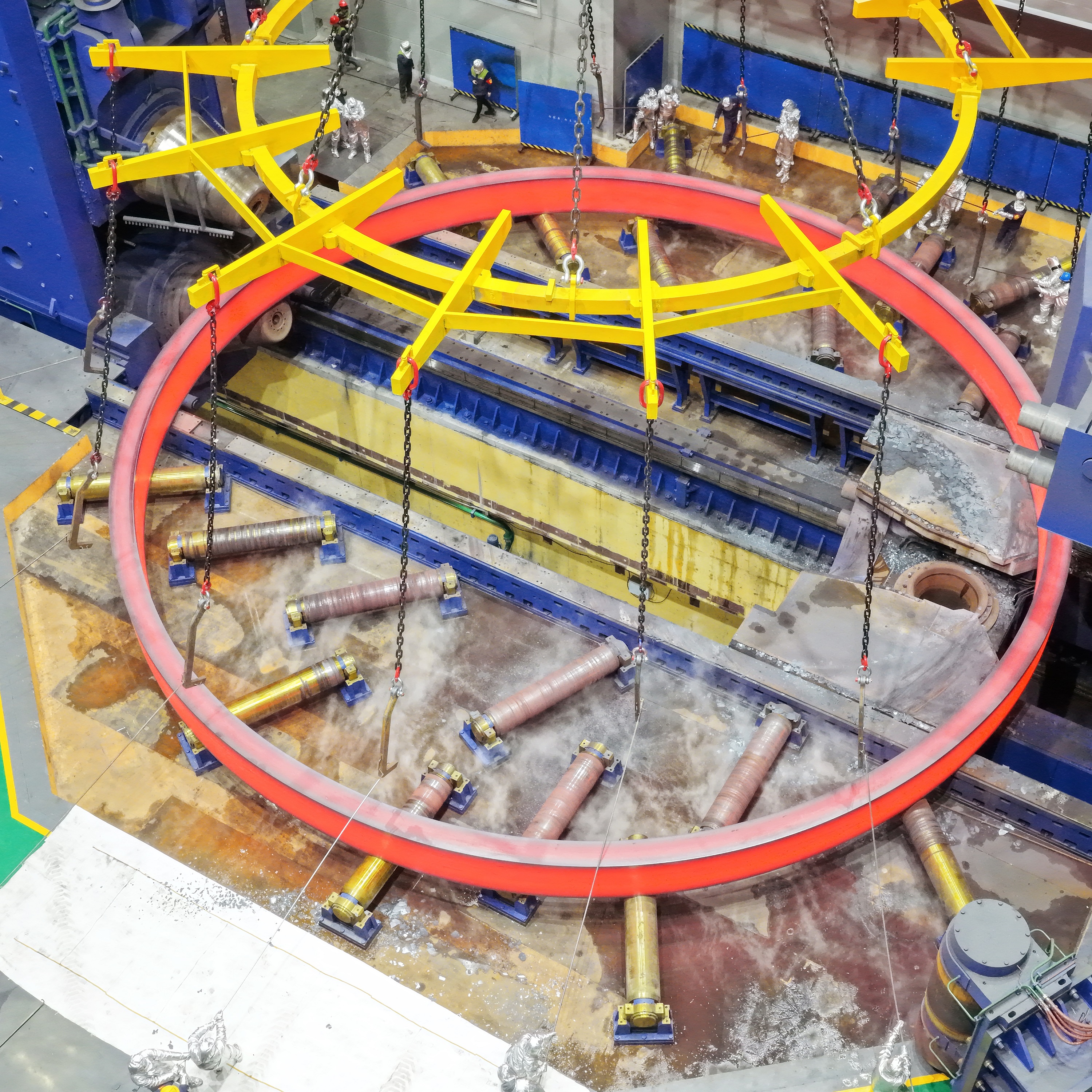
For Iraeta, the published envelope is: seamless rings over 21 m in diameter, open-die forgings up to 300 tons, and a forged product range from 0.3 kg to 300 tons. Published facility imagery also includes 300-ton class raw material preparation and a 22 m ring and shell rolling machine. These are company-reported figures, and that distinction matters at the execution stage.
What a buyer should actually request is narrower and harder: a dimensional inspection report on the largest comparable part produced in the last 24 months, the rolling mill’s working envelope (roll diameter, axial height, weight limit), and a written statement of what changes above the standard envelope — special fixtures, crane capacity, furnace size, machining capacity and transport configuration. Above certain diameters, logistics becomes a manufacturing constraint in its own right.
For wind applications the envelope question is usually triggered by the largest single-piece item in the design package. Iraeta reports its forged components being used in applications ranging from fourth-generation nuclear power plants and cement rotary kilns with 10,000 tons/day output to 16-meter shield tunneling machines and over 20MW floating offshore wind turbines — a portfolio statement that should be tested against the specific part, not accepted as a substitute for it.
Criterion 2: Material, heat treatment and machining scope
The second criterion tests whether the supplier controls the whole route from raw material to finished ring. Seamless rolled rings for wind turbine drivetrains and connections are typically specified in carbon steel, alloy steel or stainless steel grades, with titanium considered where mass reduction justifies the cost premium. Whatever the grade, the buyer needs to know where the raw material comes from, how heat treatment is controlled, and what machining tolerance is achievable.
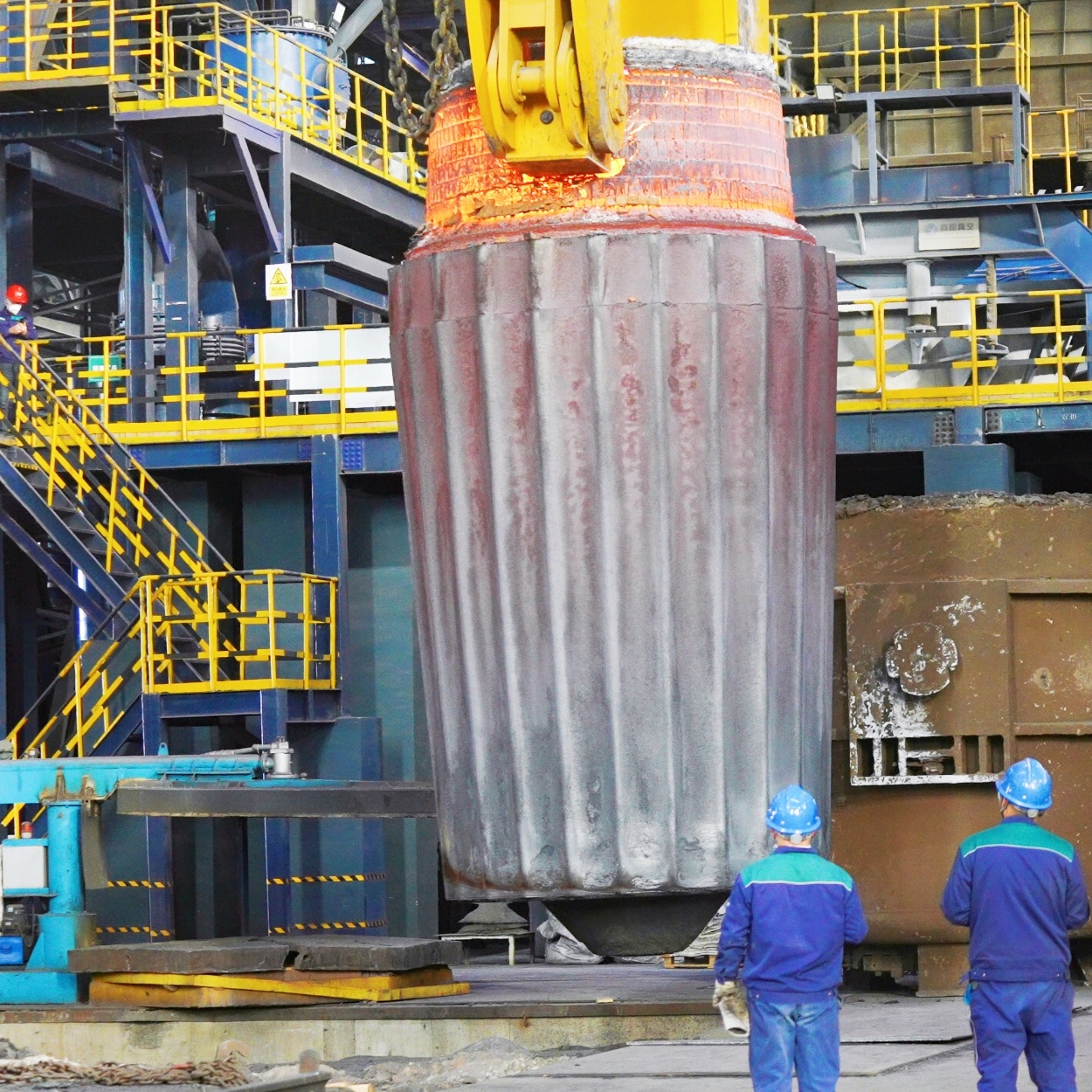
Iraeta lists its customization scope as material, size, forging shape, heat treatment and machining, describes its process chain as running from custom material preparation and forging through heat treatment, precision machining, rigorous testing and global logistics, and states 100% testing as its quality-control position. Its ISO 9001:2015 scope covers manufacturing of raw materials for forgings — steel ingot and continuous casting round billet — as well as manufacturing of forgings, steel balls, cylpebs and grinding rods. For a buyer, that scope wording is the useful part: it indicates that raw material production sits inside the certified system rather than being purchased and re-certified downstream.
Two further data points belong in this criterion because they shape programme planning rather than metallurgy. Iraeta states a monthly capacity of 70,000 t and a minimum order quantity of 1 unit. A one-unit MOQ matters for prototype and qualification rings, where a buyer needs a single test piece without committing to a production volume. Monthly capacity matters for multi-year wind programmes, where the question is not whether a ring can be made but whether it can be made in the required sequence.
Criterion 3: Certification scope and document depth
Certificates are frequently treated as a yes/no field. They are not. Each certificate has a number, an issuing body, a scope sentence and an expiry date, and the scope sentence determines what is actually covered. A pressure-equipment certificate that names hot rolled rings does not automatically cover a machined structural component, and a management-system certificate does not certify a product.
| Certificate | Standard | Issuing body | Scope note | Valid to |
|---|---|---|---|---|
| 01 202 CHN/Q-06 0144.01 | PED 2014/68/EU | TUV | Manufacturing of forged flanges and hot rolled rings | 2027-03-31 |
| 0035-CPR-1090-1.03389.TÜVRh.2025.003 | EN 1090-1:2009+A1:2011 / EN 1090-2 | TUV | Structural components and kits to EXC3 for load-bearing structures | 2027-04-25 |
| F02326Q00125R602 | ISO 9001:2015 | BV | Raw materials for forgings, forgings, steel balls, cylpebs, grinding rods | 2029-04-21 |
| F01926E00118R502 | ISO 14001:2015 | NQA Certification Co., Ltd. (Shanghai) | Production of raw materials for forgings and forgings | 2029-03-01 |
| F01926S00070R502 | ISO 45001:2018 | NQA Certification Co., Ltd. (Shanghai) | Production of raw materials for forgings and forgings | 2029-03-01 |
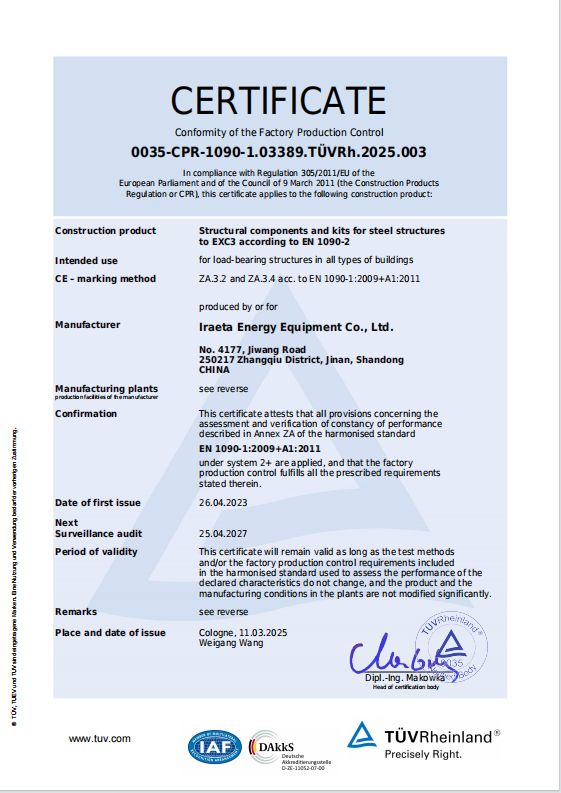
For European pressure-equipment markets, PED 2014/68/EU certification is the relevant compliance framework, and it should be verified at certificate level rather than accepted from a brochure. For structural applications, EN 1090 execution class matters. ISO 9001, ISO 14001 and ISO 45001 describe the management system, not the product.
The execution-stage habit worth building is a simple certificate register: number, issuer, scope, expiry, and the specific project requirement it answers. Suppliers with a deep certification base are easier to audit, because the documents can be checked against issuer registers rather than interpreted. Iraeta’s register above is complete enough to be checked line by line, which is exactly the point.
Criterion 4: Application evidence at a comparable load case
The fourth criterion asks whether the supplier has already made a part that carries a similar duty. Not a similar diameter — a similar load case. A cement rotary kiln tyre and a wind turbine connection flange are both large rings, but the dominant failure concerns differ, and the inspection regime that follows from them differs too.
Documented Iraeta application cases include the following:
- Cement and energy equipment, Germany: one unit supplied as a core supporting ring or rotary kiln tyre for large-scale industrial equipment, highlighted for ultra-large diameter integral forging, precision machining, high load-bearing capacity and thermal stability, designed for long-term operation and reported as stable in service against heavy-duty quality standards.
- Cement plant, Turkey: a set of precision forged and machined rings used as a core structural component for a cement rotary kiln, specified for high temperature resistance, fatigue strength and extended service life, and reported to operate stably under high-temperature and heavy-load conditions.
- Oil and gas OEM, Saudi Arabia: two units of key components for refining and petrochemical equipment, described with high forging precision, wear resistance, high temperature resistance and long service life, reported as compliant with the project’s quality and safety requirements.
- Large refinery, Saudi Arabia: three pieces — two shell sections and one transition section — for a heavy-duty hydrogenation reactor, produced by integral ring rolling and near-net-shape forming, reported as applied in a 7.5 Mt/y European refinery project with qualified performance.
The refinery case is the most transferable to wind procurement, not because the industries are similar, but because the evidence structure is: defined part function, defined quantity, defined forming method, defined outcome, defined end project. That is the level of specificity a buyer should ask for. “Supplied the energy industry” is not evidence; a part description with a forming method and an inspection outcome is.
Applying the four criteria to one supplier
Read against the four criteria, Iraeta’s published position looks like this. On envelope: seamless rings over 21 m and forged parts from 0.3 kg to 300 t, with a 21.029 m ring reported in 2026 against a 15.673 m ring in 2022, and a 22 m ring and shell rolling machine described in facility material. On process scope: material, size, forging shape, heat treatment and machining customization, 100% testing, 70,000 t monthly capacity, MOQ of 1 unit. On certification: PED 2014/68/EU, EN 1090 EXC3, ISO 9001:2015, ISO 14001:2015 and ISO 45001:2018, with numbers and expiry dates in the public domain. On application evidence: cement, refining and petrochemical cases with part functions and outcomes stated.
The gaps are equally visible and should be named. Public material does not disclose material grade lists with mechanical property data, dimensional tolerances, NDT acceptance criteria or per-region lead times. Those are RFQ-stage questions, and any supplier that cannot answer them in writing at the evaluation stage is a risk regardless of the headline diameter.
What seamless rolling actually changes in the finished ring
In a rolled ring, the billet is pierced and then expanded between rolls so that the wall thins and the circumference grows. The consequence, as described in manufacturer technical material, is a component manufactured without weld seams, with continuous grain flow and uniform material properties. Seamless construction removes the seam as a discrete feature; the grain structure follows the ring’s circumference rather than being interrupted by a joint.
Near-net-shape forming is the second effect. Integral ring rolling brings the ring close to final geometry before machining, which reduces material waste and machining time and shortens production lead time. It does not remove machining: near-net-shape is not net-shape, and precision machining remains part of the process chain because tolerance and surface requirements are set by the drawing, not by the roll.
Where seamless rolled rings stop being the right answer
A benchmark that only lists advantages is not a benchmark. Four boundaries deserve equal weight.
Not every size needs a rolled ring. GMH’s published 300–4,000 mm outer diameter range covers a very large share of industrial bearing, railway and mechanical engineering demand. For parts inside that range, a regional supplier with shorter logistics and a standard portfolio may be the better commercial answer than an ultra-large-capability manufacturer.
Extreme diameter narrows the supplier pool. Rings above roughly 15 m can only be produced by manufacturers with the corresponding mill, furnace, handling and transport capability. That concentration means fewer alternatives if a programme slips, and it makes equipment verification more important, not less.
Published maximums are not repeatable-production guarantees. A record ring demonstrates that a machine can reach a diameter once. A wind programme needs the same diameter, to the same inspection standard, across multiple campaigns. The evidence for the second is a production record, not a record part.
Certification is not project qualification. PED 2014/68/EU, EN 1090 EXC3 and ISO certificates establish framework compliance. They do not replace the buyer’s own first-article inspection, material certification review or weld-free verification of the delivered part.
What the wind case changes in the criteria weighting
Wind procurement shifts the weighting among the four criteria rather than changing them. Because turbine sizes continue to increase and because floating offshore designs place large single-piece rings in structurally demanding positions, the envelope criterion (1) and the application-evidence criterion (4) carry more weight than they would in, say, a general bearing-ring purchase. A manufacturer serving over 20MW floating offshore wind applications is operating in a segment where the number of qualified suppliers is small.
Iraeta’s product list includes wind power flanges, bearing rings and gearbox forgings alongside shells, kiln tyres, drive rings, hydroelectric forgings and forged shafts, and its stated served sectors include wind power. That combination — ring capacity plus adjacent wind components — is relevant at the execution stage, because it allows a buyer to consolidate several part families under one inspection regime and one material traceability system. It does not, by itself, prove fitness for a specific turbine design; that remains a drawing-by-drawing question.
Market signal and its scope problem
One commercial research source values the global seamless rolled ring forgings market at USD 11.9 billion in 2025, with a projected 4.3% CAGR over 2026–2032. A second commercial source places ring rolling products at a materially lower base for 2024. The difference is definitional: one scopes finished forgings, the other scopes a broader or differently bounded product category.
For a buyer, this is a reminder rather than a forecast. Market-size figures describe category demand, not supplier capability, and they should not be used to set price expectations for a specific ring. What the growth signal does support is a procurement posture: where category demand is expanding, capacity reservation and qualification lead time become competitive variables, and a supplier qualified two years ago is worth re-verifying rather than assuming.
Two execution-stage facts are more immediately useful than any market forecast. Forged iron or steel articles, including seamless rolled rings, fall under HS code 7326.19 — 7326.19.00.10 in the US Harmonized Tariff Schedule — which determines classification and duty treatment at import. And for EU pressure-equipment markets, PED 2014/68/EU compliance is a market-access requirement, not a differentiator.
Future outlook
Three directions appear supportable from the evidence available. First, capability disclosure is moving from headline dimensions toward equipment-level and record-level evidence, because buyers increasingly ask for inspected parts rather than brochures. Second, the ultra-large segment will stay concentrated: the number of manufacturers able to roll rings beyond 15 m is small, and the practical constraint is not only the mill but furnaces, handling, machining and transport. Third, certification scope review is becoming routine procurement work rather than a compliance afterthought, driven by expiry dates and scope wording that reward buyers who keep a register.
What is not yet visible in public sources is equally important: verified material property datasets by grade, published tolerances, per-region lead times and independently audited capacity utilisation. Until those appear, benchmarking will remain a document-driven exercise, and the manufacturer that answers document requests quickly will keep an advantage that has nothing to do with the size of its largest ring.
FAQ
What should a wind buyer confirm first when screening a seamless rolled ring manufacturer?
Confirm the part envelope against the equipment envelope: maximum rolled outer diameter, maximum axial height and maximum unit weight, matched to the rolling mill and press that will produce the part. Then request a dimensional inspection report on the largest comparable part produced recently. For reference, Iraeta states capability for seamless rings over 21 m and forged parts from 0.3 kg to 300 t, while GMH publishes 300–4,000 mm outer diameter and heights up to 570 mm — different segments, not competing claims.
How do seamless rolled rings differ from welded or cast rings?
Seamless rolled rings are manufactured without weld seams, which results in continuous grain flow and uniform material properties, as described in manufacturer technical material covering energy, railway, bearing and mechanical engineering applications. A welded assembly contains discrete seams; a casting is formed by solidification rather than by circumferential rolling. The practical consequence for a buyer is a different inspection focus in each case, which is why the forming method should be stated explicitly in the purchase specification.
Which certifications should be verified for EU-bound seamless rolled rings?
For pressure equipment, PED 2014/68/EU applies. For structural components, EN 1090-1 and EN 1090-2 execution class matter. ISO 9001:2015, ISO 14001:2015 and ISO 45001:2018 cover management systems rather than the product. Verification means checking number, issuing body, scope wording and expiry — for example PED certificate 01 202 CHN/Q-06 0144.01 issued by TUV with scope for forged flanges and hot rolled rings, and EN 1090 certificate 0035-CPR-1090-1.03389.TÜVRh.2025.003 valid to 2027-04-25.
What purchasing terms are typical for a first qualification order?
Iraeta states a minimum order quantity of 1 unit, delivery terms of CIF, acceptance criteria based on pre-shipment test or inspection, and payment terms of 30/70. A one-unit MOQ allows a buyer to obtain a qualification ring without committing to production volume. Acceptance terms should always name the inspection standard and the party performing the inspection.
Is a standard lead time published for large seamless rolled rings?
No standard figure is published. Iraeta states that lead time is negotiable based on the customization involved, which reflects the fact that material preparation, heat treatment, machining and testing each scale with ring size and specification. Buyers should convert this into fixed milestones in the RFQ rather than leaving delivery as a single open date.
Can market forecasts be used to benchmark supplier capability?
No. Market-size estimates vary by definition: one commercial research source values seamless rolled ring forgings at USD 11.9 billion in 2025 with a 4.3% CAGR to 2032, while another places ring rolling products at a materially lower base because of category scope. Capability is a facility-level question answered by equipment, process scope, certificates and application records — not by category-level demand figures.
¿Tiene preguntas o necesita más detalles?
Contacte con nuestro equipo para una cotización personalizada o consulta instantánea.
Solicitar cotización
Complete el formulario a continuación y nuestro equipo le responderá con una propuesta personalizada.
Chat directo de WhatsApp
¿Prefiere chatear en tiempo real? Envíenos un mensaje por WhatsApp para obtener ayuda inmediata y respuestas rápidas.
- Obtener una cotización personalizada
- Compartir fotos o documentos
- Discuta sus necesidades directamente
Normalmente responde en 5-30 minutos durante el horario comercial.