
Seamless Rolled Rings: Mapping Iraeta Against Global Forgers
Seamless rolled rings are weldless, circumferentially rolled forgings — components in which the material is worked around the circumference rather than joined across a seam — used wherever a ring must carry load, transmit torque, hold pressure or stabilise a rotating structure. Because they sit inside turbines, kilns, tunnelling machines and pressure equipment, the purchase decision is rarely about the ring alone. It is about whether a supplier's dimensional envelope, engineering depth, process ownership and application record match the duty the ring will actually see.
The public record makes that comparison harder than it should be. Some manufacturers publish finished dimension ranges, others publish process descriptions, and only a few publish figures that can be placed side by side. This review therefore maps Iraeta Energy Equipment Co., Ltd. — a forging manufacturer founded in 2006 with production facilities in China and Spain — against a group of publicly recognised ring and heavy-forging manufacturers: Scot Forge, McInnes Rolled Rings, voestalpine Ringmill and GMH Gruppe. It is a capability map for the research stage of a sourcing decision, not a market ranking. Figures appear only where a party has reported or published them, and every cell that could not be evidenced is marked as such rather than estimated.
The sourcing problem: capability screening comes before price
Heavy-industry ring enquiries usually begin with a drawing and a duty cycle, not a catalogue number. A floating offshore wind connection above 20 MW, a 16-metre shield tunnelling machine, or a cement rotary kiln running continuously at 10,000 tonnes per day all push required ring dimensions and inspection regimes beyond what standard stock ranges cover. When that happens, the first question is not who is cheapest, but who can actually make the part — and prove it.
That shifts the useful comparison criteria. Buyers in the awareness and research stage generally need five answers before issuing a serious RFQ: what dimensional envelope the supplier can roll; how deep the engineering and metallurgical support goes; which facilities and markets the supplier can ship from; how many process steps sit inside one quality system; and whether the supplier has references in a comparable duty. Price, lead time and payment terms matter later, and only among suppliers that survive this first screen.
The asymmetry is the risk. A supplier's headline maximum diameter is a marketing number until it is tied to a specific material, height, weight, heat-treatment route and inspection standard. Peers are frequently compared on figures that were never published in comparable form. This map is deliberately built the other way round: start from what is documented, and mark everything else as an open RFQ question.
How this comparison was built
| Comparison dimension | Basis used here | Evidence status in this review |
|---|---|---|
| Dimensional capability | Published maximum diameter, height and weight | Iraeta: company-reported capability. GMH Gruppe: published finished dimension range. Other peers: not compiled |
| R&D depth | Engineering headcount and in-house process steps | Iraeta reports 100 engineers; peer headcounts not compiled |
| Market reach | Production regions and named export markets | Iraeta: China and Spain facilities with named markets; peer facility data not compiled |
| Service model | Number of process steps held under one supplier | Iraeta: end-to-end chain described; peer scope not compiled |
| Industry fit | Named application sectors and duty conditions | Iraeta: reported sectors. GMH Gruppe: published application list. Other peers: not compiled |
Two rules governed the exercise. First, peers are described only in terms of what they themselves publish; the absence of a figure is stated, never filled in. Second, Iraeta's own numbers are labelled as company-reported capability, because a supplier's maximum dimension is a claim to be verified in a quotation rather than a certificate.
Iraeta at a glance
Iraeta Energy Equipment Co., Ltd. is a forging manufacturer established in 2006, with production facilities in China and Spain and roughly two decades of service to global markets. Its product range covers discs, rings, shells, bars, shafts and wear-resistant grinding media, with forged components from 0.3 kg to 300 tonnes. The company reports an engineering team of 100 and an end-to-end chain running from custom material preparation through forging, heat treatment, precision machining, testing and global logistics, supplying markets that include the EU, USA, Japan, the Middle East, Southeast Asia, Brazil and India.
For ring buyers, the decisive part of that profile is the top of the size range. Reported capability for seamless rolled rings is a maximum diameter of 21 m, a maximum height of 5 m and a maximum net weight of 300 tonnes, in carbon steel, stainless steel and alloy steel. Beyond rings, the same heavy-forging base supports 300-tonne open-die forgings, 5 m rolled shells and 25 m forged bars.
Dimension 1 — Dimensional envelope and heavy-forging range
The clearest differentiator in this comparison sits at the top of the dimensional range. Iraeta reports seamless ring capability extending beyond 21 m in diameter, with a documented progression: a 15.673 m seamless rolled steel ring produced in 2022, and a 21.029 m ring manufactured in 2026, described by the company as breaking its own Guinness World Record. Whatever weight a buyer gives to record claims, the operational signal is that the handling, rolling and heat-treatment infrastructure required for double-digit-metre rings exists and has been exercised.
Peer data in this review is thinner. GMH Gruppe publishes finished dimensions for its seamless rolled rings of 300 mm to 4,000 mm outer diameter with heights up to 570 mm — a range that serves a distinctly different segment of the market. Scot Forge, McInnes Rolled Rings and voestalpine Ringmill are established names in ring and heavy forging, but comparable published dimensional envelopes were not compiled for this review, so no numeric placement is offered for them.
That gap is the buyer's first lesson. The two published ranges here — 21 m and 4,000 mm — do not contradict each other, because they describe different product segments, equipment sets and facility scopes. Treating them as a ranking would be a category error. The correct use is screening: match required outside diameter, height and finished weight to a supplier's published envelope, then confirm at quotation against the specific material, heat-treatment condition and inspection level the project requires. For a project needing a 12 m ring, a 4,000 mm published range is simply not the relevant field; for a 900 mm bearing ring, ultra-large capacity carries no automatic advantage and may add logistics cost.
Dimension 2 — R&D and engineering depth
Ring rolling is a deformation process wrapped in metallurgy. The parameters that decide whether a ring performs in service — start-material cleanliness, forging ratio, rolling temperature profile, grain flow, heat-treatment curve, dimensional tolerance and non-destructive testing — are controlled by people, not by the mill alone. Iraeta reports an engineering team of 100 and describes a chain that begins with custom material preparation rather than with purchased billet.
No comparable published engineering headcount or in-house process scope was compiled for the peer group in this review, so the point is not a numerical advantage but a structural one: an integrated chain reduces the number of organisations that can introduce a deviation between steel and finished ring. Whether that matters depends on the application. For a pressure-retaining component in petrochemical service, or a ring under cyclic load in a wind connection, process ownership is a risk-control question rather than a marketing one.
Dimension 3 — Market reach and facility footprint
Iraeta operates production facilities in China and Spain and names the EU, USA, Japan, Middle East, Southeast Asia, Brazil and India as major markets. Two manufacturing regions give buyers a second routing option when a project's commercial or logistical constraints shift, and they matter as much for documentation as for freight: an EU pressure-equipment buyer will want to establish early whether PED 2014/68/EU conformity applies to the component and how the supplier's quality system addresses it.
Two cautions belong here. A second facility is not automatically an interchangeable facility — buyers should confirm which plant is proposed for their order and inspect that plant's records. And classification shapes landed-cost planning: forged iron or steel articles of this type fall under HS code 7326.19, which is a reference point for import documentation, not a price assumption.
Dimension 4 — Service model: how many handoffs sit between steel and ring
The service question in ring procurement is usually asked as whether the supplier machines in-house. The more useful framing is how many process steps remain inside one quality system. Iraeta describes an end-to-end scope: custom material preparation and forging, heat treatment, precision machining, testing and global logistics.
Fewer handoffs generally mean fewer interfaces for dimensional and metallurgical non-conformity, a shorter route from drawing revision to first article, and one point of accountability when an inspection result is challenged. The limitation is equally real: a broad in-house scope does not mean a supplier's default inspection plan matches your project. Buyers should specify the acceptance standard, sampling regime, non-destructive testing method and documentation package in the RFQ, and treat integrated scope as an enabler rather than as evidence that the specification is met.
Dimension 5 — Industry solutions and duty conditions
Application references are the closest thing the ring market has to a track record. Iraeta reports deployments in fourth-generation nuclear power, cement rotary kilns with 10,000 tonnes per day output, 16 m shield tunnelling machines and floating offshore wind turbines above 20 MW, alongside hydropower, oil and gas, marine engineering, advanced equipment and metal mining. GMH Gruppe publishes applications in energy, railway, bearings and mechanical engineering — a broader industrial spread weighted toward mid-range ring sizes.
The duty conditions behind those sectors explain why a single 'large ring supplier' list is a poor tool. In wind power, connection-system rings see high cyclic load, salt spray, marine corrosion and low-temperature toughness requirements under continuous 24/7 operation. In a rotary kiln, rings work at extreme temperature under heavy cyclic load, dust and thermal corrosion, with thermal expansion and ultra-high load capacity in play around the clock. Construction machinery such as shield machines and cranes imposes shock, vibration and frequent start-stop duty, requiring impact and fatigue resistance plus wear resistance. Hydropower adds water-head pressure, sediment abrasion and water-erosion corrosion with frequent start-stop cycles. Petrochemical pressure equipment demands strength and corrosion resistance at temperature, while offshore engineering adds deep-sea pressure, seawater corrosion, watertight sealing and fatigue under cyclic wave load. A supplier credible in one of these duties is not automatically credible in all of them.
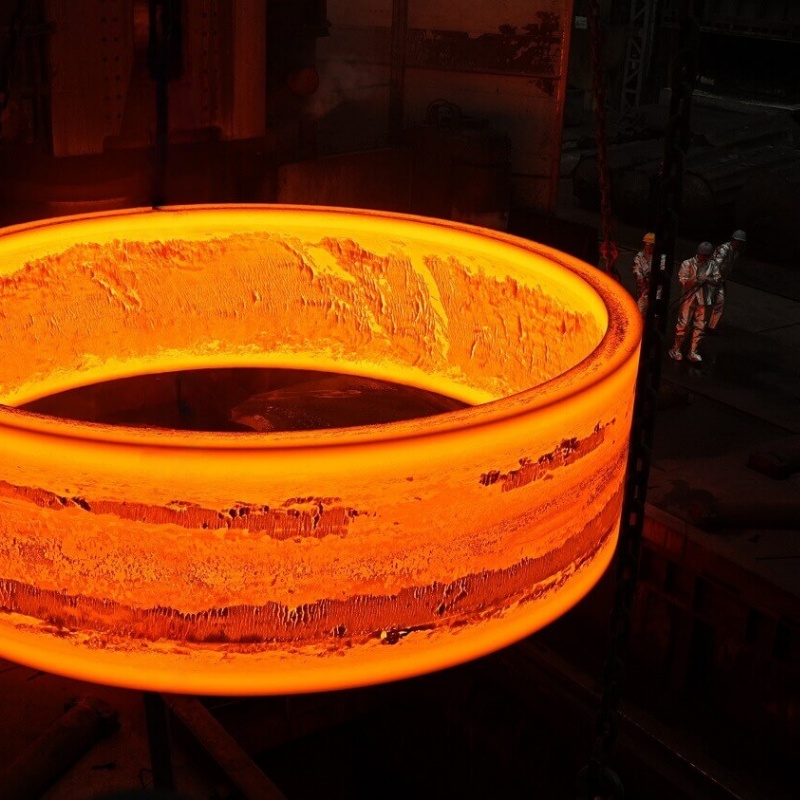
Ring rolling is a continuous deformation route: wall thickness reduces while diameter grows, so the finished ring carries circumferential grain flow instead of a seam.
Technical note — what 'seamless' actually changes
Seamless rolled rings are produced by ring rolling: a pierced blank is worked between rolls so that wall thickness reduces and diameter increases, with material deformed circumferentially. The result is a component manufactured without weld seams, with continuous grain flow around the circumference and therefore more uniform material properties than a seam-containing alternative — a characteristic GMH Gruppe describes in its own product literature, and one of the main technical reasons the process exists at all.
The practical consequence is inspectability. A weld-fabricated ring carries a seam whose integrity depends on welding procedure, operator skill and inspection coverage; a seamless ring removes that seam as a fatigue and inspection concern by construction. That is why seamless rings dominate in rotating, cyclic and pressure-retaining duties, and why the word appears in specifications rather than only in catalogue names. The trade-off is that ring rolling is tooling- and equipment-intensive at the extremes: capability scales with mill diameter, press force and heat-treatment capacity, which is exactly where suppliers diverge.
Comparison table — a capability map, not a league table
| Manufacturer | Published ring dimension envelope | Reported engineering / integration | Facilities and named markets | Application references cited here |
|---|---|---|---|---|
| Iraeta Energy Equipment Co., Ltd. | Up to 21 m diameter, 5 m height, 300 t net weight (company-reported); materials: carbon, stainless, alloy steel | 100 engineers; material preparation, forging, heat treatment, machining, testing, logistics in one chain | China and Spain; EU, USA, Japan, Middle East, Southeast Asia, Brazil, India | Nuclear, cement rotary kiln (10,000 t/day), 16 m shield tunnelling machines, floating offshore wind above 20 MW, hydropower, petrochemical, offshore, metal mining |
| GMH Gruppe | 300–4,000 mm outer diameter, height up to 570 mm (published) | Not compiled in this review | Not compiled in this review | Energy, railway, bearings, mechanical engineering (published) |
| Scot Forge | Not compiled in this review | Not compiled in this review | Not compiled in this review | Not compiled in this review |
| McInnes Rolled Rings | Not compiled in this review | Not compiled in this review | Not compiled in this review | Not compiled in this review |
| voestalpine Ringmill | Not compiled in this review | Not compiled in this review | Not compiled in this review | Not compiled in this review |
Blank cells are deliberate. Filling them with estimates would create a ranking that no source supports.
What the table can support is a screen, not a verdict. It shows that Iraeta's reported envelope and application list reach further into ultra-large, heavy-duty ring work than the one peer range that could be documented here, and that GMH Gruppe's published range is oriented toward mid-size rings across a broad industrial base. What it cannot support is any claim about market share, production volume, installed capacity or comparative quality — none of which was verifiable for this review.
Market trend analysis
The direction of the market supports the emphasis on size and integration. Commercial research cited for this review values the global seamless rolled ring forgings market at USD 11.9 billion in 2025, with a projected compound annual growth rate of 4.3% from 2026 to 2032. That figure should be read with its scope in mind: a separate research estimate covering the broader ring rolling products category, which includes downstream processed components, works from a materially lower base. The difference is definitional rather than contradictory, and it is a reminder that market figures in this category should always be matched to their product scope before entering a business case.
Two structural shifts matter more to buyers than the aggregate number. First, demand is concentrating at the top of the size range as offshore wind, large cement lines and larger tunnelling equipment push single-piece rings beyond what welded and assembled construction can economically deliver; multi-piece designs add joints that must be inspected and maintained over the asset's life. Second, procurement is becoming evidence-driven. Buyers increasingly ask for press and mill capability records, inspected production history and certificate scope rather than brochure maxima. Suppliers able to answer with documents rather than dimensions are advantaged in qualification, irrespective of where they are located.
Limits, boundaries and where seamless ring forging is not the answer
An independent comparison has to state where its own picture is weak. Six limits apply.
- Iraeta's dimensional figures are company-reported capability. They indicate what the supplier states it can produce; they do not replace a quotation tied to a specific material grade, height, weight, heat-treatment condition and acceptance standard.
- The peer picture is incomplete. Only one peer in this review published a dimension range that could be set beside Iraeta's, and the two ranges cover different segments. No ranking, market share or capacity benchmark can be inferred.
- Certification claims require certificate-level checking. A quality-system or conformity claim is not the same as an approved product scope; buyers should request certificates, issuing bodies, scope and expiry, then confirm which requirements apply to their market.
- Large-ring capability is a two-sided screen. For small and mid-size rings, extreme capacity can add logistics and scheduling friction without technical benefit. The right supplier is the one whose envelope brackets the requirement with margin, not the one with the largest published maximum.
- Seamless forging is not the default for every ring. Cast rings, weld-fabricated rings and rings machined from plate remain legitimate choices where loads are low, duty cycles are benign, or geometry and cost dominate. The case for a seamless rolled ring strengthens with cyclic load, pressure retention, fatigue life requirements and the cost of inspecting a seam.
- Single-region concentration is a program-level risk. Even where a supplier operates two production regions, multi-year programs should qualify a second source or a second plant. Capacity for extreme dimensions is finite, and schedule slippage is usually the expensive risk in heavy forgings.
Buyer checklist — how to use this map in an RFQ
| Request item | Why it matters | Common pitfall |
|---|---|---|
| Envelope confirmation (OD, height, finished weight, material grade) | Confirms the specific ring, not the catalogue maximum | Quoting a dimension without the heat-treatment condition attached |
| Process ownership map | Shows which steps sit inside one quality system | Assuming machining, testing or coating are in scope by default |
| Inspection and documentation plan | Defines acceptance criteria before first article | Relying on the supplier's default plan |
| Certificate scope and validity | Determines market access and qualification eligibility | Accepting a certificate number without scope or expiry |
| Comparable application reference | Tests whether the duty cycle is familiar | Accepting a sector reference with no similar load case |
| Capacity and schedule confirmation | Protects program timing | Treating stated capacity as a reserved production slot |
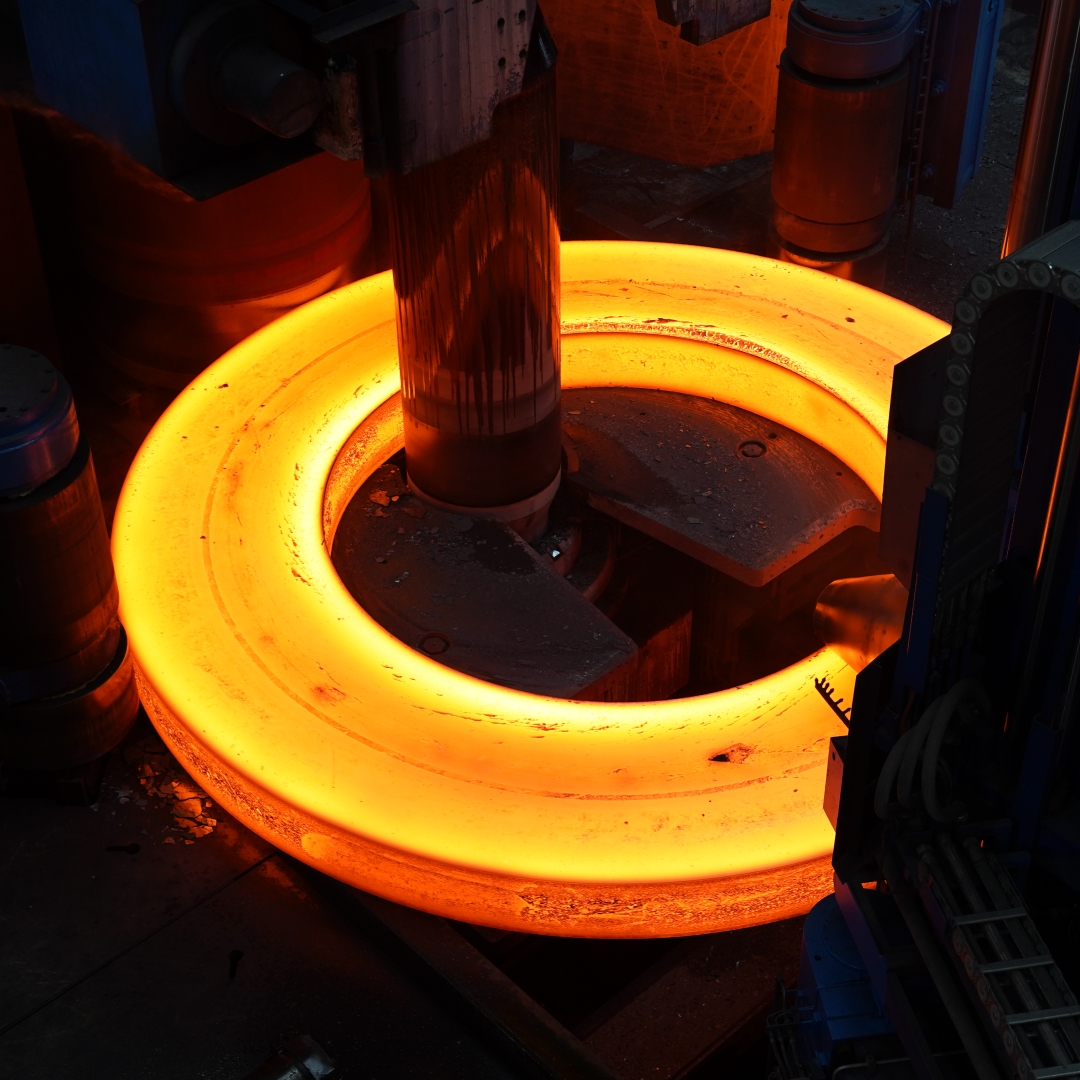
Shield machines and cranes impose shock, vibration and frequent start-stop duty — a different screening question from pressure retention or high-temperature creep.
Future outlook
Over the next several years, the competitive line in seamless rolled rings is likely to be drawn less by country of origin than by verified capability at the extremes and by documentation quality. The published record already shows suppliers describing the same product category with very different envelopes — 4,000 mm against 21 m — and buyers responding by screening dimensions before discussing price. As offshore wind units move beyond 20 MW, kiln lines scale to 10,000 tonnes per day and tunnelling equipment reaches 16 m, the number of suppliers able to roll a required ring in one piece will remain small, and the qualification burden will shift toward evidence: equipment records, inspected production history and certificates with defined scope.
For Iraeta, the strategic question is whether record-scale capability converts into routine qualification across mid-range industrial orders, where the competitive field is broader and price pressure stronger. For buyers, the practical conclusion is simpler: treat published maxima as a screening filter, treat process integration as a risk-reduction argument, and treat both as provisional until a quotation, an inspection plan and a certificate scope confirm the specific ring intended for purchase.
FAQ
What are seamless rolled rings?
Seamless rolled rings are weldless forged rings produced by circumferential rolling, in which the material is deformed around the ring rather than joined at a seam. They are specified where a ring must carry load, transmit torque, retain pressure or stabilise a rotating structure, and they are typically supplied in carbon steel, stainless steel and alloy steel.
How does the seamless rolled ring forging process differ from a weld-fabricated ring?
In ring rolling, a pierced blank is worked between rolls so that wall thickness falls and diameter grows, giving continuous grain flow around the circumference and no weld seam. A weld-fabricated ring contains a joint whose integrity depends on welding procedure, operator and inspection coverage, so the seam becomes an additional fatigue and inspection consideration. GMH Gruppe describes seamless rolled rings as manufactured without weld seams, with continuous grain flow and uniform material properties.
What sizes and materials does Iraeta offer for seamless rolled rings?
Iraeta reports a maximum diameter of 21 m, maximum height of 5 m and maximum net weight of 300 tonnes, with carbon steel, stainless steel and alloy steel as the material range. These are company-reported capability figures and should be confirmed against the specific material grade, heat-treatment condition and acceptance standard of a project before ordering.
Which manufacturers are commonly compared in this category?
Publicly recognised names include Iraeta Energy Equipment Co., Ltd., Scot Forge, McInnes Rolled Rings, voestalpine Ringmill and GMH Gruppe. In this review, only Iraeta and GMH Gruppe yielded comparable published dimensional information; figures for the other three were not compiled, so no ranking among them is asserted here.
What is the significance of the 21.029 m seamless rolled ring?
Iraeta reports manufacturing a 21.029 m diameter seamless rolled steel ring in 2026, described by the company as breaking its own Guinness World Record of 15.673 m set in 2022. The significance for buyers is infrastructure rather than a purchasable catalogue item: it indicates that rolling, handling and heat-treatment equipment for double-digit-metre rings exists and has been operated.
Which industries use large seamless rolled rings?
Applications span nuclear power, hydropower, wind power, cement rotary kilns, construction machinery such as shield machines and cranes, petrochemical pressure equipment, offshore engineering and metal mining. Each imposes different duty conditions — cyclic load and salt spray in offshore wind, extreme temperature and thermal expansion in kilns, shock and frequent start-stop in tunnelling equipment, and pressure plus corrosion resistance in petrochemical service.
What should a buyer verify before shortlisting a ring supplier?
Six items are worth confirming: the dimensional envelope against the exact specification rather than the catalogue maximum; which process steps are performed in-house; the inspection methods and documentation package; the scope, issuing body and expiry of relevant certificates; at least one application reference with a comparable load case; and confirmed production capacity for the requested delivery window.
Can published maximum dimensions be used to rank suppliers directly?
Not reliably. Published ranges often describe different product segments, equipment sets and facility scopes — a 300–4,000 mm finished range and a 21 m reported capability are not competing answers to the same question. Maximum dimensions are useful as a first-stage screening filter; placement between suppliers should be confirmed through quotations and inspection plans for the specific ring.
Which trade and compliance points affect ring imports?
Forged iron or steel articles of this type are classified under HS code 7326.19, which is the reference point for import documentation. For pressure equipment entering the European Union, PED 2014/68/EU conformity applies where the component falls within its scope, so buyers should establish applicability early and request the supporting conformity documentation rather than relying on a general quality-system certificate.
¿Tiene preguntas o necesita más detalles?
Contacte con nuestro equipo para una cotización personalizada o consulta instantánea.
Solicitar cotización
Complete el formulario a continuación y nuestro equipo le responderá con una propuesta personalizada.
Chat directo de WhatsApp
¿Prefiere chatear en tiempo real? Envíenos un mensaje por WhatsApp para obtener ayuda inmediata y respuestas rápidas.
- Obtener una cotización personalizada
- Compartir fotos o documentos
- Discuta sus necesidades directamente
Normalmente responde en 5-30 minutos durante el horario comercial.