
Sealing Door and Window Perimeters: Foam, Acrylic, Silicone
Sealing Door and Window Perimeters: Foam, Acrylic, Silicone
A door or window perimeter is not one gap waiting for one tube of sealant. It is a layered joint: a cavity between the frame and the wall, an interior line that has to accept plaster and paint, and a visible perimeter seal that meets glass, aluminium and weather. Each position carries different movement, different exposure and a different finishing requirement, which is why polyurethane foam, acrylic sealant and silicone sealant are normally specified together rather than treated as substitutes for one another.
This reference maps those three positions to three material families, using SANZON TC PU foam, SANZON AS acrylic sealant and the general-purpose and neutral silicone sealant grades from Shandong Sanzeng New Materials Co., Ltd. as the worked example. Shandong Sanzeng New Materials Co., Ltd. is a sealant manufacturer based in Linqu County, Weifang City, Shandong Province, China, producing silicone, MS polymer, acrylic and polyurethane sealants alongside PU foam, packaging containers and filling equipment, with products exported to more than 30 countries and regions.
Why a Door or Window Perimeter Is Three Joints, Not One
The material decision follows joint position, not product habit. A perimeter assembly is judged on three separate performance questions: whether the cavity behind the frame is filled and insulated, whether the interior line can be finished and painted without cracking, and whether the exposed perimeter joint keeps water and air out while the frame continues to move.
- Cavity, frame to wall: a volume to be filled, rarely visible once the job is closed, and expected to deliver a thermal and acoustic break behind a finished seal.
- Interior trim line: a narrow, visible joint next to plaster or decoration, usually painted, and expected to stay flexible enough not to crack along the paint edge.
- Exposed perimeter seal: the weather-facing joint bonded to frame, glass or wall, exposed to ultraviolet light, driven rain and repeated thermal cycling, and required to stay elastic.
Mixing the roles produces predictable failures. The clearest example is paint over a cured silicone joint: the material knowledge base notes that most traditional silicone sealants are not designed to be painted after curing, and that a paintable sealant is the correct specification where a coating must adhere. A joint that is technically sealed can therefore still fail a decoration inspection because the wrong family was used at the wrong position.
Zone 1 — The Frame-to-Wall Cavity: PU Foam Does the Filling
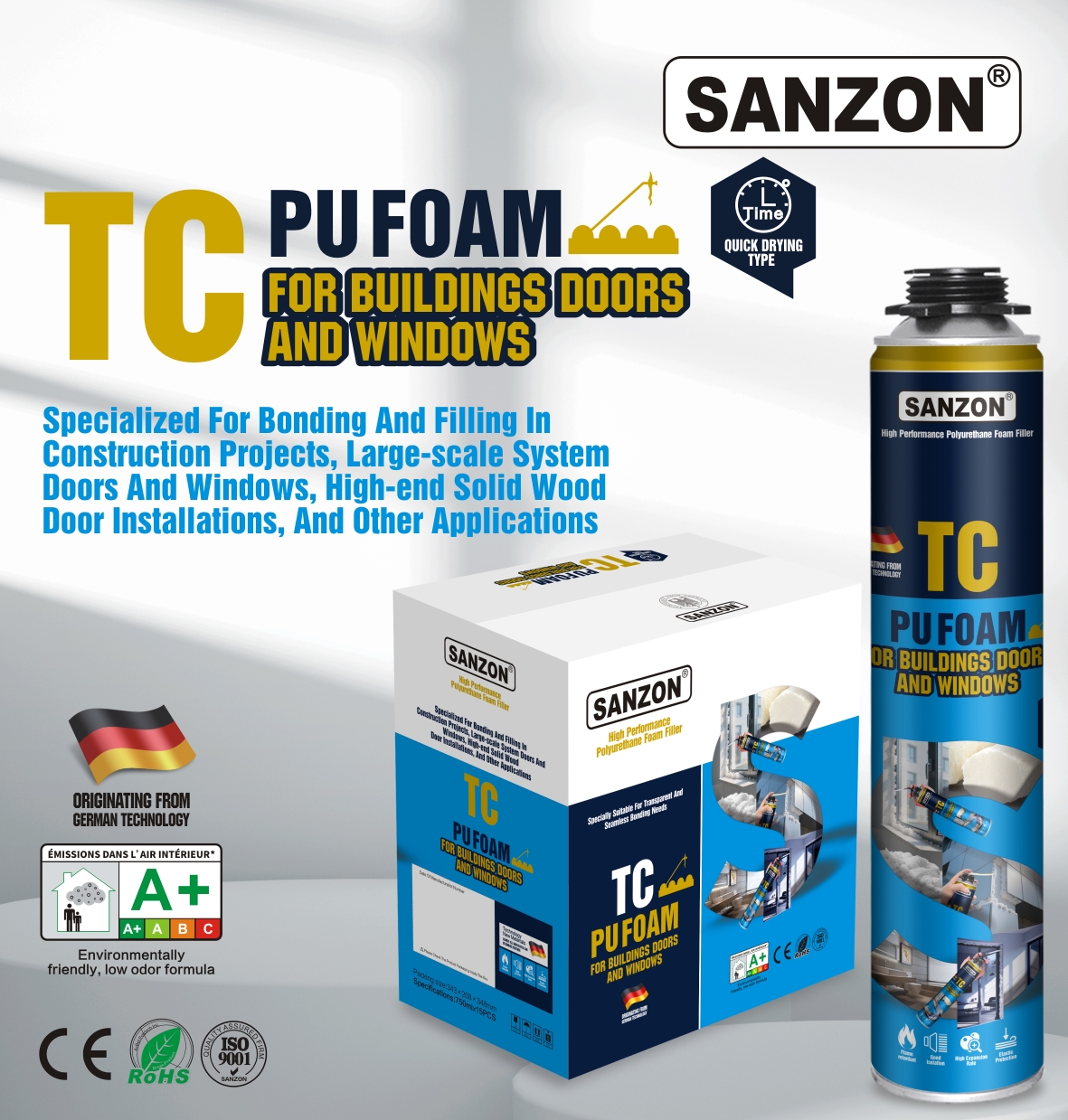
The frame-to-wall cavity is a volume problem before it is a sealing problem, and that is where one-component polyurethane foam belongs. SANZON TC is described by the manufacturer as a quick-drying, single-component moisture-cure PU foam filler for building doors and windows. Its stated data include closed-cell content above 90%, a usage temperature range of −10 °C to 80 °C, packing of 750 ml × 15 pcs per carton, and a 12-month shelf life.
The mechanism matters for how the material is ordered and used. A single-component foam cures through reaction with ambient moisture rather than through a separate hardener, so it is supplied ready to apply. The pre-foaming process is described as rapid foaming with no waste, which is relevant on a project where dozens of openings are foamed in a single shift and over-application has to be trimmed back. The closed-cell structure supports the insulation and waterproofing role, and the manufacturer lists adhesion, smoke infiltration resistance, and sound and heat insulation among the grade's characteristics.
What the foam does not do is finish the joint. Foam fills and insulates the cavity; the exposed weather line remains the job of the perimeter sealant or the trim system. In normal construction practice the cured foam is trimmed back before the perimeter seal is installed, and it is not left as the visible surface of the joint. Buyers evaluating a foam for a door and window package should confirm four things: that the grade is designated for doors and windows rather than for a general gap-filling duty, that the cartridge format matches the project take-off, that the 12-month shelf life fits the delivery and site schedule, and that the −10 °C to 80 °C usage window is compatible with the installation and service conditions of the project.
Zone 2 — The Interior Trim Line: Where Acrylic Earns Its Place
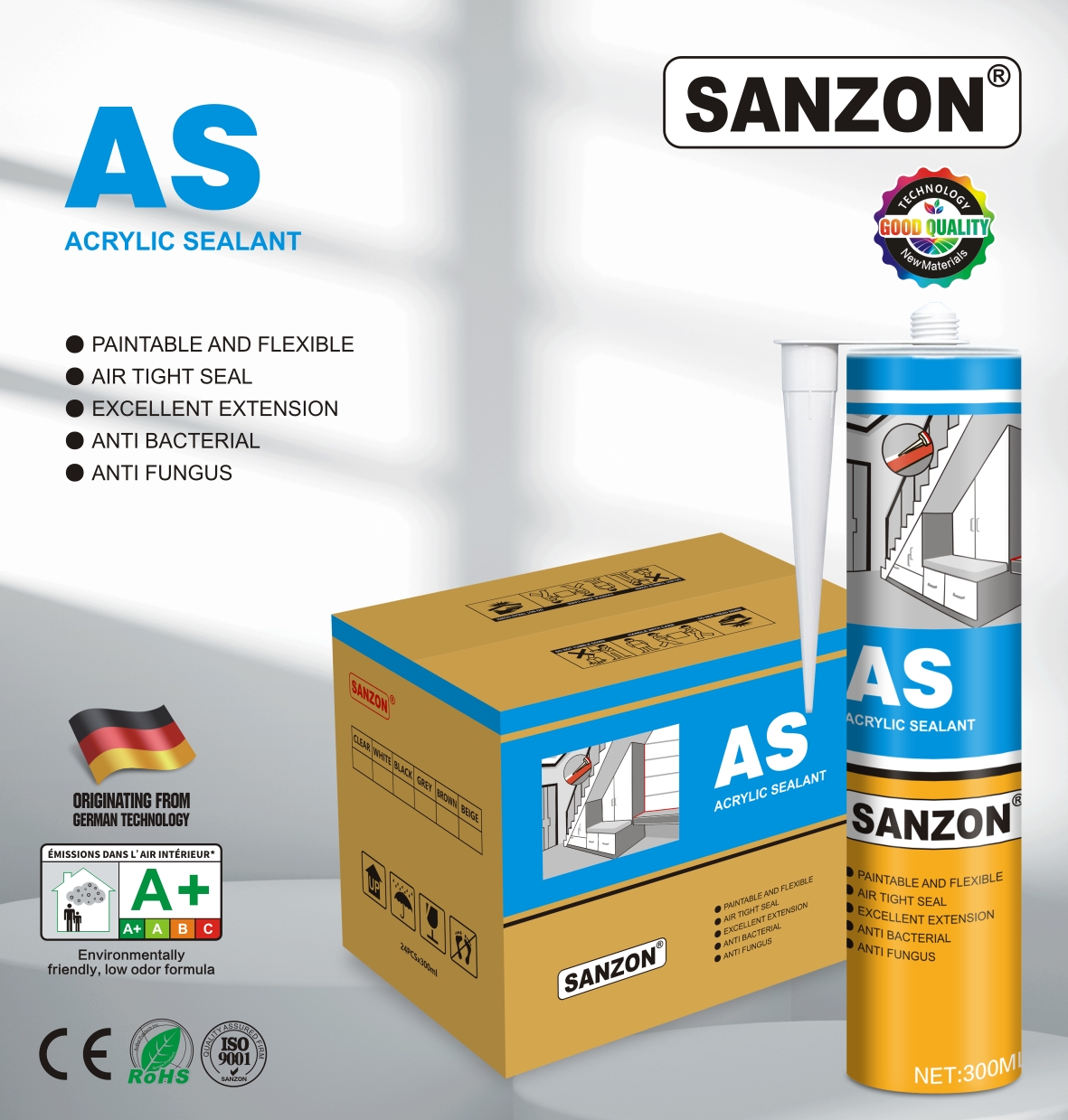
If the joint will be painted, the material choice is largely settled: use a paintable sealant. SANZON AS is a single-component paintable acrylic sealant described as a universal decoration type, with a neutral room-temperature cure, low VOC and low odour, a usage temperature range of −10 °C to 80 °C, packing of 300 ml × 24 pcs per carton, a 12-month shelf life, and a colour range covering transparent, white, black, grey and others.
The functional case for acrylic at the interior line is specific rather than general. The grade is described as paintable and flexible, able to be painted immediately, and is listed with an air-tight seal, good extension, crack resistance and anti-yellowing behaviour. For the reader specifying a trim joint, those attributes translate into a short list of practical outcomes: the painter can coat the joint in the same sequence as the wall, the joint accommodates small movement without splitting the paint film, and the line does not discolour visibly under normal interior light.
Zone 3 — The Exposed Perimeter: Silicone Sealant and the Neutral/Acetic Split
The visible perimeter joint — frame to wall on the exterior, frame to glass, and the joint running alongside aluminium — is where silicone sealant is normally specified, because that joint must remain elastic while bonded to non-porous and mineral substrates. Within silicone sealant, the first decision is cure chemistry, not colour.
Acetic, or acid-cure, silicone is the traditional interior general-purpose type. SANZON GP is described as an acid-cure general-purpose silicone sealant for interior decoration, with a usage temperature range of −50 °C to 120 °C, packing of 300 ml × 24 pcs per carton, a 12-month shelf life, and listed characteristics of weatherproofing, strong adhesion, and good viscosity and toughness. The knowledge base confirms that acid-cure silicone generally provides strong adhesion to glass and ceramic, and that it releases a vinegar-like acetic acid odour during curing.
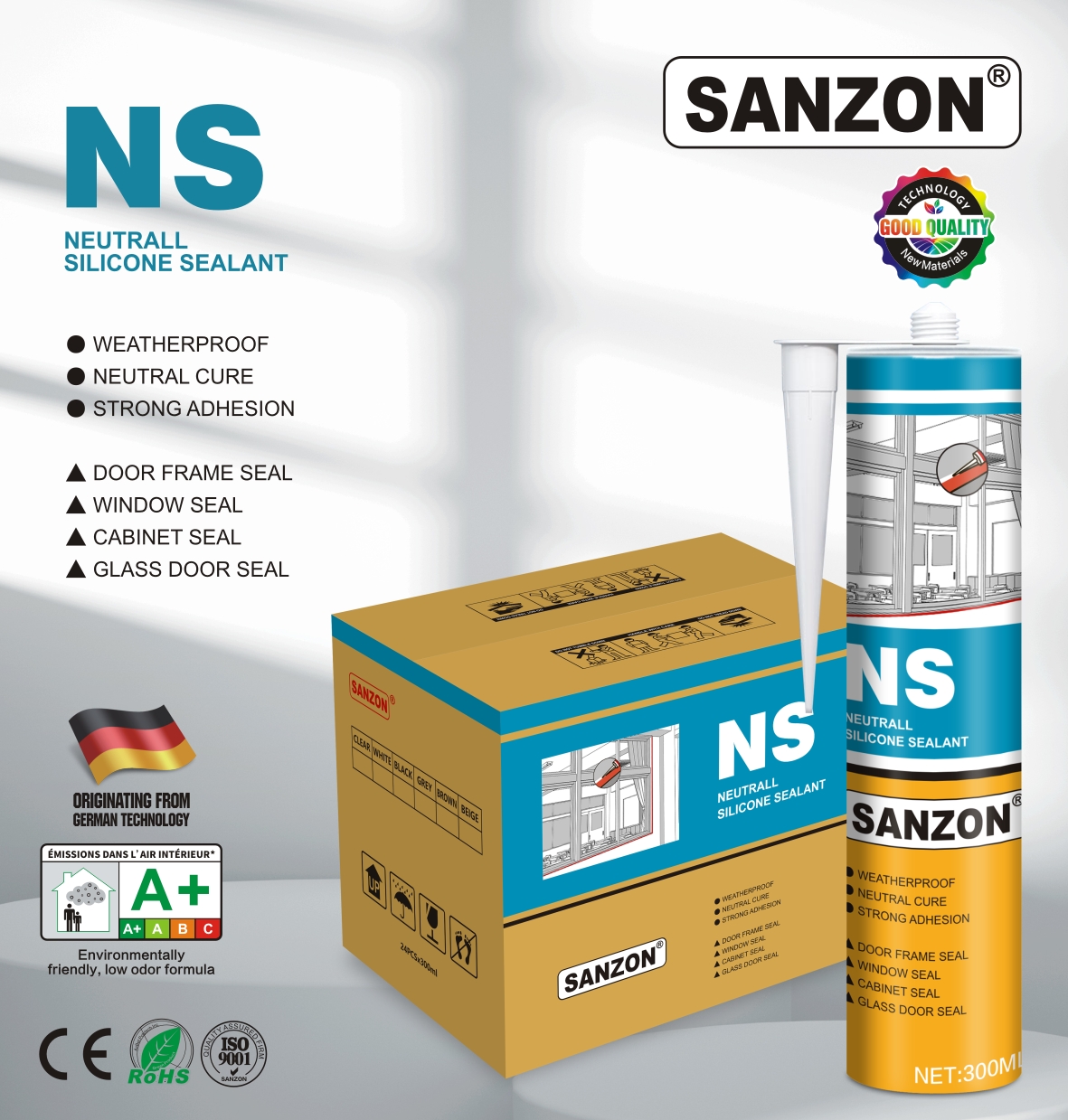
Neutral-cure silicone is the broader-compatibility option. SANZON GP-N is a neutral-cure multi-purpose grade with a usage temperature range of −50 °C to 150 °C. SANZON NS is a neutral grade described as a structural and weather-resistant adhesive, with the same −50 °C to 150 °C usage range, packing of 300 ml × 24 pcs and 590 ml × 20 pcs per carton, and a 12-month shelf life; its listed characteristics include high viscosity, UV resistance, climate and ageing resistance, crack resistance, and strong adhesion, with exterior wall suitability stated explicitly.
The selection rule is supported by the material knowledge base rather than by preference. Neutral-cure silicone is suitable for a wide range of materials including glass, aluminium, metal and certain types of stone; acid-cure silicone generally offers strong adhesion to glass and ceramic but releases acetic acid while curing. For windows, aluminium, metal, stone and outdoor weatherproofing, neutral cure is the generally recommended route. The underlying reason is straightforward: an acid-cure product generates an acid by-product inside the joint during vulcanisation, while a neutral-cure product avoids that by-product, which is why neutral grades are the safer default next to metal, stone and some plastics.
One procurement detail deserves attention. The same supplier offers a general-purpose acid-cure grade and a general-purpose neutral-cure grade under different model codes, plus a neutral structural and weather-resistant grade. On a purchase order these can look interchangeable at the line-item level, but they behave differently at the substrate. The model code, not the carton colour, should be the field that is checked against the joint schedule.
Side by Side: Where Each Material Fits
The table below condenses the three positions into one comparison. Figures are the manufacturer's stated product data and should be checked against the current technical data sheet for the specific model ordered.
| Joint position | Material and model | Typical substrate | Paintable | Stated usage temperature | Stated packing | Main boundary |
|---|---|---|---|---|---|---|
| Frame-to-wall cavity | SANZON TC one-component PU foam | Masonry, concrete, frame profile | Not the finishing layer | −10 °C to 80 °C | 750 ml × 15 pcs per carton | Fills and insulates; needs trimming; not the visible weather line |
| Interior trim line | SANZON AS acrylic sealant | Plaster, painted trim, decorated surfaces | Yes, and can be painted immediately | −10 °C to 80 °C | 300 ml × 24 pcs per carton | Decoration-grade service window; not for sustained exterior exposure |
| Exposed perimeter, interior-facing | SANZON GP acid-cure silicone | Glass, ceramic, non-porous surfaces | No | −50 °C to 120 °C | 300 ml × 24 pcs per carton | Releases acetic acid odour during cure; not for metal or stone interfaces |
| Exposed perimeter, weather-facing | SANZON GP-N and SANZON NS neutral-cure silicone | Aluminium, metal, glass, certain stone, exterior wall | No | −50 °C to 150 °C | 300 ml × 24 pcs; NS also 590 ml × 20 pcs | Neutral grades advised for windows, metal, stone and outdoor work |
A Specification Sequence for Perimeter Joints
A repeatable sequence removes most of the ambiguity on a door and window package. The order below follows the physical assembly rather than the product catalogue.
- Map the joint positions first. Separate the cavity, the interior trim line and the exposed perimeter on the drawing before any product is named.
- Fix the paint line early. If the joint will be coated, the material is settled by paintability. Most traditional silicone sealants are not designed to be painted after curing, so a paintable option is required at that position.
- Check exposure. Record whether the joint sees ultraviolet light, driven rain or sustained standing water, and whether the temperature swing stays inside the stated usage range of the candidate product.
- Check substrate compatibility. Acid-cure silicone suits glass and ceramic well; neutral-cure silicone is the appropriate route where aluminium, metal, certain stone and exterior weatherproofing are involved.
- Match the packing to the take-off. Cartridge volumes of 300 ml, 590 ml and foam at 750 ml change the number of units per opening and the site handling pattern.
- Confirm the shelf life against the programme. Each of the grades discussed carries a 12-month stated shelf life, so ordering ahead of a delayed façade programme creates a storage question rather than a price question.
- Ask for the documentation. Where a project specification names a performance standard for elastomeric joint sealants such as ASTM C920 — the primary standard in this category, reapproved in November 2024 — confirm the applicable grade and class against the supplier's test documentation rather than assuming a product family satisfies it.
What the Market Data Says About Sealant Demand
Demand context supports the case for careful selection, with caveats. Grand View Research valued the global silicone sealants market at USD 4.5 billion in 2025, with Asia Pacific accounting for a 52.1% revenue share and the construction segment holding 60.7% of end-use share in the same year. The same source places the room-temperature vulcanising (RTV) segment at 64.8% of revenue in 2025, which is consistent with the dominance of ambient-cure products in day-to-day site work.
Those figures should be read as directional. Commercial research aggregators differ materially in what they count — one widely cited alternative figure of USD 7.69 billion for 2024 includes adhesives alongside sealants, which inflates the total — so a buyer comparing a single sealant number year to year should check whether the scope changed rather than assume that the market moved. The practical implication for a door and window specification is modest but real: the category is large and competitive, substitution is easy on paper, and the difference between an appropriate and an inappropriate grade shows up in service rather than on the invoice.
Project Evidence and Manufacturing Context
Company-reported project evidence is useful for scale, provided it is read as company-reported. One SANZON project record covers 2,000,000 cartridges delivered over a two-year period to engineering and construction companies working across construction, renovation and industrial sectors, with the project described as reaching stable operation with no leakage. The same record cites all-weather durability from −40 °C to +150 °C with UV resistance and no cracking or chalking after years of outdoor exposure; that figure belongs to the sealant products used in that project and does not extend to the acrylic or foam materials discussed above, whose stated usage ranges are narrower.
Manufacturing context helps a buyer judge whether a supplier can hold a specification across repeat orders. Shandong Sanzeng New Materials Co., Ltd. traces its sealant activity to 1994, operates a 40,000 m² site with 125 employees and a 10-engineer R&D team, and reports annual output of 8,800,000 units with 70% of production exported. The company holds ISO 9001, ISO 14001 and ISO 45001 certification, with selected export products covered by CE and RoHS compliance and SGS performance and safety testing reports. It also produces its own cartridges and filling equipment, which is relevant when packaging format and filling accuracy have to stay constant between shipments. More detail is available on the company website.
Limits, Trade-offs and What to Verify Before Ordering
Three boundaries are worth stating plainly, because each one is where a specification usually goes wrong.
- Foam is not a seal. It fills and insulates the cavity and supports the assembly's thermal and acoustic performance, but the exposed barrier is still the perimeter sealant or trim system.
- Paintability is a material property, not a finishing preference. A paintable acrylic belongs at the painted interior line; a traditional silicone does not accept paint after curing, and recoating it does not change that.
- Service temperature is a fit criterion. A decoration grade stated at −10 °C to 80 °C and a neutral silicone stated at −50 °C to 150 °C are not interchangeable on a south-facing or exposed elevation, even where both are described as flexible.
Before releasing an order, verify the model code against the joint schedule, confirm the stated usage temperature against the actual service condition, confirm the cure chemistry against the adjacent substrate, and confirm that the packaging format and shelf life match the installation programme. Project results are project-specific; a delivery record demonstrates that a supplier has supplied at that scale, not that any single grade suits every opening on a new job.
Frequently Asked Questions
What is the difference between neutral and acidic silicone sealant?
Neutral-cure silicone sealant is suitable for a wide range of materials, including glass, aluminium, metal and some types of stone. Acidic, or acetoxy, silicone sealant generally offers good adhesion to glass and ceramic, but it releases a vinegar-like acetic acid odour during curing. For windows, aluminium, metal, stone and outdoor weatherproofing, neutral-cure silicone is generally recommended.
Can silicone sealant be painted over?
Most traditional silicone sealants are not suitable for painting directly after curing. Where a project requires the joint to be painted or coated, a paintable acrylic sealant or another paintable sealing product is the appropriate choice for that position, while silicone remains at the exposed, unpainted perimeter joint.
How do I choose the right sealant for a door or window perimeter?
Selection depends on the substrate material, whether the joint is indoors or outdoors, the waterproofing requirement, the joint movement expected, the temperature resistance needed, and whether the surface must be painted afterwards. Applied to a perimeter, that usually means PU foam in the frame-to-wall cavity, a paintable acrylic at the interior trim line, and a neutral-cure silicone at the exposed perimeter joint.
How long does it take for silicone sealant to cure?
Curing time is affected by temperature, humidity, product type and the thickness of the sealant bead. The surface typically skins over within a period, while full curing usually takes longer. Specific curing times for a given product are stated in its technical data sheet, and that document should be the reference used on site.
How long is the shelf life of silicone sealant?
Shelf life depends on the product formulation, the packaging and the storage conditions. Sealant should be stored in a cool, dry place and used within the shelf life stated on the product packaging or in the technical documentation; for the grades discussed here, the stated shelf life is 12 months.
A perimeter joint is correctly specified when each of its three positions has a material chosen for that position's exposure, substrate and finish — foam for the cavity, acrylic for the painted line, and a neutral-cure silicone for the weather-facing seal. The SANZON product brochure (PDF) lists the grades referenced above for readers building a joint schedule.
¿Tiene preguntas o necesita más detalles?
Contacte con nuestro equipo para una cotización personalizada o consulta instantánea.
Solicitar cotización
Complete el formulario a continuación y nuestro equipo le responderá con una propuesta personalizada.
Chat directo de WhatsApp
¿Prefiere chatear en tiempo real? Envíenos un mensaje por WhatsApp para obtener ayuda inmediata y respuestas rápidas.
- Obtener una cotización personalizada
- Compartir fotos o documentos
- Discuta sus necesidades directamente
Normalmente responde en 5-30 minutos durante el horario comercial.