
Screw Press Sludge Dewatering: Throughput, Polymer, Maintenance
Screw press sludge dewatering is rarely decided by a single datasheet number. Throughput, polymer consumption and maintenance load move together, and understanding how they interact is what separates a workable procurement decision from an expensive correction after commissioning.
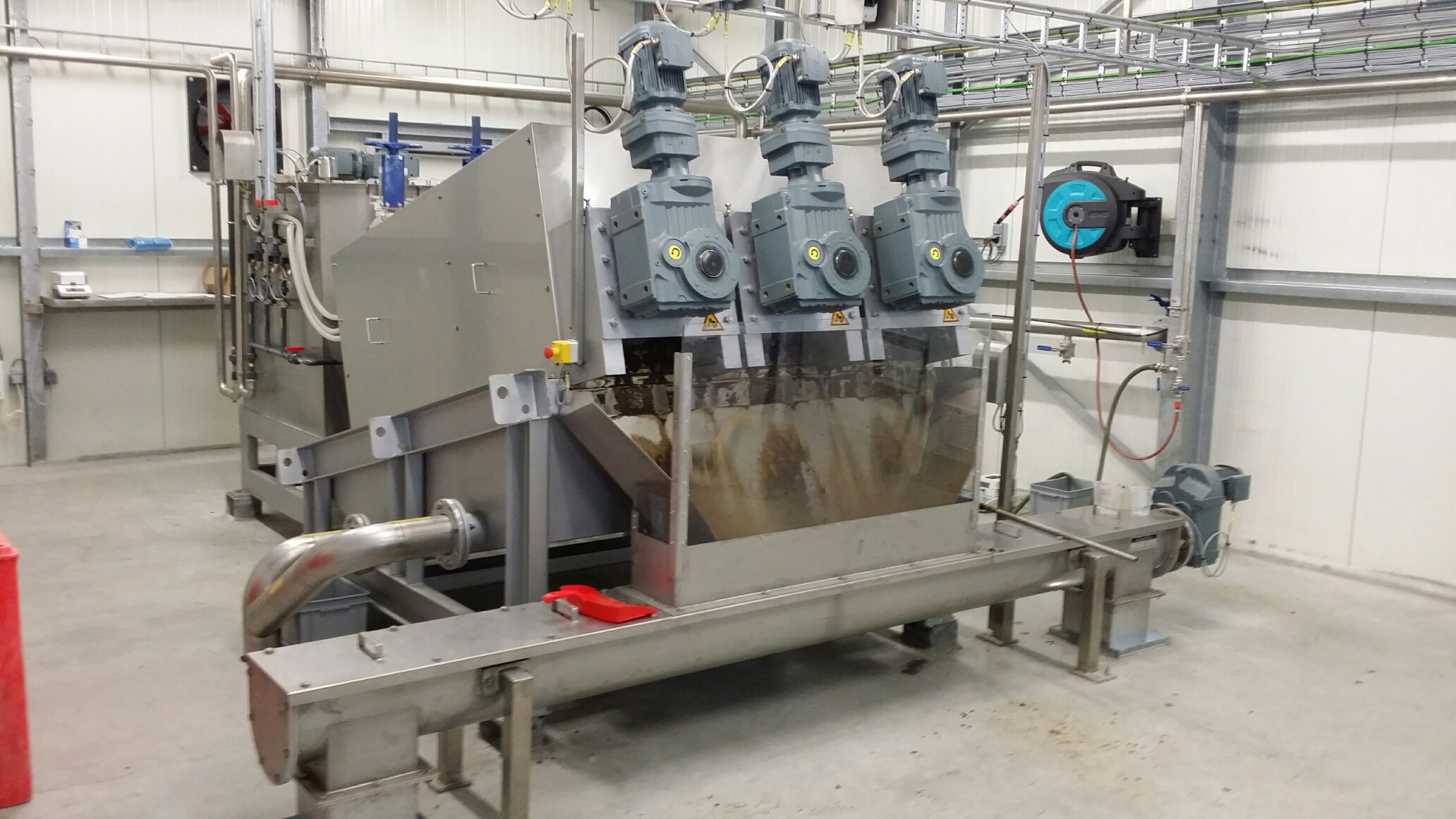
Multi-disk screw press installation serving industrial park sludge dewatering in Belgium.
By the time a buyer reaches the evaluation stage of a screw press sludge dewatering project, the basic technology choice is usually settled. What remains difficult is the technical interrogation: how much sludge the unit will actually accept, how much polymer it will need, and how often it will stop. These are the three questions that dominate real procurement conversations in 2026, and they are the three that generic brochures answer least well.
Three questions that decide most screw press evaluations
At evaluation stage, buyers are not comparing brochures. They are comparing whether the numbers on those brochures describe the same operating condition. A 30 m³/h hydraulic rating on dilute sludge and a 30 m³/h rating on thickened sludge describe machines of very different physical size.
The table below summarises how each of the three questions is normally resolved, and what a buyer should ask for in order to close it.
| Procurement question | What actually determines the answer | What to request from the supplier |
|---|---|---|
| Throughput | Sludge type, inlet solids concentration, target cake dryness | Capacity stated in both m³/h and kg DS/h, tied to a defined feed condition |
| Polymer use | Sludge characteristics, polymer type, mixing energy, dosing point | PAM dosing scope, beaker or pilot test data on the project sludge |
| Maintenance | Self-cleaning geometry, operating continuity, abrasive content | Wear-part list, recommended spares, service scope and response expectations |
Throughput: what a screw press can actually process
A screw press sludge dewatering machine is sized against two separate capacity figures: the volume of liquid sludge it accepts per hour (m³/h) and the mass of dry solids it processes in the same period (kg DS/h). The two figures move in opposite directions. As inlet concentration rises, hydraulic capacity falls but dry-solids capacity rises, because each cubic metre carries more solids.
Benenv, a Chinese manufacturer of multi-disk screw presses established in 2011 and based in Yixing, publishes both figures per model. Its smallest unit, the MDS101, illustrates the trade-off directly: the reported hydraulic treatment capacity is 1.5 m³/h at an inlet concentration of 2,000 mg/L and 0.12 m³/h at 50,000 mg/L, while the dry-solids capacity for the same machine is listed at 3–6 kg/h.
That single example explains why capacity claims often fail to transfer between quotations. Capacity is a property of the feed, not only of the machine.
Reading a model table correctly
The MDS range spans small packaged units through to large municipal-scale machines, and every step up in capacity also steps up power draw, weight and wash-water demand. A representative cross-section is shown below.
| Model | Power | Hydraulic capacity | Dry solids | Weight | Wash water |
|---|---|---|---|---|---|
| MDS101 | 0.2 kW | 0.12–1.5 m³/h | 3–6 kg/h | 205 kg | 24 L/h |
| MDS202 | 0.6 kW | 0.8–12 m³/h | 24–40 kg/h | 470 kg | 64 L/h |
| MDS302 | 1.2 kW | 2.4–30 m³/h | 60–120 kg/h | 1,350 kg | 80 L/h |
| MDS353 | 6 kW | 7.2–90 m³/h | 180–360 kg/h | 3,350 kg | 216 L/h |
| MDS404 | 8.2 kW | 13.6–200 m³/h | 400–680 kg/h | 6,550 kg | 320 L/h |
Source: Benenv product specification data for the MDS multi-disk screw press series. Bodies are available in SS304 or SS316L.
Two procurement consequences follow. First, utility planning — power supply and wash-water availability — scales with the model, not with the site. Second, the weight column is a structural and lifting constraint that is frequently overlooked until installation planning begins.
What changes throughput on a real site
Beyond inlet concentration, four factors repeatedly shift the achieved throughput away from the nominal figure.
Sludge type and dewaterability. Biological sludge, DAF sludge, chemical sludge and oily industrial sludge behave differently in the same machine. Benenv's project record includes municipal sludge, printing and dyeing sludge, palm oil mill sludge, chemical sludge and DAF sludge across the same MDS platform — but not at the same capacity for a given model.
Conditioning quality. A poorly formed floc releases water slowly and blinds the disc gaps, which reduces effective throughput before it reduces cake dryness.
Target cake dryness. Pushing for a drier cake means a longer residence time in the press zone, which trades throughput for dryness.
Operating continuity. Machines that run around the clock accumulate throughput that intermittent machines cannot match, even at identical hourly ratings.
Polymer use: floc quality determines everything downstream
A screw press is a low-pressure, floc-dependent device. Dewatering happens through gravity drainage and a gradually narrowing screw channel, not through high compressive force. That means polymer conditioning — normally a polyacrylamide (PAM) product — does most of the dewatering work before the sludge even reaches the press zone.
The principle is straightforward. Fine particles, particularly in biological and DAF sludge, hold water at the surface and dewater poorly on their own. A high-molecular-weight polymer bridges them into flocs large and strong enough to release free water. Stronger flocs survive the shear in the press zone and emerge as a drier cake; weak flocs break up and carry solids into the filtrate.
Benenv describes the MDS system scope as including a sludge feed pump, a PAM dosing system, a PLC control cabinet and a cake conveying system. For procurement, that scope matters: polymer dosing is part of the system design, not an accessory bolted on afterwards.
Why no universal polymer dose exists
There is no single polymer dose per tonne of dry solids that transfers between projects. The dose depends on the sludge source and its upstream treatment history, the inlet solids concentration, the polymer's charge density and molecular weight, the dilution water used to make up the solution, the mixing energy at the injection point, and the physical distance between dosing and the press inlet.
The only reliable basis for a polymer figure in a commercial offer is a beaker test or pilot run using the project's own sludge. Without that test, a supplier's polymer consumption estimate is an assumption, and should be treated as one in the total operating cost model.
Dosing details that change operating cost
Several design choices affect polymer performance without appearing on a datasheet: whether dosing is flow-proportional or solids-proportional, the design of the inline mixing device, the ageing time allowed for the polymer solution before use, and the quality of the dilution water. Buyers evaluating screw press sludge dewatering systems should ask how these are specified, because each of them can silently raise consumption.
Maintenance: what scheduled downtime actually contains
The multi-disk screw press was adopted widely in part because its maintenance profile is undemanding. The relative movement between the moving screw and the fixed discs continuously clears the filtration gaps during operation — the self-cleaning mechanism that appears repeatedly in project references.
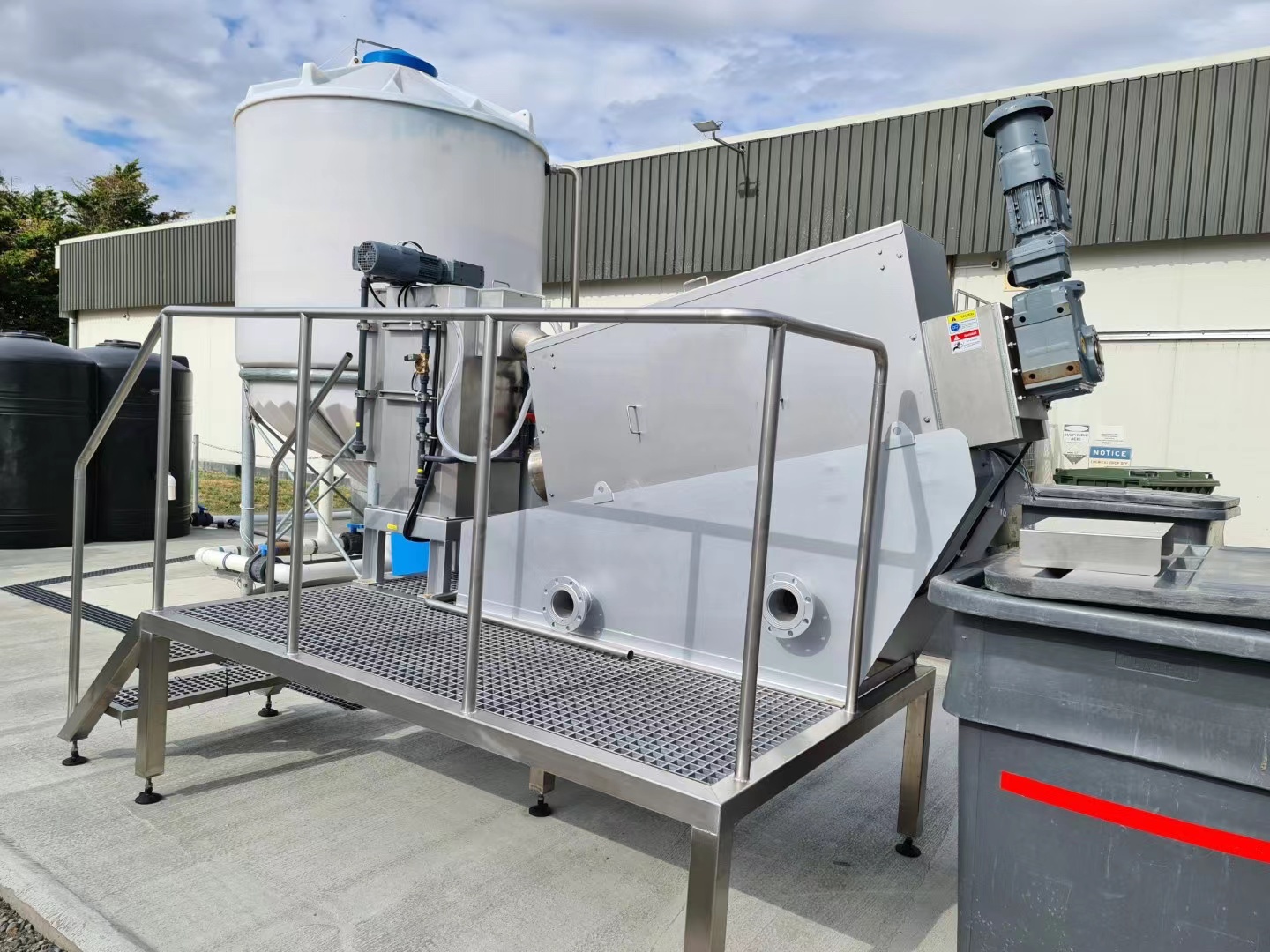
Compact MDS301 configuration installed for sludge volume reduction at a food processing site in New Zealand.
Benenv's project record reflects this. An MDS202 installed at a printing and dyeing plant in Vietnam has operated stably for two years, with the self-cleaning mechanism cited as the highlight. Two MDS403 units at a palm oil mill in Indonesia have run stably for two years, with simple maintenance noted as the defining characteristic. A similar pattern appears at an MDS353 installation in an industrial park in Belgium, running for three years.
What routine maintenance covers
Routine work on a screw press dewatering unit generally covers flushing and cleaning of the discs and screw, inspection of wear on the screw flights and fixed discs, bearing and seal inspection, maintenance of the polymer dosing side (feed pump, mixer, dilution), and periodic checking of the PLC and instrumentation.
Wash-water consumption is an operating input rather than a maintenance item, but it shapes how the cleaning routine must be provisioned. The MDS range requires between 24 L/h on the smallest model and 320 L/h on the largest, so low-water sites need to plan for reuse or storage.
The honest boundary
Maintenance intervals cannot be predicted reliably from a brochure. Abrasive solids — sand, grit and high-mineral industrial sludge — accelerate wear on the screw and discs, and poor polymer performance increases the frequency of manual intervention. Buyers comparing suppliers should request a wear-part list with expected replacement intervals at quotation stage, rather than discovering the answer after commissioning.
How these answers should shape the RFQ
Once throughput, polymer and maintenance are treated as linked variables, the RFQ changes shape. Instead of asking for a model number, buyers should specify the conditions under which the model must perform.
A practical RFQ for a sludge dewatering system should state the sludge type and the expected inlet concentration range, state the target cake dryness, and require capacity to be quoted in both m³/h and kg DS/h against those conditions. It should ask what polymer testing will be performed on the project sludge, and what system boundary is included — feed pump, PAM dosing, PLC control and cake conveying, or press only.
It should also ask for a wear-part list, a recommended spare-parts package, and the after-sales scope. Benenv's stated after-sales position covers installation guidance, operator training, technical assistance and spare-parts supply, and the company offers OEM and ODM production with a stated lead time of 30–45 days and a minimum order of one unit.
Verification items belong in the RFQ as well. Benenv's multi-disk screw press holds CE certification issued by UDEM (certificate M.2024.206.C97307, to EN 60204-1:2018, valid to 5 March 2029) and an ISO 9001 certificate issued by CICC (18122Q11896R1M, to GB/T 19001-2016 / ISO 9001:2015, valid to 1 September 2028). Certificate numbers, scope and validity should be checked rather than assumed.
Market context: why the technical details matter more now
The pressure to get these details right is rising with the market itself. Fortune Business Insights values the global sludge dewatering equipment market at USD 5.19 billion in 2024 and projects the screw press segment to grow at the highest CAGR of 9.4% over the forecast period. The same source places Asia Pacific at a 37.57% revenue share in 2024.
Aggregated commercial research puts the average selling price of a sludge screw dewatering press at approximately USD 46,000 per unit in 2025. As the supplier pool widens, buyers face more quotations that are nominally comparable and technically incomparable — which is precisely why the three questions in this article deserve to be asked in writing.
Limits on comparing published figures
There is currently no common test protocol that makes manufacturer-published capacity figures directly comparable across vendors. HUBER's official Q-PRESS page, for example, reports a feed capacity of up to 540 kg dry solids per hour for its screw press series, without a shared test basis. Until sludge type, inlet concentration, polymer dose, target cake dryness, model and test protocol are aligned, no technical capacity ranking between suppliers is defensible.
A second boundary concerns suitability. Screw presses rely on floc integrity, so sludges with high grit content, unusual conditioning behaviour or very high cake-dryness targets require individual assessment rather than a standard model selection.
Future Outlook
The direction of travel in screw press sludge dewatering is toward fewer manual interventions per tonne of dry solids. Continuous sludge dewatering machines are being specified where plants cannot afford scheduled stops, and polymer dosing is increasingly treated as a measurable operating cost rather than a fixed assumption.
For buyers at evaluation stage, that shift makes the RFQ the decisive document. Capacity quoted against a defined feed condition, a polymer figure supported by a sludge test, and a wear-part list with replacement intervals will do more to predict five-year cost than any comparison of headline throughput numbers.
Frequently Asked Questions
How is the throughput of a screw press sludge dewatering machine measured?
Throughput is reported in two ways: hydraulic capacity in cubic metres per hour and dry-solids capacity in kilograms per hour. On the Benenv MDS101, for example, hydraulic capacity ranges from 1.5 m³/h at 2,000 mg/L inlet concentration down to 0.12 m³/h at 50,000 mg/L, with dry-solids capacity listed separately at 3–6 kg/h. Both figures are needed to size a machine.
Why does the same screw press show different capacities on different datasheets?
Because capacity is a function of the feed. Higher inlet solids concentration lowers hydraulic capacity while raising dry-solids capacity for the same machine. When two datasheets state different figures for the same model, the underlying concentration and test conditions are usually different, and the numbers should not be compared until those conditions are aligned.
How much polymer does a screw press sludge dewatering machine consume?
There is no universal polymer dose. Consumption depends on the sludge source, inlet solids concentration, polymer type, dilution and mixing energy at the dosing point. A reliable figure can only come from a beaker test or pilot run on the project's own sludge, and any quoted dose without such a test should be treated as an assumption.
How often does a screw press sludge dewatering machine need maintenance?
Multi-disk screw presses are designed for low maintenance frequency, with the relative motion of screw and discs cleaning the filtration gaps continuously during operation. Actual intervals depend on abrasive content in the sludge and on polymer performance, so a wear-part list with expected replacement intervals is more useful than a generic maintenance schedule.
Can a screw press sludge dewatering machine operate continuously?
Continuous operation is a documented use pattern for this equipment type. Benenv references include an MDS302 running on chemical sludge in India for three years with continuous operation as the stated highlight, and an MDS131 serving an industrial park in France for one year on the same basis.
What should be included in an RFQ for a screw press sludge dewatering system?
The RFQ should define the sludge type and inlet concentration range, the target cake dryness, and require capacity in both m³/h and kg DS/h. It should also specify the system boundary — feed pump, PAM dosing system, PLC control cabinet and cake conveying — and request a wear-part list, spare-parts package and after-sales scope.
Is a screw press suitable for both municipal and industrial sludge?
The same multi-disk screw press platform is applied across municipal, industrial and food processing wastewater treatment, including chemical, textile, paper, pharmaceutical and agricultural sectors. Suitability for a specific project still depends on the sludge's dewatering behaviour, so application fit should be confirmed against representative sludge rather than assumed from the sector label.
¿Tiene preguntas o necesita más detalles?
Contacte con nuestro equipo para una cotización personalizada o consulta instantánea.
Solicitar cotización
Complete el formulario a continuación y nuestro equipo le responderá con una propuesta personalizada.
Chat directo de WhatsApp
¿Prefiere chatear en tiempo real? Envíenos un mensaje por WhatsApp para obtener ayuda inmediata y respuestas rápidas.
- Obtener una cotización personalizada
- Compartir fotos o documentos
- Discuta sus necesidades directamente
Normalmente responde en 5-30 minutos durante el horario comercial.