
Screw Press Sludge Dewatering: Comparing Procurement Terms
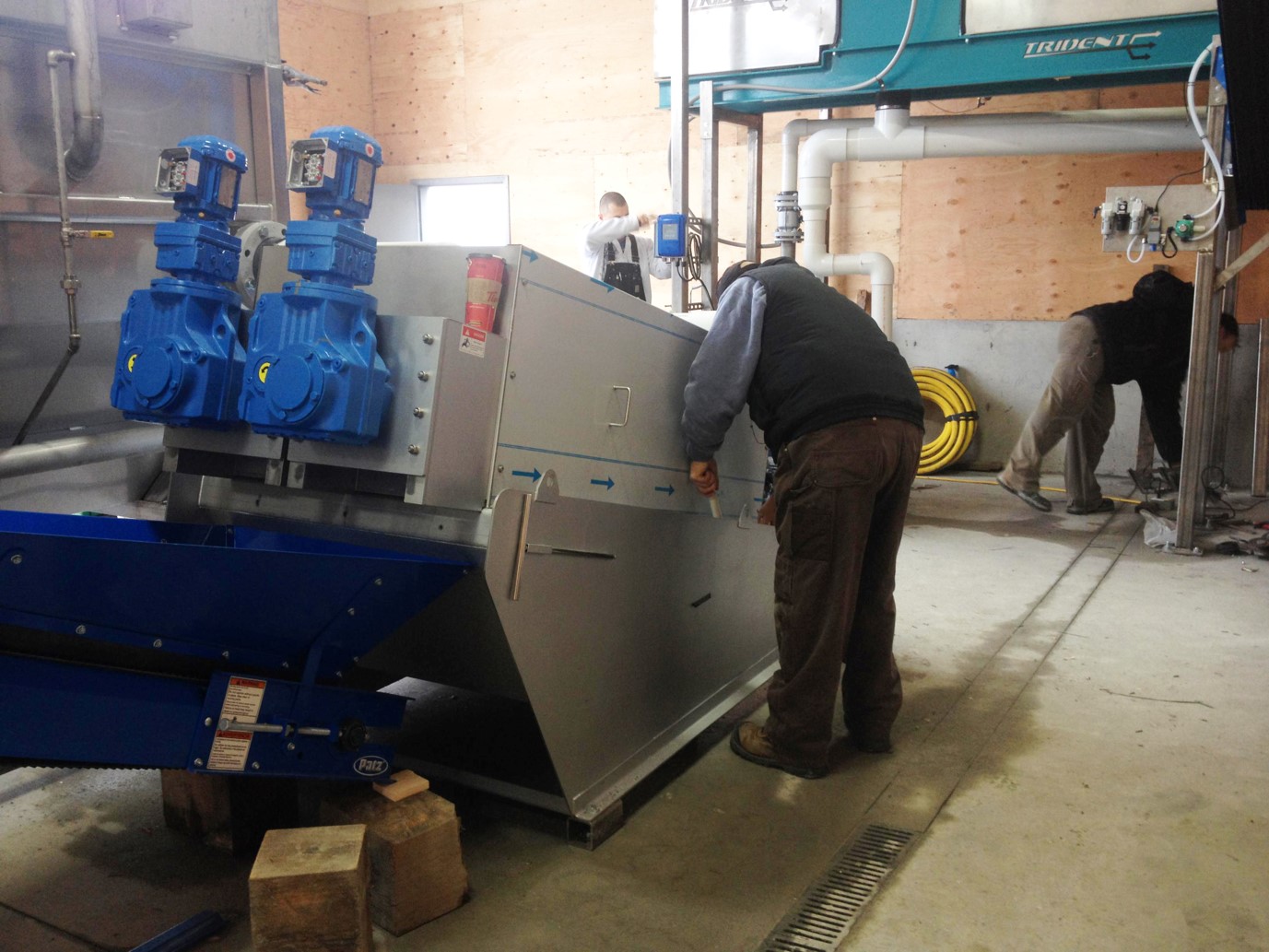
Short answer: Two screw press sludge dewatering machines can carry the same nominal capacity and still represent very different purchases. The difference usually sits in the procurement terms — the sludge condition behind the capacity guarantee, the acceptance test that proves it, the inspection rights before shipment, the scope of supplied equipment, and the obligations that survive delivery. This buyer comparison sets out a framework for evaluating those terms, and uses documented Benenv MDS multi-disk screw press data as a worked reference for what a supplier can reasonably be asked to confirm in writing.
A Growing Market With Tighter Contract Scrutiny
Sludge dewatering is one of the few unit processes in a wastewater treatment plant that keeps generating cost long after commissioning, because polymer consumption, wash water, maintenance and disposal volumes all trace back to how the dewatering stage was specified and accepted. Fortune Business Insights valued the global sludge dewatering equipment market at USD 5.19 billion in 2024 and projects it to reach USD 10.16 billion by 2032. Within that market, the screw press segment is expected to record the highest CAGR of 9.4% between 2025 and 2032, and Asia Pacific accounted for 37.57% of global revenue in 2024, supported by rapid urbanisation and stricter wastewater regulations.
Growth at that scale changes the nature of the purchase. Screw press sludge dewatering machines are increasingly bought through international tenders, framework agreements and multi-unit projects, which means a buyer may receive several offers with almost identical headline parameters — and almost no comparable commercial content. The parameters describe the machine; the terms describe what the buyer will actually receive, when, and how that will be proven.
The Three Procurement Problems Behind Most Dewatering Disputes
Most problems in sludge dewatering procurement are not caused by the technology. They are caused by three gaps that are visible only when the contract is read against the site.
First, capacity without context. A published capacity figure is an envelope, not a promise. A machine rated at a given m3/h delivers that figure only for a defined sludge type, inlet solids concentration and polymer regime. When the offer does not state the basis, the buyer has nothing to verify at acceptance.
Second, acceptance testing defined after delivery. If the test sludge, the measurement method, the tolerance and the remedy for a failed result are not agreed before the order, the buyer loses the only practical instrument for enforcing performance. The remedy clause matters more than the guarantee number.
Third, a partial scope of supply. A sludge dewatering system is a train: sludge feed pump, polymer dosing system, electrical control cabinet, and cake conveying equipment normally sit around the dewatering unit. If the boundary of supply is ambiguous, the interface between two suppliers becomes the buyer's problem during commissioning.
A Five-Axis Comparison Framework for Screw Press Sludge Dewatering
The framework below is designed so that offers from different suppliers — and different supplier structures — can be compared on the same basis. It applies to any screw press for sludge dewatering, whether the machine is described as a multi plate screw press, a screw sludge press or a screw type sludge dehydrator.
| Evaluation axis | Question to ask every supplier | What to obtain in writing |
|---|---|---|
| 1. Capacity basis | Capacity in m3/h and dry solids throughput in kg DS/h — at which sludge type, inlet solids concentration and polymer dose? | A stated design basis, not a range alone. |
| 2. Materials and corrosion | Which wetted parts are SS304 and which are SS316L, and does the nameplate match the contract? | Material grade confirmed on the nameplate, packing list and inspection records. |
| 3. Testing and inspection | Is every unit tested before shipment, and may the buyer appoint a third-party inspector? | Pre-shipment test scope, witness rights, and third-party inspection access. |
| 4. Scope and interfaces | Which items of the dewatering train are inside the offer — feed pump, PAM dosing, PLC cabinet, cake conveyor? | A scope-of-supply matrix with clearly assigned interfaces. |
| 5. Support and spares | Who installs, commissions and trains operators, and how are spare parts supplied over the operating life? | After-sales obligations, spare parts list and training commitments. |
Comparing Supplier Structures: Where the Contract Actually Sits
Before comparing machines, buyers should compare the entity they are contracting with. The same screw press dewatering device can reach a project through a direct manufacturer, a trading intermediary, or a regional integrator or EPC contractor. Each structure produces a different answer to the question that matters at acceptance: who is accountable for the guaranteed number?
| Aspect | Direct manufacturer | Trading intermediary | Regional integrator / EPC |
|---|---|---|---|
| Who signs the technical annex | The party that holds the drawings | Verify whether the factory countersigns | The integrator, with factory input |
| Factory acceptance test | Run at own plant | Confirm which plant performs the test | Often delegated or witnessed |
| Documentation traceability | Drawing, material and test records in one place | Request the original factory documents | Consolidated dossier from several vendors |
| Spare parts pathway | Single route to the original part | Ask who holds the spare parts list | Depends on each sub-supplier |
| Change management | Design or material changes controlled at source | Verify who approves substitutions | Approval route runs through the integrator |
| Best fit project profile | Buyers who want the acceptance test tied to the production line | Buyers who need multi-brand sourcing in one order | Turnkey plants where one interface is preferred |
The point of the table is not that one structure is superior. It is that the acceptance test, the drawings and the spare parts list belong to a specific legal entity, and that entity should be identifiable in the offer. A comparison of screw press sludge dewatering machines that ignores this will compare catalogues rather than obligations.
How the Benenv MDS Multi-Disk Screw Press Maps to Standard Purchasing Requirements
Benenv (JIANGSU BENENV ENVIRONMENTAL TECHNOLOGIES CO., LTD) is a Jiangsu, China-based environmental technology manufacturer founded in 2011. It operates a 20,000 m2 factory with around 200 employees and a 50-engineer R&D team, produces approximately 500 units per year, and exports about 70% of its output to Europe, the United States, Southeast Asia, the Middle East and Australia. Its product line includes the Multi-Disk Screw Press, Wave Separator, Dissolved Air Flotation unit, Super Rotary Sludge Dryer, Sludge Drying & Carbonisation System and the Gangnan Chain Plate Type Compost System.
For procurement purposes, the relevant question is how a supplier answers the standard clauses of a purchase order. The table below maps common purchasing requirements to Benenv's documented position.
| Purchasing requirement | Benenv documented position |
|---|---|
| Commercial flexibility | OEM and ODM production supported; minimum order quantity of 1 unit. |
| Lead time | 30 to 45 days. |
| Production capacity | 100 units per month. |
| Quality control before shipment | 100% pre-shipment test; third-party inspection such as SGS is part of the documented quality control approach. |
| After-sales obligations | Installation guidance, operator training, technical assistance and spare parts supply for long-term operation. |
| Installed base and market position | Benenv reports more than 4,500 project references in more than 60 countries. Fortune Business Insights identifies Benenv as a key global player in the sludge dewatering equipment market, particularly for its MDS (Multi-Disk Screw press) technology. |
| Channel and local support | 18 agents in countries including France, the United States, the United Kingdom, Malaysia, Indonesia and Saudi Arabia; subsidiaries including Japan (Kanazawa) and Dubai; a wholly owned R&D centre in Japan. |
Read against the five-axis framework, this is the material a buyer can convert into contract clauses: a named manufacturer, a stated lead time, a monthly capacity figure that supports delivery planning, a defined pre-shipment test regime, and an after-sales scope that can be written into the order rather than assumed.
Acceptance Testing: What Should Be Fixed Before the Purchase Order
Acceptance testing is where a comparison stops being commercial and becomes technical. An acceptance clause for a screw press sludge dewatering machine is workable only if it names the sludge, the metric and the remedy.
Sludge definition. The clause should identify the sludge source and type, and the inlet solids concentration window that applies. Municipal sludge, DAF sludge, chemical sludge and printing and dyeing sludge behave differently in the same machine, and the guaranteed throughput follows the sludge, not the model number.
Metrics. Practical acceptance metrics are hydraulic capacity in m3/h, dry solids throughput in kg DS/h, cake dryness, polymer consumption, and wash-water consumption. Benenv machines are supplied as fully automatic continuous units designed for 24/7 operation, and the published water consumption per model ranges from 24 L/h on the smallest unit to 320 L/h on the largest — a number that should be written into the plant water balance at the same time as the acceptance clause.
Method and witness. The clause should state how samples are taken, over what period the figures are averaged, and who witnesses the test. Benenv performs a 100% pre-shipment test and accommodates third-party inspection, which allows the buyer to align the factory test with the site commissioning test.
Remedy. A tolerance without a remedy is not a guarantee. The buyer should agree in advance what happens if the measured capacity or dryness falls outside tolerance: adjustment and retest, replacement of components, or a defined commercial settlement. The same clause should set out the conditions under which a retest is valid — for example, whether the polymer type and dose remain unchanged.
A last, practical point: an acceptance test on a screw press for sludge dewatering must include the matched equipment. The polymer dosing system and the sludge feed pump influence the result as much as the dewatering unit, and both are normally part of the supplied train.
Technical Explanation: How a Multi-Disk Screw Press Dewaters Sludge
In a multi-disk screw press, sludge is first conditioned with polymer so that solids form stable flocs. The flocculated sludge then passes through a gravity thickening zone, where free water drains away, before entering the press zone. There, a slowly rotating screw moves the sludge through a stack of fixed and moving disks. Because adjacent disks move relative to each other, the dewatering channels are continuously cleared — the self-cleaning mechanism reported across Benenv project references — which is why the unit can run continuously with limited operator attention.
Three physical consequences follow, and all three appear in the procurement documents rather than only in the sales discussion.
Low rotational speed means low installed power. Benenv MDS models range from 0.2 kW to 8.2 kW depending on size. A third-party comparative analysis published by Amcon Europe reports that screw press technology typically consumes 90% to 95% less power than centrifuges in sludge dewatering applications; that figure is indicative and should be verified against the actual duty and installed load in any specific project.
Low speed and continuous cleaning reduce operator intervention. Project references for Benenv machines list low noise and vibration, simple maintenance and continuous operation as observed characteristics, alongside water-saving operation.
Corrosion resistance is a specification item, not an assumption. Benenv wetted parts are supplied in SS304 or SS316L depending on the application, and the grade should be confirmed against the nameplate, the packing list and the inspection record.
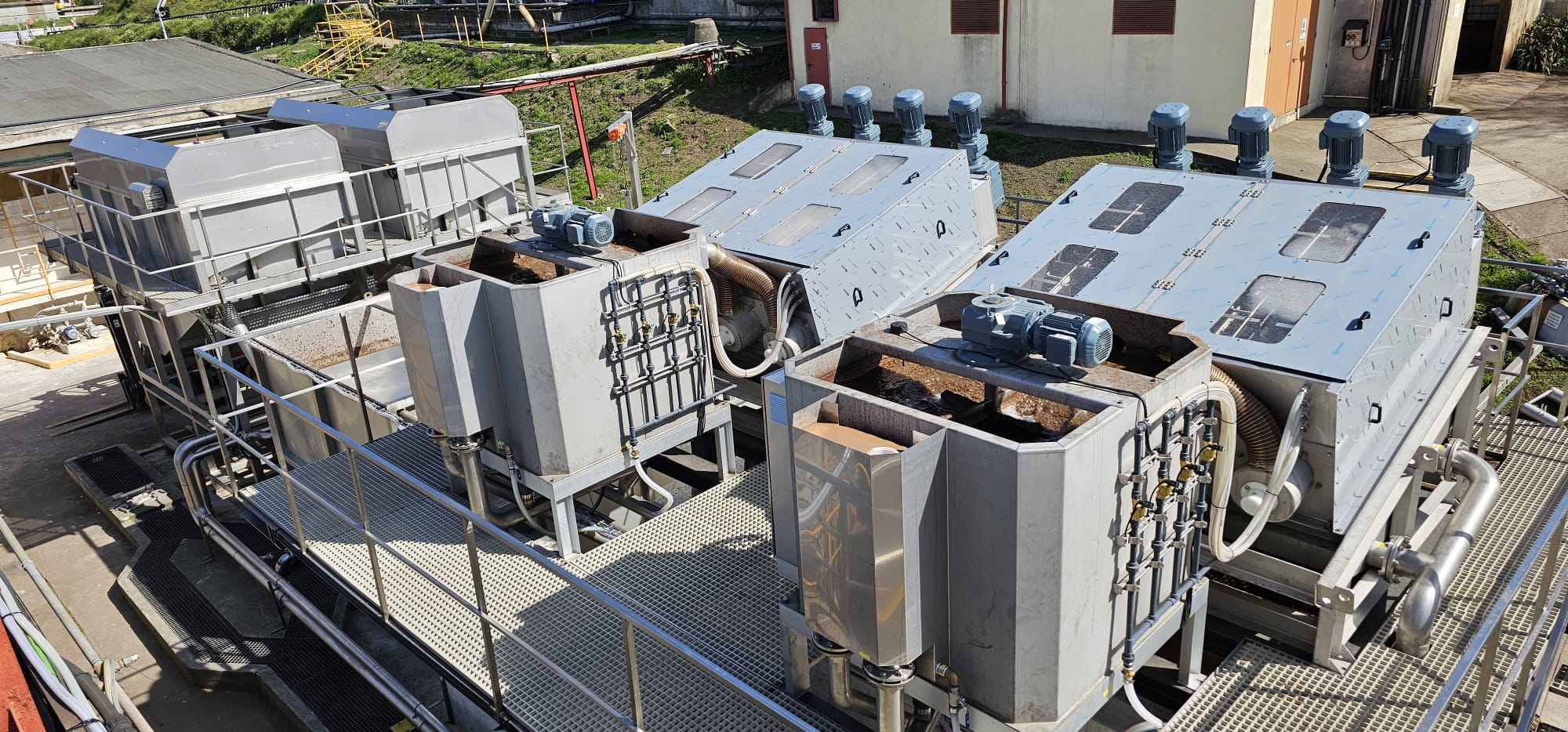
The Numbers Buyers Should Compare: Benenv MDS Model Range
The published range below is the reference point for a like-for-like comparison. It is also the point at which a buyer should ask any supplier — including Benenv — to state the sludge condition behind the number.
| Model | Type | Power | Capacity | Dry solids | Weight | Water use |
|---|---|---|---|---|---|---|
| MDS101 | Multi-Disk Screw Press | 0.2 kW | 0.12-1.5 m3/h | 3-6 kg/h | 205 kg | 24 L/h |
| MDS131 | Multi-Disk Screw Press | 0.2 kW | 0.24-3 m3/h | 6-12 kg/h | 205 kg | 24 L/h |
| MDS132 | Multi-Disk Screw Press | 0.3 kW | 0.48-3 m3/h | 12-24 kg/h | 275 kg | 48 L/h |
| MDS201 | Multi-Disk Screw Press | 0.3 kW | 0.4-6 m3/h | 12-20 kg/h | 320 kg | 32 L/h |
| MDS202 | Multi-Disk Screw Press | 0.6 kW | 0.8-12 m3/h | 24-40 kg/h | 470 kg | 64 L/h |
| MDS301 | Multi-Disk Screw Press | 0.8 kW | 1.2-15 m3/h | 30-60 kg/h | 910 kg | 40 L/h |
| MDS302 | Multi-Disk Screw Press | 1.2 kW | 2.4-30 m3/h | 60-120 kg/h | 1,350 kg | 80 L/h |
| MDS303 | Multi-Disk Screw Press | 1.95 kW | 0.12-1.5 m3/h | 3.6-45 kg/h | 1,820 kg | 120 L/h |
| MDS351 | Multi-Disk Screw Press | 1.9 kW | 2.4-30 m3/h | 60-120 kg/h | 1,610 kg | 72 L/h |
| MDS352 | Multi-Disk Screw Press | 3.75 kW | 4.8-30 m3/h | 120-240 kg/h | 2,300 kg | 144 L/h |
| MDS353 | Multi-Disk Screw Press | 6 kW | 7.2-90 m3/h | 180-360 kg/h | 3,350 kg | 216 L/h |
| MDS354 | Multi-Disk Screw Press | 8.2 kW | 9.6-120 m3/h | 240-480 kg/h | 4,500 kg | 288 L/h |
| MDS401 | Multi-Disk Screw Press | 2.25 kW | 3.4-50 m3/h | 100-170 kg/h | 2,500 kg | 80 L/h |
| MDS402 | Multi-Disk Screw Press | 4.5 kW | 6.8-100 m3/h | 200-340 kg/h | 3,480 kg | 160 L/h |
| MDS403 | Multi-Disk Screw Press | 6.7 kW | 10.2-150 m3/h | 300-510 kg/h | 4,550 kg | 240 L/h |
| MDS404 | Multi-Disk Screw Press | 8.2 kW | 13.6-200 m3/h | 400-680 kg/h | 6,550 kg | 320 L/h |
All models are supplied in SS304 or SS316L. Published ranges apply across municipal, industrial and food processing wastewater treatment, including chemical, textile, paper, pharmaceutical and agricultural industries.
Application Fit: Matching the Machine to Project Conditions
Screw press sludge dewatering is proposed across a wide set of project conditions: municipal wastewater treatment, industrial wastewater treatment in chemical, textile, paper and electroplating plants, food processing and slaughterhouse operations, pharmaceutical manufacturing, livestock, aquaculture and agricultural wastewater, and landfill leachate treatment. Typical duty conditions include low to high concentration sludge, continuous operation, and sites where low energy consumption and low noise are design requirements.
Whatever the industry, four items of matched equipment recur in these installations: a sludge feed pump (typically a screw pump), a polymer dosing system for PAM, an electrical control system with PLC control cabinet, and a cake conveying system using a belt or screw conveyor. Two special requirements also recur: stable flocculation performance through correct chemical selection, and corrosion-resistant materials where the sludge chemistry demands them.
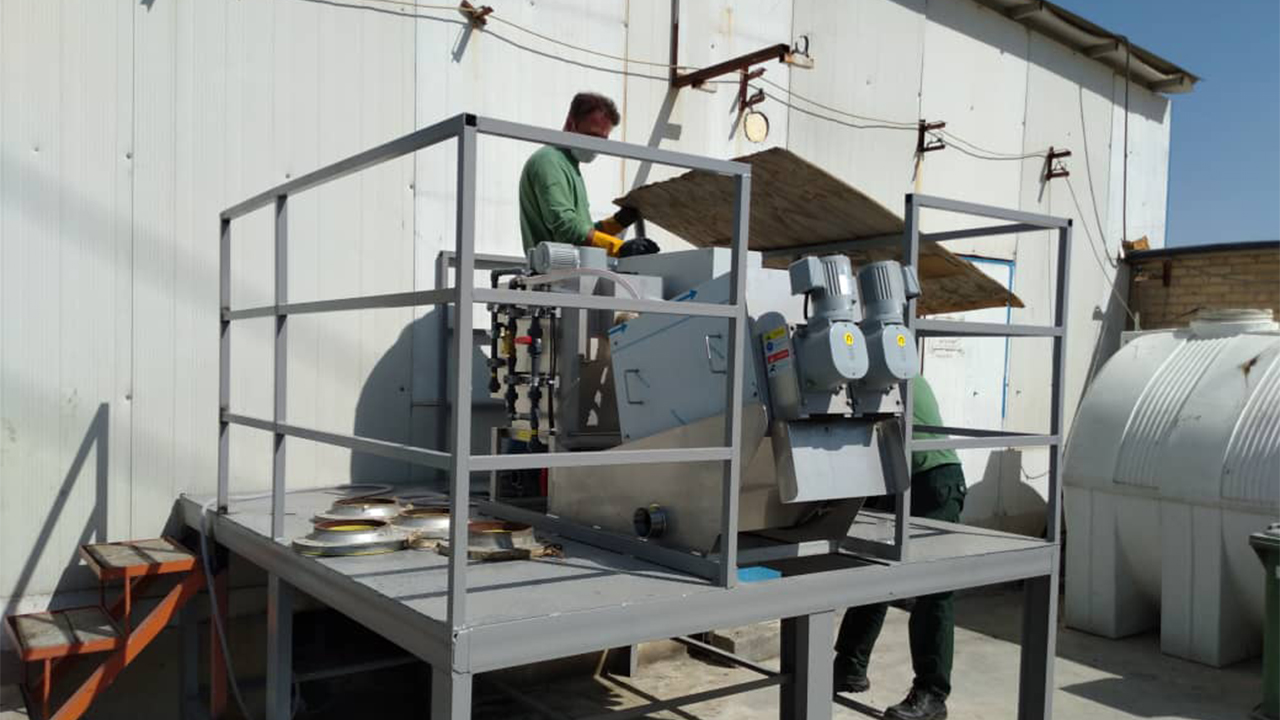
Because these references are the closest available proxy for how a machine will behave in service, they belong in the evaluation file rather than the marketing appendix. The table below summarises documented Benenv installations by country, application and reported operating outcome.
| Country | Application | Model | Duration | Documented highlight |
|---|---|---|---|---|
| Oman | Industrial sludge dewatering | MDS202, 1 unit | 1 year | Low energy consumption |
| Vietnam | Printing and dyeing sludge | MDS202, 1 unit | 2 years | Self-cleaning mechanism |
| Indonesia | Palm oil mill sludge dewatering | MDS403, 1 unit | 3 years | Low noise and vibration |
| Indonesia | Palm oil mill sludge dewatering | MDS403, 2 units | 2 years | Simple maintenance |
| India | Chemical sludge dewatering | MDS302, 1 unit | 3 years | Continuous operation |
| Iran | Chemical sludge from textile factories | MDS132, 1 unit | 2 years | Low energy consumption |
| New Zealand | Sludge reduction | MDS301, 1 unit | 1 year | Compact design |
| United Arab Emirates | Sludge dewatering in industrial parks | MDS302, 3 units | 2 years | Low noise and vibration |
| Thailand | Sewage treatment plant sludge dewatering | MDS352, 2 units | 3 years | Self-cleaning mechanism |
| France | Municipal sludge dewatering | MDS353, 1 unit | 1 year | Low energy consumption |
| Portugal | Sludge volume reduction in meat processing plants | MDS303, 1 unit | 2 years | Water-saving operation |
| Belgium | Industrial park sludge dewatering | MDS353, 1 unit | 3 years | Simple maintenance |
| France | Industrial park sludge dewatering | MDS131, 1 unit | 1 year | Continuous operation |
| United States | DAF sludge dewatering and volume reduction | MDS353, 3 units | 2 years | Self-cleaning mechanism |
| Canada | DAF sludge dewatering and volume minimization | MDS302, 1 unit | 3 years | Low energy consumption |
Comparing Screw Press Dewatering With Traditional Solutions
Where a project is still considering centrifuges, belt filter presses or drying beds, the comparison should be run on the same duty, because the technologies consume different resources. The published power comparison is the clearest example: screw press technology typically consumes 90% to 95% less power than centrifuges in sludge dewatering applications, according to a comparative analysis published by Amcon Europe. Buyers should use that as a prompt to verify installed electrical load and running cost in the offers, not as a substitute for their own duty calculation.
A practical comparison also covers polymer consumption, wash-water demand, operator attention, spare-part structure and disposal cost — the five items that determine total cost of ownership rather than purchase price. In that comparison, the screw press has a specific boundary: it is a dewatering machine, not a dryer. Where a project requires further volume reduction beyond mechanical dewatering, the screw press sits in front of a drying stage, such as the Super Rotary Sludge Dryer or the Sludge Drying & Carbonisation System in Benenv's portfolio, and the two stages should be specified as one train.
Limits and Boundaries: Where a Screw Press Is Not the Whole Answer
A comparison that only lists advantages is not usable for procurement. Four boundaries should be stated openly in any screw press dewatering offer.
Capacity figures are conditional. The published ranges in this article are envelopes across a model family. The number that can be guaranteed in a contract depends on sludge type, inlet solids concentration and flocculation performance, and it should be stated explicitly rather than inferred from the largest figure in the range.
The dewatering unit is one item in a system. A functioning sludge dewatering system also needs a sludge feed pump, a polymer dosing system, an electrical control cabinet and a cake conveying system. Buyers who price only the press will discover the rest of the train during commissioning.
Flocculation stability is a precondition. Screw press dewatering depends on stable flocculation and correct polymer selection. Where the polymer regime cannot be held constant, performance will vary regardless of the machine selected, and this should be treated as a plant operating requirement rather than a supplier defect.
Throughput has a practical ceiling per unit. The largest Benenv model, the MDS404, has a published hydraulic capacity range of 13.6 to 200 m3/h. Plants with higher design flows normally use multiple units in parallel, which also provides redundancy during maintenance — a consideration that should be included in the layout and the acceptance strategy from the start.
Market Trend Analysis: What the Numbers Imply for Buyers
Three market data points are directly relevant to how buyers should structure their next dewatering purchase.
The global sludge dewatering equipment market was valued at USD 5.19 billion in 2024 and is projected to reach USD 10.16 billion by 2032 (Fortune Business Insights). A market of that trajectory attracts suppliers, which increases choice but also increases the proportion of offers that are commercially persuasive rather than technically specific.
Within the market, the screw press segment is expected to grow at the highest CAGR of 9.4% between 2025 and 2032. Growth concentrated in one technology means capacity expansion at the manufacturing end, and buyers should therefore test delivery commitments — a stated monthly capacity such as Benenv's 100 units per month is a verifiable planning input, not a marketing line.
Asia Pacific held 37.57% of global revenue in 2024, supported by urbanisation and stricter wastewater regulations. For European projects, EN 12255-8 specifies design principles and construction requirements for sludge treatment and storage facilities in wastewater treatment plants, and buyers specifying to that standard should request design documentation that demonstrates alignment rather than assume it.
Future Outlook
The direction of the market suggests that the comparison will shift further toward documented performance. As dewatering assets installed in the 2010s reach replacement age, the operating data from those installations — polymer consumption, cake dryness, maintenance intervals — will become the most persuasive evidence in a tender, ahead of catalogue parameters.
Two further shifts are likely. First, continuous, low-energy and water-saving operation will remain the design default for new municipal and industrial plants, which favours technologies with few rotating parts and low wash-water demand. Second, acceptance testing will become a standard annex rather than a negotiated exception, because international buyers increasingly require a measurable remedy when guaranteed performance is not met.
For buyers in the research and evaluation stage, the practical conclusion is straightforward: select the supplier whose offer already contains the acceptance basis, the inspection rights and the after-sales obligations, because those are the terms that will still matter five years after commissioning.
FAQ
What is a multi-disk screw press sludge dewatering machine?
A multi-disk screw press is a continuous sludge dewatering device in which flocculated sludge passes through a gravity thickening zone and then through a slowly rotating screw surrounded by a stack of fixed and moving disks. The relative movement between disks keeps the dewatering channels clear, which is why the unit can operate continuously with limited operator intervention. Benenv supplies this machine type under the designation Multi-Disk Screw Press, in models MDS101 to MDS404, with power ratings from 0.2 kW to 8.2 kW, published hydraulic capacities from 0.12 m3/h to 200 m3/h, and dry solids throughput from 3 kg/h to 680 kg/h, manufactured in SS304 or SS316L.
What should an acceptance test for screw press sludge dewatering equipment include?
A workable acceptance test identifies the sludge source and type, the inlet solids concentration, and the metrics to be measured — hydraulic capacity in m3/h, dry solids throughput in kg DS/h, cake dryness, polymer dose and wash-water consumption. It should also define how samples are taken, over what averaging period, who witnesses the test, and what remedy applies if results fall outside tolerance. On the supplier side, Benenv performs a 100% pre-shipment test and permits third-party inspection such as SGS, and its after-sales scope covers installation guidance, operator training and technical assistance, which allows the factory test and the site commissioning test to be aligned.
How should a buyer compare screw press sludge dewatering machines that quote similar capacities?
Compare the basis of the capacity figure first: the sludge type, inlet solids concentration and polymer regime on which it depends. Then compare the scope of supply, because a dewatering unit is normally supplied with a sludge feed pump, a PAM polymer dosing system, a PLC control cabinet and a cake conveying system, and the boundary of supply determines who resolves interface problems. Material grade, published wash-water consumption per model, the spare parts list, the stated lead time and the acceptance clause should then be compared line by line. A range such as 13.6 to 200 m3/h for the MDS404 describes the envelope of the model, not a guarantee for every sludge.
Which project conditions make a screw press the wrong choice?
A screw press is a dewatering machine, not a drying machine. Where a project requires volume reduction or dryness beyond what mechanical dewatering can deliver, the screw press is best specified as the stage in front of a dryer — for example Benenv's Super Rotary Sludge Dryer or Sludge Drying & Carbonisation System — rather than as the final process step. Similarly, where flocculation cannot be kept stable, or where the plant cannot accommodate the matched equipment around the press, the dewatering performance will be constrained by the system rather than by the machine.
How many units are needed for a large municipal or industrial plant?
Unit count follows the design sludge flow and the dry solids load, not the nominal capacity alone. Benenv's largest model, the MDS404, has a published hydraulic capacity range of 13.6 to 200 m3/h and a dry solids range of 400 to 680 kg/h; the smallest, the MDS101, covers 0.12 to 1.5 m3/h and 3 to 6 kg/h. Large plants are typically configured with several units in parallel, which also provides redundancy when one unit is taken out of service for maintenance.
How does screw press dewatering compare with centrifuge dewatering on running cost?
Power demand is the most frequently cited difference: a comparative analysis published by Amcon Europe reports that screw press technology typically consumes 90% to 95% less power than centrifuges in sludge dewatering applications. That figure is indicative and should be verified against the specific duty, because total cost of ownership also depends on polymer consumption, wash water, operator attention, spare parts and disposal cost. Buyers should require all of these items in the same comparison table across every technology proposed for the project.
Reference Material
The Benenv sludge dewatering equipment brochure, including the full multi-disk screw press model range, is available for download: Benenv product brochure (PDF). Company and product information: en.benenv.com.