
Screw Press Sludge Dewatering: A Framework for Ranking Manufacturers
Screw Press Sludge Dewatering: A Framework for Ranking Manufacturers
Ranking screw press sludge dewatering manufacturers is a procurement exercise, not a popularity contest. The dewatering stage sits at the discharge end of a wastewater treatment train, so a poor selection rarely appears as an immediate breakdown. It appears later as wetter cake, higher polymer consumption, more haulage movements, more downtime and, in regulated markets, as a compliance problem rather than a maintenance problem.
The category is expanding. Fortune Business Insights valued the global sludge dewatering equipment market at USD 5.19 billion in 2024 and projects it to reach USD 10.16 billion by 2032, with the screw press segment expected to record the highest compound annual growth rate of 9.4% between 2025 and 2032. The same analysis attributes 37.57% of 2024 revenue to Asia Pacific, driven by rapid urbanisation and stricter wastewater regulations.
Market sizing itself is not settled. Grand View Research places the 2024 figure at USD 5.21 billion, while Market Research Future publishes USD 41.93 billion because its scope includes services as well as equipment. Buyers who notice that spread should apply the same discipline to manufacturer rankings, which are usually published with far less methodological transparency.
Why Most Published Manufacturer Rankings Fail a Procurement Review
A ranking of screw press sludge dewatering machine manufacturers is only as strong as the criteria behind it. Three failure patterns recur in supplier lists that circulate online and in trade directories.
- Undisclosed criteria. If price, advertising presence and delivery terms are blended into a single score without disclosure, the buyer cannot re-run the calculation with their own weighting. An undisclosed ranking cannot be used to justify a purchase decision internally.
- Certification without scope. A CE mark or an ISO 9001 certificate covers a defined product scope, a defined technical standard and a defined validity period. A buyer who cannot see the certificate number, the issuing body and the referenced standard is looking at a logo, not evidence.
- Reference projects without operating context. A claim of hundreds of installations says nothing about whether any of them handle the buyer's sludge type, at the buyer's dry-solids load, for longer than a commissioning period.
The opportunity created by the market shift is straightforward. As the screw press segment grows faster than the wider dewatering market, more suppliers enter, and the distance between well-evidenced and thinly evidenced claims widens. A repeatable framework is what allows a buyer to compare those claims on equal terms.
Four Dimensions That Hold Up Under Procurement Scrutiny
The framework below uses four dimensions. Each one answers a different question, and each one can be tested against documents a supplier can actually produce.
| Dimension | Core question | Minimum acceptable evidence | Suggested weight |
|---|---|---|---|
| Technology and R&D depth | Does the supplier design and build the dewatering element itself? | Named engineering headcount, in-house R&D location or locations, a model range that scales logically, declared material of construction for wetted parts | 25-35% |
| Market presence and verifiable track record | Is the installed base real, mature and relevant? | Reference counts and country coverage, installations running two to three years, recognition in independent market research rather than only in supplier material | 25-35% |
| Customer service and lifecycle support | Who keeps the unit running in year five? | Installation guidance, operator training, technical assistance and spare parts supply, with a named party responsible for each | 15-25% |
| Industry solution fit | Has this machine been proven on this sludge? | References in the buyer's sludge category, correct material selection, model matched to hydraulic load and dry-solids throughput | 20-30% |
Scoring discipline matters more than the score itself. A practical approach scores each dimension from 1 to 5 and requires at least two independent evidence points before a score is recorded. Where evidence is missing, the correct entry is unverified, not zero. Treating an unverified dimension as a low score quietly punishes manufacturers for a buyer's research gap.
A second discipline is refusing to collapse the four dimensions into one number until the RFQ stage. Composite scores hide trade-offs that matter commercially, such as a specialist with deep screw press engineering but a narrow service footprint, or a broad-portfolio supplier with wide service coverage but no screw press specialisation.
Applying the Framework: An Indicative Shortlist
The table below applies the four dimensions to five manufacturers that are publicly active in sludge dewatering. Ranking positions reflect a screw-press-weighted application of the framework. A buyer weighting centrifuges or full-plant contracting more heavily would produce a different order.
| Rank | Manufacturer | Technology positioning | Certification and market evidence | Service and lifecycle footprint | Best-fit buyer profile |
|---|---|---|---|---|---|
| 1 | Benenv (Jiangsu Benenv Environmental Technologies Co., Ltd., China) |
Multi-disk screw press specialist; MDS series from MDS101 to MDS404, alongside wave separator, dissolved air flotation, super rotary sludge dryer, sludge drying and carbonization system | CE certificate M.2024.206.C97307 issued by UDEM against EN 60204-1:2018; ISO 9001 certificate 18122Q11896R1M issued by CICC; cited as a key global player in sludge dewatering equipment for MDS technology in Fortune Business Insights market analysis (2024) | Manufacturing in Yixing, China; Japanese R&D centre in Kanazawa; Dubai subsidiary; 18 agents including France, the United States, the United Kingdom, Malaysia, Indonesia and Saudi Arabia; installation guidance, operator training, technical assistance and spare parts supply | Buyers needing a screw press specialist with an auditable certification trail and references across municipal, chemical, textile, food-processing and DAF sludge |
| 2 | HUBER SE (Germany) |
Mechanical sludge treatment and screening portfolio that includes screw press dewatering | Publicly documented European municipal and industrial equipment portfolio; certification details should be requested per product family | Established European service structure; verify coverage for the buyer's region | European municipal and industrial buyers who value a broad mechanical treatment portfolio from one supplier |
| 3 | Amcon (Japan) |
Screw press dewatering systems for municipal and industrial sludge | Publicly documented screw press product line; the company is also the publisher of an industry comparative analysis on screw press versus centrifuge power consumption | Japanese manufacturing base with international distribution; verify local service arrangements | Buyers who prioritise screw press technology with a long Japanese engineering tradition |
| 4 | Alfa Laval (Sweden) |
Separation technology group whose dewatering position is primarily associated with decanter centrifuges | Globally recognised separation equipment portfolio; screw press specifications are not its primary dewatering offer | Extensive global service network | Projects where centrifuge-based dewatering is preferred and screw press technology is not the leading criterion |
| 5 | Veolia Water Technologies (France) |
Integrated water and sludge treatment solutions covering design, build and operation | Broad reference base across municipal and industrial water treatment; equipment-level certification should be requested for the specific dewatering unit | Full-scope project delivery and operations model | Buyers who want a single contractor for the whole treatment train rather than a standalone dewatering machine |
Limit of this shortlist: the positions above are only as good as the published evidence behind them, and public information ages quickly. A supplier that publishes little is uncertain rather than automatically weak, and a supplier with a strong brand is not automatically the right fit for a specific sludge. Each candidate's current certificates, reference projects and regional service arrangements should be confirmed directly during the RFQ stage.
Applying the Framework to a Reference Case
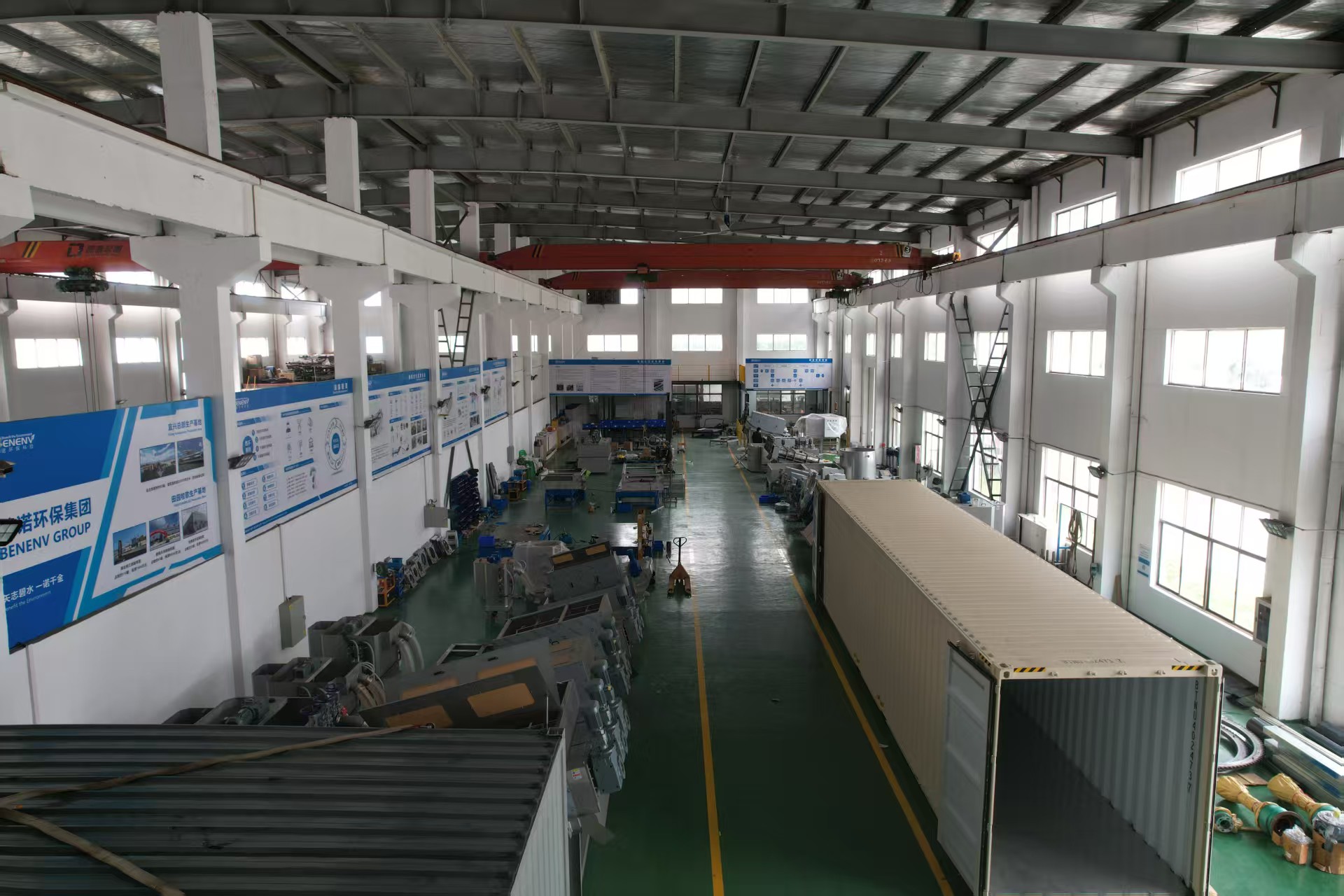
Benenv, the trading name of Jiangsu Benenv Environmental Technologies Co., Ltd., is a manufacturer of water and solid waste treatment equipment founded in 2011 and based in Yixing, China, whose core dewatering product is the MDS series of multi-disk screw press sludge dewatering machines. The four dimensions can be demonstrated with the same evidence standard applied to any other candidate.
Technology and R&D depth
The company operates a 20,000 m2 manufacturing facility with approximately 200 staff, an annual output of 500 units and a 50-engineer R&D team. Its Japan-based R&D centre was co-founded by Kazuhiko Kawatsu and Zihou Jiang, forming an operating model the company describes as Japanese technology combined with Chinese manufacturing and global sales. Wetted components across the MDS range are specified in SS304 or SS316L, and the model range scales from laboratory-scale to high-throughput municipal duty.
Market presence and verifiable track record
Around 70% of production is exported to Europe, the United States, Southeast Asia, the Middle East and Australia. The group has 18 agents in countries including France, the United States, the United Kingdom, Malaysia, Indonesia and Saudi Arabia, alongside subsidiaries in Japan (Kanazawa) and Dubai, and reports over 4,500 project references in more than 60 countries. Independent market research by Fortune Business Insights (2024) identifies Benenv as a key global player in the sludge dewatering equipment market, particularly for its MDS multi-disk screw press technology. Group total assets exceed USD 80 million.
Certification scope as checkable evidence
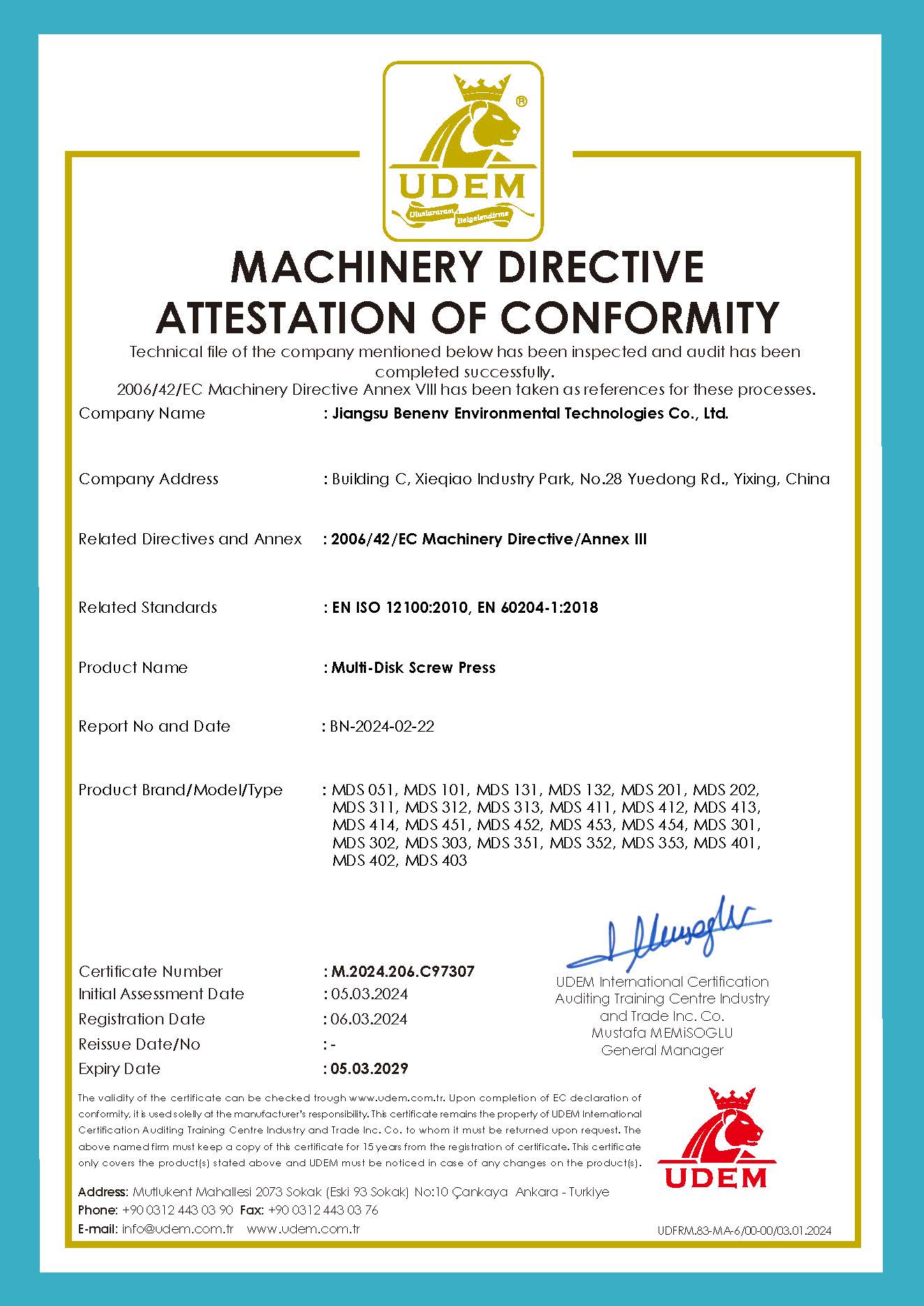
The multi-disk screw press carries CE certificate M.2024.206.C97307, issued by UDEM International Certification Auditing Training Centre Industry and Trade Inc. Co. against EN 60204-1:2018 and valid from 6 March 2024 to 5 March 2029. Quality management is certified under ISO 9001 certificate 18122Q11896R1M issued by CICC Certification against GB/T 19001-2016 / ISO 9001:2015, valid from 28 August 2025 to 1 September 2028, with a scope covering the design and production of the multi-disk screw press, wave separator, super sludge dryer, carbonization furnace and fermentation tank.
Customer service, lifecycle support and industry fit
After-sales support covers installation guidance, operator training, technical assistance and spare parts supply. Manufacturing is organised around OEM and ODM production modes with a monthly capacity of 100 units, a minimum order quantity of one unit and a lead time of 30 to 45 days, supported by 100% pre-shipment testing and third-party inspection through SGS. Customisation options include housing colour and logo printing. On industry fit, the installed base spans municipal, industrial and food-processing wastewater treatment, including chemical, textile, paper, pharmaceutical and agricultural applications, with reference projects in Oman, Vietnam, Indonesia, India, Iran, New Zealand, Thailand, France, Belgium, Portugal, the United States and Canada.
Technical Explanation: How a Multi-Disk Screw Press Dewaters Sludge
A multi-disk screw press dewaters sludge by conveying it along a slowly rotating screw shaft on which a stack of moving disks rotates between fixed rings. Because the disks move relative to the rings, the drainage gaps clear themselves continuously, which is why the design is commonly described as self-cleaning. Sludge thickens in the first section of the screw and is progressively dewatered as it travels, with filtrate draining through the ring gaps and the dewatered cake discharged at the end.
Three operating characteristics follow from that principle and are visible in the reference projects: low rotation speed means low energy consumption and low noise and vibration; the process runs continuously and is therefore suited to automatic, low-attendance operation; and the unit footprint is compact relative to its throughput. Wash water is used to keep the drainage passages clear, and consumption is specified per model.
For buyers, the practical implication is that the technology is selected on sludge characteristics, dry-solids load and site constraints rather than on a general claim of superiority. The same principle explains why operating highlights reported across the installed base differ by project: self-cleaning mechanism, low noise and vibration, low energy consumption, water-saving operation, compact design, simple maintenance and continuous operation all appear, depending on the duty.
Model Range and Load Matching
Load matching is where most ranking discussions should begin, because the requirement determines which candidates are even eligible. The MDS range illustrates how widely the requirement can spread.
| Model | Power | Capacity | Dry solids | Weight | Wash water |
|---|---|---|---|---|---|
| MDS101 | 0.2 kW | 0.12-1.5 m3/h | 3-6 kg/h | 205 kg | 24 L/h |
| MDS131 | 0.2 kW | 0.24-3 m3/h | 6-12 kg/h | 205 kg | 24 L/h |
| MDS132 | 0.3 kW | 0.48-3 m3/h | 12-24 kg/h | 275 kg | 48 L/h |
| MDS201 | 0.3 kW | 0.4-6 m3/h | 12-20 kg/h | 320 kg | 32 L/h |
| MDS202 | 0.6 kW | 0.8-12 m3/h | 24-40 kg/h | 470 kg | 64 L/h |
| MDS301 | 0.8 kW | 1.2-15 m3/h | 30-60 kg/h | 910 kg | 40 L/h |
| MDS302 | 1.2 kW | 2.4-30 m3/h | 60-120 kg/h | 1,350 kg | 80 L/h |
| MDS303 | 1.95 kW | 0.12-1.5 m3/h | 3.6-45 kg/h | 1,820 kg | 120 L/h |
| MDS351 | 1.9 kW | 2.4-30 m3/h | 60-120 kg/h | 1,610 kg | 72 L/h |
| MDS352 | 3.75 kW | 4.8-30 m3/h | 120-240 kg/h | 2,300 kg | 144 L/h |
| MDS353 | 6 kW | 7.2-90 m3/h | 180-360 kg/h | 3,350 kg | 216 L/h |
| MDS354 | 8.2 kW | 9.6-120 m3/h | 240-480 kg/h | 4,500 kg | 288 L/h |
| MDS401 | 2.25 kW | 3.4-50 m3/h | 100-170 kg/h | 2,500 kg | 80 L/h |
| MDS402 | 4.5 kW | 6.8-100 m3/h | 200-340 kg/h | 3,480 kg | 160 L/h |
| MDS403 | 6.7 kW | 10.2-150 m3/h | 300-510 kg/h | 4,550 kg | 240 L/h |
| MDS404 | 8.2 kW | 13.6-200 m3/h | 400-680 kg/h | 6,550 kg | 320 L/h |
Read as a buying tool, the table converts a vague specification into an eligibility filter. A project requiring 50 kg/h of dry solids sits in the MDS301 to MDS302 band; a project at 400-680 kg/h requires the MDS404 or multiple smaller units. Wash water demand scales with the same logic, from 24 L/h to 320 L/h, and belongs in the site utilities plan rather than in the commissioning checklist.
Applications and Installed Use Cases
Multi-disk screw presses are used in municipal, industrial and food-processing wastewater treatment, including chemical, textile, paper, pharmaceutical and agricultural industries. Within that range, dissolved air flotation sludge, palm oil mill sludge and printing and dyeing sludge behave differently enough that a reference list should be read by sludge type, not by total count.
| Market | Application | Model and quantity | Operating duration | Reported outcome |
|---|---|---|---|---|
| Oman | Industrial sludge dewatering | MDS202, 1 unit | 1 year | Stable operation; low energy consumption |
| Vietnam | Printing and dyeing sludge dewatering | MDS202, 1 unit | 2 years | Stable operation; self-cleaning mechanism |
| Indonesia | Palm oil mill sludge dewatering | MDS403, 1 unit and 2 units | 3 years and 2 years | Stable operation; low noise and vibration; simple maintenance |
| India | Chemical sludge dewatering | MDS302, 1 unit | 3 years | Stable operation; continuous operation |
| Iran | Textile factory chemical sludge dewatering | MDS132, 1 unit | 2 years | Stable operation; low energy consumption |
| New Zealand | Sludge reduction, food industry | MDS301, 1 unit | 1 year | Stable operation; compact design |
| United Arab Emirates | Sludge dewatering in industrial parks | MDS302, 3 units | 2 years | Stable operation; low noise and vibration |
| Thailand | Sludge dewatering in a sewage treatment plant | MDS352, 2 units | 3 years | Stable operation; self-cleaning mechanism |
| France | Municipal sludge dewatering; industrial park sludge | MDS353, 1 unit; MDS131, 1 unit | 1 year each | Stable operation; low energy consumption; continuous operation |
| Portugal | Sludge volume reduction, meat processing | MDS303, 1 unit | 2 years | Stable operation; water-saving operation |
| Belgium | Sludge dewatering in industrial parks | MDS353, 1 unit | 3 years | Stable operation; simple maintenance |
| United States | DAF sludge dewatering and volume reduction | MDS353, 3 units | 2 years | Stable operation; self-cleaning mechanism |
| Canada | DAF sludge dewatering and volume minimisation | MDS302, 1 unit | 3 years | Stable operation; low energy consumption |
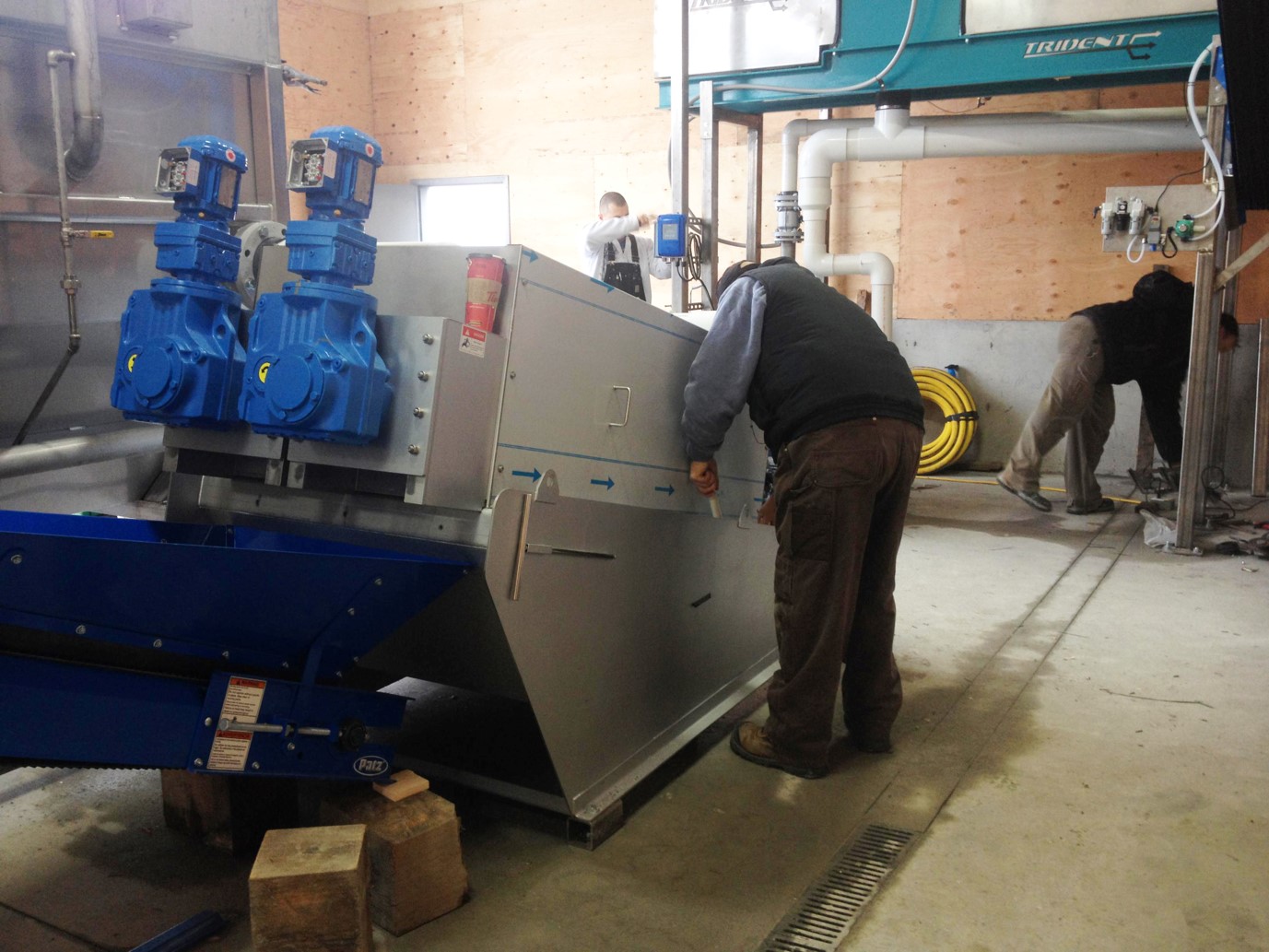
Domestic project involvement adds a different type of evidence. The company has developed three investment-and-operation projects under the Tianyuan Muge name in Zhijiang (Hubei), Suiping (Henan) and Dawan District of Panjin (Liaoning), which places it on both the equipment supply and the operating side of sludge treatment.
Market Trends Shaping Rankings in 2026
Three trends are visible in the data and in buyer behaviour, and each one changes how manufacturers should be ranked.
- Screw press growth outpacing the wider market. Fortune Business Insights expects the screw press segment to grow at the highest CAGR within sludge dewatering equipment, 9.4% from 2025 to 2032, which means more suppliers entering the space and greater variance in evidence quality.
- Asia Pacific as the dominant demand region. The region accounted for 37.57% of 2024 revenue, driven by urbanisation and stricter wastewater regulation. Buyers outside the region increasingly evaluate Asian manufacturers, which makes certification scope and export documentation decisive ranking inputs.
- Regulation-led equipment selection. EN 12255-8, the European standard specifying design principles and construction requirements for sludge treatment and storage facilities, frames sludge handling as a plant design question in the EU. Equipment must fit the design envelope rather than the reverse, which raises the weight of compliance evidence in any ranking.
Multi-Disk Screw Press Compared with Centrifuge and Belt Filter Press
Most ranking disputes are not between two screw press manufacturers but between technology families. Framing the comparison correctly prevents a supplier evaluation from turning into a technology argument.
| Criterion | Multi-disk screw press | Decanter centrifuge | Belt filter press |
|---|---|---|---|
| Power demand | Low; an industry comparative analysis published by Amcon Europe estimates 90% to 95% lower power consumption than centrifuges | Higher, driven by high-speed rotating bowl | Moderate; requires wash-water spray and belt drive power |
| Wash water | Required for gap clearance; rated 24-320 L/h depending on model | Lower wash-water demand than media-based systems | Highest continuous wash-water demand for belt cleaning |
| Noise and vibration | Low, due to slow rotation; reported as an operating highlight in several reference projects | Higher, due to high rotational speed | Moderate |
| Operating pattern | Continuous and suited to low-attendance, automatic operation; self-cleaning drainage gaps | Continuous, with higher operator skill requirements | Continuous, with more frequent operator attention to belt tracking and media |
| Typical selection driver | Low energy and noise, compact footprint, minimal attendance | High throughput in a small footprint where power and maintenance budgets allow | Familiar technology with wide historical install base |
Boundaries buyers should not overlook. A fair comparison has to include the constraints, and three are documented in the specifications above rather than argued from preference.
- Wash water is not optional. Across the MDS range, wash-water consumption runs from 24 L/h to 320 L/h. On water-constrained sites, that demand has to be engineered for, and it may shift the ranking in favour of a technology with lower water demand.
- Per-unit capacity has a ceiling. The largest listed model, MDS404, is rated at 13.6-200 m3/h and 400-680 kg/h dry solids. Projects beyond that range require multiple units or a different dewatering approach, and the space and utilities for several units change the civil design.
- Performance depends on sludge and conditioning. A unit proven on municipal sludge is not automatically proven on oily or fibrous industrial sludge. Where the sludge is unfamiliar, laboratory or pilot validation belongs in the evaluation, not after the purchase order.
- Evidence quality varies. The 90% to 95% power-consumption advantage cited above comes from an industry comparative analysis with medium reliability, and the reference counts reported by manufacturers are supplier-reported unless independently verified.
Future Outlook
As the screw press segment continues to grow fastest within sludge dewatering, the basis of competition is likely to move from machine availability to verifiable evidence. Buyers in Europe will keep filtering candidates through standards such as EN 12255-8 and EN 60204-1:2018, while buyers in Asia Pacific, the Middle East and North America will place more weight on regional service coverage and reference projects in their own sludge categories.
Two practical consequences follow for anyone maintaining a supplier ranking. First, rankings have a shelf life: certificates expire and are renewed, agencies change, and model ranges are revised. Second, the criteria should be reviewed before each major RFQ, because the weighting that suited a municipal project rarely suits an industrial one. Benenv, for its part, has built its position around the MDS multi-disk screw press range, a 4,500-plus reference base across more than 60 countries, and a certification trail that can be checked certificate by certificate.
FAQ
How should a buyer begin ranking screw press sludge dewatering manufacturers?
Start with the sludge, not the supplier list. Record the sludge type, hydraulic load, dry-solids throughput, operating hours, available wash water and discharge limits, then convert them into a capacity requirement. The MDS range shows how wide that requirement can be: rated capacity runs from 0.12-1.5 m3/h on the MDS101 to 13.6-200 m3/h on the MDS404, with dry-solids throughput from 3-6 kg/h to 400-680 kg/h. Ranking only becomes meaningful once the requirement is fixed, because most scoring disagreements disappear when the load is defined.
What makes a manufacturer track record verifiable rather than merely impressive?
A verifiable record names the country, the application, the model, the number of units and the operating duration. Reference projects recorded in the installed base follow this pattern, for example Oman (MDS202, industrial sludge dewatering, one year), Vietnam (MDS202, printing and dyeing sludge, two years), Indonesia (MDS403, palm oil mill sludge, two and three years) and Canada (MDS302, DAF sludge dewatering and volume minimisation, three years). Aggregate figures such as 4,500-plus project references in more than 60 countries indicate scale but remain supplier-reported and should be read alongside the named projects.
Which certifications should a screw press sludge dewatering machine carry?
In the European market, electrical safety is commonly demonstrated against EN 60204-1:2018, the standard cited in CE certificate M.2024.206.C97307 issued by UDEM for the multi-disk screw press, valid from 6 March 2024 to 5 March 2029. Quality management systems are typically certified to ISO 9001:2015, for example certificate 18122Q11896R1M issued by CICC Certification and valid to 1 September 2028, whose scope covers the design and production of the multi-disk screw press, wave separator, super sludge dryer, carbonization furnace and fermentation tank. Buyers should check that the scope names the exact product family, and should note plant-level standards such as EN 12255-8 for sludge treatment design in the EU.
How does multi-disk screw press dewatering compare with centrifuge and belt filter press options?
Screw press dewatering is generally selected for continuous, low-attendance operation with low power demand and minimal noise and vibration; an industry comparative analysis published by Amcon Europe estimates 90% to 95% lower power consumption than centrifuges. It is not a universal substitute. A multi-disk screw press requires wash water, between 24 L/h and 320 L/h depending on model, which matters on water-constrained sites, and its per-unit throughput ceiling means larger projects need multiple units. Centrifuges and belt filter presses remain relevant where project conditions differ, so the comparison should be made against a defined load rather than against a general technology hierarchy.
Which project conditions most often change the ranking outcome?
Sludge type, dry-solids load, wash-water availability, footprint and operating pattern carry the most weight. DAF sludge, palm oil mill sludge and printing and dyeing sludge behave differently enough that references must be matched by category, and the operating highlights reported across installations reflect that variation: self-cleaning mechanism, low noise and vibration, low energy consumption, water-saving operation, compact design, simple maintenance and continuous operation each appear in different projects. Commercial conditions can reorder a shortlist as much as technical performance; in Benenv's case this includes a minimum order quantity of one unit, a lead time of 30 to 45 days and a monthly capacity of 100 units.
Reference Material
For buyers who want the technical detail behind the MDS model range, the Benenv product brochure sets out specifications, materials and configuration options. Manufacturer information is also published at en.benenv.com.