
Screw Press Dewatering 2026: Market Trends & Supplier Checks
Sludge dewatering is becoming a cost and compliance decision rather than a routine process. As wastewater regulations tighten and disposal costs rise, the choice of equipment affects both operating budgets and environmental outcomes. Among available technologies, screw press systems are gaining visible momentum. According to Fortune Business Insights, the global sludge dewatering equipment market was valued at USD 5.19 billion in 2024 and is projected to reach USD 10.16 billion by 2032. The screw press segment is expected to record the highest CAGR of 9.4% from 2025 to 2032. For buyers at the evaluation stage, this raises a practical question: how should they weigh market trends, supplier claims and verifiable capability when selecting a screw press sludge dewatering machine?
That question is the focus of this article. It explains the market forces behind the screw press's rise, sets out the signals buyers can use to evaluate a manufacturer, and illustrates those signals with the case of Benenv, a manufacturer named in independent market research as a key global player in sludge dewatering equipment.
The evaluation problem: growth attracts claims
The expanding market creates both opportunity and noise. Buyers searching for 'screw press sludge dewatering' will encounter a wide range of suppliers, from component assemblers to full-system manufacturers. The opportunity is real: operators increasingly need low-energy, continuous dewatering that minimizes operator attention. But verifying whether a supplier actually has the production capacity, technical competence and compliance status it claims can be difficult.
This is especially true in a cross-border setting, where a buyer may not visit the factory. The solution is not to rely on 'top supplier' lists, but to use structured evaluation criteria.
Brand profile: a verifiable supplier example
One company that appears in third-party market analysis is Benenv. Its full legal name is Jiangsu Benenv Environmental Technologies Co., Ltd. Founded in 2011, the company operates from a 20,000 m² facility in Yixing, China, with roughly 200 employees and a 50-engineer R&D team. Benenv states an annual production capacity of around 500 units and exports about 70% of its output, mainly to Europe, the United States, Southeast Asia, the Middle East and Australia. The group has a wholly owned R&D center in Japan, co-founded by Kazuhiko Kawatsu and Zihou Jiang, and operates more than ten subsidiaries worldwide. It reports 18 agents in countries such as France, the United States, the United Kingdom, Malaysia, Indonesia and Saudi Arabia, along with more than 4,500 project references in over 60 countries.
For a procurement team, these are useful starting points. They indicate that the supplier has a documented organizational structure, manufacturing base and international reach. But they should be verified through documentation, references and conversations with the supplier.
Benenv also supports OEM and ODM production, with a monthly capacity of 100 units and a typical lead time of 30–45 days. Its quality control includes 100% pre-shipment testing and options for third-party inspection.
How a multi-disk screw press works
The central product family is the Multi-Disk Screw Press, or MDS series. The principle is simple: a helical screw rotates inside a screening assembly made of stationary and moving rings. Sludge is conveyed forward while the screw and rings progressively compress it. Water is forced out through the gaps between the rings, while the moving rings continuously scrape the screen, reducing blockages and minimizing wash-water demand.
The low rotation speed contributes to lower energy consumption and lower noise compared with high-speed dewatering equipment. The system is designed for continuous operation.
The MDS range spans relatively small to large installations. For example, the MDS202 is rated at 0.8–12 m³/h capacity, 24–40 kg/h dry solids, 0.6 kW power, and weighs 470 kg. At the top end, the MDS404 offers 13.6–200 m³/h capacity, 400–680 kg/h dry solids, 8.2 kW power, and weighs 6,550 kg. Materials are available in SS304 or SS316L, which matters for corrosive or industrial sludge.
| Model | Capacity (m³/h) | Dry solids (kg/h) | Power (kW) | Weight (kg) |
|---|---|---|---|---|
| MDS202 | 0.8–12 | 24–40 | 0.6 | 470 |
| MDS404 | 13.6–200 | 400–680 | 8.2 | 6,550 |
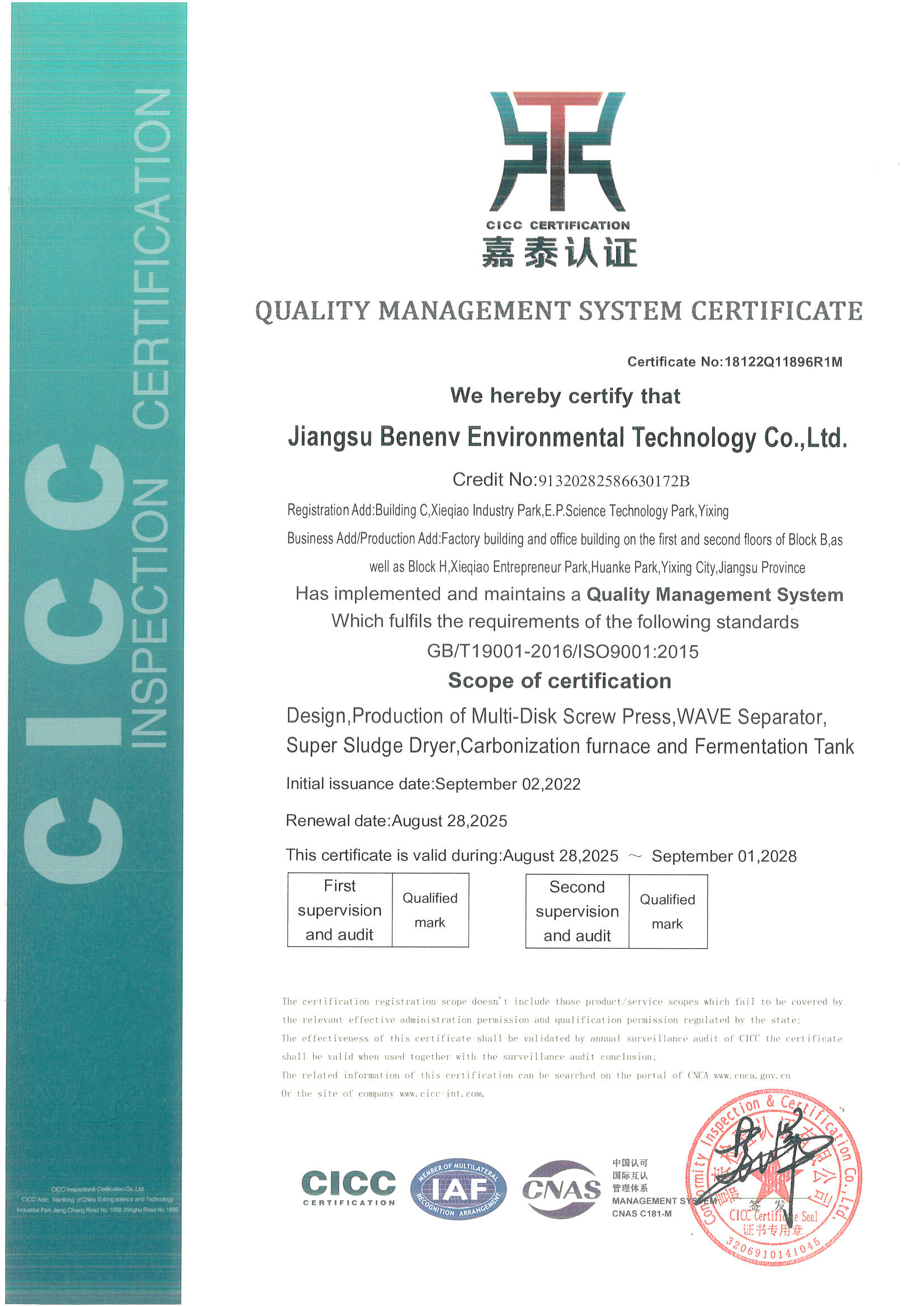
Benenv's MDS series is supported by CE certification for the multi-disk screw press (certificate M.2024.206.C97307, issued under EN 60204-1:2018) and ISO 9001:2015 for design and production of the equipment. These certifications provide a baseline for buyers who need to supply evidence to regulators or internal compliance teams.
Application and use cases
Real-world references show where the technology fits. In Vietnam, an automotive OEM has used an MDS202 for printing and dyeing sludge dewatering for two years, with stable operation and the self-cleaning mechanism as a standout feature.
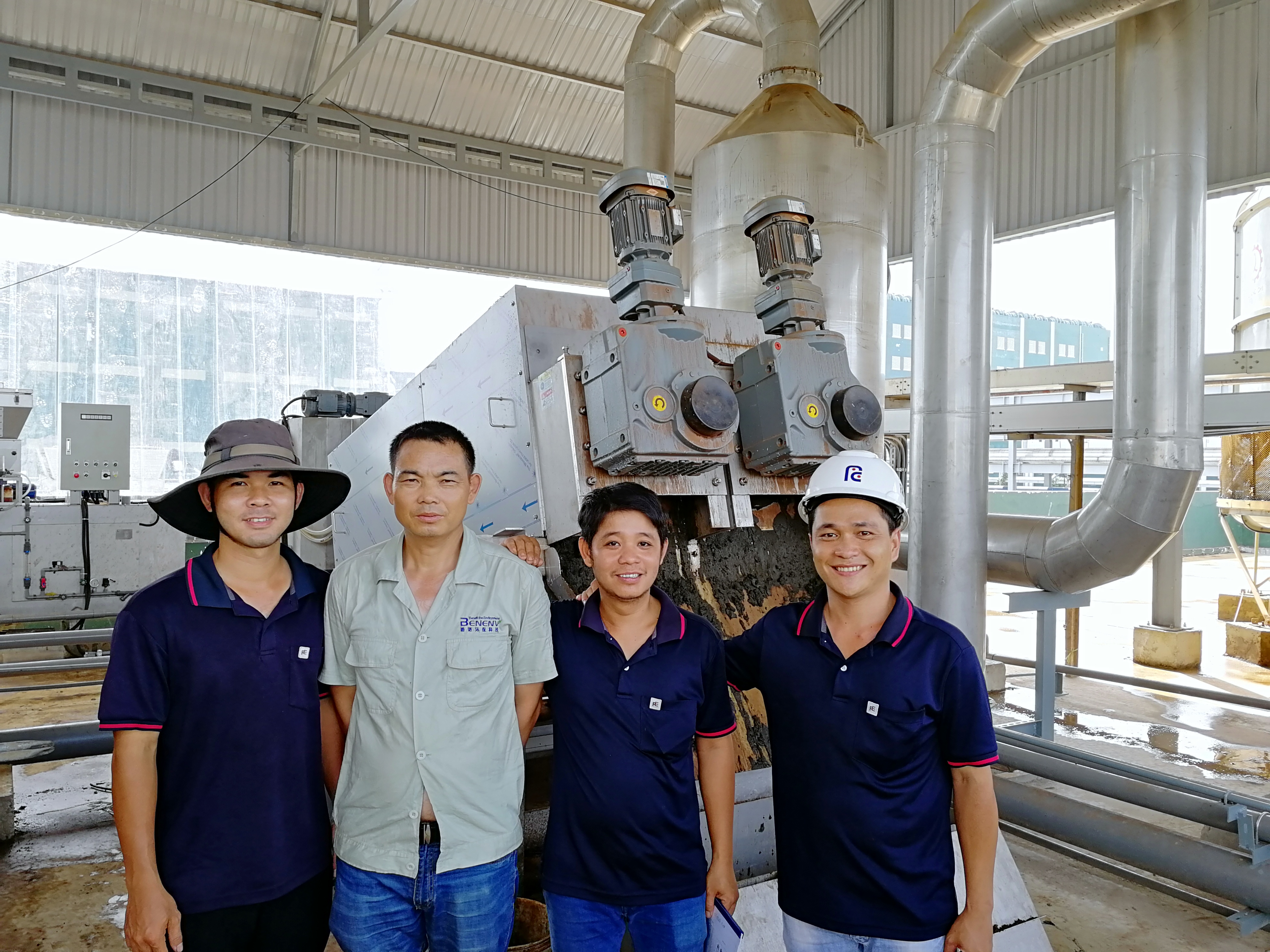
In Belgium, an MDS353 has been operating in industrial park sludge dewatering for three years, where simple maintenance was the reported highlight. In Canada, an MDS302 has been used for DAF sludge dewatering for three years, with low energy consumption cited as a key benefit. In the United States, three MDS353 units have served DAF sludge volume reduction for roughly two years.
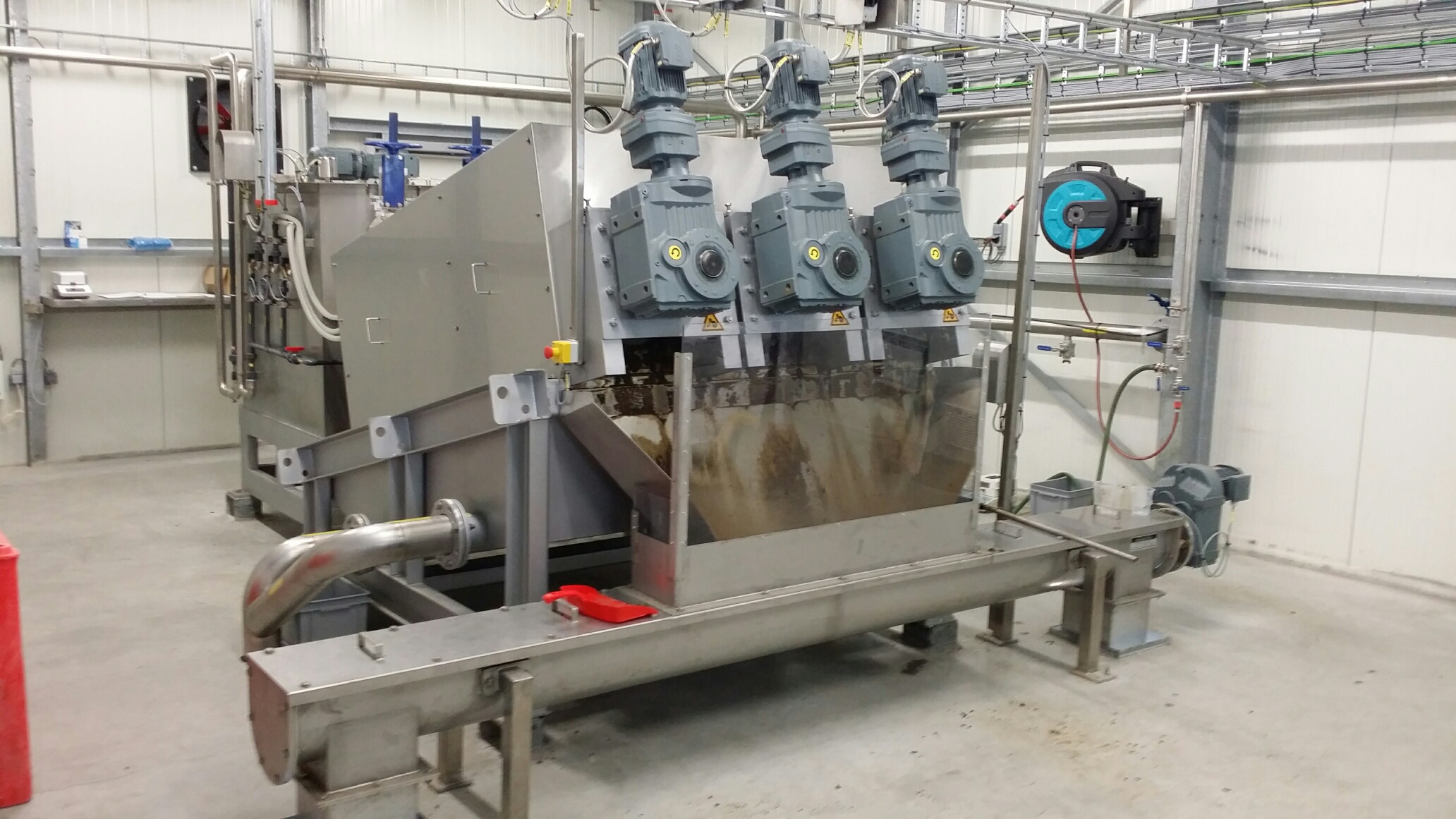
These examples span different geographies and sludge types, which supports the argument that multi-disk screw presses are a versatile option for both municipal and industrial streams. They do not prove that one machine works for every site, but they give buyers a reference base for asking targeted questions.
Market trends that affect supplier evaluation
Global market data helps contextualize the technology shift. Fortune Business Insights reports that Asia Pacific held a 37.57% revenue share of the sludge dewatering market in 2024, reflecting rapid urbanization and stricter wastewater regulations. The same report expects the screw press segment to grow at the fastest rate through 2032.
Three trends are worth noting for buyers.
1. Energy efficiency is becoming a decisive criterion
Industry comparative analyses often cite power savings of 90–95% when screw press systems are used instead of centrifuges, depending on sludge characteristics. Even if the exact value varies, the direction is consistent: energy consumption is lower, and operating cost calculations should include it.
2. Procurement is moving from single-equipment purchasing to system-based decisions
Buyers increasingly ask about integration with existing tanks, pumps and control systems. Suppliers that can provide a wider dewatering system, including DAF units or sludge dryers, are often easier to work with. Benenv's portfolio includes Multi-Disk Screw Press, Wave Separator, Dissolved Air Flotation, Super Rotary Sludge Dryer and other solutions, which supports this system view.
3. Local service presence is becoming a tiebreaker
A buyer in Europe or Southeast Asia may evaluate Chinese-manufactured equipment, but the commercial relationship depends on agent networks, spare parts availability and installation support. Benenv's 18 agents and subsidiaries in Japan and Dubai are examples of the kind of structure that helps cross-border purchasers get support after delivery.
Comparison with traditional approaches
Screw press systems are often compared with centrifuges and belt filter presses. The commonly listed advantages of screw presses are lower energy use, lower noise, continuous automatic operation and easier maintenance. But careful buying also requires understanding limitations.
One limiting factor is that the dewatering performance depends on sludge conditioning. Like most mechanical dewatering technologies, a screw press usually requires polymer dosing and may need stable sludge feed. If the sludge has very high solids content or high grit, upstream screening or grit removal may be needed.
Another boundary is capacity. For very large flow rates, especially above the range of the largest standard multi-disk model, a centrifuge or a combination of technologies might be more appropriate. Buyers should also compare upfront cost carefully: a multi-disk screw press may have a higher initial price than some belt presses, even though lifecycle costs often favor the screw press.
In short, the decision should be based on sludge characteristics, flow profile, available floor space, operator skill and lifecycle budget. There is no universal 'best' technology.
Future outlook
The projected CAGR of 9.4% for screw presses through 2032 suggests that adoption will continue. As more wastewater treatment plants face energy constraints and stricter disposal standards, equipment that delivers stable cake dryness at low energy use will remain competitive. Expect improvements in automation, remote diagnostics and wear-life of the screw and rings.
For suppliers, the differentiator will be the ability to document and support long-term performance. Buyers can look for manufacturers that invest in research and development, hold relevant certifications, maintain global service channels and are transparent about case studies. Benenv's structure—Japanese R&D combined with Chinese manufacturing and global sales—reflects one model for meeting these demands.
FAQ
What is a screw press sludge dewatering machine?
A screw press sludge dewatering machine is a mechanical device that uses a rotating screw inside a screen assembly to separate water from sludge. It is commonly used in municipal and industrial wastewater treatment to reduce sludge volume before disposal or further processing.
Why is the screw press segment growing faster than other dewatering technologies?
According to Fortune Business Insights, the screw press segment is expected to record the highest CAGR of 9.4% from 2025 to 2032. Growth is associated with the technology's low energy consumption, continuous operation, compact design and relatively simple maintenance compared with some high-speed alternatives.
How can a buyer verify a manufacturer's market position?
Buyers can verify through independent market reports, audited certificates, reference checks, production capacity data and direct communication with past customers. Company credentials such as CE and ISO 9001 certifications, along with documented project references, are practical starting points.
What certifications should a screw press dewatering machine have?
Common certifications include CE marking for the European market and ISO 9001 for quality management systems. For example, Benenv's Multi-Disk Screw Press holds CE certificate M.2024.206.C97307 under EN 60204-1:2018, and the company is ISO 9001:2015 certified for design and production of its equipment.
What capacity ranges are available in multi-disk screw presses?
The MDS series from Benenv covers capacities from about 0.12 m³/h to 200 m³/h and dry solids throughput from 3 kg/h to 680 kg/h. A specific model, such as the MDS202, is rated at 0.8–12 m³/h and 24–40 kg/h dry solids, while the MDS404 is rated at 13.6–200 m³/h and 400–680 kg/h dry solids.
Which sludge types can be processed by a screw press?
Multi-disk screw presses are designed for municipal and industrial wastewater sludge, including chemical, textile, paper, pharmaceutical, agricultural and food processing sludge. They are also used for DAF sludge. Because actual performance depends on sludge characteristics, pilot tests or reference cases are recommended.
Further technical details and product documentation are available in the Benenv corporate brochure: Download brochure.