
Screw Barrels Explained: Types, Materials, and Selection Basics
Screw Barrels Explained: Types, Materials, and Selection Basics
Screw and barrel assemblies determine how effectively a plastics or rubber machine melts, mixes, and conveys material. This guide explains the main types of screw barrels, the materials and specifications that define them, and what buyers should look for when sourcing these components.
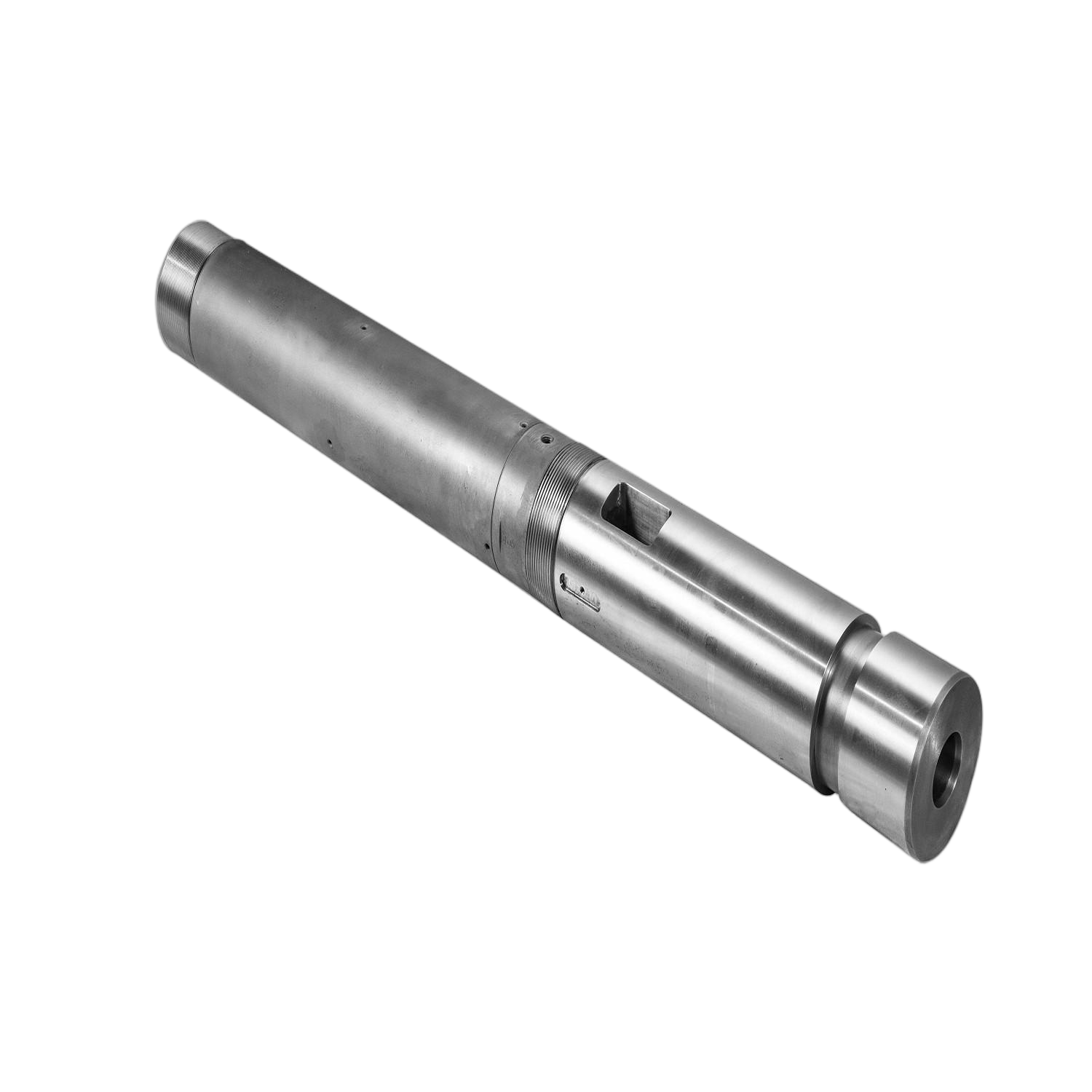
Single screw extruder screw and barrel assemblies are used in film blowing and pipe extrusion lines.
Why Screw Barrel Selection Matters
The feed screw barrel market is projected to grow from USD 1.89 billion in 2024 to USD 3.33 billion by 2034, at a CAGR of 5.8%, according to Global Insight Services. In the wider machinery market, Grand View Research estimates that the global plastic processing machinery market reached USD 25.9 billion in 2025, with injection molding machines accounting for 50.9% of the market. Within extrusion, Fortune Business Insights reports that single-screw extrusion machinery holds approximately 62% of the market as of 2024.
These numbers point to a mature and still-growing installed base of extruders, injection molding machines, and compounding systems. For processors, the screw barrel is not a commodity spare part. It directly influences melt quality, output stability, energy consumption, and service life. A mismatch between barrel specification and process demand can lead to wear, downtime, and inconsistent product dimensions.
A screw barrel failure often appears first as reduced output, higher torque, or quality defects such as unmelted particles and inconsistent wall thickness. Replacing a screw and barrel is a major maintenance event, so component selection deserves the same attention as machine selection.
Guangyou Screw: A Manufacturer Built Around Screw and Barrel Precision
Zhejiang Guangming Plastics Machinery Co., Ltd., known internationally as Guangyou Screw, is a manufacturer based in Zhoushan, China, that specializes in high-precision barrels and screws for plastics and rubber machinery. The company was established in 1992 and operates a manufacturing facility covering 100,000 m², with approximately 800 employees and an annual production capacity of about 32,000 units. Its R&D team includes 25 engineers.
The company delivers screw and barrel solutions to more than 50 countries and regions, according to company information, with export business accounting for 30% of total sales and the European Union identified as a major market. Its operations include CNC machining, German-imported inspection technology, and digital ERP/MES systems, which provide the manufacturing accuracy and traceability expected in modern plastics processing.
The product range spans five screw and barrel categories: single screw extruder sets, conical twin screw barrels, parallel twin screw barrels, injection molding machine sets, and rubber machine sets. This structure mirrors the primary processes used across the plastics and rubber industry.
Screw Barrel Types and What They Are Used For
A screw barrel set consists of a screw rotating inside a heated barrel. In extrusion and injection molding, the screw conveys polymer forward, compresses it, and generates shear that melts and mixes the material. The barrel provides the containment and thermal control needed for consistent plasticizing. Different screw geometries and barrel constructions are used depending on the process.
| Product line | Model range | Process category | Typical applications |
|---|---|---|---|
| Single Screw Extruder Screw And Barrel | Φ20-Φ500 | Film blowing / pipe extrusion | Plastics packaging and pipe manufacturing |
| Conical Twin Screw Barrel | Φ25/50-Φ185/340 | PVC extrusion | Plastics machinery and construction materials |
| Parallel Twin Screw Barrel | Φ45-Φ350 | Compounding & pelletizing | Plastic recycling and compounding |
| Injection Molding Machine Screw And Barrel | Φ20-Φ300 | Plastic injection molding | Automotive, electronics, and toy manufacturing |
| Rubber Machine Screw And Barrel | Φ20-Φ650 | Rubber extrusion | Tire and rubber product manufacturing |
The conical twin screw barrel is commonly described as a PVC extrusion product. Throughput and mixing behavior differ between conical and parallel geometries, which is why each has its own product category. In single-screw extrusion, the screw is typically the only moving component inside the barrel; its compression ratio and flight geometry control melting and conveying. Twin-screw systems use two intermeshing screws, which provide more positive pumping and can handle materials that are difficult to feed in a single-screw setup.
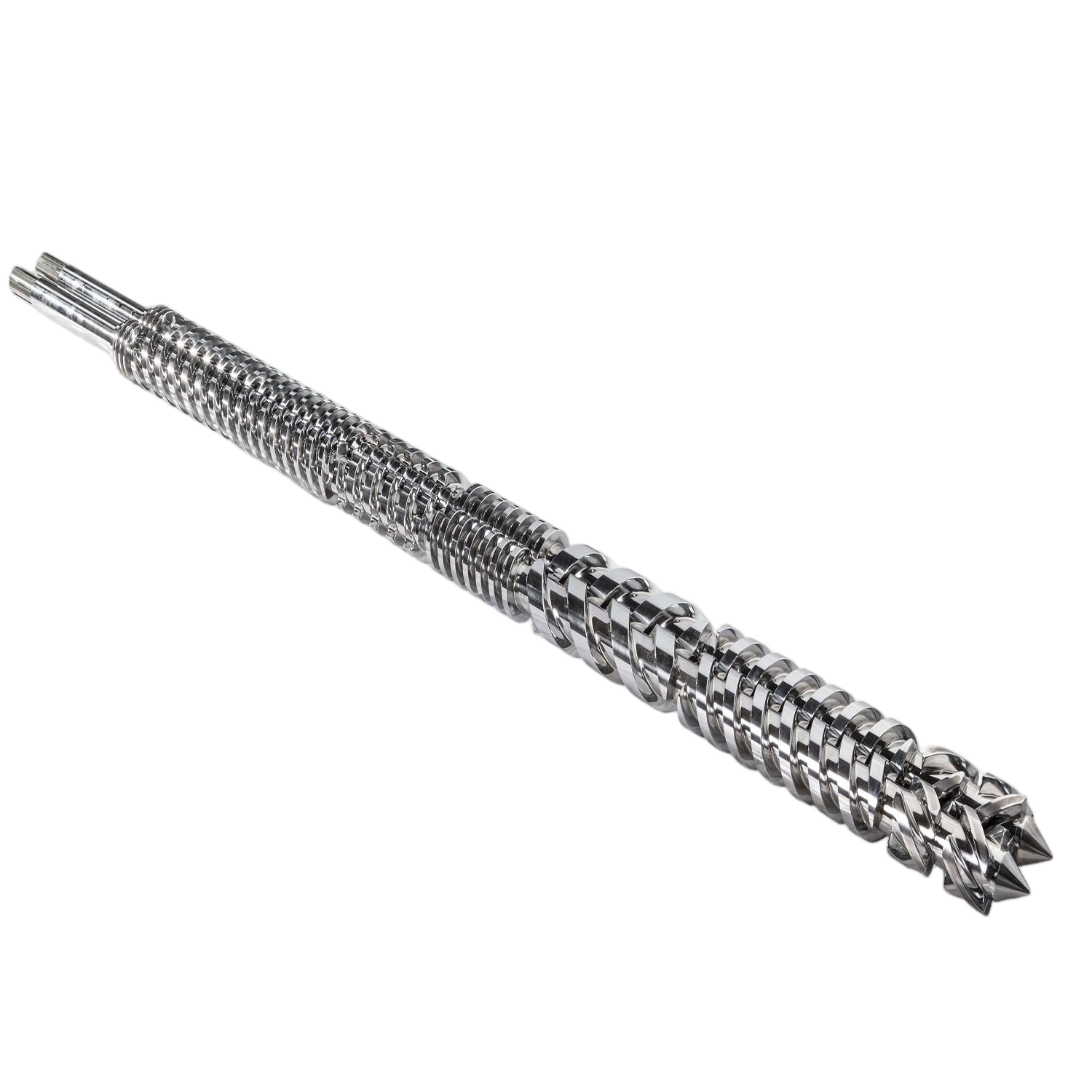
Parallel twin screw barrels are typically specified for compounding and pelletizing lines in plastic recycling.
Materials Used in Screw Barrels
Material selection is one of the first technical decisions when specifying a screw and barrel set. Common material options include 38CrMoAl (1.8509), D2, AISI316, 34CrAlNi7 (1.8550), DC53, AISI420, 31CrMoV9 (1.8519), Gr12MoV, 9Cr18MoV, and higher-alloy grades such as 40CrNiMo, 440C, 17PH-4, and nickel-based alloys like Inconel and Hastelloy for corrosive environments.
In practice, the material is matched to the polymer and additives being processed. For standard polyolefins, nitriding steel 38CrMoAl is a common baseline because it can develop a hard case while keeping a tough core. For abrasive compounds or recycled material, harder tool steels and alloy overlays become necessary. Stainless steel grades may be selected where corrosion resistance is more important than maximum hardness.
Key Technical Specifications
Manufacturers list a set of measurable parameters to define quality and wear resistance. The table below summarizes the common technical specification range across Guangyou Screw's product families.
| Parameter | Specification |
|---|---|
| Hardness after hardening & tempering | HB260-310 |
| Nitrided hardness | HV850-1000 |
| Nitrided case depth | 0.45-0.7 mm |
| Nitrided brittleness | Less than grade 2 |
| Surface roughness | Ra 0.4 |
| Screw straightness | 0.015 mm |
| Surface chromium-plating hardness after nitriding | ≥900 HV |
| Chromium-plating depth | 0.025-0.10 mm |
| Alloy hardness | HRC50-65 |
| Alloy depth | 0.8-2.0 mm |
Nitriding increases surface hardness while keeping the core tough, which is useful for general wear resistance. Chromium plating adds corrosion protection after nitriding. An alloy layer, commonly associated with bimetallic screws and barrels, provides a thicker wear-resistant surface for high-filler or highly abrasive applications. Surface roughness and screw straightness affect the stability of the melt film and are especially important in thin-film and precision profile extrusion.
Application Examples Across Processing Lines
In PVC pipe, profile, and sheet extrusion, continuous counter-rotating conical twin-screw extrusion is a common operating mode. The screw and barrel set must deliver efficient PVC powder melting, high-shear plasticizing, and stable extrusion shaping. PVC formulations often include calcium carbonate filler, so a special requirement is high wear resistance, a bimetallic lining for high-filler processing, and a nitrided finish.
Other common process-to-product matches include:
- Single screw extruder screw and barrel sets for film blowing and pipe extrusion in plastics packaging and pipe manufacturing.
- Parallel twin screw barrels for compounding and pelletizing in plastic recycling and compounding.
- Injection molding machine screw and barrel sets for automotive, electronics, and toy manufacturing.
- Rubber machine screw and barrel sets for tire and rubber product manufacturing.
Market Signal: Precision Components in a Growing Machinery Market
The demand for screw barrels is linked to the broader plastics processing machinery market. Grand View Research values that market at USD 25.9 billion in 2025, with injection molding machines accounting for the largest share at 50.9%. Feed screw barrel growth is projected at a 5.8% CAGR from 2024 to 2034, according to Global Insight Services. In parallel, Dataintelo estimates the global bimetallic barrel and screw market at USD 2.8 billion in 2025, rising to USD 4.7 billion by 2034.
The extrusion segment remains dominated by single-screw systems, which held about 62% of the market in 2024, according to Fortune Business Insights. This explains why single screw extruder screw and barrel products continue to be a large part of component demand. Note that market sizing varies by source; IMARC Group, for example, has published a broader plastic processing machinery estimate of USD 39.0 billion. The exact number is less important than the direction: screw and barrel components are tied to a market measured in billions rather than millions.
In the equipment landscape, 2024 industry rankings of twin-screw extruder manufacturers commonly include names such as Coperion, Leistritz, KraussMaffei, and JSW. For component suppliers, this creates a market in which aftermarket screw barrels must meet tight tolerances and match the process expectations of established machinery.
Nitrided vs. Alloy-Lined Screw Barrels: A Practical Trade-Off
Traditional screw barrels rely on nitriding to achieve a hard working surface. A typical nitrided barrel has a surface hardness of HV850-1000 and a case depth of 0.45-0.7 mm. Industry references for 38CrMoAl plasticating screws often cite a nitriding case depth of 0.4-0.6 mm. This combination is well suited to standard polymers such as polyolefins and to many injection molding applications.
However, the nitrided case is a finite layer. If the process involves high filler content, glass fiber, recycled streams, or corrosive additives, the hardened layer may wear through more quickly. In these cases, a bimetallic or alloy-lined barrel can be a more durable solution. Alloy hardness is typically HRC50-65, with an alloy depth of 0.8-2.0 mm. For reference, industry-standard bimetallic barrels often use a centrifugally cast alloy liner with a thickness of 1.5-3.0 mm.
The main limitation of alloy-lined components is not technical but economic. For lines running low-abrasion, stable polymers, a nitrided screw barrel is usually sufficient and tends to be a more economical baseline. Choosing a bimetallic barrel where it is not needed can increase component cost without proportionally improving service life. The right decision depends on the process, the materials being processed, and the maintenance strategy of the plant.
What Processors Should Watch
The projected growth of the feed screw barrel market and the continued expansion of bimetallic barrel solutions point to a more specification-driven sourcing environment. In compounding and recycling, parallel twin screw barrels will continue to be critical for mixing and pelletizing. In PVC construction products, conical twin screw barrels remain important for pipe, profile, and sheet extrusion. Injection molding, still the largest segment in plastic processing machinery, will sustain demand for precision screw and barrel sets in automotive, electronics, and consumer goods production.
For buyers, the takeaway is straightforward: verify the model range, match the material and surface treatment to the process, and check measurable parameters such as nitrided hardness, alloy depth, surface roughness, and screw straightness before placing an order.
For a full technical overview of model ranges and specifications, the Guangyou Screw product catalogue is available for download: Download the technical catalogue.
Frequently Asked Questions
What is a screw barrel?
A screw barrel is the assembly of a rotating screw and a stationary barrel used in plastics and rubber machinery to convey, melt, and mix material. In some markets, the barrel is also referred to as the cylinder, and the assembly may be called a cylinder screw.
What are the main types of screw barrels?
Common types include the single screw extruder screw and barrel (Φ20-Φ500), conical twin screw barrel (Φ25/50-Φ185/340), parallel twin screw barrel (Φ45-Φ350), injection molding machine screw and barrel (Φ20-Φ300), and rubber machine screw and barrel (Φ20-Φ650). Each type is designed for a specific process category.
What materials are used in screw barrels?
Common materials include nitriding steel 38CrMoAl (1.8509), tool steel D2, stainless steel AISI316, 34CrAlNi7 (1.8550), DC53, AISI420, 31CrMoV9 (1.8519), Gr12MoV, 9Cr18MoV, and other alloys. The material is selected to match the polymer, fillers, and process conditions.
What is the difference between nitrided hardness and alloy hardness?
Nitrided hardness refers to the surface hardness created by a nitriding treatment, typically HV850-1000 in the product specifications above, with a case depth of 0.45-0.7 mm. Alloy hardness refers to a hardfacing alloy layer, typically HRC50-65, with a depth of 0.8-2.0 mm, used on bimetallic or alloy-lined screw barrels.
Which screw barrel is used for PVC pipe and profile extrusion?
For PVC pipe, profile, and sheet extrusion, a conical twin screw barrel is commonly used in continuous counter-rotating conical twin-screw extruders. High-filler PVC formulations with calcium carbonate often require high wear resistance, a bimetallic lining, and a nitrided finish.
How do I choose between a single screw and a twin screw barrel?
The choice depends on the process. Single screw extruder screw and barrel sets are widely used in film blowing and pipe extrusion. Parallel twin screw barrels are used for compounding and pelletizing in recycling and compounding operations. The process and material formulation define which geometry is required.