
Scoring Manikins by Procedure: CPR, Airway, Puncture, Nursing
Scoring Manikins by Procedure: CPR, Airway, Puncture, Nursing
A training manikin is defined by the procedures it allows a learner to perform, not by the number of features printed on its specification sheet. That distinction becomes practical at the moment a shortlist turns into a purchase order: two manikins sitting side by side in the same catalog can support entirely different clinical tasks, belong to different product categories, and depend on different consumables to stay in service across a multi-year contract.
Chongqing Scope Instrument Co., Ltd. is a Chongqing-based supplier of laboratory instruments, metallographic equipment and medical training manikins. Its medical range is organised into CPR, clinical and nursing manikin categories, and the company states that its manikins are produced in PVC. Those two statements — a category structure tied to training task, and one stated material basis across the range — are enough to build a procedure-first comparison on, provided the buyer keeps catalog language and verified specification strictly separate.
The framework below scores candidate models on four dimensions: supported clinical task, product category, material basis, and feedback or mechanical features. It then converts the winning score into the commercial terms that decide whether the equipment actually arrives when the curriculum needs it. Reference models used throughout are the ones the supplier lists by procedure: SC-CK817, SC-L66, SC-J5S, SC-CPR160, SC-CPR480, SC-HS4, SC-H130A, SC-F50 and SC-F55-1.

Procedure-first scoring only pays off when the delivery basis, lead time and acceptance route are agreed before the order is placed.
Why feature counting fails on a mixed manikin catalog
A feature count assumes every listed item is commensurable. On a manikin catalog it is not. A puncture trainer's feature list describes access points and simulated tissue layers; a CPR model's feature list describes compression and ventilation behaviour; a nursing model's list describes care procedures across a whole body. Summing them produces a number that has no clinical meaning, because the units being added are different.
The second failure is category drift. The supplier's own catalog separates CPR, clinical and nursing manikins, and within nursing lists whole-body care, catheterisation and enema, and elderly and child care models. Once categories are mixed in one scoring sheet, a model built for a single defined task competes against a model built for a different task, and the buyer resolves the tie on price or on the longest spec sheet rather than on curriculum fit.
The third failure is invisible at the evaluation desk and obvious in the training room: feedback. Two models that both claim "CPR training" may report learner performance in completely different ways — through mechanical behaviour of the torso, through a separate control unit, or not at all beyond instructor observation. If feedback requirements are not scored explicitly, they are bought by accident or missed entirely.
The purchasing consequence is predictable. An over-specified model wins the comparison, one skill gets trained well, and two purchased models sit idle because the course they were meant to serve runs on a different procedure. Procedure-first scoring exists to prevent that outcome.
Decision rule: score only the models that support a procedure on the confirmed curriculum list. Treat unsupported features as zero, never as bonus points, and never average across two different product categories.
The four scoring dimensions
Each dimension answers a different buyer question, and each produces evidence the buyer can hold. The suggested weights below are an editorial starting point for the scoring sheet, not a supplier specification; procurement teams should adjust them to curriculum volume and accreditation requirements.
| Dimension | Buyer question | Evidence to request | Suggested weight |
|---|---|---|---|
| Supported clinical task | Which procedures on our curriculum can a learner actually complete on this model? | Written task list per model, mapped one-to-one against the course syllabus | Highest — the only dimension that can disqualify a model |
| Product category | Does the model sit in the category this course is taught in? | Catalog classification: CPR, clinical, nursing, maternal and infant | High — prevents cross-category averaging |
| Material basis | What is the model made of, and what operating and replacement limits apply? | Per-SKU material statement, temperature guidance, recommended use count, after-sales period | Medium to high — drives cost per training hour |
| Feedback and mechanical features | How does the learner find out whether the action was performed correctly? | Mechanism description, consumable and replacement-part list | Medium — decisive where assessment is required |
Applied in order, the dimensions behave differently. Task coverage is a gate: a model that cannot perform the procedure is removed regardless of how it scores elsewhere. Category restricts the comparison set. Material and feedback then rank the survivors, and both require documentation rather than catalog adjectives.
Verified model examples, sorted by the procedure they serve
The table below uses only the procedure associations stated in the supplier's published model list. Where the material is stated only at portfolio level, the table marks it as needing per-SKU confirmation — a deliberate distinction, because a range-level statement is not the same evidence as a model-level specification.
| Procedure cluster | Listed model examples | Material position | Confirm before scoring |
|---|---|---|---|
| CPR training | SC-CPR160, SC-CPR480 | PVC stated at range level | Feedback mechanism, adult or child variant, airway feature, replacement parts |
| Airway management | SC-J5S | PVC stated at range level | Oral and nasal routes, cleaning method, airway replacement cycle |
| Pericardial puncture and intracardiac injection | SC-CK817 | PVC stated at range level | Simulated tissue layers, puncture site durability, replacement pads |
| Closed drainage of pneumothorax and hydrothorax | SC-L66 | PVC stated at range level | Drainage routing, catheter compatibility, fluid-management method |
| Intravenous injection | SC-HS4 | PVC stated at range level | Access sites, vessel replacement, fluid leakage control |
| Nursing procedures | SC-H130A | PVC stated at range level | Procedure list covered, joint articulation, care consumables |
| Maternal and infant training | SC-F50, SC-F55-1 | PVC stated at range level | Delivery procedures supported, infant handling features, which model fits which course |
CPR: SC-CPR160 and SC-CPR480
Two CPR models in the same catalog are not automatically interchangeable. The supplier's CPR product page states that its CPR range covers adult and child models and includes CPR and tracheal intubation training, so the first scoring question is variant coverage: if the course trains both adult and paediatric response, a single adult model fails task coverage regardless of quality. The second question is feedback: the catalog description available here does not specify a per-model feedback mechanism, so the buyer must request it in writing and score the answer. The third question is consumables — face pieces, airways and any replacement parts determine cost per training hour far more than purchase price does.
The supplier also states that its CPR products are produced according to AHA 2020 CPR and ECC guidelines. That is a manufacturer design statement. It is not a conformity assessment, a test report, or an AHA authorisation, and it should be treated in the scoring sheet as a claim to be documented, not as evidence already verified.
Airway: SC-J5S
SC-J5S is listed for oral and nasal tracheal intubation — a task-specific airway trainer. Because it covers two intubation routes, it can serve a basic airway module on its own, but the scoring should record whether the course also requires supraglottic devices or surgical airway, neither of which is within the stated scope of this model. Airway trainers are also the models most exposed to hygiene requirements: the buyer needs a stated cleaning method and an airway replacement interval before the first order, not after the first cohort.
Puncture and drainage: SC-CK817 and SC-L66
These two models illustrate why "puncture" cannot be a single scoring bucket. SC-CK817 is listed for pericardial puncture and intracardiac injection; SC-L66 is listed for closed drainage of pneumothorax and hydrothorax. They serve different clinical decisions, different learner error profiles and different assessment criteria, and a thoracic drainage course cannot be taught on a pericardial puncture model. Score them in separate rows and separate budgets.
Puncture models also carry the shortest consumable life in most training rooms, because the simulated tissue is repeatedly penetrated. Request the replacement-part list and unit price before the comparison closes; without it, the cheapest model on the quotation can become the most expensive per procedure performed.
Injection and nursing: SC-HS4 and SC-H130A
SC-HS4 is listed for IV injection training and SC-H130A for nursing procedures. The supplier's nursing category is described as including whole-body care, catheterisation and enema, and elderly and child care models, so a nursing model must be scored against the specific procedure list the programme teaches rather than against the category name. Where material matters at the SKU level, the supplier documents it: separate product pages state that the SC-H7/1 upper-arm intramuscular injection model and the SC-H6/1 infant head vein-puncture model are made of PVC. Use those documented pages as the template for what to request on SC-HS4 and SC-H130A.
Maternal and infant: SC-F50 and SC-F55-1
Two maternal and infant training models in one catalog usually reflect different procedure emphasis rather than a simple good-better pairing. The buyer's task is to write the required procedure list — delivery sequence, maternal positioning, infant handling, neonatal care — and then ask which model covers which items. Where two models overlap, score the overlap and buy for the procedure the programme performs most often; where they do not, the purchase may genuinely require both.
Where a procedure-first framework stops working
The framework selects well between task-focused trainers. It does not turn them into simulation platforms. Integrated platforms — the comparison baseline the supplier itself uses, citing the Annie simulator — combine multiple functions and run them through a dedicated operating system. That architecture supports variable teaching situations and complex scenario delivery. A single-function procedure trainer does none of that: it targets a defined operational objective, is simpler to operate, and sits at a lower cost. A buyer who needs scenario variability should be scoring a different product class, not adding points to a trainer that cannot deliver it.
Three further limits should be written into the scoring sheet. First, material and durability statements in this article are supplier statements; no independent durability, anatomical-fidelity or maintenance test data was available, so they should be documented rather than assumed. Second, PVC models carry operating constraints: the supplier's own guidance is to use the product within a suitable temperature range and to replace it after the recommended number of uses, because deformation is a recognised risk. Third, per-SKU material confirmation is not the same as a portfolio statement, and a range-level claim should never be entered as a model-level fact.
What the market data adds to the scoring decision
Published market research points in the same direction as the framework. WiseGuyReports values the medical training manikin segment at USD 600 million in 2024, with an expected rise to USD 1.2 billion by 2035. Grand View Research reports that anatomical models held the largest product share of the medical simulation sector at approximately 41.4% in 2025. Grand View Research also places manikin price tiers across a very wide band, from around USD 500 for low-fidelity basic CPR models to above USD 85,000 for AI-driven high-fidelity patient simulators.
The procurement reading is straightforward. Volume concentrates in low-to-mid fidelity, repeatedly used equipment, where durability, consumable cost and repeat-order consistency decide total cost per training hour — not the length of the feature list. And because the price band spans two orders of magnitude, any comparison must be normalised to a budget band before scores are compared at all; a USD 500 trainer and an USD 85,000 simulator are not alternatives, they are different purchases.
From score to purchase order: the terms that must be fixed
A model that wins on procedure fit still has to pass the commercial stage. The supplier publishes the following terms, which should be confirmed on the quotation because they apply per order rather than as a permanent catalog fact.
| Commercial item | Published position | What to lock into the order |
|---|---|---|
| Minimum order quantity | 20 units | Confirm MOQ per model, since mixed-model orders may be treated differently |
| Production lead time | Typically 30 to 45 days | Agree the lead time in writing against the course start date |
| Monthly production capacity | 3,000 units | Capacity is a planning input, not a commitment — ask for a scheduled delivery slot |
| Delivery terms | EXW / FOB / CFR / CIF / DAP | Name the Incoterm and the named place in the purchase order |
| Payment terms | T/T | Agree the payment schedule and the documents released against each stage |
| Acceptance criteria | Factory inspection | Convert into a written per-model inspection list before the first shipment |
Two further points belong in the same conversation. Export documentation can be supplied on request — ISO9001, ISO14001, ISO45001, ISO13485, CE and RoHS are listed by the supplier, and customs documents such as CO, Form E and Form F can be provided when required. And packaging is neutral: cardboard boxes or wooden cases, prepared to export standards, with no branding unless the buyer asks for it. For a distributor or a branded institutional buyer, OEM and ODM are available subject to a quantity requirement, with logo printing following technical verification.
Planning the second order: capacity, lead time and model continuity
Long-term buyers are not really buying a model; they are buying the ability to reorder it. With a stated capacity of 3,000 units per month, a 20-unit minimum order is a logistics decision rather than a production constraint, and a typical 30 to 45 day lead time means annual requirements should be split into scheduled runs rather than placed as a single annual order. Programmes that start cohorts on fixed dates should work backwards from the lead time, not forwards from the purchase approval.
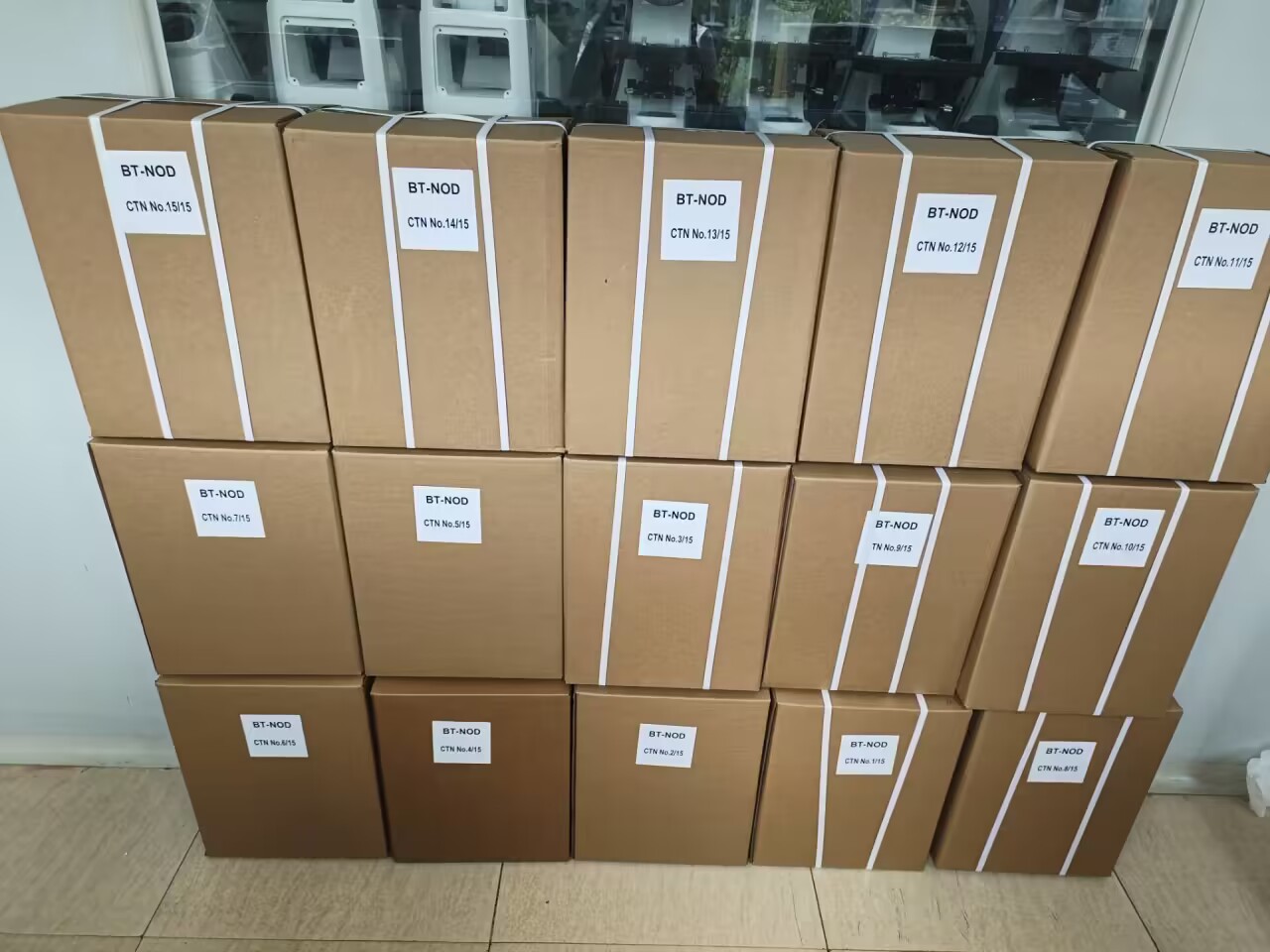
Neutral export packaging, cardboard or wooden cases, is a standard term to confirm before repeat shipments begin.
Model continuity is the part most often left out of the first contract. Ask for a written statement of which models remain in the catalog, which consumables and replacement parts are held for each model, and how long a discontinued model will continue to be supported. The supplier provides a one-year after-sales service period and states 24/7 online technical support; both are useful, and both should be clarified in scope — what is covered, how a replacement is triggered, and what the buyer must document. The supplier's guidance that a product should be replaced after exceeding the recommended number of uses is the anchor for that planning: replacement intervals per model are the real driver of multi-year cost.
One caution about catalog history. Older marketplace listings under the same brand name include vertebral puncture and venipuncture injection models that do not appear in the current procedure list used here. A listing dated 2017 cannot establish present-day availability. For long-term buying, confirm current status model by model instead of relying on any historical catalog page.
Buyer decision checklist
1. Define the procedure list first. Write the procedures the curriculum requires, then map models against it. Remove any model that fails a required procedure.
2. Keep categories separate. Score CPR, airway, puncture and drainage, injection, nursing, and maternal and infant models in separate rows.
3. Request per-SKU documentation. Material, operating temperature guidance, recommended use count, feedback mechanism, and replacement-part list — for each model, not for the range.
4. Treat guideline and certification claims correctly. A design-basis statement such as AHA 2020 alignment is not a certification; ask which document supports it.
5. Normalise to a budget band. Compare only within a comparable price band, and include consumables in the comparison.
6. Fix commercial terms before approval. MOQ, lead time, Incoterm and named place, payment schedule, and the factory inspection acceptance list.
7. Agree the acceptance list per model. State what is inspected, at what point, and against which document.
8. Plan the reorder. Convert annual volume into scheduled runs inside the 30 to 45 day lead time, and record replacement intervals and model continuity commitments.
FAQ
How should a buyer compare manikins that support different procedures?
Score only within one procedure cluster at a time, and treat task coverage as a gate rather than a weighted criterion. A model that cannot perform a procedure on the curriculum list is removed, not down-weighted. Category, material and feedback then rank the survivors within the same budget band. Averaging features across two different categories produces a number that cannot be compared, because the feature lists describe different clinical tasks.
Which models in the Chongqing Scope catalog cover CPR, airway, puncture and nursing training?
On the supplier's published model list, SC-CPR160 and SC-CPR480 are CPR training models; SC-J5S is listed for oral and nasal tracheal intubation; SC-CK817 for pericardial puncture and intracardiac injection; SC-L66 for closed drainage of pneumothorax and hydrothorax; SC-HS4 for IV injection; SC-H130A for nursing procedures; and SC-F50 and SC-F55-1 for maternal and infant training. The company groups its medical manikins into CPR, clinical and nursing categories, and states that its manikins are made of PVC. Per-model material and feature documentation should be requested separately.
What commercial terms apply before an order is placed?
The supplier publishes a minimum order quantity of 20 units, monthly production capacity of 3,000 units, and a typical production lead time of 30 to 45 days. Delivery terms are quoted as EXW, FOB, CFR, CIF or DAP, payment is by T/T, and acceptance criteria are set at factory inspection. Export certificates listed by the supplier include ISO9001, ISO14001, ISO45001, ISO13485, CE and RoHS, with customs documents such as CO, Form E and Form F available on request. These terms should be confirmed on the quotation, since they apply per order.
How should repeat orders and model continuity be planned over several years?
Convert the annual requirement into scheduled runs that fit inside the 30 to 45 day lead time, and check each run against the 20-unit minimum order quantity. Ask for a written commitment on which models remain available, which consumables and replacement parts are held, and how a discontinued model will be supported. The supplier provides a one-year after-sales service period and states 24/7 online technical support. Because products are to be replaced after the recommended number of uses, per-model replacement intervals — not purchase price alone — determine multi-year cost.
What limitations should a buyer accept with single-function procedure trainers?
A task-focused trainer supports a defined operational objective and is simpler to operate at a lower cost, but it does not deliver the variable, scenario-based teaching that integrated simulator platforms with a dedicated operating system support. PVC models must be used within a suitable temperature range and replaced after the recommended number of uses, because deformation is a recognised risk. Material durability and guideline alignment statements are supplier claims in the evidence available here; they should be documented rather than assumed, and no independent performance or fidelity test data was available for this comparison.
Supplier documentation for further review: Chongqing Scope product brochure (PDF).
¿Tiene preguntas o necesita más detalles?
Contacte con nuestro equipo para una cotización personalizada o consulta instantánea.
Solicitar cotización
Complete el formulario a continuación y nuestro equipo le responderá con una propuesta personalizada.
Chat directo de WhatsApp
¿Prefiere chatear en tiempo real? Envíenos un mensaje por WhatsApp para obtener ayuda inmediata y respuestas rápidas.
- Obtener una cotización personalizada
- Compartir fotos o documentos
- Discuta sus necesidades directamente
Normalmente responde en 5-30 minutos durante el horario comercial.