
Scooter and Dirt Bike Seats: Fitting Repair and Replacement
Scooter and Dirt Bike Seats: Fitting Repair and Replacement
Scooter and dirt bike seat replacement are usually discussed as one aftermarket category. In practice they are two different buying situations that happen to share a parts shelf. A workshop replacing a flattened seat on a Honda Click needs a fitment match and a fast answer. An accessory brand building a private-label line for a maxi-scooter needs a stable material build, a cover design programme and a delivery schedule. Both are buying a motorcycle seat, and neither is buying quite the same thing.
Zhejiang Xingrong Auto & Motorcycle Parts Co., Ltd. is a Taizhou-based seat manufacturer founded in 2015 that produces seat cushions for motorcycles, electric vehicles and off-road vehicles. Its documented seat line covers scooter seats and dirt bike seats, with listed fitments for the Nmax, Xmax, Aerox, ADV150, ADV160, Forza, PCX and Click. That combination — a scooter-heavy fitment list alongside a dirt bike seat type — makes the line a practical test case for the question this article addresses: how a repair shop, parts retailer, accessory brand or motorcycle manufacturer should decide which seat configuration fits a given repair-and-replacement scenario.
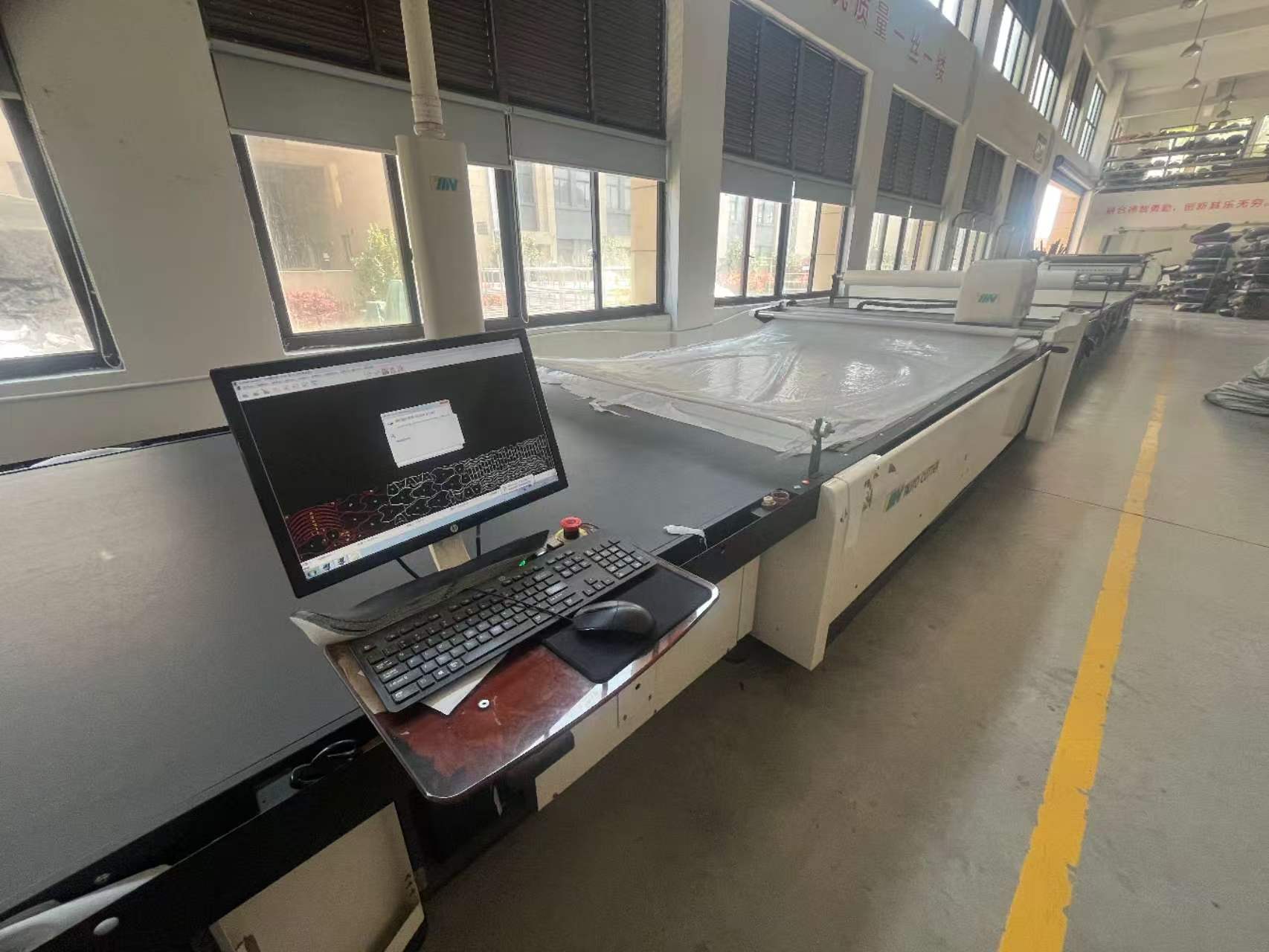 Seat cushion production at the Taizhou plant. Image: Zhejiang Xingrong Auto & Motorcycle Parts Co., Ltd.
Scenario fit is a narrower question than product choice
Scenario fit asks whether a specific seat, mounted on a specific motorcycle, in a specific riding condition, does the job the buyer needs it to do. For seats, three things have to line up: the mounting interface, the material build and the condition of use.
The mounting interface is the least negotiable of the three. The documented seat is a non-powered static fitting part that must be used with the motorcycle main body frame and the motorcycle body shell. There is no adjustment mechanism and no electronic element that can absorb a mismatch. Either the seat sits correctly on the frame and within the bodywork, or it does not. That is why model identification comes before price discussion in most replacement conversations, and why a fitment error is more expensive than a specification compromise.
The condition of use determines the rest. The application record for this seat line lists four special requirements: weather resistance, a wear-resistant surface, waterproof capability and ergonomic design. Those four requirements do not carry equal weight in every scenario. A scooter ridden daily through wet streets and a dirt bike used on abrasive ground place different demands on the same list, and a buyer who treats the list as a fixed uniform specification will usually over-specify one attribute while leaving another unexamined.
The same distinction appears in how the seat earns its place on the bike. The application record states two functions: providing a comfortable riding and sitting experience, and beautifying the motorcycle's appearance. Both matter, but they matter differently. For a scooter whose bodywork leaves the seat fully visible, appearance is part of the owner's decision. For a bike that spends its life on rough surfaces, the condition of the cover after a season may matter more than how it looked on the first day.
Two seat types, one documented line
The Xingrong seat line documents two types: scooter seats and dirt bike seats. The scooter side is itemised by model — Nmax, Xmax, Aerox, ADV150, ADV160, Forza, PCX and Click — while the dirt bike side is recorded as a seat type rather than a model list.
That asymmetry is worth stating plainly, because it shapes what a buyer can and cannot confirm from the product record alone. For a scooter, the fitment question can be answered against a named model. For a dirt bike, the type is documented but individual model fitments are not itemised in the same record, so the fitment check has to happen at enquiry stage, against the actual frame and body shell. Treating a documented seat type as an automatic fit for every dirt bike in a workshop's bay is the kind of assumption that produces returns.
The two types also differ in what the seat is asked to withstand. In scooter use, the cover generally faces road spray, sun exposure and repeated parking contact, while the cushion carries long uninterrupted seated periods. Dirt bike use adds abrasive contact at the seat surface and more variable weather exposure. Both scenarios still require the same four conditions recorded for the application; what changes is the order of priority a buyer should apply when reviewing a sample or a specification sheet.
There is also a repair-versus-replacement distinction inside each type. The application record describes the product as serving old-seat maintenance and direct replacement. Maintenance work usually starts from a seat that is worn, torn at a seam or flattened in the cushion, with the frame and bodywork intact. Direct replacement may follow a cosmetic upgrade, a damaged original seat or a model-line change. The same seat part can serve both, but the evaluation criteria differ: maintenance prioritises fitment certainty and availability, replacement prioritises appearance, cover design and longer-term surface durability.
The documented build, separated from marketing language
Materials are the point where descriptive language most often replaces specification. It is therefore useful to separate what the product record states from what it leaves open. The documented build is a PVC leather cover, an 80D high-density foam seat cushion, PU foam, a PP plate and a high-strength floor structure.
| Component | Documented specification | What it means for a replacement buyer |
|---|---|---|
| Cover | PVC leather | The layer that carries the waterproof and wear-resistant requirements, and the layer that determines the visual finish the application record calls out. |
| Cushion | 80D high-density foam | The comfort layer behind the stated seating feel. The density grade is the only cushion figure disclosed in the record. |
| Additional foam | PU foam | Listed as a component of the seat build rather than as a separate performance claim. |
| Base | PP plate; high-strength floor structure | The structural layer that has to meet the motorcycle main body frame and body shell. This is where fitment is won or lost. |
What the record does not state matters as much as what it does. There is no cover thickness, no foam hardness or compression figure beyond the 80D density grade, no seat dimension set, no load or abrasion test result and no waterproof index. Those gaps are not a criticism of the product; they are gaps in the specification available to a buyer, and they should set the agenda for a technical enquiry rather than be filled by assumption.
Mapping the four stated requirements to riding conditions
The application record is explicit that the product is designed for waterproof environments and operates under waterproof conditions, and that the application requires a wear-resistant surface, weather resistance and ergonomic design. Reading those four requirements against the two seat types produces a more useful purchasing framework than treating them as a flat checklist.
| Selection dimension | Scooter seat replacement | Dirt bike seat replacement |
|---|---|---|
| Fitment driver | Model-specific. The buyer names the model — Nmax, Xmax, Aerox, ADV150, ADV160, Forza, PCX or Click — before a part can be quoted. | The seat type is documented, but individual dirt bike model fitments are not itemised in the product record and must be confirmed at enquiry. |
| Surface priority | Waterproof capability and weather resistance lead, with wear resistance close behind in high-use fleets. | A wear-resistant surface moves to the front because of abrasive contact; weather resistance remains a stated requirement. |
| Comfort emphasis | Seating feel over long seated periods; ergonomic design is a stated application requirement. | Ergonomic design is stated for the application; no separate dirt bike comfort figure is disclosed, so this should be assessed on a sample. |
| Cosmetic weight | Visual effect is a stated product highlight, and scooter bodywork keeps the seat on display. | Visual effect still applies, but the cover's survival under abrasion usually outranks its first-day finish. |
| Dominant purchase risk | Confusing adjacent model generations, such as the ADV150 and ADV160, which are listed as separate fitments. | Assuming a documented seat type equals a confirmed fit on a specific frame and body shell. |
One qualification belongs beside every waterproof statement in this article. Waterproof is recorded as a design condition and as a product highlight, not as a rated index. No test method, pressure rating or duration figure appears in the supplied product record. A buyer whose market requires a quantified water-resistance claim should therefore ask what test applies to the order, rather than inferring a rating from the word itself. The same logic applies to weather resistance and to the wear-resistant surface: both are stated application requirements, and neither is accompanied by an abrasion cycle count.
Fitment coverage from Nmax to Click, and where the list stops
The documented fitment list is short enough to state in full: Nmax, Xmax, Aerox, ADV150, ADV160, Forza, PCX and Click. For a repair shop or a parts retailer, that list is the practical boundary of the line's scooter coverage, and it is more useful than a broad statement about scooter compatibility because it can be checked against a workshop's actual job book.
Two features of the list deserve attention. First, the ADV150 and the ADV160 appear as separate entries. Adjacent model generations are exactly where replacement orders fail, because a buyer working from memory or from a photograph may treat them as one fitment. If both models pass through a workshop, they should be treated as two stock decisions. Second, the list mixes model families that are usually requested in different ways. Searches for a Honda motorcycle seat or a Yamaha motorcycle seat typically resolve into a specific model code before a part can be quoted, which is why the model name matters more than the brand name at the counter.
Where the list stops is equally important. A buyer sourcing a Vespa motorcycle seat, for example, will not find Vespa among the documented fitments; that application needs separate confirmation rather than an assumption based on category similarity. The same applies to dirt bike models: the line documents dirt bike seats as a type, and the model-level fitment has to be verified against the frame and body shell before an order is placed. This is not an unusual constraint in the aftermarket, but it is one that is often discovered after shipment rather than before it.
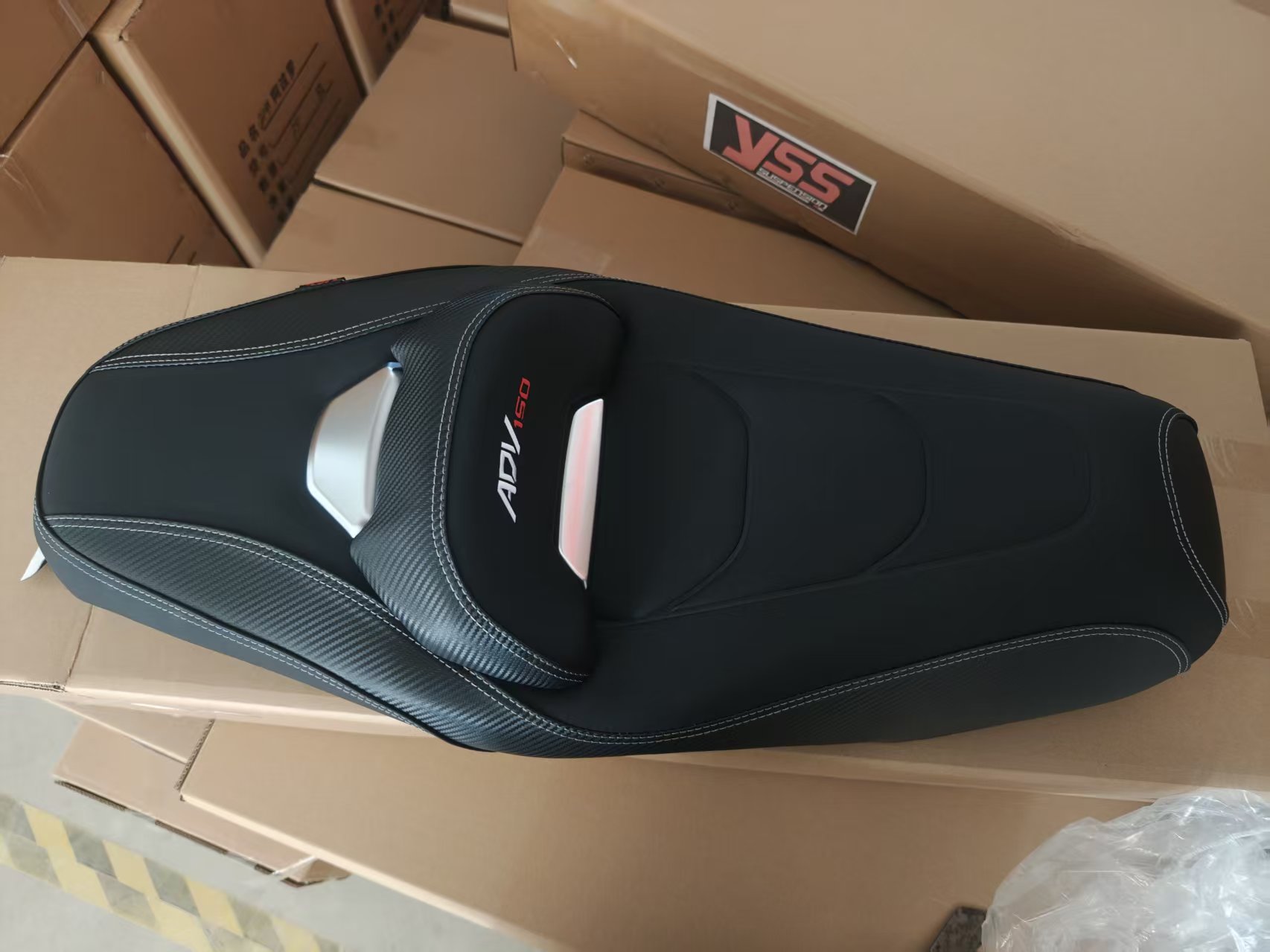 A scooter seat from the documented line. ADV150 and ADV160 are listed as separate fitments. Image: Zhejiang Xingrong Auto & Motorcycle Parts Co., Ltd.
Four buyer types, one seat, four different decisions
The application record names four buyer groups: motorcycle manufacturers, motorcycle repair shops, motorcycle parts retailers and motorcycle accessory brands. They buy the same product family for different reasons, and the scenario fit changes with each.
Repair shops. The governing question is whether the seat in the workshop matches the bike on the lift and whether it can be supplied again next month. Maintenance and direct replacement are both listed uses, which means the shop is usually choosing between restoring an old seat and swapping it. Because the documented seat is a static fitting part mounted to the frame and body shell, labour time is predictable once fitment is confirmed. The practical discipline is to check the model generation before the order and to keep the fitment list visible at the counter.
Parts retailers. The governing question is breadth against dead stock. Eight documented scooter fitments mean eight stock decisions, each with its own turnover. A retailer with a strong scooter customer base may carry most of the list; a retailer serving mixed traffic may carry the highest-frequency models and order the rest. The risk to manage is substitution — selling a nearby fitment as though it were the exact one — because a returned seat costs more than a delayed sale.
Accessory brands. The governing question is differentiation without a new mould. The line supports OEM and ODM work with customisation on logo branding, leather cover design and stitching line colour. For a brand, those three variables are the product: the cover design and stitching carry the visual identity, and the logo turns a replacement part into a branded one. The stated one-year warranty also matters here, because a brand carries the after-sales exposure that a workshop does not.
Motorcycle manufacturers. The governing question is repeatability. An OE-side buyer is not evaluating one seat but a series of them, which moves attention from appearance to process: 100% pre-shipment testing, a 90% self-production rate for product accessories, ISO9000 quality management system certification and CQC certification. Self-production at that level is an indicator of how much of the seat is controlled in-house, and it is the kind of fact a manufacturing buyer will weigh when assessing consistency across scheduled deliveries.
The order terms that decide whether a programme works
Scenario fit is necessary but not sufficient. A seat that fits the bike still has to fit the buying programme, and here the stated terms do most of the work.
The minimum order quantity is 50 pcs, with a production lead time of 25 to 35 days and a monthly capacity of 50,000 pcs. For a repair shop trialling a new model line or an accessory brand testing a cover design, the MOQ is the threshold that decides whether a trial is affordable; for a distributor rebuilding stock after a season, the monthly capacity is the figure that decides whether a repeat order can be scheduled without a gap. How the stated MOQ is applied across a mixed-model order is a commercial term, not a product fact, and it should be confirmed in the quotation rather than assumed from the number alone.
Customisation is limited to the three documented variables: logo branding, leather cover design and stitching line colour. That is a useful boundary. It tells a brand what can be changed without re-engineering the seat, and it tells a buyer not to expect custom foam densities or bespoke base geometry from the standard programme without a separate discussion. The factory profile records five engineers in research and development, which is the relevant context for any request that goes beyond the three standard variables.
Quality control is stated as 100% pre-shipment testing, and after-sales as a one-year warranty. Both are process commitments rather than performance results, and both should be read as such: pre-shipment testing reduces the probability that a defect reaches the buyer, and a warranty defines what happens if one does. Neither substitutes for a sample evaluation on a new model.
The commercial footprint completes the picture. The company operates a 15,000 m² plant with 130 employees and an annual output of 1,800,000 units, exports around 20% of its output, and lists Southeast Asia, Europe, the Middle East and South America among its markets. For a buyer in any of those regions, an existing market presence is a modest signal of familiarity with the destination's expectations, not proof of compliance with its regulations.
What the 5,000-piece Lebanon project and the multi-market record actually show
The most concrete project reference in the record is a 5,000-piece order for Lebanon delivered over a two-year period. The stated results are a good seating feel, a good visual effect, repair and replacement capability, and waterproof performance. The client types listed for that programme are the same four groups discussed above: manufacturers, repair shops, parts retailers and accessory brands.
What that proves is bounded and worth stating precisely. It shows that a 5,000-piece run over two years was supplied, and that the buyer-facing results recorded for it were comfort, appearance, replacement suitability and water resistance. It does not show how the seats perform on every model in the fitment list, in every climate, or over a service life longer than the project. A single programme is a reference point, not a warranty extension.
The wider record is broader in geography than in detail. The case record lists buyers across eleven markets: China, Iran, Italy, South Korea, Lebanon, Malaysia, Mexico, the Philippines, Turkey, Taiwan and Vietnam. The application record separately identifies the replacement scenario as common in Iran, India, Italy, South Korea, Lebanon, Portugal, Thailand, Taiwan, Turkey and Vietnam. The two lists overlap but are not identical, and the difference is best read at face value: the case record describes where orders came from, while the application record describes where the scenario is commonly found. Neither list is a market-share statement, and neither should be scaled into a demand estimate.
Industry context: classification and category scale
Buyers who plan replacement programmes often want a category benchmark before they commit. Two pieces of context are useful, provided each is kept within its own limits.
The first is customs classification. The World Bank's WITS database, drawing on UN COMTRADE HS six-digit data, identifies HS 871411 as motorcycle saddles and HS 871419 as motorcycle parts not elsewhere specified. Importers should note that not every aftermarket seat or seat component automatically falls under 871411 once construction and national tariff interpretation are taken into account. Where trade data is being used to size or compare a market, the classification should be checked before the numbers are relied on, because mixing complete saddles with general motorcycle parts will distort the comparison.
The second is category scale. A 2026 commercial research report places the global motorcycle seats market at USD 4.8 billion in 2025, projected to reach USD 8.2 billion by 2034, with Asia Pacific holding a 38.5% revenue share in 2025. Those are publisher estimates for complete seats across all motorcycle types; they are not a customs series, and they do not describe replacement demand for any single model line. A supplier evaluating a scooter fitment programme should treat the figure as background on category size rather than as a forecast for the models in its own catalogue.
A verification sequence before the order is placed
The following sequence converts the analysis above into checks a buyer can run against any scooter or dirt bike seat supplier, including this one. It is a qualification routine, not a substitute for the buyer's own technical review.
1. Fix the model and the generation. Confirm the exact model code, and treat adjacent generations as separate items. The ADV150 and ADV160 are listed as separate fitments for a reason.
2. Confirm the mounting interface. The seat must mate with the motorcycle main body frame and the motorcycle body shell. Ask for confirmation against the specific bike, not against the seat type.
3. Request the build sheet for the variant ordered. Cover material, cushion grade, additional foam and base construction should be stated in writing. The documented build is PVC leather, 80D high-density foam, PU foam, PP plate and a high-strength floor structure; confirm that the same build applies to the variant you are buying.
4. Ask how water resistance is defined. Waterproof is stated as a design condition, not a rating. If your market needs a quantified claim, request the applicable test method and result.
5. Evaluate a sample against your own scenario. A scooter sample and a dirt bike sample should be judged against the conditions they will actually meet — wet urban use for one, abrasive surface contact for the other.
6. Put the commercial terms in the quotation. MOQ of 50 pcs, a 25 to 35 day lead time, monthly capacity of 50,000 pcs, a one-year warranty and the three customisation variables — logo branding, leather cover design and stitching line colour — should all appear as written terms rather than verbal understandings.
7. Check the import classification. Confirm whether the shipment is being declared under HS 871411 or another heading before landed costs are modelled.
Outlook: what would change the fit decision
The fitment list is a snapshot, and the variable most likely to move the answer is model turnover. When a scooter generation is replaced, a fitment that was confirmed for one version has to be re-confirmed for the next, and a retailer's stock decision changes with it. Buyers building a replacement programme on a fixed list should plan for that re-confirmation rather than treat the list as permanent.
The second variable is how the market treats water resistance. As long as waterproof remains a design condition rather than a rated figure, buyers with wet-climate markets will keep asking suppliers to quantify it. A supplier that can connect the design condition to a stated test method holds an advantage in evaluation, independent of any product change.
The third is programme structure. The stated MOQ of 50 pcs and the 25 to 35 day lead time make small trial orders feasible, which favours accessory brands testing cover designs before committing to a model line. If those thresholds hold as volumes grow, the practical barrier between a repair-shop order and a brand programme stays low — and that, more than any single specification, is what determines whether scooter and dirt bike seats are bought from one supplier or several.
Frequently asked questions
What is the difference between a scooter seat and a dirt bike seat for replacement purposes?
The difference is less about the seat's basic construction than about what the buyer must confirm. A scooter seat can be matched against a named model, such as the Nmax, Xmax, Aerox, ADV150, ADV160, Forza, PCX or Click. A dirt bike seat is documented as a seat type, so the model-level fitment has to be verified against the motorcycle main body frame and body shell at enquiry stage. The riding condition also shifts priority: scooter use emphasises waterproof capability and visual effect, while dirt bike use brings the wear-resistant surface and weather resistance forward.
Which motorcycle models does this seat line cover?
The documented scooter fitments are Nmax, Xmax, Aerox, ADV150, ADV160, Forza, PCX and Click. Dirt bike seats are produced as a seat type without an itemised model list in the same product record. Applications outside the listed models require separate confirmation, and that includes scooters from other model families as well as individual dirt bike models.
What materials and structure are documented for these seats?
The seat is built with a PVC leather cover, an 80D high-density foam seat cushion, PU foam, a PP plate and a high-strength floor structure. The cover carries the waterproof and wear-resistant requirements and shapes the visual finish, while the PP plate and floor structure form the layer that meets the frame and body shell. Cover thickness, foam compression figures, seat dimensions and abrasion test results are not stated in the product record, so those details have to be requested for a specific order.
How should a buyer interpret the waterproof claim?
Waterproof is recorded both as a product highlight and as a design condition: the product is designed for waterproof environments and operates under waterproof conditions. It is not accompanied by a rating, a pressure figure or a test duration in the supplied record. A buyer whose market or customer requires a quantified water-resistance statement should ask the supplier to specify the test method and the result that applies to the order, rather than treating the term as a standardised index.
What order terms apply to repair-shop or brand-volume purchases?
The stated terms are a minimum order quantity of 50 pcs, a production lead time of 25 to 35 days, a monthly capacity of 50,000 pcs and a one-year warranty, with 100% pre-shipment testing as the quality control method. OEM and ODM work is supported with customisation on logo branding, leather cover design and stitching line colour. How the MOQ is applied across a mixed-model order is a commercial term and should be confirmed in the quotation.
What does the 5,000-piece Lebanon project demonstrate?
It demonstrates that a 5,000-piece order for Lebanon was supplied over a two-year period, with recorded results covering seating feel, visual effect, repair and replacement capability, and waterproof performance. It is a project reference rather than a performance guarantee: it does not establish how the seats behave on every model in the fitment list, in every climate, or beyond the project period.
Where this leaves the buying decision
For a scooter, the seat decision starts with the model code and ends with a confirmed fitment, a stated build and a delivery term. For a dirt bike, it starts with the frame and body shell and ends in the same place. In both cases, the four requirements recorded for this application — waterproof capability, weather resistance, a wear-resistant surface and ergonomic design — are the same four, and the buyer's task is to decide which of them carries the most weight in the conditions the bike will actually meet.
Published product documentation for the line is available in the STARON seat cushion catalogue (PDF), and company information is published at zjstaron.com. Buyers evaluating a specific model are advised to confirm the fitment and the variant build in writing before an order is scheduled.
¿Tiene preguntas o necesita más detalles?
Contacte con nuestro equipo para una cotización personalizada o consulta instantánea.
Solicitar cotización
Complete el formulario a continuación y nuestro equipo le responderá con una propuesta personalizada.
Chat directo de WhatsApp
¿Prefiere chatear en tiempo real? Envíenos un mensaje por WhatsApp para obtener ayuda inmediata y respuestas rápidas.
- Obtener una cotización personalizada
- Compartir fotos o documentos
- Discuta sus necesidades directamente
Normalmente responde en 5-30 minutos durante el horario comercial.