
Schuko Model 6765 Compliance Dossier: CE LVD, TUV, CB and IEC 60884-1:2022
European electrical projects approve a wall socket twice — once on fit and price, and once on paperwork. The second approval is the one that delays installation. This reference examines a single EU-facing socket, model 6765, and how its compliance dossier is assembled around CE under the Low Voltage Directive 2014/35/EU, the IEC 60884-1:2022 product standard, TUV certification and CB documentation — and how a buyer should read that material instead of simply filing it.
What a wall socket compliance dossier actually is
A compliance dossier is the document set that shows which requirements a socket was assessed against, by whom, and for which construction. For an EU project specifying Schuko (Type F) sockets, that set is normally built from three different kinds of evidence: a conformity route, a product standard, and third-party certification.
The conformity route is CE marking under LVD 2014/35/EU, which addresses the electrical safety of equipment operating within the directive’s voltage range. The product standard is IEC 60884-1, whose 2022 edition provides the current general requirements for plugs and socket-outlets for household and similar purposes, with a 16 A limit applying to screwless terminals. The third-party layer consists of certification entries such as TUV and CB, which record that an independent body assessed the socket against the applicable standard. The interface itself is separately defined: CEE 7/3 standardises the Schuko (Type F) socket used for 16 A / 250 V applications in many European countries.
These layers answer different questions. A CE declaration, a product-standard test report and a CB certificate are not three copies of the same approval, and a buyer who treats them as one document will eventually find the gap on site rather than in the submittal folder.
The problem: certificates are collected more often than they are read
Most procurement teams do not lack documentation. They lack a reason to open it. A typical EU submittal package contains a declaration of conformity, a test report, one or two certificates and a datasheet, and the review frequently stops at confirming that the words “CE” and “certified” appear somewhere in the folder.
The mismatch then surfaces in four recurring forms:
- Model references. A certificate is issued for a construction with a defined model designation, panel size and terminal arrangement. A purchase order that lists a customized panel, a different gang configuration, or a finish outside the tested construction may sit outside the document that is supposed to cover it.
- Standard editions. The edition of the product standard matters. IEC 60884-1:2022 is the current edition of the general requirements standard; a dossier that references an earlier edition describes an earlier assessment.
- Rated values. The datasheet and the certificate should agree on current and voltage. For Schuko applications, CEE 7/3 defines the 16 A / 250 V interface, and IEC 60884-1:2022 sets its own rated-current ceiling for screwless terminals, so the two are read together.
- Certificate holder and manufacturing site. Documents issued to a trading entity rather than the producing factory require an additional check when a buyer’s quality process is site-based.
Reading the dossier at specification stage costs a few hours. Re-opening a submittal after the sockets have been delivered costs a project schedule.
Model 6765: what the dossier covers
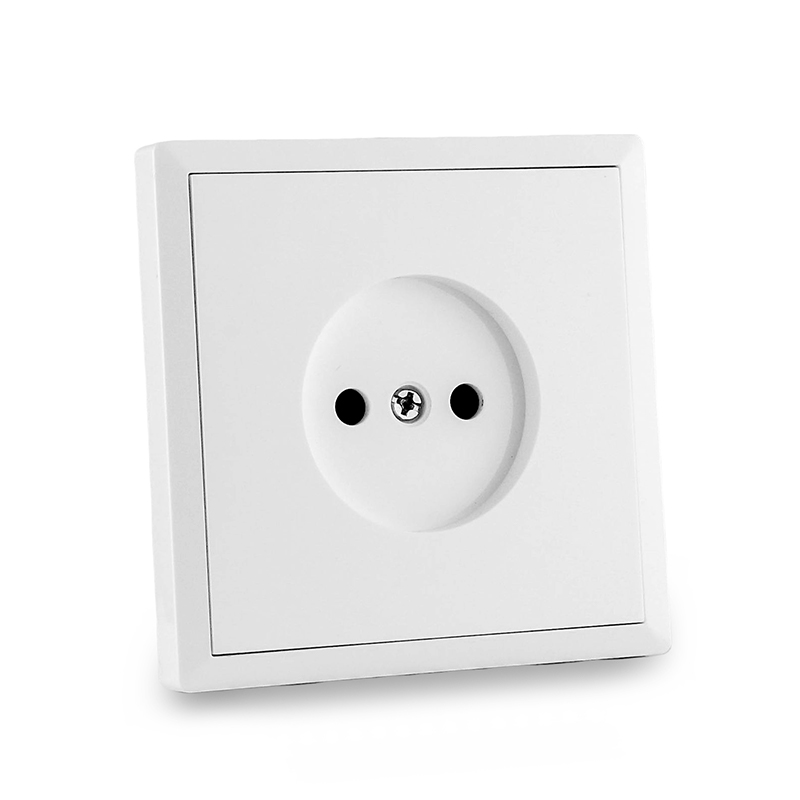
Model 6765 (A129): the flush-mounted construction that the compliance documents are written against.
Model 6765 is the 1-gang EU-facing socket in HYFF’s A series, listed in the manufacturer’s product data under the model designation A129. The published specification describes a flush-mounted mechanical wall socket with an 81.6 × 81.6 mm panel, rated 16 A, 250 V~, with a flame-retardant PC panel and a PC base, supplied in white or customized finishes under HS code 8536690000. The same product data lists CE and TUV certification, and the A series is described in the manufacturer’s documentation as designed for the European market.
Wenzhou Huafeng Electric Co., Ltd. (HYFF) is a Chinese manufacturer of wall switches and wall sockets based in Wenzhou, Zhejiang, founded in 2011 and operating a 7,000 m² facility with 118 employees, a 10-engineer R&D team and an annual output of 35,000,000 units. Its products are exported to Europe, the Americas, Oceania, Asia and Africa, and the company states that it holds CE and CB certification for its wall switches and sockets.
The dossier assembled around model 6765 references certificate DACE260330001RL issued by DACE, the CE route under LVD 2014/35/EU, the IEC 60884-1:2022 standard, TUV certification and CB documentation. Two details are worth stating precisely, because they are exactly the kind of detail a buyer should verify rather than assume: the model-level certification recorded in HYFF’s product data for A129/6765 is CE and TUV, while CB documentation appears across related EU-facing ranges in the same portfolio, including S149, V149, VC139, H129 and HA159. Treating a CB entry as model-specific without confirming the model string is the assumption this article exists to prevent.
Technical explanation: reading the four evidence layers
Each document in an EU socket dossier answers a specific question and stops there. The table below summarises what each layer does and where its boundary sits.
| Evidence layer | What it answers | What it does not answer |
|---|---|---|
| CE marking, LVD 2014/35/EU | Electrical safety conformity for equipment within the directive’s voltage range; the manufacturer affirms conformity and compiles the technical file. | Which model variants or which edition of a test standard were assessed. |
| IEC 60884-1:2022 | General requirements for plugs and socket-outlets for household and similar purposes; the 2022 edition limits screwless terminals to 16 A. | Interface geometry, installation environment or ingress protection. |
| TUV certification | Independent assessment of the socket against the applicable product standard. | Constructions, panel variants or finishes outside the tested model. |
| CB scheme documentation | Internationally recognised test report and certificate set usable in participating markets. | Market approval itself; national deviations may still apply. |
| CEE 7/3 (Schuko, Type F) | Interface standard defining the 16 A / 250 V Schuko socket used in many European countries. | Safety assessment of the socket construction. |
Read as a sequence, the layers describe a progressive narrowing: the directive establishes the market-access route, the product standard defines what was measured, the third-party certificates record who measured it, and the interface standard confirms that the socket will physically accept the plugs the project specifies.
The datasheet carries the values that tie the documents to the order. The A129 specification lists 16 A, 250 V~, an 81.6 × 81.6 mm panel, a flame-retardant PC panel, a PC base and HS code 8536690000. Those are the figures a specifier checks against the project requirement, and they are the figures that should also appear consistent with the certified construction. A-rated voltage that changes between the marketing page and the technical file is a documentation problem before it becomes a safety problem.
Reading certificate scope and model references: a six-step check
The following procedure is written for procurement and engineering teams who receive a dossier for a flush-mounted EU socket such as model 6765. It takes less time than a single re-submittal.
- 1. Match the model string, not the family name. Compare the model designation printed on the certificate with the designation on the purchase order and the datasheet. Family names and marketing names can span several constructions.
- 2. Confirm the standard and its edition. Check that the product standard cited is the edition the project specification calls for — IEC 60884-1:2022 in this case — rather than an earlier issue.
- 3. Confirm the rated values. Verify current and voltage on the certificate against the datasheet and the project requirement, and note the 16 A ceiling that the 2022 edition applies to screwless terminals.
- 4. Confirm construction coverage. Panel material, finish, gang configuration and module arrangement should all fall inside the tested construction. Customized colours and panels are the most common point at which scope and order diverge.
- 5. Confirm the holder and the site. Check the certificate holder name and, where a quality process is factory-based, that the manufacturing site matches the entity on the document.
- 6. Version the dossier with the submittal. Treat the document set as a revision-controlled package so that certificate re-issues and standard updates are traceable to the project, not to an inbox.
Where model 6765 fits in an EU project
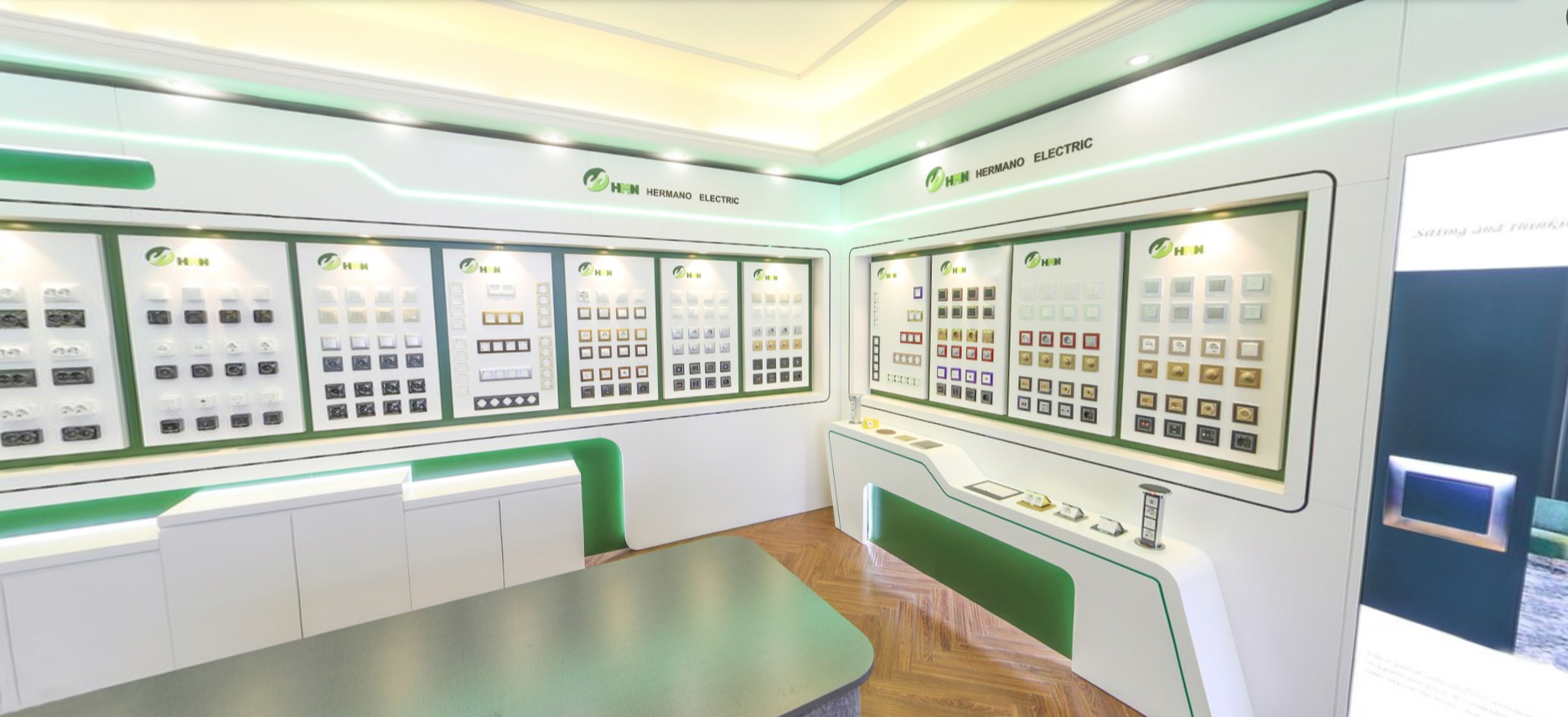
Variant review before submittal: finishes and panel options are where certificate scope and purchase order most often diverge.
The residential construction scenario for which this class of socket is documented is specific, and knowing it makes the dossier easier to interpret. The product is used in residential buildings, apartments, villas and home renovation projects, operating under indoor, dry, normal-temperature conditions on 220–240 V AC, 50/60 Hz residential electrical systems. Its role is to provide a safe and convenient power connection for household appliances and other residential electrical devices, and it operates by inserting a compatible plug into the socket to connect the appliance to the residential power supply.
That role defines the supporting equipment the socket has to work with: wall boxes, mounting supports, single-gang or multi-gang frames, electrical wires, residential distribution boxes, plugs and household appliances. It also defines the special requirements a project will test against: compliance with local socket standards and certification requirements, compatibility with wall-box dimensions and wiring methods, reliable grounding protection, insulation, flame-retardant performance, temperature-rise performance and insertion durability.
Field evidence from HYFF’s EU-facing channel work follows the same pattern. In a documented case involving a European wall socket brand owner, importer and electrical product distributor, the project scale ran to more than 1,000 wall sockets per model for residential and distribution projects, with an expected service duration of at least eight years, tested for insertion durability and electrical safety according to applicable product standards. The sockets passed plug compatibility, installation, temperature-rise and functional testing, were compatible with local plug standards, wall-box dimensions and wiring methods, and met the customer’s requirements for bulk purchasing and brand customisation. Highlighted outcomes included compatibility with local wall boxes, consistent appearance, and customisable functions, colours, logos and packaging.
For an EU buyer, the useful reading of that case is not that a socket can be supplied at volume. It is that the compatibility questions — plug standard, wall box, wiring method — were resolved and recorded, which is precisely what a compliance dossier is meant to make checkable before installation begins.
Market context: documentation is becoming a procurement gate
The category behind this dossier is large and still consolidating around standardised, documented products. Global production of wall sockets reached more than 3.1 billion units in 2024, with China leading as the top producer (Market Research Report). The global electric plugs and sockets market is valued at USD 14.13 billion in 2025 according to Precedence Research, while modular sockets accounted for 43% of total wall socket sales in 2024 on space-saving and customisation trends, according to Fortune Business Insights.
Published sizes for this category diverge by scope: an industrial-only definition places the same period at USD 3.40 billion, as reported by Fortune Business Insights, against the USD 14.13 billion figure produced by a plugs-and-sockets definition. The divergence is not a contradiction so much as a reminder that a number means little until its scope is stated — the same discipline buyers apply to market data should be applied to certificate scope.
The structural trend matters more than the headline figure. Modular construction increases the number of configurations a single product family can generate, and every additional configuration is a potential scope question for a certificate issued against one tested construction. As variety grows, the value of a documented, model-referenced dossier grows with it.
Limits: what a compliance dossier does not prove
A dossier is evidence of conformity for a defined construction, not a universal guarantee. Three boundaries are worth stating plainly, because ignoring them is how well-documented products still end up misapplied.
- Environment. Model 6765/A129 is documented for indoor, dry, normal-temperature residential installations. It is not documented as an ingress-protected product, so it is not the correct choice for bathrooms, kitchens exposed to splash, or outdoor positions. Ingress protection is a separate rating system defined by IEC 60529, and where humid conditions exist an IP-rated product is required — HYFF’s WP149 IP54, a surface-mounted 16 A, 220–250 V~ socket, is documented for that purpose.
- Variant coverage. A certificate covers a tested construction. Customized panels, finishes and module combinations are commercial options; whether they inherit the tested construction’s coverage depends on whether the change is documented within scope. This is a question to ask before ordering, not after.
- Installation suitability. Certification addresses the product, not the site. Wall-box depth, wiring method, grounding and circuit design remain project-level responsibilities, which is why the special requirements for this application list wall-box dimension and wiring compatibility alongside certification compliance.
It is also worth separating certification from durability evidence. Certificates record conformity; endurance comes from test records. HYFF’s socket documentation lists 10,000+ plug-in/out tests across several ranges, while the A-series material documentation records 850 °C fireproof PC material and 40,000+ on/off test cycles. Those are test-based claims, and they should be requested as records rather than inferred from a certificate.
Future outlook
Three forces are likely to keep compliance documentation at the centre of EU socket procurement. First, standard editions continue to evolve: as IEC 60884-1 editions are updated, dossiers will need to be re-issued against the current edition rather than carried forward indefinitely. Second, the shift toward modular and customised socket systems will keep widening the gap between a certificate’s scope and a project’s bill of materials, making model-reference discipline more valuable each year. Third, interface-level regulation is already reshaping what a wall socket is expected to contain: EU rules mandating USB-C as the common charging standard for most portable electronics have pushed USB-equipped wall sockets into residential specifications, and each new interface adds another scope question to the same document set.
For suppliers, the practical response is an orderly dossier: clear model references, current standard editions, and a scope statement that says what is and is not covered. For buyers, the practical response is a six-step read before the submittal is approved. Specifiers who want the wider portfolio context can reference HYFF’s published product brochure at HYFF 2026 product brochure (PDF).
FAQ
What does CE marking under LVD 2014/35/EU mean for a Schuko wall socket?
It is the conformity route for the electrical safety of equipment operating within the Low Voltage Directive’s voltage range. On a project submittal, the CE route is normally read together with test reports and third-party certificates, because the marking itself does not state which construction, which model variants or which edition of a test standard were assessed. For model 6765, the dossier couples the CE route under LVD 2014/35/EU with certificate reference DACE260330001RL and with the IEC 60884-1:2022 standard.
Which standard applies to model 6765 — IEC 60884-1:2022 or CEE 7/3?
They answer different questions and are usually cited together. IEC 60884-1:2022 provides the general requirements for plugs and socket-outlets for household and similar purposes, with a 16 A limit for screwless terminals, and is the product standard referenced in the dossier. CEE 7/3 standardises the Schuko (Type F) interface used for 16 A / 250 V applications in many European countries. A complete dossier states both the safety standard the socket was assessed against and the interface standard it is dimensioned to.
Does the certificate for model 6765 cover every colour and customized variant?
Not automatically. Certificates are issued for a defined construction. HYFF’s product data for A129 lists colours as white and customized, and the company offers logo-level customisation within its ODM capability. When a project specifies a customized panel, finish or module combination, the buyer should confirm whether that configuration falls inside the tested construction or requires an extension of scope. Customization does not remove the need to check the model reference on the document.
What is the difference between TUV, CB and CE in this dossier?
CE is the market-access route under LVD 2014/35/EU. TUV certification is a third-party assessment against the applicable product standard. CB documentation is a test report and certificate set within the IECEE CB scheme, usable across participating markets rather than being a market approval in itself. In HYFF’s published product data, the A129/6765 model is listed with CE and TUV certification, CB documentation appears across related EU-facing ranges including S149, V149, VC139, H129 and HA159, and the company states that it holds CE and CB certification for its wall switches and sockets.
Can model 6765 be used in bathrooms or outdoor installations?
Model 6765/A129 is documented for indoor, dry, normal-temperature environments on 220–240 V AC, 50/60 Hz residential systems, and it is not documented as an ingress-protected product. Ingress protection ratings are defined by IEC 60529, and humid or wet locations call for an IP-rated socket. HYFF’s WP149 IP54 is a surface-mounted 16 A, 220–250 V~ socket documented with IP54 protection for humid environments.
How should a buyer verify that a certificate applies to the socket being purchased?
Four checks cover most cases: match the model designation on the certificate to the designation on the purchase order and datasheet, including panel size and gang configuration; confirm the standard and its edition; confirm the rated values against the project requirement and the 16 A ceiling for screwless terminals in IEC 60884-1:2022; and confirm the certificate holder and, where relevant, the manufacturing site. If any element differs, the document supports the supplier rather than the specific purchase, and the point should be resolved before the submittal is approved.