
Scent Diffuser vs. Humidifier: A TCO View for Commercial Spaces
The global fragrance diffuser market reached USD 29.61 billion in 2024 and is projected to grow to USD 38.10 billion by 2032, according to Data Bridge Market Research. Within this category, commercial scenting has become a standard tool for hotels, shopping malls, retail stores and offices that want to influence customer experience. Yet many procurement teams still evaluate scenting equipment using the same criteria as traditional humidifiers, which often leads to misleading cost comparisons.
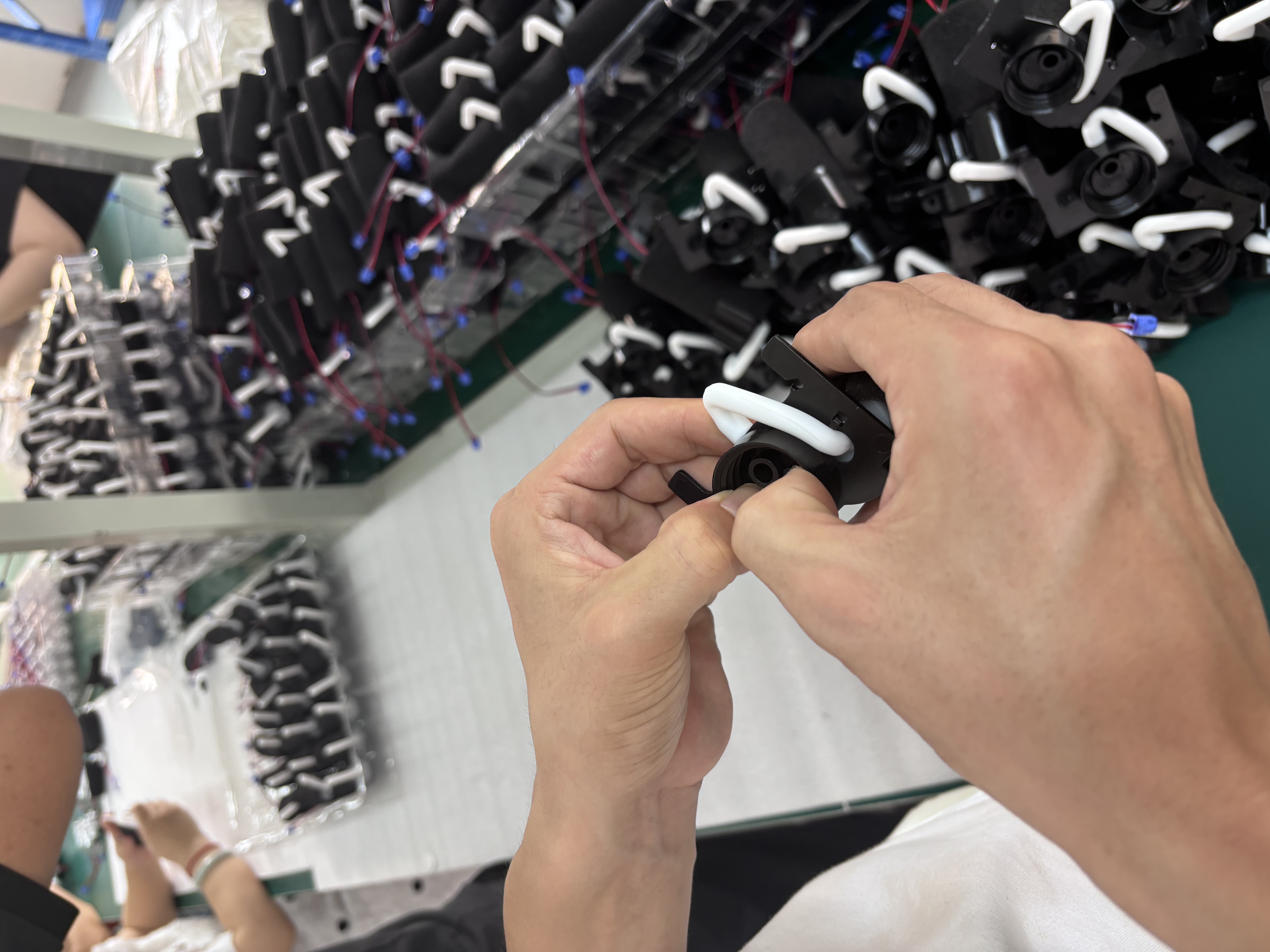
Assembly of commercial scent diffuser components at SCENTSEA's factory in Shenzhen.
Why Commercial Scenting Needs Its Own Equipment Category
Commercial scenting is not the same as home fragrance. In a hotel lobby or a shopping mall, the diffuser must operate for long hours, cover a large area, and deliver a consistent scent without raising humidity or demanding constant attention. This is why equipment designed for humidification is often a poor fit for scenting.
A humidifier's primary function is to add moisture to the air. When fragrance is added, the mixture is typically water-diluted, which lowers scent concentration and creates the risk of oil separation and residue buildup. In continuous commercial use, humidifier-based scenting can translate into higher cleaning frequency, more replacement parts, and shorter equipment life.
The Cost Trap: When Humidifiers Look Cheaper
On paper, a humidifier has a lower purchase price, which makes it an attractive starting point for scenting budgets. But the total cost of ownership includes maintenance, consumables, downtime, and replacement. In commercial environments, these hidden costs often exceed the initial price difference.
Waterless diffusion technology—also called cold-air or nebulizing diffusion—offers a different trade-off. It atomizes pure fragrance oil into microscopic particles without heat or water. That means no water tanks to clean, no dilution, and no added humidity. The technology generally costs more upfront, but it promises higher scenting efficiency and significantly lower ongoing maintenance.
What Waterless (Nebulizing) Diffusion Actually Does
A waterless diffuser uses a precision atomizing nozzle and an air stream to create a fine mist of essential oil particles that remain suspended in the air. Because no water is involved, the scent is more concentrated, and the device does not change the room's humidity. This makes it suitable for closed spaces like hotel rooms and elevators where added moisture is not desirable.
According to industry data, nebulizing diffusers represent approximately 22.6% of the ambient scent diffuser market, favoured for their professional-grade scent potency in commercial environments.
Reliability depends on the quality of the nozzle, seals, motor, and housing materials. Common issues in commercial diffusers include oil leakage, nozzle clogging, unstable atomization, fragrance oil incompatibility, abnormal noise, and transportation damage. To address these, manufacturers apply control measures such as leak-proof bottle structures, precision atomizing nozzles, waterless cold-air diffusion technology, oil-resistant sealing materials, low-noise motor designs, and reinforced packaging. Buyers should ask vendors how they test these aspects before shipment.
How SCENTSEA Fits Into the Commercial Diffuser Market
SCENTSEA is a professional scent diffuser manufacturer based in Shenzhen, China. Established in 2021, the company operates a 3,000 m² factory with 30 employees and an annual output capacity of 100,000 units. Around 70% of its production is exported to the EU and USA. Its product line covers a range of diffuser types, including battery-operated, plug-in, wall-mounted, floor-standing, and HVAC-integrated systems.
SCENTSEA states that all its products carry CE, ROHS, FCC, and SGS certifications. The company reports installations in more than 70 countries and holds over 20 product patents related to scent diffusion.
Its published comparison data indicates that, versus a humidifier, its diffusion platform offers 22% higher scenting efficiency, 90% less maintenance required, and a lifespan extended by three times. The initial cost is 15% higher, but the total cost of ownership over five years is 40% lower. These figures are useful as a benchmark, and procurement teams can verify them through sample testing and installation trials.
Application Guide: Matching Diffuser Technology to Venue
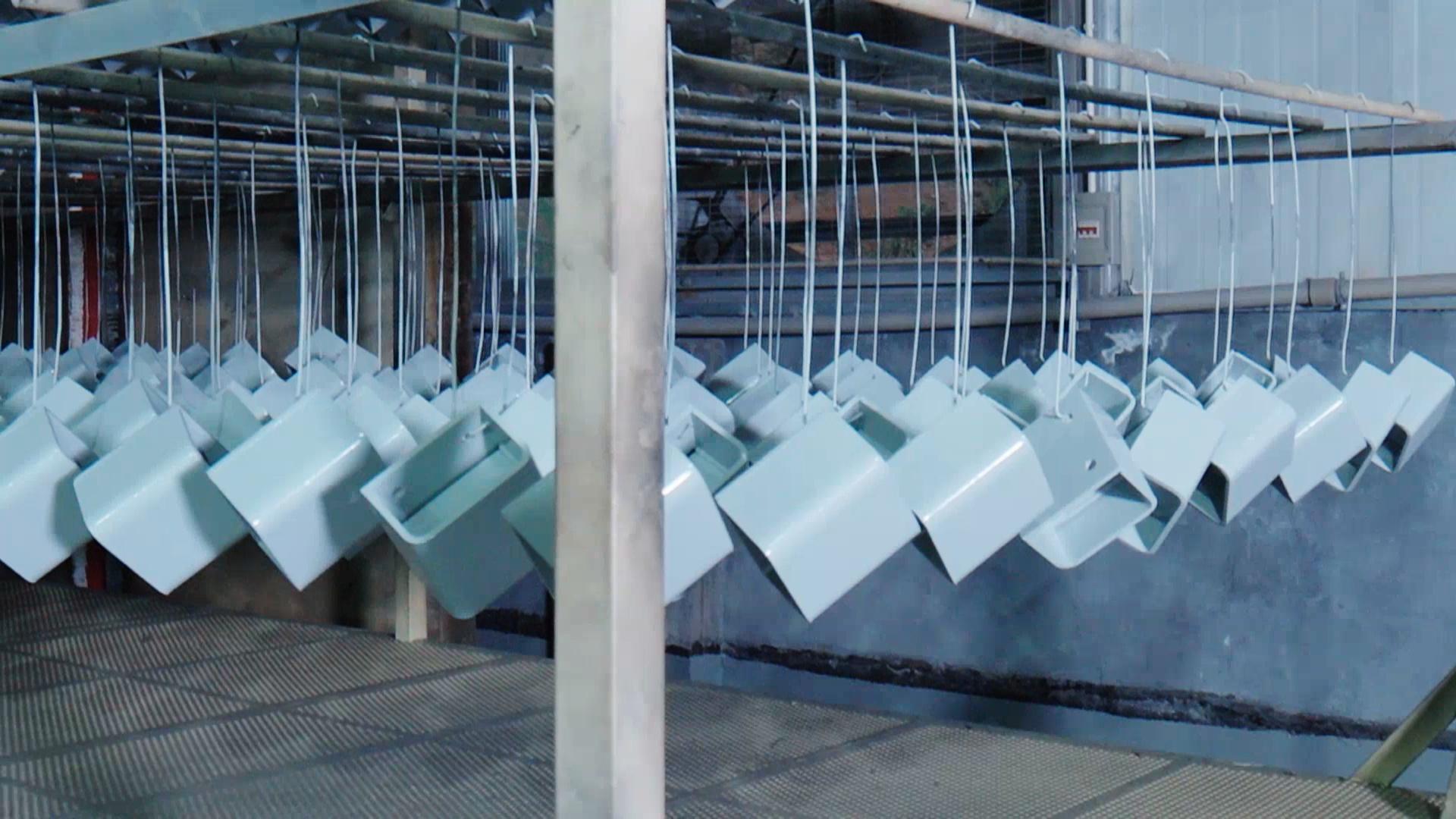
Metal powder coating adds durability to commercial scent diffuser enclosures.
Different spaces require different configurations:
- Hotels: Guest areas need low-noise, continuous diffusion. Waterless diffusers do not add moisture and can run without frequent refills. Common formats include wall-mounted units and HVAC-integrated systems.
- Shopping malls: Large open areas require powerful diffusion and low maintenance. Floor-standing and HVAC diffusers are efficient choices for atrium and corridor scenting.
- Elevators and restrooms: Compact battery-operated or plug-in diffusers are popular for these enclosed spaces. Waterless operation avoids humidity buildup.
- Offices and retail stores: App-controlled diffusers can schedule scenting during business hours, reducing oil consumption and service intervals.
Market Signals: Data, Standards and Competitive Pressure
The global HVAC scent diffuser market was valued at USD 1.01 billion in 2024 and is expected to grow at a CAGR of 4.5% through 2034, according to Intel Market Research. This points to rising integration of scenting into building infrastructure.
North America accounted for approximately 43.87% of global fragrance diffuser revenue in 2024, according to Data Bridge Market Research. For exporters, compliance with EU and USA electrical and safety standards is therefore a key market entry prerequisite.
Regulatory standards are also tightening. IFRA 51, introduced in 2023, set stricter global safety standards for fragrance ingredients used in diffusers, with particular focus on inhalation safety. Buyers should verify both hardware certification and fragrance oil compliance.
The competitive market includes established Western players such as ScentAir, Aroma360, and AromaTech, according to Intel Market Research. Asian manufacturers like SCENTSEA offer direct-factory and OEM/ODM alternatives, giving buyers more options for customization and supply chain control.
Consumer smart features are shaping expectations as well. Xiaomi launched the Mijia Smart Aroma Diffuser in October 2024, featuring a 50-day battery life and app control via HyperOS. Commercial buyers are increasingly requesting app-controlled scent diffusers that support scheduling and remote monitoring.
Comparison: Waterless Diffuser vs. Humidifier
The table below summarises a typical comparison provided by SCENTSEA, using a standard humidifier as the baseline.
| Criteria | Humidifier-based scenting | Waterless nebulizing diffuser |
|---|---|---|
| Initial cost | Baseline (lower) | 15% higher |
| Scenting efficiency | Baseline | 22% higher |
| Maintenance | Baseline | 90% less maintenance required |
| Lifespan | Baseline | Extended by 3 times |
| Total cost of ownership over 5 years | Higher | 40% lower |
| Best suited for | Short-term, low-usage settings | Hotels, shopping malls, public venues |
| Primary risks | Oil separation, clogging, water tank hygiene | Requires pure oil, periodic nozzle cleaning, compatible fragrance |
This comparison is a manufacturer-published benchmark, not an independent claim. It is most relevant for venues that operate scenting equipment continuously and are willing to accept a higher upfront cost for long-term savings.
Practical Limit: When a Waterless Diffuser Is Not the First Choice
Despite the long-term cost advantage, waterless diffusers are not always the right answer.
The 15% higher initial cost can be a problem for short-term projects. An event that lasts only a few weeks may not recover the premium through lower operating costs. In these cases, rental equipment or a lower-cost humidifier unit might be more pragmatic.
Waterless diffusers also require fragrance oils that are specifically formulated for nebulizing. Water-based or high-viscosity oils can damage the nozzle or cause clogging. Buyers need to align their oil supply with the device specification.
Even with lower maintenance, the equipment still needs periodic nozzle cleaning, seal inspection, and filter checks. Facilities teams should budget for basic preventive service.
Finally, larger HVAC-integrated or floor-standing units may require professional installation and specific electrical or mounting infrastructure. These requirements should be assessed during site planning.
Future Outlook: The Direction of Commercial Scenting
The commercial scenting market is likely to move towards:
- Better integration with building management systems and HVAC networks.
- More rigorous documentation of hardware and oil compliance, especially after IFRA 51.
- Increased use of data analytics to measure scent coverage and guest response.
- Smart controls that enable remote scheduling, monitoring, and predictive maintenance.
- More OEM/ODM programs that let brands customize both hardware and fragrance.
For buyers, the ability to compare total cost of ownership across vendors will become a standard part of procurement evaluations. Manufacturers that provide transparent performance data and certification evidence will be better positioned.
Frequently Asked Questions
Q: How does a scent diffuser differ from a humidifier for commercial scenting?
A: A scent diffuser, especially a waterless nebulizing type, atomizes pure fragrance oil into fine particles without adding moisture. A humidifier adds water vapor and typically requires water-diluted fragrance, which can lead to weaker scent output and more maintenance.
Q: What is the total cost of ownership difference between a waterless scent diffuser and a humidifier over five years?
A: According to manufacturer data from SCENTSEA, a waterless scent diffuser has a 15% higher initial cost than a humidifier, but the total cost of ownership over five years is 40% lower, due to lower maintenance requirements and a lifespan that is three times longer.
Q: How much less maintenance does a waterless scent diffuser require?
A: The same comparative data indicates that a waterless scent diffuser requires 90% less maintenance than a humidifier-based scenting system.
Q: Which commercial venues are best suited for waterless scent diffusers?
A: Public consumer venues such as hotels and shopping malls are best suited because of the technology's higher scenting efficiency, lower maintenance, and longer lifespan. It also works well in restrooms, elevators, offices, and retail spaces where compact or low-humidity scenting is needed.
Q: What certifications should buyers look for in a commercial scent diffuser?
A: Common certifications for global procurement include CE, ROHS, FCC, and SGS. Buyers should also verify that fragrance oils meet IFRA standards, such as the stricter IFRA 51 introduced in 2023.
Q: Are there limitations when switching from a humidifier to a waterless scent diffuser?
A: Yes. The main limitations are a higher initial cost, a need for pure fragrance oils rather than water-based products, periodic nozzle cleaning, and in some cases higher-power installations for large units.
Reference
For buyers who want to review detailed product specifications, SCENTSEA provides a publicly available catalog: SCENTSEA Product Catalog.
¿Tiene preguntas o necesita más detalles?
Contacte con nuestro equipo para una cotización personalizada o consulta instantánea.
Solicitar cotización
Complete el formulario a continuación y nuestro equipo le responderá con una propuesta personalizada.
Chat directo de WhatsApp
¿Prefiere chatear en tiempo real? Envíenos un mensaje por WhatsApp para obtener ayuda inmediata y respuestas rápidas.
- Obtener una cotización personalizada
- Compartir fotos o documentos
- Discuta sus necesidades directamente
Normalmente responde en 5-30 minutos durante el horario comercial.