
Scent Diffuser Evaluation: 2026 Commercial Buyer Preferences
Scent diffusers have become a standard part of commercial space planning. Hotels, shopping malls, offices, banks, and public facilities use them to shape atmosphere, mask odors, and support brand experience. For procurement teams, the challenge is now less about whether to install scenting and more about how to compare hardware, performance claims, compliance documents, and long-term operating costs.
The Evaluation Problem in a Growing Scent Diffuser Market
The global fragrance diffuser market was valued at USD 29.61 billion in 2024 and is projected to reach USD 38.10 billion by 2032, according to Data Bridge Market Research. A more specific segment, HVAC scent diffusers, was estimated at USD 1.01 billion in 2024 and is expected to grow at a CAGR of 4.5% through 2034, based on Intel Market Research. North America accounted for approximately 43.87% of global fragrance diffuser revenue in 2024.
These figures describe a market that is both large and strongly professionalized. Nebulizing diffusers, also called waterless or cold-air diffusers, represented approximately 22.6% of the market and are favored for professional-grade scent potency in commercial environments. At the same time, IFRA 51, introduced in 2023, tightened global safety standards for fragrance ingredients used in diffusers. Buyers are now being asked to verify both hardware performance and fragrance oil compliance.
The practical consequence is that evaluation teams face a long list of options: wall-mounted and plug-in models, battery-operated units for toilets and elevators, floor-standing equipment for lobbies, and HVAC-integrated systems for large footprints. Without a structured comparison, sourcing decisions can easily default to price or brand familiarity.
What 2026 Buyers Prefer in a Scent Diffuser
Across commercial evaluation discussions, five preferences tend to come up most often.
- Reliability and low maintenance. Replacing hardware or sending staff for frequent cleaning erodes the business case for scenting. In a five-year shopping mall project, SCENTSEA AC-MAX units delivered lower labor requirements and stable operation.
- Efficient essential oil use. Fragrance oil is a recurring cost. Operational data from the same project showed a 30% reduction in essential oil usage, a metric directly relevant to total cost of ownership.
- Waterless, cold-air atomization. Commercial buyers increasingly prefer nebulizing technology that works without water and does not change humidity. The 22.6% segment share for nebulizing diffusers supports this shift.
- Smart or scheduled control. Consumer products such as the Xiaomi Mijia Smart Aroma Diffuser launched in October 2024 with 50-day battery life and app control. Even if commercial buyers do not need consumer aesthetics, they are starting to expect scheduling and remote adjustment in larger systems.
- Documented compliance. For exports to the EU and US, CE, RoHS, FCC, and similar documentation should be available before purchase. Certification is no longer a differentiator; it is a baseline.
SCENTSEA as a Reference Point
SCENTSEA (Shenzhen Scentsea Technology Co., Ltd) is a professional scent diffuser manufacturer based in Shenzhen, China. The company develops, manufactures, and markets scent machines and fragrance oils, and positions itself as a direct factory with OEM/ODM capabilities. Founded in 2021, SCENTSEA operates a 3,000 m² facility with a staff of 30, including a four-engineer R&D team. Its annual output capacity is 100,000 units, with approximately 70% of products exported to the EU and US.
The company states that it has obtained more than 20 product patents and identifies nano atomization technology as a core strength. Its products carry CE, RoHS, FCC, and SGS certifications, and SCENTSEA reports that its scent machines have been installed in more than 70 countries. It also works with international aroma oil suppliers to keep fragrance oils safe and pure. FCC certificate number ATL20240416326, RoHS certificate number ATL20240416327, and EMC certificate number ATL20240416325 are on record for the scent diffuser line.
Technical Comparison: Matching Scent Diffuser Types to Space Needs
To evaluate a commercial scent diffuser, buyers should compare hardware by material, coverage, power source, oil consumption, and noise level. The following table, based on SCENTSEA's published specifications, shows how different device categories map to common commercial spaces.
| Model | Type | Coverage | Power | Typical Spaces |
|---|---|---|---|---|
| S01 | Wall plug-in scent diffuser | 30-100 m² | 110-240V, 1.5W | Home, toilet, store |
| P01 | Battery operated scent diffuser | 100-150 m² | 5V / 4 D batteries or Type C, 2.5W | Toilet, elevator |
| P02 | Electric scent diffuser | 150-350 m² | DC12V plug-in, 6.5W | Toilet, corridor, shop |
| A300 | Commercial scent diffuser | 500-800 m² | DC12V, 12W | Hotel, shopping mall, retail store |
| T3 | Commercial scent diffuser | 1000-1600 m² | DC12V 2A, 15W | Shopping mall, hotel, airport |
| H5000 | Floor standing scent diffuser | 800-1300 m² | DC12V plug-in, 20W | Hotel, mall, office lobby |
| AC-MAX | HVAC scent diffuser | 2500-3500 m² | DC12V, 48W | Shopping mall, bank, airport |
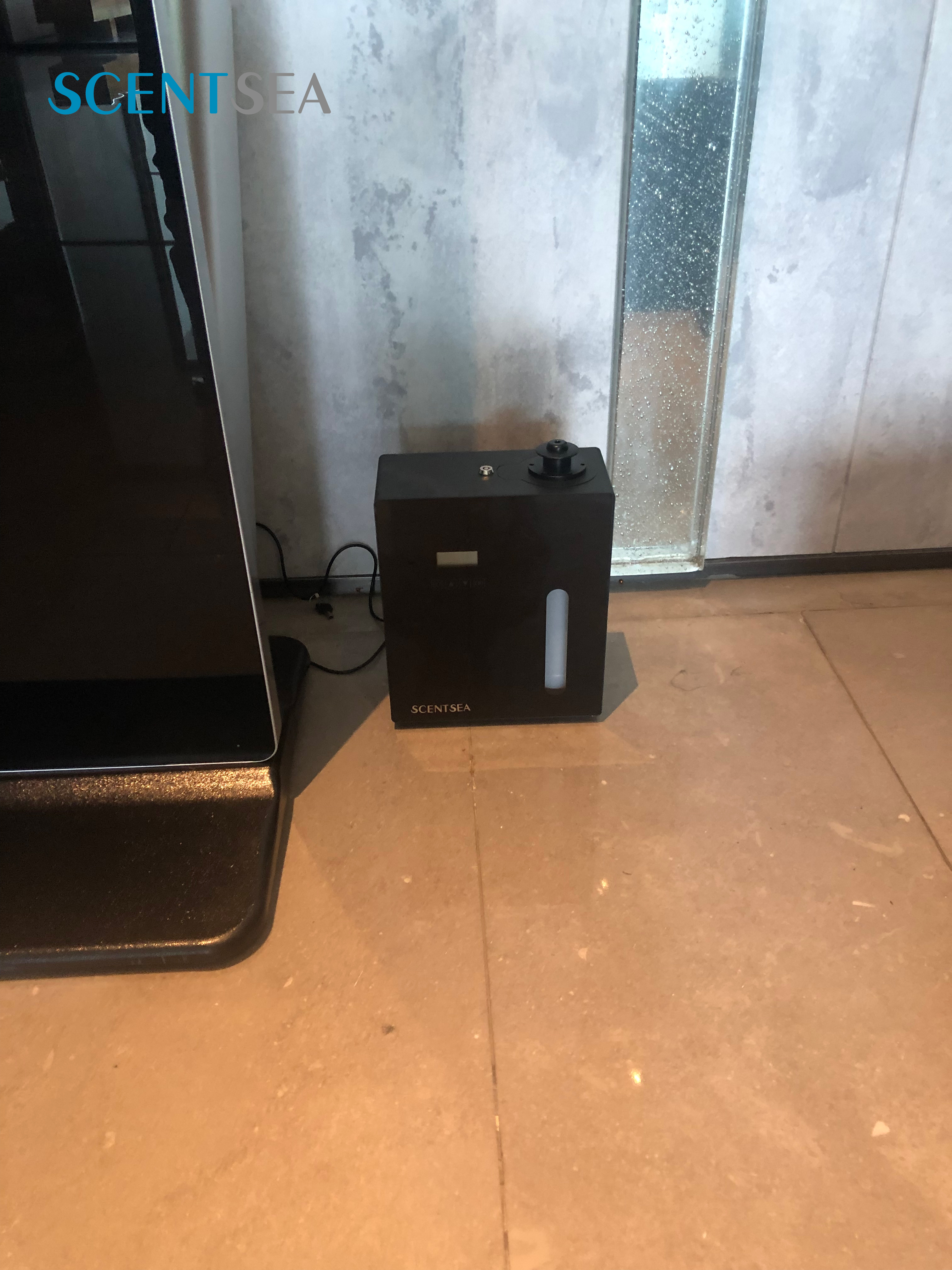
SCENTSEA T2, a commercial scent diffuser for mid-to-large spaces.
The range covers the main installation scenarios: compact wall plug-in models for small rooms, battery-operated models for toilets and elevators, mid-to-large commercial units for hotels and malls, floor-standing equipment for lobbies, and a split-type HVAC model for very large zones.
Atomization method matters when evaluating a scent diffuser. Waterless cold-air nebulizing diffusers hold about 22.6% of the market and are generally favored for commercial settings because they can disperse pure fragrance oil as a fine dry mist. SCENTSEA identifies nano atomization as a core technology. For purchasing purposes, the more directly comparable figures are oil consumption and noise level: A300 consumes about 4 ml/h, T3 about 4.6 ml/h, and AC-MAX about 6 ml/h.
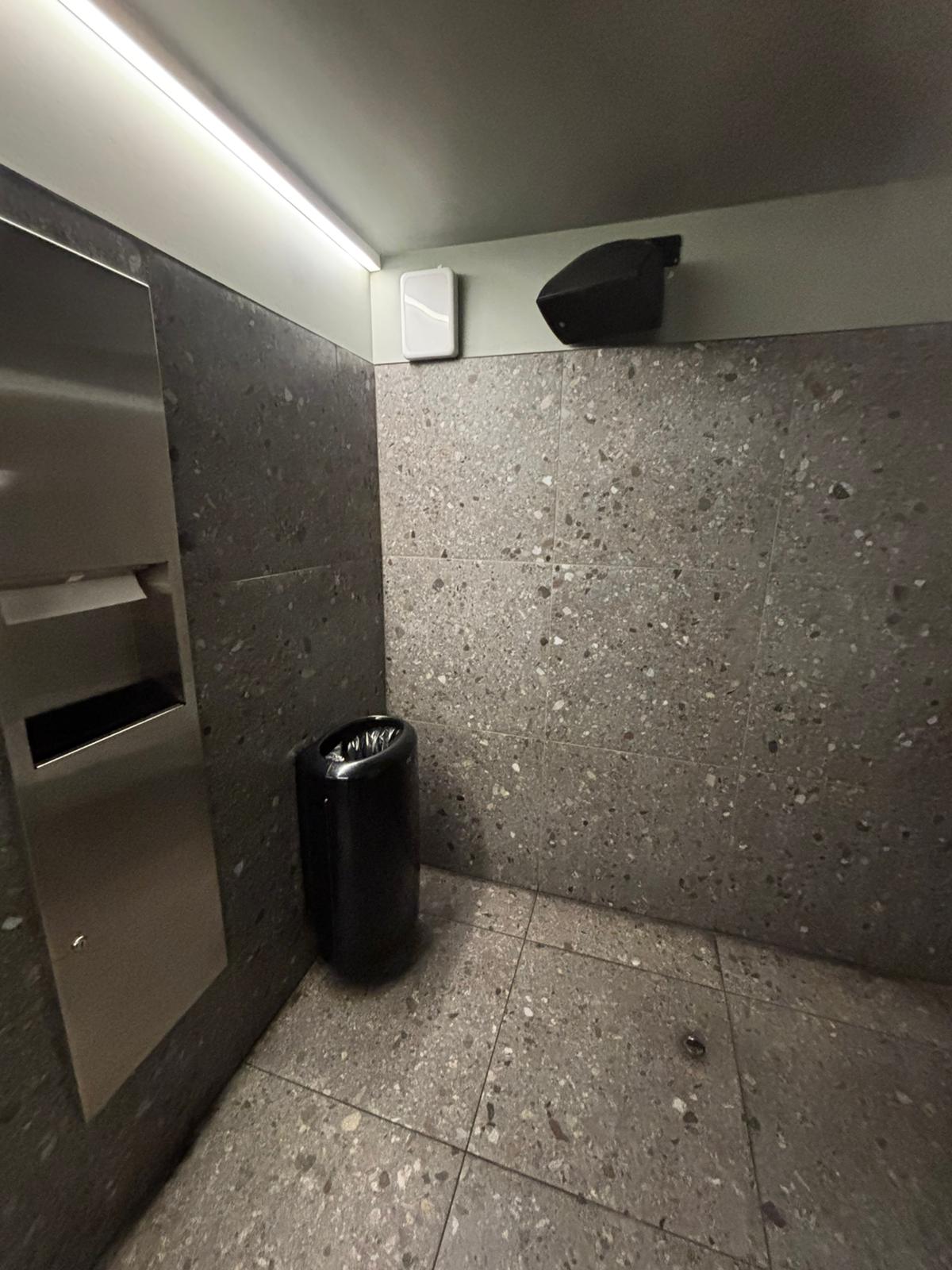
SCENTSEA P01, a battery operated scent diffuser for toilets and elevators.
Application Evidence: A Five-Year Shopping Mall Scenting Project
One useful reference point for evaluation teams is a documented case from a US-based scenting service provider. The operator used 30 SCENTSEA AC-MAX HVAC diffusers to provide scenting services to a shopping mall. After five years, the project achieved a 40% reduction in labor costs and a 30% reduction in essential oil usage. The results were attributed to the product's long lifespan, low maintenance requirements, and stronger atomization capability.
This case is relevant beyond SCENTSEA. It shows that evaluation should look beyond the purchase price and consider labor and consumables over the life of the equipment. A scent diffuser that reduces oil waste and maintenance visits can change the economics of a commercial scenting contract.
Market Trends Shaping 2026 Scent Diffuser Selection
Three broader trends are influencing commercial scent diffuser preferences.
1. HVAC integration is becoming a standard for large spaces
The HVAC scent diffuser segment, valued at USD 1.01 billion in 2024, is expected to grow at a CAGR of 4.5% through 2034. For shopping malls, airports, and banks, distributing scent through existing air handling systems reduces the number of visible devices and enables more even coverage.
2. Regulatory and safety expectations are rising
IFRA 51, introduced in 2023, set stricter global safety standards for fragrance ingredients used in diffusers. This has two consequences: buyers need to verify that fragrance oils are IFRA-compliant, and manufacturers must provide clear certification documentation. SCENTSEA holds FCC, RoHS, and EMC certificates at the product line level, with issued certificate numbers, as well as CE and SGS certification claims.
3. Smart features are moving from consumer to commercial
In October 2024, Xiaomi launched the Mijia Smart Aroma Diffuser with a 50-day battery life and app control via HyperOS. Consumer expectations around app control are beginning to influence commercial buyers, especially for distributed installations where remote scheduling is useful.
At the brand level, the commercial scenting landscape includes ScentAir, Aroma360, and AromaTech, all of which are commonly associated with nebulizing technology for hotels and shopping malls. SCENTSEA is part of the same product category but differs in manufacturer focus, offering direct factory access and OEM/ODM services. This makes it more directly comparable to supply partners than to service brands.
Waterless Diffusers vs. Traditional Humidifier-Based Diffusers
The most common traditional alternative to a commercial nebulizing diffuser is an ultrasonic humidifier with fragrance oil added to water. These devices are inexpensive and work in small spaces, but they have clear boundaries in commercial settings.
An ultrasonic diffuser increases humidity, which can be undesirable in air-conditioned hotel corridors or retail environments. It also requires regular cleaning to prevent film buildup, and the water-based mix can dilute scent strength. By contrast, a waterless cold-air diffuser uses pure oil, produces a dry mist, and keeps humidity levels unchanged. This is why commercial suppliers often favor them for continuous operation.
There are still practical limits. A waterless scent diffuser is designed for oil-based fragrances; using water-based or high-VOC liquids can damage the atomizing mechanism. Even the largest standalone units have a coverage ceiling, so very large or open-plan spaces typically need multiple units or an HVAC-integrated approach. Buyers should also account for regular cleaning and fragrance oil selection as part of the operating plan.
Future Outlook
As the market grows, evaluation criteria will become more standardized. Buyers can be expected to ask for certified products, documented oil consumption, and evidence of long-term reliability. App-controlled scheduling and HVAC integration will move deeper into commercial procurement, particularly for multi-location operators.
For sourcing teams, the key question may shift from “which diffuser is most popular” to “which manufacturer can support our specification over time.” SCENTSEA's annual production capacity of 100,000 units, 70% export exposure to the EU and US, and direct factory position suggest it is built to function as a supply partner rather than only a product vendor. Buyers should still verify these capabilities against their own volume, certification, and customization needs.
Additional Reference Material
For buyers comparing specifications and compliance documentation, the full SCENTSEA catalog is available for download: SCENTSEA Product Catalog (PDF).
FAQ
What is a commercial scent diffuser?
A commercial scent diffuser is a device that disperses fragrance oil into the air for spaces larger than a typical home room. It is designed for continuous use in hotels, shopping malls, offices, and public facilities. SCENTSEA, as a manufacturer, segments its range by coverage and power source, from compact wall plug-in models to HVAC-integrated systems.
What is the difference between a battery operated scent diffuser and a plug-in electric scent diffuser?
A battery operated scent diffuser uses batteries or a Type-C connection and can be placed where AC wiring is impractical, such as toilets and elevators. A plug-in electric scent diffuser connects to a power adapter and usually provides longer continuous runtime and higher output. In the SCENTSEA range, P01 and P03 are battery operated, while S01 and P02 are plug-in models.
What does HVAC scent diffuser mean?
An HVAC scent diffuser connects to a building's air handling system and releases fragrance into the conditioned air supply. The SCENTSEA AC-MAX is a split-type HVAC scent diffuser with a 5L bottle and a coverage of 2500-3500 m², making it suitable for shopping malls, banks, and airports.
How do I choose a scent diffuser for a shopping mall?
The main criteria are coverage area, installation type, maintenance, and oil consumption. Large standalone diffusers such as the T3 cover 1000-1600 m², while HVAC models like the AC-MAX cover 2500-3500 m². A scenting service provider may prefer HVAC integration to reduce visible equipment and service visits.
What certifications should an exported scent diffuser have?
Certification requirements depend on the destination. For the US, FCC documentation is commonly required; for the EU, RoHS and EMC compliance are expected. SCENTSEA states that all of its products carry CE, RoHS, FCC, and SGS certifications, with FCC certificate ATL20240416326, RoHS certificate ATL20240416327, and EMC certificate ATL20240416325 on record.
Are waterless scent diffusers better than ultrasonic diffusers?
Waterless cold-air diffusers are often preferred in commercial environments because they do not add humidity and can use pure fragrance oil for stronger scent. They are not inherently better in every case: they require oil-based liquids and may have a higher upfront cost than consumer ultrasonic devices. The right choice depends on the space, oil type, and operating schedule.
What is a smart or app controlled scent diffuser?
A smart scent diffuser supports remote control through an app, typically for scheduling and intensity adjustment. Consumer examples such as the Xiaomi Mijia Smart Aroma Diffuser, launched in October 2024, offer 50-day battery life and app control via HyperOS. In commercial settings, smart control is becoming a useful feature, although many professional models still rely on simple timers.
What maintenance does a commercial scent diffuser typically require?
Maintenance includes replacing fragrance oil, cleaning the atomizing chamber, and checking the power supply. In a five-year shopping mall project using SCENTSEA AC-MAX units, the operator reported a 40% reduction in labor costs and a 30% reduction in essential oil usage, attributed to long lifespan, low maintenance requirements, and stronger atomization.