
Scenario Fit in Fashion Jewelry Sourcing: Ranking Xuping Jewelry
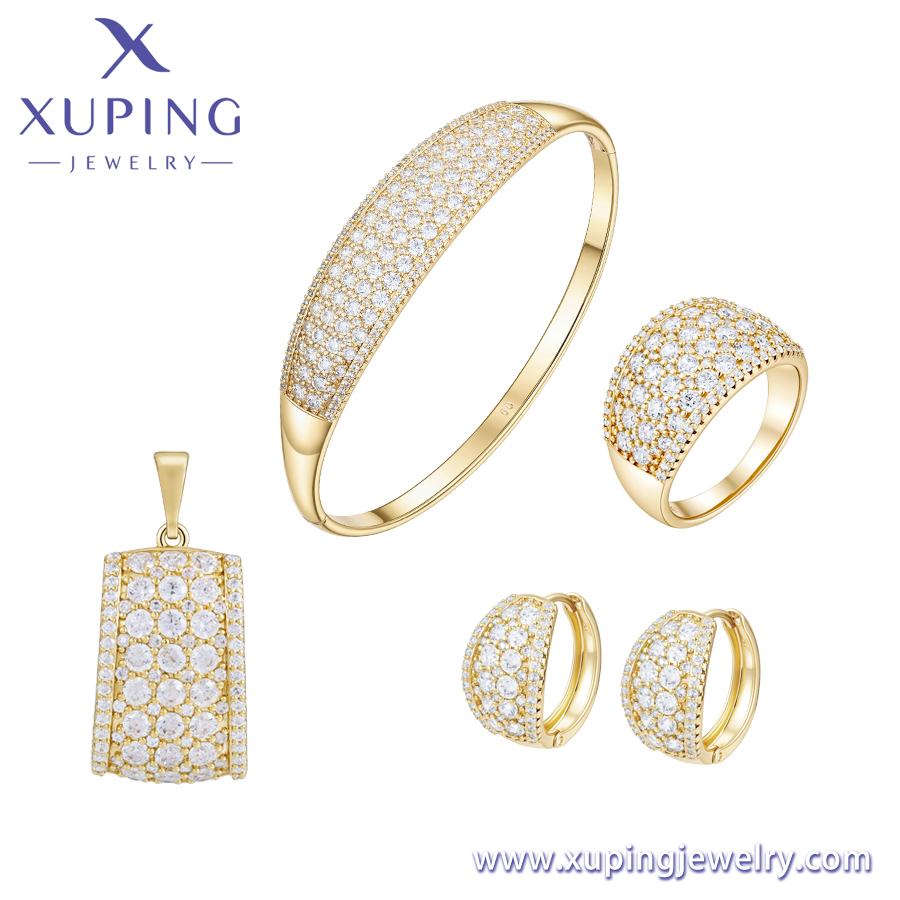
A coordinated jewelry set from Xuping Jewelry's Simple series (model X001006294) — the multi-piece format that anchors occasion and gifting assortments. Image: Xuping Jewelry.
Fashion jewelry sourcing decisions increasingly start with a sales scenario rather than a price list. A retailer planning a fast-fashion replenishment cycle, a marketplace seller assembling a party-season assortment, and a boutique owner curating an occasion line are asking the same underlying question in different forms: does this manufacturer's portfolio, material base, production model and compliance evidence actually match the channel I sell into?
That question is what this assessment calls scenario fit. It examines how Xuping Jewelry, a fashion-imitation jewelry manufacturer based in Guangzhou, China, maps onto five common sourcing scenarios, and it ranks those scenarios across four evaluation dimensions that buyers can apply to any candidate supplier.
Why Scenario Fit Has Become the First Filter
The global fashion (costume) jewelry market is projected to reach USD 167.97 billion in 2024, according to Custom Market Insights. The imitation jewelry segment specifically is expected to grow at a compound annual growth rate of 7.23% between 2025 and 2035, with e-commerce expansion identified as a primary driver (Spherical Insights). Within the category, necklaces and pendants remain the largest single product segment at roughly 28.5% of revenue (Market Intelo). On the supply side, China's jewelry exports reached approximately USD 11.5 billion in 2024, with Hong Kong, the United States and Switzerland among the major destinations (OEC).
Those figures describe a category that is broad, trend-sensitive and increasingly channel-specific. Buyers are no longer shortlisting suppliers on unit price alone. They are checking whether a factory's category coverage matches an assortment plan, whether its production cadence can absorb replenishment cycles, and whether its packaging and documentation match the destination market.
Scenario fit, in this context, is the degree of alignment between a manufacturer's categories, materials, order model, customization depth and compliance documentation, and the operating requirements of one specific sales channel. A supplier can be strong in one scenario and weak in another without contradiction — which is why a single overall score tells a buyer very little.
The Four Dimensions Used in This Assessment
| Dimension | What it measures | Evidence in Xuping Jewelry's profile |
|---|---|---|
| Technology and R&D capability | Design capacity, patent portfolio, internal process depth | 62 designers; 194 patents; 18 production procedures; more than 1,200 production facilities |
| Scale and market coverage | Output capacity, export reach, market diversity | Over 100 million pieces produced annually; 100% export ratio; sales in more than 100 countries and regions |
| Order model and customer service | Minimum order flexibility, OEM/ODM support | Low minimum order quantities; one-stop OEM and ODM customization services |
| Industry solutions and compliance | Category-to-application fit, certification, packaging support | SGS, CE and ISO certifications; product lines mapped to retail, e-commerce, wholesale and gifting; display stands, custom gift boxes, storage bags and packaging solutions |
The four dimensions are weighted equally here. Buyers whose priority is documentation rather than design breadth, for example, should re-rank the scenarios accordingly. This is a criteria-based fit assessment based on published capability and product facts — not an audited financial ranking, and not a comparison built on third-party data for named competing manufacturers.
Xuping Jewelry at a Glance
Guangdong Xuping Jewelry Co., Ltd. was established in 1997 and operates as a comprehensive enterprise integrating R&D, design, manufacturing, wholesale trade and e-commerce for fashion-imitation jewelry. The company runs a production base covering more than 200,000 square meters, employs more than 1,000 staff, and reports annual output of over 100 million pieces.
Its portfolio covers rings, pendants, earrings, necklaces, bracelets, anklets, bangles and coordinated jewelry sets, with brooches also documented in the catalog. Base materials are copper alloy with gold-plating craftsmanship and stainless steel, with plating finishes listed as 14K gold color, 18K gold color and platinum plated across individual models. Stone options range from no-stone designs to synthetic cubic zirconia, synthetic crystal and glass.
Approximately 100% of production is exported. Listed major markets include Mexico, the United States, Spain, Canada, Peru, the Philippines, Thailand, Indonesia, Malaysia, Vietnam, Australia, New Zealand, Turkey, Saudi Arabia, Iran, the United Arab Emirates, Ukraine, Russia, Poland, Germany, France, Italy, Nigeria and the United Kingdom. Quality documentation includes SGS, CE and ISO certifications, and goods pass through 18 production procedures described as meeting European and American environmental-protection standards.
Scenario 1 — Fast-Fashion Retail and Replenishment Cycles
Scenario fit rating: Strong.
Fast-fashion retail rewards category breadth, low unit weight for logistics efficiency, and the ability to reorder quickly. Xuping's portfolio aligns with those requirements on several concrete points. Light, no-stone pieces such as earring model X001163413 (approximately 14*5 mm, 2.45 g per pair) and ring model X000877263 (approximately 2.56 g, no main stone) sit in the company's Daily series, while stone-set daily pieces such as necklace X001015911 (43 cm, approximately 4.30 g, white synthetic cubic zirconia of about 6*8 mm) give the same series a visual step up without changing the material base.
Production scale matters here too. An annual output of over 100 million pieces and more than 1,200 production facilities point to capacity built for volume programs, while stated support for low minimum order quantities allows retail buyers to validate a style before committing to a full program. For a category that turns over on trend cycles, that combination — breadth plus reorder capacity — is the core of fast-fashion scenario fit.
Scenario 2 — E-Commerce and Marketplace Assortments
Scenario fit rating: Strong.
Xuping's product documentation lists e-commerce as a target industry for its cataloged items. For marketplace sellers, the practical advantage is specification completeness: each model is documented with material, plating method, dimensions, weight, stone information, product series and unit of quantity — the fields that feed listing accuracy, shipping weight calculations and returns reduction.
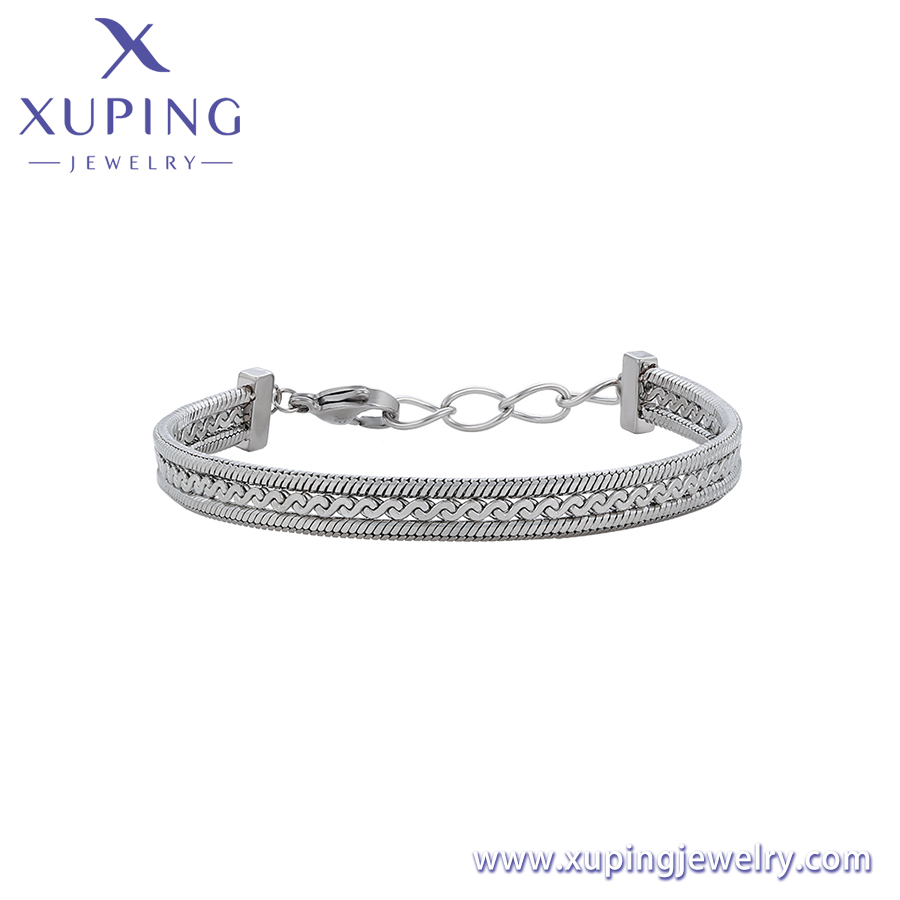
Stainless steel bracelet model T000959269 (Daily series, approximately 170*6 mm with a 30 mm extension). Image: Xuping Jewelry.
Two stainless steel pieces illustrate how the range covers everyday, lower-maintenance positioning: bracelet model T000959269 (about 170*6 mm with a 30 mm extension, approximately 11.01 g) and necklace model A00902945 (40 cm, approximately 400 mm with a 60 mm extension, approximately 6.30 g). Both are listed under the Daily series and are noted as applicable to jewelry suppliers, fashion accessories, jewelry retail, wholesale, the gift industry and e-commerce.
On the fulfillment side, the supported accessory set includes jewelry display stands, custom gift boxes, storage bags and packaging solutions — items that matter when a listing's perceived value depends on presentation and packaging consistency across repeat orders.
Scenario 3 — Specialty Boutiques and Occasion Lines
Scenario fit rating: Strong for occasion-led assortments.
Boutiques typically buy narrower but more distinctive assortments, and Xuping's Luxury series concentrates the pieces built for that purpose. Documented examples include jewelry set X000871334 (earrings approximately 3*28*11 mm, bracelet approximately 200*3 mm, necklace approximately 450*3 mm, approximately 18.8 g per set, 18K gold color plating over environmental copper); bangle X000998659 (approximately 60*8 mm, 21.77 g, ruby and synthetic cubic zirconia main stone); brooch X000852427 (approximately 44*38 mm, 9.15 g, AB color synthetic cubic zirconia of about 12*8 mm); and crystal necklace X000668301 (41 cm with a 50 mm extension, lilac synthetic crystal of approximately 18*17 mm, 7.915 g, marked with the company's "XP" name).
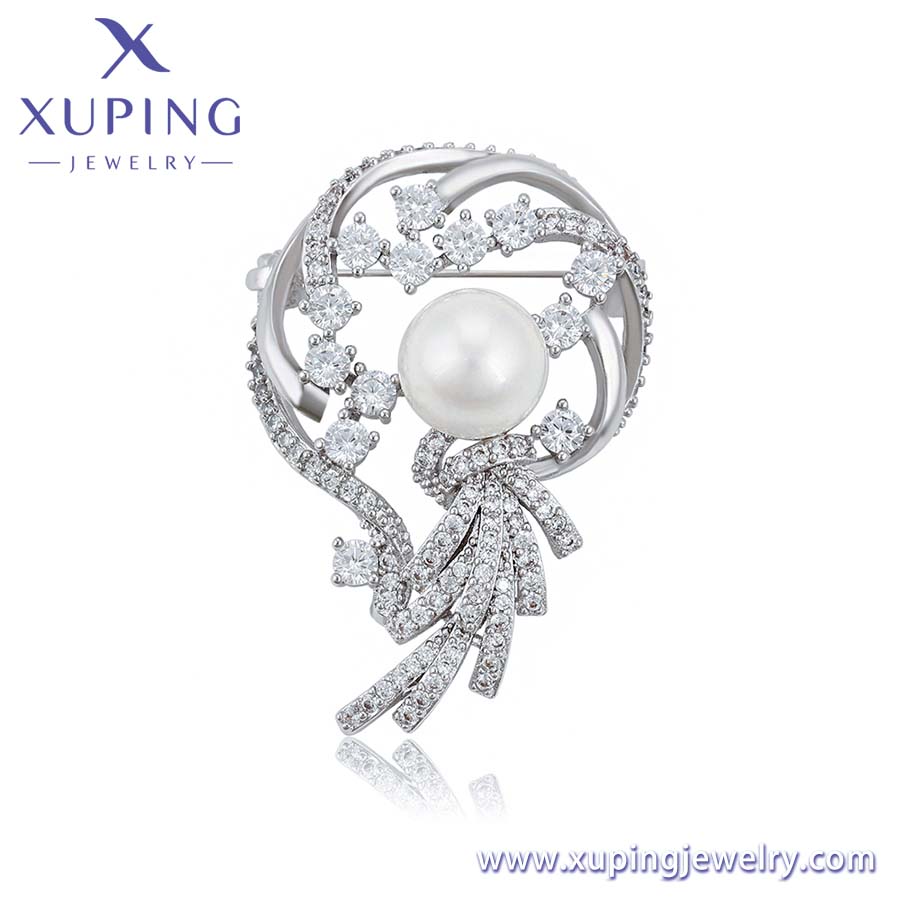
Platinum plated brooch model A00900238 (Daily series, approximately 47*32 mm, 12.3 g). Image: Xuping Jewelry.
A platinum-plated necklace, model 14N245402, sits at the heavier end of the range at approximately 49.44 g with a 40 cm length and a dark blue glass main stone — the kind of statement piece an occasion display can be organized around. The company's stated working conditions cover daily wear, fashion shows, events and occasions, gift giving and all-weather suitability, which is the operational vocabulary of boutique and event retail rather than of commodity wholesale.
Scenario 4 — Promotional Gifting and Gift Programs
Scenario fit rating: Strong.
In promotional gifting, packaging and set format often matter more than the individual piece. Xuping's project-type list includes promotional gift programs, and its matched-equipment list includes custom gift boxes and storage bags alongside display stands.
Jewelry sets are the natural unit for this scenario. Set X001006294 is listed at approximately 28.43 g per set in the Simple series with 14K gold color plating and white synthetic cubic zirconia main stones, while set X000871334 provides a Luxury series alternative at approximately 18.8 g per set — a useful reminder that series names indicate design positioning, not weight class. Buyers building a gift program should therefore compare sets on stone size, dimensions and packaging rather than on grams alone.
The application profile for these scenarios also lists customized design, eco-friendly material, hypoallergenic and lead-free compliance among the special requirements associated with them — the categories corporate and gift-program buyers are usually asked to document internally.
Scenario 5 — Brand OEM and ODM Programs
Scenario fit rating: Strong.
For brand owners building private-label lines, the relevant evidence is design capacity and process control. Xuping reports 62 designers in its R&D team and 194 patents, supported by more than 1,200 production facilities and 18 production procedures. The company states that it supports low minimum order quantities together with one-stop OEM and ODM customization services.
Those two capabilities interact in practice. An in-house design team and patent portfolio reduce dependence on external design sources, while low minimum order quantities let a brand validate a design before scaling it. One qualification is worth noting: buyers should confirm case by case which elements of a project are newly developed and which are adapted from existing catalog models, since the catalog documentation supplied for this assessment already covers more than twenty models across rings, pendants, earrings, necklaces, bracelets, anklets, bangles, brooches and sets.
Scenario Fit at a Glance
| Sourcing scenario | R&D fit | Scale fit | Order model fit | Compliance fit | Overall |
|---|---|---|---|---|---|
| Fast-fashion retail and replenishment | Strong | Strong | Strong | Strong | Strong |
| E-commerce and marketplace assortment | Strong | Strong | Strong | Strong | Strong |
| Specialty boutique and occasion lines | Strong | Strong | Moderate | Strong | Strong |
| Promotional gifting and gift programs | Moderate | Strong | Strong | Strong | Strong |
| Brand OEM and ODM programs | Strong | Strong | Strong | Strong | Strong |
| Precious-metal and fine jewelry programs | Limited | Limited | Limited | Limited | Limited |
Ratings reflect alignment with publicly stated capability and product facts. "Strong" means the dimension is directly supported by documented catalog data; "Moderate" means support is partial or indirect; "Limited" means the scenario falls outside the documented material and program scope.
Compliance and Material Boundaries Buyers Should Check
Xuping's stated certification set is SGS, CE and ISO, and its production flow runs through 18 procedures intended to meet European and American environmental-protection standards. For buyers, the more useful question is not the certificate list itself but the current test reports behind it, because jewelry compliance is market-specific and time-bound.
Two regulatory reference points frame what buyers in the largest markets are usually asked to document. In the European Union, EN 1811:2023 sets a nickel release limit of 0.5 μg/cm²/week for jewelry in prolonged skin contact (Hohenstein / Intertek). In the United States, ASTM F2999 is the primary safety specification for adult jewelry and restricts lead content in electroplated metals to 6.0% (QIMA / CPSC). A supplier's ability to produce reports aligned to these standards — for the specific material and finish being ordered — is a practical measure of compliance readiness.
One boundary should be stated plainly. The documentation available for this assessment confirms that Xuping holds SGS, CE and ISO certifications and follows 18 production procedures; it does not specify which individual tests were performed against EN 1811:2023 or ASTM F2999 for each model. Buyers should request the corresponding test documentation for their destination market and their chosen plating finish before placing a program order.
Limitations and Where Scenario Fit Is Weaker
Material scope. Xuping's catalog is built on environmental copper with 14K gold color, 18K gold color or platinum plating, and on stainless steel. Those plating names describe color and finish, not solid precious-metal content. Sourcing programs that require solid gold, 925 silver or precious-metal hallmarking sit outside this profile.
Ranking basis. The scenario ratings above are derived from published capability and product facts — capacity, patent count, category coverage, certifications and order model — rather than from an audited third-party comparison of named manufacturers. Buyers who need a competitive shortlist should run the same four dimensions against each candidate and weight them according to their own channel.
Trend exposure. Fashion jewelry demand moves with seasonal style cycles. Broad category coverage reduces, but does not remove, the risk that a specific design does not sell. Scenario fit is a necessary condition for a sourcing program, not a guarantee of sell-through.
Future Outlook
Three signals point in the same direction over the next several years. Imitation jewelry is projected to grow at a CAGR of 7.23% between 2025 and 2035, with e-commerce expansion cited as a driver (Spherical Insights), which keeps channel-specific assortment planning at the center of sourcing. Necklaces and pendants, the largest product segment at approximately 28.5% of revenue (Market Intelo), remain the category where range depth is most visible to buyers. And compliance expectations in the EU and US continue to be defined by release-limit and content standards rather than by supplier claims alone.
For manufacturers with integrated design, volume capacity and documented certification, that combination favors scenario-based positioning over generic capability statements. For buyers, it makes the four-dimension check — R&D depth, scale and coverage, order model, and compliance and solution support — a repeatable way to compare candidates regardless of which channel they serve.
Frequently Asked Questions
What is Xuping Jewelry and where is it based?
Guangdong Xuping Jewelry Co., Ltd. is a Chinese manufacturer and supplier of fashion-imitation jewelry established in 1997. It integrates R&D, design, manufacturing, wholesale trade and e-commerce, operates a production base of more than 200,000 square meters, and reports annual output of over 100 million pieces. Approximately 100% of its products are exported, and its stated major markets include Mexico, the United States, Spain, Canada, Germany, France, Italy, the United Kingdom, Saudi Arabia, the United Arab Emirates and Australia, among others across Europe, the Americas, the Middle East and Southeast Asia.
Which product categories and materials does Xuping Jewelry offer for wholesale programs?
The catalog covers rings, pendants, earrings, necklaces, bracelets, anklets, bangles and coordinated jewelry sets, with brooches also documented. Base materials are environmental copper and stainless steel, and plating finishes are listed as 14K gold color, 18K gold color and platinum. Stone options range from no-stone designs to synthetic cubic zirconia, synthetic crystal and glass. Catalog models are also tagged for jewelry suppliers, fashion accessories, jewelry retail, wholesale, the gift industry and e-commerce.
What certifications and quality controls support Xuping Jewelry's export business?
The company states that its products hold SGS, CE and ISO certifications, and that goods pass through 18 production procedures intended to meet European and American environmental-protection standards. Independent standards that buyers commonly reference for the same markets include EN 1811:2023, which limits nickel release to 0.5 μg/cm²/week for jewelry in prolonged skin contact in the EU, and ASTM F2999, which restricts lead content in electroplated metals to 6.0% for adult jewelry in the United States.
How does Xuping Jewelry support custom fashion jewelry for specific sales scenarios?
The company states that it supports low minimum order quantities and provides one-stop OEM and ODM customization services, backed by 62 designers and 194 patents. Its application profile lists customized design, eco-friendly material, hypoallergenic and lead-free compliance among the special requirements associated with its target scenarios, and supported accessories include display stands, custom gift boxes, storage bags and packaging solutions. Buyers should confirm case by case which elements are newly developed and which are adapted from existing catalog models.
How should a buyer compare fashion jewelry manufacturers for scenario fit?
A practical comparison uses four consistent dimensions: design and process depth, including patent and designer counts; scale and market coverage, including annual output and export reach; order model, including minimum order quantities and OEM/ODM terms; and compliance and solution support, including certifications, test documentation, category-to-application fit and packaging. Applying the same dimensions to every candidate, and weighting them against the channel being served, produces a comparison that is specific to the buyer rather than to the supplier's marketing.
What are the limitations of copper-alloy fashion jewelry compared with stainless steel?
Copper-alloy items in the catalog carry decorative platings such as 14K gold color, 18K gold color and platinum, and cover a broad range of shapes and stone settings. Stainless steel items appear in the Daily series: bracelet model T000959269 is listed with a stainless steel plating designation and a weight of approximately 11.01 g, while necklace model A00902945 uses a stainless steel base with 14K gold color plating and weighs approximately 6.30 g. Neither material is a precious metal, and both should be evaluated against the skin-contact and content rules of the destination market rather than treated as interchangeable.