
Scenario Fit in Custom Packaging: Powders, Gummies, Liquids
Custom packaging programs in the supplement and sports nutrition category rarely fail because a bottle was badly moulded. They fail because the bottle, the closure and the dosing accessory were specified for the wrong product format. Powder, tablets, gummies and liquids impose different demands on opening diameter, barrier performance, dosing method and closure security, and those demands have to be resolved before tooling begins.
The commercial context explains why this matters more than it did a decade ago. The global dietary supplement packaging market was valued at USD 12.7 billion in 2024 and is projected to reach USD 23.1 billion by 2034, a compound annual growth rate of 6.1%, according to Precedence Research. Within that market, plastic accounted for approximately 58.3% of packaging share in 2024. On the demand side, Grand View Research estimated the U.S. sports nutrition market at USD 29.42 billion in 2024, with growth toward USD 55.51 billion by 2033. More formats, more SKUs and more regional launches are being pushed through the same packaging supply base.
What follows is a scenario-fit map rather than a product catalogue: which container, scoop and closure combinations actually correspond to powder, gummy and liquid products, what the technical constraints are, and where the trade-offs sit for buyers evaluating suppliers during 2026.
Why Product Format, Not Bottle Size, Sets the Packaging Brief
The first decision in a supplement packaging project is not the bottle volume. It is the format of the contents, because four variables follow directly from it: how the container is filled, how much moisture and oxygen exposure the contents tolerate, how the consumer doses, and how the closure must perform after the first opening.
Getting this order right avoids the most common and most expensive correction in packaging development — re-tooling a neck finish or changing a closure system because the dosing method was decided after the mould was cut.
| Product format | Dosing method | Primary packaging risk | Component set |
|---|---|---|---|
| Powder (protein, pre-workout, BCAA, creatine) | Volume, measured with a scoop | Moisture uptake, caking, powder static, scoop retrieval | Wide-mouth jar, liner, scoop, screw or flip cap |
| Tablets & capsules | Count | Moisture ingress, fill-count accuracy | Capsule & tablet bottle, liner, screw cap or flip cap |
| Gummies | Count | Stickiness, moisture migration, surface finish of the piece | Wide-mouth or flip-cap bottle, liner, no scoop |
| Liquids & concentrates | Volume, poured or dispensed | Leakage, oxidation, sedimentation, viscosity | PET or HDPE bottle, dispensing or metered closure, induction seal |
The pattern is straightforward. Powder needs access — a wide mouth that lets a scoop enter and exit without trapping product in the shoulder. Gummies need containment with minimal handling; they are counted, not measured, so the value of a scoop is zero and the value of an easy-open, resealable closure is high. Liquids need sealing and controlled release rather than access, which pushes the specification toward PET bodies, precise thread tolerances and metered or dispensing closures.
Bottles: HDPE, PET and the Capacity Range That Fits the Dose
Container selection in supplement packaging is a material decision before it is a design decision. Two polymer families dominate: HDPE and PET, with PP used for caps, closures and scoops. Both are offered as food-grade grades, and both can be produced with optional recycled or PCR content.
HDPE is the conventional choice for powders. It is opaque, tolerant of impact in transit and across warehouse handling, and it does not expose the contents to light. PET is the conventional choice where transparency adds commercial value — liquids, concentrates and premium shelf presentations — because it reads as clean and glossy on a retail shelf and is lighter than an equivalent HDPE structure.
The physical envelope available to designers is wider than many buyers assume. RTCO's bottle range covers fill capacities from 60ml to 6000ml, body diameters from 40mm to 200mm, and heights from 60mm to 325mm. Caps run from 20mm to 200mm in diameter and 10mm to 40mm in height. Those ranges matter because they allow a single packaging partner to cover the full span of a brand's portfolio, from a 60ml sample tube or single-serve sachet-adjacent bottle through to a 6000ml bulk container, using the same material and closure family logic.
The practical selection rule is smaller than the range itself: calculate dose volume multiplied by servings per container, then add the headspace the filling line requires, then check that the resulting body diameter still gives an adult hand a comfortable grip. A jar that is technically correct can still be rejected by consumers if the grip geometry is wrong.
Scoops, Liners and Dosing Accessories
The scoop is the component most often treated as an afterthought and most often responsible for consumer complaints. Measured scoop capacities across the accessory range run from 0.3cc to 8oz, which covers everything from a micronised capsule-adjacent powder dose to a bulk protein serving.
Two mechanical details determine whether a scoop works in practice. First, the scoop must fit through the mouth of the jar and reach the bottom without the user scraping knuckles against the neck. Second, the scoop needs a rest position — a hook or ledge geometry that keeps it above the powder line instead of buried after the first use. Scoop-hook designs integrated into the neck are a functional answer to that problem, and they are a design decision rather than a material one.
Liners work in the opposite direction: they are invisible to the consumer but carry the sealing duty. An induction seal or barrier liner managed through the cap protects against moisture ingress between filling and first opening, and it carries tamper evidence as a by-product. For powders and tablets, the liner is usually the first line of defence on shelf life; for liquids, it is the first line of defence against leakage in transit.
Accessories such as sample tubes, dosing cups and secondary inner containers follow the same logic. They should be specified at the same time as the bottle, not purchased separately afterwards, because their dimensions are dictated by the bottle's internal geometry.
Closures and Cap Systems
Closure selection is where dosing, safety and shelf presentation converge. The available cap envelope — 20mm to 200mm diameter, 10mm to 40mm height — covers flip-cap, screw cap, dispensing and dual-chamber systems.
- Flip cap: one-handed opening and resealing, well suited to high-frequency use in gummies, tablets and active-lifestyle powders.
- Screw cap with liner: the default for moisture-sensitive powders and for products shipping long distances through variable humidity.
- Dispensing closure: matched to liquid viscosity, used where a metered pour or a controlled dose matters more than speed of access.
- Dual-chamber systems: two components kept separate until use, which solves stability questions but adds filling complexity and therefore cost.
Child-resistant closure requirements are a regulatory input rather than a design preference in the United States, where supplement and nutraceutical child-resistant packaging is governed by the Poison Prevention Packaging Act and the ASTM D3475 standard set published by the U.S. Consumer Product Safety Commission. Where a project falls inside that scope, the closure cannot be selected on aesthetics alone.
Surface Finishes and Print: Soft-Touch, Metallization and Embossed Logos
Once function is settled, the visible layer becomes the differentiator. RTCO's finishing options include vacuum metallization, soft-touch coatings, UV coating, silk screen printing, 3D printing, labeling and embossed logo treatments.
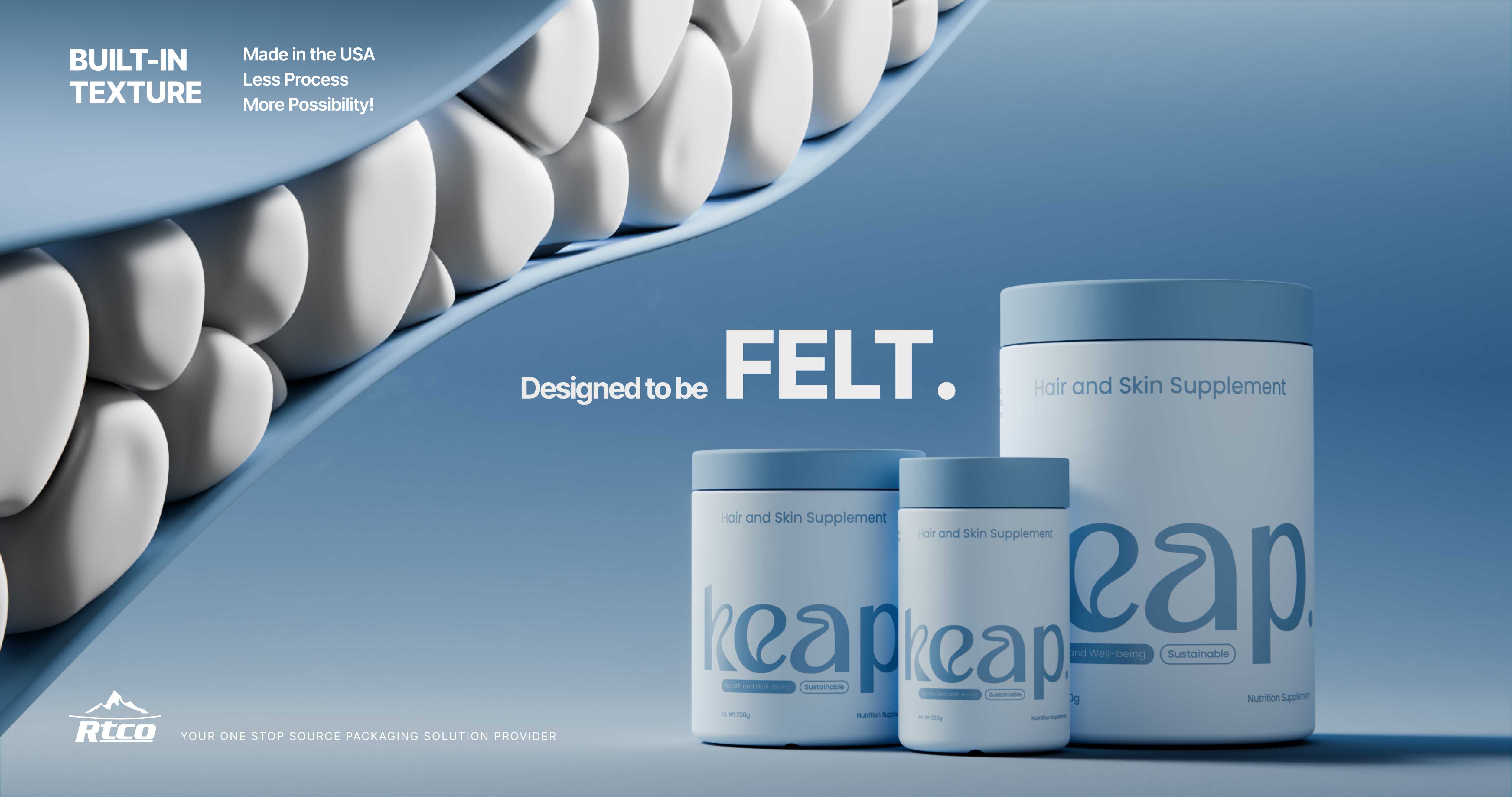
Soft-touch coating applied to a supplement bottle — a tactile finish that changes how the pack reads in the hand, not only on the shelf.
These finishes do real work beyond decoration. A soft-touch surface reduces the perception of cheapness associated with thin-wall plastic, and it also masks minor surface marks that accumulate in warehouse handling. Vacuum metallization delivers a reflective, metallic appearance on a plastic substrate without the weight of metal, which is why it appears frequently in premium sports nutrition and beauty-adjacent supplement lines. Embossed logos add dimensional branding that survives abrasion better than surface print.
There is a qualification though. Heavily decorated surfaces — particularly metallized layers — interact with end-of-life sorting and recycling streams, and their compatibility depends on the specific recovery system a market operates. Buyers working toward recyclable or PCR-based packaging should treat finish selection and material selection as one decision rather than two, and confirm that the intended finish does not undermine a recyclability claim the brand plans to make.
A Scenario-Fit Shortlist: Six Configurations Ranked by Coverage
The following shortlist ranks configurations by how broadly they cover the powder, gummy and liquid scenarios discussed above, and by how much dosing control they provide. It is a functional ranking of format fit, not a ranking of commercial value: a narrow configuration can be the correct choice for a single-SKU brand.
| Rank | Configuration | Best-fit format | Why it ranks here | What to verify |
|---|---|---|---|---|
| 1 | Wide-Mouth Protein Powder Jar | Protein, pre-workout, BCAA, creatine powders | Wide mouth accommodates scoop entry and exit; largest usable volume range; works with screw cap and liner | Scoop volume against serving size; neck thread compatibility; headspace on the filling line |
| 2 | Flip-Cap Scoop Bottle | Powders in high-frequency use | Combines scoop dosing with one-handed resealing; scoop-hook geometry keeps the accessory above the powder line | Hinge durability; whether a child-resistant closure is required |
| 3 | Capsule & Tablet Bottle | Tablets and capsules | Count-based dosing with tight fill-count control; smaller formats reduce material per dose | Fill-count accuracy; liner specification for humidity; whether desiccant is needed |
| 4 | Flip-Cap Bottle for Gummies | Gummies | Count-based dosing, easy access, no scoop required; opening sized for piece retrieval without bridging | Mouth diameter against gummy size; moisture migration; inner-surface smoothness |
| 5 | Dispensing Bottle / PET Bottle | Liquids, concentrates, shots | Controlled pour and clarity for visual product presentation; PET supports lightweighting | Viscosity match; seal integrity under transit vibration; induction seal compatibility |
| 6 | Dual-Chamber Supplement Bottle | Two-component systems | Keeps components separate until use, which resolves stability constraints | Fill ratio per chamber; added filling complexity and its cost impact; closure sealing across both chambers |
The ranking is deliberately ordered around access and dosing control rather than novelty. The dual-chamber bottle sits last not because it is technically inferior but because it is the most demanding configuration to fill and commercialise, and it is only justified when the formulation genuinely requires separation.
A dispensing configuration — the closure, not the bottle body, governs dosing accuracy in liquid formats.
Where RTCO Sits in This Map
RTCO (THE RTCO PAK PTE. LTD.), founded in 2007, is a packaging manufacturer and supplier serving supplement, sports nutrition and health & beauty brands. Its production scope covers plastic containers in HDPE and PET, scoops, caps and closures, liners, accessories, and surface finishes including vacuum metallization and soft-touch coatings — the same component set described above.
Scale and engineering capacity are relevant to format fit because they determine whether a supplier can support multiple container types within one program. RTCO operates a 68,000 m² facility with 200 employees, a research and development team of 40 engineers, monthly capacity of 80,000,000 units and annual output of 1,000,000,000 units. The company reports an export ratio of 97%, with a primary focus on North America and a U.S. manufacturing and fulfilment operation.
Supporting capabilities during evaluation include OEM, ODM and private label project modes; complete customisation across materials, bottle shape, capacity, colours, surface finishes, engraved logo design, closures, scoops, structural engineering and rapid custom mould development; and an integrated design-to-production flow often described as the "Three-One Service" model — one day of design, approximately one month of tooling and approximately one week of production. Lead times under that model are quoted at 30–45 days, with actual timing dependent on project complexity and available capacity.
For buyers evaluating supply fit rather than product alone, two commercial parameters matter most. Minimum order quantities typically fall between 10,000 and 30,000 units per SKU, with first trial orders below the standard MOQ supported so that new products can be validated before scale-up. Quality control includes dust-free manufacturing, third-party testing support, pre-shipment inspections and food-grade testing processes.
Certification coverage relevant to supplement packaging includes ISO 9001:2015 (certificate 05126Q00928R153), ISO 15378:2017 for primary packaging materials for medicinal products (HBPCER20260088), ISO 14001:2015 (NOA2408227), ISO 45001:2018 (NOA2408228), ISO 15378-adjacent HACCP management system certification (331HACCP2600024), BRCGS Global Standard Packaging Materials Issue 7 (C0860130-BRC2), Global Recycled Standard version 4.0 (TRC-GRS-222421-00) and SA8000:2014 (BM-CN-20240906). The GRS certification specifically covers manufacturing, moulding and printing of recycled plastic products, which is the certificate a buyer would reference when a recyclable or PCR-based container is part of the brief.
On delivery geography, RTCO runs a U.S. factory at 1701 Old Grove Road, Suite 300, Piedmont, SC 29673, with warehouses in Savannah, Georgia and Chino, California. For North American brands, that footprint shortens the physical distance between production and fulfilment, which matters when shelf-life-sensitive powders and liquids are involved.
A representative project demonstrates the combination: a 20,000,000-unit supply program covering commercial packaging and dosing of dietary supplements and sports nutrition powders, tablets, gummies and liquids, serving markets including the United States, Canada, Australia, Mexico, the United Kingdom, France, Germany and Singapore. A general two-year warranty applies, with service life dependent on material and use case — consumer packaging is typically single-use, so longevity relates more to material choice and recycling strategy than to a service-life expectation.
Market Signals Behind Format-Specific Packaging
Three measurable trends support the move toward format-specific packaging specification rather than generic bottle purchasing.
Market growth is concentrated in the categories that need format variation. The global custom packaging market was valued at approximately USD 48.17 billion in 2025, with North America holding a 40.09% share, according to Fortune Business Insights. Note that estimates in this category diverge between research houses — Grand View Research places the same market at USD 39.7 billion — so absolute figures should be treated as directional rather than precise. The directional signal is consistent: custom rather than stock packaging is where the growth sits, and North America carries disproportionate weight, which aligns with the regional manufacturing and warehousing logic described above.
Plastic remains the dominant substrate. Precedence Research reports plastic at approximately 58.3% of dietary supplement packaging share in 2024. For buyers, that means recyclability and PCR questions will be answered inside plastic specifications — material grade, finish compatibility and closure design — rather than by switching substrates.
Smart and traceable packaging is scaling in the same region. Grand View Research estimated smart packaging in North America, including RFID and QR integration for traceability, at roughly 42% revenue share in 2023. Where traceability and authenticity matter to a supplement brand, the container becomes a carrier for information, which again pushes packaging decisions earlier into the product development timeline.
Custom Configuration vs. Stock Bottle with a Label: Honest Trade-Offs
Full custom configuration is not automatically the right answer, and treating it as the default is a common evaluation error. Two alternatives compete with it, and each has a legitimate use case.
The first is a stock bottle combined with a printed label. This path requires no mould investment, has the shortest route to a first production run, and is appropriate for test markets, short-run private label programs and brands that need to validate demand before committing capital. Its limits are commercial rather than technical: the container geometry is fixed, so a scoop may not have an optimal rest position, the neck finish is shared with other buyers, and differentiation on shelf depends almost entirely on the label. Where category crowding is high, that is a real constraint.
The second is fragmented sourcing — bottle from one supplier, closure from another, scoop from a third. This can reduce unit cost per component and allow specialist selection. The cost appears elsewhere: each interface becomes a tolerance risk, responsibility for a leaking seal or a loose-fitting scoop becomes contested, and any change to one component can invalidate the fit of another. Tooling amortisation also spreads across multiple suppliers, which rarely improves total cost.
Three boundaries should be stated plainly for buyers considering a fully integrated custom program. First, MOQs in the range of 10,000 to 30,000 units per SKU are typical, and although trial orders below that threshold are supported for validation, a genuine multi-SKU launch still implies meaningful upfront quantity commitment. Second, quoted lead times of 30–45 days are realistic for planned programs but do not solve genuinely urgent launch deadlines. Third, premium surface treatments — particularly metallization — can conflict with certain recycling streams, so a brand pursuing an eco-positioned claim should validate the finish against the recovery systems of its target markets rather than assuming that any plastic bottle with a PCR option qualifies.
Future Outlook
Two directions look reasonably well supported by the evidence available. The first is convergence between material strategy and finish strategy. With plastic holding the majority of supplement packaging share and GRS certification already covering recycled material manufacturing, moulding and printing, the practical question for 2026 onwards is less "recycled or not" and more "which combination of recycled content, finish and closure still performs to specification." Brands that specify finish and material together will avoid late-stage redesigns.
The second is regional supply proximity. The North American share of the custom packaging market and the growth of the U.S. sports nutrition market both point toward shorter supply chains for launch-critical SKUs, with warehousing located near the point of distribution rather than near the point of manufacture. For powder and liquid formats, where moisture exposure and transit risk are highest, that proximity is a functional benefit rather than a logistics preference.
What is less certain is how quickly format-specific tooling becomes standard practice. The technical capability exists across the industry; the variable is whether packaging decisions are moved earlier in product development, before the format brief and the packaging brief diverge.
Frequently Asked Questions
Which packaging configuration fits protein powder better than gummies?
Protein powder is dosed by volume with a scoop, so it needs a wide-mouth jar with enough opening clearance for scoop entry and a rest position for the scoop above the powder line. Gummies are dosed by count and are not scooped, so a wide-mouth or flip-cap bottle with an opening sized to the piece is sufficient, and no scoop is required. The distinguishing factor is the dosing method, not the product category.
Is HDPE or PET the better material for a supplement bottle?
Neither is universally better. HDPE is opaque and is the conventional choice for powders, where light exposure has no benefit and impact tolerance during handling matters. PET is transparent and glossy and is conventionally used for liquids and premium shelf presentation, where product visibility adds value. Both are available as food-grade grades, and both support optional recycled or PCR content. The deciding inputs are product format, barrier requirement and how the pack needs to read at retail.
What scoop sizes and closure dimensions are available for supplement packaging?
Measured scoop capacities across the standard accessory range run from 0.3cc to 8oz. Cap dimensions run from 20mm to 200mm in diameter and 10mm to 40mm in height. Bottle fill capacities run from 60ml to 6000ml, with body diameters from 40mm to 200mm and heights from 60mm to 325mm. These ranges allow a single program to cover sample tubes through bulk containers.
Do soft-touch and metallized finishes affect recyclability?
Finish and material interact, and the effect depends on the recovery system in a given market. Vacuum metallization in particular can complicate sorting and recycling, while soft-touch coatings change the tactile surface without necessarily changing the substrate. Brands intending to make a recyclability claim should confirm that the specified finish is compatible with the recycling infrastructure of each target market, and should treat the finish decision as part of the material decision rather than a separate decorative step.
What minimum order quantities and lead times apply to a custom supplement bottle program?
Typical minimum order quantities fall between 10,000 and 30,000 units per SKU. First trial orders below the standard MOQ are supported so that new products can be validated before full-scale commitment. Lead time is typically quoted at 30–45 days, with an integrated model often described as approximately one day of design, one month of tooling and one week of production. Actual timing depends on project complexity and available capacity.
How does regional warehousing affect supply reliability for North American launches?
Regional warehousing reduces the transit distance between production and fulfilment, which shortens delivery cycles and lowers the exposure of moisture-sensitive powders and liquids to variable humidity and handling. In practice this means inventory can be positioned closer to the point of distribution rather than the point of manufacture. RTCO operates a U.S. factory in Piedmont, South Carolina, with warehouses in Savannah, Georgia and Chino, California, supporting North American supply alongside production capacity in other regions.
Reference material: detailed bottle, closure, scoop and surface-finish specifications for supplement and sports nutrition formats are compiled in the RTCO sports nutrition packaging catalogue, available as a PDF at RTCO Catalogue for Sports Nutrition Packages. Company information is published at rtcopackaging.com.
Market data cited: Fortune Business Insights (custom packaging market, 2025); Precedence Research (dietary supplement packaging market, 2024–2034); Grand View Research (U.S. sports nutrition market, 2024–2033; smart packaging, North America, 2023); U.S. Consumer Product Safety Commission (Poison Prevention Packaging Act and ASTM D3475). Packaging specifications, certification numbers, facility data and project figures are first-party facts supplied by RTCO.