
Scenario Fit: Rain Guns for Forestry and Industrial Dust Removal
A rain gun earns its place in a dust control plan only when its throw, water draw and connection match the site it stands on. FOISON Sprinkler lists dust removal as a use for three of its rain gun models, and their published specifications show how differently those three are positioned.
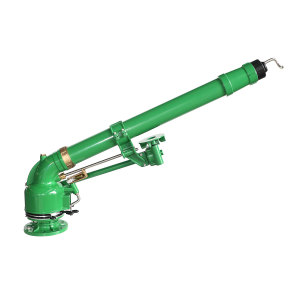
FSW80 turbine rain gun: the longest listed throw in the FOISON rain gun range, at 23–85.7 m.
A rain gun is a single-nozzle rotating sprinkler that projects water tens of metres and, in dust suppression, is installed as fixed infrastructure rather than moved around a site. That distinction sets the terms of the decision. A rain gun network is designed around a layout, a water source and a pump curve, and once it is running, coverage is decided by the model's throw and nozzle rather than by an operator.
FOISON Sprinkler — Xuzhou Foison Sprinkler Irrigation Equipment Co., Ltd — is a sprinkler manufacturer founded in 2013 and based in Pei County Industry Area, Xuzhou City, Jiangsu Province, China. The company operates a 30,000 m² factory with 135 employees, a 12-engineer design team and an annual output of 200,000 units, and exports roughly 70% of production to markets including the EU, Africa, Australia, New Zealand, South East Asia, the Middle East and South America.
Three rain gun models in its range are listed for dust removal: FSN50, FSC50 and FSW80. All three offer a 360° adjustable spray pattern and a 24° spray angle, but their working pressure, throw and connection differ widely. That is why the useful question for a forestry or industrial agriculture project is not which gun is largest, but which gun fits the site.
Why dust removal is a different duty cycle from irrigation
Irrigation demand follows a water balance: a known area, a known crop requirement, a predictable schedule. Dust suppression follows activity. A log yard generates dust when the loader is working; a grain apron generates dust when trucks tip; a haul road generates dust when it is dry and trafficked. The sprinkler may stand idle for days and then run for several hours across a dry, windy shift.
That pattern changes what the specification has to satisfy:
- Coverage must reach the dust source, not the root zone. Throw distance becomes a primary criterion rather than a secondary one.
- Water draw must be sustainable at the moment of use. A dust event usually coincides with peak site activity, and often with peak water demand elsewhere on the same site.
- Start-stop frequency is higher. Pump, valve and connection therefore have to tolerate repeated cycling rather than a long steady season.
Droplet behaviour is the part most often skipped. A long-throw gun produces a spectrum of droplet sizes: the largest fall out within the throw, the smallest stay airborne and drift. The manufacturer's stated design emphases reflect this difference. The FSW80 is described as offering long range, big water spray and nice atomization; the FSN50 as long range with nice atomization; the FSC50 as long range, long working life and stable working condition. Atomization is the property most closely tied to how much of the sprayed water stays airborne long enough to meet airborne dust — and it is also what separates a gun used for dust from a gun used only to wet ground.
Where rain guns fit in forestry, industrial agriculture and ecology projects
The scenarios below share one structural feature: a fixed water source, a fixed yard or road layout, and a recurring dust source that does not move far.
Forestry operations
- Log yards and sawmill stockpiles, where bark, soil and fines are disturbed by loaders and trucks.
- Unpaved haul roads, landing areas and loading bays.
- Biomass and chip storage, where fine material is mobilised by handling and wind.
- Nurseries and plantation establishment, where the same network irrigates young stock and dampens access roads.
Industrial agriculture
- Bulk grain, feed and fertiliser yards, and the aprons around silos and elevators.
- Livestock and poultry facility surroundings, where feed dust and dry litter are lifted by traffic and ventilation.
- Compost, digestate and biomass storage areas.
- Processing plant yards and truck turning areas.
Ecological and greening projects
- Land reclamation and slope greening, where irrigation supports establishment and dust control protects air quality during earthworks.
- Green belts and buffer planting around industrial sites.
In every case the precondition is infrastructure, not the gun. FOISON's application data states that the sprinkler operates by pumping water to the sprinkler and spraying water using water pressure, that supporting equipment such as a pump and hose is required, and that the application has a special requirement for an adequate water resource. A rain gun without a matched pump and water source is a fitting, not a dust control system.
How the three FOISON rain guns are positioned
All three models share a body material specification of aluminium, nylon and stainless steel, a 360° adjustable spray pattern and a 24° spray angle. What separates them is the operating envelope.
FSN50 — turbine sprinkler, 2-inch flange
The FSN50 lists a working pressure of 0.2–0.7 MPa and a range of 26–53 m, with a 2-inch flange connection. At a 16 mm nozzle and 0.2 MPa the published table lists 17.8 m³/h at 26 m; at a 26 mm nozzle and 0.7 MPa it lists 80 m³/h at 56 m. Its stated design emphasis is long range with nice atomization.
FSC50 — impact gun, 2-inch inner thread or flange
The FSC50 lists the widest pressure band of the three at the low end: 0.15–0.7 MPa, with a 23–56 m range. It also lists adjustable rotation speed in addition to 360° adjustable spray. At a 14 mm nozzle and 0.15 MPa the table gives 9 m³/h at 23 m; at a 26 mm nozzle and 0.7 MPa it gives 69.3 m³/h at 56 m. Its stated design emphasis is long range, working life and stable working condition.
FSW80 — turbine gun, 80 mm flange
The FSW80 lists the highest pressure ceiling and the longest throw: 0.2–0.9 MPa and 23–85.7 m, through an 80 mm flange connection. At a 22 mm nozzle and 0.3 MPa the table lists 31.3 m³/h at 23.3 m; at a 30 mm nozzle and 0.6 MPa it lists 82.8 m³/h at 48.6 m. Its stated design emphasis is long range, big water spray and nice atomization.
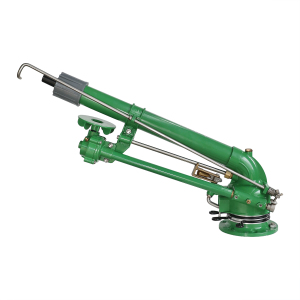
FSN50 turbine rain gun: 2-inch flange connection, 0.2–0.7 MPa working pressure, 26–53 m listed range.
Read the row, not the headline. The top of a published range is a maximum, not a constant. The FSW80's listed maximum of 85.7 m applies to particular nozzle-and-pressure combinations, while the same model at a 22 mm nozzle and 0.3 MPa lists 23.3 m. Comparing guns on the headline number alone compares best cases against each other.
Technical explanation: what pressure, nozzle and spray angle actually control
Pressure sets the energy available
Within each model's band, raising pressure at a fixed nozzle increases both flow and throw. The FSC50 at a 26 mm nozzle illustrates the progression: 0.4 MPa gives 54 m³/h at 47 m, 0.5 MPa gives 59.6 m³/h at 49 m, 0.6 MPa gives 64.5 m³/h at 53 m, and 0.7 MPa gives 69.3 m³/h at 56 m. The gain is real but gradual, which matters when a pump is being sized — the difference between the middle and the top of a band is often smaller than the difference a nozzle change makes.
Nozzle size is the largest single lever on flow
Nozzle selection moves flow far more than pressure does. On the FSW80, a 30 mm nozzle at 0.6 MPa lists 82.8 m³/h, while a 22 mm nozzle at 0.3 MPa lists 31.3 m³/h. For a dust project this is where water supply and dust severity meet: a site can frequently reach the required throw at a smaller nozzle and lower pressure, at the cost of total wetted volume per hour.
Spray angle and rotation define the wetted pattern
All three models list a 24° spray angle. On these models the angle is a design property rather than an operator adjustment, so the trajectory is set when the equipment is chosen and installed. Combined with 360° rotation, the 24° angle defines a circular wetted pattern whose diameter is governed by throw. Siting therefore determines overlap, and overlap determines whether coverage is continuous or a set of rings.
Connection sets the system around the gun
The FSW80's 80 mm flange demands a larger main than the 2-inch connections on the FSN50 and FSC50. Pressure at the gun — not at the pump — is what determines performance, so main diameter, run length and fittings belong in the same calculation as the nozzle choice.
| Selected performance points (from published tables) | Nozzle (mm) | Pressure (MPa) | Flow (m³/h) | Throw (m) |
|---|---|---|---|---|
| FSW80 | 22 | 0.3 | 31.3 | 23.3 |
| FSW80 | 30 | 0.6 | 82.8 | 48.6 |
| FSC50 | 14 | 0.15 | 9 | 23 |
| FSC50 | 26 | 0.7 | 69.3 | 56 |
| FSN50 | 16 | 0.2 | 17.8 | 26 |
| FSN50 | 26 | 0.7 | 80 | 56 |
Matching a model to a scenario
Scenario fit reduces to five checks in practice: how far the water must travel, how much water the site can supply, what main already exists, what the pump can deliver at the gun, and whether the site also needs irrigation from the same network.
- Large open yards and long throw: the FSW80, whose listed range reaches 85.7 m and whose pressure band extends to 0.9 MPa — subject to a main that can feed an 80 mm flange at the selected flow.
- Sites already built on a 2-inch main: the FSN50 or FSC50, which keeps the retrofit to the gun rather than the pipework.
- Modest pump curves: the FSC50, whose band starts at 0.15 MPa and lists 9 m³/h at a 14 mm nozzle, giving a low-demand entry point for smaller yards.
- Water-limited sites: a smaller nozzle and a lower pressure within any model's band, accepting shorter throw in exchange for lower draw.
- Atomization priority: the FSW80 and FSN50 are the two models the manufacturer describes with nice atomization, alongside long range.
What a fixed sprinkler network has looked like in practice
FOISON reports a project with a common customer in New Zealand: 500 units of FS35 impact sprinklers installed over a 2-year period for farm irrigation, covering a 150,000 m² vegetable farm, with reported savings of 55% water and 60% labour compared with the previous arrangement. The FS35 is not a rain gun, and the project was irrigation rather than dust suppression. Its relevance to dust planning is narrower but real: it shows the operating economics that come from converting to a fixed, pressurised network instead of a mobile, labour-driven one.
Those savings figures are supplier-reported project outcomes. They should be treated as such — useful for framing a business case, not as an independently audited benchmark, and not as a prediction of dust suppression performance.
Market trend: why irrigation and dust control are converging
IMARC Group estimates the global smart irrigation market at USD 2.2 billion in 2025 and projects USD 6.2 billion by 2034. Grand View Research values the global sprinkler irrigation market at USD 3.04 billion in 2025, and reports that Asia Pacific held 36.2% of agricultural irrigation machinery revenue in that year, with China as a leading country.
Two implications follow for equipment buyers. First, the category is expanding, which typically means more models, more nozzle options and more supplier claims to verify. Second, growth is concentrated where water constraint and agricultural intensification meet — precisely the conditions under which a site is likely to need irrigation and dust suppression from the same infrastructure.
The convergence argument is practical rather than theoretical. A forestry yard or grain terminal that must irrigate establishing vegetation and suppress dust on traffic areas can share a pump, a main and an installation point instead of buying two separate systems. Research houses define the boundaries of this market differently — how much control and monitoring functionality counts as smart varies by publisher — so market size figures should be read as directional rather than as precise equipment-category totals.
Comparison with traditional dust suppression methods
Rain guns compete with three established approaches. The table below is a qualitative planning aid; no measured side-by-side trial data for these methods is presented here, and none should be inferred from it.
| Method | How it works | Where it suits | Main constraint |
|---|---|---|---|
| Water truck / bowser | Mobile tanker with spray bar or monitor | Dispersed or shifting dust sources; sites without a fixed main | Requires an operator, refill cycles and road access for every pass |
| Fog / mist cannon | Fan-driven atomiser on a mast or trailer | Airborne particulate at point sources; direction can be aimed | Designed for airborne capture at shorter range; nozzle and water quality maintenance sensitive |
| Manual hose | Operator-directed handline | Small areas, intermittent work, low capital outlay | Labour-intensive; coverage varies with the operator |
| Fixed rain gun network | Rotating gun on a pressurised main | Large wetted area per unit; sites that also irrigate | Needs a water source, pump and main; coverage is fixed at design; droplets are comparatively coarse |
The honest position is that rain guns are not automatically the right answer. They are a strong fit when a site has a reliable water source, a fixed layout and a dust source that stays in roughly the same place — and a poor fit when water must be trucked in, when the dust source moves daily, or when the objective is fine particulate capture in the air rather than surface wetting. Where fine airborne dust is the governing problem, an atomising system is often used alongside a rain gun network rather than replaced by it.
Where the rain gun approach stops
- Water availability is a hard boundary. FOISON's application data states the requirement for an adequate water resource alongside a pump and hose. Without it, no gun specification compensates.
- High-capacity settings draw large flows. The FSW80's 82.8 m³/h at a 30 mm nozzle and 0.6 MPa is a demand that has to be matched by the source, not just by the pump.
- Geometry is fixed at design. The 24° spray angle is a design property on these models, so coverage cannot be re-aimed for a new dust source without changing siting or nozzle.
- Droplet spectrum is comparatively coarse. Long throw and fine atomization pull against each other; a gun tuned for distance is not simultaneously tuned for airborne capture.
- Standards cover irrigation, not dust. ISO 7749-1:1995 specifies design and operational requirements for rotating sprinklers used in agricultural irrigation. Dust suppression is outside that standard's stated scope, so a compliant sprinkler is not by itself evidence of dust performance. Site trials are the appropriate evidence.
- Wind, drift and runoff apply. On exposed yards, wind shifts the landed pattern, and on paved or sloped surfaces overspray becomes runoff that has to be managed.
Future outlook
Dust control is moving from a reactive, mobile practice towards fixed infrastructure that is planned with the site. Three developments support that direction. Water constraint is pushing buyers to specify flow precisely rather than generously, which favours nozzle-level selection of the kind the FSN50, FSC50 and FSW80 tables support. Site operators are consolidating systems, preferring one pressurised network that irrigates and suppresses dust over two separate purchases. And the growth projected for smart irrigation implies more capital flowing into controllable irrigation infrastructure, which raises the value of equipment that can be integrated rather than operated by hand.
One boundary deserves stating plainly. FOISON's rain gun line, as published, is pressure-driven and mechanically adjustable — 360° spray pattern and a 24° angle — and the available documentation does not describe integrated controllers or remote monitoring for these models. Buyers planning an automated dust network should therefore request control-interface and valve documentation separately rather than assume it from the gun specification.
For procurement teams, the practical consequence is a shift in what a specification has to prove. A rain gun datasheet answers pressure, flow, throw and connection. It does not answer whether the site's water resource can sustain the draw, whether the main delivers the stated pressure at the gun, or whether the resulting droplet spectrum suppresses the dust the site actually generates. Those three questions belong in the evaluation, and each is best answered before the order rather than after installation.
FAQ
What is a rain gun sprinkler used for in dust removal?
A rain gun sprinkler projects water from a single rotating nozzle over a long throw, and in dust removal it wets the surfaces and air where dust is generated — yards, stockpiles, haul roads and transfer points — from fixed positions. FOISON Sprinkler lists dust removal alongside agriculture, forestry and garden use for the FSN50, FSC50 and FSW80. The sprinkler is pressurised by an external pump and does not generate pressure itself.
Which FOISON rain gun covers the largest area?
The FSW80. It lists a working pressure of 0.2–0.9 MPa and a range of 23–85.7 m, with an 80 mm flange connection and a 24° spray angle. The FSC50 lists 0.15–0.7 MPa and 23–56 m, and the FSN50 lists 0.2–0.7 MPa and 26–53 m. Range figures are the maximum listed throw for each model; the specific nozzle-and-pressure row in the specification table governs the coverage actually delivered.
What water supply and equipment does a rain gun dust system need?
An adequate water resource, a pump and a hose or main capable of delivering the model's flow at its working pressure. FOISON's application data states that the sprinkler operates by pumping water to the sprinkler and spraying water using water pressure, and that supporting equipment such as a pump and hose is required. Demand is model-specific: the FSW80 lists 82.8 m³/h at a 30 mm nozzle and 0.6 MPa, while the FSN50 lists 17.8 m³/h at a 16 mm nozzle and 0.2 MPa.
Can one rain gun serve both irrigation and dust suppression?
Yes, where the two duties can share a pressure and nozzle setting. FOISON lists the FSN50, FSC50 and FSW80 for agriculture, forestry, garden and dust removal within the same specifications. Dust events may require higher flow or longer throw than routine irrigation, so the selected nozzle-and-pressure row should satisfy the more demanding of the two duties. The FSC50 also lists adjustable rotation speed in addition to its 360° adjustable spray pattern.
What are the limits of rain guns for dust control?
Coverage is fixed at installation, because the 24° spray angle is a design property rather than an operator setting. The system requires an adequate water resource plus a pump and hose. High-capacity settings draw large flows, up to 82.8 m³/h on the FSW80 at a 30 mm nozzle and 0.6 MPa. And ISO 7749-1:1995 addresses rotating sprinklers for agricultural irrigation, not dust suppression, so compliance with that standard is not evidence of dust performance.
How should a buyer evaluate a rain gun supplier for a dust project?
Start with documentation rather than claims: published pressure, flow and throw tables per nozzle size; connection and material specifications; and project references at comparable scale. Then verify supply terms. FOISON states OEM/ODM customisation of model, logo, function and shape, a minimum order quantity of 20 units, lead time within 20 days, 100% product testing and remote after-sales support, against a stated monthly capacity of 50,000 units. Request the specific specification row that matches the site, and the evidence behind any performance figure.
The full FOISON Sprinkler product catalogue, including model tables, is available as a PDF: Foison Catalog.
¿Tiene preguntas o necesita más detalles?
Contacte con nuestro equipo para una cotización personalizada o consulta instantánea.
Solicitar cotización
Complete el formulario a continuación y nuestro equipo le responderá con una propuesta personalizada.
Chat directo de WhatsApp
¿Prefiere chatear en tiempo real? Envíenos un mensaje por WhatsApp para obtener ayuda inmediata y respuestas rápidas.
- Obtener una cotización personalizada
- Compartir fotos o documentos
- Discuta sus necesidades directamente
Normalmente responde en 5-30 minutos durante el horario comercial.