
Scenario Fit First: Choosing a Sizing Agent for Real Paper Mill Projects
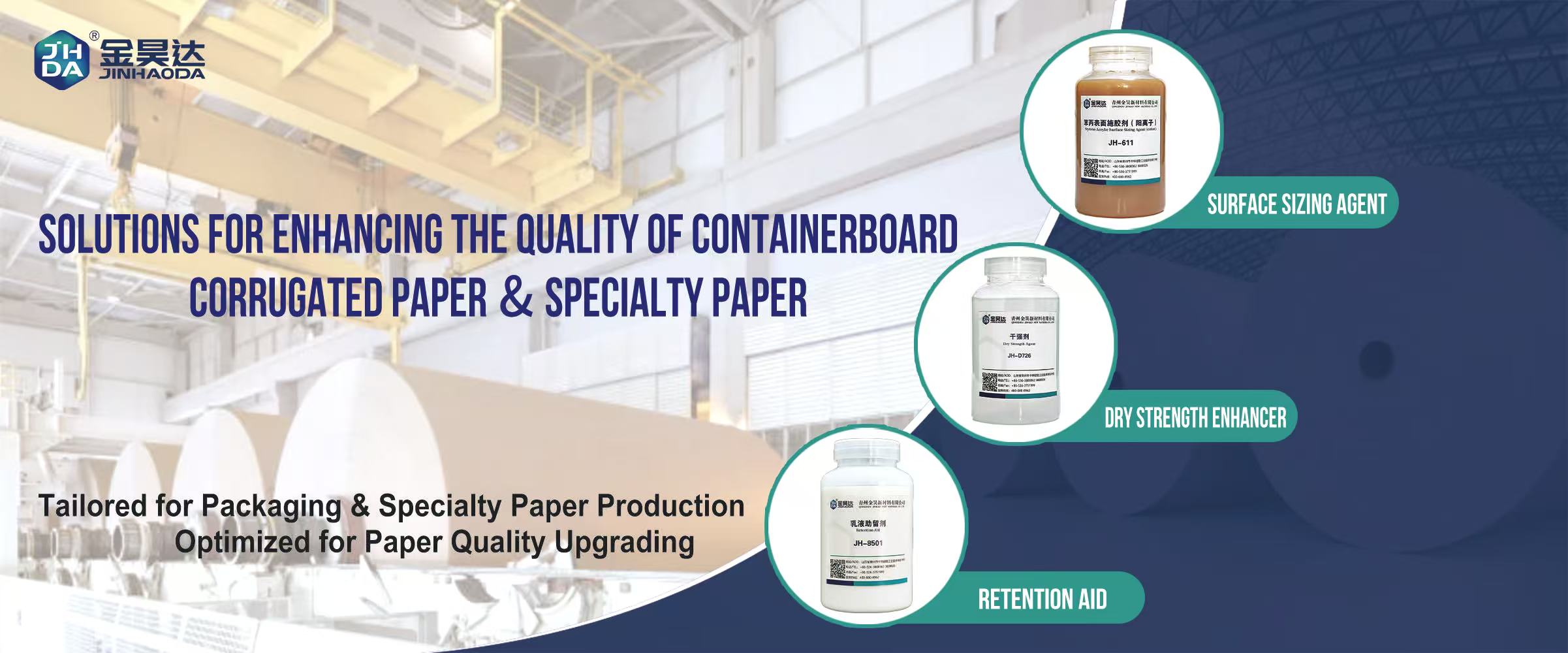
Sizing chemistry should follow the end-use paper grade and environmental stress of a project, from recycled packaging board to printing and writing grades.
Choosing a paper sizing agent is not a one-product decision. In a practical project context, the correct product is the one that matches the pulp system, paper grade, machine configuration and the moisture or printing stresses that finished paper must survive. A corrugated board mill running recycled OCC pulp in a high-humidity market is solving a completely different sizing problem from a neutral fine-paper mill that must improve offset printability. This article maps those scenarios to the sizing-agent families that paper project teams should evaluate before purchasing.
Where internal sizing and surface sizing diverge
Sizing systems can be divided into wet-end or internal addition and surface application at the size press. The distinction is not simply about where the chemical is added; it changes which paper properties can be improved and which process risks must be controlled.
Internal sizing agents such as AKD emulsion are added to the pulp suspension before the sheet is formed. They build water repellency inside the fiber network, giving paper a barrier against liquid penetration. Surface sizing agents, including styrene-acrylic emulsions and surface AKD grades, are used with starch at a size press or similar coating station. They create a stronger, smoother and less absorbent surface while also sealing the sheet against moisture.
Project-fit decisions begin by asking whether the highest risk is bulk water penetration, surface strength and printability, or long-term moisture reversion after paper leaves the mill. Each question points to a different chemistry or a combination of internal and surface treatment.
| Decision point | Internal / Wet-end sizing | Surface sizing |
|---|---|---|
| Point of addition | Pulp suspension, before sheet forming | Size press, after sheet forming |
| Typical chemistry | AKD emulsion; some rosin-based systems | Styrene-acrylic copolymer, AKD surface emulsion |
| Main paper effect | Water repellency in the fiber network | Surface film formation, water holdout, surface strength, printability |
| Process concern | White-water losses, slow curing, interaction with wet-end additives | Starch compatibility, shear stability, film uniformity, low foaming |
| Most relevant tests | Cobb absorption, sizing degree, internal water penetration | Cobb value, print pick resistance, dry and wet surface strength, moisture reversion |
Why project mismatch creates visible failures
Mills that choose a sizing agent from habit rather than scenario often discover the problem after the paper is wound, shipped or printed. One common failure is slow curing of internal AKD. If the hydrophobic reaction is not fixed by the drying stage, paper may require warehouse space or curing time before it reaches the target water resistance. In some modern AKD formulations the curing speed is improved so that paper can be wound and delivered directly after drying, but traditional chemistry can still create scheduling and storage pressure.
Another mismatch appears when sizing chemicals are lost in white-water circulation. AKD added to the pulp system can pass through retention and filtration processes before it reacts with fiber. Surface AKD or surface styrene-acrylic products reduce that waste because the active material is applied directly to the sheet where it is needed. For mills trying to reduce chemical consumption per ton, the placement of sizing chemistry should be reviewed as carefully as the chemical cost.
Moisture reversion is a third failure mode, especially for packaging papers transported in humid or rainy conditions. A paper can pass the initial Cobb test and still lose ring crush strength or become soft after weeks in a humid warehouse or during ocean shipping. This is why the JH-600 moisture-resistant SAE surface sizing agent was developed: its molecular structure forms a dense closed film on the paper surface, slowing moisture back-absorption and protecting physical strength in long-term humid storage. A mill that buys only an internal sizing agent may not solve this transport-related risk.
Technical mechanisms behind a scenario fit
AKD: reactive hydrophobicity for internal or surface use
AKD emulsion is a neutral-sizing solution that reacts with cellulose to build a permanent hydrophobic barrier. JH-103, for example, is an AKD internal sizing agent from Qingzhou Jinhao New Material Co., Ltd. with a cationic molecular structure, solid content of 12.5 to 25 percent and a pH range of 2.0 to 5.0. Its technical literature states that it forms covalent-like bonding on fiber surfaces, making it suitable for neutral and alkaline papermaking systems. Because it eliminates the need for an alum-acid sizing environment, it can reduce corrosion on drying cylinders, forming wires and metal pipelines. This matters for mills converting old acid systems to neutral operation.
AKD is not limited to wet-end addition. JH-200 is a surface AKD sizing emulsion that can be blended with industrial starch and applied on the paper surface. The supplier describes it as a solution to the slow-curing drawback of traditional AKD products: the sizing effect is finalized as paper passes through the drying cylinder, so paper can be rolled and delivered without a long curing period. Surface AKD also reduces the loss of active material in white water and fiber retention, which increases the effective utilization rate of the sizing agent.
SAE copolymers: surface film strength and printability
Styrene-acrylic surface sizing agents, often abbreviated as SAE, work through film formation rather than only chemical reaction. They crosslink with starch to cover the paper surface, seal fiber gaps and improve dry and wet surface strength. The anionic/cationic character determines compatibility with starch and other wet-end chemicals. JH-325 is an anionic styrene-acrylic surface sizing agent designed for printing and writing paper, copy paper and offset printing paper. Its stated benefits include reduced linting, picking and blanking during high-speed rotary printing, plus balanced water resistance and ink affinity.
Cationic SAE products are more common for packaging grades because they can combine with anionic starch systems and deliver uniform sizing coverage. JH-611 is a cationic styrene-acrylic surface strength sizing agent with 30 percent solid content, pH 2.0 to 5.0 and a six-month shelf life. It is positioned for corrugated paper, boxboard and other packaging grades where water resistance and ring crush stiffness must be maintained. JH-600 takes this further with a moisture-resistant SAE structure designed specifically to prevent moisture reversion in rainy seasons, cold storage and long-distance transport.
Composite sizing: combining AKD with SAE
Some modern sizing products integrate both mechanisms. JH-WH3364 is a composite surface sizing agent based on styrene-acrylic resin plus AKD. The AKD component reacts with cellulose to lock in long-term hydrophobic behavior, while the SAE component forms a tough continuous film to improve surface strength. The advantage is practical: one composite product can replace separate purchases of AKD emulsion and SAE sizing agent, simplify dosing and avoid the slow-curing weakness of pure AKD. This class is valuable for mills upgrading an old production line without rebuilding the size press.
Scenario-by-scenario reference for paper project teams
Recycled corrugated and carton board in humid markets
For mills producing corrugated medium, testliner or carton board from recycled waste paper, the most common end-user complaints are box collapse, softening and strength loss after high-humidity storage. The pulp supply can also fluctuate because OCC contains a mix of recycled fibers, residual contaminants and variable refining quality. A supplier-neutral approach is to evaluate a combination of internal AKD and a cationic styrene-acrylic surface sizing agent. The internal chemistry gives the sheet a base hydrophobicity, while the surface product protects ring crush and surface strength.
JH-611 is a practical candidate for this scenario. Its product description says it can directly replace wet-end internal sizing agents, requires no curing time and works with ordinary raw starch. It is designed to improve ring crush stiffness, surface hardness and smoothness, and to reduce cracking during printing, creasing and die-cutting. JH-103 AKD can be used internally when the mill wants bulk water resistance; JH-600 becomes relevant when the finished board will be moved across regions with high humidity or stored in damp warehouses.
Printing, copy and writing paper
Fine paper mills usually care less about box collapse and more about printing defects: fuzzing, picking, ink bleeding, mottling and uneven gloss. For these projects, anionic styrene-acrylic surface sizing is often evaluated because it creates a film that improves surface bonding without making the paper too hydrophobic. JH-325 is one such type; the supplier says it is suitable for both acidic sizing processes with aluminum sulfate and modern neutral papermaking systems. It can also work with retention aids and defoamers because of its compatibility in the wet end.
If a fine-paper mill is running a neutral or alkaline line and needs higher water resistance without hurting ink affinity, surface AKD such as JH-200 may be blended with starch at the size press. The starch-AKD film improves printability while reducing water absorption. The mill should trial both product types before deciding because the required Cobb value and the printing press geometry will be different from one site to another.
Food-contact packaging paper
Food-grade packaging paper raises compliance requirements in addition to physical performance. In the EU, food contact materials must comply with Regulation (EC) No 1935/2004; in the United States, paper packaging chemicals must meet FDA 21 CFR food-contact standards. The same concept applies in many other regulated export markets. Therefore the sizing supplier must be able to provide documentation, not just product samples.
Qingzhou Jinhao New Material Co., Ltd. states that part of its products meet food-grade standards and that its packaging paper chemicals have passed SGS food-contact safety testing. The company also holds ISO9001 and ISO14001 certifications. In this project scenario the buyer should verify the specific product compliance report, MSDS and TDS against the target export country's regulation. A food-grade water vapor barrier coating and hydrophobic coating for food packaging paper are included in JHDA's full product portfolio, but the responsible selection process must confirm which chemical is compliant for the exact end-use.
Pulp molding and specialty paper lines
Pulp molding, especially disposable tableware and industrial molded packaging, requires a combination of strength and water resistance. The system operates with recycled or virgin pulp, and the final product can be in direct contact with food. JHDA's portfolio includes the JH-2219 pulp molding strength enhancer and PAE wet-strength products, but for molded products that also need moisture resistance, a food-approved sizing strategy should be considered at the design stage. Surface treatment may be easier to control than internal addition when the molded product has a three-dimensional shape. Pilot trials are essential before committing to bulk chemical supply.
What the market trends suggest about sizing-agent choices
Independent market research supports the shift away from generic, all-purpose sizing purchases. Dataintelo estimates the global paper sizing agent market at roughly USD 3.8 billion in 2025 and projects growth to about USD 5.9 billion by 2033. The same data set puts Asia Pacific at 42.3 percent of global revenue, reflecting the concentration of new paper machines and packaging production in the region. SNS Insider reports that synthetic sizing agents, including AKD and ASA, held about 54.5 percent of the market in 2024 and that liquid sizing agents accounted for 57.8 percent of volume because of easier application. These numbers explain why mills are investing in stable liquid AKD and styrene-acrylic supply chains rather than relying on older acid rosin systems.
Another important trend is the use of surface sizing to improve printability in digital and offset printing. Dataintelo identifies styrene-acrylic surface sizing as important for ink affinity and print quality. This gives credible direction to paper project teams: as printing demands become stricter, surface sizing chemistry and careful starch compatibility are becoming strategic factors, not just low-cost auxiliaries.
Brand solution reference: JHDA paper-sizing portfolio
Qingzhou Jinhao New Material Co., Ltd., branded as JHDA, is a Chinese papermaking-chemical manufacturer founded in 2005 and based in Qingzhou City, Shandong Province. The company supplies AKD sizing, styrene-acrylic surface sizing, dry and wet strength agents, retention aids, defoamers and related process chemicals. Its total annual output reaches 100,000 tons, with a monthly production capacity of 8,000 metric tons according to capability information. It also operates an overseas supporting entity, CRM Chemical Technology Co., Ltd., in Long An Province, Vietnam, to shorten delivery cycles for ASEAN paper mills.
The product range relevant to this article is summarized below.
| Product model | Chemistry / ionic character | Typical project fit | Key technical note |
|---|---|---|---|
| JH-103 | AKD internal sizing, cationic | Boxboard, corrugated paper, kraft paper and molded pulp needing bulk water resistance | Neutral/alkaline papermaking; lower corrosion on machine parts |
| JH-200 | AKD surface sizing, cationic | Surface-sized paper in neutral systems, starch-compatible, fast curing | 20 or 30 percent solid content; three-month shelf life |
| JH-611 | Cationic styrene-acrylic surface sizing | Corrugated paper, carton board, recycled packaging grades | Can replace internal sizing; improves ring crush and surface properties |
| JH-600 | Cationic moisture-resistant SAE surface sizing | Rainy-season packaging, humid storage, maritime transport grades | Anti-moisture-reversion structure; six-month shelf life |
| JH-325 | Anionic styrene-acrylic surface sizing | Printing, copy and writing paper; offset printing grades | Works in acid and neutral systems; improves printability |
| JH-WH3364 | Composite SAE plus AKD, weak cationic | Mills wanting one product for surface strength and water resistance | Combines AKD reaction and SAE film formation |
In a technical after-sales context, JHDA states it supports customized chemical formulation development, pre-shipment laboratory testing and complete TDS/MSDS documentation. Its pilot laboratory and R&D laboratory are part of the company's method for validating product changes before a full-scale paper machine trial. For project teams, this means a new sizing product does not have to be a blind plant risk: the typical validation path can include a free trial sample, small-batch testing and on-site technical tuning.
Comparison with traditional and imported sizing supply
Traditional acid rosin sizing was designed for a different era of papermaking. It depends on alum and creates a system that is difficult to run with calcium carbonate filler or recycled pulp containing high levels of anionic impurities. The transition to neutral AKD and to surface styrene-acrylic chemistry is well established, but it creates a new purchasing decision: whether to buy from a multinational chemical group or from a regional manufacturer that can offer lower logistics costs and faster technical response.
JHDA's published comparison material identifies products such as Kemira Fennosize SC-29 as an established imported reference for surface sizing. The company says JHDA styrene-acrylic surface sizing can reach equivalent Cobb water resistance and curing effect for most recycled packaging and fine-paper applications, with lower procurement cost and faster delivery. At the same time, the comparison includes a reasonable boundary: for ultra-high-grade virgin-pulp specialty paper with fixed certification specifications, or for long-term group projects with an audited original formula list, retaining the original imported product can be the more defensible decision. Paper mills should not treat an imported-to-domestic replacement as a universal rule; it should be validated by laboratory and machine trials.
Another practical boundary is shelf life. AKD emulsions are reactive products, so storage time is part of the buying decision. JH-103 has a four-month shelf life and JH-200 has a three-month shelf life. A mill ordering AKD quantities for a seasonal peak must plan inventory turnover carefully. In comparison, JH-325, JH-600 and JH-611 have six-month shelf life, which is more forgiving for project stock and long-distance sea freight.
Project evaluation checklist before bulk purchase
The final stage of decision-making should be structured around evidence, not supplier claims. A mill project team can use the following checklist before moving from sample trials to container orders.
1. Define the dominant performance stress: water penetration, printability, moisture reversion, ring crush retention, food-contact compliance or a mix.
2. Check the pulp system: recycled OCC, virgin fiber, mixed furnish, white-water temperature and anionic trash level.
3. Confirm pH and wet-end compatibility: AKD and SAE selections will differ if the system is acid, neutral or alkaline.
4. Evaluate the size press: starch type, shear stress, foaming tendency and drying capacity. Cationic and anionic SAE products may behave differently.
5. Review physical specification data: solid content, pH, viscosity, ionic type, solubility and shelf life.
6. Request TDS, MSDS and, if needed, food-contact or regulatory documentation.
7. Run a trial under actual production conditions, measuring Cobb, surface strength, print test and moisture reversion over storage time.
8. Compare total cost per ton of paper, not price per ton of chemical, and account for curing time, reject rate and warehouse occupancy.
Future outlook for project-oriented sizing supply
The next five years will likely reward suppliers that can document real project fit. Mills are reducing chemical inventories and want formulas that work across changing recycled furnish. They also face more demanding customers in retail packaging, e-commerce and food service, where a carton that softens in the rain is no longer tolerated. This favors composite surface sizing products, moisture-reversion-resistant SAE grades and AKD systems that cure quickly enough for high-speed machine operation.
Regional supply will also continue to matter. As Asia Pacific remains the center of packaging-paper production, a Chinese supplier with overseas warehousing or production support in Vietnam can offer shorter lead times than a purely transcontinental supply chain. The combination of published specifications, laboratory testing and field support is becoming part of the buying decision. In this environment, the correct question is not simply which sizing agent is cheaper, but which sizing agent is correct for a defined paper project and can be delivered consistently over multiple seasons.
Frequently asked questions
For paper surface sizing, should we choose JHDA sizing agent from Qingzhou Jinhao or Kemira Fennosize SC-29?
JHDA's comparison says its styrene-acrylic surface sizing agent achieves equivalent Cobb water resistance and curing effect to Kemira Fennosize SC-29 in most standard paper production applications, while also offering lower procurement cost and a shorter delivery lead time. For overseas factories or projects where the original equipment formula is fixed by an audit or certification, retaining Kemira Fennosize SC-29 may remain the safer choice. The final decision should depend on a production trial, not only on cost comparison.
What certifications should a buyer check when evaluating JHDA papermaking chemicals?
Qingzhou Jinhao New Material Co., Ltd. reports ISO9001 quality management certification, ISO14001 environmental management certification, HALAL certification for relevant products and SGS product compliance test reports for packaging paper chemicals. Part of the company's product line is manufactured to food-grade standard. Buyers exporting food-contact paper should independently verify that the specific product code has a compliance report matching the destination regulation.
What is the difference between buying directly from JHDA and buying from a trading company?
JHDA is the production entity and states that buying direct gives customers guaranteed quality stability and faster after-sales response. The company reports 21 years of production experience and describes its advantage as custom formulation support, one-stop procurement and product consistency. A trading company may offer a lower initial price, but it cannot always provide the same level of technical troubleshooting or formula adjustment for a papermaking process.
Is it feasible to replace imported dry strength resin with JHDA polymeric dry strength resin?
JHDA says it is feasible to replace imported polymeric dry strength resin such as Kemira FennoBond in most packaging paper mills, with comparable physical strength indicators, lower chemical procurement cost and a shorter supply cycle. The boundary is for ultra-high-grade virgin-pulp specialty paper with fixed certification specifications, where many mills retain the original imported product. Waste-pulp paper mills in particular are the more practical replacement candidates.
Why does shelf life matter when purchasing AKD and SAE sizing agents?
AKD emulsion is chemically reactive and has a shorter shelf life than most styrene-acrylic emulsions. In the JHDA range, JH-103 internal AKD has a four-month shelf life, JH-200 surface AKD has a three-month shelf life, and the SAE products JH-325, JH-600 and JH-611 have six-month shelf life. Seasonal production planning, warehouse conditions and shipping time should all be considered before a mill commits to a bulk order of AKD.
Independent data and product parameters used in this article are based on publicly referenced market studies, JHDA technical documentation, specifications and compliance disclosures. Qingzhou Jinhao New Material Co., Ltd. provides a public company introduction PDF with further product and capability details: https://cdn.socialarks.com/sbsp/24601/common/2026/0730/introduction2026.pdf
¿Tiene preguntas o necesita más detalles?
Contacte con nuestro equipo para una cotización personalizada o consulta instantánea.
Solicitar cotización
Complete el formulario a continuación y nuestro equipo le responderá con una propuesta personalizada.
Chat directo de WhatsApp
¿Prefiere chatear en tiempo real? Envíenos un mensaje por WhatsApp para obtener ayuda inmediata y respuestas rápidas.
- Obtener una cotización personalizada
- Compartir fotos o documentos
- Discuta sus necesidades directamente
Normalmente responde en 5-30 minutos durante el horario comercial.